Showing posts with label Hadley. Show all posts

Thursday, June 27, 2013

Rima Marius Layering

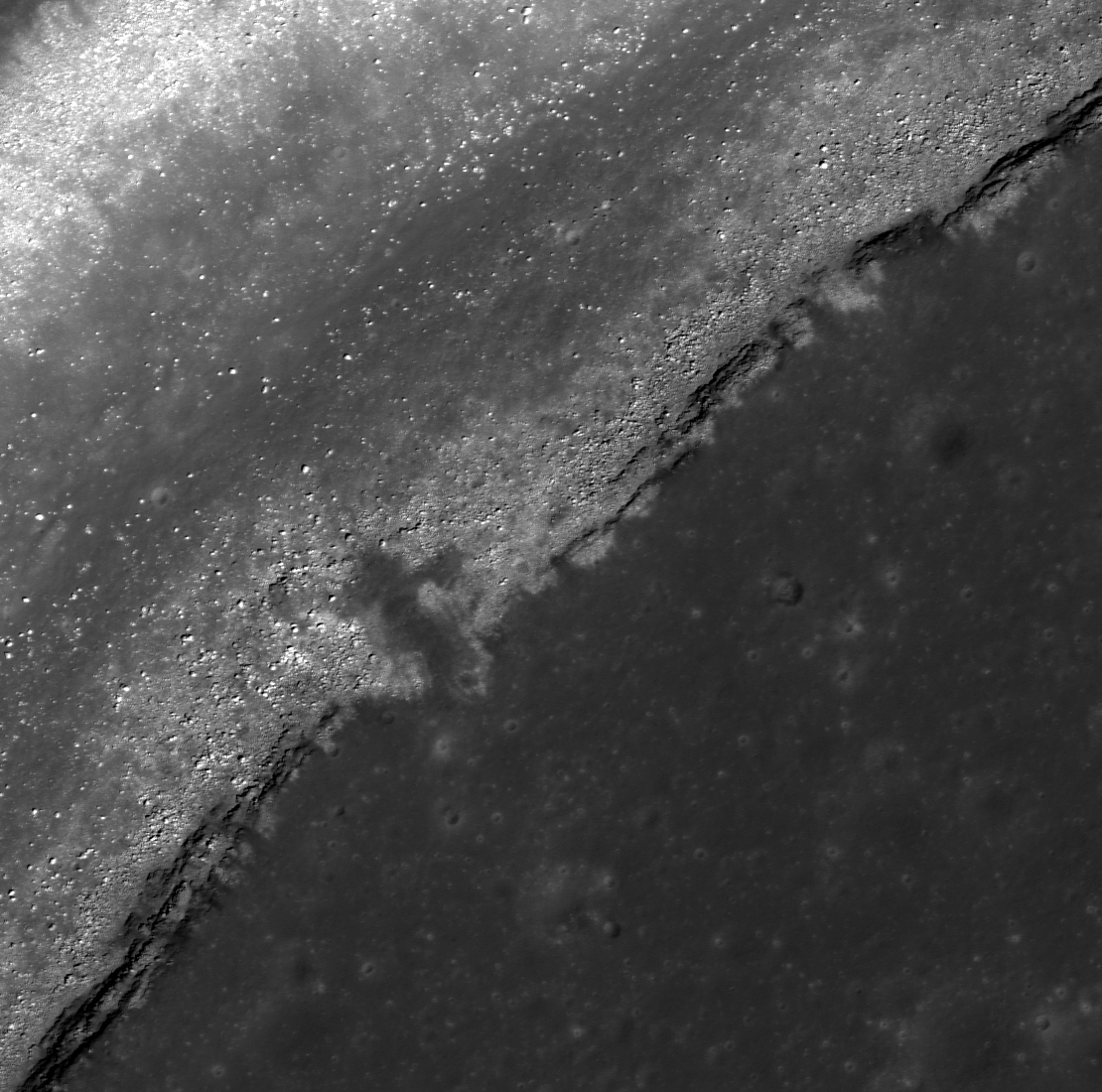
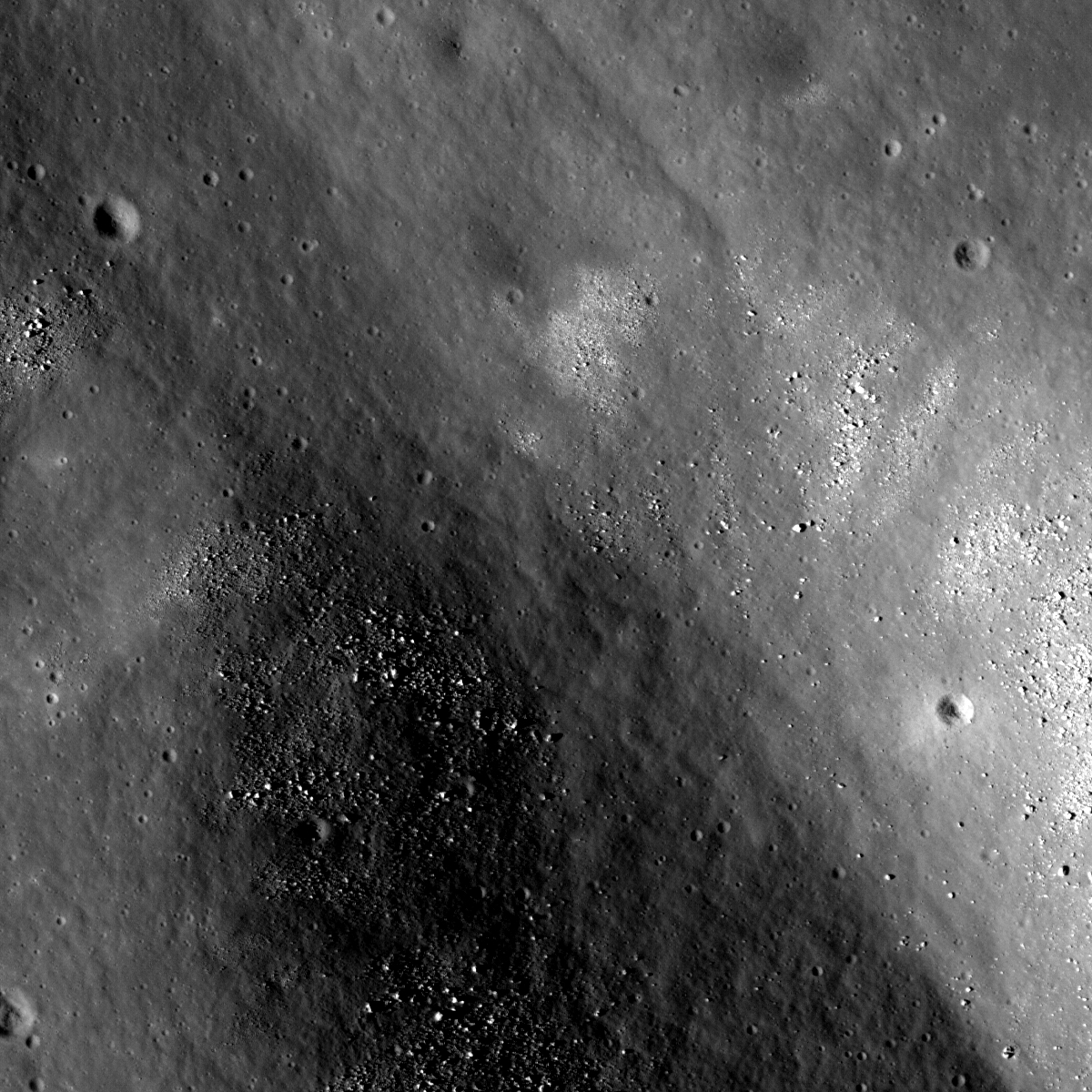
Basalt layering, a slice through the floor of Oceanus Procellarum, is visible along the wall of this section of Rima Marius. LROC Narrow Angle Camera (NAC) Extended Science Mission observation M1103881010R, LRO orbit 14991, October 3, 2012; 21.88° angle of incidence over a 1.3 km-wide field of view, resolution 0.99 meters from 121.1 km  [NASA/GSFC/Arizona State University].
Sarah Braden
LROC News System

Mare basalt layering is visible in the walls of a number of impact craters such as Caroline Herschel Crater and Pytheas Crater. Layers were seen in the wall of Hadley Rille near the Apollo 15 landing site and Today's Featured Image shows a few layers of mare basalt along the top edge of the wall of Rima Marius.

Look closely at the Featured Image to see the individual layers.

Rima Marius is about 280 km long, sinuously slicing through large extents of mare basalt. The are seen in the Featured Image is centered at 14.986°N, 311.565°E.

LROC Wide Angle Camera context view of the southern leg of winding Rima Marius. The arrow marks the location of the field of view shown at high resolution in the LROC Featured Image. LROC WAC M166161047CE (604 nm) spacecraft orbit 9621, July 2, 2011, 63.53° angle of incidence, 58.9 meters resolution from 42.35 km [NASA/GSFC/Arizona State University].
Rilles form when large volumes of low viscosity magma erupt and flow turbulently. The erosive force of the turbulent flow carves a channel into the lunar surface and then drains away, leaving behind an empty groove in the Moon. Studying the thickness of mare basalt layers using areas like the Feature Image help scientists model the viscosity and eruption volume of single eruption events.

The 280 km length of Rima Marius and the LROC Featured Image field of view (arrow) as seen from Earth is more easily seen through telescopes from Earth with the lengthening shadows of local late afternoon illumination, a few days after a Full Moon. In this crop, from a high-resolution lunar mosaic captured by Yuri Goryachko and colleagues at Astronominsk in Belarus, September 25, 2008, shows vast context for Rima Marius within central Oceanus Procellarum, from the Aristarchus Plateau in the North to the Marius Hills, Marius crater and Reiner Gamma swirl albedo to the south [Astronominsk].
Explore the entire LROC NAC for more Rima Marius, HERE.

Related Images:
Dark surface materials surrounding Rima Marius
Discontinuous rilles
Hadley Rille and the Mountains of the Moon
Layers near Apollo 15 landing site

Tuesday, March 6, 2012

Follow the tracks (Apollo 15)

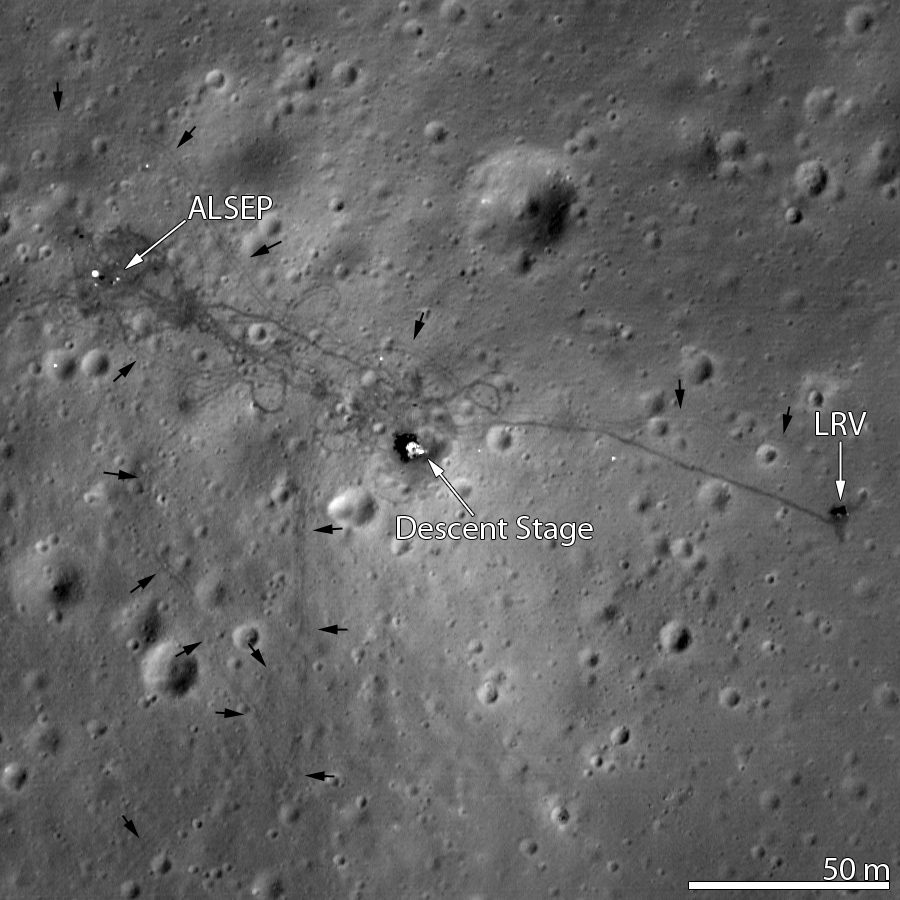
1971 Landing site of Apollo 15, from unusually low altitude - From only 25 kilometers (LROC observation M175252641, L and R frames). The Lunar Roving Vehicle (LRV) is parked to the far right, the Lunar Module descent stage is at center; LRV tracks are indicated with arrows. View the larger Featured Image HERE [NASA/GSFC/Arizona State University].
Mark Robinson
Principal Investigator
Lunar Reconnaissance Orbiter Camera
Arizona State University


Apollo 15 from unusually low altitude - Apollo 15 landing site imaged from an altitude of 25 km (M175252641L,R) allowing an even higher resolution view! The Lunar Roving Vehicle (LRV) is parked to the far right, and the Lunar Module descent stage is in the center, LRV tracks indicated with arrows [NASA/GSFC/Arizona State University].

The Apollo 15 Lunar Module (LM) Falcon set down on the Hadley plains (26.132°N, 3.634°E) a mere 2 kilometers from Hadley Rille. The goals: sample the basalts that compose the mare deposit, explore a lunar rille for the first time, and search for ancient crustal rocks. Additionally, Dave Scott and Jim Irwin deployed the third Apollo Lunar Surface Experiments Package (ALSEP) and unveiled the first Lunar Roving Vehicle (LRV). The ALSEP consisted of several experiments that were powered by a Radioisotope Thermoelectric Generator (RTG) and sent back valuable scientific data to the Earth for over six years after the astronauts left. This new LROC NAC image taken from low altitude shows the hardware and tracks in even more detail.

Mons Hadley Delta, where Hadley Rille, the mountains of the Apennine range and the Palus Putredinis mare plain all intersect near the landing site of Apollo 15 (yellow arrow), first of the Apollo "J" missions, devoted to lunar science. 30 kilometer-wide monochrome (604 nm) field of view from LROC Wide Angle Camera observation M150497920CE, LRO orbit 7313, January 24, 2011; incidence = 65.77° at 54 meters resolution from 39.36 kilometers altitude. [NASA/GSFC/Arizona State University].
The LRV, a lunar "dune buggy", allowed the astronauts to traverse far from the LM and explore much more local geology than the astronauts on previous missions (Apollo 11, 12, 14). Not only did the LRV allow the astronauts to move from place-to-place at a lively rate of eight to sixteen kilometers per hour (five to ten miles per hour), but the LRV also allowed brief periods of rest that in turn helped to conserve oxygen.

LROC Apollo 15 Traverse Map - Apollo 15 traverse routes sketched on subsampled NAC M106855508L/R. Red letters mark locations of images in the next figure [NASA/GSFC/Arizona State University].
The LRV wheels were 82 centimeters (32 inches) in diameter, and 23 centimeters (9 inches) wide. Typically LROC NAC pixels are about 50 centimeters square, so it is not always easy to pick out the LRV tracks. In previous LROC images, the LRV tracks are usually only visible near the LM where the descent engine exhaust plume disturbed the surface. The LRV wheels broke through the changed surface and thus the tracks have more contrast near the LM.

For two one-month periods last year (2011), the LRO orbit was lowered such that overflights of the Apollo sites were only 25 to 30 kilometers, rather than the usual 50 kilometers. These low passes resulted in NAC pixel scales near 25 centimeters! LRO has a ground speed of a bit over 1600 meters (5249 feet) per second, and the shortest NAC exposure time is 0.34 millseconds, so images taken from this low altitude are smeared down track a bit. However, the smear is hardly noticeable and features at the Apollo sites definitely come into sharper focus. In this new low-altitude NAC image of the LRV, tracks are visible about half of the time, usually when the tracks are at an angle to the Sun direction, rather than parallel.


Apollo 15 LRV Tracks - Details showing Apollo 15 LRV track from traverse map above [NASA/GSFC/Arizona State University].

It was during Apollo 15 that the rover was driven on the steepest slopes while exploring the base of a mountain named Hadley Delta (it was named Delta because of its shape, not because it was a river delta). In fact at Station 6a, as Dave Scott stepped off the rover, it started to slide downhill. He was able to grab the rover and stabilize it with no problem.

Apollo 15 LRV Station 6a - Note the slope is steep enough one of the wheels is off the ground. But how steep is steep? The boulder in the foreground is indicated with a white arrow in the next figure. AS15-86-11659 (high resolution) [Dave Scott- NASA/ALSJ/JSC].
How steep is steep? At the time, the astronauts estimated the slope at Station 6a between 15 and 20 degrees. With NAC stereo observations the LROC team is able to make detailed topographic maps (see below). Instead of estimating the steepness of the slope, we can now measure the slope.

Station 6a Topography Map - LROC NAC-derived topographic contours superposed on low altitude image. Black arrows indicate LRV tracks, white arrow the Station 6a boulder seen in Dave Scott's photograph above, while the black line shows the trace of the slope profile represented in plot below. (Contour interval 5 meters, elevations relative to average lunar radius) [NASA/GSFC/Arizona State University].


Station 6a profile - LROC NAC derived topographic profile through Station 6a (profile location shown in the above figure). The straight red line shows a consistent slope in the area of 18°, right in the middle of the range estimated by Jim Irwin while they were taking samples.

Following the tracks of Irwin and Scott is a lot fun - join the adventure, HERE.

Previous Apollo 15 Featured Images:

Hadley Rille and the Mountains of the Moon
Retracing the Steps of Apollo 15
40th Anniversary of Apollo 15 celebrated at Kennedy Space Center 
A Fundamental Point on the Moon
Kaguya captures Hadley Rille, Apollo 15
Water found in Apollo samples 
Apollo metric camera digital elevation model completed
Long-term degradation of optics on the Moon

Friday, November 18, 2011

LROC: Shiny Mound

Northeastern edge of a high-reflectance mound within "driving distance" of the Apollo 15 landing site on the southeastern frontier of Mare Imbrium. Downslope is to the upper-right. (Field of view 1512 meters across). LROC Narrow Angle Camera (NAC) observation M106869873R, LRO orbit 890, September 6, 2009; resolution 1.26 meters per pixel, incidence angle 36.72° from an altitude of 153.64 kilometers. View the much larger, full size LROC Featured Image HERE [NASA/GSFC/Arizona State University].
Hiroyuki Sato
LROC News System

At the southeastern edge of Mare Imbrium, about 25 km west of Rima Hadley, there is a small shiny mound on a dark and flat mare basalt plain which looks like a white sand island in the middle of a black ocean. This mound is about 2.7 by 2.2 km across. 

Normally fresh slopes and fresh ejecta have high reflectance due to less space weathering but this mound is brightest at its highest elevations and not down the slopes, brighter than nearby ejecta implying the mound is composed of higher-reflectance materials than mare basalts. Then how was this shiny island was formed?

Whole view of high-reflectance mound centered at 25.482°N, 1.684°E (Field of view about 5.3 kilometers. See the original LROC context image HERE, also from LROC NAC frame M106869873R [NASA/GSFC/Arizona State University].
Most likely, the mound is a remnant of highlands sticking through the mare, a hummock of plagioclase-rich highlands materials was embayed by mare basalt volcanism, burying all except its summit. If so, mare basalt is overlapping the mound's skirt. 

Can you see the an overlap contact in today's Featured Image?

An oblique view from a simulated low altitude looking northeast over the LROC WAC 100 m monochrome Global Mosaic affixed to LOLA topography, using NASA's ILIADS program. The bright mound is near the center of the view, with the Hadley Rille Valley and the landing site of Apollo 15 in the background. Does the angle of this view seem familiar? [NASA/GSFC/Arizona State University].
Unfortunately, the contact is not clear or sharp. Over time such sharp contacts are blurred by micrometeorite bombardment. If we are lucky, in the future, a small impact may occur right at the contact once again revealing the sharp contact. Or perhaps a future explorer might take a shovel to this spot and settle the question!

Explore this shiny mound in the full NAC image!

Related posts:
Farside Highlands Volcanism!
Up from the depths
Hortensius Domes - Constellation ROI

Tuesday, November 8, 2011

Hadley Rille and the Mountains of the Moon

NASA Lunar Reconnaissance Orbiter (LRO) rolled to capture a dramatic oblique view of the Apollo 15 landing site 26.1°N, 0.25°E on the plains of Hadley Rille Delta. Hadley Rille, a great chasm in the lunar surface, carves through the center of this scene. Explore the full size LROC image HERE. LROC Narrow Angle Camera (NAC) observation M165842369, orbit 9574, July 20, 2011 [NASA/GSFC/Arizona State University].
Samuel Lawrence
LROC News System

On 20 July 2011 (coincidentally, the 42nd anniversary of the first steps humans took on another world) the NASA Lunar Reconnaissance Orbiter was commanded to roll to the east, allowing the Lunar Reconnaissance Orbiter Camera to obliquely observe Hadley rille and the Apollo 15 landing site. One of humanity's greatest voyages of exploration, the adventures of mission commander David Scott, lunar module pilot James Irwin, and command module pilot Al Worden transformed our understanding of the Moon and the Solar System. The shadow of the descent stage of the Lunar Module Falcon is visible, as is that of NASA's first lunar roving vehicle. Additionally, the sampling stations explored by the Apollo 15 astronauts are easy to pick out.

Full scope of the LROC NAC oblique frames detailed HERE. Hadley Rille is about 1.2 km wide. The whole scene is 28 kilometers from left-to-right [NASA/GSFC/Arizona State University].
Apollo 15 was the first of three long-duration “J-missions”; more would have flown had the Apollo program not been brought to a premature conclusion in 1972 after the Apollo 17 mission. The J-missions featured heavily instrumented command and service modules, improved spacesuits to promote crew agility, upgraded lunar landing vehicles, and the electric Lunar Roving Vehicles (or LRVs) to expand the crew's range on the surface. Prior to the mission, the Apollo 15 crew received extensive geoscience training, which (along with the increasingly capable hardware) resulted in an extraordinary bounty of scientific results. Apollo 15 was also the only lunar mission where all crewmembers were graduates of the University of Michigan and United States Air Force officers (the lunar module, Falcon, was named after the mascot of the United States Air Force Academy, and the Apollo 15 command module Endeavour is now on permanent display at the National Museum of the U. S. Air Force in Dayton, OH).

LROC NAC mosaic from M170538271, sampled at 2 meter pixel scale (from the original 0.5 m) showing area where lunar sample 15555, "Great Scott," was collected (Station 9A) west of the Apollo 15 landing site. View the larger original 2 meter image prepared for this essay HERE [NASA/GSFC/Arizona State University].
Astronauts Scott and Irwin spent almost three days exploring the Hadley-Apennine valley, traversed over 28 kilometers (17 miles) using the first lunar rover, and collected over 77 kilograms (170 pounds) of priceless lunar materials, including the famous “Genesis Rock”, a piece of the primordial lunar crust. While Scott and Irwin explored the surface, command module pilot Worden used the extensive instrument suite aboard the command module Endeavour to successfully complete a complex series of orbital observations. You can view digital scans of the original Apollo 15 flight films taken by Endeavour's Fairchild Mapping Camera at the Arizona State University Apollo Digital Image Archive

The geologically complex Apollo 15 site is a high priority target for future human lunar exploration, and consequently was one of the Constellation Regions of Interest that were a focus of LROC observations during the LRO Exploration Systems Mission Directorate mission (the 1st year of LRO operations). Thanks to the exploration of the Apollo 15 astronauts, we now have a well-defined set of scientific questions that can only be addressed through a future human sortie mission to the Hadley-Apennine region. In addition, recovering materials from the descent stage of Falcon would provide valuable information to present-day engineers about how materials survive on the lunar surface for long periods of time.

Edge of Hadley rille where lunar sample 15555 (Station 9A) was collected, August 2, 1971. The disturbed soil at 9A are the foot prints and LRV tracks left by Scott & Irwin, 40 years ago, testifying to the intensive study and sampling at this site. See the larger image prepared for this essay, from an observation not due for release until December, HERE [NASA/GSFC/Arizona State University].
On Saturday, November 5, as part of the School of Earth and Space Exploration's annual Earth and Space Exploration Day, Arizona State University unveiled a display featuring a piece of Apollo Lunar Sample (ALS) 15555, a mare basalt collected by Col. Scott about 12 meters from the rim of Hadley rille at Station 9A. This lunar rock is the largest and one of the most intensively studied samples collected by the Apollo 15 astronauts, and is predominantly composed of silicate minerals such as olivine, pyroxene, and plagioclase. The bulk composition of 15555 is thought to represent a primitive volcanic melt and has been used for experimental and theoretical studies related to the geologic origin of lunar basalts. Planetary scientists use information gleaned from such analyses to gain key insights into how terrestrial planets like the Moon and Earth form and evolve. Sample 15555 has also been used for critical tests designed to help perfect and calibrate methods of radiometric age dating employed by different laboratories around the world.

On their third EVA, before sampling 15555, Col. Scott took a picture of its location and immediately handed the camera to Jim Irwin, who then captured a series of shots for a standard panorama of Station 9a. The three legged gnomon was placed beside the sample so scientists could later determine its orientation of the rock on the surface [NASA, AS15-82-11164].
What is a mare basalt and what is its significance? The lunar mare basalts are very similar to terrestrial basalts. If you drove up to Sunset crater outside Flagstaff AZ, you can find basalt. If you go to Hawaii, Iceland, India, Ethiopoa and many other countries you can find basalt. The oceanic crust on the Earth is composed of basalt. If you visit Mars you will likely land on basalt or basalt derived sediments. If you land on Venus - same! The Dawn spacecraft is right now orbiting an asteroid, Vesta, that is composed of basalt. Basalt is common in the Solar System. The fascinating fact about basalts is that they represent a sample of the upper mantle. We can't get to the mantle directly, but nature provides us with samples of the deep interior (mantle) in the form of basalt. Volcanism is the delivery truck! Since the mantle makes up most of the mass of the Earth, Mars and the Moon we must have samples of the mantle to understand each body as a whole. You can think of 15555 as a piece of the Moon's interior, even though it was picked up on the surface.

Apollo Lunar Sample 15555 on display at the Lunar Reconnaissance Orbiter Camera Science Operations Center [E. Speyerer, Arizona State University].
A generous loan to Arizona State University from the NASA Lyndon B. Johnson Space Center, this 76 gram (2.7 ounces) piece of mare basalt will be displayed in the Lunar Reconnaissance Orbiter Camera Science Operations Center Visitor Gallery. This stunning and unique lunar sample display will enable visitors to view and learn about an amazing piece of our Moon, while just a few meters away, behind a glass partition, the LROC team is sending commands to LROC and receiving images in return that enable scientists and engineers to plan for future human and robotic exploration of the Moon.

We heartily encourage anyone interested in space exploration to come view this priceless American treasure and learn how lunar scientists around the world are pioneering your future in space. The work we do at LROC is tremendously exciting, but ultimately, it is the human passion for discovery that drives this enterprise.

Explore the complete NAC oblique image of the Hadley-Apennine valley!


Visit the LROC Science Operations Center

Read more about the Apollo 15 landing site
in previous LROC Team posts
:

Layers Near Apollo 15 Landing Site (30 August 2011)
Retracing the Steps of Apollo 15: Constellation Program Region of Interest (16 April 2010)
LROC's First Look at the Apollo Landing Sites (17 July 2009)
Lunar Highs and Lows (22 July 2008)
The Mighty Apennine Mountain Range (30 September 2008)
Hadley-Apennine: the Apollo 15 Landing Site (14 November 2007)

Further Related Posts:

40th Anniversary of Apollo 15 celebrated at Kennedy Space Center
Al Worden award with Moon Rock
Kaguya captures Hadley Rille

Hadley Rille Valley of Palus Putredinis on the Imbrium side of the Apenninus mountain ridge, 1971 landing site of the Apollo 15 expedition. LROC Wide Angle Camera (WAC) mosaic from 7313 and 7314, January 24, 2011; resolution 53 meters, incidence angle 65.77° from 36.36 kilometers [NASA/GSFC/Arizona State University].

Wednesday, August 31, 2011

LROC: Stratigraphic layers exposed by Hadley Rille


West side edges of Hadley Rille, 45 kilometers southwest of the 1971 Apollo 15 landing zone. LROC Narrow Angle Camera observation M113941548L, LRO orbit 1925, November 27, 2009; resolution is 50 cm/pixel, field of view 500 meters with a solar illumination incidence angle 59° from the southeast. View the full size LROC Featured Image HERE [NASA/GSFC/Arizona State University].

Hiroyuki Sato
LROC News System

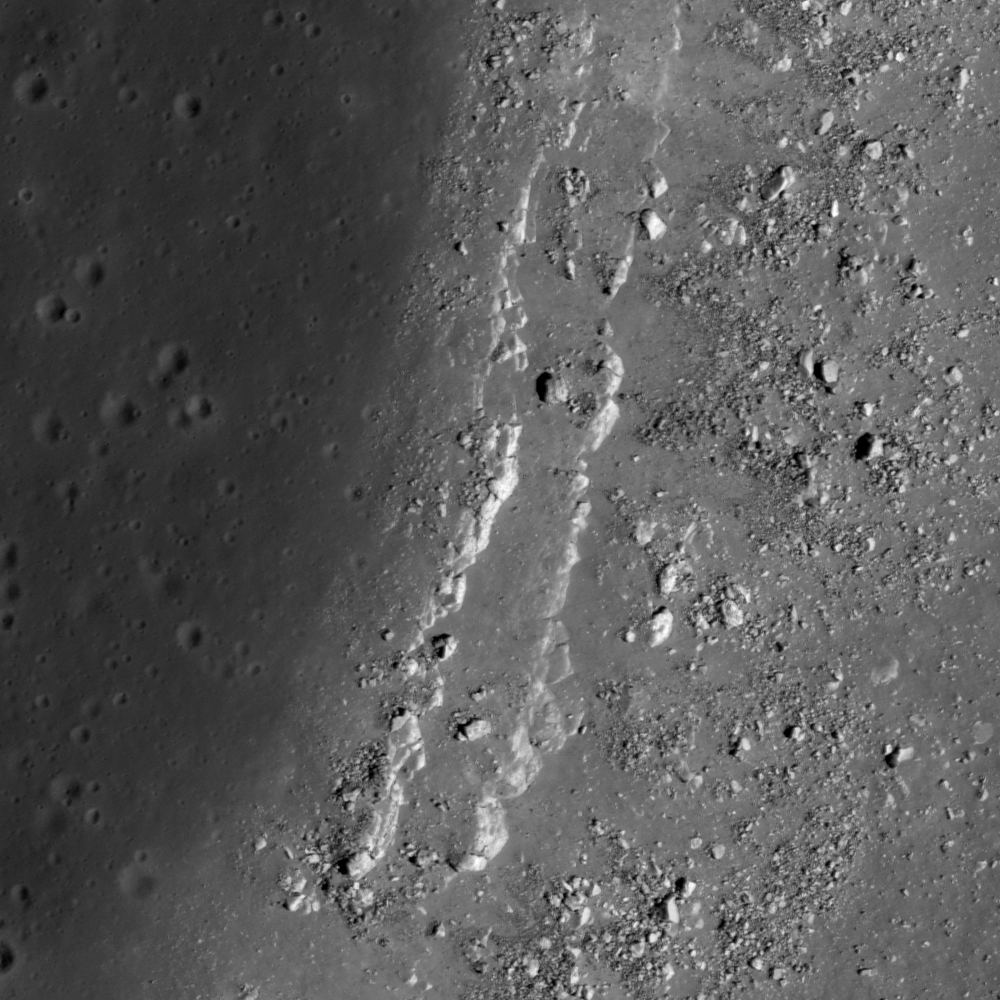
Today's Featured Image are bedrock outcrops at the western edge of Hadley Rille, in an area located about 50 km southwest from the Apollo 15 landing site. Two parallel lines of high-reflectance rocks extend in a north-south direction on the western rim of the Rille. The right side of the image is the downward slope of the rille, where you can see multiple boulders that have likely fallen from the outcrops in the center in the billions of years since the great rille was carved into the mare by flowing lava.


For context, the layers of extrusive volcanism that formed the surface of Palus Putredinis and the Hadley Rille Delta and later exposed in the formation of Hadley Rille are seen in the full width 300 by 4oo meter crop from NAC frame M113941548L [NASA/GSFC/Arizona State University].

These two layer outcrops can be almost continuously observed along the flank of Hadley Rille for about 2.5 km length, which suggesting that these layers have relatively wide area coverage and an almost uniform thickness.


A late afternoon LROC Wide Angle Camera (WAC) 604 nm band mosaic shows the Hadley Rille Delta and Palus Putredinis between the Apollo 15 landing zone (red square) and the strategraphic area of interest 45.3 km to the southwest pinpointed in the LROC Featured Image released August 30, 2011. LROC WAC mosaic stitched from observations made during LRO orbits 7313-7315, January 24, 2011 [NASA/GSFC/Arizona State University].

Detailed topographic assessments using the Lunar Orbital Laser Altimeter Digital Terrain Model or possibly even NAC stereophotogrammetry will enable lunar scientists to obtain accurate thickness measurements for these two rock layers, as well as derive estimates for the thickness of the overlaying regolith layer in this area. This information will be very useful to lunar scientists who are currently trying to understand the geologic processes involved with mare volcanism. If we assume that these layers correspond to mare basalt flows, then determining the thickness and the spacial extent of these flows will be important information for calculating the viscosity and eruption volume of lava at one event. Research efforts like this one are helping lunar scientists define key questions that will be answered by future human lunar exploration!


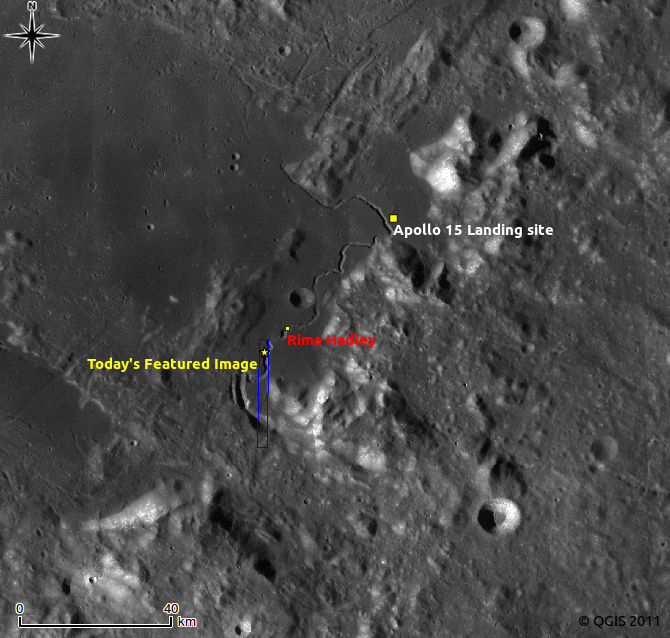
LROC WAC monochrome mosaic 100 m/pixel around Hadley Rille. Image center is latitude 25.52°, longitude 3.11°. Blue box and white star indicate the locations of NAC frame and LROC Featured Image, August 30, 2011. View the larger version HERE [NASA/GSFC/Arizona State University].

Explore the parallel bedrock outcrops at Hadley Rille in the full NAC frame!

Related posts:
Layering in Euler Crater
Dark surface materials surrounding Rima Marius
Lava Flows Exposed in Bessel Crater
Dark streaks in Diophantus crater
Linné Crater

Thursday, July 28, 2011

40 Anniversary of Apollo 15 celebrated at KSC


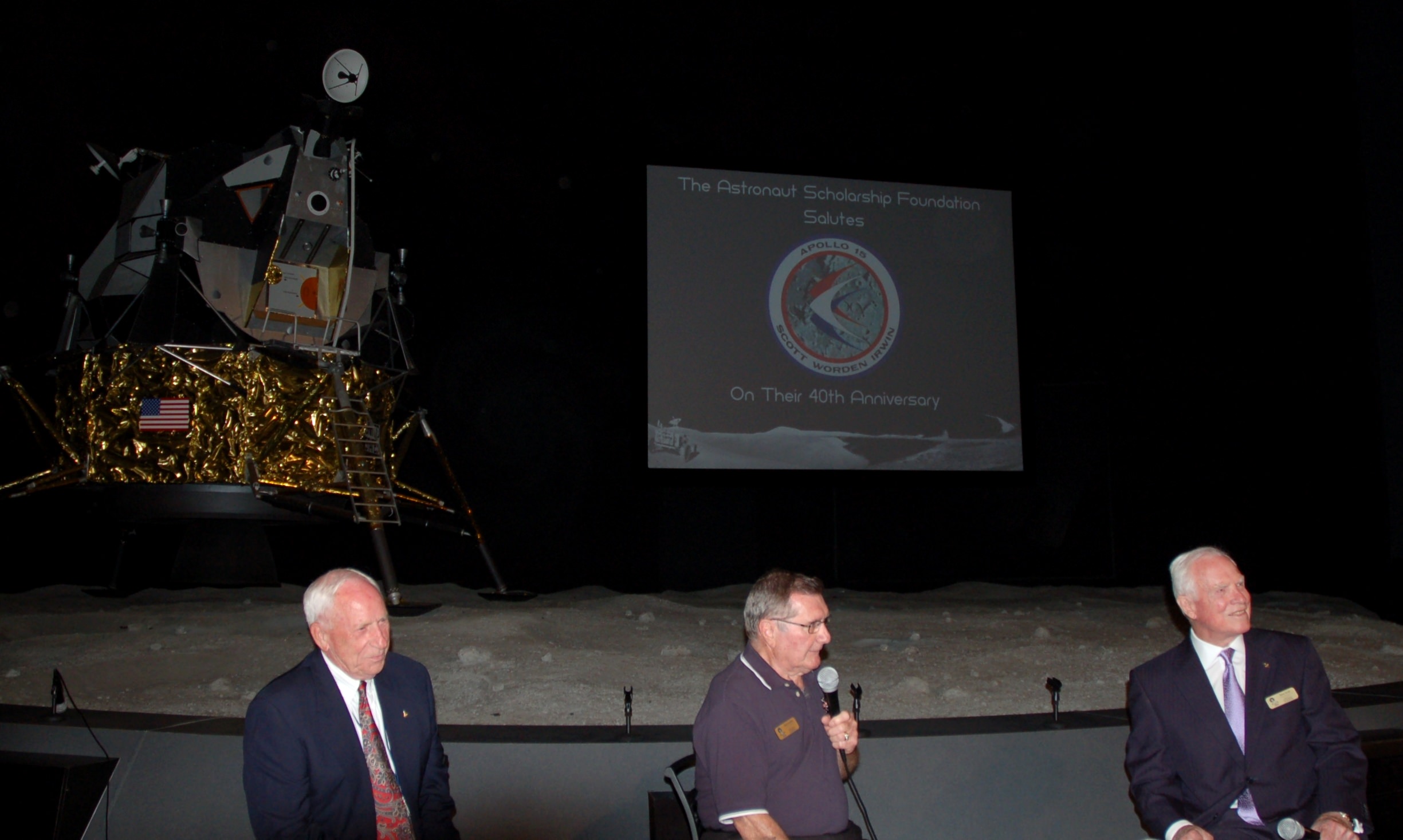
From left to right: Apollo 15 Command Module Pilot Al Worden, Apollo 12 Command Module Pilot Dick Gordon and Apollo 15 Commander Dave Scott at the Apollo 15 - 40th Anniversary Panel Discussion hosted at the Kennedy Space Center Visitor Complex [Jason Rhian/Universe Today].

Jason Rhian
Universe Today

Cape Canaveral – Apollo 15 was the first manned lunar mission to use a lunar rover, the first of the “J” missions that would stay on the lunar surface longer and be focused on conducting science. Apollo 15 marked its 40th anniversary on Sunday. Most of the crew as well as other Apollo-era astronauts were present at the Kennedy Space Center Visitor Complex to mark the occasion.

Read the full story HERE.


Detail from the panoramic view as captured by mission commander Dave Scott during the second EVA of the Apollo 15 science expedition to the Hadley Rille Valley (MET: 144:50:48), August 1, 1971. According to the Apollo 15 Surface Journal, "twenty years after the mission, this 500-mm photograph" was still Scott's favorite. View the high-resolution image HERE [ASJ/NASA].


Hadley Station, landing site of Apollo 15, 39 years, 4 months and 13 days later, as viewed from 43.33 kilometers overhead, in LROC Narrow Angle Camera (NAC) observation M146959973L, swept up December 14, 2010. The LM descent stage is at the center of this sample with a path leading left (eastward) to the first lunar rover of the Apollo program, where Scott & Irwin parked it 40 years ago. Their trail to the ALSEP experiments and laser reflector array can be seen on the opposite side. Lighting conditions at local sunrise were similar to those the crew experienced during their landing in 1971 [NASA/GSFC/Arizona State University].

Sunday, May 15, 2011

Discontiguous Rilles


Northwest end of a disconnected depression, possibly a collapsed or buried segment of Rima Marius (14.53°N, 311.43°E), northwest of Marius C and not far east from a similar phenomena investigated by India's Chandrayaan 1 orbiter west of the Marius Hills. LROC Narrow Angle Camera observation M135507533R, LRO orbit 5103, August 3, 2010; solar illumination incidence 58°, field of view 550 meters. View the full-size LROC Featured Image HERE [NASA/GSFC/Arizona State University].

Hiroyuki Sato
LROC News System

Sinuous rilles (like Hadley Rille, near the Apollo 15 landing site) are narrow, long depressions that meander across the lunar surface like a terrestrial river. Lunar geologists think that sinuous rilles formed either as erupting lavas carved their way through the surface, or by roof-collapse of lava tubes. A portion of the rille (named Rima Marius) in today's Featured Image is discontinuous, with a partially-closed depression that possibly marks the source region for this rille. Perhaps the "blockage" in the channel is a intact lava tube roof.

While there are no signs of any natural bridge structures or other openings in this region, it is possible that a small section of the lava tube might have simply had its entrance and exit blocked by collapse debris.


Jim Irwin captured this spectacular view of Hadley Rille during the second EVA of Apollo 15 in 1971. See the high-resolution image HERE [NASA/ASJ].


Full-width view of the LROC NAC strip shows the discontinuity in some context [NASA/GSFC/Arizona State University].


LROC Wide Angle Camera (WAC) 100 meter / pixel monochrome mosaic view of Rima Marius, with the discontinuity near its terminus, northwest of Marius C [NASA/GSFC/Arizona State University].

Sinuous rilles like Rima Marius are high priority targets for future human lunar exploration in part because they expose deeply buried mare units, meaning that human exploration of locations like Rima Marius will provide important new scientific insights into the duration and evolution of lunar volcanism.

Explore the entire NAC frame!

Related images:
Sinuous Chain of Depressions
Rilles as far as the eye can see in Prinz!
Rimae Posidonius
Rimae Prinz Region - Constellation ROI
Marius Hills Pit - Lava Tube Skylight?


A 3.5 kilometer discontiguous rille west of the Marius Hills that may have had origins in common with the sinuous rille system the winds through those hill's largest mounds, now thought to be one volcano. This image was composed from data collected by the Terrain Mapping Camera on-board India's Chandrayaan-1 [ISRO].

Friday, October 1, 2010

The Far Shore of Palus Putredinis

Rima Bradley, surface manifestation of an apparently deep fault under the Apenninus piedmont (It's concentric with the Montes Apenninus front), and disappearing under Palus Putredinis. "Almost too much to take in," is the description frequently given to certain of the LROC Wide Angle Camera assemblies. This one is a 80 km-wide early morning look at a scene familiar to telescope observers on Earth, southwest of the Hadley Rille Valley and the Apollo 15 LZ. It is a mosaic of four monochrome (659nm) LROC WAC observations swept up in successive lunar orbits December 24, 2009.

Can you spot Putredinis 1, a 2 km wide pyroclastic vent, just off the southwest shore of Palus Putredinis? Is it yet another surface manifestation, the same stratigraphic source as Rima Bradley? [NASA/GSFC/Arizona State University].

Take a closer look at the WAC mosaic and find these two (of four) oblong "sinks" (Ann, left, near 25.1°N, 0.07°W, and Patricia, right; 800 to 1200 meters in length, respectively) tied into ancient Rima Vladimir, etched on a blasted plain pasted over a filled-in valley that radiates from Mare Imbrium's center. This image also is from a mosaic, left and right frames of LROC Narrow Angle Camera (NAC) observation M104519138; LRO orbit 562, August 10, 2009; alt. 145.98 km, res. 1.46 m, phase angle 55.94° [NASA/GSFC/Arizona State University].

Saturday, April 17, 2010

LROC: Retracing the steps of Apollo 15: Constellation ROI


The third and final EVA of Apollo 15 brought the astronauts to the edge of Hadley Rille (lower left in this sample swept up by the LROC narrow-angle camera on board NASA's Lunar Reconnaissance Orbiter in polar orbit 47 kilometers overhead, last October). Disturbed regolith is observed along the crater rim at Station 9 and at the edge of the rille at Station 9A. Rover tracks are visible between stations 9A and 10 (and elsewhere). For perspective on the sample above, click here. Sample width represents 520 meters, at 52 centimeters per pixel (LROC NAC M11171816R) [NASA/GSFC/Arizona State University].

Brent Garry
LROC News System

The Apollo "J" missions were designed to allow the crews to stay and work longer on the Moon's surface and included a Lunar Rover so they could explore several kilometers away from the Lunar Module. Hadley Rille and the Apennine Mountains provided a dramatic backdrop for the first Apollo "J" mission.

This landing site presented Apollo 15 Commander Dave Scott and Lunar Module Pilot Jim Irwin not only a spectacular view, but access to two key geologic features: a "young" volcanic sinuous rille and "older" highland massifs. These geologic features afforded a chance to sample different events from the Moon's geologic history: early crust formation and late stage volcanism.

Over the course of 3 EVAs (Extra-vehicular Activities), aided by the first of the three lunar rovers Scott & Irwin covered a total distance of ~28 km (17.4 miles), collected ~77 kg (~170 lbs) of lunar samples and spent 18.5 hours exploring the Moon's surface.


A favorite target for earthbound observers, the Hadley River Delta region is contiguous to the Apennine Range, an outer rim of the milestone Imbrium impact event, and source of Palus Putredinis, the "Marsh of Decay," a relatively dark oblique triangle-shaped plain of material on edge of the vast Imbrium basin to the west-northwest. Repeatedly photographed from orbit, modern surveys recommenced with Terrain Camera data gathered by Japan's Kaguya (SELENE-1) orbiter in 2008. That detail, represented in the image above was limited to 5 meters per pixel, insufficient to fully resolve the Apollo 15 descent stage, definitively imaged in 2009 by the LROC team using the narrow-angle camera on-board LRO. [Google Earth v.5].

The LROC Narrow Angle Cameras (NAC) have provided images with 50 cm/pixel resolution of the Apollo 15 landing site. In previous posts, we have shown the Lunar Module descent stage, Lunar Rover, Apollo Lunar Surface Experiment Package (ALSEP) instruments, and darkened paths of regolith disturbed by the crew and the rover. Here, we focus on what the crew accomplished at two locations away from the immediate landing site, accompanied by transcribed voice transmissions describing their discoveries and observations.

EVA 2: Station 7The Genesis Rock


Full Image Above HERE.

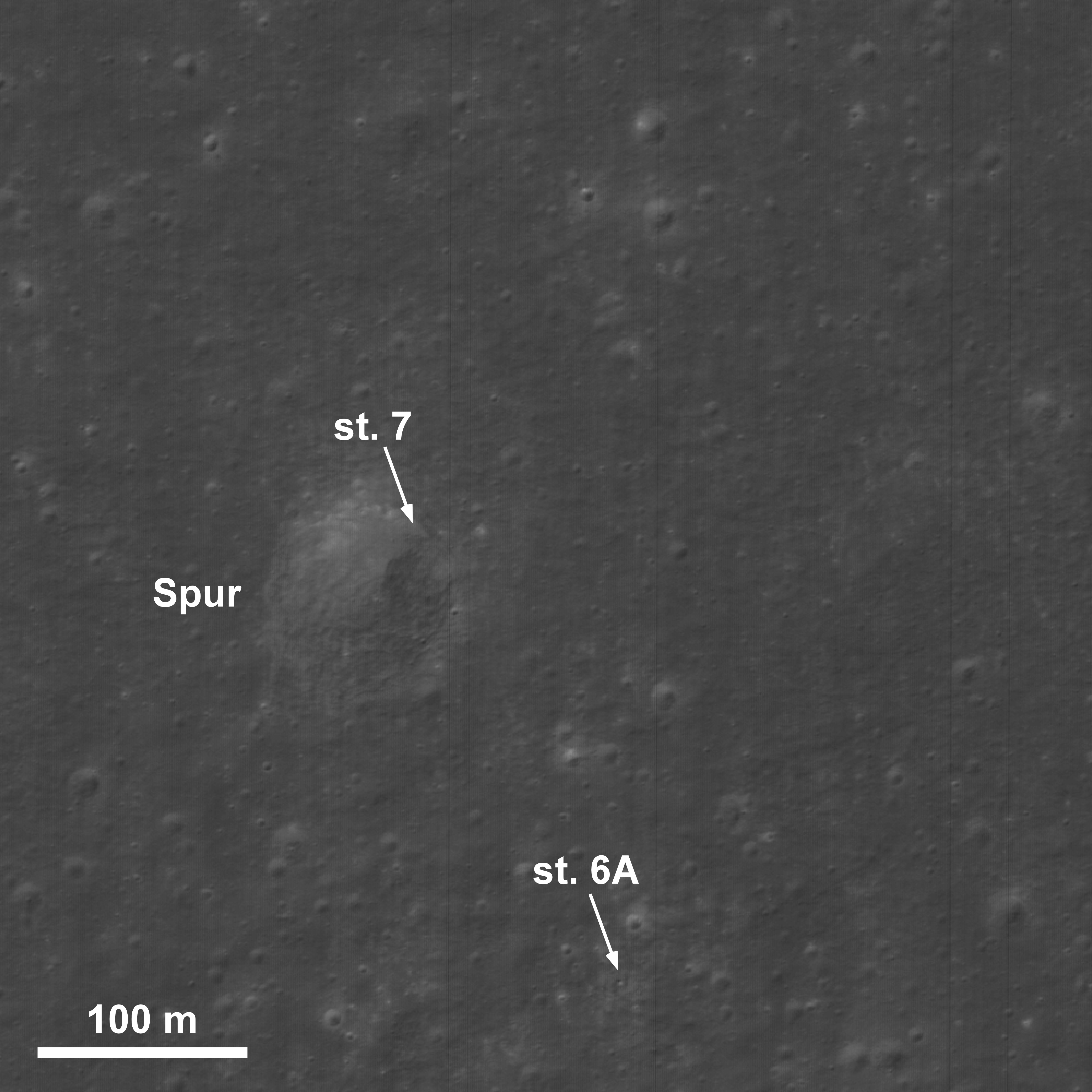
Station 7 is at Spur, a 90 meter crater on the slope of the massif to the south known as Mount Hadley Delta. The crew parked along the northeast crater rim (on the downslope side) where they could sample the ejecta blanket. This station is now famous for the collection of "the Genesis Rock," the 4 billion year old sample of anorthosite representative of the original lunar crust. Scott & Irwin's excitement at the discovery is evident in the transcription:
145:42:41 Irwin: Oh, man!
145:42:41 Scott: Oh, boy!
145:42:42 Irwin: I got...
145:42:42 Scott: Look at that.
145:42:44 Irwin: Look at the glint!
145:42:45 Scott: Aaah.
145:42:46 Irwin: Almost see twinning in there!
145:42:47 Scott: Guess what we just found. (Jim laughs with pleasure) Guess what we just found! I think we found what we came for.
145:42:53 Irwin: Crystalline rock, huh?
145:42:55 Scott: Yes, sir. You better believe it.

The Genesis Rock was collected along the rim of Spur at Station 7. The arrow above points to disturbed regolith along the crater rim and rover tracks are visible south of the boulder at Station 6A. This sample from LROC NAC frame M111571816LE is 520 meters in width; north is at top [NASA/GSFC/Arizona State University].


The Genesis Rock presented itself in situ on the top of a pedestal, "as though it had been waiting for someone to retrieve it." Scott & Irwin, aware on sight of the sample's potential scientific values, were careful to photograph the find both before and after retrieval [Mosaic of Genesis Rock "before" and "after" photos, assembled by David Harland/ALSJ].


Detail from AS15-86-11670

Images of the Genesis Rock (left of the gnomon) just prior to collection and later on Earth, cataloged where it continues to be studied extensively at the Lunar Sample Bldg. at the Johnson Space Center in Houston. [NASA].

EVA 3: Station 9A - Observations of Hadley Rille

The last EVA allowed the crew to explore the edge of Hadley Rille. Pans at Stations 9 and 10 show two different craters the crew visited; one of which is a fresh crater with a blocky texture. 10Station 9A was a terrace that allowed Scott and Irwin a chance to peer down into the rille, which is approximately 1.3 km wide and 400 m deep along most of its length.


EVA-3 Stations 9-10, in perspective, at full-size, HERE.

The crew was able to observe and photograph bedrock along the upper part of the western rille wall. Test pilots by profession, the crew went through extensive geology training so that they could communicate their observations effectively and efficiently to the Science Backroom in Houston, Texas. Most of us are familiar with different historic phrases from various Apollo missions. What is sometimes forgotten is that there was also a great deal of science being accomplished and discussed. Field geologists normally have a field notebook to write down and draw their observations in, but on the Moon everything has to be described verbally. Here is an example from Commander Scott's geologic description of the rille wall at this location and one of the images that corresponds with it. Compare his description with the photograph and this panorama.
165:22:50 Scott: I can see from up at the top of the rille down, there's debris all the way. And, it looks like some outcrops directly at about 11 o'clock to the Sun line. It looks like a layer. About 5 percent of the rille wall (height), with a vertical face on it. And, within the vertical face, I can see other small lineations, horizontal about maybe 10 percent of that unit.

165:23:26 Scott: And that unit outcrops (at various places) along the rille. It's about 10 percent from the top, and it's somewhat irregular; but it looks to be a continuous layer. It may be portions of (mare basalt) flows, but they're generally at about the 10-percent level. I can see another one at about 12 o'clock to the Sun line, which is somewhat thinner, maybe 5 percent of the total depth of the rille. However, it has a more-well-defined internal layering of about 10 percent of its thickness. I can see maybe 10 very well-defined layers within that unit.

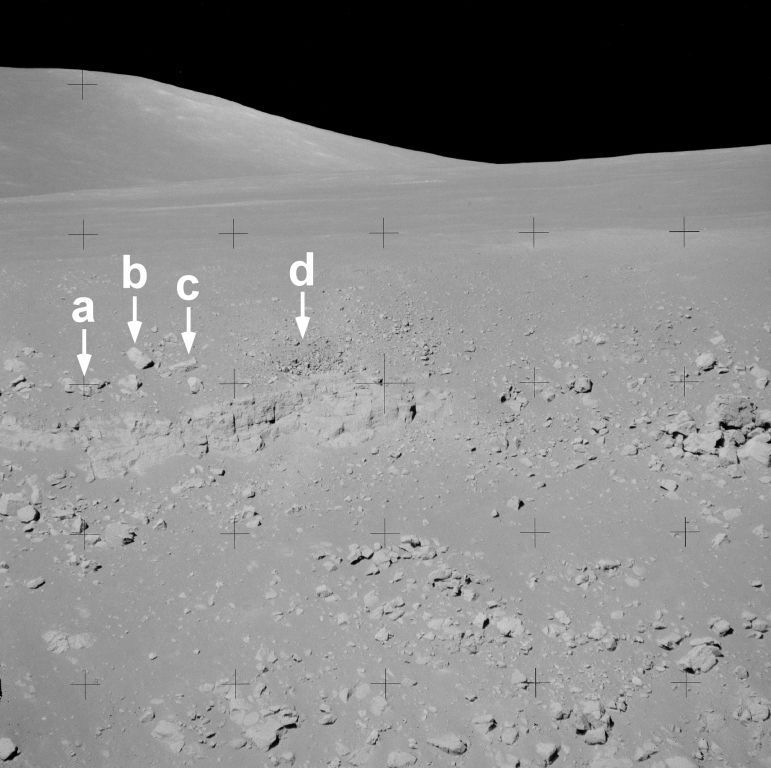
Outcrop of basaltic lava exposed along the western wall of Hadley Rille. Photographed from Station 9A. Letters point to rocks seen in the LROC NAC frame below. Apollo 15 image AS15-89-12115 [NASA].


The same outcrop photographed by Apollo 15, along the western wall of Hadley Rille as shown above, from an "aerial" perspective in this sample of LROC NAC frame M111571816RE. The letters point to the same rocks in the image taken from the ground in 38 years, 2 months and 28 days earlier. (The outcrop is ~75 m long.) [NASA/GSFC/Arizona State University].

The high resolution imagery from LROC allows us to retrace the steps of previous Apollo missions. Compare the Apollo 15 surface panoramas at the different stations with the LROC images to see if you can locate some of the individual rocks and outcrops seen in both perspectives.

Future crews that explore Hadley Rille and the Apennine Mountains could continue where Apollo 15 left off. Combining our previous exploration experience at the site with new remote sensing data sets, a new mission could explore the massifs to the north, additional sites along Hadley Rille, as well as revisit any of the Apollo 15 stations.

Explore the entire LROC NAC frame here and decide the spots you would like to explore on a future mission.

Read more about the Apollo 15 landing site in previous ASU posts:

LROC's First Look at the Apollo Landing Sites (July 17, 2009)

Lunar Highs and Lows (July 22, 2008)

The Mighty Apennine Mountain Range (Sept. 30, 2008)

Hadley-Apennine: the Apollo 15 Landing Site (Nov. 14, 2007)

Text from the corrected Apollo 15 transcript and links to panoramas are from the Apollo Lunar Surface Journal.