Showing posts with label SpaceX. Show all posts

Tuesday, February 24, 2015

Astrobotic, Hakuto team up to ride Falcon 9 to Moon

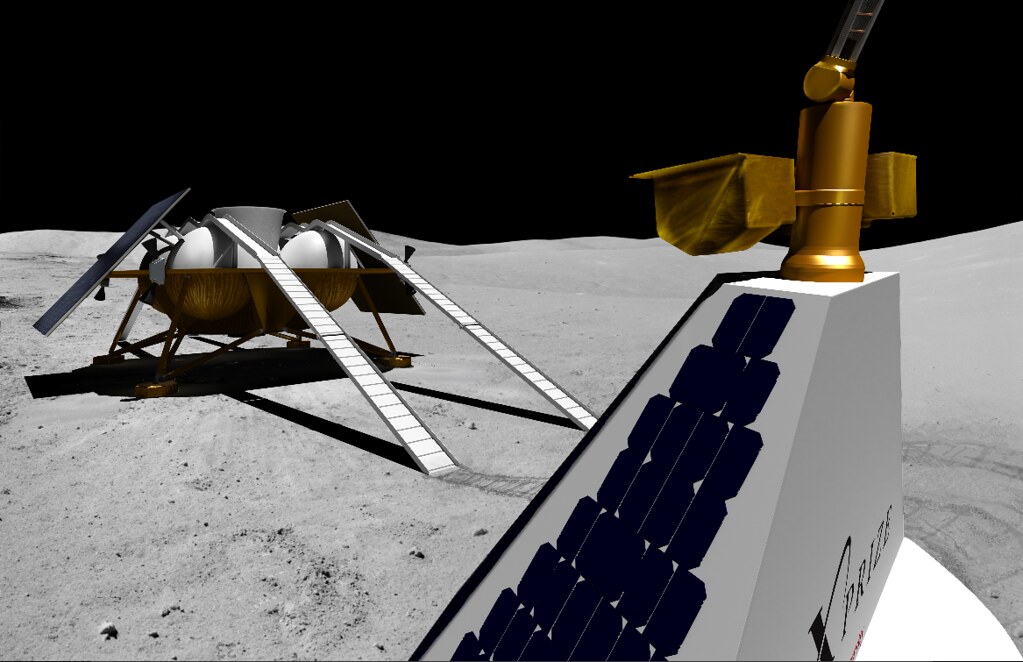
The combined strategy utilizes the Astrobotic "Griffin" lander (carrying their "Red Rover," in foreground) to deploy a total of three robotic rovers, including the Hakuto "Tetris" and "Moonraker" [Astrobotic/CM].
Angela Moscaritolo
PC

Two rivals battling it out in Google's $30 million competition to land a private spacecraft on the moon are teaming up for a joint trip to the lunar surface.

Hakuto, the only Japanese team competing in Google's Lunar XPrize competition, and Pittsburgh-based Astrobotic on Monday announced they are partnering for a moon journey during the second half of 2016.

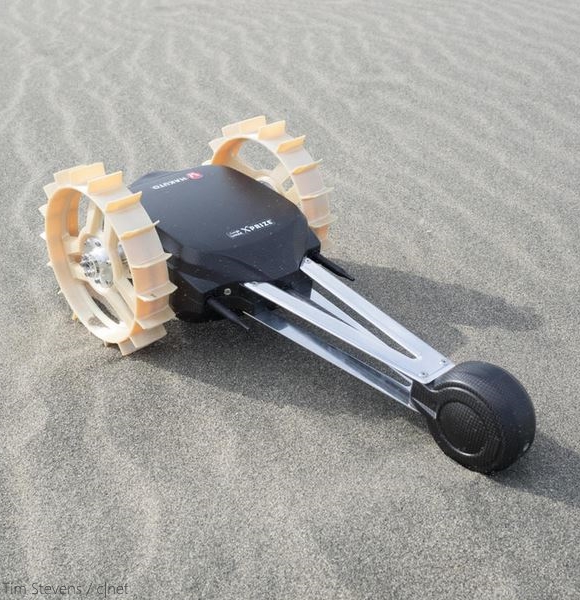
Hakuto rover Moonraker (and back-up) undergoing hazard and slope avoidance testing in 2014 [Tim Stevens/C|NET].
The plan is that Hakuto's twin rovers — dubbed "Moonraker" and "Tetris" — will "piggyback" on Astrobotic's so-called "Griffin" lander to reach the moon.

Hatuto sub-rover Tetris [Tim Stevens/C|NET].
Astrobotic will launch the mission next year on a SpaceX Falcon 9 rocket from Cape Canaveral, Fla. After touching down, Hakuto's rovers will be simultaneously released alongside Astrobotic's "Andy" rover, developed by Carnegie Mellon University.

Read the full story HERE.

Additional story at Pittsburgh Business Times, HERE.

Astrobotic Technology Red Rover design concept, picked by Popular Science as one of 100 Best Innovations of 2011.

Thursday, January 29, 2015

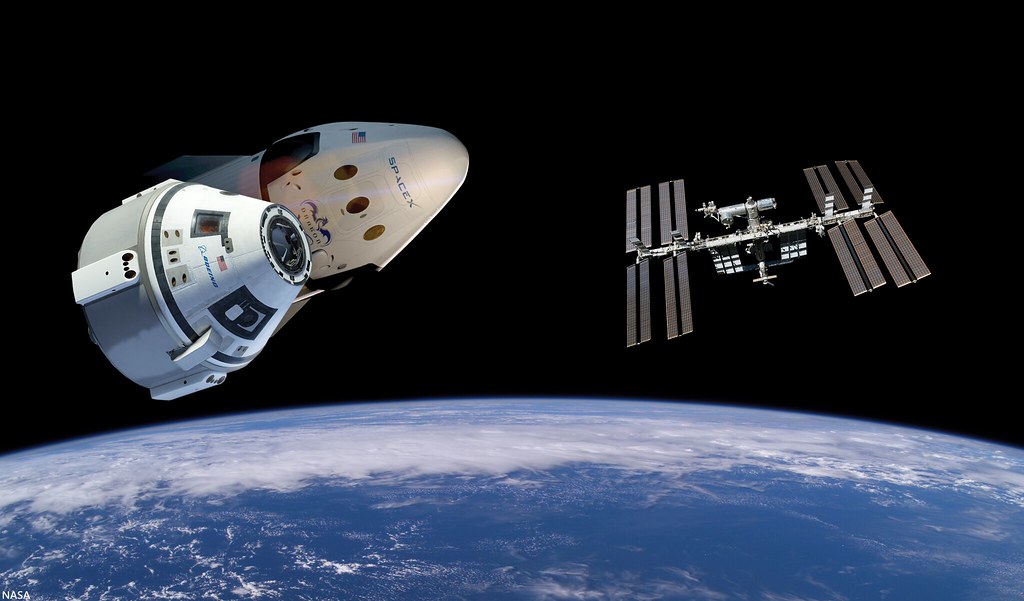
Boeing and SpaceX to launch crews to ISS in 2017

Boeing CST-100 and SpaceX Dragon V2 will orbit manned spacecraft and rendezvous and supply the International Space Station starting in 2017, NASA announced Monday [NASA].
Ken Kremer
Universe Today

After a hiatus of six long years, US astronauts will finally launch to space in a revolutionary new pair of private crew capsules under development by Boeing and SpaceX, starting in 2017, that will end our sole source reliance on the Russians for launching our astronauts to the International Space Station (ISS).

Two years from now, crews will start flying to space aboard the first US commercial spaceships, launching atop US rockets from US soil, said officials from Boeing, SpaceX and NASA at a joint news conference on Monday, Jan. 26. The human rated spaceships – also known as ‘space taxis’ – are being designed and manufactured under the auspices of NASA’s Commercial Crew Program (CCP).

A two person mixed crew of NASA astronauts and company test pilots will fly on the first test flights going to the space station in 2017.

Read the full report, HERE.

Monday, July 23, 2012

The Tale of Falcon 1

Liftoff of Flight 4 of the Falcon 1 from Kwajalein, September 28, 2008. SpaceX achieved an elliptical orbit (621 x 643 km) at 9.3° inclination and carried into orbit a dummy payload at 165 kg designed and built for the mission [SpaceX].
Paul D. Spudis
The Once and Future Moon
Smithsonian Air & Space

  
Elon Musk founded Space Exploration Technologies Corporation (SpaceX) in 2002.  Its stated business objective was the development of launch services for a fraction of the cost of the then-available commercial launch providers – to the greatest extent practicable, they would create reusable pieces of its launch system, thereby greatly lowering the cost of space access.  Toward that end, SpaceX sponsored the development of its own launch vehicle and engines, using a vertically integrated business model in which SpaceX would design, fabricate, prepare and operate a launch system.

Alan Boyle’s recent review of commercial efforts to supply the International Space Station naturally included coverage of the successful flight of SpaceX’s Falcon 9 rocket and Dragon’s delivery demonstration.  The article focused on the way commercial space is financed, specifically how NASA is sponsoring the development of some of these capabilities.  This financial arrangement is the basis for a point repeatedly voiced by critics of the heralded vision of “New Space” replacing “government” space – a company like SpaceX is not actually commercial in the traditional free market sense, but simply another government-funded contractor using a different procurement model.

Falcon 1 was the first rocket developed by SpaceX.  It is a two-stage launch vehicle capable of putting a metric ton (1000 kg.) into low Earth orbit.  Falcon 1 uses a single Merlin, a SpaceX-developed, LOX-kerosene rocket engine producing ~570,000 newtons of thrust (for comparison, a single Shuttle main engine burns LOX-hydrogen fuel and produces about 2,300,000 newtons of thrust).  The Falcon 1 was designed to put relatively small satellites into low earth orbit.  With such payload capacity, it is also capable of sending 100-200 kg microsats beyond LEO, into cislunar space.

Much of the private start-up capital for SpaceX was used to develop the Falcon 1.  They also received some government funding from other than NASA.  The Department of Defense (DOD) had need for reliable, quick, and cheap space access for small payloads.  To that end, SpaceX received funding from several DOD entities, including several million dollars from the U.S. Air Force under a program to develop launch capability for DARPA (a defense research agency).  Space X was given access to and the use of DOD launch facilities at the Reagan Test Site (formerly Kwajalein Missile Range) in the Marshall Islands.

The early days of Falcon 1 development were not pretty.  The first launch failed after 25 seconds of flight.  The second flight successfully launched and staged, but did not reach orbit.  After the third attempt at flight failed during staging, a review board looked in detail at SpaceX’s launch processing stream and made recommendations for some significant changes.  The next launch was successful in putting a dummy payload into orbit.  In July 2009, six years after Falcon 1 development had begun, SpaceX achieved its first (and so far, only) commercial space success with the launch and orbit of the Malaysian RazakSAT imaging satellite on a Falcon 1 launch.

Typically when a space company finally achieves a long-sought success, it moves rapidly to exploit the new vehicle’s operational status and begins to aggressively market and sell its new launch service.  However, no Falcon 1 launch has occurred since the success of RazakSAT.  A visit to the SpaceX web site describes the Falcon 1 vehicle, but at the bottom of the page it states that a Falcon 1 launch is no longer available for purchase.  Instead, small, one-ton class payloads will be accommodated in the future through “piggyback” rides on the new, Falcon 9 medium-class launch vehicle.

For a company to spend six years and start up money developing a needed launch system, only to abandon it just as success and profit is at hand, is difficult to sort through.  One could be forgiven for imagining that the development of the Falcon 1 as a commercial launch system was never intended but rather a pretext to flight qualify the pieces (specifically the Merlin 1 engine) used in the nine-engine cluster that powers the Falcon 9 launcher.  Interestingly, others have noted that the now-cancelled NASA Constellation Ares I launch vehicle (“The Stick”), purportedly designed to launch the new Orion spacecraft to LEO, likewise appeared to be more of a development effort than a flight project, in that its various pieces (e.g., cryogenic upper stage, five-segment SRB) were all needed to build the large Ares V heavy lift rocket.

Meanwhile, customers in need of low-cost options for launching small payloads are out of luck.  Falcon 9 has yet to launch an ounce of commercial payload and Falcon 1 is not for sale.  Of course, one can launch small satellites using Orbital’s Taurus launch vehicle, but its ~$50-70 M cost and recent record of unreliability (e.g., the Glory satellite launch failure) engender neither comfort nor confidence.  More significantly, after investing in the R&D effort of a new, unproven company that was offering a low cost, small launch vehicle, SpaceX’s original DoD customers, banking on the creation of a quick, inexpensive capability to launch small satellites, saw their support of Falcon 1 go by the board.  It appears that SpaceX dropped their initial operational vehicle for the promotion and promise of far more ambitious and distant goals.

Artist's rendering of the Falcon 9 heavy-lift launch
plans for which are expected in 2013
[SpaceX].
That template seems to work for them – NASA has “invested” more than $500 million in the Falcon 9 over the last five years.  Now, SpaceX holds court to advance their founder’s Mars fantasies and plans for a Falcon “heavy” launch vehicle – designed and marketed as sending very large payloads into space, at unbelievably low prices.  (As an aside, I thought that a New Space article of faith is that heavy lift is a boondoggle and that fuel depots are the way to go beyond LEO.)

When New Space advocates characterize old NASA contractors, legacy launch companies and politicians with NASA centers in their districts as “pigs at the trough of government funding,” they’d be wise to watch out for a “pig” donning falcon feathers.  Debate, like competition is good and helpful but only useful when advocates honestly pitch their abilities, services, products and intentions.   Money is an important consideration, however our nation’s ability to compete in the arena of space must be the overriding concern.  In light of the current situation, that ability is slipping further and further away.  We need to honestly assess what we’re buying before nothing remains of our decades long investment and leadership role in space.

Originally published at his Smithsonian Air & Space blog The Once and Future Moon, Dr. Spudis is a senior staff scientist at the Lunar and Planetary Institute. The opinions expressed are those of the author and are better informed than average

Wednesday, May 16, 2012

"The Flight of the Dragon"

The Falcon 9 launch vehicle [SpaceX/Chris Thompson].
Paul D. Spudis
The Once and Future Moon
Smithsonian Air & Space

If things go according to plan Tuesday, the world will witness SpaceX launch its first Dragon cargo supply mission to the International Space Station.  As this flight has been heralded as the dawn of a new age in spaceflight – a paradigm shift in the way the spaceflight is approached – it is appropriate to step back for some reflection and perspective on what this flight may or may not represent.  As noted by many, this particular cargo flight has a lot riding on it – with overarching concern for success (even if a bit unfair), created in part both by vociferous advocacy and excessive public pronouncements.

1.  A successful or unsuccessful result from this flight neither confirms nor negates the value and/or viability of commercial spaceflight.

This proposition should be obvious.  Launch to orbit is an inherently difficult and risky endeavor.  Even launch vehicles with long histories of reliable flight fail, sometimes with distressing frequency.  We tend to think that space access should be routine but that appearance is deceiving; spaceflight is never routine, simply because orbital flight is possible only on the very edge of our capability.  Think of it as carrying a heavy load of luggage while ice skating – you may know how to do it and you may even pull it off successfully a number of times, but if you start taking it for granted, a fall on the posterior is quite likely (with this eventuality more probable in the early stages of the endeavor).

Looked at in another way, a successful mission does not “prove” the case for commercial human spaceflight (the case for commercial unmanned space launch has long since been proven) nor does it negate its feasibility.  The real issue with commercial human spaceflight is the existence of a market.  Right now, such a market does not exist.  New Space advocates have unlimited faith that one will emerge, but hope is not a business plan.  It will take years of successful commercial launches (and safe returns) for the creation of a genuine commercial market.  The uncertainties in the future legal status of commercial human spaceflight is enough to give one pause – contemplate the likely consequences following the first fatal accident in a commercial human spaceflight, after the ambulance chasers get their teeth into the flesh of every company who ever had anything whatsoever to do with the flight.

2.  The creation of SpaceX capability is not “commercial” in the sense that we in the capitalist United States of America understand it.  Likewise, a government space program is not “socialism.”

The word commercial has been re-branded.  Previously, in most entrepreneurs’ way of thinking, “commercial” enterprise meant that a person or group drew up a business plan, raised private capital and shouldered the financial risk in an attempt to make a profit by providing a product or service.  The understanding of the term “commercial space” has been stretched to encompass a business plan where a start-up company requests (and expects) government subsidies on their promise of future delivery of a product and/or service.  Because it’s not “run” by the government, this form of government-sponsored crony capitalism is now deemed “commercial.”   Financial tweaking is not how most would understand or define a new paradigm in space travel.

Typically during the last 50 years of our federal civil space program, we were working toward some clearly articulated, reachable (that adjective is important) goal on some kind of timetable.  Because spaceflight, particularly the manned variety, was considered to be dangerous and technically cutting edge, the program was more of an engineering research program than the deployment of an operational transportation system.  Such R&D has important national security and economic ramifications and as such, fits perfectly under the constitutional requirement for the federal government to provide for the common defense and promote economic development.  If that’s “socialism,” then America has been a socialist country from its founding.

3. True commercial space firms exist, but they are pursing their goals quietly and generally without excessive hype.  They do not rely on government money to support their R&D costs.

Burt Rutan developed Space Ship One for Paul Allen in order to win the Ansari X-Prize (and did) and is currently developing a new spacecraft for Richard Branson’s Virgin Galactic suborbital spacelineRobert Bigelow’s company took a discarded NASA design for inflatable spacecraft and is developing a future commercial space station, available for sale of lease (it’s the transportation problem to and from his station that’s holding him back.)  None of these efforts are taking the King’s shilling – they are developing hardware and capability themselves.  It’s interesting that unlike some New Space firms, they tend to make fewer public pronouncements and the ones they do make are both substantive and realistic (you tend to operate that way when you’re risking your own nickel).

4.  The process of contracting with “commercial” firms to carry payloads into orbit is not a space policy.

This last item is obvious, but only if you’re not getting your news exclusively from the space media.  Even if SpaceX is completely successful, all we will have done is to add another player to the existing roster of supply vehicles that enable the occupation and use of the ISS.  Since discarding the Vision for Space Exploration over two years ago, we have no long-term goal or strategic direction for our civil space program.  The pre-existing Commercial Crew and Cargo Program has been billed as a “new direction” but it is simply a utilitarian effort to keep an existing program going, not a new path or direction to follow.  Mirages of human missions to asteroids and following a “flexible path” will produce pointless viewgraph engineering – and no missions getting off the ground.  At least with the VSE, the nation knew where, when and why we were going.

Even as we hope for a successful SpaceX launch and return, it is vital that America recognize that our government has no space policy or strategic direction – commercial or otherwise.  From both a security and an economic perspective, this is a dangerous situation for our nation.

Originally published at his Smithsonian Air & Space blog The Once and Future Moon, Dr. Spudis is a senior staff scientist at the Lunar and Planetary Institute. The opinions expressed are those of the author and are better informed than average.

Friday, May 11, 2012

SpaceX joins Bigelow in marketing LEO stations

Exterior camera view of the unmanned inflatable Bigelow Genesis orbital station, in low Earth orbit April 27, 2009 [Bigelow Aerospace].
Hawthorne, California and Las Vegas, Nevada – SpaceX and Bigelow Aerospace have agreed to conduct a joint marketing effort focused on international customers. The two companies will offer rides on SpaceX’s Dragon orbiter, using the Falcon launch vehicle, carrying passengers to Bigelow habitats in low Earth orbit.

Bigelow president and founder Robert T. Bigelow said, “We’re very excited to be working with our colleagues at SpaceX to present the unique services that our two companies can offer to international clientele. We’re eager to join them overseas to discuss the substantial benefits that BA 330 leasing can offer in combination with SpaceX transportation capabilities”.

The BA 330 is a habitat that will provide roughly 330 cubic meters of usable volume and can support a crew of up to six. Bigelow Aerospace plans to connect two or more BA 330s in orbit to provide national space agencies, companies, and universities with unparalleled access to the microgravity environment.

NASA signed off on the 7 passenger Dragon seating layout, May 8
[NASA].
“SpaceX and BA have a lot in common. Both companies were founded to help create a new era in space enterprise,” said SpaceX President Gwynne Shotwell. “Together we will provide unique opportunities to entities -- whether nations or corporations -- wishing to have crewed access to the space environment for extended periods. I’m looking forward to working with Bigelow Aerospace and engaging with international customers,” Shotwell explained.

SpaceX’s Dragon spacecraft will be capable of carrying seven passengers to orbit. With the company’s Falcon family of rockets, SpaceX is working to create the world’s safest human spaceflight system.

The companies will kick off their marketing effort in Asia. Representatives from Bigelow and SpaceX will meet with officials in Japan shortly after the next launch of the Falcon 9 and Dragon spacecraft.

Wednesday, April 4, 2012

Astrobiotic unveils Polaris high-latitude explorer

Polaris prospects for water at the lunar poles. One of three lunar rover designs by Astrobotics Technology, Polaris has three vertical solar panels to generate 250 watts of power and two radiator panels to rid itself of excess heat. Stereo cameras and laser are used to guide Polaris and generate 3-D video and models of the lunar surface. The robot communicates directly with Earth using a pointed S-band antenna to receive commands and send video and data. Polaris carries up to 175 lbs (80kg) of payload, such as a drill to take core samples and science instruments to identify water content. Polaris is capable of driving and avoiding obstacles autonomously including traverses into dark regions in the lunar pole’s long shadows. Polaris suspension includes raise and lower capability to vary chassis ground clearance to lower for drilling and raise for driving on rough terrain. The suspension maintains four-wheel ground contact over sloped and rocky lunar terrain without the use of springs. Surface operations are carefully preplanned to maintain unobstructed views of the sun for power and the earth for communication. View the full-size artist concept HERE [Astrobotic Technology/CMU].

Pittsburgh / CMU - Astrobotic Technology unveiled its new Polaris lunar rover design, which will prospect for potentially rich deposits of water ice, methane and other resources at the moon's north pole in three years.

A powerful Falcon 9 rocket from SpaceX will launch Polaris from Cape Canaveral in late October 2015. Four days later Polaris will land during north pole summer, when patches of ground that are in cold shadow most of the year get brief illumination. This is where ice will be found closest to the surface, and when a solar-powered robot will get the sunlight needed to sustain exploration. Polaris will search for ice for the next 12 days until sundown in early November.

Polaris carries up to 175 lbs (80kg) of payload, such as a drill and instruments to analyze samples from the drill. To find the best spot to drill, two sensors will look for signs of hidden ice beneath the surface layer of dry soil. A neutron spectrometer will measure the number of neutrons given off by the first yard of soil beneath the rover; a dip in the reading indicates neutrons coming in from space are being absorbed by hydrogen (in water or methane) in ice beneath the robot. A near infrared spectrometer will look for variations in surface temperature that may hint at ice below.

Polaris is adapted from a lunar excavation machine that Astrobotic has been prototyping under a NASA contract granted in 2010. After Polaris and other prospecting robots find the highest ice concentrations, excavation robots will remove the covering layer of dry soil to recover the ices and deliver them to a plant that turns them into rocket propellant.

Tuesday, February 28, 2012

Additional ILDD contract awarded to Astrobotic

Prototype Astrobotic Scout Rover undergoes field tests in a
Big Island "lunar proxy" environment in 2011 [Astronbotic].

NASA has awarded Astrobotic Technology Inc. an additional task in its $10 million Innovative Lunar Demonstrations Data (ILDD) contract under which NASA buys information about the company’s commercial robotic expeditions to the Moon. The $100,000 task order brings total funding under the ILDD contract thus far to $610,000.

Astrobotic Technology will launch its first expedition on a Falcon 9 rocket under contract from Space Exploration Technologies (SpaceX).

 In May 2015, it will deliver a robot to the Moon’s south pole to prospect for water, methane and other minerals. Turned into rocket propellant, these resources will dramatically reduce the cost of space exploration by providing an off-planet refueling station.

“The number one challenge in space exploration today is the cost,” said David Gump, Astrobotic’s president. “Commercial robotic expeditions can serve space agencies at one-third the cost they traditionally spend with cost-plus contractors. And by prospecting for rocket fuel ingredients at the Moon’s poles, we can provide a much lower cost source for spacecraft propellant as they venture further away from Earth.”

Astrobotic is a spinout from the Robotics Institute at Carnegie Mellon University, which carries out lunar research funded by Astrobotic. 

In October 2010 NASA awarded first phase ILDD contracts to Astrobotic (Pittsburg, PA), The Charles Stark Draper Laboratory, Inc., Cambridge, MA, Dynetics Inc., Huntsville, AL, Earthrise Space Inc., Orlando, FL, Moon Express Inc., San Francisco, CA and Team FREDNET, The Open Space Society, Inc., Huntsville, AL.

Read the full Astrobotic news release HERE.

Wednesday, January 25, 2012

'Everybody has won, and all must have prizes'


Paul D. Spudis
The Once and Future Moon
Smithsonian Air & Space

The Dodo rewards Alice's own thimble back as a prize, from
Alice's Adventures in Wonderland.
In space circles, the idea of offering incentive prizes to develop complex technology has some currency.  Most notably, Republican presidential candidate Newt Gingrich recently advocated a prize-based incentive model coupled with a leaner NASA as an alternative to our currently stalled, government bureaucratic model of space operations.  The incentive idea is behind the current Centennial Challenges program of NASA, which offers money for the demonstration of certain specified technologies or procedures.  Presumably, Gingrich is speaking not of this existing program but about a vastly expanded prize structure, funded by the federal government, for significant milestones in humanity’s expansion into space.

This model structure harkens to early days of aviation when prizes for specific aeronautical achievement proliferated.  Notable was the $25,000 Orteig Prize offered by New York hotelier Raymond Orteig for the first non-stop air flight between New York and Paris.  Charles Lindbergh won the Orteig Prize in 1927 in his specially built Spirit of St. Louis.  After this flight, probably due more to celebrity culture and the frenzy of fame rather than actual flight accomplishment, commercial aviation enjoyed a boom of popularity with the public and industry.  In short, the prize offering succeeded in producing a PR stunt; the design features of Spirit of St. Louis were specifically optimized to permit Lindbergh to win the prize, not to advance aeronautical technology or establish commercial transatlantic flight operations.

Currently, the most visible prize structure for spaceflight is Peter Diamandis’ X-Prize Foundation, a private funding group that awards prizes for specific space-related goals.  The first and most famous, the Ansari X-Prize founded in 1996, was offered to the first non-government group that could (within two weeks) twice launch and safely return to Earth a reusable, manned spacecraft.  In 2004, the $10,000,000 X-Prize was won by Burt Rutan’s SpaceShipOne, funded by Microsoft’s Paul Allen.  This vehicle used an innovative airborne launch system, a hybrid solid-liquid rocket engine and a “wing feathering” method for re-entry and return flight.  Plans were immediately made to construct a commercial version of SpaceShipOne, to be sponsored and operated by Richard Branson’s Virgin Galactic organization.

However, since that prize-winning flight almost eight years ago, things have not proceeded smoothly.  An explosion in 2007 destroyed the rocket fabrication facility and killed three workers.  Virgin Galactic established an operations base in New Mexico on October 17, 2011.  There is a passenger manifest backlog of 455 subscribers but as of this writing, not a single commercial passenger spaceflight has occurred.

Another current space prize is the Google Lunar X-Prize, offering a $20 million award for successfully landing a spacecraft carrying a high-definition imaging system and roving on the Moon at least 500 meters.  Since its announcement in 2007, over 30 companies have registered to participate in the competition.  Additional prize increments are awarded for other accomplishment, such as long range (> 5 km) roving, survival over a lunar night, and documentation of the presence of water in lunar soil.  No lunar mission has yet been launched nor has any launch date been announced.  The original expiration date for the lunar X-Prize was 2012 but was extended to the end of 2015.

An alternative incentive approach is milestone-based contracting.  NASA’s Commercial Orbital Transportation Services (COTS) program awards government money to companies that meet specific milestones on previously announced timescales.  That money is to be spent developing specific capabilities required for government needs.  The reward at the end of this cycle is a performance-based government contract for launch services.  However, under this government-sponsored incentive program, a commercial human spaceflight industry has yet to develop.

Bigelow Aerospace, a builder of private, “For Lease” space stations, recently laid off over one third of their workforce.  Part of the problem is the lack of assured, commercially available access to their orbital stations.  In 2004, Bigelow himself established and funded a $50 million prize to develop a commercial crew vehicle for orbital transport; the prize expired in 2010 without a single attempt at flight.  Although rumor has it that Boeing is developing a spacecraft to serve private space stations, nothing has yet appeared, even in prototype form.  Due to some unidentified technical issues, SpaceX has delayed the launch of the first flight of their Dragon cargo vehicle to ISS from early next month to an unspecified future date.

The simple glaring fact is the United States has no commercial human spaceflight industry.  NASA’s attempt to encourage the development of such through COTS is floundering against some unpleasant realities:  it is both very difficult and very costly to get into and back from space.  The former drives up the cost, severely limiting potential markets.  The latter stops not only imagined demand (such as space tourism) dead in its tracks but also real demand, such as government contracts for ISS crew access.

The hope of space prize enthusiasts for explosive growth in space similar to that seen in aviation innovation and industry following the winning of the Orteig Prize is unlikely to be realized.  The problem is that spaceflight is a vastly more difficult field in which to participate than aviation.  Many amateurs could and did fabricate aircraft in their garages and barns in the early decades of the last century.  The First World War made surplus aircraft widely available at low cost, furthering the development of a robust early aviation industry.  In contrast, no one has flown a surplus government space vehicle and “barnstorming” rockets do not exist, despite some imaginative depictions in Hollywood films.

Unfortunately, this is the space program we now have.  No American human spaceflight flight systems exist and their development is dependent on the advent of a demand that has not yet materialized.  Meanwhile, we comfort ourselves with fantasies about human missions to Mars.  I appreciate and applaud Gingrich’s enthusiasm for space, a visionary attitude sorely lacking in most politicians.  He needs to think carefully about how to incentivize the development of space and about the critical national needs served by our civil space program.  Prizes seem attractive because of their historical role in stimulating a nascent aviation industry.  But significant differences between aviation and spaceflight and our primitive level of development of the latter suggest that what worked before may not work now.

Originally published January 25, 2012 at his Smithsonian Air & Space blog The Once and Future Moon, Dr. Spudis is a senior staff scientist at the Lunar and Planetary Institute. The opinions expressed are those of the author and are better informed than average.

Thursday, March 3, 2011

Astrobotic's Guide for lunar payload developers


Lander-rover architecture by Astrobotic Technology, a leading competitor for the Google Lunar X-Prize [Astrobotic Technology, Inc.]

Astrobotic Technology today released a new guide for researchers on preparation of their instruments for the company's planned December 2013 robotic expedition to the surface of the Moon.

The expedition, based on technology from Carnegie Mellon University, will carry up to 240 pounds of science, engineering, and marketing payloads. Any university, government agency or company is eligible to purchase payload accommodations on the December 2013 flight.

"To get their sensors and experiments to the lunar surface, researchers have had to propose entire missions to space agencies such as NASA or the European Space Agency," said Astrobotic president David Gump.

"This initiative allows engineers and scientists to focus on just their own instruments, with Astrobotic providing the delivery and support utilities like power and communications. They can buy just what they need from us by the pound, watt, and byte."

Last month Astrobotic announced that it has signed a contract with SpaceX to launch its mission on a Falcon 9 rocket, the same vehicle that NASA will use to send supplies to the International Space Station. The Falcon 9 will throw the Astrobotic spacecraft into a lunar trajectory for a four-day cruise to the Moon.
Read the full release, HERE.

Wednesday, February 17, 2010

What's next for US spaceflight, if not the moon?

‘Dragonlab’: Artist’s conception of the SpaceX ATV, a "reusable space ‘tug,’ designed to lift payloads to the space station" [SpaceX/Christian Science Monitor/AP].

Peter N. Spotts
Christian Science Monitor

The Obama administration has submitted budget proposals to Congress that give a new direction to the US space program, particularly its human-spaceflight activities.

During the next five years, the president proposes to boost spending for the National Aeronautics and Space Administration by $6 billion over 2010 levels. However, gone is the ambitious Constellation program, which aimed to build a replacement for the space shuttle and put US astronauts back on the moon by 2020.

In its place – if Congress is willing (and several key lawmakers don’t appear to be) – is a NASA that would instead develop partnerships w ith the private sector. These would support the ability among commercial companies – from veterans such as Boeing to upstarts such as SpaceX – to build and operate rockets to provide cargo and taxi services to and from low-Earth-orbit destinations such as the International Space Station.

Read the full Article, HERE.

Tuesday, February 2, 2010

NASA selects Boeing and Lockheed Martin for Commercial Crew Development Program

[Editor's Note: After the understandable enthusiasm for the Obama administration's proposed NASA program changes and 2011 budget wains a bit, it will be fair to ask if some some people might be confusing the new commercial space initiative with "privatization." It would be foolish to suspend critical judgment because of a passionate desire, because the new NASA initiative appears to match a certain assumption of what commercial space ought to be.

The end of Constellation probably means an end to Orion, certainly Altair; vehicles being designed and built by Northrup Grumman and Boeing. Along with Lockheed Martin, these are commercial companies, also. Despite being latecomers whose joint initiative ultimately lost out to SpaceX and Orbital Sciences for the first twenty ATV launches to ISS, it would be foolish to underestimate their competitve ability if the new initiative gains congressional approval.


United Launch Alliance (ULA) is a joint venture of Lockheed Martin and Boeing formed in December 2006.]

February 2. NASA announced today its selection of United Launch Alliance to participate in its new Commercial Crew Development (CCDev) Program. NASA created the CCDev Program to develop system concepts, key technologies, and capabilities that ultimately will be used in commercial crew space transportation systems. ULA was awarded $6.7 million to develop an Emergency Detection System (EDS), which is a significant element necessary for a safe and highly reliable human rated launch vehicle.

"ULA is pleased to participate with NASA on the CCDev Program," said Michael Gass, ULA President and Chief Executive Officer. "We look forward to supporting NASA as they embark on a new initiative that emphasizes commercial access to space. We are confident that our flight-proven Atlas V and Delta IV launch vehicles can help NASA achieve its goals."

The EDS monitors critical launch vehicle and spacecraft systems and issues status, warning and abort commands to the crew during their mission to low Earth orbit. ULA studies show that the development of the EDS will help meet the requirements for human rating the Atlas V and Delta IV launch vehicles.

The CCDev Program will allow ULA to build upon its heritage launch systems and its on-going company investments toward commercial human space flight. ULA will work closely with NASA to identify critical failure modes of the flight-proven Atlas V and Delta IV launch vehicles. ULA will then develop the hardware components and software processes that will detect these modes allowing for rigorous and exhaustive testing on a prototype EDS before an initial crewed flight.

With ULA's unparalleled heritage and experience in expendable launch vehicle development and operation, ULA is uniquely qualified to support NASA in developing and demonstrating the EDS for a Commercial Crew Program. ULA's goal is to develop a system for NASA that builds upon the proven reliability of both the Atlas V and Delta IV for safe human space flight.

ULA program management, engineering, test and mission support functions are headquartered in Denver, Colo. Manufacturing, assembly and integration operations are located at Decatur, Ala., Harlingen, Texas, and San Diego, Calif. Launch operations are located at CCAFS, Fla., and Vandenberg Air Force Base, Calif.

For more information on the ULA joint venture, visit the ULA website at www.ulalaunch.com, or call the ULA Launch Hotline at 1-877-ULA-4321 (852-4321).

Monday, November 9, 2009

Col. Scott Henderson joins SpaceX

Hawthorne – SpaceX has announced Col. Scott Henderson has joined the company.

He will serve as the director of Mission Assurance and Integration and will also handle Florida external relations, assisting with state and local governmental, customer and media relations. Henderson will primarily support former astronaut Ken Bowersox, vice president of SpaceX's Astronaut Safety and Mission Assurance office, working out of the company's Florida office.

Henderson joins SpaceX after 25 years in the United States Air Force (USAF), an experience that began by earning a degree in Astronautical Engineering from the U.S. Air Force Academy. His prestigious career in the USAF included assignments in a wide variety of high level space operations and acquisition positions. A certified acquisition professional, Henderson has also earned a masters degree in Engineering Management from the Florida Institute of Technology and was a National Defense Fellow at the Massachusetts Institute of Technology.

Prior to SpaceX, Henderson held the position of Commander with the 45th Launch Group at the Cape Canaveral Air Force Station (CCAFS) in Florida. His responsibilities in this position focused on Department of Defense (DoD), civil and commercial space launch-related activities. Henderson joins SpaceX just as the company is preparing for the first Falcon 9 launch from CCAFS.

"Scott Henderson brings a great deal of operational launch experience and technical expertise to our company," said Bowersox. "As we begin the first flights of the Falcon 9/Dragon system, Henderson will serve as a critical link between the SpaceX Safety, Mission Assurance, Operations and Integration teams."

Selling Dragon as 60% cost saver


Doug Messier
ParabolicArc.com

The Examiner has a Q&A with SpaceX founder Elon Musk in which he talks about how much cheaper it will be once his company’s Falcon 9 rocket begins launching Dragon spacecraft into orbit:

SA: A manned flight to the ISS aboard a Soyuz currently costs about 50 million dollars. Where do you see this price in a few years when the Falcon 9 comes online and what are the benefits to US taxpayers?

EM: In contrast to the existing manned systems, a seat on-board the Dragon Spacecraft launched by the Falcon 9 rocket and would cost less than $20M per seat and it is 100% manufactured and launched in the United States. We are estimating that it would create well in excess of a 1000 high quality jobs at Cape Canaveral and an equivalent number in California and Texas, where we do our manufacturing and testing. Moreover, the total cost would only be $1.5 billion, so taxpayers would save $2 billion.

Read more HERE.

Tuesday, September 15, 2009

SpaceX and Musk laud Armadillo

The following message has been widely distributed:

'A Message from SpaceX'

"SpaceX congratulates John Carmack and the entire Armadillo Aerospace team on the completion of the Level 2 requirements for the X PRIZE 2009 Northrop Grumman Lunar Lander Challenge! SpaceX is a proud supporter of the X PRIZE Foundation, a great example of innovation and inspiration in aerospace."

- Elon

Thursday, August 20, 2009

NASA: 'Outlook Bleak'

Jim Garettson
ExecutiveBiz Bog

After just seven more missions to the International Space Station (ISS), the Space Shuttle will retire without a replacement. Ex-Lockheed Martin CEO Norm Augustine, chair of the United States Human Space Flight Plans Committee review, has published his committee’s findings, and NASA’s budgetary future looks bleak. Augustine told PBS “the human space flight program really isn’t executable with the money we have.” Augustine has given the “White House a dilemma” of accepting the necessary increase in spending or continuing on a path that leads to severely constrained and delayed space exploration.

To find alternatives, NASA has committed $500 million dollars in stimulus funds to help two private firms, Space Exploration Technologies (better known as SpaceX) and Orbital Sciences Corp (NYSE: ORB), deliver cargo to the station, but will only commit $50 million dollars for commercial human transport to the ISS. For perspective, “Fifty million is what it costs for one seat on the (Russian) Soyuz,” according to SpaceX founder and CEO Elon Musk.

But Lockheed Martin warns that commercial transit to the ISS would be costly and unsafe. John Stevens, director of business development for human spaceflight at Lockheed Martin Space Systems, said “we’re having a hard time affording the Orion program, which is designed to take humans to the station and the Moon, and now they’re talking about starting a commercial program to take humans [to the ISS]…If we can’t afford one program, how can we afford two?”

Bottom line: unless NASA’s budget gets some significant breathing room, the US may lose its edge in manned space exploration.

Sunday, August 9, 2009

Orbital discusses 2011 Taurus II launch plans with Wallops Island community

Notional launch of Orbital Taurus II Medium-Class Launch Vehicle, now rescheduled for Spring 2011, from Wallops Island, Virginia's Mid-Atlantic Spaceport. (Orbital Sciences Corporation Taurus II Fact Sheet)

Carol Vaughn
Staff Writer
Delmarvanow.com

Accomac - Orbital Sciences Corp. launch site manager Norm Bobczynski appeared before the Accomack County Board of Supervisors for the first time Wednesday to update the county about progress on Orbital's Taurus II rocket project at Wallops Island.

Bobczynski, a Norfolk native, has worked for decades in the space industry, including in the Atlas rocket program and most recently for Orbital's competitor SpaceX. He began work at Orbital in June 2008, the same week the company committed to using Wallops Island as the launch site for its Taurus II rocket, which will carry cargo to the International Space Station in eight contracted missions between 2011 and 2015.

An initial demonstration flight previously scheduled for December 2010 is now expected to happen in spring 2011.

Bobczynski said the company has the capability to launch more than those missions NASA has contracted for and expects to get more business from the Department of Defense and other commercial missions after it completes an initial launch of Taurus II successfully.

"It is important to Orbital Sciences Corp. to have a good working relationship with the community," Bobczynski said, adding that the company hopes to provide good jobs in the future.

Read the full article HERE.

Thursday, June 18, 2009

Orbital in $250 million deal with Thales for pressurized cargo modules for ISS resupply

Orbital Sciences, with SpaceX, last year won NASA contracts to fly twenty Automated Transfer Vehicle (ATV) cargo re-supply flights to the International Space Station through mid-2015.

Thales announced on Wednesday that Orbital has contracted with Thales Alenia in a $250 million deal to design and build the pressurized modules for Orbital's own ATV, Cygnus.

"The contract foresees the first unit delivery in December 2010," Thales announced. "The Pressurized Cargo Modules will be designed and developed for Orbital’s CRS (Commercial Resupply Services) contract with NASA."

"Cygnus first flight is planned for the spring of 2011."

"The maneuvering spacecraft will consist of Orbital’s Service Module with which the PCM, will be integrated. The PCMs to be developed by Thales Alenia Space has experience acquired from previous ISS-related programs, such as the Multi-Purpose Logistics Module Leonardo built on behalf of the Italian Space Agency and NASA, and the ATV Jules Verne produced by Thales Alenia Space for ESA."

"The nine PCMs will start with one built for a COTS demonstration mission"

The COTS demonstration mission is scheduled to take place in the fourth quarter of 2010.

"With the award of the Commercial Resupply Service," said Orbital, "NASA has selected Orbital to provide 8 pressurized cargo missions beginning in the latter half of 2011

For NASA, CRS will provide a U.S.-produced and-operated automated cargo delivery service for ISS logistic support, to complement Russian, European and Japanese ISS cargo vehicles.

(Which seems to beg the question whether Thales is building the Japanese ATV, as well, and whether they've played any role in announced improvements in Russia's standard Progress ATV's.)

"Orbital will carry out design, manufacturing and test of the new Taurus II launch vehicle in Dulles, Virginia and Chandler, Arizona.

"The company’s development, production and integration of its Cygnus spacecraft and cargo modules will be done in Dulles and Wallops Island.

"The Taurus II launch vehicle will have a payload capacity of 4,750 to 6,250 Kg to low-Earth orbits (depending on altitude and inclination). The Cygnus spacecraft will be capable of delivering up to 2,700 Kg of pressurized or unpressurized cargo to the ISS, and will be capable of returning up to 1,200 Kg of cargo from ISS to Earth."

Of the twenty CRS ISS resupply missions NASA awarded nine to Orbital and eleven to SpaceX of California, now testing engines for their Falcon 9 vehicle already deployed at Cape Canaveral."

Tuesday, June 16, 2009

Falcon 9 engine testing on schedule


Engine testing for the inaugural Falcon 9 flight proceeds at a rapid pace with no major problems or concerns. Six of the nine first stage flight engines have completed acceptance testing and all nine flight engines are on schedule to complete acceptance testing by mid July. - SpaceX, June 16

Tuesday, June 2, 2009

Space 2.X: Private Rocket Race takes off

WIRED Hawthorne, CA – Building a successful startup in Silicon Valley is hard, but it’s not rocket science. Unless you’re SpaceX.

Eschewing the traditional startup trappings of two college grads eating ramen, watching Adult Swim and coding until the wee hours of the night, SpaceX instead employs hundreds of brainiacs and builds its rockets in a massive hangar that once housed a 747 assembly line.

Started in 2002 by PayPal founder Elon Musk, SpaceX (short for Space Exploration Technologies Corporation) brings a startup mentality to launching rockets into orbit, which until recently was almost exclusively government turf. The hope is that minimal bureaucracy, innovation and in-house manufacturing and testing can be used to put payloads into space at roughly one-tenth the cost of traditional methods.

If the company’s newest rocket, the Falcon 9, successfully completes its two scheduled launches this year, it will rendezvous with the International Space Station in 2010. After that, it will officially begin its mission as NASA’s Commercial Orbital Transportation Services platform, replacing the space shuttle as the method for transporting cargo and crew to the ISS.

SpaceX launched its first rocket, the Falcon 1, last September, placing a dummy payload into orbit. Space enthusiasts are holding their breath to see how Falcon 9 performs.

WIRED has a behind-the-scenes look at SpaceX’s facility. This is how the private sector builds a rocket capable of space travel.

Monday, June 1, 2009

SpaceX: new date for launch of Razaksat

SpaceX and Astronautic Technology of Malaysia have announce a new launch window hfor Falcon 1 Flight 5, carrying the RazakSAT satellite. The launch window opens Monday, July 13 through Tuesday, July 14, with a daily window to open at 2100 (UT).

The launch was delayed last month after SpaceX identified potential for unfavorable interaction between the satellite and the launch vehicle.

After further analysis, SpaceX determined implementation of a simple vibration isolation system would address this concern.

SpaceX selected the SoftRide isolation system from CSA Engineering for this purpose, citing the system's strong flight heritage and established success in addressing vibration concerns.

RazakSAT was designed and built by ATSB, a pioneer in design and manufacture of satellites in Malaysia. It is expected to provide high resolution images of Malaysia that can be applied to land management, resource development and conservation, forestry and fish migration.

SpaceX's Falcon 1 launch site is located approximately 2500 miles southwest of Hawaii on Omelek Island, part of the Reagan Test Site (RTS) on Kwajalein Atoll in the West Central Pacific.

SpaceX will provide live coverage of the Falcon 1 Flight 5/RazakSAT mission, via webcast at: www.SpaceX.com, beginning 20 minutes prior to launch, and it will include mission briefings, live feeds and launch coverage from the launch site.

Post-launch, video footage and photos will be available for download on the same website.