Showing posts with label Northrup Grumman. Show all posts

Friday, March 2, 2012

Chronicles of Grumman's Lunar Module

Ross Bracco, part of the Grumman ascent-stage team, at the Cradle of Aviation Museum in Garden City, NY, in front of a display that shows Neil Armstrong taking the first step on the lunar surface [EDN].

Steve Taranovich
senior technical editor, EDN

President John F. Kennedy's vision was put into motion, stretching America toward the goal of landing man on the moon during the 1960s. A group of daring, talented men was specially chosen for the success of this heroic, pioneering effort. They were not astronauts but a team of young Grumman engineers about to embark upon an historic journey filled with technical design challenges in an extremely hostile environment. Their goal: to protect the lives of the many crews of astronauts that would be ferried to the moon and back.

Roserio (Ross) Bracco was selected as one of the initial group of 25 engineers who would begin development of the LEM (Lunar Excursion Module) in November 1962 at Grumman's Bethpage, NY, facility. The contract was completed in 1966 with 21 LEMs built-14 for flight and seven designated as LTA (LEM test article) -1 through -7.

Bracco is a graduate of Cooper Union in New York and was one of the first students there to receive a master's degree in mechanical engineering. When I visited him recently at the Cradle of Aviation Museum in Garden City, Long Island, NY, where he volunteers, he shared some incredibly interesting memories of his design journey in pursuit of a dream to have the first man safely set foot on the moon. Most of the pictures in this article were taken at the museum; it has an extraordinary display of LEM history, including actual, full-size LEM test articles. One is located in a huge room simulating the lunar surface and sky, complete with stars and the earth as it looked to Neil Armstrong when he stepped onto the moon's surface. The museum also has an exhibit that chronicles the entire history of flight, including some amazing restorations and models of aircraft. It's definitely worth a visit!

Read the full article HERE.

Tuesday, July 19, 2011

Northrup Grumman honored for Apollo LM


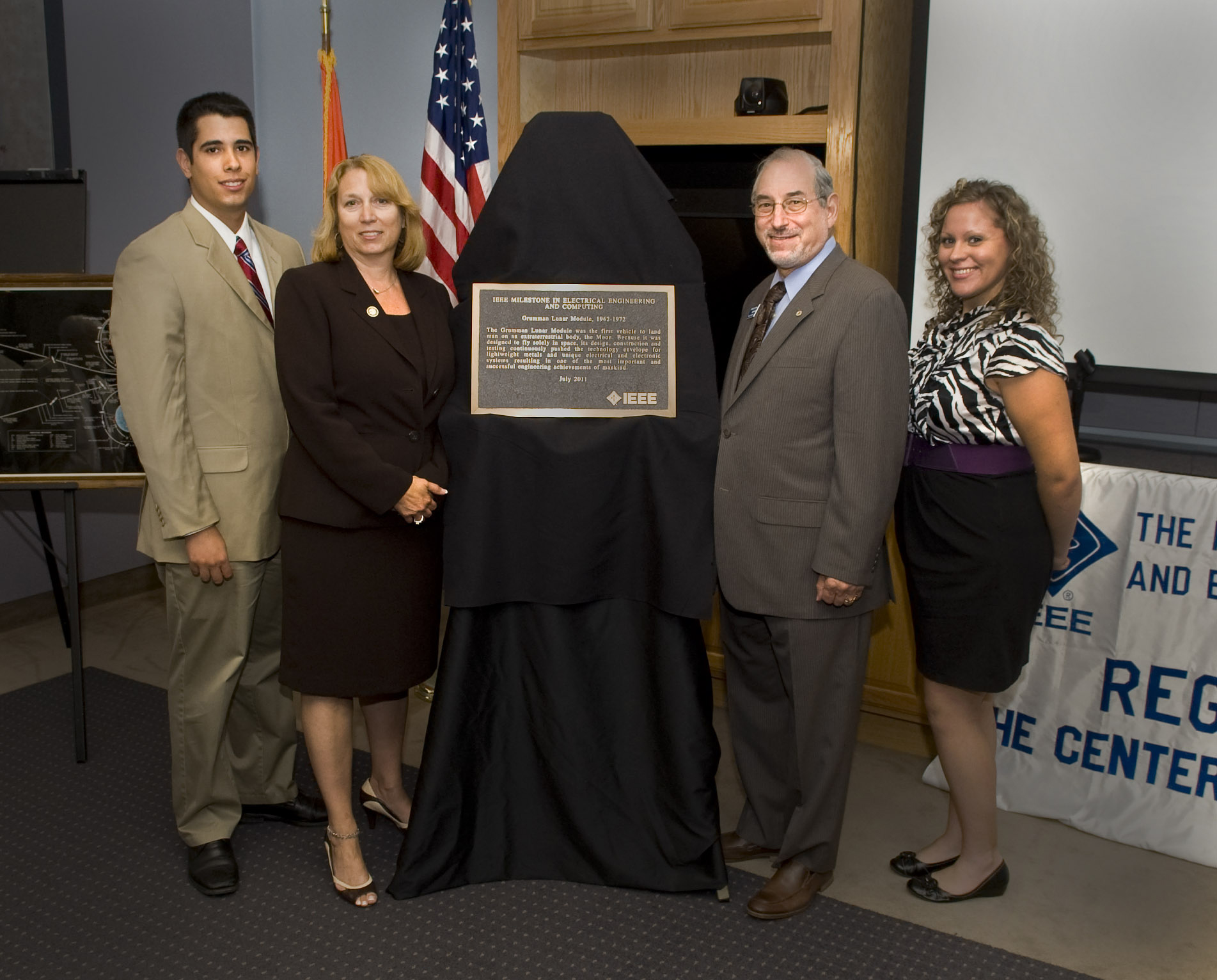
From left to right, Juan Leon, representating Congressman Steve Israel (2nd CD), Pat McMahon; sector vice president and general manager, Northrop Grumman Aerospace Systems Battle Management and Engagement Systems Division, Dr. Charles Rubenstein; director, IEEE Region 1, and Martha Sosnowski; regional assistant for U.S. Senator Kirsten Gillibrand (NY) following the unveiling of the bronze plaque honoring the Grumman-made Apollo lunar module [Northrup Gruman].

On the 42nd anniversary of Apollo 11 Commander Neil A. Armstrong's first steps on the moon's surface, Institute of Electrical and Electronics Engineers (IEEE), the world's largest technical professional association, today honored Northrop Grumman (NYSE:NOC) with its IEEE Milestone in Electrical Engineering and Computing award in recognition of the company's work on the lunar module.

The Apollo lunar module, America's first vehicle to enable astronauts to land on the moon and return safely to earth, was designed, developed and built by Grumman Corporation on Long Island. Between 1969 and 1972, six Grumman lunar modules carried 12 astronauts to and from the surface of the moon, including the famed Eagle which first carried Commander Armstrong and Lunar Module Pilot Buzz Aldrin to the Sea of Tranquility. They returned to Earth on July 24, 1969. One module – Aquarius – served as a lifeboat for three astronauts, Jim Lovell, Jack Swigert and Fred Haise, during the ill-fated Apollo 13 mission, which never landed on the moon but returned safely to earth.


The last lunar module to land on the Moon, Apollo 17's Challenger, photographed by Dr. Harrison Schmitt from their lunar rover in December 1972 [AS17-124-20508].

Read the Full Press Release HERE.

Tuesday, February 2, 2010

NASA selects Boeing and Lockheed Martin for Commercial Crew Development Program

[Editor's Note: After the understandable enthusiasm for the Obama administration's proposed NASA program changes and 2011 budget wains a bit, it will be fair to ask if some some people might be confusing the new commercial space initiative with "privatization." It would be foolish to suspend critical judgment because of a passionate desire, because the new NASA initiative appears to match a certain assumption of what commercial space ought to be.

The end of Constellation probably means an end to Orion, certainly Altair; vehicles being designed and built by Northrup Grumman and Boeing. Along with Lockheed Martin, these are commercial companies, also. Despite being latecomers whose joint initiative ultimately lost out to SpaceX and Orbital Sciences for the first twenty ATV launches to ISS, it would be foolish to underestimate their competitve ability if the new initiative gains congressional approval.


United Launch Alliance (ULA) is a joint venture of Lockheed Martin and Boeing formed in December 2006.]

February 2. NASA announced today its selection of United Launch Alliance to participate in its new Commercial Crew Development (CCDev) Program. NASA created the CCDev Program to develop system concepts, key technologies, and capabilities that ultimately will be used in commercial crew space transportation systems. ULA was awarded $6.7 million to develop an Emergency Detection System (EDS), which is a significant element necessary for a safe and highly reliable human rated launch vehicle.

"ULA is pleased to participate with NASA on the CCDev Program," said Michael Gass, ULA President and Chief Executive Officer. "We look forward to supporting NASA as they embark on a new initiative that emphasizes commercial access to space. We are confident that our flight-proven Atlas V and Delta IV launch vehicles can help NASA achieve its goals."

The EDS monitors critical launch vehicle and spacecraft systems and issues status, warning and abort commands to the crew during their mission to low Earth orbit. ULA studies show that the development of the EDS will help meet the requirements for human rating the Atlas V and Delta IV launch vehicles.

The CCDev Program will allow ULA to build upon its heritage launch systems and its on-going company investments toward commercial human space flight. ULA will work closely with NASA to identify critical failure modes of the flight-proven Atlas V and Delta IV launch vehicles. ULA will then develop the hardware components and software processes that will detect these modes allowing for rigorous and exhaustive testing on a prototype EDS before an initial crewed flight.

With ULA's unparalleled heritage and experience in expendable launch vehicle development and operation, ULA is uniquely qualified to support NASA in developing and demonstrating the EDS for a Commercial Crew Program. ULA's goal is to develop a system for NASA that builds upon the proven reliability of both the Atlas V and Delta IV for safe human space flight.

ULA program management, engineering, test and mission support functions are headquartered in Denver, Colo. Manufacturing, assembly and integration operations are located at Decatur, Ala., Harlingen, Texas, and San Diego, Calif. Launch operations are located at CCAFS, Fla., and Vandenberg Air Force Base, Calif.

For more information on the ULA joint venture, visit the ULA website at www.ulalaunch.com, or call the ULA Launch Hotline at 1-877-ULA-4321 (852-4321).

Thursday, November 5, 2009

LCROSS wins 2009 Aviation Week Program Excellence Award

Stephen L. Carman, Director, Technical Operations, Space & Defense Products, Northrop Grumman Aerospace Systems, accepts the Program Excellence System Level Production and Sustainment Award for the Lunar CRater Observation and Sensing Satellite (LCROSS). With him are (from left to right) Glenn P. Brady, Lead Partner, Aerospace & Defense Practice - Operations, Risk and Compliance, PricewaterhouseCoopers LLP; Thomas F. Fallon, Jr., Sector Vice President, Mission Assurance, Northrop Grumman Technical Services; Daniel R. Andrews, Project Manager, LCROSS, National Aeronautics and Space Administration; Carman; Tony Velocci, Editor-in-Chief, AVIATION WEEK; Stephen J. Hixson, Vice President, Advanced Concepts-Space & Directed Energy Systems, Northrop Grumman Aerospace Systems. [Northrup-Grumman]

LCROSS has been awarded the 2009 Aviation Week Program Excellence Award in the System Level Production/Sustainment category.

The award is presented annually to recognize and promote best practices in program leadership, encompassing the full range of responsibility and commitment necessary to develop and execute the program. LCROSS was evaluated against award criteria that includes risk management, budget and schedule management, and performance and also addresses value creation, best practices in organizational processes, leadership development, complexity and metrics.

"We are gratified to win this award," said Steve Hixson, vice president of Advanced Concepts - Space and Directed Energy Systems for Northrop Grumman Aerospace Systems. "It is a significant acknowledgement of the high caliber of our engineering skills and our close partnership with NASA Ames Research Center. It also validates our ability to build small, inexpensive spacecraft with high science value very quickly, awakening the industry and the nation to the viability of this mission class."

Monday, November 2, 2009

Lunar Lander Challenge wrap

Doug Messier
Parabolic Arc

Reports out of Cantil indicate that Unreasonable Rocket has ended its quest to win the Northrop Grumman Lunar Lander Challenge. During a test flight using a crane and tether, Unreasonable’s Silver Ball lander oscillated, broke the tether, and fell back onto the launch pad on its side. A leg punctured the fuel tank, damaging the vehicle and preventing another flight attempt on the last day of the competition.

The end of Unreasonable’s effort brings the NASA sponsored contest to an end and means a big payday for Masten Space Systems, which won the $1 million first prize for Level 2 and $150,000 for finishing second in Level 1. Armadillo Aerospace will be awarded $500,000 for a second place finish in Level 2. Last year, Armdillo won $350,000 for winning first prize in Level 1.

Read the Story, HERE.

Saturday, October 31, 2009

Armadillo disputes Mastin advantage, Unreasonable heartbreaker in Northrup Grumman Lunar Lander X-Prize Challenge

Update: Rob Goldsmith at the Space Fellowship has posted YouTube video taken on-board Unreasonable Rocket's Blue Bell, during it's spectacular but failed attempt to reach Level One of the 2009 Northrup Grumman Lunar Lander Challenge, Saturday, HERE.

"Done for the day," after a long day of last minute technical challenges, "Blue Ball" comes down on target five seconds too soon after running out of fuel in flight. Though the feisty vehicle was only slightly damaged, the father and son team of the Breed family's Unreasonable Rocket group is out of options for achieving requirements for Level One of the Northrup Grumman Lunar Lander X-Prize Challenge. The team will go for Level Two with their "Silver Ball" precision lander, Sunday. [X-Prize/Unreasonable Rocket]

John Carmack of Armadillo Aerospace calls foul, raises level of controversy over an apparent unfair advantage to Mastin Space Systems by X-Prize judges

Keith Cowling
NASA Watch

"The rules have given the judges the discretion to do just about anything up to and including awarding prize money for best effort if they felt it necessary, so there may not be any grounds to challenge this, but I do feel that we have been robbed. I was going to argue that if Masten was allowed to take a window on an unscheduled day with no notice, the judges should come back to Texas on Sunday and let us take our unused second window to try for a better accuracy, but our FAA waiver for the LLC vehicle was only valid for the weekend of our scheduled attempt."

Friday, October 30, 2009

Fire thwarts Mastin in X-Prize round


"Here's the Xoie engine. Sun makes it hard to see but some wires are fried. Also 6in from center #ngllc" - via Twitter & twitpic Northrop Grumman Lunar Lander Challenge.

John Antczak
Silicon Valley Mercury News

A rocket flew halfway through a simulated lunar landing mission in the Mojave Desert on Thursday before a fire thwarted the attempt to win a $1 million prize.

Masten Space Systems' Xoie, a robotic rocket, took off from a launch pad at Mojave Air & Space Port and flew to another pad where it set down on its legs among large boulders as flame licked up the side.

The fire damaged wires, a tube and insulation but the rocket could be ready to fly as early as Friday, said David Masten, president and chief executive of Masten Space Systems, based in Mojave, Calif.

However, Thursday's effort had been expected to be Masten's last chance and it was unclear if the judges of the NASA-backed Northrop Grumman Lunar Lander Challenge would allow another attempt.

Filed report HERE.
Updates from RLV & Space Transport News
Mastin Space Systems Level II Attempt

Wednesday, October 28, 2009

Million-dollar rocket showdown

Masten Space Systems' Xoie rocket was designed to go after a million-dollar prize.

Alan Boyle
Cosmic Log

The climactic rocket showdown for a million-dollar prize from NASA is under way in California's Mojave Desert.

Just as folks at Kennedy Space Center in Florida were celebrating the successful launch of NASA's Ares I-X rocket prototype, Masten Space Systems readied its own Xoie prototype at the Mojave Air and Space Port for its first attempt to win the Level 2 competition in the Northrop Grumman Lunar Lander Challenge.

Today Masten was grounded by glitches, but it has another day to go for the prize.

Read the Post HERE.

Wednesday, September 16, 2009

Next up, Mastin Space System's Xombie

After watching Scorpius from Aerospace take the lead in the second tier of the 2009 Northrup Grumman / X-Prize Lunar Lander Challenge, Mastin Space Systems is preparing to perform for the judges beginning early morning Wednesday. MSNBC's Alan Boyle has the Story, HERE.

Tuesday, September 15, 2009

High profile for Armadillo from Challenge


Scorpius, a 1,900-pound,
rocket-powered craft, built by Armadillo Aerospace, ascended 50 meters (164 feet) into the air, flew over to land on a simulated rocky lunar surface 50 meters (164 feet) away, and then rose and flew back to land where it started. The flight included a requirement of at least 180 seconds of flying time [SPACE.com].

The successful landing puts Armadillo in a comfortable position as it waits to see if the other teams can complete the takeoffs and landings. If they can’t, Armadillo will walk home with the cash. The team also won the $350,000 phase 1 competition, a similar mock landing that only required 90 seconds of flight time.

The competition is part of the X Prize Foundation, which funds projects that benefit humanity and has already forked over $10 million to achieve a privately funded manned spaceflight. Peter Diamandis, founder and chairman of the foundation, called Saturday’s flight “a stepping stone toward suborbital tourism, rocket racing and landing on the moon” [Dallas Observer]. The two other teams are scheduled to attempt the phase 2 landing in October. [- Discover ]

Sunday, September 13, 2009

Armadillo Aerospace takes lead in Lunar Lander Challenge


At science.slashdot.org, kdawson quotes Dagondanum, who writes, "Armadillo Aerospace has officially won the 2009 Northrop Grumman Lunar Lander Challenge Level 2, on a rainy day at Caddo Mills, Texas. Reports came in from various locations during the day and spectators posted videos and images using social networking tools such as Twitter. The Level 2 prize requires the rocket to fly for 180 seconds before landing precisely on a simulated lunar surface constructed with craters and boulders. The minimum flight times are calculated so that the Level 2 mission closely simulates the power needed to perform a real descent from lunar orbit down to the surface of the Moon. First place is a prize of $1 million while second is $500,000."

Mark Whittington of the Houston Space News Examiner writes:

"Armadillo Aerospace, with its Scorpius rocket, has taken the lead to win Level 2 of the Lunar Lander Centennial Challenge and one million dollars of NASA’s money. Last year, Armadillo won Level 1 by launching a rocket to more than a 160 feet in the air, hovering for a minute and a half, landing on a nearby launch pad, then taking off again and repeating the feat to land again on the original launch pad. Armadillo won $350,000 for that feat.

"This year, the competition was more challenging. This time the Armadillo team was obliged to launch their rocket, hover for at least three minutes, land on a pad strewn with simulated lunar boulders, refuel, then fly again to the original launch pad. This Armadillo was able to do during a break in the weather at the Texas site where the Lunar Lander competition, sponsored by Northrup Grumman and the X-Prize foundation, was held this year. The Scorpius managed to land within a meter of the intended targets each time."

Read the Examiner piece, HERE.

Wednesday, August 19, 2009

Nanotech advances in lunar dust mitigation

Hard to duplicate: one unique constituent grain of lunar dust, plasma fused by micrometeoroid bombardment and doped with nanophase iron from cosmic rays, the lunar exosphere presents a danger to humans and equipment, particularly seals and other moving parts. The familiar blast of the descent stage of the Apollo lunar modules is now believed to have lofted some lunar dust as high as the orbiting Command Service module orbiting overhead, and even to escape velocities. The arrival of Apollo 12 turned out to be the source of all traceable "damage" found when retrieved parts of Surveyor 3 were returned to Earth by Conrad & Bean in 1969.

In 2007 the National Academies of Science Space Studies Board listed lunar dust mitigation among the hairiest problems in need of attention before extended human activity on the Moon. Apollo 17 Geologist Sen. Harrison Schmitt, on the other hand, while not ignoring the threat to personnel and equipment posed by the dusty lunar exosphere, has advised lunar exploration enthusiasts not to be too worried. He is a proponent of sintering of lunar dust, essentially melting dusty areas into hard-tops, and taking advantage of the unique, difficult to duplicate presence of nanophase iron in most lunar dust for a variety of technologies.

Be that as it may, an interim grade given NASA on its progress with the Board's recommendations in 2008 grade NASA efforts in lunar dust mitigation and in situ resource utilization highly, while grading the Agency's progress as problematic.

Now, Ronald Pirich, John Weir, Dennis Leyble and Michael DiGiuseppe of the Technology Development Department at Northrop Grumman Aerospace Systems in Bethpage, New York, have proposed a new family of coating systems provides self-decontamination against dust and biological pathogens for future space exploration.

Dust contamination is a serious problem for equipment and vehicles for space exploration. For example, the Moon's dust (lunar regolith) is chemically composed of several elements and compounds, and lunar ‘weathering’ has left the soil with a relatively fine texture compared to the size distribution of terrestrial dust particles. Previous NASA investigations indicated a lunar-regolith deposition rate of approximately 0.3% coverage per day, although this will vary both geographically and as a function of time. In addition, the Moon's surface is electrostatically charged by its interaction with the local plasma environment and solar UV- and x-ray-induced photoemission of electrons. The lunar thermal environment poses unique challenges to coatings since it is characterized by large temperature variations, long hot and cold soak times, and reduced heat-rejection capability caused by the presence of regolith. Dust gathers on photonic sensors, inhibiting motion and data gathering. Devices that require transparency to light for maximum efficiency (such as solar photovoltaic power systems, video cameras, and optical or IR detectors) also suffer from dust accumulation (see Figure 1). Some scientists have even suggested another potential hazard, that equipment might inadvertently capture extraterrestrial bacteria or spores, possibly leading to catastrophic contamination of human habitats.

The Apollo astronauts noted that their extravehicular-mobility suits were worn through the outer layer. Gauge dials were so abraded during the Apollo 16 mission that they were unreadable. The sun shade on Harrison Schmitt's face plate was so scratched that he could not see in certain directions. NASA strongly believes that these abrasion problems must be solved, especially for very light-transmission-sensitive photonic lenses and coatings. Dust contaminant particles can absorb or scatter light either out of or into certain pixels, thus giving rise to dark and bright artifacts, respectively.

Only very localized and weak magnetic fields exist on the lunar surface, leaving it essentially directly exposed to the impact of solar UV and x-rays, solar-wind plasma, and energetic particles. The lack of an atmosphere results in positive (negative) charging of the environment in sunlight (shadow) regions. This leads to potentials that can vary over orders of magnitude in response to changing solar illumination and plasma conditions. At the macroscale, contaminant adhesion caused by surface (van der Waals) forces are very small and can be easily perturbed by other external forces. However, on nanoscales van der Waals forces can be significant. In general, ionizing radiation does not affect these intermolecular forces unless the surface-molecular structure is changed, since van der Waals interactions are always present between molecules. They only depend on the number of electrons in a given molecule and the distance between molecules. Ionizing radiation would primarily affect the surface chemistry of the material used for the coating material.

In cooperation with NASA, small businesses, and leading universities, we are developing a family of self-cleaning and anti-contamination coating systems that provide self-decontamination against dust, chemical agents, and biological pathogens, as well as toxic industrial compounds and materials and other environmental foulants. They are self-cleaning because contaminants are easily removed from surfaces by solar wind or mechanical vibration. More importantly for lunar-dust mitigation, we have shown that these coatings can be designed using low-surface-energy materials that reduce all particle adhesion very significantly (see Figure 2). In addition, we are developing a family of hybrid catalytic coatings that present a unique and paradigm-changing approach to dust mitigation using biocidal and chemical neutralization features. Dust accumulation on sensors, solar cells, and thermal radiators gradually reduces their effectiveness until they no longer generate or dissipate enough energy to sustain operation of equipment. Our new coating systems have the potential to minimize these effects. NASA believes it is also critical to prevent accumulation of dust and other contaminants on vehicles and mechanical equipment to prevent performance degradation and reduce maintenance. These coatings offer the potential to simplify decontamination procedures by neutralizing unintentionally captured micro-organisms or harmful chemicals on surfaces of structures and equipment during assembly—both on earth and in extraterrestrial environments—preventing inadvertent and possibly catastrophic contamination.

We are designing an integrated approach to solving the dust problems—including the required coatings properties—as a function of ionizing radiation, temperature, and space-contamination effects. We are developing and testing hydrophilic, hydrophobic, and hybrid-coating self-cleaning techniques, as well as a new approach incorporating various catalytic mechanisms (stoichiometric, photo-, and electrocatalytic) for decontamination in the lunar environment.

Controlling and excluding dust particles from photonic systems will be of paramount importance to ensure the safety of future space exploration missions, reliable operation of solar arrays, radiators, sensors, internal/external structural surfaces, and other photonic-related equipment. Development of self-cleaning coatings to mitigate dust contamination accumulation is critical to meeting extended exploration mission requirements. One potential component of this solution includes a range of coatings that possess the required photonic performance and reduce extraterrestrial cleaning requirements, while providing lower maintenance and overall mission costs.

18 August 2009, SPIE Newsroom. DOI: 10.1117/2.1200908.1744

Tuesday, March 17, 2009

Webb Sunshield has SPF of 1.2 million

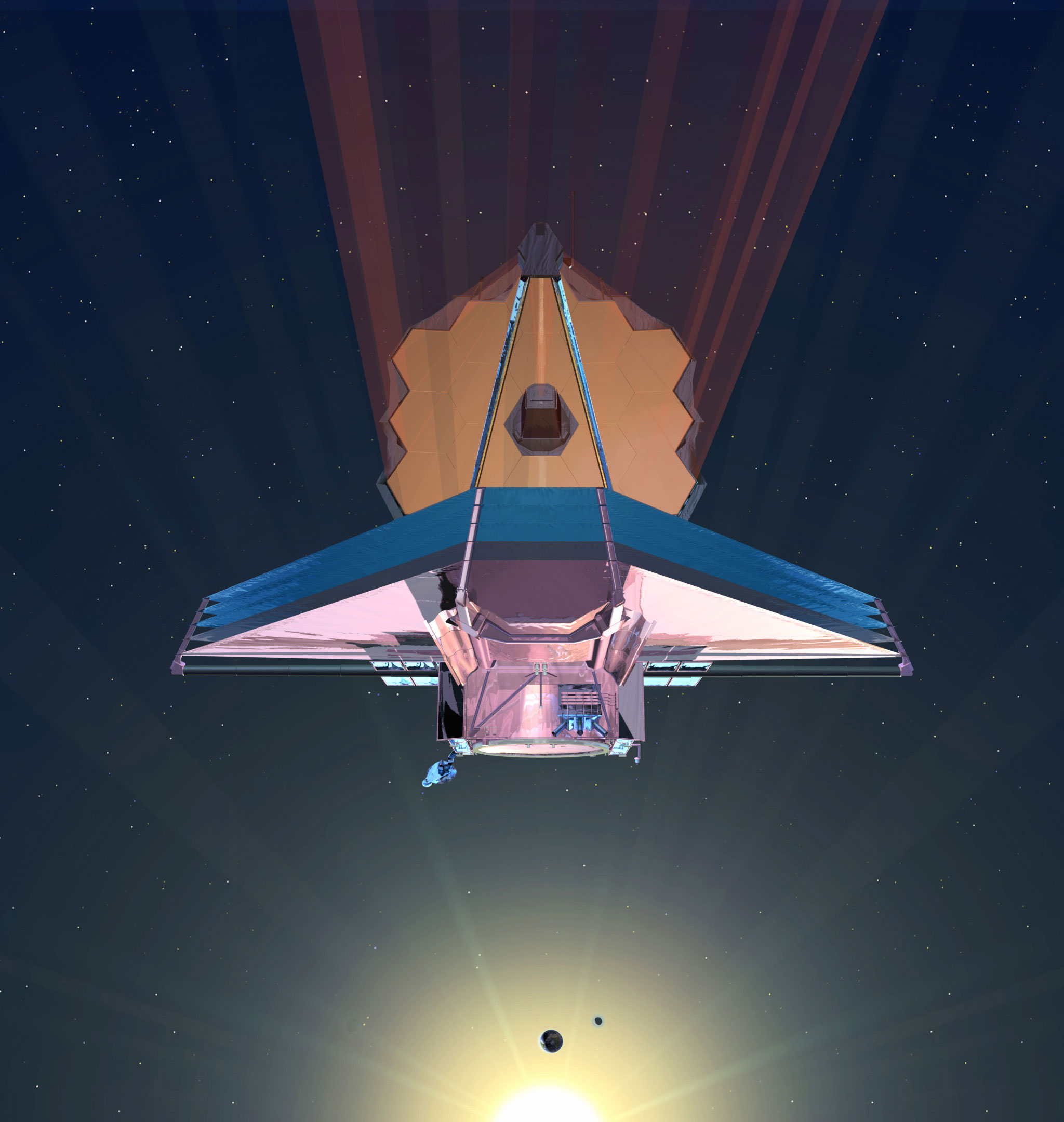
Wolfgang Gruener of TGDaily reports NASA's James Webb Space Telescope will be fitted with a new sunshield Northrup Grumman claims has the equal to 1.2 million Sun Protective Factor.

NG recently completed a preliminary design review of the sunshield membrane that's the size of a tennis court and shaped like a beach umbrella.

The shield is designed to block solar radiation and help the observatory operate at cryo temps. Schedule for launch in 2013. JWST should detail those galaxies that formed at the end of the Cosmic Dark Age, 300 million years after the Big Bang.

With its resolution of electro-magnetic frequencies largely unabsorbed by clouds and dust, JWST should solve enduring questions as to the true extent of extra-galactic dust, and why ground and space measurements of very energetic cosmic rays indicate less attenuation and more cosmic rays than there should be.

Exploring the region between the Cosmic Background heat and the emergence of galaxies, the so-called Dark Ages, awaits the radio quiet and large baselines possible for telescopes astronomers hope to build on the Moon's Far Side.

Tuesday, December 9, 2008

RCS Thruster fueled In Situ and Safe

The Engineer

At an anonymous looking facility in Redondo Beach, California, engineers are applying the finishing touches to a rocket engine that could be at the heart of NASA plans to take us back to the Moon, and ultimately Mars.

Developed by Northrop Grumman, the company behind the lunar module descent engine used for the Apollo landings, the so-called TR408 is a reaction control engine (RCS) designed to provide the subtle bursts of power required for delicate manoeuvres such as docking.

Engineered specifically for the ascent phase of a lunar lander, the engine runs on cryogenic liquid oxygen and methane which, the company claims, could be manufactured from materials in the lunar or Martian soil and atmosphere.

Outlining the design challenges, Gordon Dressler, chief engineer at Northrop's Propulsion and Fluid Products Centre, said for lengthy missions it is particularly important that the propellants are non-toxic, as the alternative air supply for astronauts is limited, and that they will not spontaneously ignite. It is also critical that exhaust gases do not contaminate the soil or atmosphere.

Fortunately, said Dressler, there is plenty of scope for innovation. 'Where I work we pride ourselves on being able to rapidly develop cutting-edge — some would call it bleeding-edge — technology to take on the challenges of advancing spacecraft propulsion,' he said.
Read more HERE.

Tuesday, November 25, 2008

Lunar Lander Challenge 09, Pomerantz and Diamandis

From the SpaceFellowship, here is "an update from the Launchpad:

In late October, the 2008 Northrop Grumman Lunar Lander Challenge drew to a close. History was made several times over: the first prize awarded in that competition, the largest prize to date as part of NASA’s Centennial Challenges, the first attempt at Level Two of that competition, the first time with multiple vehicles flying at the event. But before that event was finished, we at the X PRIZE Foundation were already turning our eyes towards 2009, with a goal of offering the remaining prize money in the most fair and most sustainable way possible.

In the first two years of competition, the Northrop Grumman Lunar Lander Challenge was tied to a larger event called the “X PRIZE Cup,” an educational exposition bringing crowds in contact with rockets and with the entrepreneurial and inventive teams who design and operate them. In 2008, there was no X PRIZE Cup, so the Challenge was offered as a stand alone event. In all three years, the Challenge was offered at great expense to the X PRIZE Foundation, which receives no funding from NASA to conduct this competition.

Moving forward, the concept of conducting a large common event at which all teams fly their vehicles is likely not financially sustainable for the Foundation. Additionally, the conduct of such an event imposes non-negligible expenses on our teams, who must not only transport themselves and their vehicles to the venue for the competition, but who also must complete their design process, their regulatory paperwork, and their procurement of insurance with not only their own “home facility” but also the competition venue in mind. As such, the fairest and most sustainable model may prove to be one where each team plays host to a crew of Judges and X PRIZE personnel at a facility of their choice.

Sunday, October 26, 2008

Armadillo Aerospace wins Round One of the Lunar Lander Challenge

Armadillo Aerospace won the Level One portion of the Northrop Grumman Lunar Lander Challenge, flying at Las Cruces International Airport on October 25 and earning the $350,000 in prize money.

While they made an attempt to win Level Two on Saturday, Armadillo was unable to pull off a double victory, leaving $1.65 million worth of prize money on the table.

According to LiveScience.com, “The Northrop Grumman Lunar Lander Challenge is over for the day. John Carmack and his Armadillo Aerospace team have declared no more flights today. They have run into a problem with their vehicle that needs significant testing - issues that must be addressed before flight can be resumed.”

Monday, March 24, 2008

To the moon: Northrop Grumman aims for a big hit with lunar satellite

By Muhammed El-Hasan, Staff Writer
Long Beach Press-Telegram

RELATED LINKS:
  • » Timeline for manned moon bases
  • » NASA uses Antarctica to test moon gear

  • NASA's plan to establish permanent manned bases on the moon may hinge on the results of a "suicide mission" by a spacecraft that resembles a 6-foot-diameter sewer pipe.

    The Lunar Crater Observation and Sensing Satellite is scheduled to launch this autumn in search of ice on the moon that would help astronauts sustain long-term stays on the lunar surface.

    In the process, the spacecraft dubbed LCROSS will smash into a dark crater that has never seen sunlight at the moon's south pole.

    Northrop Grumman Space Technology is building and testing the satellite at the company's Space Park campus in Redondo Beach.

    "Ours is a suicide mission. When we impact, we don't survive," said Stewart Moses, Northrop's director of space science and exploration for civil missions. "The vast majority of our spacecraft are built to last a very long time. Suicide missions are not very common."

    LCROSS differs from most other space missions in another major way: The satellite was an afterthought that will piggyback on another lunar mission.

    In early 2006, NASA decided to use a larger-than-planned rocket for a mission called the Lunar Reconnaissance Orbiter, or LRO, which would circle the moon to map the giant globe's surface.

    The new rocket, known as the Centaur, can carry about 2,000 more pounds. NASA announced that it was seeking ideas for a secondary mission to coincide with the LRO.

    Northrop proposed LCROSS, and NASA accepted.

    "We came up with this idea of impacting the surface of the moon," Moses said. "The idea is that one way to find out if there's ice on the moon is to slam something really heavy and hard on the moon. With the right instruments, we're looking to see if there's ice or other interesting materials left by comets other than the dirt that makes up the moon."

    The idea arose from a 1999 NASA lunar mission that observed neutrons coming from the moon's north and south poles, a possible sign of water.

    When the Centaur rocket is launched from Kennedy Space Center in Florida, LRO will separate and begin its mission circling the moon.

    LCROSS and the Centaur's upper stage will enter an egg-shaped orbit around the Earth and moon for about three months.

    When the moon is in the optimal position, the Centaur rocket will detach from LCROSS. The rocket will then lurch toward the moon at 6,000 mph as LCROSS follows a number of minutes behind.

    Centaur will smash into a south pole lunar crater, causing a miles-high plume of moon dust. LCROSS will fly through that plume, taking pictures and sending them back to Earth.

    Then LCROSS will smash into the crater, causing another giant plume that will be examined by LRO, observatories on the Earth and even amateur astronomers.

    Unlike most of Northrop's satellite programs, LCROSS runs on a small budget. The total contract is valued at $79million, with $56 million as Northrop's share. That's far less expensive than Northrop's typical spacecraft contract that can be worth hundreds of millions of dollars.

    Furthermore, the development schedule demanded break-neck speed, with little time to create innovations that usually take years to perfect.

    "We have to not only build this for much less cost than a normal spacecraft (but) we have to do it in two years," said Stephen Carman, Northrop's project manager for LCROSS.

    Instead of building a whole new spacecraft from scratch, Northrop engineers took an ESPA Ring, which is a large "pipe" with six holes around it. Typically, the ring is used to mount spacecraft that are being launched into space.

    For LCROSS, the ring became the spacecraft. Sensors and other equipment were simply bolted onto it.

    In addition, the ESPA Ring will be sturdy enough for LRO to sit on it during launch and before separation.

    Northrop engineers went on a shopping spree to buy all the components and systems they needed for LCROSS.

    "These are all off-the-shelf items," Moses said. "We couldn't invent anything new, which is what we usually do in our missions."

    NASA may use the speed and low cost of LCROSS as a blueprint for future missions, said Dan Andrews, project manager for LCROSS at NASA Ames Research Center near Sunnyvale.

    Because LCROSS is being built so quickly and on the cheap, without the usual redundancies and large workforce, the spacecraft is classified as a highest-risk mission, known as Class D.

    LCROSS remains on schedule and within its budget. A successful mission could lead NASA to try more such Class D missions. That would mean the space agency could use the resulting savings to launch additional missions, Andrews said.

    "Because LCROSS has demonstrated it is very successful in being on time and on budget, people are starting (to notice)," Andrews said.

    muhammed.el-hasan@dailybreeze.com

    Friday, February 29, 2008

    Northrop Grumman Integrating LCROSS Instruments; Mission to Seek Water Ice On Moon's South Pole - "on the fast track"

    REDONDO BEACH Northrop Grumman Corporation is integrating the cameras, spectrometers and photometer comprising the nine instrument payload for the NASA's Lunar Crater Observation and Sensing Satellite (LCROSS) onto the spacecraft. LCROSS will impact the moon to determine the presence of water ice in one of its permanently shadowed craters at the lunar South Pole.

    A photo accompanying this release is available at http://media.primezone.com/noc
    The LCROSS payload is shown undergoing checkout following its arrival at Northrop Grumman's manufacturing facility in Redondo Beach, Calif. Built by NASA Ames, the payload consists of nine science instruments, weighs only 27.3 pounds (12.4 kilograms) and was designed to provide multiple complementary measurements. Eight of LCROSS' nine sensors are surrounded by a sunshade. The ninth LCROSS sensor views a perpendicular plane during the final impact and is located to the lower right outside the sunshade.

    NASA Ames Research Center delivered all nine payload instruments to Northrop Grumman in mid-January, already assembled on a single, 30-by-40 inch spacecraft panel. The first step in integration, attaching electrical harnesses for power, telemetry and thermal control functions, has been completed, and the remaining steps will be completed over the next several weeks.

    "Our entire approach to building, testing and integrating LCROSS was designed for speed," said Steve Hixson, vice president of Advanced Concepts for Northrop Grumman's Space Technology sector. "We're using innovative techniques to manage the LCROSS schedule, and this latest milestone is an outstanding example of the transparency between the government and industry teams that will be critical to our success. It's coming together very well, so we're already seeing the payoff in terms of schedule."

    LCROSS is a fast track spacecraft development project. The Northrop Grumman-NASA team is utilizing streamlined acquisition and production processes to meet the mission's accelerated development schedule and cost constraints. Northrop Grumman expects to deliver the spacecraft about 26 months after the program start, less than half the time of a traditional spacecraft development program.

    LCROSS and the Lunar Reconnaissance Orbiter, scheduled to launch at the end of the year aboard an Atlas V rocket, are the first American missions to return to the moon since the Lunar Prospector mission in 1999. LCROSS is the only current mission to the lunar surface. NASA scientists expect the impact plume will be visible from Earth with a medium-size (10-12 inch) amateur telescope.

    LCROSS' nine science instruments, some of which were obtained commercially and qualified at NASA Ames, will analyze the plume from the impact for the presence of water ice or water vapor, hydrocarbons and hydrated materials. They consist of five cameras, operating in the visible, near infrared and mid-infrared light regimes; three spectrometers, operating in the ultraviolet, visible and near infrared; and one photometer operating in the visible light regime.

    The LCROSS Spacecraft will ship to Florida late this summer for integration aboard the Atlas V launch vehicle. LCROSS will be launched as a secondary payload to NASA's Lunar Reconnaissance Orbiter from the NASA's Kennedy Space Center. Northrop Grumman is working under a $56 million contract to NASA Ames Research Center in Sunnyvale, Calif.

    Northrop Grumman Corporation is a $32 billion global defense and technology company whose 120,000 employees provide innovative systems, products, and solutions in information and services, electronics, aerospace and shipbuilding to government and commercial customers worldwide.

    CONTACT: Sally Koris
    Northrop Grumman Space Technology
    310.812.4721
    sally.koris@ngc.com