![]() |
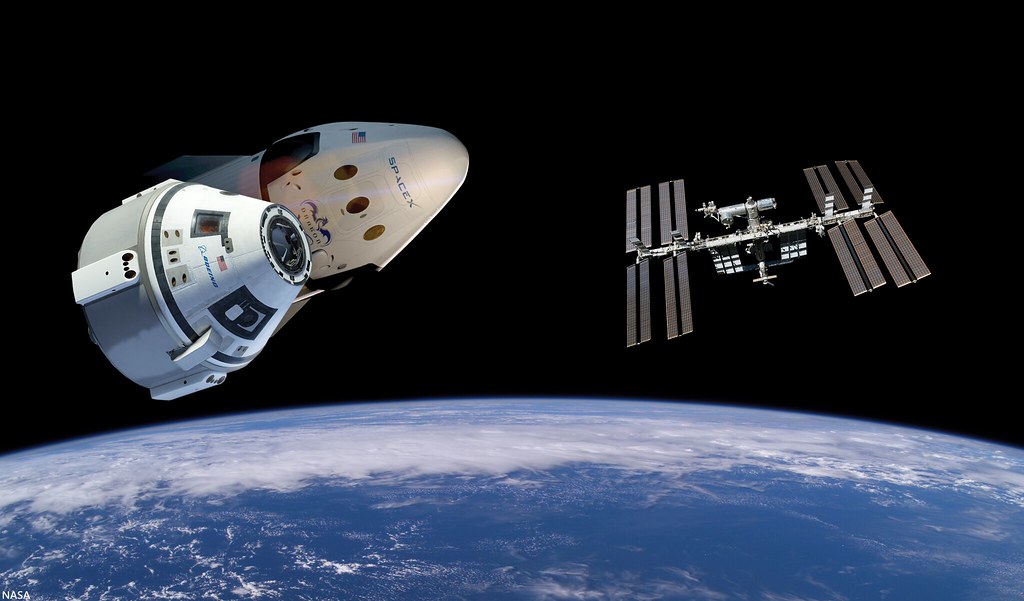
| Boeing CST-100 and SpaceX Dragon V2 will orbit manned spacecraft and rendezvous and supply the International Space Station starting in 2017, NASA announced Monday [NASA]. |
Universe Today
![]() |
| Boeing CST-100 and SpaceX Dragon V2 will orbit manned spacecraft and rendezvous and supply the International Space Station starting in 2017, NASA announced Monday [NASA]. |
‘Dragonlab’: Artist’s conception of the SpaceX ATV, a "reusable space ‘tug,’ designed to lift payloads to the space station" [SpaceX/Christian Science Monitor/AP].
The Boeing/Bigelow Aerospace commercial crew capsule concept that is part of the Boeing company's $18 million funded space act agreement for the Commercial Crew Development initiative.
[Editor's Note: After the understandable enthusiasm for the Obama administration's proposed NASA program changes and 2011 budget wains a bit, it will be fair to ask if some some people might be confusing the new commercial space initiative with "privatization." It would be foolish to suspend critical judgment because of a passionate desire, because the new NASA initiative appears to match a certain assumption of what commercial space ought to be.
Artist's concept of the X-37 Advanced Technology Demonstrator, gliding to landing. Its design features a rounded fuselage topped by an experiment bay; short, double delta wings and twin stabilizers forming a "V" at the vehicle's aft. [NASA/Dryden (1999)]On August 5 and 6, the Optimizing Science for Exploration Working Group (OSEWG) held a workshop at the Lunar and Planetary Institute in Houston and discussed ways robots and humans could cooperate in future lunar missions.
Experts from the science, exploration, and robotics communities walked through various lunar mission scenarios and offered insights into how each group could support the overall mission objectives while reducing budgets and risk.
The all-star lineup of presenters included Chip Shearer (LEAG), Jim Head (Brown University), Chris Culbert (NASA-JSC), Rob Ambrose (NASA-JSC), Brian Wilcox (NASA-JPL), and David Wettergreen (Carnegie Mellon University). Private industry interests and abilities were represented by one presenter (Chel Stromgren - SAIC) and several conference attendees from aerospace companies like Boeing and Lockheed Martin.
Read the review HERE.
June 23 (Reuters) - Satellite-launch services provider Sea Launch Co along with 5 affiliates filed for Chapter 11 protection, Tuesday. In U.S. Bankruptcy Court for the District of Delaware, Sea Launch listed assets of up to $500 million and liabilities of more than $1 billion. In Sea Launch Co LLC et al, U.S. Bankruptcy Court, District of Delaware. No. 09-12153 representatives cited liquidity "concerns" and operational losses.The Long Beach, California-based company said in the filing it intends to explore the sale of one or more of its divisions, according to Reuters.
Sea Launch, which offerred equatorial launch services on ocean-going platforms and commercial launch services from Baikonur is owned by Boeing, Energia and Norway's Aker ASA, among others.
Democrats did not take over state government in Florida. Republicans retain a super majority in both the state House and Senate, 75-44 and 26-14 respectively, maintaining GOP control of the legislature and the Governor's Mansion."We were happy to support this requested review of how Space Florida is tracking in its responsibilities with the numerous statutory requirements," Kohler wrote. "Space Florida concurs with OPPAGA's findings as it supports the actions and decisions we have pursued. We thank the OPAGGA team for their very thorough and professional review of Space Florida's operations and processes. From the beginning, Space Florida's goals and strategic activities have been designed around creating and establishing the competitive edge for the State of Florida and Space Florida."
"As part of our statutory requirements, Space Florida completed Phase I of the Spaceport Master Plan update. At that time, Space Florida did not have the LC-36 assignment, and Spaceport planning was being undertaken by he 45th Space Wing for the Eastern Range, and separately by NASA/KSC. It made sense to suspend further development of a Spaceport Master Plan update in isolation of the work being done by the other entities involved in civil, military and commercial launch."
"Space Florida does not see these recommendations affecting its current timeline for the construction of Launch Complex 36. The architectural and design and associated environmental studies are underway and no construction can begin until those are completed," Space Florida reports. "In the meantime, the Spaceport Master Plan updates will be integrated into the Space Florida Spaceport Master Plan and Space Florida's strategic business plan and all will be published upon completion."
From the January 30 report in the Orlando Sentinel "several legislators saw the report as damning -- and an indication that the $14.5 million they appropriated to rebuild Launch Complex 36 at the Cape Canaveral Air Force Station was in danger of being wasted."
"It's essential that we get to the bottom of this," said Sen. Mike Haridopolos, R-Indialantic, a budget writer who is in line to be Senate president in 2010. "If they can't improve it, we need to figure out some way to do it better."
"Money for a rebuilt launchpad, intended to lure commercial ventures, has failed to attract a company willing to launch there. And the study found "there is some disagreement over the feasibility" of plans to have one pad serve different rockets."
"For example, United Launch Alliance, jointly owned by Lockheed Martin Corp. and Boeing Co., uses four pads at Cape Canaveral Air Force Station for its three types of rockets that launch military, NASA and commercial satellites. Its Delta II-class rockets use separate pads because one is bigger and heavier than the other."
"Rocket-company executives also worry about potential conflicts with other users of a shared pad. That's one reason that Space X, the largest new commercial spaceflight company launching in Florida, uses a pad it leases directly from the Air Force."
"And Orbital Sciences Corp., which is developing a rocket to resupply the international space station, last year chose to launch from Virginia instead of the Cape."
"But Space Florida defended its plan last week, writing to the Legislature's analysis and accountability office that the multiuse pad "not only can be done, it has been done." And Space Florida spokeswoman Deborah Spicer said Thursday her agency has "a number of potential customers" interested in launching rockets as well as putting payloads on any spacecraft that take off from Launch Complex 36.
In (his) statement, Space Florida President Steve Kohler said the agency has begun work on a more detailed master plan. The agency wrote to the analysis and accountability office last week that it might even enlist the help of visiting Yale University architecture students "to assist us in our on-going planning needs, particularly during these very difficult financial cutbacks." The agency said it planned to have the plan finalized by December.
Rick SmithOn Christmas Eve-Eve, NASA finally announced the results of its long-running Commercial Resupply Services competition, and as the tidbit above correctly points out, neither Lockheed nor Boeing (nor Alliant Techsystems (NYSE: ATK), for that matter) wound up in the winners circle. What you may not know, is that none of these three companies were actually bidding for the contract at all, at least not directly.
Instead, these three giants of the aerospace industry chose to hitch their carts to a foal of a company named PlanetSpace, which acted as the prime contractor in the bid. Turns out, NASA was not amused -- nor impressed.
Instead of awarding its $3.5 billion in cosmic-milk-run contracts to "Big Space" in the person of little PlanetSpace, NASA went with trusted workhorses this time:
Now, Reuters may consider these two firms "start-ups", but the fact is that unlike PlanetSpace, both have already been vetted by NASA, and found superior. In the recent Commercial Orbital Transportation Services (COTS) contest, for example, Motley Fool Rule Breakers recommendation Orbital (25 years old, and so hardly a start-up) received $171 million worth of funding. Meanwhile, SpaceX got off to a running start with a $278 million contract of its own. (Not bad for a start-up, eh?)
Read More HERE.
"Boeing is under contract to NASA to produce the Ares I upper stage and instrument unit avionics. It will build the upper stage at NASA's Michoud Assembly Facility in New Orleans in late 2009.
"Boeing will help Orion with much of their internal training to deal with propulsion system processes and items needed in producing the RCS for Ares I," said Ray Robin, a supplier management official in Boeing's Exploration Launch Systems group. "We will also share some of our best Lean manufacturing practices with them to ensure they have efficient production processes." Boeing will also provide support with business development, human resources and supply chain management.
"The benefit to Boeing is that we get a partner who meets our schedule and cost requirements and provides technical expertise in reaction control systems -- it's a win-win for everyone," said Robin.
"We are very excited to be chosen as NASA's first Mentor-Protege this year and are grateful to have the opportunity to grow our business with the support of Boeing," said OPI Chief Executive Officer Tim Pickens. "This agreement will help us become a more cost-effective and viable subcontractor to NASA, Boeing and other customers. We look forward to making the most of this historic opportunity to contribute to our nation's new launch vehicle."
Boeing, 2 California Aerospace Suppliers Receive Nunn-Perry Awards for Outstanding Teamwork on Department of Defense Mentor-Protege Program The Boeing Company [NYSE: BA] and two of its California-based suppliers, Pacific Contours and KAP Manufacturing, received Nunn-Perry Awards from the U.S. Department of Defense (DOD) last month in Daytona Beach, Fla., at the DOD Mentor-Protege Conference. Pacific Contours is located in Anaheim, and KAP Manufacturing operates in San Dimas.
The Nunn-Perry Award, named in honor of former U.S. Sen. Sam Nunn and former Secretary of Defense William Perry, recognizes outstanding teamwork in the DOD Mentor-Protege Program. Both men were instrumental in creating the program, which is designed to encourage DOD contractors to help diverse small businesses develop technical and business capabilities. Winners are selected based on the companies' success in creating cost efficiencies, enhancing the protege company's capabilities and increasing business opportunities with DOD suppliers.
"The innovation and enterprising spirit that small and diverse suppliers bring is crucial to Boeing remaining the leader in aerospace," said Janell Bursac, director of Supplier Diversity for Boeing Integrated Defense Systems. "The tools and skills shared and the objectives met through programs such as Mentor-Protege are essential to Boeing's focus on growth and productivity."
And here's some other award that follow a pattern of diversity sure to prove to Senator Barbara Mikulski that Boeing is not the soulless corporation designed to make money for we who have owned stock in here since they rolled out the Dash-80:
Read on. See the pattern here? (Remind me to add the links later...)
"Pacific Contours, a woman-owned small business and a supplier to Boeing for more than 10 years, manufactures bulkheads, escape hatches, jettison cockpit doors, and upper and lower cabin doors for the CH-47 Chinook helicopter program. The company's mentor-protege relationship with Boeing has focused on Lean manufacturing improvements and augmenting the skills of its craftsman machinists by providing technology training through California State University (CSU). Additionally, an internship for CSU students provided computer training to Pacific Contours employees and help with revamping the supplier's Web site. Since entering the mentor-protege agreement, Pacific Contours has doubled its work force, increased its physical space and added equipment to support Boeing's growing business needs. As further indication of a successful partnership, Boeing recognized Pacific Contours as its 2006 Supplier of the Year in the Diversity/Boeing Protege category.
"KAP Manufacturing is a woman-owned small business specializing in custom machine parts and assemblies for the aerospace and defense industries. The company manufactures machine parts that support numerous Boeing programs, including F-15 and F/A-18 fighter aircraft, the AH-64 Apache attack helicopter and Airborne Laser. The mentor-protege agreement with Boeing has focused on improving the company's capabilities and affordability. Training provided by Cerritos College and Florida International University as part of the program has reduced cycle time, increased capacity and efficiency, and improved quality and delivery performance.
"Helping suppliers like Pacific Contours and KAP Manufacturing develop is good for them, good for Boeing and good for our customers," Bursac said. "And the Mentor-Protege Program is just one of many ways we foster mutually beneficial relationships with our suppliers. We feel honored that the Department of Defense once again has recognized our supplier-diversity successes."
"Boeing, which has received 10 Nunn-Perry honors since the award's inception in 1995, currently has active DOD mentor-protege agreements with 17 suppliers. The company also has seven Department of Homeland Security mentor-protege agreements, one NASA mentor-protege supplier relationship and many informal supplier-mentoring programs across the enterprise."
NASA received more than 30 proposals for the lander study. Industry should provide their own concepts. We’re onto next design cycle, LDAC-2 for safety features. The minimum functionality lander [already arrived at] may not have global capability.
Altair project is embracing the [Ares V cargo launch vehicle] 10m shroud for the lander, the primary impact being on structures, we can widen and squat the descent module. Doesn’t change subsystems but gets the deck closer to the surface.
Biggest challenge is getting the payload to the moon. We are justifying every functionality and system we add so we do not have to strip down the design later and then buy back functions.
We think it could drive a different safety paradigm, where you don’t assume that two tolerance means its safe.
The Lunar Architecture Team's (LAT) work will impact LDAC-2.
Our design can be indifferent to that [what cargo demands LAT needs]. If we are maximising that capability then we are giving them everything we can with the lander configuration that meets three missions, sortie, outpost and cargo.
The cargo lander has 14,000kg capability to the surface right now, so the regolith mover or the habitats have to fit that 14,000kg.
The [contract winning] companies have been given a one page lander requirements document. It is what the Altair project office team had at the beginning.
Industry is out of phase by one cycle but they are going to evaluate LDAC-1 and propose changes while project office is working on LDAC-2, which is to add safety features to the lander.
We want a scalable, point of departure design to be the outcome of LDAC-2 and industry input.
Dorris didn’t recall the JSC/MSFC Phase b cost estimate. The project office asked JSC and MSFC engineering for pre-Phase A, Phase A and Phase B work estimates, along then lines of how NASA has always done business.
The lander is exclusively a US responsibility but there has been interest from European companies.
We have looked at a drop stage. So have some of our industrial partners. [Boeing has and one of its designs is the embedded image in this posting.]
“Concept I’ve seen more frequently [from industry] is it [the drop tank] would perform [Lunar orbit insertion] burn and then it would drop off. It’s not complete ruled out.”
But when you get to a detailed design they tend to see the drop tank dropped.
Although the study announcement asked how would companies perform the work, during some conversations with industry some wanted to bring drop tank to the table.
Apollo Sages – it has been fantastic. I would like an independent technical assessment by the government and contractor sages. We had a question and answer session with three to four Apollo astronauts. None of them were present at the design review stage.
We are addressing the LOX/LH2 boil off issue. Amount of [Earth orbit] loiter time affects whether it is a problem or not. Looking at a similar mechanism to Ares V EDS, a passive capability, it is still in the trade zone.
Landing areas and scavenging hydrogen issues are in the trade space for surface systems people.