Showing posts with label LPSI. Show all posts

Saturday, November 3, 2012

Ocean of Storms, Oceans of Argument

Oceanus Procellarum, the "Ocean of Storms," is easily the largest feature of the Moon's complex topography visible, even to the naked eye, from Earth. But is it a true remnant of a basin-forming impact, merely a low remnant of early lunar morphology or perhaps the largest remnant of a hemisphere-sized impact some have labeled "Gargantua? Thumbnail of a 48-image mosaic captured by Yuri Goryachko, Mikhail Abgarian and Konstantin Morozov (ASTRONOMINSK) of Belarus, August 3, 2010.
Paul D. Spudis
The Once & Future Moon
Smithsonian Air & Space

Once upon a time, back in the Dark ages when I was a young student of lunar science, an idea was advanced that Oceanus Procellarum (the largest dark maria on the near side of the Moon) was the site of an ancient, almost obliterated impact basin.  This “Procellarum basin” (then called the “Gargantuan” basin – superlatives fail us sometimes) has been invoked to explain any and every observed aspect of lunar geology, from the distribution of the dark mare lavas, the near/far side dichotomy, the thickness of the crust, the composition of highland rocks, and the relative amounts of radioactively generated heat flow in the Moon.  Such a useful concept to explain so much!

The acceptance by lunar scientists of a Procellarum basin has waxed and waned over the years.  Originally proposed by Peter Cadogan in 1974, the presence of a large, ancient impact basin covering most of the western near side of this part of the Moon, was advanced to explain the unusually high concentration of the chemical component called KREEP – (K) potassium, (REE) rare earth elements, and (P) phosphorus.  Subsequently, Ewen Whitaker (noted cartographer of the Moon) carefully mapped landforms, such as ridges and massifs (mountains) over this area, which purportedly showed that the patterns were best explained by a three-ring basin – 3200 km across, centered on the western near side.  Whitaker named this feature the “Procellarum basin” after the largest mare region that filled it.  Lunar geologist Don Wilhelms fully embraced this interpretation in his classic book The Geologic History of the Moon, making the Procellarum basin the prime cause for the distribution of geologic units on the Moon.
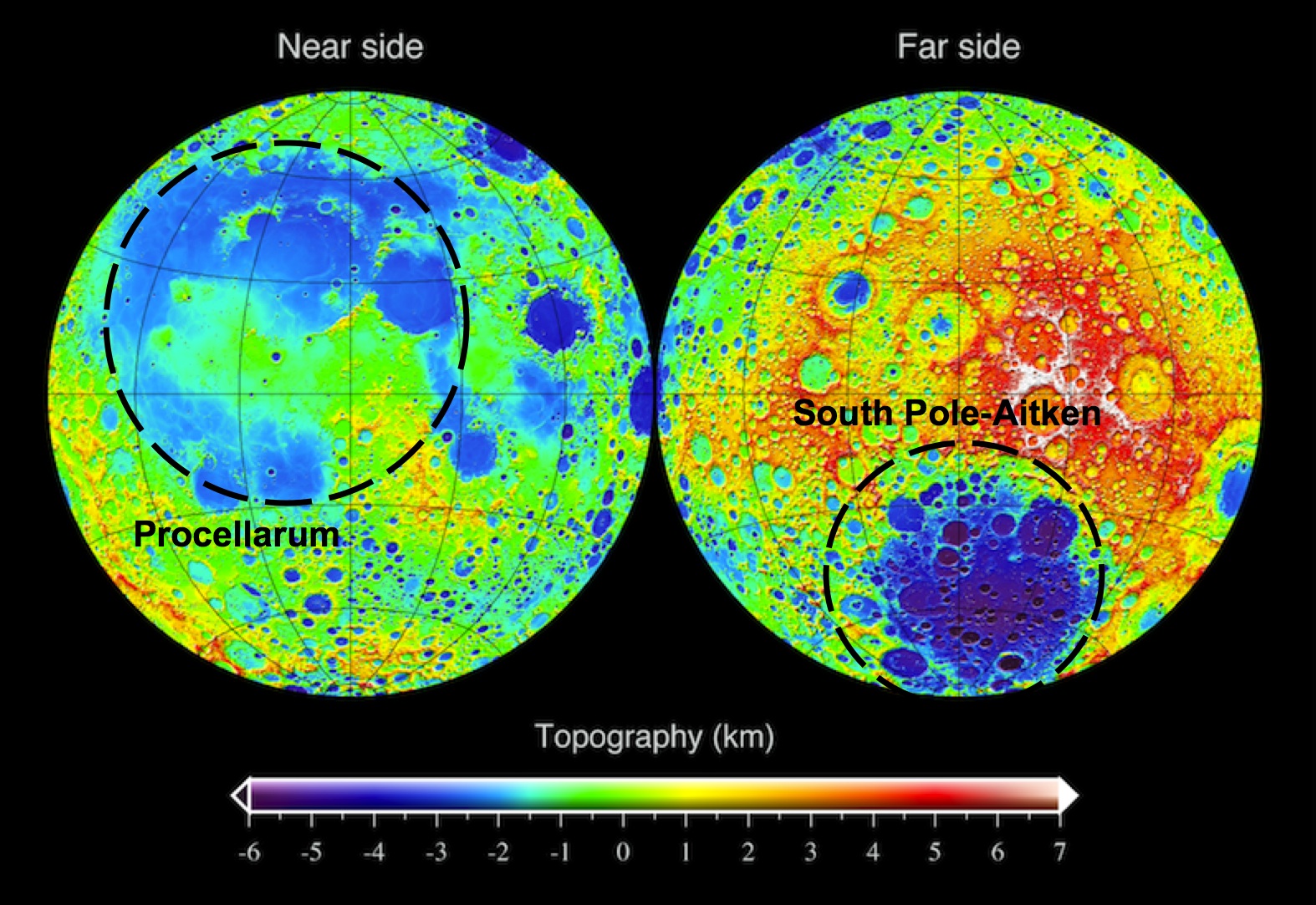
LRO topographic map of the Moon, showing the approximate outline of the "Procellarum" basin on the near side (left) and the South Pole-Aitken basin on the far side (right). One's real, the other isn't.
Yet doubts persisted.  In 1985, Peter Schultz and I suggested that the quasi-concentric arrangements mapped by Whitaker, were related to the Imbrium basin (not to an earlier, underlying mega-basin) on the basis of the ring pattern of this putative feature.  We also pointed out that the patterns of rock compositions supposedly explained by a Procellarum basin were not consistent everywhere, at least casting doubt on the predictive power of the basin’s presence.  The 1994 Clementine mission gave us our first global topographic map of the Moon.  Interestingly, that map dramatically revealed the presence of a circular mega-basin on the far side of the Moon – the enormous 2600 km-diameter South Pole-Aitken basin.  The Procellarum region was also shown to be a low region, but it is not circular (more horseshoe-shaped) and is not as clearly defined as Whitaker’s ring structure suggested.  The stock in the existence of Procellarum basin declined.

But some ideas in lunar science never really go away.  Since that time, several attempts have been made to resurrect the basin.  The latest effort, just published in Nature Geoscience, comes from mineralogical mapping data obtained from the Japanese Kaguya (SELENE) mission.  The authors of this study claim that orthopyroxene (a magnesium-silicate mineral) is distributed on the Moon in association with its largest basins – South Pole-Aitken and Imbrium.  However, in addition to those occurrences, additional outcrops occur in the highlands adjacent to Oceanus Procellarum.  Therefore, these rocks were made during the slow cooling of an enormous impact melt sheet created by the impact which formed the Procellarum basin.

The logic here seems weak.  It has not been established that orthopyroxene only forms from the slow cooling of an impact melt sheet.  When this mineral occurs with the most abundant mineral of the lunar highlands (plagioclase), it makes up a rock type called norite.  Norite is very abundant on the Moon.  It is the dominant rock type at the Apollo 14, 15 and 17 landing sites and occurs elsewhere on the Moon in quantity.  It is particularly prevalent around the edges of the Imbrium basin and one could argue that norite is a characteristic of that basin and the presence of Procellarum basin to explain its occurrence is unnecessary.  Likewise, the existence here of a large differentiated impact melt sheet is inferred from analogy to a terrestrial example, the Sudbury igneous complex, but even in this case, the impact origin of the terrestrial igneous body is not universally accepted.

Evidence for the existence of Procellarum basin must be sought in its topography.  The clarity and preservation of the far side’s South Pole-Aitken basin in the topographic data is surprising.  This feature is one of the oldest on the Moon, yet it preserves relief of over 12 km (the depth one would expect of a fresh feature).  One might expect such an old feature to be indistinct at best, making the discovery of its large relief one of the surprises of the Clementine mission.  At the same time, Procellarum is a vast irregular depression averaging less than 3-4 km deep; its lack of topographic expression is more in line with what one might expect for the oldest basin on the Moon.  However, unlike all other lunar basins, a topographic bulge 2-3 km high occurs near the center of this feature (near the crater Copernicus).  No other basin on the Moon (or on any other planet) contains interior topography higher than the elevation of its topographic rim; at SPA, all of the terrain within the 2600 km diameter rim crest is lower than its rim.  The unusual relation of a bulge within Procellarum does not support the concept that it is an impact basin.  It seems more likely that it is either a feature of internal origin (possibly related to early melting episodes) or a coalescence of several overlapping impact craters and basins.

The elliptical South Pole-Aitken (SPA) basin, mostly on the Moon's farside though it's mountainous outer ring encompasses the the nearside's polar south and the Moon's lowest elevations. The oldest and largest of the Moon's definitively identified impact basins, recent studies appear to have pushed it's formation back beyond 4.1 billion years ago, within less than 500 million years after the formation of Earth and Moon [NASA/GSFC/LOLA].
As we search for the truth, Procellarum basin may well crop up again.  But for today and contrary to the current space press, the new results do not uniquely point to the existence of a large basin here.  In fact, the observations tend to support previous ideas that it is the smaller, overlying Imbrium basin that is associated with a large regional ejecta blanket of roughly noritic composition.

Originally published at his Smithsonian Air & Space blog The Once and Future Moon, Dr. Spudis is a senior staff scientist at the Lunar and Planetary Institute. The opinions expressed are those of the author and are better informed than average.

Sunday, September 30, 2012

Hit-and-Run Science

From 'A new hit and run Giant Impact scenario,' July 28, 2012;  Figure 1a: Five snapshots from the 30° impact angle and 1.30vesc impact velocity case (cC06) showing cuts through the impact plane. Colour coded is the type and origin of the material. Dark and light blue indicate target and impactor iron; Red and orange show corresponding silicate material. The far right shows the situation at the time of impact. At 0.52h, it can be seen how the impactor ploughs deep through the targets mantle and pushes considerable amount of target material into orbit. A spiral arm of material forms and gravitationally collapses into fragments. The outer portions of the arm mainly consist of impactor silicates and escapes due to having retained a velocity well above escape velocity. The silicate fragments further inward are stronger decelerated and enter eccentric orbits around the target. The impactor's iron core also looses much of its angular momentum to the outer parts of the spiral arm and re-impacts the proto-Earth. -  Figure 1b: The origin of the disk material highlighted, half a collisional timescale ( (Rimp + Rtar) / vimp ) after impact. In the grazing reference case (cA08), the majority of the proto-lunar disk originates from a spill-over of the impactor. In the head-on cases (cC01, fB06, iA10), much more material comes from the target mantle, being pushed out into orbit by the impactor core. Colours are identical to figure 1. Turquoise on the right shows water ice for the icy impactor case iA10. Reufer, et al. (2012) Icarus 221, 296
Paul Spudis
The Once & Future Moon
Smithsonian Air & Space

The origin of the Moon is a long-standing problem in planetary science.  Reconstructing complex events in the distant past is difficult and requires both knowledge and imagination.  The facts to be explained are relatively straightforward.  The Moon’s overall density (about 3.3 grams per cubic centimeter) and bulk chemical composition are about the same as that of the mantle of the Earth, suggesting a possible relationship between the two.  The idea that Earth and Moon are compositionally related is supported by the ratio of isotopes of oxygen in the lunar samples, which indicate that Earth and Moon are made from matter derived from the same region of the solar nebula (material that is compositionally distinct from that making up the various meteorite groups).  Finally, the Earth and Moon collectively have a very high angular momentum, mostly as a consequence of the high spin rate of Earth and the relatively large mass of our Moon compared to its primary planet.

Prior to the Apollo missions, three different models (capture, fission, binary accretion) vied for acceptance among the lunar science community.  The capture model proposed that the Moon formed elsewhere in the Solar System before a close, chance encounter resulted in the Earth capturing the Moon into orbit.  The fission model proposed that a large mass of molten material spun off a rapidly spinning early Earth, was thrown into orbit and over time, coalesced into the Moon.  The binary accretion model suggested that Earth and Moon assembled themselves independently as two distinct and separate bodies from the beginning.  None of these models seemed able to account for all the “constraints” mentioned above, but no one had any better ideas.

About 30 years ago, the problem of lunar origin was widely considered “solved” with the general acceptance of the Giant Impact model.  In this concept, four and a half billion years ago, the proto-Earth shared its orbit around the Sun with an object about the size of the planet Mars (dubbed Theia, in Greek mythology, the titan who gave birth to Selene, goddess of the Moon).  A chance encounter between these two planetoids resulted in their merging as the Earth-Moon system.  It was thought that a grazing (low angle) impact would serve to both spin up the Terra-Luna system, resulting in its relatively high angular momentum, and hurl vaporized mantle material from Theia into orbit around the Earth.  The disk of orbiting debris quickly coalesced into the Moon and this rapid accumulation resulted in the release of large amounts of heat, which proceeded to melt at least the outer few hundred kilometers of the Moon, creating an “ocean” of molten rock, or magma.

The Giant Impact model seemed to nicely account for most of the properties of the Moon.  But like many big ideas in science, the closer and longer we look at it, the more issues seem to arise.  It was long assumed that the Moon was made of material derived mostly from mantle of the impacting planet (Theia); in this view, the Giant Impact was really just a variant of the capture model.  As such, it did not explain either the chemical similarity of the Moon to the mantle of the Earth, nor their identical oxygen isotope compositions.  This objection was usually brushed away with the admonition that complications might be expected from planet-scale impacts.

A new set of computer models has looked at the consequences of a slightly more head-on planetary collision.  In contrast to the traditional oblique (few degrees) off-center Big Whack, researchers modeled the effects of an impact at about 30° incidence and relatively high velocity (about 1.3 times escape velocity, or roughly 14 km/sec).  They find that in this case, most of the material from which the Moon forms comes not from the impactor Theia, but from the mantle of the Earth.  This result might better explain the compositional attributes of the Earth-Moon system.  In fact, several models were run (slightly varying these conditions) and while none perfectly fit the chemical and dynamical constraints, this one matched them most closely.

While this modeling was underway, another group was analyzing the composition of isotopes of titanium in samples from the Earth, the Moon and meteorites.  The work has established that the chemical fingerprints that relate Earth and Moon are not merely close – they are virtually identical (to the best precision of the measurements).  The authors of this study claim that this result creates problems for the Giant Impact model, as that idea had called for most of the Moon to be derived from the mantle of the impacting planet Theia.  However, with the results of the new computer models of giant impacts discussed above demonstrating that the parameters of the collision can be adjusted to match the constraints on lunar origin, perhaps this is not such a problem for the Giant Impact model after all.

These developments should probably give lunar scientists pause.  After all, the Giant Impact model became popular because the earlier, traditional three models (capture, fission, binary accretion) were all inadequate and their boundaries and defining parameters had to be adjusted to permit their (barely acceptable) viability.  In other words, the models were stretched to fit any inconvenient facts or problem observations.  Now it appears that the same thing is happening to the new, “explains-it-all” Giant Impact model.  A scientific idea that can be stretched to fit any observable fact is not very useful as an explanatory principle – it is simply a glorified “Just So” story.  The late Karl Popper argued that often in science, an idea cannot be shown to be true, but it can always be shown to be wrong – that is, “falsified.”  If a hypothesis cannot be falsified, Popper argued, then it was not scientific. We need a mechanism in science to enable us to dismiss useless or irrelevant concepts and falsification is one way to do that.

So where does such philosophy leave the origin of the Moon?  Perhaps more knowledge and imagination is needed before we can pronounce lunar genesis a “solved problem.”

Originally published at his Smithsonian Air & Space blog The Once and Future Moon, Dr. Spudis is a senior staff scientist at the Lunar and Planetary Institute. The opinions expressed are those of the author and are better informed than average.

Related Posts:
A Sawtooth-like timeline for the first billion years of lunar bombardment (August 28, 2012)
A new 'hit and run' Giant Impact scenario (July 28, 2012)
"Our view of the Moon has turned upside down" (April 26, 2012)
Ti paternity test fingers Earth as Moon's parent (March 28, 2012)
NLSI team sheds light on 'late heavy bombardment' (February 28, 2012)
Spudis: Cataclysmic Conundrum (February 14, 2012)
'Significant change' in bombardment timing (January 6, 2012)
LOLA reveals distinct populations in bombardment record,
Diviner finds "no pristine lunar mantle" even within SPA
(September 16, 2010)
'The Grand Lunar Cataclysm and how LRO can help test it' (September 7, 2009)

Friday, August 31, 2012

"From the Earth to the Moon"

Still capture from "From the Earth to the Moon," produced by David Kring, CLSE, NLSI, LPSI.
I have often argued that the Moon is the best and most accessible place in the solar system for robotic and human assets to address fundamentally important scientific questions while simultaneously providing an opportunity to expand our technological capabilities. 

To remind ourselves of the opportunities on the Moon, the Center for Lunar Science and Exploration team has created a brief (3 minute) video with scenes so dramatic you may find yourself reaching out to pick up a rock and becoming restless for a chance to walk among lunar peaks.

The video and soundtrack "From the Earth to the Moon"
(http://www.lpi.usra.edu/nlsi/moonVideo/)

*       Provides an inspirational view of the lunar surface, which humans have not visited since 1972, despite being the best and most accessible place in the solar system to explore the fundamental principles of our origins;
*       Highlights vast portions of the lunar surface that have yet to be explored; and
*       Demonstrates how new images are revealing dramatic details of future landing sites suitable for both robotic and human missions.

I encourage you to download the HD version of the video (from the bottom of that website - cross-linked at the bottom of this post) to fully marvel at this tour of the lunar surface.  I also note that we have intentionally produced a few scenes with a patchwork of images of different resolutions to illustrate the additional detail that LRO has provided.

David A. Kring, Ph.D.
Center for Lunar Science & Exploration

Options for download

Downloads can be streamed by clicking on the options below.  For best viewing, however, you may want to right click, save the link to your own computer, and then play the file from your computer
Quicktime (HD 1080p)
Windows Media
(HD 720p)
iPhone 3gs/iPod video

iPhone 4/iPad

Saturday, July 28, 2012

A new 'hit-and-run' Giant Impact scenario

Figure 1a: Five snapshots from the 30° impact angle and 1.30vesc impact velocity case (cC06) showing cuts through the impact plane. Colour coded is the type and origin of the material. Dark and light blue indicate target and impactor iron; Red and orange show corresponding silicate material. The far right shows the situation at the time of impact. At 0.52h, it can be seen how the impactor ploughs deep through the targets mantle and pushes considerable amount of target material into orbit. A spiral arm of material forms and gravitationally collapses into fragments. The outer portions of the arm mainly consist of impactor silicates and escapes due to having retained a velocity well above escape velocity. The silicate fragments further inward are stronger decelerated and enter eccentric orbits around the target. The impactor's iron core also looses much of its angular momentum to the outer parts of the spiral arm and re-impacts the proto-Earth. -  Figure 1b: The origin of the disk material highlighted, half a collisional timescale ( (Rimp + Rtar) / vimp ) after impact. In the grazing reference case (cA08), the majority of the proto-lunar disk originates from a spill-over of the impactor. In the head-on cases (cC01, fB06, iA10), much more material comes from the target mantle, being pushed out into orbit by the impactor core. Colours are identical to figure 1. Turquoise on the right shows water ice for the icy impactor case iA10.
Reufer, Meier, Benz & Wieler
Universität Bern
Eidgenössische Technische Hochschule Zürich
Lund University, Sölvegatan
 

The formation of the Moon from the debris of a slow and grazing giant impact of a Mars-sized impactor on the proto-Earth (Cameron & Ward 1976, Canup & Asphaug 2001) is widely accepted today. We present an alternative scenario with a hit-and-run collision (Asphaug 2010) with a fractionally increased impact velocity and a steeper impact angle.

Hydrodynamical simulations have identified a slow, grazing impact in being able to reproduce the Moon's iron deficiency and the angular momentum of the Earth-Moon-system. But in this canonical scenario, the Moon forms predominantly from impactor material, thus contradicting the Moon's close geochemical similarity to Earth. Furthermore, due to the slow impact velocity, only limited heat input is provided for the aftermath of the collision. Post-impact mechanisms (Pahlevan & Stevenson 2007) required to match the impact scenario with the compositional observations, depend on the thermal conditions in the post-impact debris disk. We show that a new class of hit and-run collisions with higher impact velocities and a steeper impact angles is also capable of forming a post-impact debris disk from which the Earth's Moon can later form, but leads to a much hotter post-impact debris disk. Furthermore, the ratio of target body material in the debris disk is considerably larger, compared to the canonical scenario. This new class of impacts was previously rejected due to the limited resolutions 26 of early simulations (Benz 1989).

View the (pdf) Icaris manuscript, at arXiv 1207.5224
Figure 2: Comparing post-impact temperatures of the proto-Earth between the grazing reference simulation left (cA08) and the head-on case on the right (cC06). Color coded is temperature in K in logged scale. The initial average temperature before the impact inside the target mantle is ~2000K.

"While the Moon has an iron core like Earth, it does not have the same fraction of iron - and computer models supporting the Theia impact idea show just the same thing

"However, the ratio of the Earth's and the Moon's oxygen isotopes is nearly identical, and not all scientists agree on how that may have come about.

"Confounding the issue further, scientists reporting in Nature Geoscience in March said that a fresh analysis of lunar samples taken by the Apollo missions showed that the Moon and the Earth shared an uncannily similar isotope ratio of the metal titanium."

Moon formation: Was it a 'hit and run' accident?
BBC News, Science & Environment, July 27, 2012

Friday, February 24, 2012

Google Lunar X-Prize 'fashion show'

As yet unnamed rover design by the Part-Time Scientists.
Nick Azer, author of the Luna C/I (Colonization and Industrialization) blog and now an official part of the LPI's MyMoon Street Team, has been busy, "running down the Best of the Best, 'fashion-wise,' of the competing Google Lunar X-Prize lunar rovers.

"The $30 million Google Lunar X PRIZE has 26 teams competing for the prize - each with their own rover, and each jockeying for the adoring love of the space community.

"Each rover, lander, hopper, ball, and other budding moon explorer has different functionality, but their own brand of robochique. The best rover may win but the foxiest will walk away with the style points.

"To that end, I'll be rolling out each of the 26 teams' rovers onto the catwalk for the ultimate in wheeled robotic fashion shows! Bundle up and brace yourself for a whirlwind tour of the finest Mr. and Mrs. Moons Luna will have to offer circa 2015."

Begin a tour of the Google Lunar X-Prize rovers, HERE.

Friday, July 22, 2011

Opportunities for postdoctoral researchers in lunar science

The Universities Space Research Association's Lunar and Planetary Institute (LPI) invites applications for lunar science and exploration postdoctoral fellowships. The opportunities include research in:

Lunar Surface Geology and Remote Sensing - Primarily using new LRO data and integrating it with existing lunar data to evaluate processes associated with impact cratering and/or planetary differentiation. Experience with orbital remote sensing methods, photometry of lunar materials, and photogeology of lunar or lunar-like terrains is preferred.

Experimental and/or Analytical Petrology and Geochemistry - Primarily using Apollo and lunar meteorite samples (or synthetic analogues of them) to evaluate processes associated with impact cratering and/or planetary differentiation. Experience with electron microprobe, ion microprobe, and/or LA-ICPMS techniques is preferred.

Modeling of Impact Cratering Processes - Primarily using hydrocodes and relevant analytical techniques to evaluate different types of cratering processes on the Moon, to model specific crater or basin-forming events, and potentially guide future exploration scenarios.

The successful candidates should be able to work independently, although encouraged to take advantage of the tremendous lunar-related expertise in the Houston area. The successful candidate will be a member of the LPI-JSC Center for Lunar Science and Exploration, which is one of the core teams within the NASA Lunar Science Institute.

USRA offers a competitive salary and benefits package. If there are any questions about the science involved in the position, please contact Dr. David A. Kring. Interested applicants should submit a curriculum vita with list of publications, a two to three page statement of research interests, and a list of three references to resume@lpi.usra.edu. There is no firm application deadline, although a review of applications will begin August 15, 2011.

The Universities Space Research Association is an Equal Opportunity Employer.

David A. Kring, Ph.D.
Center for Lunar Science & Exploration
USRA - Lunar and Planetary Institute
3600 Bay Area Blvd.
Houston, TX 77058-1113
(281) 486-2119

Research publications:
http://www.lpi.usra.edu/science/kring/research.shtml
Email: kring@lpi.usra.edu

Saturday, February 13, 2010

Audio: Preview of LPS XLI 2010

Head's Up to "365 Days of Astronomy" for the audio preview by Bob Hirshon, AAAS of the 41st Lunar and Planetary Science Conference HERE.

Thursday, December 10, 2009

LOIRP: Boulder Trails on the Moon


An update to our post Wednesday from Keith Cowing and the Lunar Orbiter Image Restoration Project (LOIRP), demonstrating the tremendous progress that group has made creating new images of the Moon from restored 40 year old telemetry.

"Keith's note: This image was taken on 21 November 1966 by Lunar Orbiter II at an altitude of 44 miles. The image is taken from frame 92, Framelet 445 and has resolution is 0.98 meters/pixel. As such the large boulder that has left a trail is around 6-7 meters in diameter.

"The image on the left shows the highest resolution image available online at (the Lunar and Planetary Institute). On the right is the raw unprocessed image we retrieved this afternoon.

"While the large boulder's trail is seen in both images, the details of that trail and the rest of the boulder field are much sharper in our newly retrieved image."

Read the details HERE, and witness a clever demonstration of the resolution of this latest wholly new Lunar Orbiter imagery.

Friday, December 4, 2009

LRO DIVINER LPSC Symposium, February 2010


It's beginning to look like the 41st Annual Lunar and Planetary Science Conference at The Woodlands in Texas, March 1-5, 2010, will be among the very best places to get any advance view of the long-on-promise data from the Lunar Reconnaissance Orbiter and its seven experiments now in lunar orbit.

The Lunar Reconnaissance Orbiter (LRO) Diviner instrument team will host a symposium on the Sunday afternoon before the LPSC to acquaint the Planetary Science community with the Diviner experiment, its dataset and scientific findings to date.

The meeting will be held in the Montgomery Ballroom of the the Woodlands Waterway Marriott Hotel and Conference Center in Houston, TX - the same hotel hosting the LPSC 2010 meeting, and the Brown-Vernadsky Microsymposium entitled “Compositional Structure of the Lunar Crust: The New View from the Moon” (http://www.planetary.brown.edu/html_pages/micro51.htm).

The Diviner symposium will directly follow the Brown-Vernadsky Microsymposium, scheduled for all day Saturday, February 27 and again on Sunday morning, February 28.

A detailed agenda for the Diviner Symposium will be posted in advance of the meeting on the LRO Diviner instrument site.

Thursday, November 12, 2009

A Sustainable Return to the Moon

On Monday, the Lunar Exploration Analysis Group
begins its annual meeting in Houston.


Paul D. Spudis
Lunar and Planetary Institute
Annual Meeting of LEAG (2009)

Our ultimate goal in space is to be able to go anywhere, at any time with whatever capabilities to accomplish any task or job we choose to undertake. We are light-years away from achieving such a goal, largely because we must drag everything we need in space with us from the bottom of a very deep gravity well – the Earth’s surface. As long as this paradigm prevails, we will remain mass- and power-limited in space and thus, capability-limited as well.

The Vision for Space Exploration, outlined by President Bush in 2004 and endorsed by two Congresses, is the official space policy of the United States. The Vision is designed to serve national scientific, economic and security interests. It calls for extending human missions beyond low Earth orbit by learning how to use the material and energy resources of the Moon to create new capabilities in space. The VSE was envisioned from the beginning to be accomplished under existing and inflation-growth budgetary envelopes. Thus, our challenge is to design a program in which time (rather than money) is the free variable. We want to make steady, constant progress towards our goals. This requires an architecture that uses small, affordable steps (incremental) that occur at frequent intervals (paced program) and build upon each other with time (cumulative) to create new and lasting space faring capability.

The Moon is key to gaining this new capability. It has the material and energy resources needed to operate and live in space. It is over 45% by weight oxygen, extractable through a variety of well-known industrial chemical processes. Hydrogen is also present; at the equator it occurs in concentrations of up to 100 parts per million, extractable through simple solar thermal heating. But the real “pay dirt” on the Moon is at the poles, where concentrations of hydrogen have been confirmed (the current debate is over what form this hydrogen takes). Water ice likely exists in the permanently dark regions of the lunar poles. Moreover, we have documented areas at both poles that are in near-constant sunlight (a consequence of the low obliquity of the Moon’s spin axis). So the Moon’s poles contain both the material (water) and energy (sunlight) resources needed for sustainable human presence there.

An incremental architecture designed to take advantage of these possibilities is possible under current budgetary limitations. The key is to pre-emplace much of the assets we need on the Moon robotically, prior to the arrival of humans. Small robotic landers can survey resources and characterize the terrain for an outpost. Slightly larger landers can deliver equipment; rovers with earth-moving attachments can prepare a habitat site. Large solar arrays can be deployed to generate hundreds of kilowatts of electrical power. Small oxygen production equipment can experiment with different processing techniques, characterizing their yields and efficiencies. All of these robotic devices can be teleoperated from Earth (only a three second time delay); each landing incrementally increases our capability on the Moon and independence from terrestrial logistics. When humans finally arrive on the Moon, they move into a turn-key operation – a pre-emplaced outpost, operating and ready for use.

On the Moon, we will learn the skills needed and develop the technologies required to live and work productively on another world. Our objectives are to arrive, to survive and to thrive. Tasks include building a transportation system, preferably with maximum utility and reusability (arrive), closing the life support loop and extracting consumables from local materials (survive), and producing products for export that create new capability in space, such as rocket propellant (thrive). By establishing a space transportation system that can routinely access the lunar surface and return to low Earth orbit, we have created a system that can also routinely access all other points in cislunar space, where all of our commercial and national security assets – and more than 90% of our scientific assets – reside.

Such a strategy has significant implications for the lunar return architecture. The Orion CEV should be designed in a minimalist, Apollo-scale configuration; its function is only to transport crew to and from Earth’s surface to staging areas in orbit. Staging can be done from the ISS, making that program an asset in our lunar return. Cargo takes solar-electric “slow boat” routes to an Earth-Moon Lagrangian staging point while the crew arrives later using “fast” chemical transport. The Altair lander is more LM than behemoth; a 20-30 mT vehicle, its only job is to transport crew to and from the lunar surface. The crew lives on the lunar surface in habitats pre-emplaced and built through robotic teleoperation. Vehicles are designed to be reused in space and, eventually, re-fueled on the Moon and in cislunar space.

Creation of this new transportation system completely changes the paradigm of space flight; no longer are we limited to what we can bring up from Earth. Space systems become maintainable and extensible. Very large distributedaperture sensor systems can be built and upgraded. We will only launch high-information density payloads from Earth, such as complex machines, sensors and computers, and refuel stages in Earth orbit for placement in higher orbits (e.g., GEO) or into interplanetary space. Creating this cislunar transport infrastructure is analogous to building a “transcontinental railroad” in space – it will open up the space frontier to an ever increasing and varied customer base, not just academic science and government.

The Vision’s purpose was to break the tyranny of the rocket equation by learning how to use what we find in space to create new capability. It was to be undertaken under existing or modestly enhanced budgetary envelopes. We go to the Moon not touch the surface and blast off for Mars but to learn the skills needed to become a space faring civilization. Fulfilling this goal makes space relevant to many different customers, with a wide variety of interests and purposes. The intent of the Vision was to redirect the agency onto a path that creates new wealth, instead of merely consuming it.

Thursday, August 20, 2009

OSEWG talks joint human & robotic sortees

Brian Enke

On August 5 and 6, the Optimizing Science for Exploration Working Group (OSEWG) held a workshop at the Lunar and Planetary Institute in Houston and discussed ways robots and humans could cooperate in future lunar missions.

Experts from the science, exploration, and robotics communities walked through various lunar mission scenarios and offered insights into how each group could support the overall mission objectives while reducing budgets and risk.

The all-star lineup of presenters included Chip Shearer (LEAG), Jim Head (Brown University), Chris Culbert (NASA-JSC), Rob Ambrose (NASA-JSC), Brian Wilcox (NASA-JPL), and David Wettergreen (Carnegie Mellon University). Private industry interests and abilities were represented by one presenter (Chel Stromgren - SAIC) and several conference attendees from aerospace companies like Boeing and Lockheed Martin.

Read the review HERE.

Wednesday, January 21, 2009

Background: LPI Teams with NLSI

The virtual NLSI, NASA's Lunar Science Institute, and the January 10 announcement naming the first of seven teams collaborating on the October 2011 LADEE lunar dust explorer has been followed up by a flurry of institutional press releases. The vital and essential Lunar and Planetary Institute, on the verge of celebrating its 40th anniversary, is no exception.

COLUMBIA, Jan. 21 /PRNewswire-USNewswire/ -- The Universities Space Research Association (USRA) is proud to announce NASA's recent selection of a team of scientists from USRA's Lunar and Planetary Institute (LPI) and the Johnson Space Center (JSC) to be one of seven initial members of NASA's Lunar Science Institute (NLSI). The NLSI, a new organization managed by NASA Ames Research Center and designed to supplement and extend existing NASA lunar science programs, is modeled on NASA's Astrobiology Institute and features teams across the US working to help lead research activities related to lunar exploration goals.

The LPI/JSC team is lead by Dr. David Kring, visiting scientist for the Lunar Exploration Initiative at the LPI and recognized expert in the planetary sciences. The team will use the latest technology to determine if a storm of bombarding asteroids and comets resurfaced the Earth and moon 3.5 to 4 billion years ago and will investigate whether any bombardment may have affected the origin and early evolution of life on Earth. The LPI/JSC efforts have a strong university component as faculty and students at the University of Houston, University of Arizona, University of Maryland, The University of Notre Dame and Rice University will be directly involved in the scientific research and the team has organized a consortium of 12 universities throughout Texas to provide educational opportunities for their students.

"NASA has created a unique opportunity for our team to integrate lunar science with the human exploration program," said Kring. "Our program will help drive the growth of our nation's technical capabilities, while simultaneously creating paths of opportunity for students interested in cutting-edge space science."

Most of the LPI/JSC team's work at JSC will be conducted by the Astromaterials Research and Exploration Science Directorate, which will be integrated with the Office for Lunar and Planetary Exploration in the Constellation Systems Program Office. "I am delighted with the opportunity to be part of one the initial member teams of the agency's Lunar Science Institute," said Eileen Stansbery, director of Astromaterials Research and Exploration Science at JSC. "The NLSI is a very important initiative for NASA's future. Our research effort builds on our respective institution's lunar science capabilities and will provide important input for the Constellation Program."

About the LPI

The Lunar and Planetary Institute, a division of the Universities Space Research Association, was established during the Apollo missions to foster international collaboration and to serve as a repository for information gathered during the early years of the space program. Today the LPI is an intellectual leader in lunar and planetary research.

About USRA

The Universities Space Research Association, established in 1969 by the National Academy of Sciences, is a private, nonprofit consortium of 102 universities offering advanced degrees in space- and aeronautics-related disciplines. USRA's mission is to conduct leading-edge research, develop innovative technologies, promote education and policy across the breadth of space science, and operate premier science and technology facilities by involving universities, private industry and government.

Tuesday, December 30, 2008

LPSC Travel Grants Available

The Lunar and Planetary Institute (LPI) is proud to announce its second LPI Career Development Award. This award will be given to graduate students who have submitted a first-author abstract for presentation at the 40th Lunar and Planetary Science Conference (LPSC).

A travel stipend of $750.00 will be awarded to the top applicants to help cover their travel expenses for attending the LPSC in March. (The deadline for submitting the abstract is January 8, 2009 - Ed.)

The application deadline for the LPI Career Development Award is February 2, 2009.
Applications should be directed to:Dr. Stephen Mackwellc/o Claudia Quintana3600 Bay Area BoulevardHouston TX 77058-1113 quintana@lpi.usra.edu

Hat Tip to the Women in Planetary Science

Thursday, April 3, 2008

LPSI researcher to speak on lunar mapping

Western News Communications Staff

Paul D. Spudis, a scientist with the Lunar and Planetary Institute in Houston, Texas will discuss a mission to map the moon in an upcoming talk on the Western Campus.

Spudis will speak on Mini-SAR: An Imaging Radar for the Chandrayaan-1 Mission to the Moon on Thursday, April 3 from 1:30 p.m. - 2:30 p.m. in Room 123 of the Physics & Astronomy Building.

The Mini-SAR is a spacecraft being readied for India’s Chandrayaan-1 Mission to the moon with a goal of mapping the moon for two years. This mission will help to answer questions about the presence, extent and purity of polar ice.

Tuesday, March 11, 2008

Michael Griffin Redux

Faithfully reporting in from the Lunar and Planetary Science Conference sponsored by the LPSI, Star Stryder (Dr. Pamela L. Gay) comments on remarks by NASA chief Michael Griffin, "the only thing between us and dinner."

"Now, Griffin – acknowledging he is the only thing between us and dinner – is starting with a reference to Kennedy and his vision of going to the Moon. He is pointing out that today’s politicians aren’t know for their stirring oratories, but he is looking for other people to be our inspiration. It is a NASA one, US one, inspiration – In the eyes of the world first in space means first, period; second in space is second in everything. He is praising the Lunar and Planetary Institute (the host organization for this meeting) for its work to promote and carry out projects beyond Earth’s orbit."

The total of an informative read HERE.