
 |
| An international corporation, operating under the auspices of the Moon Treaty, could allow for commercial uses of the Moon while providing a regime for property rights that doesn’t exist today [NASA)]. |
Vid Beldavs
The Space Review
The lack of an internationally agreed-to regime for the commercial development of the Moon and other celestial bodies is arguably the most significant barrier to more rapid commercial development beyond Earth orbit. Near-Earth services are structured to meet direct Earth-based needs and fit relatively easily within both established commercial practices and definitions of ownership and property rights. Very little business would be done in a place without property rights and rules of doing business. Much of modern wealth results from intellectual property rights. Without effective patenting systems innovation would stop.
Space is an environment where even the possibility of a claim to resources does not formally exist. The California gold rush that got underway with little government structure would soon have been a bust without a system of claims. A regime for the establishment of claims appears to be necessary due to the likelihood of disputes that will increase rapidly in response to competitive pressures.
Many have pointed to the need for an international regime to enable commercial space development. The Moon Treaty was a serious attempt by the world community to address the need for an international regime for space resources based on agreements reached earlier with the Law of the Sea and the concept of Common Heritage of All Mankind. The Moon Treaty was negotiated in the context of the North-South divide marked by the poverty of developing countries that had votes in the UN and the increasing power of multinational corporations to control economic resources. Space advocacy constituencies in the US saw the Moon Treaty as a power grab by poor developing countries to claim space resources through the power of UN bureaucracies that they did not have the technical means to reach on their own.
The US did not sign nor ratify the Moon Treaty, and neither have any of the major spacefaring powers. However, the Moon Treaty has been signed and ratified by Australia, Austria, Belgium, Chile, Kazakhstan, Lebanon, Mexico, Morocco, Netherlands, Pakistan, Peru, Philippines, Saudi Arabia, Turkey, and Uruguay. France, Guatemala, India and Romania have signed the Treaty, but have not yet ratified it. As Michael Listner noted last year (see “The Moon Treaty: it isn’t dead yet”, The Space Review March 12, 2012):
"Turkey’s accession to the Moon Treaty will give the accord strength not so much in terms of individual political strength, but through political strength in numbers. As those numbers grow, the “Big Three” could find that their influence as non-parties of the Moon Treaty will be challenged by a chorus of many smaller nations who are parties."
It is noteworthy that three members of the European Union have signed and ratified the Treaty while an additional two EU countries have signed, opening the possibility for the entire EU to agree to the Treaty to enhance and accelerate opportunities for space development of member states, as well as to enhance the large-scale developmental assistance programs of the EU towards African and other developing nations.
Today, China, India, and other countries that were poor and without major space programs in the 1970s have programs to explore the Moon and the rockets to get there. China’s Chang’e-3 lander is slated to land on the Moon on December 14. Russia has plans for an ambitious lunar base program and the EU, Japan, India, and South Korea have programs directed at lunar resources. The US, by contrast, has no serious Moon-directed program in its forward plan. Unless there is a dramatic shift in US space policy, the US will be trailing China, the EU, and others in lunar exploration and commercialization in the coming years. Even the entrepreneurial initiative of US firms represented by the Google Lunar X PRIZE is unlikely to meet GLXP goals by 2015 and lesser objectives are being substituted, even as the programs of China, India, Russia and the EU appear to be expanding.
Exploration of the Moon by China, Russia, and others is being planned in a very different spirit from the NASA missions of the 20th century that were scientific in nature. Water and other valuable resources have been confirmed on the Moon. New programs have a focus on potential commercial and strategic exploitation. The Moon is the greatest mineral find in human history. Astronomically speaking the Moon is nearby, gravity is low, it has vacuum and very abundant materials from which things can be built that people need in space: solar power arrays, habitats, electronics, and soil and water for growing food and producing industrial chemicals.
A number of companies have been formed to exploit lunar resources and more are on the drawing boards. However, they all assume that a miracle of some kind will allow them to set up and start operations undisturbed by the dozens of other groups readying to do the same. This adds urgency to the lack of an international regime for commercial development of the Moon.
What are the options?
The Space Review
The lack of an internationally agreed-to regime for the commercial development of the Moon and other celestial bodies is arguably the most significant barrier to more rapid commercial development beyond Earth orbit. Near-Earth services are structured to meet direct Earth-based needs and fit relatively easily within both established commercial practices and definitions of ownership and property rights. Very little business would be done in a place without property rights and rules of doing business. Much of modern wealth results from intellectual property rights. Without effective patenting systems innovation would stop.
Space is an environment where even the possibility of a claim to resources does not formally exist. The California gold rush that got underway with little government structure would soon have been a bust without a system of claims. A regime for the establishment of claims appears to be necessary due to the likelihood of disputes that will increase rapidly in response to competitive pressures.
Many have pointed to the need for an international regime to enable commercial space development. The Moon Treaty was a serious attempt by the world community to address the need for an international regime for space resources based on agreements reached earlier with the Law of the Sea and the concept of Common Heritage of All Mankind. The Moon Treaty was negotiated in the context of the North-South divide marked by the poverty of developing countries that had votes in the UN and the increasing power of multinational corporations to control economic resources. Space advocacy constituencies in the US saw the Moon Treaty as a power grab by poor developing countries to claim space resources through the power of UN bureaucracies that they did not have the technical means to reach on their own.
The US did not sign nor ratify the Moon Treaty, and neither have any of the major spacefaring powers. However, the Moon Treaty has been signed and ratified by Australia, Austria, Belgium, Chile, Kazakhstan, Lebanon, Mexico, Morocco, Netherlands, Pakistan, Peru, Philippines, Saudi Arabia, Turkey, and Uruguay. France, Guatemala, India and Romania have signed the Treaty, but have not yet ratified it. As Michael Listner noted last year (see “The Moon Treaty: it isn’t dead yet”, The Space Review March 12, 2012):
"Turkey’s accession to the Moon Treaty will give the accord strength not so much in terms of individual political strength, but through political strength in numbers. As those numbers grow, the “Big Three” could find that their influence as non-parties of the Moon Treaty will be challenged by a chorus of many smaller nations who are parties."
It is noteworthy that three members of the European Union have signed and ratified the Treaty while an additional two EU countries have signed, opening the possibility for the entire EU to agree to the Treaty to enhance and accelerate opportunities for space development of member states, as well as to enhance the large-scale developmental assistance programs of the EU towards African and other developing nations.
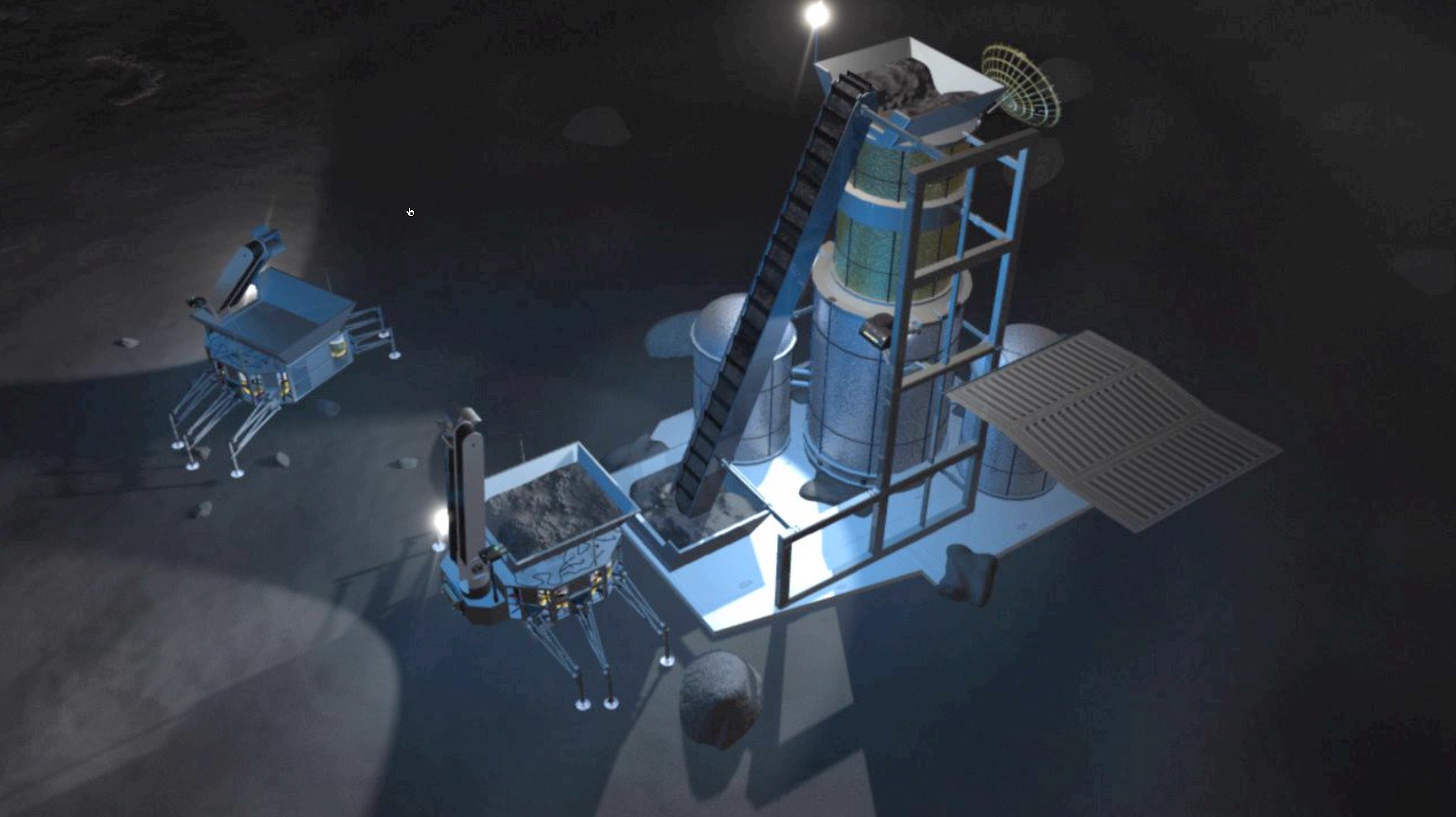 |
| Proposed robotic demonstration of In Situ Resource Utilization (ISRU) presented to the AIAA in 2012. Even a modest, perhaps critical, program to prove the reward worth the risk seems almost pointless without the concept of property [Frassinito/Spudis]. |
Exploration of the Moon by China, Russia, and others is being planned in a very different spirit from the NASA missions of the 20th century that were scientific in nature. Water and other valuable resources have been confirmed on the Moon. New programs have a focus on potential commercial and strategic exploitation. The Moon is the greatest mineral find in human history. Astronomically speaking the Moon is nearby, gravity is low, it has vacuum and very abundant materials from which things can be built that people need in space: solar power arrays, habitats, electronics, and soil and water for growing food and producing industrial chemicals.
A number of companies have been formed to exploit lunar resources and more are on the drawing boards. However, they all assume that a miracle of some kind will allow them to set up and start operations undisturbed by the dozens of other groups readying to do the same. This adds urgency to the lack of an international regime for commercial development of the Moon.
What are the options?
Read the full article, HERE.


