Showing posts with label Mare Fecunditatis. Show all posts

Thursday, May 23, 2013

Pit Crater in Fecunditatis

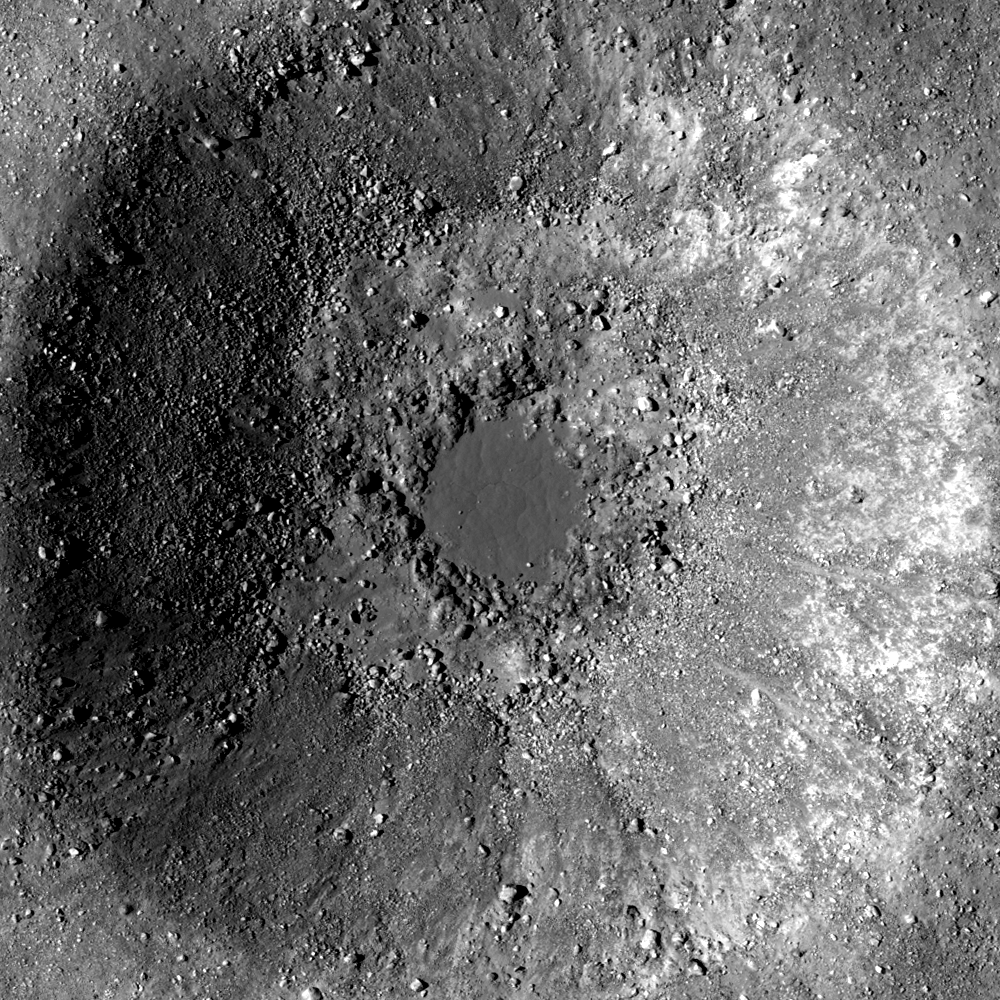
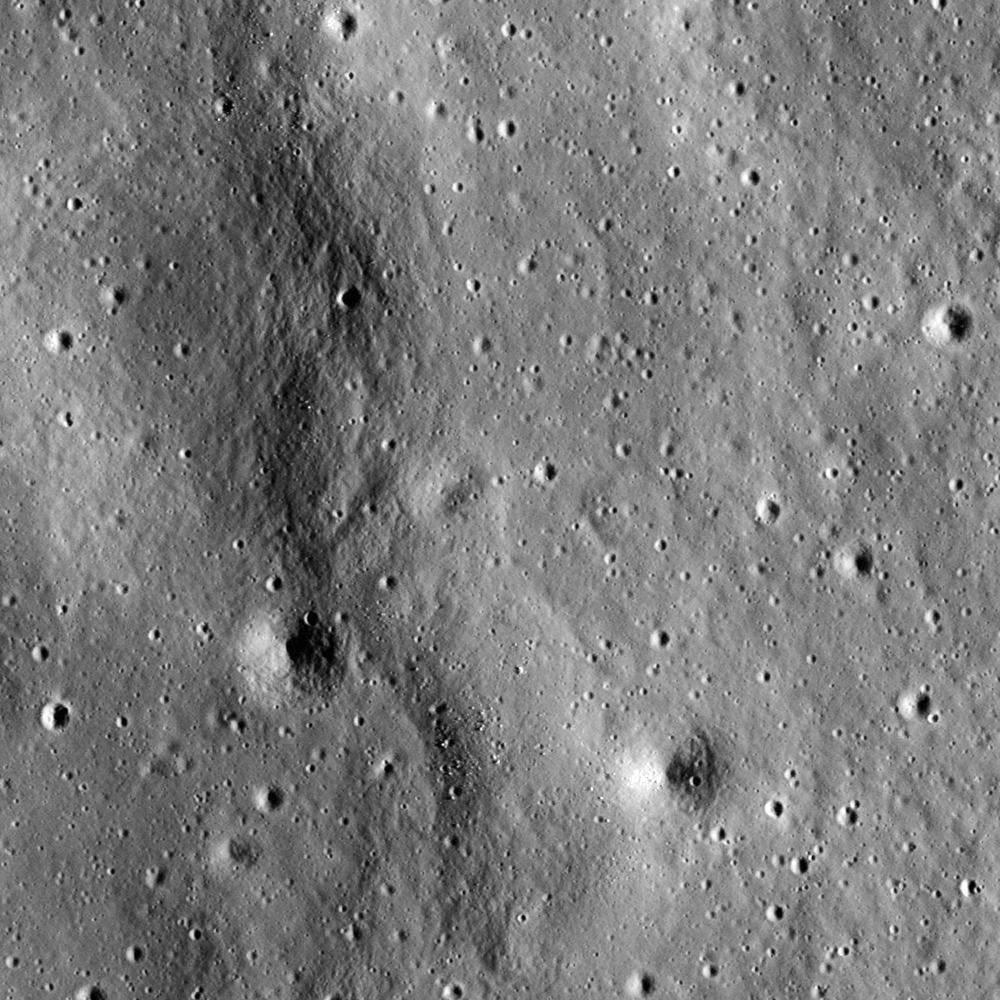
What may be a newly resolved "pit crater," similar to at least three other unique features found elsewhere on the Moon. This one is near the equator in Mare Fecunditatus (0.92°S, 48.66°E). The nearly circular 110 meter-wide opening may or may not narrow in diameter further into its interior. LROC Narrow Angle Camera (NAC) observation M1107960917R, (at 180%) LRO orbit 11562, November 19, 2012; angle of incidence 62.93° from 108 km [NASA/GSFC/Arizona State University].
Joel Raupe
Lunar Pioneer

It’s time to inventory the Moon’s “pit craters.” The first, the "Haruyama," or "Marius Hills pit crater" (14.065°N, 303.224°E) is in a sinuous rille immediately west of the famous shield volcano range in Oceanus Procellarum.

A second and third have now been found and photographed from many angles, in Mare Tranquilitatis (8.34°N, 33.22°E) and Mare Ingenii (35.95°S, 166.06°E), respectively.

It appears the LROC team at Arizona State University uncovered another, over the past year, out on the vast equatorial plains of Mare Fecunditatis (0.92°S, 48.66°E).

This is remarkable for a number of reasons, not least among them the mission’s elapsed time. As of this writing LRO has completed 17,801 orbits around the Moon. Without knowing the exact percentage of the lunar surface yet to be photographed by the LROC Narrow Angle Cameras – it’s remarkable a 110 meter wide target could have been missed until relatively recently.

That is it might seem remarkable, until we consider some basic “beta angles,” so to speak, some basic mission priorities and logistics.

Location of a possible pit crater in a 155 km-wide field of view of northwest Mare Fecunditatis. LROC QuickMap 250 meter per pixel resolution [NASA/GSFC/Arizona State University].
The target is within a single degree south of the equator. Obviously a spacecraft in polar orbit is going to see its orbital pathways and targeting opportunities converge directly over the poles, conversely those same opportunities will be at their greatest distance apart at the equator.

A closer look through one particularly fine set of LROC Wide Angle Camera passes over target (arrow), the feature is just visible in this imperfectly merged monochrome (604 nm) WAC mosaic swept up during three sequential orbital passes; from 47.4 km altitude. Resolution roughly 55 meters, 63° angle of incidence; field of view a little over 40 km, from west to east [NASA/GSFC/Arizona State University].
Secondly, this has got to be one of the Moon’s great “Rub’ al khali's,” an empty quarter, which must have seemed nearly void of inviting targets, with very inviting targets nearby, particularly to the west, where the fascinating Messier and Messier A craters reside. The east rim of Messier B is only a little over 20 kilometers directly to the west. The desire, even the need, to slew the spacecraft and camera’s off nadir to examine these and other nearby targets is reason enough for the pit to have been overlooked.

Then there’s the target itself, which brightens considerably between a 30° and 0° angle of incidence. Under the highest sun, near noon, and again, very near the equator, the target looks like what it may in fact be: an unusual but still rather commonplace nearly fresh crater.

It proves, yet again, that there are still great new discoveries yet to be made on the Moon.

Raw rendition of the LROC NAC observation which may have touched off further interest in a new "target of opportunity," in the months that followed. The pit crater in Mare Fecunditatis shows up on the very edge of this frame from orbit 13087, April 28, 2012. LROC NAC M190280022L, 62.93° angle of incidence, 1.09 meters resolution from 108.01 km [NASA/GSFC/Arizona State University].
Having to guess just what drew their interest, the target seems to have been photographed at high resolution April 28, 2012, in orbit 13087. Amazingly, the pit was nearly missed. You can see the north half of the target at the very top of LROC Observation M190280022L, HERE.

By last fall it seems the pit was directly targeted under three lighting conditions, the first, last September, must have seemed disappointing. With the Sun only five degrees from directly overhead what little topography might be seen on target and in the region may have seemed washed out in shadowless albedo contrasts. If this was a pit crater the “ledge,” if any, was not overshadowing.

First full close-up released to the PDS shows a brightly lit interior, and little to no depth. But the Sun was high, and the location less than a degree south of the equator. LROC NAC M1103245601L, orbit 14902, September 25, 2012, angle of incidence 7.765° at 0.94 meters resolution, from 108.88 km [NASA/GSFC/Arizona State University].
A month later the Sun was a little more favorable. LROC NAC M1105602888L, orbit 15232, October 23, 2012; angle of incidence 35.18° at 0.93 meters resolution from 108.28 km [NASA/GSFC/Arizona State University].
After yet another month, the mid-morning Sun is at an even greater angle. Shown at its original resolution, this is the image at the top of the post. LROC NAC M1107960917R, orbit 15562, November 19, 2012; angle of incidence 62.93° at 1.1 meters resolution, from 108.01 km [NASA/GSFC/Arizona State University].

Related Posts:
Impact melt collapse pit (March 2, 2012)
Failed Skylights of Copernicus (January 24, 2012)
New view of Sinas pit crater (November 11, 2011)
Sublunarean Void (February 7, 2011)
New views of lunar pits (September 14, 2010)
How common are mare pit craters? (July 15, 2010)

Wednesday, May 15, 2013

Small Pond in Fecunditatis

Unnamed crater floor at the western edge of Mare Fecunditatis. LROC Narrow Angle Camera (NAC) M167919653R, LRO orbit 9880, August 14, 2011. Image center 6.422°S, 43.747°E, field of view 561 meters across, angle of incidence 42.28° at 56 cm per pixel resolution, from 26.95 km [NASA/GSFC/Arizona State University].
Hiroyuki Sato
LROC News System

Today's Featured Image highlights an unnamed small crater (roughly 600 meters in diameter) observed at western edge of Mare Fecunditatis.

As seen in images further down, the higher reflectance (optically) immature ejecta blanket of this crater suggests a young age relative to the adjacent craters.

The crater walls are mostly covered by collapsed materials but the bottom still shows the original floor. The most remarkable feature is the central pit filled with impact melt (~100 m in diameter) with wrinkles on its surface. What are wrinkles telling us?

Full 56 cm per pixel resolution view of the crater of interest in Mare Fecunditatis, from LROC NAC M167919653R [NASA/GSFC/Arizona State University].
Most of the ejecta blanket from a mosaic of both the left and right frames (M167919653LR) of the LROC NAC observation, a field of view 2.06 km-wide [NASA/GSFC/Arizona State University].
Probably this is a quenched surface of melt flows that coalesced from multiple directions, and each wrinkle corresponds to the contact boundary of different flow units. The mushroom shape extending from south toward the center could have been the last flow unit that squeezed through the earlier arriving melt. Post surface cracking may also contribute resulting in these complicated patterns. Impact melts exhibit large variety in their final shapes due to their complicated rheology changing with time. It must be interesting to see how different or similar they are to the volcanic surfaces of active Hawaiian volcanoes.

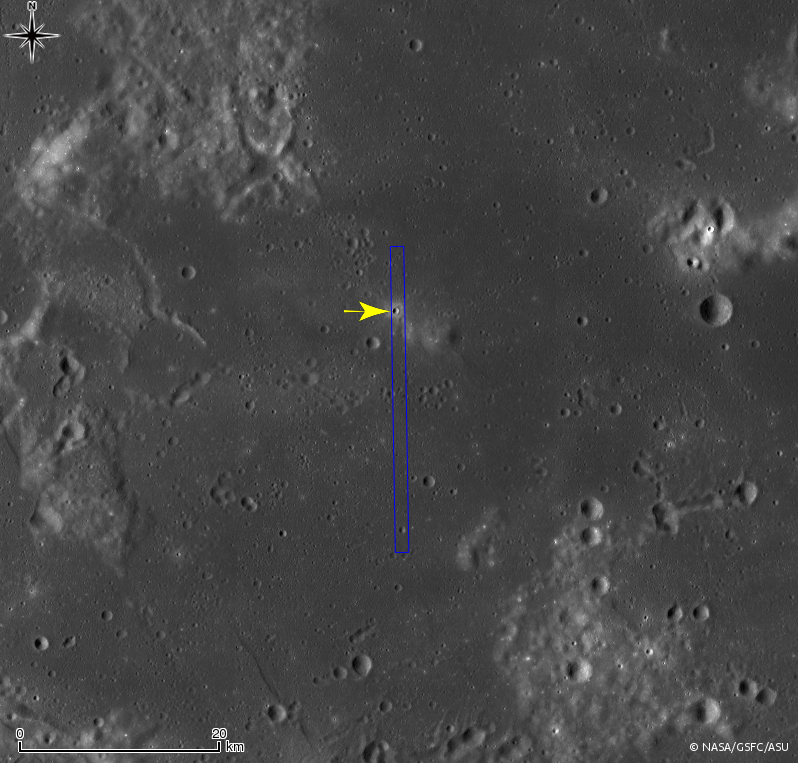
LROC WAC monochrome mosaic (100 m/pix) of the western portion of Mare Fecunditatis, centered at 6.67°S, 43.73°E shows the NAC footprint (blue box) and location of the area shown at high resolution in the Featured Image above (yellow arrow) [NASA/GSFC/Arizona State University].
Explore the wrinkles on this tiny melt pond in full NAC frame for yourself, HERE.

Related Posts:
Channels And Fractures
Farside impact!
Crater in 3D!
Young Highlands Crater
Rippled Pond
Messy Crater

Wednesday, October 31, 2012

Ghosts of Fecunditatis

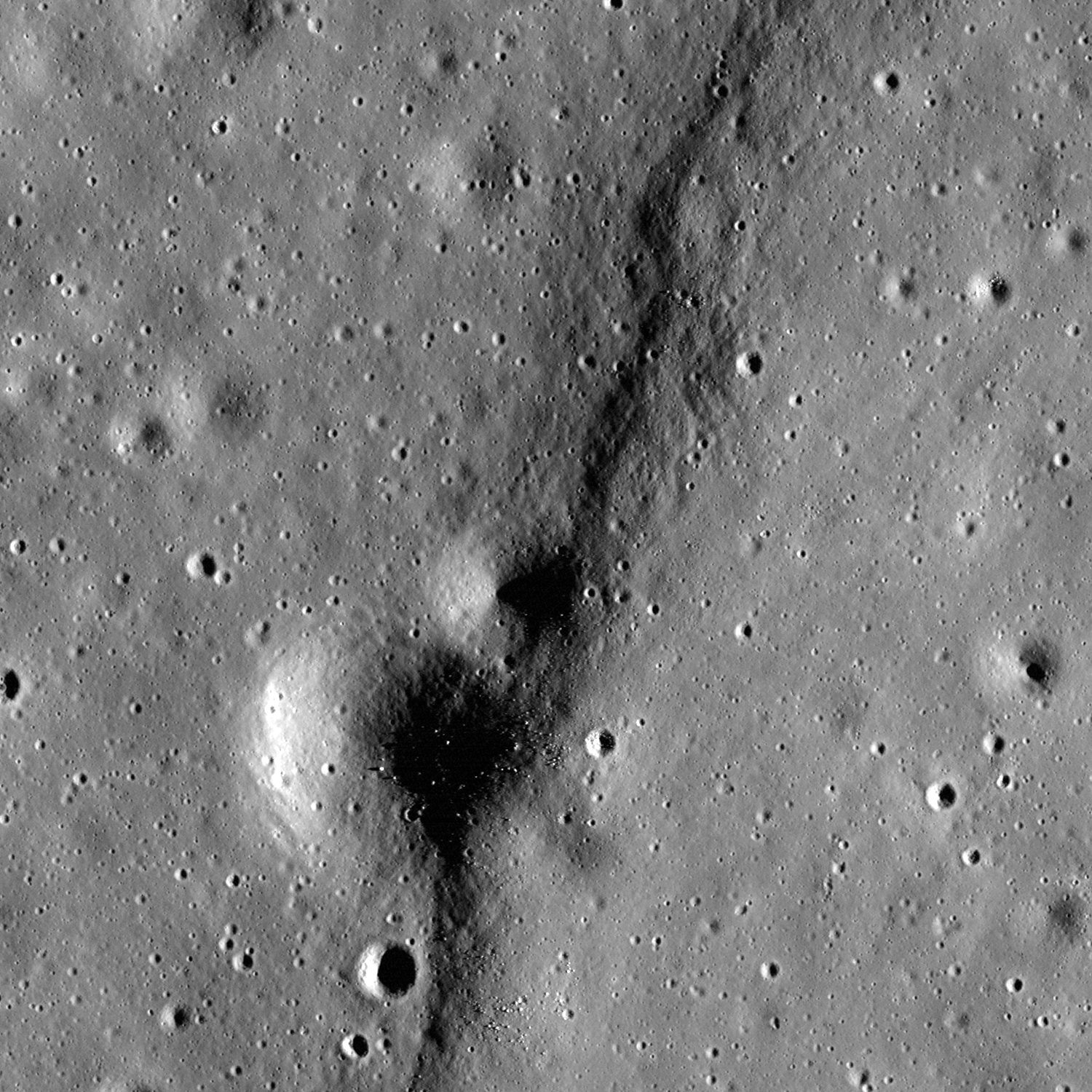
A gentle but distinctive topographic high designates the location of an ancient crater rim, nearly covered by basin flooding by volcanism, inside the boundaries of Mare Fecunditatis. LROC Narrow Angle Camera (NAC) frame M146662326L, illumination is from the east, angle of incidence 72.34° ; an approximately 1 kilometers-wide wide field of view at 0.98 meters resolution (in the original) from 47 kilometers altitude [NASA/GSFC/Arizona State University].
James Ashley
LROC News System

Today's Featured Image focuses on ancient craters that predate mare basin flooding, and which are often recognized by subdued, sometimes discontinuous circular patterns best seen near local lunar sunrise and sunset (high solar incidence as measured from the surface normal). These circles mark the locations of once majestic excavations in the lunar crust. However the emplacement of volcanic deposits filling, surrounding, and overtopping the rims have buried these ancient craters in many instances. The presence of the near-surface rims produce local stresses in the deposits, which in turn deform the mare layers. The result is a wrinkle ridge-like topography with a circular pattern. They are thus often referred to as "ghost" craters, and can be found haunting many large, basin-filling mare deposits.

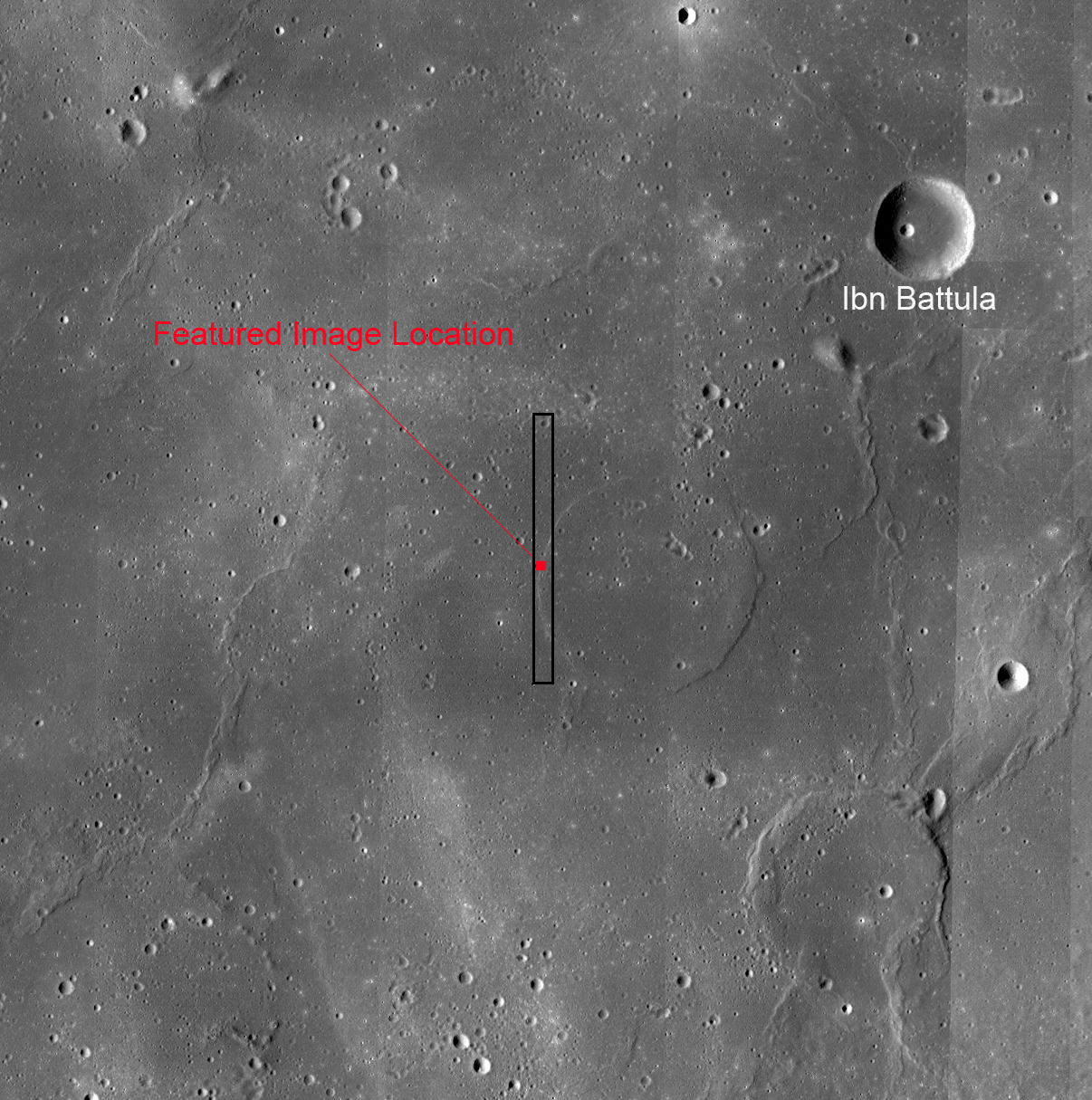
LROC Wide Angle Camera (WAC) mosaic centered on the Featured Image field of view. Note a second and more prominent ghost crater (Goclenius U) in the southeast corner of this approximately 120 km-wide frame [NASA/GSFC/Arizona State University.

At least two large ghost craters can be found here in the Mare Fecunditatis basin just south and southwest of the crater Ibn Battula. Some portions are simply unrecognizable as former crater rims without the large scale mosaic for context (see example below).

Another portion of the crater rim gives a muted appearance like that of a snow-covered park bench. Field of view width is ~700 meters.

Examine the full NAC frame (HERE) to see a greater length of ghost crater rim. Another example of a ghost crater is presented in the Ghost Crater in Southern Mare Crisium, a Tier 2 Constellation program Region of Interest. Contrast the appearance of a ghost crater to that of a flooded crater (e.g., as in Balcony Over Plato).

Friday, April 6, 2012

LROC: The Rays of Messier A

The surface of Mare Fecunditatis, west of Messier A, peppered with hundreds of small craters. Image field of view is around 620 meters,  LROC Narrow Angle Camera (NAC) frame M159650657L, orbit 8661, May 10, 2011; incidence angle = 45.26° resolution 47 centimeters per pixel, from 40 kilometers altitude [NASA/GSFC/Arizona State University].
James Ashley
LROC News System

If you have ever studied the Moon through a backyard telescope, you may have noticed the Messier impact feature in Mare Fecunditatis (Sea of Fertility) beginning around day 5 of the lunar cycle. The distinctive appearance of the ray structure is particularly eye-catching. The high-reflectance of the main ray pair contrasts nicely with the lower reflectance background of Mare Fecunditatis. What would these rays look like close up? The LROC Narrow Angle Camera allows us to "zoom in" and find out as the subject of today's Featured Image.

When scanning the full NAC frame (see link again at the bottom of this post), we can readily detect the location of the prominent ray pair. Not surprisingly, we see many small, relatively recent craters when examining the scene more closely. At first glance it may seem that the bright rays are due entirely to these small craters, many of which excavated immature mare material (high-reflectance) from beneath the space-weathered surface layer of regolith.

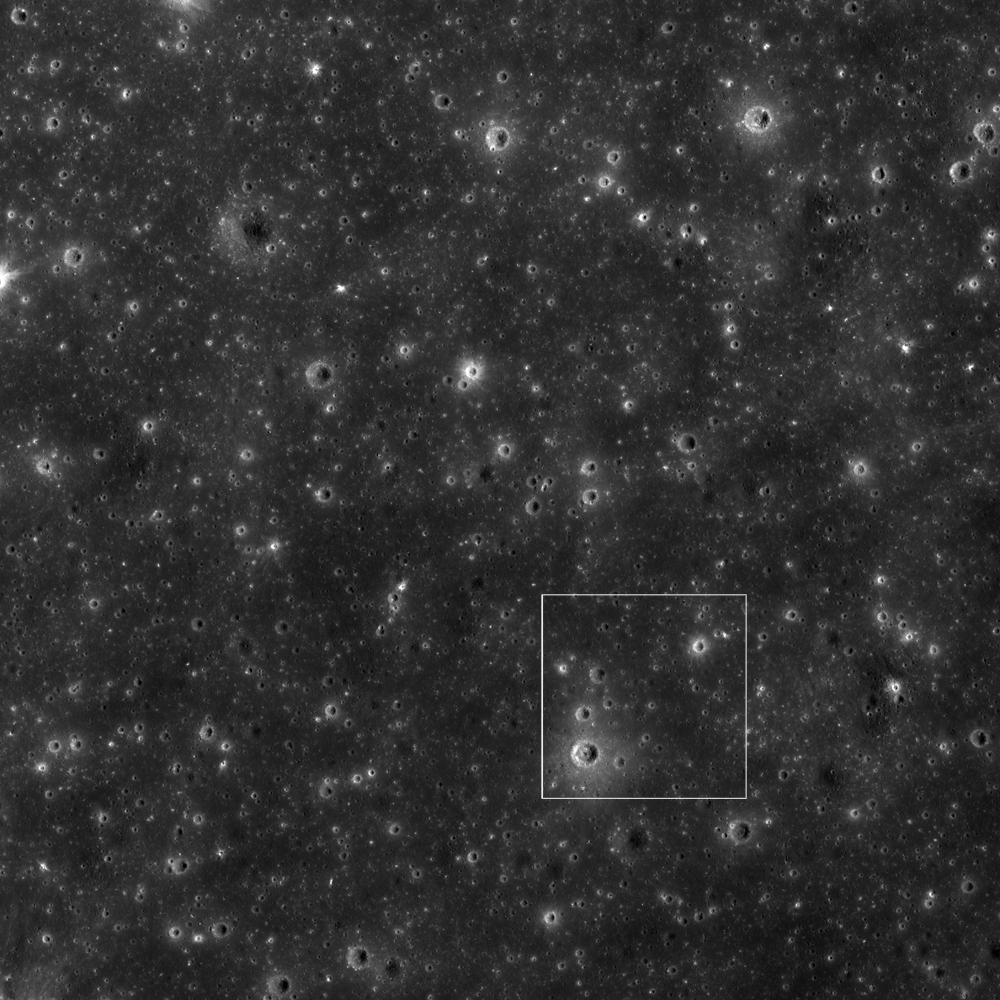
A wider view shows the field of view in the LROC Featured Image (April 5, 2012) (white square) represents a much larger region of similar impacts. Field of view here is ~2.5 km. View the full-sized LROC context image HERE [NASA/GSFC/Arizona State University].
It would be tempting, then, to conclude that these small craters are all associated with the Messier A impact event. However, this determination is not straightforward. While some of these craters may be the result of Messier ejecta, there are also a great many similarly small, recent craters which clearly lie beyond the rays across the mare plains. It is possible that our eyes are deceived by the high-reflectance materials emplaced during the Messier impact event; note how the background reflectance between craters within the rays appears brighter than the reflectance outside of the rays. 

Elsewhere in the same NAC frame, a few kilometers to the north, the wide distribution of small boulders in the area of the bright rays trailing westward from Messier A, are, in a few spots, punctuated by 'house-sized' examples, deposited or present and clearly 'disturbed' by the force of perhaps three crater-forming Copernican Age impacts [NASA/GSFC/Arizona State University].
Because of the prevalence of random small impacts across the mare, it is difficult to determine which craters in this image are primary impacts and which are true secondaries associated with the Messier A impact. The impacting body that created Messier A excavated rock from the impact site (the vast majority of which was target rock, not the impacting meteoroid). The larger fragments may have been capable of creating recognizable craters. Distinguishing secondary from primary impacts can be a serious challenge for researchers who count craters to determine surface ages.

The Featured Image field of view is embedded within Messier A's unusual ray structure, something that becomes increasingly clear as the distance and perspective widens, in this LROC Wide Angle Camera mosaic and the images which follow. Field of view is 50 km across. [NASA/GSFC/Arizona State University].
Messier A, and a unique and newly simulated perspective from 26 kilometers over Fecunditatis, east by northeast of the familiar double crater (LROC WAC mosaics over LOLA laser altimeter-based topography). The landmark bright rays are directly opposite from how they are seen from Earth. The yellow arrow again shows the location of the field of view seen in the Featured Image. Though the Messier A progenitors' angle of attack was  highly oblique, the twin impacts also appear not to have been simultaneous. The rays continue beyond the western edge of Fecunditatis, 150 to 200 kilometers away [NASA/GSFC/LOLA/LMMP/Arizona State University].
Take a close look at the full NAC frame HERE to see more clearly where the ray begins and ends on this mare surface. You can find the Messier area in a small telescope by looking in Mare Fecunditatis beginning around day 5 of the waxing crescent Moon with each new lunar cycle. The walls of Messier A crater, with further discussion of the Messier crater complex, are showcased in Layering in Messier A. Other posts showing examples of secondary craters can be found in Regolith on Basalt, and Chain of Secondaries on Mare Orientale.

The face of Mare Fecunditatis and the bright rays trailing west from Messier and Messier as seen from Earth, in an extraordinary April 2009 mosaic imaged, layered and stitched by Astronominsk in Belarus. View the original HERE [Astonominsk].


Messier and Messier A  inspire a variety of theories about their origin, each suggesting an oblique impact, but like John Moore, we don't mean to suggest the single theory mentioned further above (that a group of moderately separated asteroids or comets past their Roche threshold, still sharing the same orbital plain, rendezvoused violently with Mare Fecunditatis in a cluster of three impacts) be thought of as definitive.

We added this video because it's, well... awesome!

Friday, July 22, 2011

LROC: Layering in Messier A

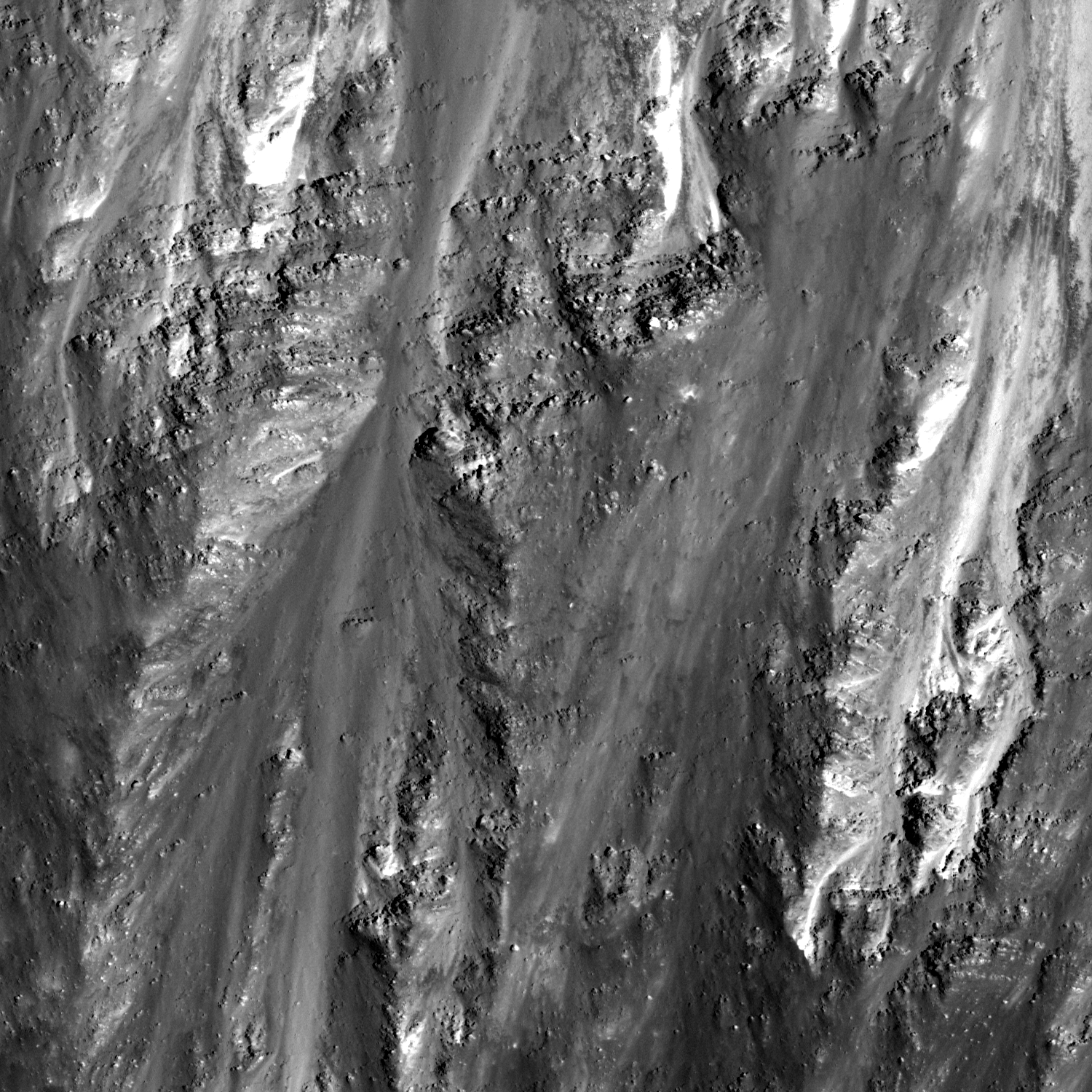
Avalanches festoon the layered south interior walls of nearside telescopic landmark Messier A (2.2°S, 46.9°E). LROC Narrow Angle Camera observation M126622485R, LRO orbit 3793, April 23, 2010; solar incidence 25°, from the east - north is up. field of view roughly 625 meters across. View the full-size LROC Featured Image HERE [NASA/GSFC/Arizona State University].

James Ashley
LROC News System

Like sand sifted through the fingers of a giant, loose debris beautifully ornaments the slopes of the Messier A crater walls. Outcropping bedrock projections stand in relief against avalanches that once flowed on either slide. Take a closer look at the outcrops in the expanded view of this image and you will see fine layering! This is yet another region of mare deposit where we see evidence for multiple, thin lava flows, now exposed in cross-section by the excavations of an impact. This fine layering is a surprise to planetary scientists - one of the many revelations about the Moon made with NAC-scale imaging.

This particular area may have captured your eye if you have ever looked at the Moon through a backyard telescope. It is visible beginning with the waxing crescent phase, and remains so until a couple days past full. Named after the 18th Century French amateur astronomer, Messier crater is located in Mare Fecunditatis (the Sea of Fertility). Its peculiar "comet-like" appearance is still somewhat mysterious to planetary scientists, but seems to have involved a complex interplay between more than one impacting object with at least one of them impacting at a highly oblique angle. The impact(s) excavated mare materials and spread them out as an extended pair of rays that stretch to the west, looking very comet-like indeed through the telescope eyepiece.

The Messier A crater region as seen through an amateur telescope of moderate power, five nights after New Moon. The unusual oblong shape of Messier, the double impact and westerly direction of the bright rays extending from Messier A seem to point to a very steep and oblique impact.

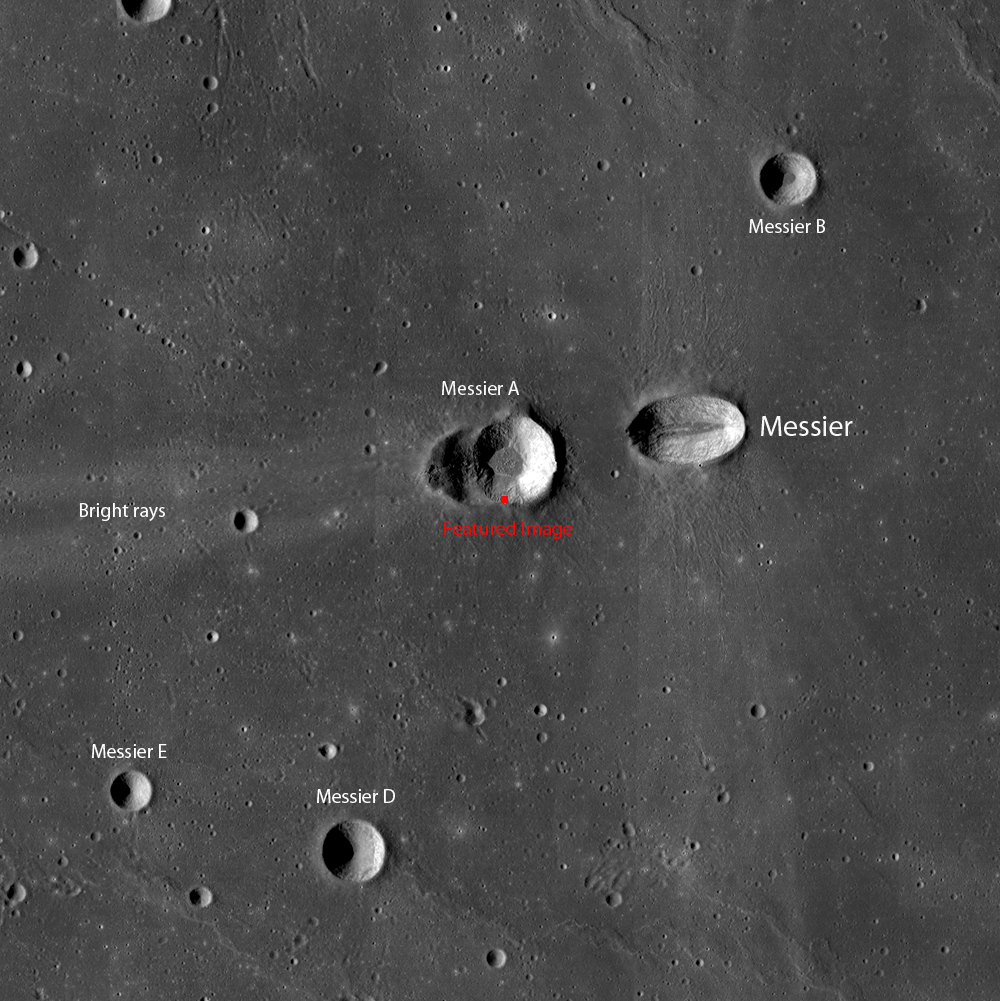
A portion of the LROC Global Wide Angle Camera (WAC) mosaic showing the Messier crater region of Mare Fecunditatis, with the LROC Featured Image for July 19, 2011 marked in red. Field of view is about 55 kilometers across. View the full-size LROC WAC labeled context image HERE [NASA/GSFC/Arizona State University].

Explore the full NAC frame here. What other features can you find? Additional examples of mare layering can be found. Look for layering in the flows of Bessel crater, Linne crater and in the walls of pit craters.

A slightly different angle on the LROC WAC Global Mosaic, and take, on Messier and Messier A with west at the top reveals to the eye the distinct texture of impact melt on the floor of Messier A and the landslide region on the crater's south interior wall (to the left). Through the NAC close-up (below) the impact melt appears to harbor more than one collapse pit [NASA/GSFC/Arizona State University].

Scattered among the debris on the impact melt covering the floor of Messier A are more than a few collapse pits, to the northeast of the location of the LROC Featured Image for July 19, 2011 [NASA/GSFC/Arizona State University].