Showing posts with label Space Weather. Show all posts

Tuesday, October 23, 2012

Beautiful Young Crater in Icarus

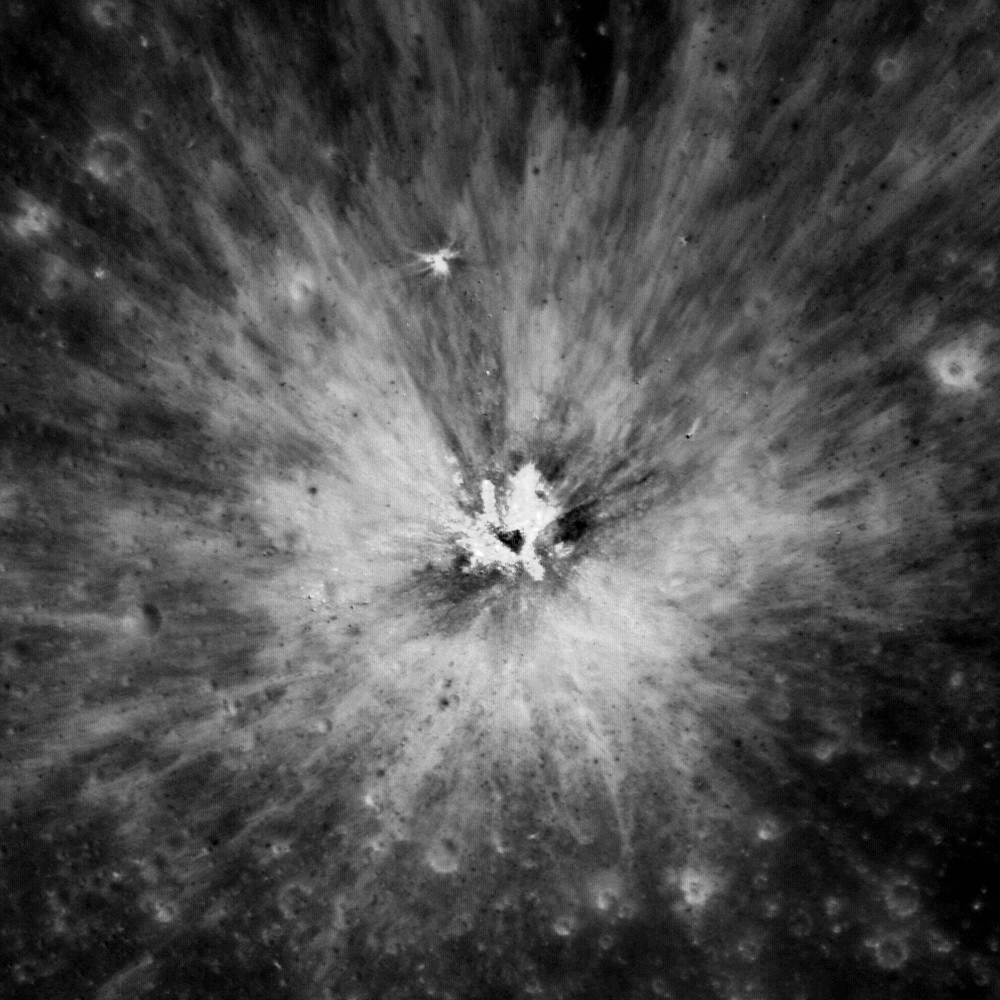
A beautiful, young crater inside of the complex crater Icarus. Field of view 550 meters from LROC Narrow Angle Camera (NAC) observation M156367058L, LRO orbit 8177, April 2, 2011; 0.6 meters resolution over an angle of incidence 10.53° from 58.61 kilometers [NASA/GSFC/Arizona State University].
Sarah Braden
LROC News System

Icarus is a large, complex crater (diameter 93.7 km) with a central peak, located at 5.584°S, 186.998°E. Icarus is named after the mythical Greek flyer. The Featured Image shows a young, fresh crater (located at 5.929°S, 187.696°E) superposed on the older terraces of Icarus. The ejecta of the impact is higher in reflectance compared to the surroundings since the newly excavated material has been exposed to space weathering for a relatively short time. Over time space weathering causes the reflectance of fresh regolith to decrease. The ejecta of the crater in the Featured Image will fade over hundreds of millions of years, until it can no longer be distinguished from the rest of Icarus crater.

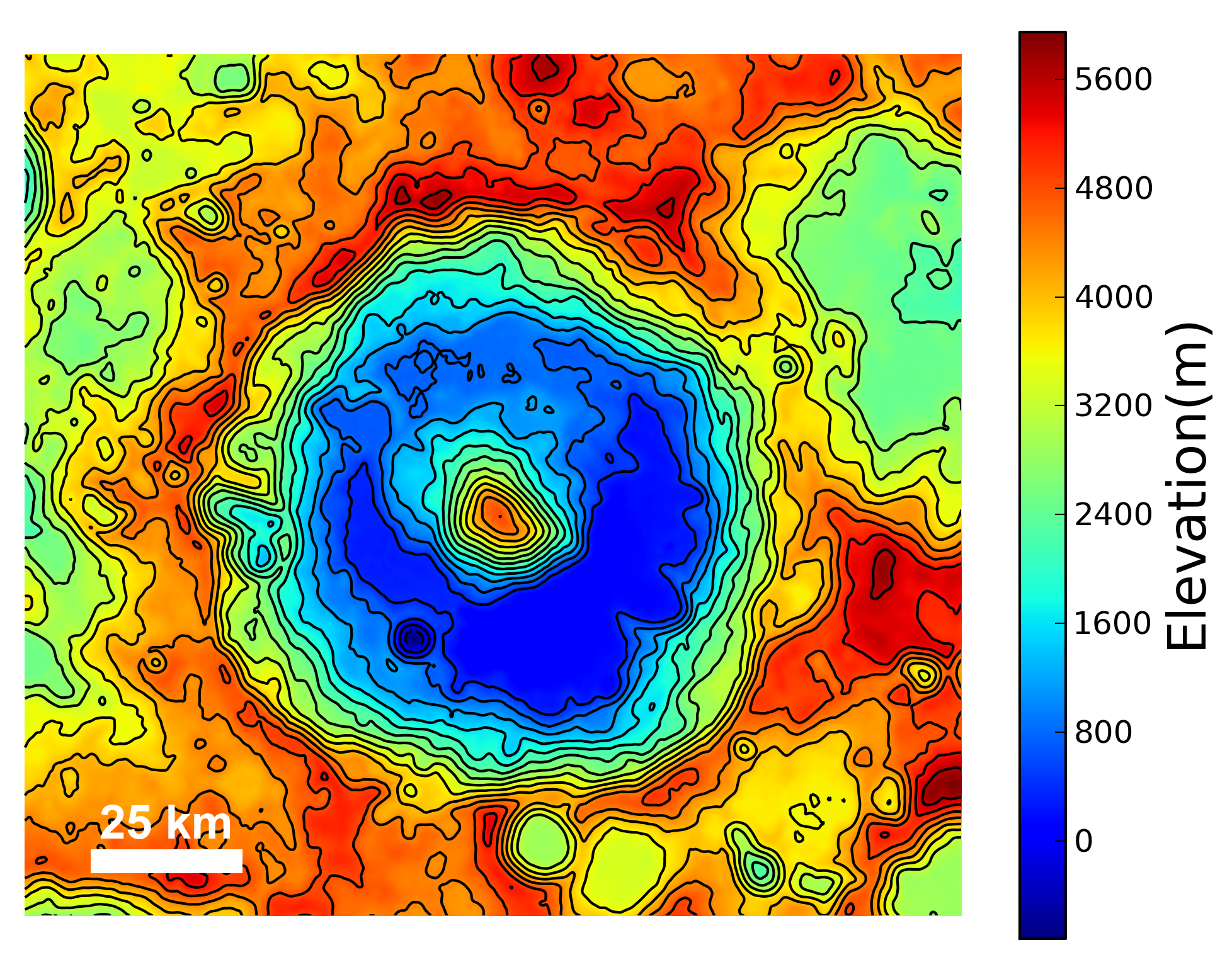
While the rim and terraces of Icarus are heavily degraded by subsequent impacts, the crater's central peak is still quite tall. The central peak rises about 4475 meters above the crater floor! Compared to other craters of similar diameter, this is quite a tall central peak! Consider many of the other complex craters with central peaks featured in the LROC images: Moretus, Hayn, Aristarchus, Theophilus, Bullialdus, Langrenus, Copernicus, and Tsiolkovskiy. For example, Tycho (~82 km in diameter) crater's central peak is 2 km above the crater floor.

Topography of Icarus crater. The northeast edge of the rim is partially destroyed [NASA/GFSC/Arizona State University].
All of these complex craters have a few common characteristics. First, the impact has to be large enough to cause a complex crater. Relatively smaller impacts create simple craters, which are bowl-shaped and have no central peak or terraces. After the excavation phase of the impact, the transient cavity collapses. This collapse is driven by gravity, which causes the uplift of the central peak as well as the collapse of the rim inward, which forms terraces along the interior wall. Some times an impact is so large that it creates a ring of peaks instead of just one central peak.

LROC Wide Angle Camera (WAC) context image of Icarus, the white asterisk marks the location of the fresh crater in the Featured Image [NASA/GSFC/Arizona State University].
Explore more of the interior of Icarus with this LROC NAC, HERE.

Related Images:
Lunar Topography - As Never Seen Before!
Copernicus Central Peak From The West
View From The Other Side

Friday, March 23, 2012

Expectations for the LADEE LDEX

The 'Dust, Atmosphere, and Plasma: Moon and Small Bodies' (DAP-2012) meeting will take place in Boulder, June 6-8, 2012. Please visit our webpages http://ldap2012.colorado.edu/  to register and submit an abstract by 3/30/2012, if you plan to attend.

We are looking forward to see you in Boulder!

- Alan Stern and Mihaly Horanyi
A lasting lesson from Apollo. The lunar exosphere gets into everything, fine as talcum, abrasive as broken glass, and a significant cumulative threat to seals and any and all working parts generally, whether biological and mechanical. Beyond its demonstrated mission threat the Moon's dusty environment is a delicate, "pristine" and important  part of a 4.5 billion year history of space weather near Earth. Apollo 17 lunar module pilot and geologist Harrison H. "Jack" Schmitt moves forward with the patina of 22 hours activity on the lunar surface clinging to his suit. AS17-145-22157 [NASA/JSC/ALSJ].
The Moon's sodium tail,
Potter and Morgan (1998).
The Lunar Dust Environment:
Expectations for the LADEE
Lunar Dust Experiment (LDEX)

Mihaly Horanyi, Sternovsky & Shul
with Colette, Grün, Kempf, Srama & Mocker
43rd Lunar and Planetary Science Conference, #2635

Introduction: The lunar dust environment is expected to be dominated by submicron-sized dust particles released from the Moon due to the continual bombardment by micrometeoroids, and due to plasma-induced near-surface intense electric fields. The Lunar Dust EXperiment (LDEX) is designed to map the spatial and temporal variability of the dust size and density distributions in the lunar environment on-board the upcoming Lunar Atmosphere and Dust Environment Explorer (LADEE) mission

LDEX is an impact detector, capable of measuring the mass of submicron sized dust grains. LDEX will also measure the collective signal of dust grains below the detection threshold for single dust impacts; hence it can search for the putative population of grains with r ~ 0.1 μm lofted over the terminator regions by plasma effects.

LDEX has been developed at the Laboratory for Atmospheric and Space Physics and Colorado Center for Lunar Dust and Atmospheric Studies (LASP/CCLDAS, University of Colorado at Boulder) and has a high degree of heritage based on similar instruments on the HEOS 2, Ulysses, Galileo, and Cassini missions. The LDEX flight model will be tested and calibrated at both the (Max-Planck-Institute for Nuclear Physics, Heidelberg, Germany) and Boulder dust accelerator facilities.

At the Lunar and Planetary Science Conference, March 21, 2012, Dr. Horányi summarized expected capabilities of LDEX and made predictions for its measurements in lunar orbit, based on current theoretical models. The authors also discussed a proposed LDEXPLUS instrument being developed for a possible LADEE follow-up mission to add the instrument's design capability for in-situ chemical analysis of impacting dust particles, perhaps to verify "the existence of water ice on the lunar surface and map the density of valuable resources of commercial interest".

Figure 1. LDEX EM and FM units and the schematic drawings of the instrument.
The LDEX instrument: The two expected sources of dust in the lunar environment are ejecta production due to continual bombardment by interplanetary meteoroids and lofting due to plasma effects. LDEX is an impact ionization dust detector with a sensor area of ~0.01 m\2. LDEX is a low risk, compact instrument and uses no flight software (Figure 1). In addition to individual dust impacts of grains with radii r > 0.3 μm, LDEX can identify a large population of smaller grains (0.1 < r < 0.3 μm) by measuring their collective signal.The expected impact rates, and the signature of lofted small grains expected over the terminators are shown in Figure 2.

Figure 2. Expected impact rates on a 30x100 km orbit with its pericenter over the morning terminator.

Initial test and calibration of the LDEX FM model were done at the CCLDAS dust accelerator facility. Full calibrations are planned in early 2012 at both the Heidelberg and the Boulder facilities. Figure 3 shows the preliminary test results, indicating that LDEX will meet or exceed its measurement requirements.

Figure 3. Initial test results for the LDEX FM instrument showing the detected particle mass versus their velocity. At the expected impact speed of 1.6 km/s,

LDEX will detect particles with radii r > 0.4 μm. The ratio of detected and undetected particles matches the expected value due to the duty cycle of the electronics and the transparency of the screens that provide shielding and exclude the solar wind electrons from entering LDEX.

The LDEX-PLUS instrument extends the LDEX capabilities to also measure the chemical composition of the impacting particles with a mass resolution of M/ΔM > 30. Traditional methods to analyze surfaces of airless planetary objects from an orbiter are IR and gamma-ray spectroscopy, and neutron backscatter measurements. A complementary method is to analyze dust particles as samples of planetary objects from which they were released. The source region of each analyzed grain can be determined with accuracy at the surface that is approximately the altitude of the orbit.

This ‘dust spectrometer’ approach provides key chemical constraints for varying provinces on the lunar surfaces. LDEX-PLUS is of particular interest to verify from orbit the presence of water ice in the permanently shadowed lunar craters. LDEX-PLUS combines the impact detection capabilities of LDEX with a linear time-of-flight system, similar to the Cassini Cosmic Dust Analyzer (CDA) instrument. Figure 4 shows an example time-of-flight mass spectrum of an ice-bearing dust grain.

Figure 4. Spectrum of a water ice particle obtained at ~ 4 km/s impact speed by the Cassini CDA instrument in Saturn's E ring. The dominant peaks are mass lines of water cluster ions (H2O)nH+, generated upon impact of an ice-bearing particle.
Schematic of documented species of horizon glow, such as the famous mid-lunar night imagery captured by Surveyor 7 in 1968.

Conclusions. LDEX, on-board LADEE, is scheduled to launch in May 2013 and will be capable of mapping the density distributions of both the large ejecta particles and the collective signal of small lofted grains. LDEX-PLUS, on-board a follow-up lunar mission, can collect a large number of samples from a greater part of the entire surface for analysis.

The instrument is especially sensitive to the metallic compounds of minerals and any species which easily form ions (e.g. water). The accuracy of the trajectory back-tracing to the surface is comparable to the altitude of the satellite. This in-situ method allows compositional surface mapping of the Moon. Since the dust spectrometer is particularly sensitive to refractory compounds which are difficult to access by other methods it is also complementary to remote sensing spectroscopy and an ion or neutral mass spectrometer. A ram pointing dust spectrometer and a nadir pointing remote sensing instrument collect data from approximately the same spot on the surface of the Moon, hence the combination of these measurements greatly enhances our ability to map the chemical composition of the surface and identify water-bearing regions.

An LDEX-PLUS type instrument can also address many of the science goals of a Europa Jupiter System Mission (EJSM) regarding the surface chemistry of icy satellites. See original Conference abstract, HERE, for citations.
Lunar Horizon Glow (LHC) as televised (vidicon photography) in local night, early 1968 [NASA].

Monday, August 3, 2009

A Quick Lunar History

Micrometeorite erosion: One of many kinds of space weathering common on the Moon, Apollo 16 sample of lunar breccia steadily "smoothed" by exposure to the conditions in the part of the inner-Solar System occupied by Earth is recorded on the Moon. The immediate surface of the Moon is "gardened," re-worked every two million years (Apollo 16-NASA: Sample A64455).

In preparing for the Lunar Regolith/Simulant Workshop in Huntsville, this past March, Jennifer E. Edmunson of NASA's Marshall Space Flight Center put together a clear, mostly jargon-free "history of the Moon," showing "explanations for the importance of understanding lunar history for engineers and users of lunar simulants. Included are summaries of the initial impact that is currently in favor as explaining the moon's formation, the crust generation, the creation of craters by impactors, the era of the lunar cataclysm, which some believe effected the evolution of life on earth, the nature of lunar impacts, crater morphology, which includes pictures of lunar craters that show the different types of craters, more recent events include effect of micrometeorites, solar wind, radiation and generation of agglutinates. Also included is a glossary of terms.

Download the pdf HERE.

Saturday, June 6, 2009

Space Weather: What it is and why it matters

Communications Technology

The National Oceanic and Atmospheric Administration (NOAA) is predicting a mild solar storm season for the next 11-year solar cycle. (For the initial announcement, click here.) But what does that mean, and why do we care?

What it is

To simplify, space weather is electromagnetic stuff happening in space - usually involving the sun - that can affect us here on Earth. That can include such things as solar flares, solar storms, coronal mass ejections and solar wind. These can affect satellites, power grids and radio propagation.

"This whole concept of space weather is kind of an interesting one," said Ron Hranac, a technical leader at Cisco and CT's senior technology editor. "The sun can do a lot of good stuff for us ... but it can also do some interesting and some nasty things, like spit out huge storms that can have a pretty severe impact on things here on Earth, including the climate and technology."

As an aside, sun transit outages, sometimes mistakenly called "sunspot outages," are not space weather and have nothing to do with sunspots. Sun transit outages interfere with signals from geostationary satellites around the spring and fall equinoxes because of geometry. During the equinoxes, the orbits of the sun, Earth and geostationary satellites align such that a receive antenna on the Earth can't "see" the satellite because the sun is directly behind it.
What it can do

Of primary interest in telecommunications is space weather's effect on satellites and power grids.

"What happens in a space weather storm is, yes, there's a risk to satellites; yes, there can be interference at discrete frequencies; and there can be problems induced in the (power) transmission lines, which saturates the core of the transformers at the power stations, which then can make its way to the distribution network," said Doug Biesecker, a scientist with the NOAA's Space Weather Prediction Center.

Biesecker said geostationary satellites, via which many cable operators receive programming, are subject to RFI from the sun and that severe space weather can take out a transponder or entire satellite. He cites the following example.

"Telstar 401 in 1997, space weather, it was gone for good," he said. "Yeah, there are instances of satellites completely killed by space weather."

Losing the bird leads to a scramble to re-establish the programming it formerly carried, Hranac said.

"If a satellite gets damaged - permanently damaged - by a solar event," he said, "then the cable companies that are carrying those program services they are receiving by satellite would then have to point the satellite dish to another satellite that is operating in a backup capacity."

Power grids and railroad tracks, both essentially being very long conductors, are also at risk. A big solar flare in 1989 caused power outages in Canada that affected about 6 million people.

"There are surge currents, if you will, induced in those long conductors - railroad tracks, cross-country high-voltage transmission lines, and things like that," Hranac said. "These surges can, if they're severe enough, damage electrical equipment - transformers, substations, and other things. It essentially overloads this stuff, and it gets some pretty substantial surge damage."

What to do

Luckily, space weather events affecting satellites and power grids are rare. Because the sun is a sphere, relatively few solar events face the Earth, so most dissipate out into space. Still, it's wise to be prepared, Hranac said. Know the backup transponders and satellites for your programming and whether your dishes have a clear line of sight to them.

"There probably should be some kind of Plan B in place at the system level, or certainly at the corporate level of a cable operator," he said. "What are you going to tell your systems to do if the satellite carrying HBO goes out because of a solar flare? It may be one of those low priority things, but discuss it. Put together a Plan B; just be aware of it. Say, 'This happens, and this is what you do. This is who you call, here are the numbers, this is the information.'"

To learn more about space weather, check out the Web sites for the Space Weather Center and the National Weather Service Space Weather Prediction Center. *

- Ron Hendrickson
*Don't forget Spaceweather.com!