Showing posts with label Lunar Module. Show all posts

Tuesday, January 8, 2013

Golden Spike taps Northrup Grumman to design manned lunar lander

The Altair lunar lander, shelved by Congress together with most components of the late Constellation program, in one of many manned and unmanned configurations [NASA/Frassinito & Associates].
Ben Evans
AmericaSpace

Officially revealed to the world barely a month ago, the Golden Spike Company last week announced a contract with aerospace giant Northrop Grumman to begin design work on a lunar landing vehicle which could see astronauts back on the surface of the Moon by 2020. Although Golden Spike—founded by Alan Stern, Associate Administrator for NASA’s Science Mission Directorate in 2007–2008 and Principal Investigator for the New Horizons mission to Pluto, and including former Apollo Flight Director Gerry Griffin as Chair of the Board—remains in what it calls “Phase A” of its forward path, the contract with the only company to have a proven track record of building human-rated lunar landers is a significant advance and brings the goal of bootprints on the Moon closer.

Read the full article HERE.

Thursday, August 2, 2012

Apollo 15 departs Hadley Rille Delta - 41 years ago


August 3, 1971 - 1:11 pm (EDT-US): Hadley Delta, Palus Putridanis, Earth's Moon. Lift off of Apollo 15 lunar module ascent stage, with Dave Scott and Jim Irwin on-board, as captured by remote-operated live color television camera on Apollo's first lunar rover.


From automated DAC camera - on-board lunar module Falcon: From ascent stage ignition through pitch-forward and an excellent - though brief - view of the descent stage/launch pad left behind and below. This footage shows the range track west, over Hadley Delta and Hadley Rille, through a slight roll maneuver allowing a longer view of Hadley Rille north of the landing site and points west over the Palus Putridanis formation on the southeastern frontier of Mare Imbrium.

 [NASA/GSFC/Arizona State University].
The animation above views the Apollo 15 landing site through shifting shadows of a lunar day, courtesy of the LROC Featured Sites index which premiered ;ast month. After the dust settled, almost immediately following the departure of Scott and Irwin expedition 41 years ago, the Sun has passed overhead 548 times, and very little appears to have changed.

A Lasting Legacy: Short of a large erasing impact or interference by future visitors, the relentless bombardment of micro-meteorites will eventually "garden" the top three centimeters or so of regolith, finally erasing all traces of the rover tracks and footprints in about 2 million years. After that, it's anyone's guess how long it might take to pummel away the artifacts of Apollo 15.

Friday, March 2, 2012

Chronicles of Grumman's Lunar Module

Ross Bracco, part of the Grumman ascent-stage team, at the Cradle of Aviation Museum in Garden City, NY, in front of a display that shows Neil Armstrong taking the first step on the lunar surface [EDN].

Steve Taranovich
senior technical editor, EDN

President John F. Kennedy's vision was put into motion, stretching America toward the goal of landing man on the moon during the 1960s. A group of daring, talented men was specially chosen for the success of this heroic, pioneering effort. They were not astronauts but a team of young Grumman engineers about to embark upon an historic journey filled with technical design challenges in an extremely hostile environment. Their goal: to protect the lives of the many crews of astronauts that would be ferried to the moon and back.

Roserio (Ross) Bracco was selected as one of the initial group of 25 engineers who would begin development of the LEM (Lunar Excursion Module) in November 1962 at Grumman's Bethpage, NY, facility. The contract was completed in 1966 with 21 LEMs built-14 for flight and seven designated as LTA (LEM test article) -1 through -7.

Bracco is a graduate of Cooper Union in New York and was one of the first students there to receive a master's degree in mechanical engineering. When I visited him recently at the Cradle of Aviation Museum in Garden City, Long Island, NY, where he volunteers, he shared some incredibly interesting memories of his design journey in pursuit of a dream to have the first man safely set foot on the moon. Most of the pictures in this article were taken at the museum; it has an extraordinary display of LEM history, including actual, full-size LEM test articles. One is located in a huge room simulating the lunar surface and sky, complete with stars and the earth as it looked to Neil Armstrong when he stepped onto the moon's surface. The museum also has an exhibit that chronicles the entire history of flight, including some amazing restorations and models of aircraft. It's definitely worth a visit!

Read the full article HERE.

Monday, September 19, 2011

A mission to find the missing lunar module


Tom Stafford and Gene Cernan in the Apollo 10 lunar module "Snoopy" prepare to dock with John Young, who snapped this picture on May 23, 1969. Away only eight hours Stafford and Cernan put the LM into a transfer orbit and descended to 14.4 km above the lunar surface before dropping the landing stage and firing the critical ascent stage six subsequent missions would depend upon to return them to ferry them back the Command Module and eventually to Earth. It was only the second time humans had visited the Moon's vicinity less than two months before Apollo 11. When later Jettisoned, the LM ascent stage engine was ignited remotely, on a trajectory placing the vehicle in orbit around the Sun, where it is presumed to remain to the present day. "Snoopy" is the only intact LM ascent stage remaining of the ten full Apollo lunar landers eventually launched into space [NASA/JSC].

Adrian West
Universe Today

Where is the Apollo 10 Lunar capsule? It’s somewhere out there — orbiting the Sun — and there’s a new initiative to try and find it!

The Apollo 10 mission launched on May 18, 1968 and was a manned “dry run” for its successor Apollo 11, testing all of the procedures and components of a Moon landing without actually landing on the Moon itself.

After carrying out a successful lunar orbit and docking procedure, the Lunar Module (called “Snoopy”) was jettisoned and sent into an orbit around the Sun.

After 42 years, it’s believed to still be in a heliocentric orbit and a team of UK and international astronomers working with schools are going to try and find it.

Read the full story HERE.

Monday, August 23, 2010

Rocketdyne-Lunar Ascent Engine


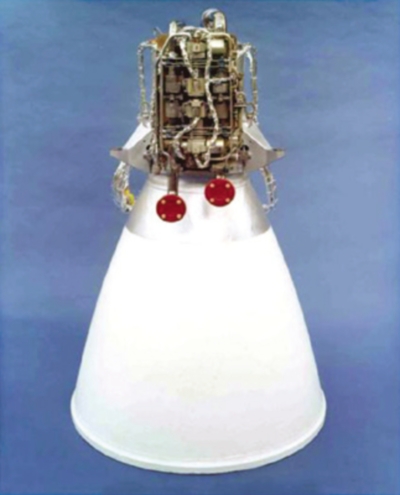
Scale model of the Apollo lunar module ascent stage engine, by an important small company. The story of this vital and non-redundant system, built by a subcontractor, illustrates how a project within a project can sometimes be made to work [Pratt and Whitney Rocketdyne].

Tim Harmon
Chapter 7, Remembering the Giants

First time, everytime, there was no second chance. The lives of two men on another planet hung on the flawless performance of a single engine. Frames by Kipp Teague from the video [Apollo Surface Journal].

Redundancy was really a major hallmark of the Apollo Program. Everything was redundant.

Once you got the rocket going, you could even lose one of the big F-1 engines, and it would still make it to orbit. And once the first stage separated from the rest of the vehicle, the second stage could do without an engine and still make a mission. This redundancy was demonstrated when an early Apollo launch shut down a J-2 second-stage engine. Actually, they shut down two J-2 engines on that flight. Even the third stage, with its single J-2 engine, was backed up because the first two stages could toss it into a recoverable orbit. If the third stage didn’t work, you were circling the earth, and you had time to recover the command module and crew.

Remember how on the Apollo 13 flight, there was sufficient system redundancy even when we lost the service module. That was a magnificent effort. TRW Inc. really ought to be proud of their engine for that.

We had planned for redundancy; we had landed on the moon. However, weight restrictions in the architecture said, “You can’t have redundancy for ascent from the moon. You’ve got one engine. It’s got to work. There is no second chance. If that ascent engine doesn’t work, you’re stuck there.” It would not have looked good for NASA. It wouldn’t have looked good for the country. There was a letter written that President Richard Nixon would read if the astronauts got stuck on the moon, expressing how sorry we were and so forth. It was a scary letter, really. The ascent engine was an engine that had to work.

Read the full presentation (pdf, 4 Mb), HERE.

Saturday, March 14, 2009

Flight of the Spider - The unsung triumph of Apollo 9

BBCNews: 'Ungainly' perhaps: The Spider, Apollo's First
Lunar Module never left Earth orbit.

Forty years ago this week, mankind's attempts to land on the Moon took a giant leap forward with the maiden spaceflight of the Apollo Lunar Module. Continuing his series of essays for the 40th anniversary of the Moon landings, Dr Christopher Riley reminds us of the importance of the often overlooked Apollo 9 mission and the momentous message one of its crewmen brought back to Earth.
Read the Tribute HERE.

Sunday, March 16, 2008

Lunar Module replica to fetch X-Prize

Word from Edward Peyer and the SpaceTraveler's Blog that plans are underway to actually build and equip a replica of an Apollo Lunar Module for a return to the Moon in 2010, after a fortieth anniversary tour of the United States in 2009.

Construction would be done by volunteers in front of PBS cameras near Washington, D.C. beginning in October.

From the platform, organizers intend to complete the requirements necessary to bring home the Google Lunar X-Prize, all of which would require a lot of new and modern body work, modern electronics, and a robotic rover, guidance, power systems, and more.

Chance are it will weigh quite a bit less than an original LM, even when accounting for the lack of human cargo.

Not a bad plan, really. You can bet the computers will be a lot more reliable and cheaper, ironically dependent on innovations made possible by the original.

READ MORE: Space Traveler's (Science) Blog & Edward Peyer, Inc.