Showing posts with label Charlie Duke. Show all posts

Monday, July 23, 2012

Charlie Duke commemorates Aldrin communion

Apollo 11 capcom and Apollo 16 lunar module pilot Charlie Duke addresses Monte Sano Methodist Church in Alabama, July 22, 2012. Congregants snacked on Moon Pies and Tang before heading into the sanctuary to commemorate Buzz Aldrin's "lunar communion" 43 years ago, Friday [Glenn Baeske/The Huntsville Times].
Steve Doyle
The Huntsville Times
 

"It seemed only appropriate that astronaut Charlie Duke - the 10th human to set foot on the moon - was the guest of honor at the church's "Lunar Communion" service Sunday morning.

Pastor Dale Clem said Monte Sano United Methodist is one of just two U.S. churches that commemorate astronaut Buzz Aldrin taking communion on the moon July 20, 1969 - 43 years ago Friday. Aldrin's church, Webster Presbyterian in Houston, is the other.Before heading into the sanctuary, worshipers snacked on Moon Pies, crescent-shaped cantaloupe slices and, of course, Tang.

Selected for the astronaut program in 1966, Duke was in mission control as Aldrin and Neil Armstrong delicately maneuvered their Apollo 11 lunar landing module toward the moon's surface.

"Roger, copy you down, Eagle...We're
breathing again." As Apollo 11 capcom,
Duke was first to talk directly with
another on the Moon [NASA].
Duke, the lunar landing module pilot, said his heart was racing at 144 beats per minute as the Saturn V took to the heavens. Commander John Young, making his second space voyage, was a relaxed 70 beats per minute.

When Duke's heart finally stopped hammering, wonder took over. He said he'll never forget the first time he gazed back toward home from 20,000 miles away.

"That jewel of Earth - the browns of the land and the crystal blue of the oceans and the pure white of the snow and clouds - is indelibly imprinted upon my mind."

Duke said he didn't have a spiritual experience, per se, during the 20 hours he spent combing the moon's surface.

But after returning to a hero's welcome and diving back into the business world, he said he began longing for something more.

Duke said he found what he was looking for when he reluctantly agreed to attend a three-day Bible study at a tennis club in New Braunfels, Texas.

Read the full article, HERE.

Tuesday, June 19, 2012

Astronaut's eye view of the Apollo 16 landing site

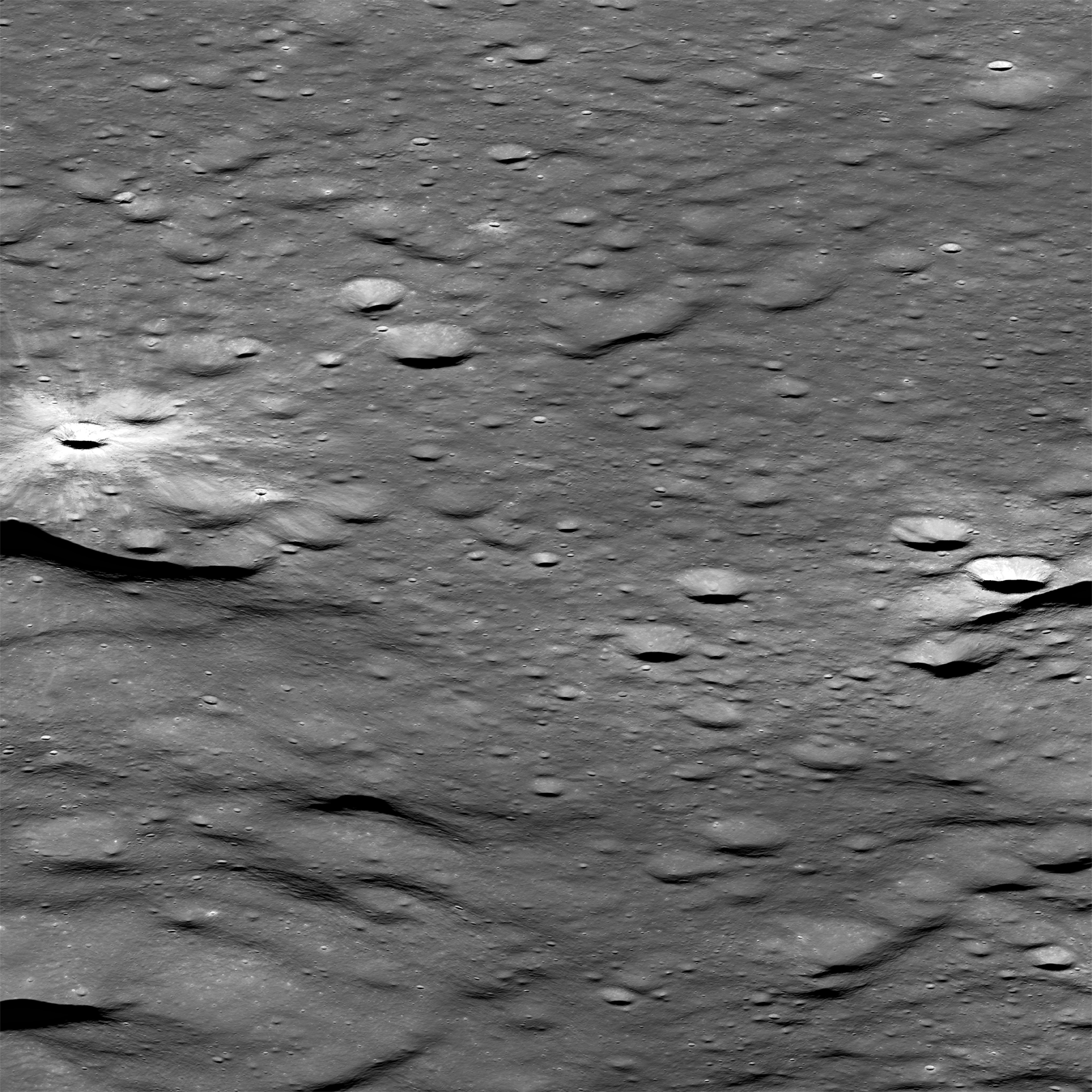
Oblique LROC Narrow Angle Camera (NAC) image of the Apollo 16 landing site, viewed from east to west.  Brighter South Ray crater is center left and North Ray crater center right, and the distance between the two landmark crater centers is 10.5 km. LROC NAC montage M192817484LR, LRO orbit 13442, May 28, 2012. View the 1600 x 1600 full-size 4 meter resolution LROC Featured Image HERE [NASA/GSFC/Arizona State University].
Mark Robinson
Principal Investigator
Lunar Reconnaissance Orbiter Camera
Arizona State University

On May 28 LRO was slewed 59° to the west, from an altitude of 92 km (57 miles) and captured a dramatic view of the Apollo 16 landing site.

During the Apollo 16 mission Ken Mattingly passed over the site several times at an altitude of 120 km (75 miles).  If you imagine yourself in the Command Module, then this view is close to what you would have seen.

The lighting is nearly identical to that of when the Lunar Module Orion set down on the Moon.

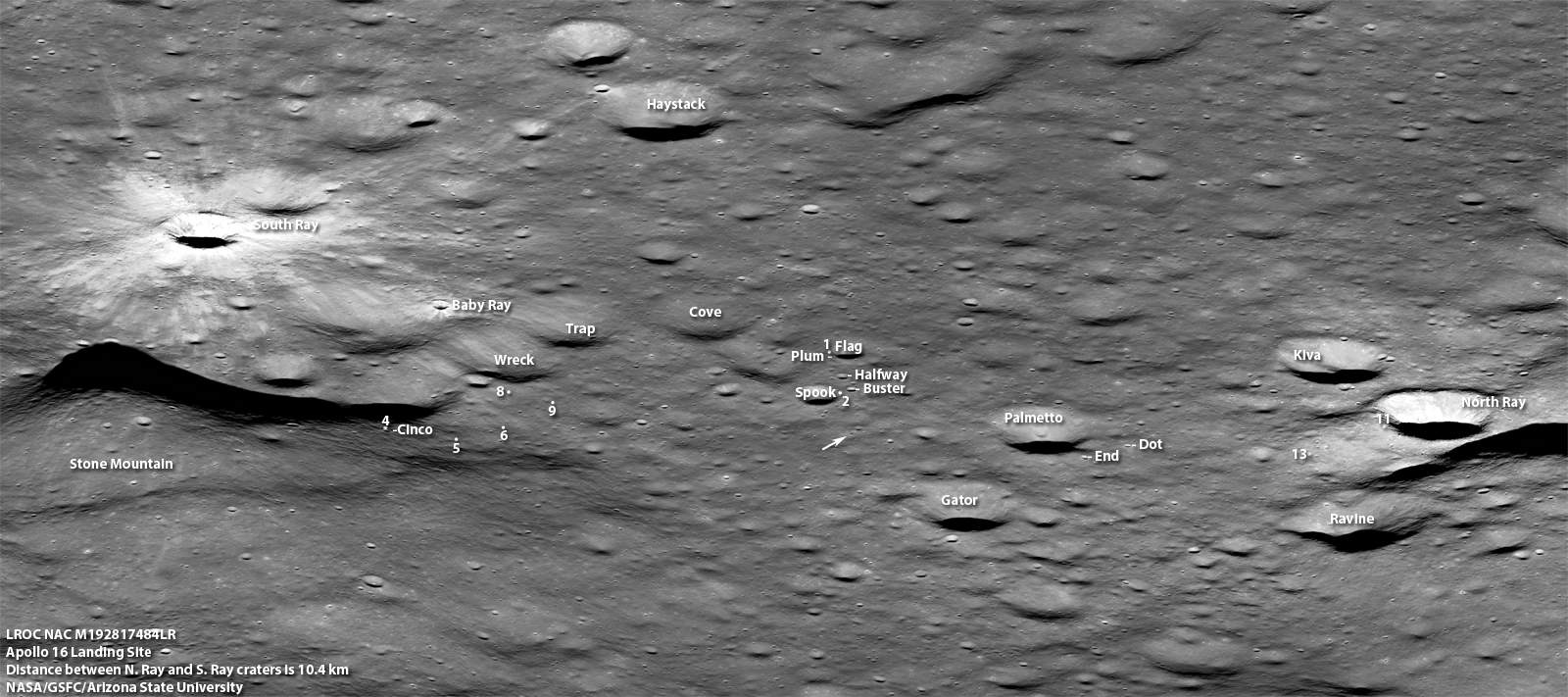
Subsampled subimage centered on Apollo 16 site, key craters and astronaut sampling stations are labeled (arrow shows location of lunar module descent stage and lunar rover), field of view 11 km across. View the 1600 px, full-size annotated image HERE [NASA/GSFC/Arizona State University]
On the second day of surface activities John Young and Charlie Duke headed south to sample material from Stone mountain and ejecta from South Ray crater. They headed south and turned east climbing up the flank of Stone Mountain. Imagine the view that Young and Duke had from Cinco crater (Station 4)! From their vantage point some 300 meters above the LM, the astronauts could see all the way from South Ray crater to North Ray crater.

Full resolution details from the Apollo 16 oblique image. Upper left: Lunar Module descent stage above and to the left of the forever parked Lunar Rover (arrows). Upper right: House Rock on the rim of North Ray crater. Lower left: Baby Ray crater. Lower Right: Shadow Rock (arrow). Each view is 530 meters wide and 1240 meters deep [NASA/GSFC/Arizona State University].
Full resolution field of view from a LROC Wide Angle Camera (WAC) monochrome (604nm) montage, swept up from a mere 38.27 kilometers, in orbit 11299, December 3, 2011; 52.3 meters resolution. Like the Featured Image, the illumination from the east, at a 69.57° angle of incidence, is similar to the lighting during the Apollo 16 expedition in April 1972 [NASA/GSFC/Arizona State University].
With the annotated version you can easily retrace the routes followed by Young and Duke as they spent three days exploring this highland landing site. Read a detailed reconstruction of the astronaut activities through the Apollo Lunar Surface Journal

What did they find at House Rock? Why was Shadow Rock an important science target? Is Baby Ray crater older or younger than South Ray crater? Then imagine yourself picking up where the Apollo astronauts left off over forty years ago!

When will we return to the Moon?

Dive into the full resolution oblique shot of the Apollo 16 site, HERE.

Retrace the astronaut traverses in an annotated version of oblique image, HERE.

Previous Apollo 16 LROC Featured Images
How Young is Young?


Friday, April 27, 2012

Forty years ago

Diver crews off the carrier U.S.S. Ticonderoga hustle recover Apollo 16 command module soon after splashdown in the Pacific (0°43′S 156°13′W), April 27, 1972. Along with the distinct scarring of their fiery direct-return re-entry John Young, Charlie Duke and Ken Mattingly return, arrive following 11 days in Space with 95.71 kg of lunar samples. During their mission the U.S. House of Representatives directed development of a Space Shuttle transportation system to debut in 1976. The next and last expedition to the lunar surface would take place the following December, and Young commanded the first orbital flight of Space Shuttle Columbia in 1981 [NASA/JSC/ALSJ].

Tuesday, April 24, 2012

LROC: Orion, Up Close

40 years parked on the Cayley plain northwest of the Descartes formation.
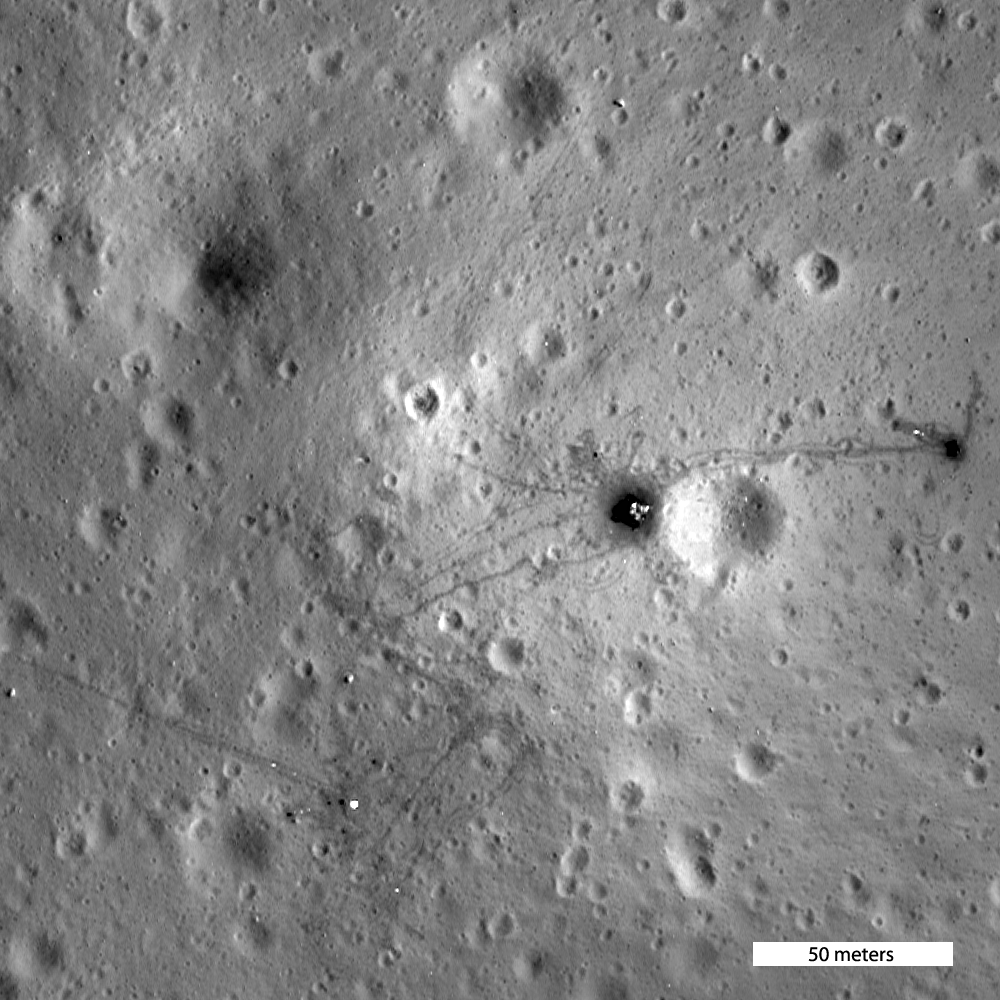
The second of two narrow periapsis orbital passes afforded the LROC team an opportunity to capture this astounding view of the Apollo 16 landing site, orbit 10950, November 6, 2011. LROC Narrow Angle Camera (NAC) mosaic M175179080; field of view above = 145 meters. See the 250 meter FOV in the LROC Featured Image, released on the 40th anniversary of the lift-off from the Moon of the Apollo 16 lunar module ascent stage Orion, April 22, 2012, HERE [NASA/GSFC/Arizona State University].

Mark Robinson
Principal Investigator
Lunar Reconnaissance Orbiter Camera
Arizona State University

The Apollo 16 Lunar Module Orion set down on the lunar surface 40 years ago (21 April 1972) after remaining in a holding pattern for six hours while technical issues with the Command Module Casper were resolved.

Here John Young and Charlie Duke undertook the first and only exploration of a highlands site; their main goal was to sample the enigmatic light plains deposits that geologists had interpreted as remnants of a large scale explosive volcanic eruption.

These proposed volcanic rocks were to be very different than the volcanic mare basalts sampled at previous sites (Apollo missions 11, 12, and 15).

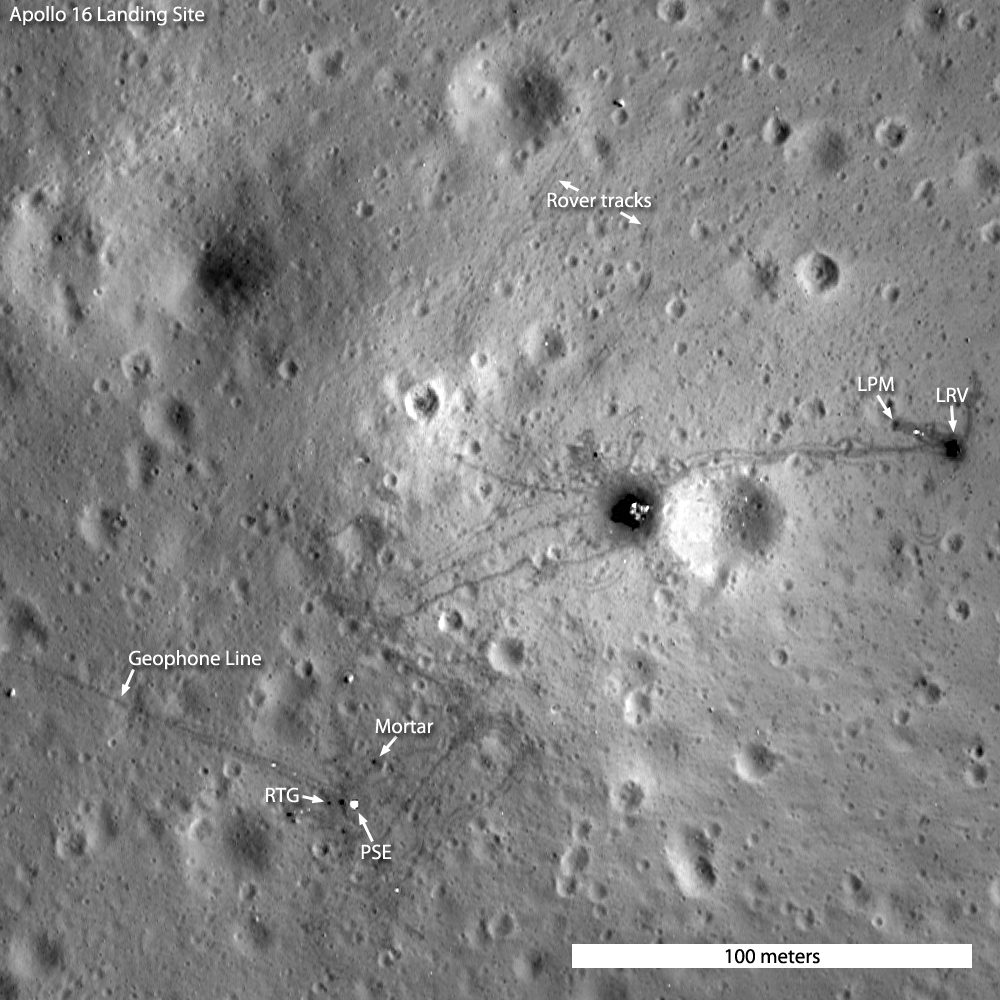
Annotated version of the LROC commemorative Featured Image of the Apollo 16 landing site, full image release 250 meters field of view (M175179080) HERE [NASA/GSFC/Arizona State University].
Once Young and Duke started looking at rocks near Orion, it became clear that there were no strange highland volcanic rocks. What they found were breccias, breccias, and more breccias. Why breccias, and how did they form? The Apollo 16 rocks were most similar to those collected by Apollo 14 astronauts Al Shepard and Ed Mitchell. As it turns out, the breccias formed as part of massive flows of ejecta from the Imbrium and Nectaris basin-forming events. Young and Duke were sampling crushed rocks that flowed hundreds of kilometers from their source!

Enlargement of Apollo 16 site, the Lunar Portable Magnetometer (LPM) is in the center of the dark spot below the annotation, the arrow shows Sun glint off an electronics cable, M175179080 [NASA/GSFC/Arizona State University].
Similar to the other Apollo missions, the Apollo 16 crew set up science instruments to measure varied aspects of the Moon and its environment. Most science instruments were part of the Apollo Lunar Surface Experiments Package, or ALSEP. The Apollo 16 crew also carried with them on their geology traverses the Lunar Portable Magnetometer (LPM) that measured variations in the strength of the Moon's weak magnetic field. Some of the ALSEPs (Apollo missions 12, 15, 16) carried a stationary Lunar Surface Magnetometer (LSM) that provided a point measurement for the landing site as a whole.

On April 22, 1972, minutes before the end of their third and final EVA, John Young took this photograph from his vantage over the lunar rover, parked for the final time so it's color television camera, controlled from Houston, could capture the ascent stage lift off. The LPM is just outside the full-size picture (AS16-116-18716) to the right, and the ALSEP site is in the distance on the left. [NASA]. 
Still image from the televised feed, after nearly 21 hours out on the lunar surface, at Mission Elapsed Time (MET) 175 hours, 31 minutes, 49 seconds, Young and Duke lift off in the Orion ascent stage, headed for rendezvous with Tom Mattingly awaiting them in the Command Module, and home [NASA/Apollo 16 Lunar Surface Journal]. 
The LSMs showed that from site-to-site the magnetic field varied by about a factor of fifty, from a low of 6 gammas (Apollo 15) to a high of 313 gammas (Apollo 16). From the LPM station-to-station measurements within the Apollo 16 traverses, the magnetic low was 121 gammas and high the high was 313 gammas; a factor of nearly three over a distance of 7 km.

The Apollo 16 Lunar Portable Magnetometer in its final configuration beside the parked rover. Note lunar sample rock 60335 is  temporarily perched on the magnetometer for calibration purposes. AS16-116-18721 [NASA].
The magnetometer on Lunar Prospector (1998-99) mapped
what may be the most intense crustal magnetism on the Moon
80 kilometers south of the Apollo 16 landing site, associated
with the bright albedo north of ancient Descartes crater
[Richmond, et al., (2003)].

After setting up the LPM, a final experiment was performed by measuring the magnetic field before and while a small rock was perched on the experiment. This experiment returned two important results: a) the local rocks had a remnant magnetic field so weak that the LPM could not detect it, and b) that the LPM was still working as before launch. These results came from the fact that the astronauts brought the sample (60335) back to Earth, and it was measured by an identical LPM as well as well as even more sensitive instruments.

What did these varied magnetic readings tell us about the Moon? The Moon's magnetic field comes from crustal and mantle materials, has no dipole signature, and is very weak. 

This is a magnetic field very different from the dipole field generated in the Earth's core. Right now scientists do not understand the origin of the lunar magnetic field or its variations. Perhaps the signature of an early, but now extinct, dipole field was captured in ancient lunar rocks as they cooled from a magma ocean. 

Perhaps basin-forming impacts induced local fields in the crust. These Apollo area measurements do tell us that the interior of the Moon is heterogeneous and complicated: the Moon is not a simple body. The two GRAIL spacecraft, Ebb and Flow, that are now in orbit about the Moon will provide gravity measurements that geophysicists will use to deepen our understanding of the lunar interior; the Apollo era magnetic readings will be part of that unfolding story.

Find the LPM and the rest of the ALSEP hardware in the full NAC image, HERE.

Previous LROC Apollo 16 Featured Images:
Apollo 16, Footsteps Under High Sun
How Young is Young?
Apollo 16 First Look
Apollo 16 North Ray crater

Young put the Orion ascent stage into a slow roll so Tom Mattingly could photograph the buckled skin of the spacecraft first noticed after the lunar module was retrieved from the SIVB after trans-lunar injection. The damage was made much worse by the force of its lift-off from the Moon. Back in lunar orbit, the distinctive craters Messier and Messier A can be seen at right. AS16-122-19535 [NASA/JSC].
Previous Low Altitude LROC Image Releases:
Apollo 11
Apollo 12
Apollo 14
Apollo 15
Apollo 17, Shorty crater

A fanciful edit of AS16-107-17435, showing how the Orion descent stage may look forty years after the brief, but productive expedition of Apollo 16.

Saturday, April 21, 2012

Duke recalls Moon landing on 40th anniversary

General Charles Duke (USAF, Ret.) sat down for an interview with WBTV (Charlotte , NC) in nearby Lancaster, South Carolina. Duke was tenth among the twelve who've walked on the lunar surface, and, as CAPCOM for Apollo 11, he was the first to talk to another human being standing on the Moon [WBTV].
Trent Faris
WBTV Charlotte

LANCASTER, SC (WBTV) - Most kids grow up dreaming of the stars wanting to be an astronaut.

When Charlie Duke was at Lancaster High School in 1950 he just dreamed of following his father's footsteps to be a military officer. After graduating from the Naval Academy, Duke became a pilot in the Air Force.  He was serving as a fighter pilot in Germany when he heard about the first selection of astronauts to go into space.

"I began to say man that ought to be a fun, fun experience, but I wasn't qualified. Then I thought the space program would pass me by," said Duke during a rare sit-down interview with WBTV.


Duke ended up at MIT where his work on Apollo guidance and navigation systems earned him a ticket onto the Apollo program. In the nine Apollo missions to go to the moon, Duke worked on five of them, including Apollo 11.

"Well, Neil Armstrong came to me and said 'How about doing the same thing you did on 10 for us' so I developed those procedures," said Duke.

Everyone knows these famous words: "Houston, Tranquility base here. The Eagle has landed." Those words came from Armstrong after the first successful landing on the lunar surface in 1969. 

The voice you hear next on the transmission from mission control - was Duke. "Roger that Tranquility. We copy you on ground. You've got a bunch of guys about to turn blue, we're breathing again," Duke was recorded saying.

Duke was the back-up Lunar module pilot for Apollo 13 and 17, but Apollo 16 was his mission to the moon.
Read the article, HERE.
Related Posts:
Forty years ago: 'a big ol' Navy salute'

Forty years ago: 'a big ol' Navy salute.'

Joy - The second of two 'mid-air' salutes. (Detail from AS16-113-18340, April 21, 1972, Apollo 16, EVA 1) by Cmdr. John Young answering Charlie Duke's request that he to pose for a photograph with two jumps, accompanying each with 'a big ole Navy salute.' [NASA/JSC/ALSJ].
From the Apollo Lunar Surface Journal: 120:25:42 "John Young jumps off the ground and salutes for this superb tourist picture. He is off the ground about 1.45 seconds which, in the lunar gravity field, means that he launched himself at a velocity of about 1.17 m/s and reached a maximum height of 0.42 m. Although the suit and backpack weigh as much as he does, his total weight is only about 65 pounds (30 kg) and, to get this height, he only had to bend his knees slightly and then push up with his legs. In the background, we can see the UV astronomy camera, the flag, the LM, the Rover with the TV camera watching John, and Stone Mountain. Journal Contributor Joe Cannaday notes that high-point of John's first jump was at a time close to 120:25:49 and the second was almost exactly three seconds later."


After trading places for Young to capture Duke's 'Air Force salute' Houston passes along 'good news.' The U.S. House of Representatives has authorized the Space Shuttle program. 

Young, who will command the first Space Shuttle mission 9 years later, answers, "Beautiful. Wonderful. The country needs that Shuttle mighty bad. You'll see."

From the Apollo Lunar Surface Journal: "John became the Chief of the Astronaut Office in 1975 and, later, appointed himself to command the first Shuttle flight. STS-1 was 36-orbit mission launched on April 12, 1981, the twentieth anniversary of Yuri Gagarin's Vostok flight. The pilot - and only other crewmember - on STS-1 was Robert Crippen.".
Landing site of Apollo 16, between North Ray and South Ray craters, northwest of the Descartes Formation ("Stone Mountain, at lower right) in the nearside lunar highlands. Full 52 meter resolution detail from LROC Wide Angle Camera monochrome (604nm) observation M177535094C, LRO orbit 11299, December 3, 2011; angle of incidence 69.4° from 38.2 kilometers altitude [NASA/GSFC/Arizona State University].

Forty years ago

Lunar module pilot Charlie Duke captured this view, through Apollo 16 commander John Young's window, April 21, 1972 (UT). To the left is Stone Mountain, northwest extreme of the Descartes Formation, where the astronauts would gather samples during their second of three EVA's. On the right is the bright ejecta blanket of South Ray crater, easy to spot through modest amateur telescopes from Earth, and a relatively recent impact that had conveniently excavated some of the oldest rocks in the lunar highlands. AS16-113-18300 [NASA/JSC].

Follow the Mission at the Apollo 16 Lunar Surface Journal

The latest released and indexed LROC Narrow Angle Camera (NAC) image of the Apollo 16 landing site was swept up in local morning lighting (incidence angle = 69.64°) not very different than the conditions encountered by Young and Duke forty years ago. The Orion descent stage, the astronaut's dusty boot-trails churned through optically immature regolith just exposed by the descent stage engine and the lunar rover parked just to the east are all visible. LROC NAC M177535538L, orbit 11299, December 3, 2011 from 38.6 kilometers [NASA/GSFC/Arizona State University].
Related Posts:

Wednesday, April 11, 2012

Schmitt and Duke among NASA notables urging agency adopt balanced climate agenda

The sole professional scientist to explore the lunar surface, geologist and former U.S. Senator Harrison Schmitt, and Apollo 16 lunar module pilot Charles Duke, together with five other Apollo astronauts, are among the 49 former NASA directors, scientists and astronauts who signed an open letter to NASA Administrator Charles Bolden last week, "admonishing (NASA) for it’s role in advocating a high degree of certainty that man-made CO2 is a major cause of climate change while neglecting empirical evidence that calls the theory into question."

The group, which includes two former directors of Johnson Space Center in Houston, are "dismayed over the failure of NASA, and specifically the Goddard Institute For Space Studies (GISS), to make an objective assessment of all available scientific data on climate change."

They charge that NASA is relying too heavily on "complex climate models that have proven scientifically inadequate in predicting climate only one or two decades in advance."

H. Leighton Steward, chairman of the non-profit Plants Need CO2, noted "many of the former NASA scientists harbored doubts about the significance of the C02-climate change theory and have concerns over NASA’s advocacy on the issue." While making presentations in late 2011 to many of the signatories of the letter, Steward "realized that the NASA scientists should make their concerns known to NASA and the GISS," according to the press release accompanying the letter.

“These American heroes – the astronauts that took to space and the scientists and engineers that put them there – are simply stating their concern over NASA’s extreme advocacy for an unproven theory,” Steward said.

“There’s a concern that if it turns out that CO2 is not a major cause of climate change, NASA will have put the reputation of NASA, NASA’s current and former employees, and even the very reputation of science itself at risk of public ridicule and distrust.” 

Select excerpts from the letter:
The unbridled advocacy of CO2 being the major cause of climate change is unbecoming of NASA’s history of making an objective assessment of all available scientific data prior to making decisions or public statements.”

We believe the claims by NASA and GISS, that man-made carbon dioxide is having a catastrophic impact on global climate change are not substantiated.” 

We request that NASA refrain from including unproven and unsupported remarks in its future releases and websites on this subject.”
 The full text of the letter and signatories, HERE.

Related Post:

Wednesday, April 21, 2010

Apollo 16: 38 years on

Early in the first of three EVA's on the Cayley Plain terrain between North Ray and South Ray crater immediately northwest of the Descartes Formation, Apollo 16 lunar module pilot Charlie Duke suggested the lighting and backdrop, including the U.S. flag and "Stone Mountain" beyond was a beautiful photo opportunity. After a moment of hesitation, the famously sedate Cmdr. John Young jumped up and Duke took this now-famous image [NASA/ALSJ]. As cataloged by Eric Jones in the indispensable Apollo 16 Lunar Surface Journal:
"120:25:42 John Young jumps off the ground and salutes for this superb tourist picture. He is off the ground about 1.45 seconds which, in the lunar gravity field, means that he launched himself at a velocity of about 1.17 m/s and reached a maximum height of 0.42 m. Although the suit and backpack weigh as much as he does, his total weight is only about 65 pounds (30 kg) and, to get this height, he only had to bend his knees slightly and then push up with his legs. In the (full) background, we can see the UV astronomy camera, the flag, the LM, the Rover with the TV camera watching John, and Stone Mountain. Journal Contributor Joe Cannaday notes that high-point of John's first jump was at a time close to 120:25:49 and the second was almost exactly three seconds later."

Up the slope of "Stone Mountain," near the southern terminus of their second EVA, April 22, 1972, Charlie Duke photographed the bright highlands plain below, all the way to the northern terminus at North Ray and Kiva craters he and Young would visit the following day. In this inset from one in the telephoto panorama, the lunar module is seen from a perspective directly opposite from that seen in the "tourist shots" taken the previous day.


And also through "heavy lenses," from ~50 km overhead (and 37 years after Young and Duke completed their mission), the Descent Stage of their Orion lunar module was imaged in bright lunar mid-day; phase angle = 7.77° (~51.7 cm pp). LROC NAC M113853974LE [NASA/GSFC/Arizona State University].

Thirty Eight years ago today, Young and Duke began emerged on the Cayley Plains of the Moon northeast of Descartes and began three days of exploration. It's a good time to take advantage of the rich legacy of this second to last manned expedition to the Moon by sampling its still-studied science at the Apollo 16 Lunar Surface Journal.

Thursday, February 18, 2010

Carpenter, Cernan & Duke urge support for Constellation

Dear Friends:

There has never been, and likely never will be, another government program that expedites technological innovation so much as the U.S. space program. There is not another program that has so successfully rallied a nation, inspired youngsters toward academic achievement or established the U.S. as the world leader in technology.

The manned space program has, in particular, been a source of our nation’s strength and character. But an Achilles heel in the form of our country’s executive branch threatens a mortal wound. Under the Obama 2011 budget, the U.S. will no longer ferry humans into space— no moon, no Mars. The source of much of America’s inspiration and spirit, the impetus for so much discovery, technology and imagination, is in jeopardy. The demise of America’s space program is just another step in the dismantling of our nation.

Where's the vision put so eloquently in 1962 when President Kennedy said," serve to organize and measure the best of our energies and skills." President Kennedy delivered a vision to the American public that demanded courage, imagination and follow-through. The long-term focus has always been to progressively conquer new frontiers. Certainly, that focus has been shared by both government and private enterprise but to withdraw government from manned space flight will surely obliterate those far-reaching frontiers and precipitously lower our nation’s preeminence in technology.

We are the only country to ever conquer the high ground, the moon. And now we are to give that up to the Russians and Chinese who are committed to having a permanent presence there? The national security implications are starkly real. From the high ground, foreign governments will have greater access to monitor U.S. technology assets in Earth orbit. Whoever controls the high ground becomes the world’s leader in technology.

We ask you to join those members of Congress who have the fortitude and courage to embrace the vision that has become part of our nation’s signature and who are advocates of returning to the moon and maintaining America’s leadership role in the exploration of space.

Charles Duke - Scott Carpenter - Eugene Cernan
www.supportconstellation.com

Wednesday, May 27, 2009

Charlie Duke's surface notebook at auction

The cuff mounted checklist worn by Apollo 16 Lunar Module Pilot Charlie Duke while exploring the Descartes region on the moon in 1972 is displayed at Bonhams, April 27, in London. The piece, expected to fetch between $200,000 and $300,000, makes up part of a historic collection of space exploration artifacts being sold at auction on July 16. (Getty)

How did this piece of American history end up on the auction block, in London? The Getty Image above does not do it much justice.

This is the notebook that was once mounted to the cuff of Apollo 16 lunar module pilot and Brig. General Charles M. Duke, Jr. (USAF), referencing sampling to be done during his and Captain John Young's third EVA, north of their landing site, from the "Ejecta Blanket" of North Ray Crater.

The artwork is probably only a mystery to me

Was it added before or after the mission, and was it drawn by General Duke himself?

A contemporary of mine who, like me, remained glued to the television just as much during Apollo 16 as during Apollo 11, calls one of the sketches "endearingly crude." (I think they are magnificent. Do you know what a thimble filled with lunar dust is worth, just for its science value alone, these days?)

A student, too young to remember when there was not an International Space Station simply calls the artwork "cute," and calls my reluctance to post the sketch seen here, "charming." I think she just misunderstands my appreciation of fine art, what Dr. Sigmund Freud was referring to when pondering "what's on man's mind?"

What really grabs my attention is the sheer iconography this notebook represents, not simply because Larry Scott and I became enthralled with Descartes Formation, and its fascinating magnetic anomaly or bright albedo, in our studies - though it is true that my eye is first drawn in a telescope to North and South Ray Craters, and Descartes, when gazing through the telescope at Ellis Cove.

Imagine, for a moment, stumbling upon the notebooks of Columbus. You know already, because of his son's Ferdinand's biography, about Columbus and there are samples of his handwriting, her and there, apparently.

Just as we've collected those splendid restorations of the photography from Apollo 16, however, there is just no substitute for the experience of actually standing on Descartes, at EVA Station 4, for example, or the rim of Kiva, or experiencing the actual Descent down into the narrows between the "Smoky Mountains" and "Stone Mountain," the very northern edge of the rolling Descartes phenomena.

This notebook comes pretty close. It evokes inspiration, bordering on idolatry in me, I have to confess. It is hard evidence real human beings walked on the Moon with a studied purpose, forty years ago. I didn't just dream that.

There are few seemingly both unaffected and deeply affected by that experience than Charlie Duke. We can't all drop in on General Duke, down in the Texas Hill Country, and especially unannounced. Fortunately, he did leave a virtual light on.

He has a website, thank goodness. It's bound to keep fanatical pilgrims, the curious and the kooky, at a safe distance. - JCR


(In addition to becoming Tenth to walk on the Moon in 1972, General Duke also served as CapCom during the Apollo 11 landing in 1969. Many have heard his voice and not recognized his unique part in the last anxious moments that first Terminal Descent to the lunar surface. General Duke was the first person to talk to someone on the Moon.)

Thursday, April 9, 2009

Duke speaks at Texas State on Apollo 16

As reported last month, Charlie Duke told the story of his experience as lunar module pilot on Apollo 16 at Texas State University in San Marcos, this week. I couldn't be there, as I had keenly wanted, unfortunately, but Sean Wardwell, managing editor of NewsStreamz.com in San Marcos did attend, and filed a better than average story on the moonwalker's lecture.

Almost exactly thirty-seven years after exploring the Cayley plain between North Ray and South Ray Crater, and along the northwestern rim of Descartes Formation at Stone Mountain, along with Captain John Young, Charles Duke came to San Marcos, Monday, and said, "I'm a story teller."

"And what a story he had to tell," Wardwell wrote.

Read the historic account HERE.

Thursday, March 12, 2009

Charlies Duke to speak at San Marcos

He was the tenth and youngest man to walk on the Moon in April 1972, serving with Commander John Young as lunar module pilot on Apollo 16. His most famous role, oddly enough, may be one he is least credited with, the first human to talk with another human on the Moon while serving as capcom during the landing Apollo 11 landing, three years earlier.

"Roger, copy you down Eagle. You got a bunch of guys about to turn blue, we're breathing again," Duke said, acknowledging Dr. Armstrongs confirmation that, "the Eagle has landed."

A few days shy of the 37th anniversary of his and Young's exploration of the northern reaches of the Descartes Formation, Brig. General Charles M. Duke, Jr. (USAF, Ret.) is scheduled to speak on “The Adventure of the Apollo Moon Landings” April 7 on the campus of Texas State University in San Marcos.
Read more HERE.

Thursday, March 6, 2008

In The Shadow Of The Moon

Documentary: US - 86 minutes
Sandra Hall, reviewer -The Sydney Morning Herald

Alan Bean of the Apollo 12 crew has always thought of himself as one of the more fearful astronauts. Lift-off sent his heart rate shooting up to 144 beats a minute. In contrast, the heart of John Young, the sleepy-eyed slow talker who captained the Apollo 16 flight, kept ticking away at a steady 70.

So astronauts are human - something that didn't dawn on the rest of us until Tom Wolfe dramatised the backstage story of America's first manned space missions in The Right Stuff. Since then, we've known the astronauts best through their on-screen alter egos. The real-life models have merged into that emblematic figure - Neil Armstrong setting foot on the moon while intoning those sonorous words: "That's one small step for man, one giant leap for mankind."

So this documentary, which combines film taken during the space voyages with footage of the era and interviews with the astronauts, arrives late in the day. Yet just a few minutes in, you begin to realise that the long gap between recollection and reality makes it all the more revealing.

The director, David Sington, has gathered crew members from every Apollo mission that flew to the moon and these men, with their space careers long behind them, prove a wry and reflective bunch who rejoice in bringing the wisdom of hindsight to their experiences. They belong to a select company. The Apollo program ended in 1972, which means they are still the only humans to have walked on the lunar surface.

All were former test pilots and they remind us that if they hadn't gone to the moon, they would have gone to Vietnam. Gene Cernan, who captained the last Apollo flight, still sounds rueful about this. "They were fighting my war for me," he says of the test pilots with whom he trained. He remembers, too, that they were being shot down on combat missions while he was front-page news as the latest spaceman.

The footage filmed by the astronauts has been transferred to high-definition tape and looks spectacular. None of them has a gift for poetry, but one finds the right words when he comments on the jewel-like nature of Earth hanging in the blackness of space. Others talk about how fragile it looks. There's nothing like leaving the Earth's atmosphere, I imagine, to sharpen your sense of attachment to the one place in the cosmos you can call home.

The moon elicits less poetry. Michael Collins, who flew with Neil Armstrong and Buzz Aldrin on Apollo 11, remembers it as a hostile, scary place. That was from above. He had no chance to get closer for he was the one who stayed aboard the spacecraft. Was he disappointed? It seems not. Rather, he relished his unique perspective. He was able to look down on Earth with its billions of people and on the moon with just two.

He also knew he could return to Earth - unlike Jim Lovell and the rest of the crew of Apollo 13, whose mission was cut short by a systems failure. The moon ceased to matter as they became consumed by the question of how to get home. Home. For all the astronauts, it seems, their trips into space intensified their love of Earth. As for their spiritual nourishment, some credit their lunar adventures with awakening or renewing their interest in religion. Others, such the humorous and very likeable Collins, say merely that after you've flown to the moon some of our terrestrial squabbles don't seem nearly as important.

See the Trailer HERE.