Showing posts with label IAF. Show all posts

Thursday, May 24, 2012

Re-release of Iconic Copernicus 'Image of the Century'

Newly processed high-resolution detail from an unprecedented oblique view of the interior of Copernicus captured by Lunar Orbiter 2, from the "Image of the Century" photographed November 24, 1966. Higher and full resolution images are linked to the Moonviews (LOIRP) announcement, HERE [LOIRP].
Keith Cowing
Lunar Orbiter Image Recovery Project
moonviews.com
NASAWatch.com


Today an iconic image from the initial exploration of the Moon is being re-released showing detail that could not have been seen using technology available at the time the photo was taken. This image features a dramatic view inside the majestic crater Copernicus - a view that left millions in awe when it was first released.

This image was announced at the First Global Space Exploration Conference, co-sponsored by the AIAA and IAF, in Washington, DC.

Between 1966 and 1967 NASA sent five Lunar Orbiter spacecraft to the Moon. Their job was to survey the surface to help determine landing sites for the upcoming Apollo missions. In addition to their recon role, these spacecraft also contributed to the nascent scientific understanding of the Moon. But every once in a while these spacecraft also served as artists, snapping photos of this nearby world in a way that human eyes had never been able to see before.
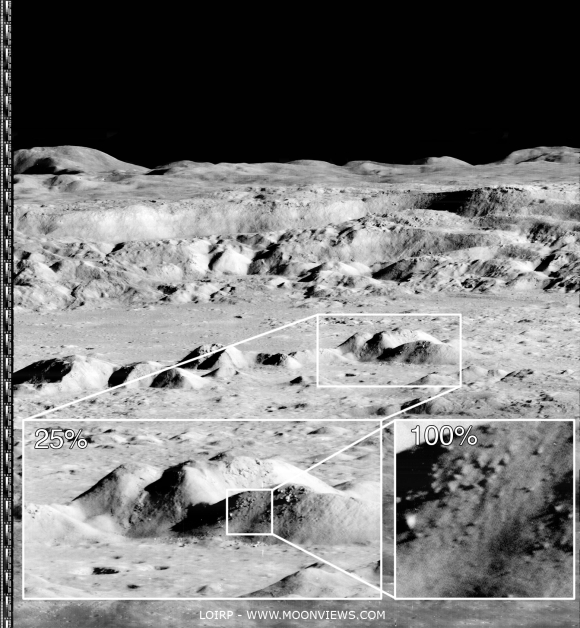
New magnification possible using the 21st century techniques employed by LOIRP. Higher and full resolution images are linked to the Moonviews (LOIRP) announcement, HERE [LOIRP].
Once such image was taken of crater Copernicus on 24 November 1966 by the Lunar Orbiter 2 spacecraft. What made this photo so unique was the oblique angle it was taken at as well the close proximity of the spacecraft to its target. The image was taken at an altitude of 45 km (27.1 miles) at a distance of approximately 207.7 km (~125 miles) from the center of the crater. Instead of looking down, the spacecraft looked sideways at the Moon.

The bouldered area of the central peaks of Copernicus seen newly sampled at "100 percent" in the image further up were swept up by the Lunar Reconnaissance Orbiter Camera in orbit 909, September 9, 2009; LROC Narrow Angle Camera (NAC) observation M107006443R; resolution 1.15 meters (shown here at 4 meters per pixel) from an altitude of 130.11 kilometers [NASA/GSFC/Arizona State University].
For the first time people saw the Moon as a world with mountains and boulders and other features (some of them strange) that were not apparent from photos where the view was looking straight down. So taken were people at the time that Life Magazine took to calling the photo "The Picture of the Century"

Read about the full details in the original article, HERE.

Monday, May 17, 2010

Global Lunar Conference and an "International Robot Village" on the Moon


The International Astronautical Federation (IAF), the International Lunar Exploration Working Group (ILEWG), the Chinese Astronautics Society and others are preparing to host the Global Lunar Conference in Beijing, May 31 - June 3, 1010.

Global Lunar Conference
11th ILEWG Conference on Exploration
and Utilisation of the Moon:

Representatives of the world's space agencies gather at the Global Lunar Congress with a new sense of mission, a result of recent news that there is water on the Moon. A popular concept of the 2004-2005 era, an international robot village on the Moon, is on the agenda, along with other ideas that prevailed before interest in returning Man to the Moon began losing ground to other space objectives. Host China can be expected to present a status report on its Chang’e 3-stage lunar mission.

The international robot village is described as an array of cooperating lunar landers by 2014 that prepares the ground for an "effective, affordable human lunar exploration and permanent presence by 2024."

The Chinese mission will culminate with the launch and landing of a rover on the moon to collect mineral samples in 2012. China became only the third nation, after the United States and Russia, to send a manned spacecraft into orbit. In September, the country’s space scientists announced they have completed the world’s highest-resolution three-dimensional map of the Moon.

The joint organizers of the congress, the Chinese Society of Astronautics and the International Astronautical Federation, argue that lunar missions will lead to new understanding of the origin and the development of the Solar System, opening "new avenues towards a utilisation of lunar resources that could be used in both the exploration of outer space and here on planet Earth."
For further information, the official conference website is here.