Showing posts with label sampling. Show all posts

Wednesday, December 18, 2013

Chang'e-5 lunar sample mission on for 2017

Chang'e-5 ascent stage
A preliminary notional view of the Chang'e-5 ascent stage on departure from the lunar surface. Officials of China's Lunar Exploration Program (CLEP) have confirmed the sample return mission is scheduled for 2017.
Global Times (Beijing) -China has announced the next step in its lunar exploration program will be carried out by a new moon probe, Chang'e-5, expected to launch in 2017.

This follows the successful soft-landing of the Chang'e-3 probe on the lunar surface Saturday evening.

"The research and development of Chang'e-5 is proceeding smoothly at present and we expect it to be finished and ready to launch in 2017," announced Wu Zhijian, spokesman for the State Administration of Science, Technology and Industry for National Defense at a press conference Monday.

The third and final stage of the unmanned missions to sample the lunar surface is expected to be completed by 2020, using the Chang'e-5 and 6 lunar probes, which will be able to return samples to Earth, said Wu.

This is also the last phase of the China Lunar Exploration Program as a part of the National Guideline for Medium and Long-term Plan for Science and Technology Development (2006-20) issued by the State Council in 2006.

China has completed the first two phases of the program, said Wu.

The first phase was achieved when the Chang'e-1 lunar orbiter launched in 2007, while the second phase was marked as complete when the Chang'e-3 lunar probe and its moon rover separated and took photos of each other on the extraterrestrial body on Sunday.

By Monday morning, five of the eight exploratory devices on Chang'e-3 had been put into operation to survey the lunar surface topography and geology, said Zou Yongliao, an engineer from the Chinese Academy of Sciences

M177x3C_604nm-anot-580x800
LROC Wide Angle Camera (WAC) monochrome (604 nm) mosaic of a 35.7 km-wide parcel of the Laplace F - Le Verrier region in north central Mare Imbrium, marking the December 14, 2013 landing site of China's Chang'e-3. From a 200 km-long field of view swept up in three sequential orbits, December 5, 2011; a sunrise angle of incidence of 76° at 61.5 meters resolution, from 44.7 km [NASA/GSFC/Arizona State University].
"The program's third phase will be more difficult because many breakthroughs must be made in key technologies such as lift-off from the moon's surface, sampling encapsulation, rendezvous and docking in lunar orbit, and high-speed Earth re-entry, which are all new to China," said Wu.

The Chang'e-4 probe, which served as a backup for Chang'e-3, will now be used to test the new techniques for the mission's third phase.
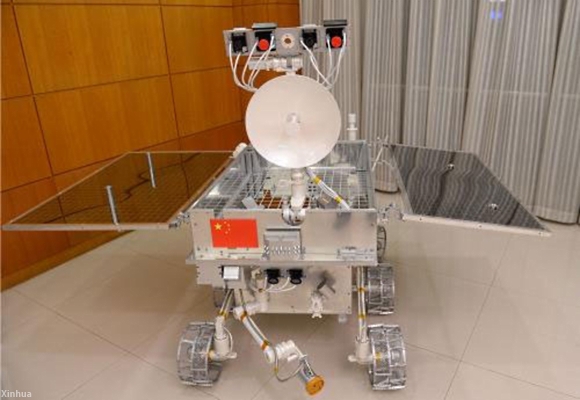
Scale model Yutu
Scale model of the six-wheeled robotic moon rover 'Yutu' (Jade Rabbit), without the, by-now familiar, gold foil thermal blankets. Picture taken at the Beijing Aerospace Command and Control Center [Xinhua].
In response to questions of international cooperation concerning lunar exploration, Wu noted that China is always positive in maintaining good cooperation with other regions and organizations. Data collected through the Chang'e-1 and Chang'e-2 probes is accessible to scientists from across the world, according to Wu.

Wu pointed out that China's exploration will follow the consistent aim of the peaceful use of outer space, which will promote new breakthroughs in high-technology development.

"Despite our current progress, China still lags behind space giants like the US and Russia in many aspects. We need to work harder and move faster," Wu said.

Wednesday, February 13, 2013

Geological sampling and planetary exploration

Representation of Luna 24, lifting off from Mare Crisium after collecting a drill sample for return to Earth. For many years to come, this will be the only way certain kinds of critical testing can be done [RussianSpaceWeb/Anatoly Zak].
Paul D. Spudis
The Once & Future Moon
Smithsonian Air & Space

Samples are currently making news for NASA’s planetary exploration program.  Last August, the rover Curiosity, equipped with a package of laboratory instruments, landed on Mars.  On February 9th the rover’s robotic arm drilled its first hole in a rock selected by scientists.  In their attempt to gain more information about Mars, scientists will use the rover’s science package to remotely analyze these samples on the martian surface.  The results will give them some fairly detailed knowledge on the chemical and mineral make up of these rocks.  But what else can we possibly learn from samples?

Geologists in general and planetary scientists in particular often emphasize that “such and such” cannot be known for certain “until we obtain samples” of some planetary surface or outcrop.  What is this obsession with samples?  Why do (some) scientists value them so highly and exactly what do they tell us?  Answers to this question (for there is not a single, simple one) are more involved than you might think.

With today’s technology providing us with only the most rudimentary information, sample analyses made remotely on a distant planetary surface is limited.  Some of the things we want to know, such as the formation age of rocks, can only be discovered with high precision, careful laboratory work.  That’s a tall order for remote systems.  For example, one of the most common techniques used to “date” a rock’s age requires the separation of individual minerals that make up the rock.  Next, the ratio of minute trace elements and their isotopes in each grain must be determined.  Assuming that the rock has not been disturbed by heating or a crater shock event, this information can be used to infer an age of formation.  If we can convince ourselves that the rock being studied is representative of some larger unit of regional significance, we can use this information to reconstruct the geological history of the region and eventually, the entire alien world.  So sample analysis is an important aspect of geological exploration.

As I have written previously, we used images to geologically map the entire Moon, noting its crater, basin and mare deposits, and their relative sequence of formation.  When the first landing missions were sent to the Moon, great emphasis was placed on obtaining representative samples of each landing site.  It was thought that such samples could be studied in detail in Earth laboratories and then extrapolated to the larger regional units shown on the geologic maps.  With few exceptions, this approach worked pretty well.  As we moved from the landing sites on the maria (ancient lava flows) into the complex highlands, the “context” of the samples – their relation to observed regional landforms or events – became more obscure.  A lunar highland rock is typically a complex mixture of earlier rocks, sometimes showing evidence for several generations of mixture, re-fragmentation, and re-assembly.  Loose samples lying on the surface were collected from the highlands, none of them were sampled “in place” (i.e., from bedrock).  Although this is also true of the rocks from the maria, we observed bedrock “in place” at most of the mare sites and may have actually collected at least one sample from lava bedrock at the edge of Hadley Rille near the Apollo 15 site.

None of the highland samples possess the same degree of contextual certainty as the mare samples.  This fact, coupled with their individual complexity, sometimes leads to consternation over exactly what the samples are telling us.  It doesn’t help that the Moon’s early history was itself very complex, with magmas solidifying, lavas erupting, volcanic ash hurled into space and laid down in bedded deposits.  On top of all those processes were cratering events that mixed and reassembled everything into a complex geologic puzzle, a virtual stew of processes and compositions that hold clues to billions of years of the Moon’s (and Earth’s) history.  Nonetheless, we can still perceive most of the story of the Moon’s history, enough at this point to tell us that without those lunar samples in hand, we would be well and truly ignorant of even its most important events and basic processes.  The fixation with sample return stems from the science community’s belief that with just a few more carefully selected samples from some key units, all that is now dark will be made light.

There may be severe consequences to the science community’s insistence on the primacy of sample return.  The most recent “decadal survey,” the ten-year community study that gives NASA our wish lists for missions and exploration, made a sample return from Mars the centerpiece and sine qua non of future robotic missions.  The NRC report was so emphatic in its insistence that it might be paraphrased as saying, in effect, “Give us a Mars sample or give us death!” (with apologies to Patrick Henry).  Alas, that formulation may be more apt than anyone desired, as proposed out year budgets for the next five years of NASA funding cuts planetary exploration by almost 30% – a landscape of shifting priorities that raises questions and uncertainty for the future.

Robotic sample return missions to large bodies like the Moon or Mars are expensive because they consist of multiple spacecraft – a lander, which softly places the spacecraft on the surface, a device (such as a rover) to collect and store the samples and an ascent vehicle to bring the sample back to Earth.  While none of these functions individually are exceedingly difficult to achieve, all of them (done correctly and in proper sequence) add up to a substantially difficult, complex mission profile.

Among the more recent artist's representation of the high-priority MoonRise mission, ascending from South-Pole Aitken basin [NASA/JPL].
In the space business (as with most endeavors), more difficult and complex means that more money is required.  Moonrise, a proposed robotic mission to return about a kilogram of sample from the far side of the Moon, was projected to cost around one billion dollars.  A Mars sample return mission consisted of three separate missions: one to land, collect and store the samples, another one to retrieve those samples and place them into orbit around Mars, and a final mission to return the samples to Earth.  With each step costing up to several billion dollars, such a technically challenging Mars sample return mission would be unaffordable.

Although samples have many advantages over remote measurements, those benefits must be weighed against the cost and difficulty of obtaining them.  Perhaps the complete extent of what can be accomplished remotely has yet to be fully explored.  As mentioned above, absolute ages are key information that we get from samples.  Several dating techniques could be adapted to a remote instrument; these methods may not be the most precise imaginable, but they might be of adequate precision to answer the most critical questions.  On the Moon, we do not know the absolute age of the youngest lava flows in the maria; age estimates range from as old as ~ 3 billion years to as young as less than 1 billion years.  In such a case, a measurement with 10-20% precision is  adequate to resolve the first-order question:  When did lunar volcanism cease?  In addition, such a result would enable us to calibrate the cratering curve for this part of lunar history, a function that is widely used to infer absolute ages throughout the Solar System.  A solid result obtained from a robotic lander – even such a relatively imprecise one – would have important implications for lunar volcanic processes, thermal history, impact flux, and bulk composition.

Complex robotic operations in space are always dicey, especially when attempting something for the first time.  Samples are a key part of a planetary scientist’s toolbox but their acquisition is difficult, time-consuming and expensive.  Samples from robotic missions are more likely to have ambiguous context, thus rendering less scientific value.  Scientifically useful sample collection may remain problematic until people can physically go to exotic places in space and fully use their complex cognitive skills.  This trade-off between cost and capability must be carefully considered when weighing future exploration alternatives and desired outcomes.

Previous Relevant Posts:
Humans and field work
Lunar robotic sample return
Mars sample return
The Last Sampler: Failure, then Success
India hopes to join JPL Moonrise mission to SPA
Moonrise SPA sample-return mission and Washington University

Just publishedThe Clementine Atlas of the Moon, Revised Edition, an updated atlas and reference guide to lunar features, by Ben Bussey and yours truly.

Originally published at his Smithsonian Air & Space Magazine blog "The Once and Future Moon," Dr. Spudis is a senior staff scientist at the Lunar and Planetary Institute. The opinions expressed are those of the author and are better informed than average.

Friday, August 24, 2012

A Cheap Date

The MoonRise mission concept, in its most recent iteration, in cooperation with the Canadian Space Agency. The mission should fulfill a need to obtain a baseline sample of the 4 billion year-old South Pole-Aitken basin, only a small part of which spills over onto the Moon's nearside in line of sight with flight directors on Earth [NASA/NLSI].
Paul D. Spudis
The Once and Future Moon
Smithsonian Air & Space
  
Returning samples to Earth for analysis is one of planetary sciences’ holiest of grails. Although many different, complex measurements on returned samples are possible, one of the most important ones – from the standpoint of geologic study – is to determine the age of a rock.  Ages are determined by obtaining precision measurements of the amounts of different isotopes of certain elements (some of which are radioactive and decay at known rates).  By comparing the ratio of these radioactive elements to their daughter products, the amount of time that has elapsed since the rock formed can be calculated and thus, the age of that rock can be inferred.  If we know from which regional unit the rock comes, we can infer the ages of major events in planetary history.  This is one of the principal reasons why planetary scientists crave samples from other worlds.

We’ve determined the ages of most of the more than 380 kg of rock and soil samples returned from the Moon during Apollo.  Using that information and the geological mapping of the Moon from photographs, we were able to deduce the time sequence of major lunar and Earth-Moon system events.  Broad-scale, regional relations determined by remote mapping allowed us to identify the relative timing and significance of major units, while the returned rock samples allowed us to assign absolute ages to those same units.  The method proved so effective in reconstructing lunar history, that sample return became an idée fixe of the planetary science community, who strongly desired applying this approach to another planet.  Because questions surrounding its potential as a reservoir of life and because its nature permits the landing, retrieval and return (barely) of samples, Mars, with its complex, well mapped surface geology, was the object of most immediate interest.

When the planetary community wrote its recent “decadal survey” (a report outlining the highest priority robotic missions to undertake in the coming ten years), sample return came in as the highest priority for Mars (so high, that in effect, the decadal study told NASA to do a Mars sample return or do nothing).  Once Mars sample return was studied in detail, cost became an issue.  NASA robotic missions are classified according to the cost category they fall under.  The most expensive missions are “Flagship” missions, whose costs exceed $2 billion (the current MSL “Curiosity rover Flagship mission cost about $2.6 billion).  A Mars sample return would require not one but three separate Flagship-class missions: one to rove and collect the samples, another to launch the samples into orbit around Mars, and finally a mission to collect those samples from Mars orbit and return them to the Earth.  Using a variety of scenarios, the effort would cost over $10 billion, with a possible price tag exceeding $20 billion.  This staggering cost quickly shelved Mars sample return while planetary scientists scrambled for something to fill in a possible multi-decadal gap with no mission.

The question became, “Can a different and cheaper approach begin to address some of the key issues for which sample return is thought to be essential?”  Although many kinds of measurements can be done on returned samples, radiometric dating is one of the most critical and one thought to be possible only in laboratories on the Earth.  By using the absolute age of a single unit to bracket the timing of a host of different units mapped from remote sensing data, a single rock from a surface outcrop of a clearly defined unit of regional significance might enable us to calibrate the geologic time scale of Mars.
So the question before us is, “Is it possible to measure the absolute age of a rock remotely?”
Several groups around the country have been investigating the possibility of creating a small, portable laboratory for radiometric dating.  These instruments could be miniaturized and flown aboard a future robotic rover.  Rocks could be selected for analysis as the vehicle roams across the planet.  If such a rover were sent to areas of known geological context (e.g., a large, regional lava flow), rocks dated by the rover would define an absolute age for the flow.  A large lava flow would have numerous impact craters on it (the more densely a surface is cratered, the older it is).  For Mars, we now have to estimate (i.e., guess) how old its units are by comparing crater densities with those for lava flows on the Moon (from which the Apollo astronauts returned samples).  Although this approach is better than nothing, Mars has had its own cratering history and direct comparison to lunar history may not be valid.  A few solid absolute ages for lavas of widely varying age on Mars could “tie down” the cratering curve, such that we would not only date the flows we visit, but we could with precision, confidently estimate the ages of many other geological units not visited.

Indicative of a healthy and engaged science community, not all are convinced that ages obtained from an automated lab would be as useful as the high precision results that would be obtained from state-of-the-art terrestrial laboratories.  But a collection of imprecise ages from a variety of different units on Mars is better than no dates from any unit at all.  Given the astronomical costs and high technical risk of robotic sample return from Mars, the idea that we might be able to measure ages remotely looks increasingly attractive and practical.  This technique could also be applied to other planetary objects.  A properly equipped rover could make numerous measurements of the ages of craters and lava flows over a wide area on the Moon, where such information could be tied into the existing high-quality (but incomplete) lunar time scale.  Remote age dating would also be useful on planets from which launch of a sample return vehicle is nearly impossible, such as Venus (with a dense atmosphere and a very high surface gravity).

As sample return missions escalate in cost and difficulty, we should investigate how much can be learned about a planet’s history short of sample return.  A properly equipped robotic rover could blaze a new “Lewis and Clark Trail,” traversing large distances and making precision measurements along the way – returning information of inestimable value for a relatively low price.

Originally published at his Smithsonian Air & Space blog The Once and Future Moon, Dr. Spudis is a senior staff scientist at the Lunar and Planetary Institute. The opinions expressed are those of the author and are better informed than average.

Related Posts:
How the Mars community shot itself in the foot (March 10, 2012)
LROC: The Soviet lunar sampling missions (March 16, 2012)
The Last Sampler: Failure, then Success (March 17, 2012)
LROC: Retracing the steps of Apollo 15 / Constellation ROI (April 17, 2010)
The Rosetta Stone of the Solar System (November 19, 2009)
The Keepers of the Moon (July 8, 2008)