Showing posts with label Moscoviense. Show all posts

Tuesday, March 11, 2014

Modified Craters of Moscoviense

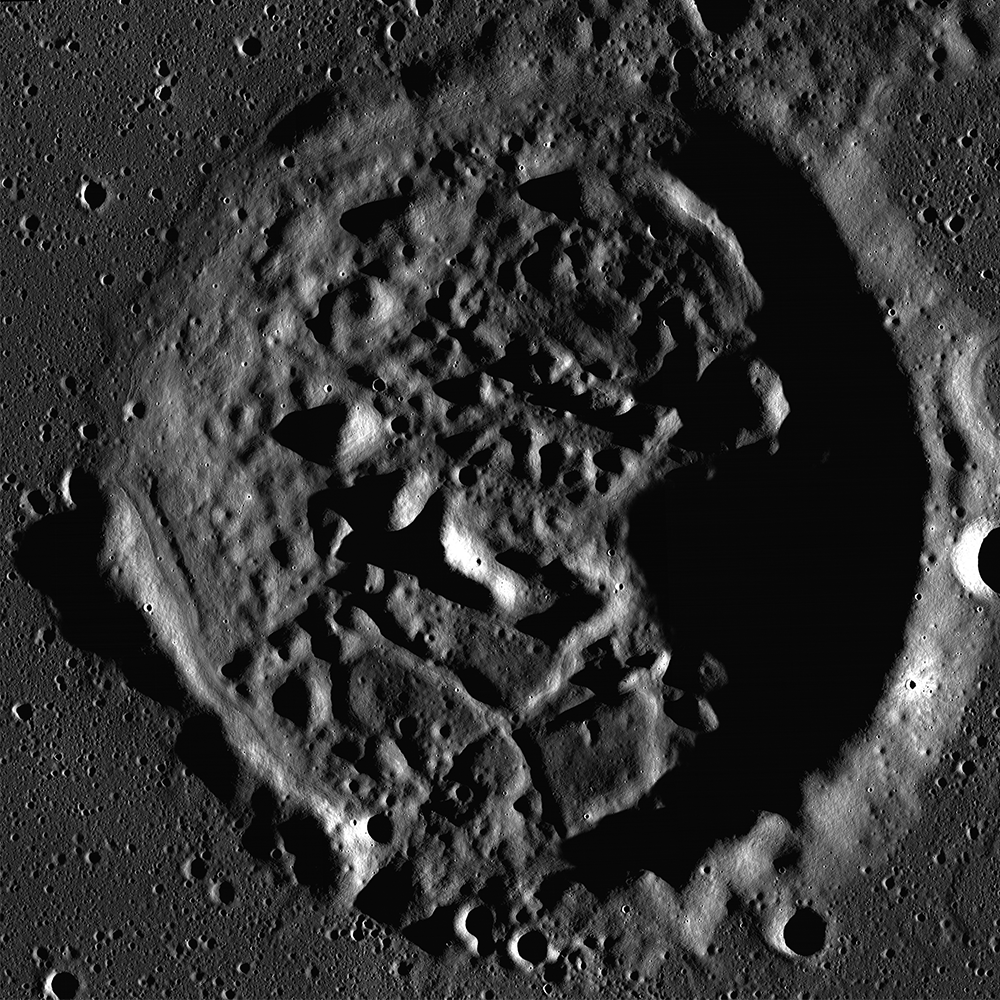
Morning light beams over the walls and peaks of an irregularly shaped crater in Mare Moscoviense. This unnamed crater is approximately 17 km in diameter; portion of controlled NAC Mosaic MOSCOVNSLOA, downsampled for web browsing [NASA/GSFC/Arizona State University].
J. Stopar
LROC News System

This crater is one of several similarly shaped craters in Mare Moscoviense. These craters are pockmarked by craggy peaks and fractured floors. The dramatic illumination in the opening image, with the sun low on the horizon, exaggerates the crater's lumpy topography.

This crater, and others like it, represent one type of volcanically modified impact crater. The floor of the crater, shown in detail below, is not much below the surface of the surrounding volcanic plains, and looks nothing like a typical fresh impact crater, such as Giordano Bruno or simple bowl-shaped crater like this one on the farside. Sharp boundaries with flat-lying mare basalts around the crater rim (arrows) indicate where the crater was once surrounded (embayed) and nearly covered by large outpourings of lava. Only the upper part of the crater rim remains.

Unnamed 17km diameter crater in Mare Moscoviense, located at 146.391°E, 26.805°N. Arrows indicate extent of mare embayment. Click on the image for a higher resolution view of the crater floor [NASA/GSFC/Arizona State University].
How did this crater get so lumpy inside? Did volcanic materials push up from beneath the crater floor? Did molten lava intrude through fractures or low points in the crater rim and walls? Did the heat of nearby lava and magma deform the crater like hot plastic? The answer may be a combination of these processes, though most scientists think that the changes in crater shape occur mainly as a result of magma intruding from below.

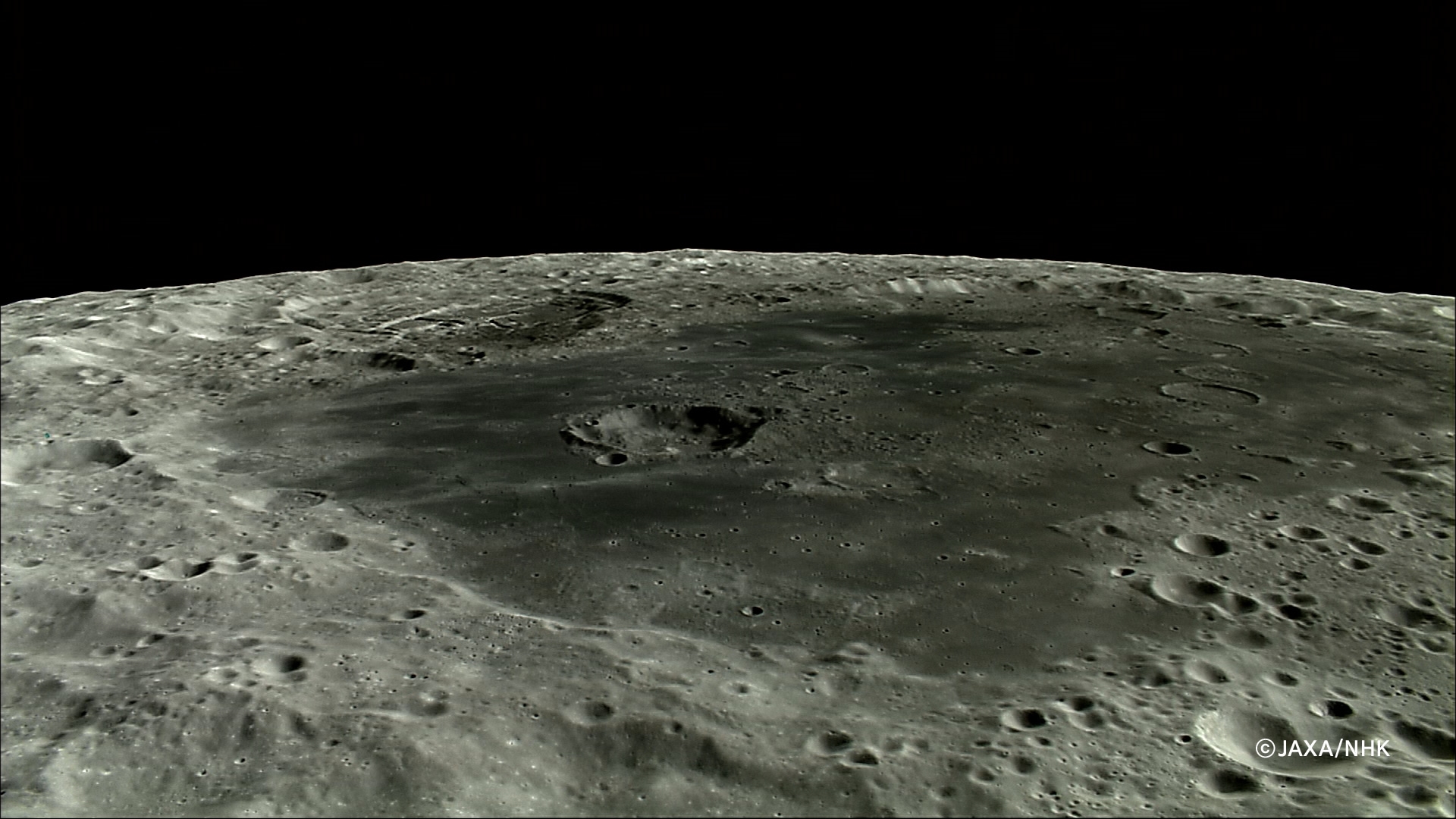
HDTV still from Japan's lunar orbiter SELENE-1 (Kaguya) show the horizon to horizon extent of Mare Moscoviense, now known to be an unusually thin part of the Moon's crust in the farside lunar highlands. The view is from the north, from an altitude of about 100 km. The wallpaper-sized original can be viewed HERE [JAXA/NHK/SELENE].
Explore this crater and two more like it in entire NAC mosaic, HERE.

Re-visit these other volcanically modified impact craters:

Thursday, January 23, 2014

A colorful history of floor-fractured Komarov

Small fresh crater in Komarov
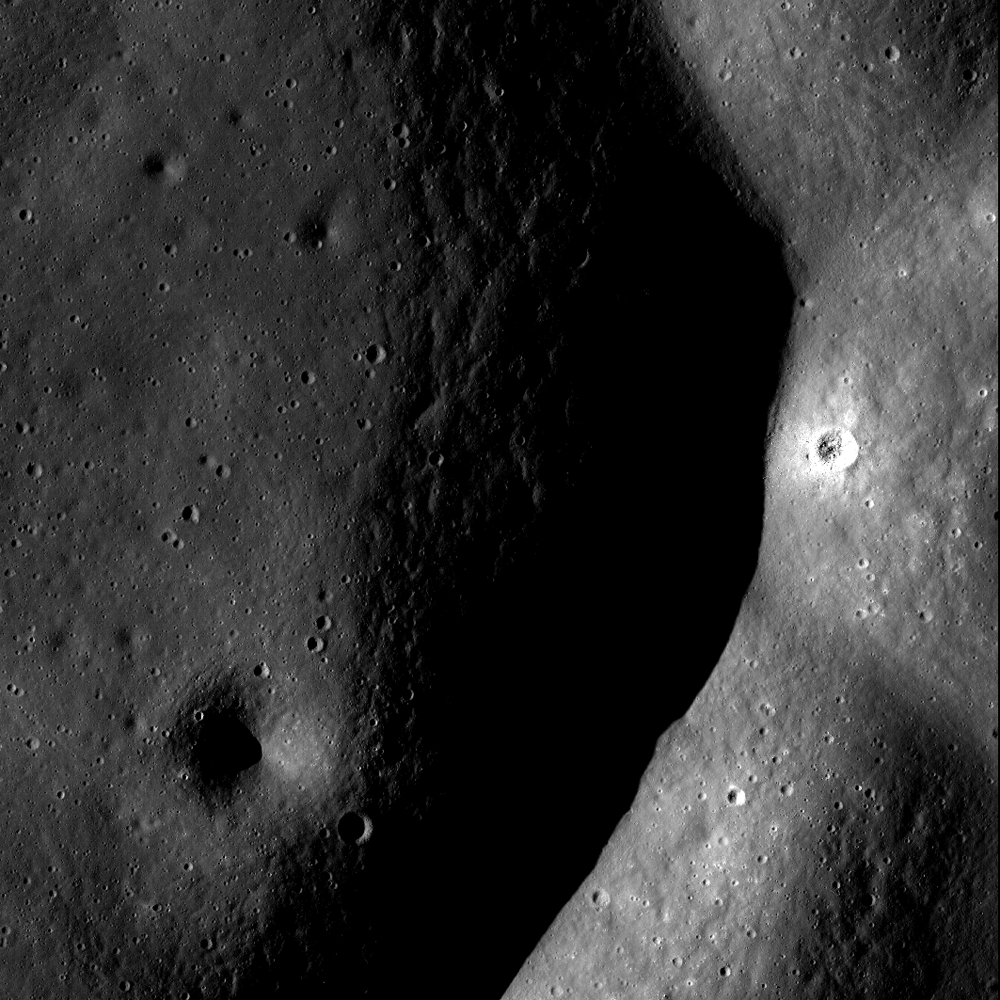
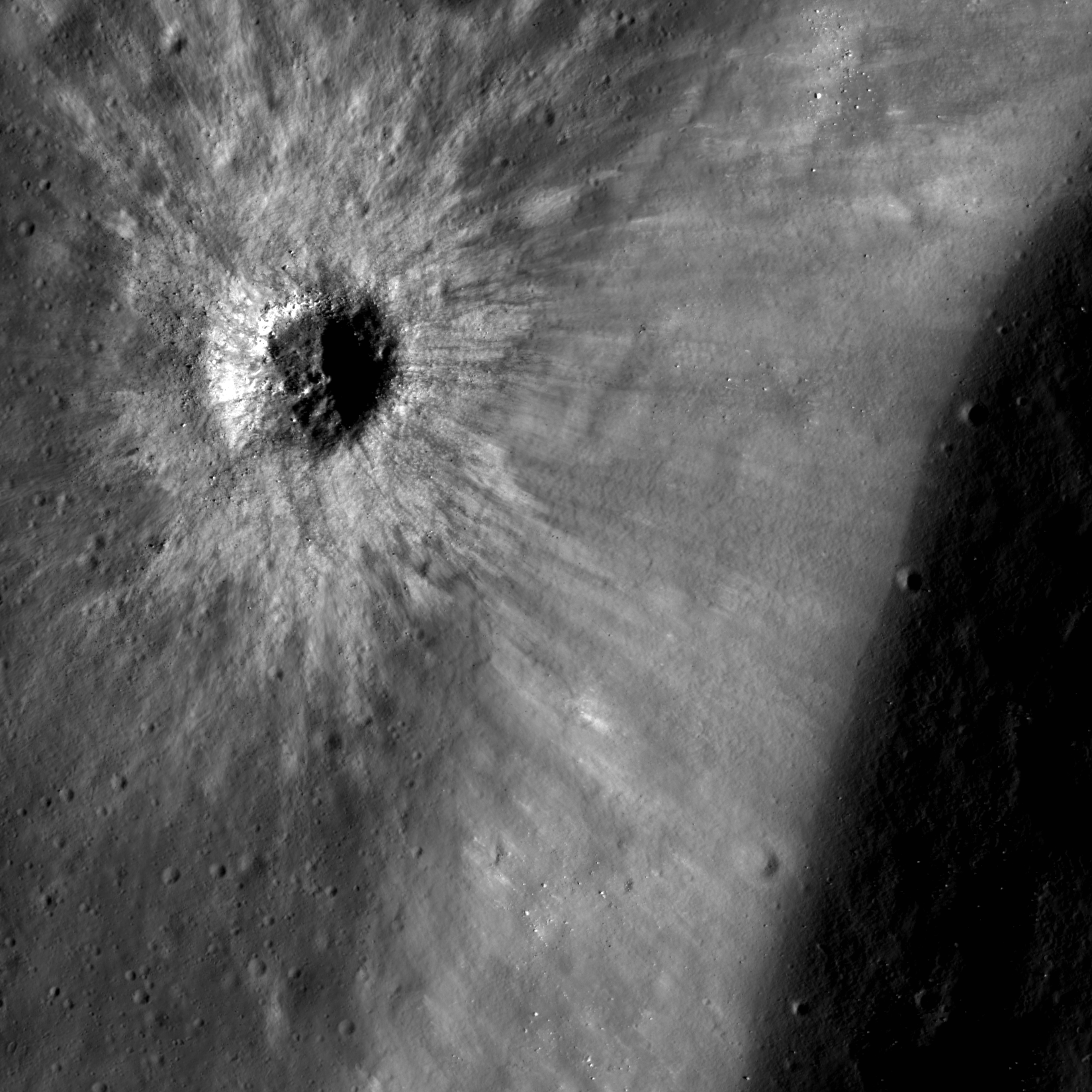
A small, fresh crater dots the wall of a fracture in the floor of Komarov crater. An approximately 2.5 km-wide field of view from LROC NAC frame M130653607, LRO orbit 4388, June 8, 2010; incidence angle 71.7° at 63 cm per pixel resolution from 60.73 km [NASA/GSFC/Arizona State University].
H. Meyer
LROC News System

A small, fresh crater can be seen on the right side of Today's Featured Image on the floor of Komarov crater. The crater was formed when an impactor smashed into the wall of one of the fractures (or graben) in the crater floor. Some of the ejecta from the impact can be seen draping the wall of the graben. This graben is one of many in the floor of Komarov.

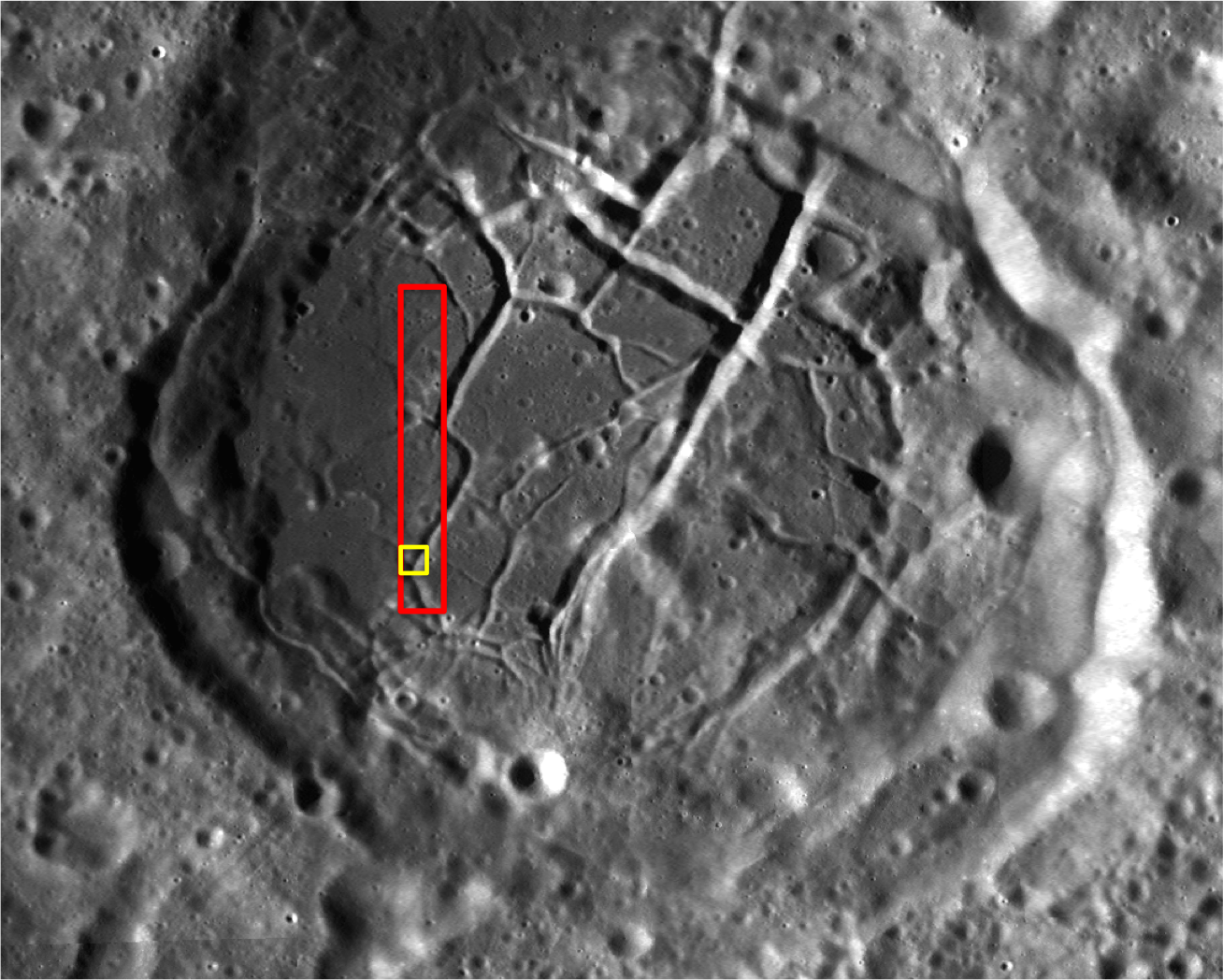
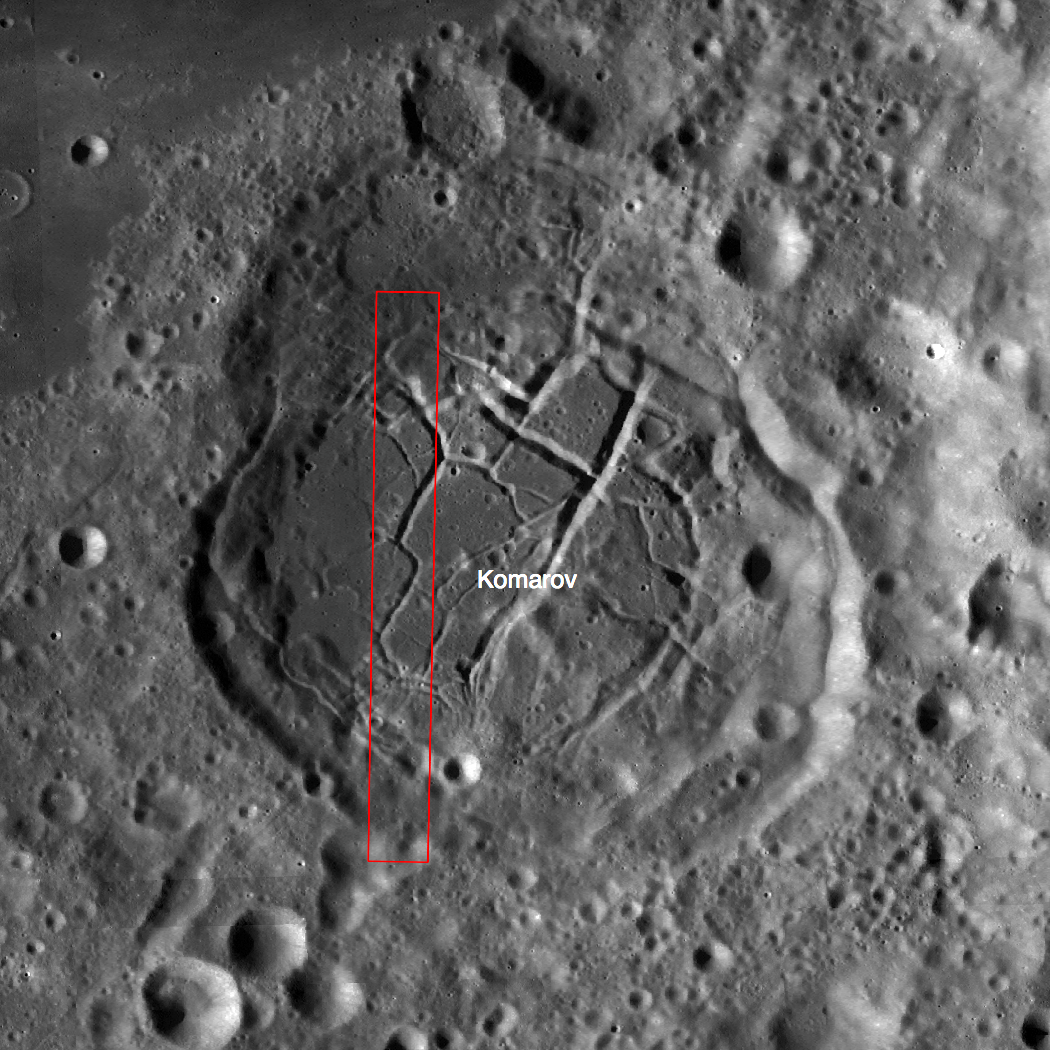
Komarov, best seen in the context image below, is known as a floor-fractured crater whose fractures likely formed through intrusive magmatic activity. The western portion of Komarov crater has been modified by the deposition of smooth, low albedo material and the formation of floor fractures. Is this the same low albedo mare basalts that filled nearby Mare Moscoviense?

Virtual view from an imaginary point 93 km over the lunar farside, south of Komarov. The LROC 302 ppd WAC mosaic draped over LOLA 128 laser ppd topography shows how pyroclastic flow overran the mare-filled Moscoviense floor. Both the famous long floor and Komarov are each well inside the larger, circular and less obvious Moscoviense basin [NASA/GSFC/LMMP/Arizona State University].

Komarov (context)
LROC Wide Angle Camera (WAC) context image of the western interior, wall and rim of floor-fractured Komarov, outlining the LROC Featured Image field of view (yellow), released January 22, 2014, with the frame of the LROC NAC observation from which it was derived outlined in red [NASA/GSFC/Arizona State University].
WAC2_Moscoviense-1560x1125
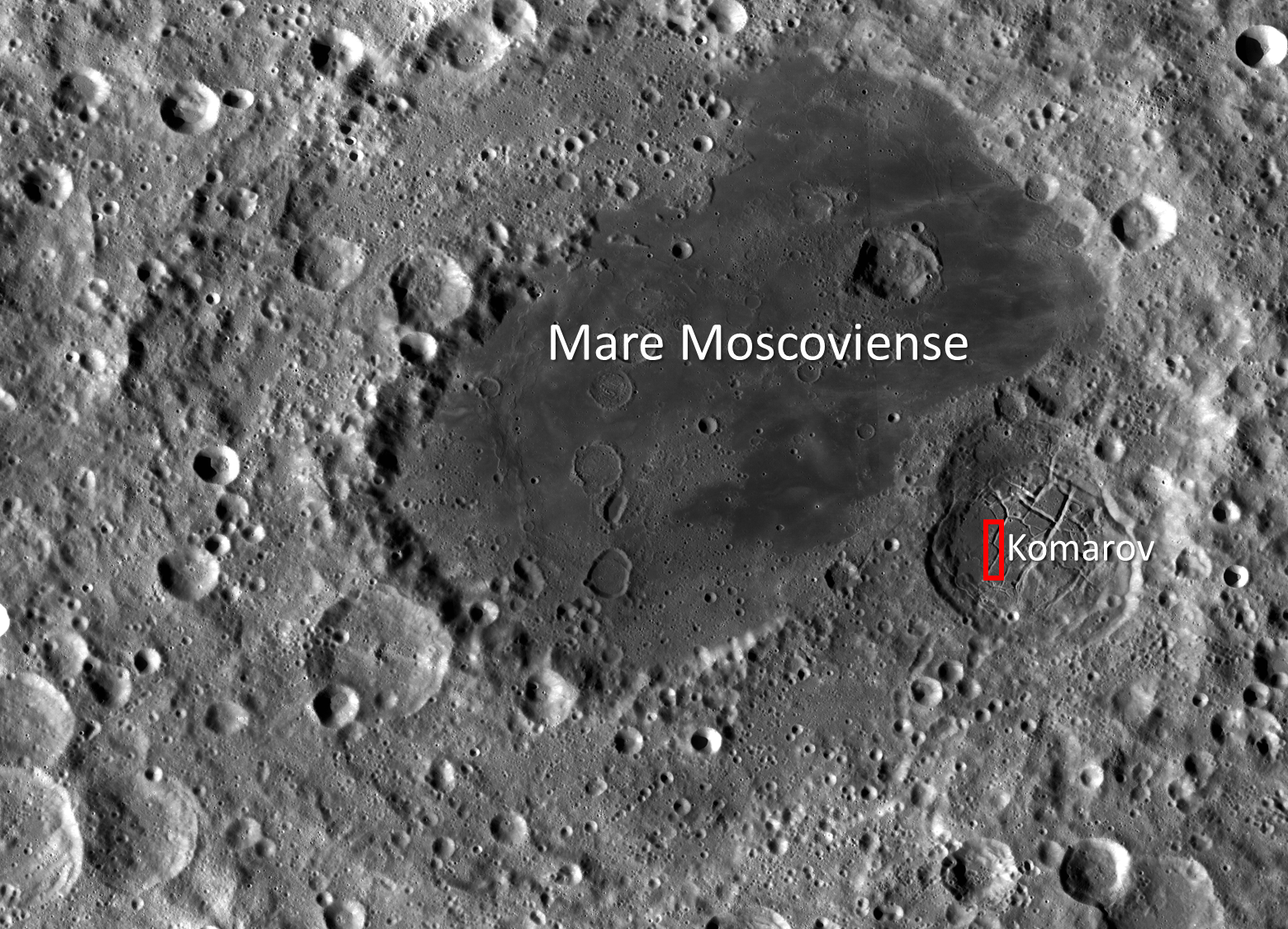
LROC WAC context image of Komarov crater (~80 km in diameter) relative to Mare Moscoviense (centered at 27.282°N, 148.122°E). The red box denotes the full NAC frame from which Today's Featured Image was taken. Image field of view is approximately 450 km wide [NASA/GSFC/Arizona State University].
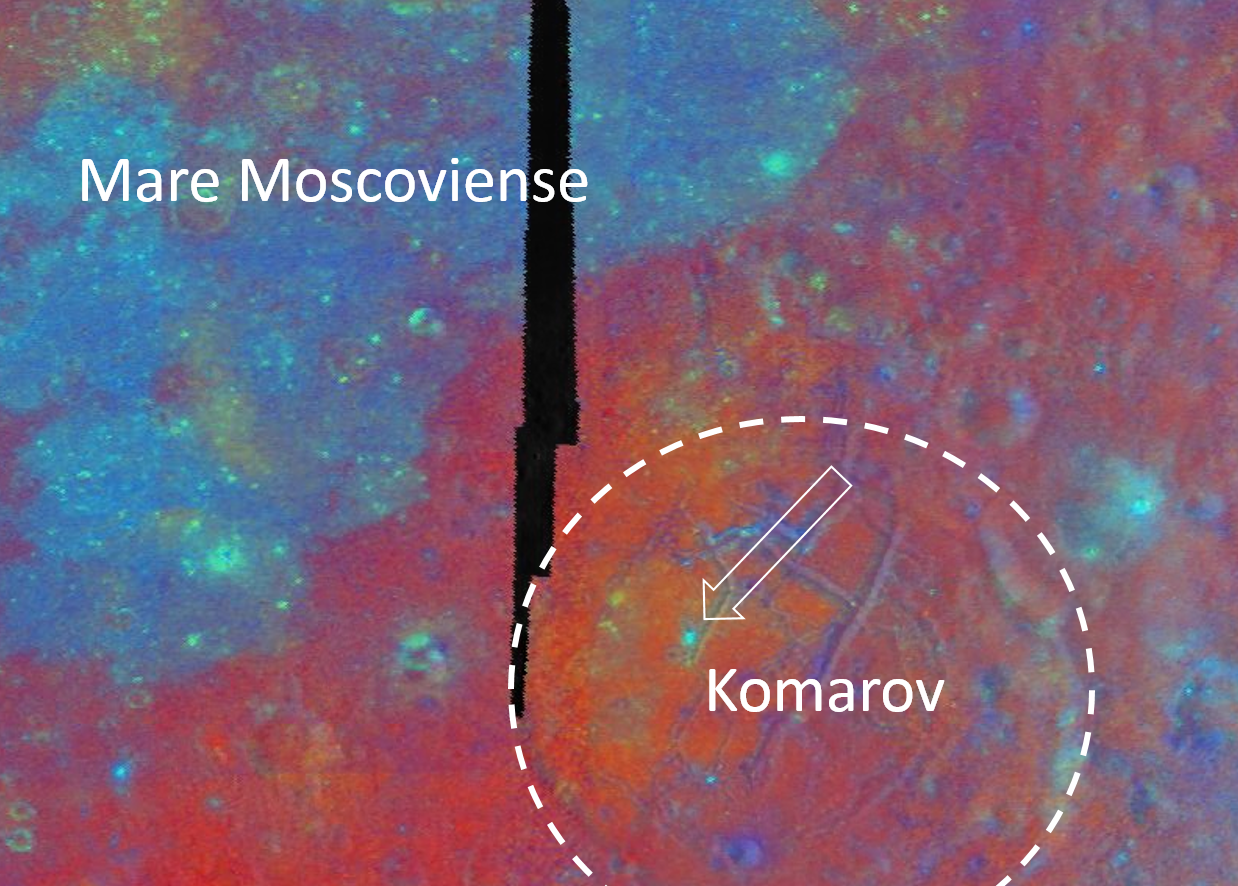
Though Komarov is located on the edge of Mare Moscoviense, it is not covered in the same smooth, low albedo mare basalts that are seen in the Moscoviense basin today (See WAC context image above and Clementine false-color image below). Compositional differences in and around Mare Moscoviense indicate multiple episodes of volcanic activity. Three bands (415 nm, 750 nm, and 1000 nm) from the Clementine UVVIS camera were used to create the false-color image below. The three bands were ratioed to control the colors of the false-color image. The 750/415 ratio controls the red component, which is an indication of low titanium or high glass content as found in mature lunar regolith and to a greater degree pyroclastic deposits. The 750/1000 ratio controls the green component and is an indicator of the amount of iron on the surface. The 415/750 ratio controls the blue component and indicates high titanium or bright slopes and albedos.

Clementine-1994-multispec-Komarov-1238x886
Clementine false-color multi-spectral mosaic of Komarov and Mare Moscoviense. The dashed circle denotes the rim of Komarov and the white arrow points to a fresh crater from the full NAC frame. Field of view approximately 180 km across [NASA/DOD/USGS/Arizona State University].
Notice in the false-color image above that Mare Moscoviense appears blue (higher in titanium since we know Mare Moscoviense is a low albedo feature), whereas Komarov appears red. Even within Komarov, the western side is more red (likely pyroclastics or low-titanium basalts) than the eastern side, which is comparable to deep red of the surrounding highlands (mature regolith). A crater in the NAC frame from which Today's Featured Image was taken appears bright blue and stands out from the rest of Komarov's floor. This bright blue color is likely due to the fact that this crater is fresh and has brought up unweathered (fresh) higher albedo material from depth. The fresh crater from the opening image is too small to be seen in the Clementine false-color image.

Investigate this complex region for yourself, HERE.

Related Posts:
Fresh crater in Komarov's fractured floor
Bah Humboldt!
Gassendi's Fractures
Atlas
Karpinskiy Floor Fractures

Thursday, August 8, 2013

Convergence

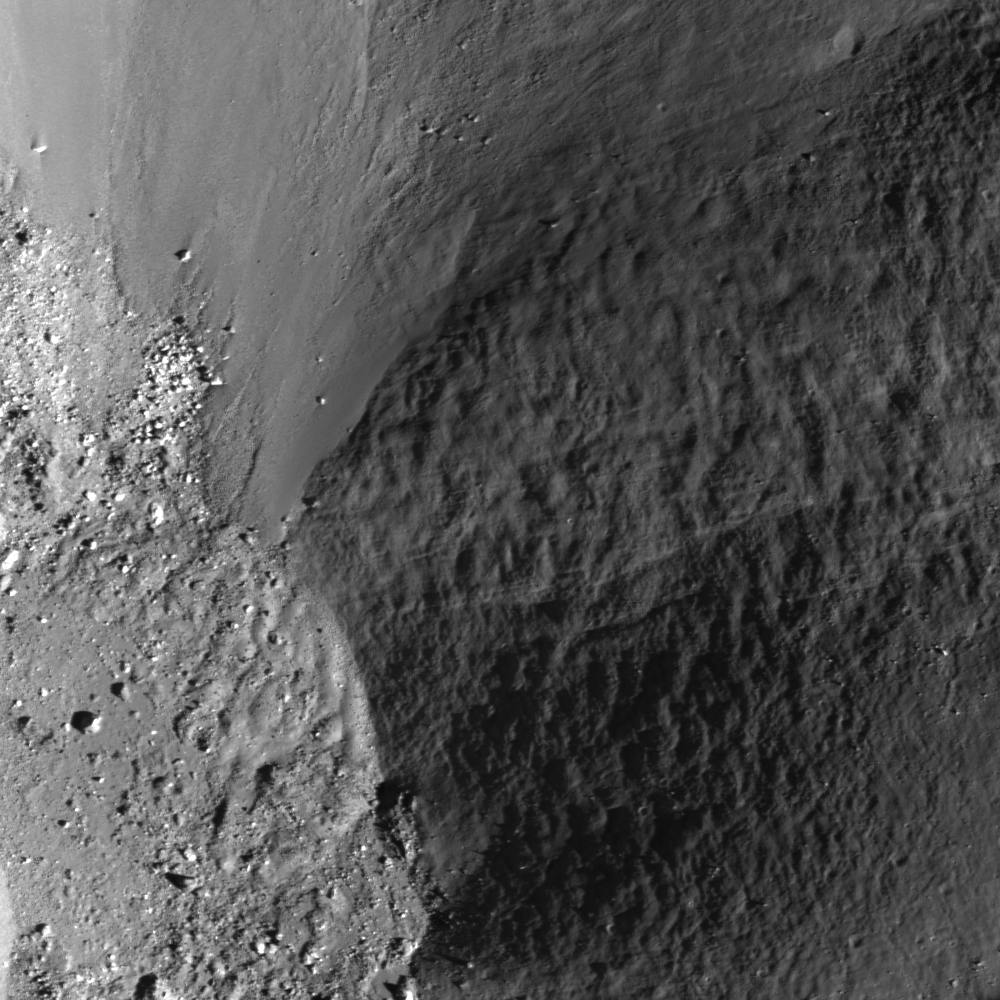
Debris flows converge at the bottom of a youthful crater on the northern frontier of the Moscoviense basin (32.660°S; 143.668°E). LROC Narrow Angle Camera (NAC) frame M1107331321R, spacecraft orbit 15474, November 12, 2012; 62.63° incidence, 1.45 meters resolution from 145.44 km. Field of view approximately 1.4 km across [NASA/GSFC/Arizona State University].
James Ashley
LROC News System

Small crater floors are places where slopes facing different compass directions (azimuths) naturally approach each other.

Steep, recently formed slopes will often produce debris flows that migrate part way or completely to the floor.

The resulting zones of debris convergence can present interesting juxtapositions of coarse and fine deposits with variable light and shadow effects. On an airless body like the Moon, the patterns are frequently striking, and make for studies in artistic composition. The play of sunlight on these surfaces often create some surprising textural patterns and relationships.

Context for the LROC Featured Image within a 7 km field of view [NASA/GSFC/Arizona State University].
This small, unnamed farside crater in the lunar highlands presents a nice example. High-reflectance ejecta in the WAC context image shows it to be the result of a relatively recent impact. Mass wasting events have generated debris flows that have different textures by the time they come to rest at or near the crater floor. Their different slopes produce different angles of illumination and different intensities of reflection.

M187306990RL-NASA/GSFC/Arizona State University
Roughly 9.2 km-wide field of view from LROC NAC mosaic M187306990LR, LRO orbit 12672, March 25, 2012; 31.65° angle of incidence, resolution 105 cm per pixel from 161.18 km over 32.67°E, 143.77°E [NASA/GSFC/Arizona State University].
 Slightly less than 40 km-wide field of view from LROC Wide Angle Camera frame M167260236CE, orbit 9783, 56.55° angle of incidence, 67.4 meters per pixel resolution from 50.4 km [NASA/GSFC/Arizona State University].
There are also examples of impact melt visible in the debris, best seen in the full NAC frame just south of the Featured Image boundary. What clues would you look for to help distinguish impact melt from fine-grained debris flows?

The bright ejecta from the small crater (arrow) contrasts sharply from its far more 'optically mature' surroundings, allowing the eye to easily pick area of interest in small scale albedo maps and this segment of the LROC GLD100 mosaic showing the crater's location with respect to Mare Moscoviense [NASA/GSFC/Arizona State University].
Explore additional details in the full NAC frame HERE.

Similar Featured Image posts have been presented as "Diversity," "Complicated Crater," and "Rubble Pile on Fresh Crater Floor."

Saturday, August 18, 2012

LROC: Fresh crater in Komarov's fractured floor

A fresh crater splashing ejecta across the edge of a fracture in Komarov crater. Field of view is 2.5 kilometers, from LROC Narrow Angle Camera (NAC) observation M191967463R, LRO orbit 13324, May 18, 2012; native resolution 1.52 meters. View the 1650 x 1650 LROC Featured Image, HERE [NASA/GSFC/Arizona State University].
Sarah Braden
LROC News System

The wispy, bright rays of this small crater (~475 meters in diameter, 24.801°N, 151.687°E) extend down into the fracture (graben).

You can see that this small crater is younger than the fracture because the bright rays of the crater are not visibly deformed by the edges of the fracture.

Gradually, cratering events like this contribute to the erosion and infilling of fractures and other craters on the lunar surface.

Komarov crater is on the southeastern edge of Mare Moscoviense and is located at 24.59°N, 152.25°E (diameter 80.43 km). The floor was long ago filled with mare basalt, and then cut with a spectacular set of intersecting fractures, or graben. Graben form when a section of the crust sinks as two parallel faults pull the crust apart. Note that the northwestern section of Komarov's rim has an irregular shape. the irregular shape is likely due to a preexisting impact crater. The older crater influenced the formation of Komarov's rim, and may have been partially flooded with molten mare material when Komarov's floor was filled in.

LROC Wide Angle Camera context image of Komarov Crater; the red box marks the total area imaged in the LROC NAC frame containing the field of view in the LROC Featured  Image. View the original LROC context image HERE [NASA/GSFC/Arizona State University].

Explore the rest of Komarov's fractures in the full resolution LROC NAC frame, HERE.

Related Images:
Alphonsus crater mantled floor fracture
Gassendi's Fractures
Atlas

Virtual view from an imaginary point 93 km over the lunar farside, south of Komarov. The LROC 302 ppd WAC mosaic draped over LOLA 128 laser ppd topography shows how pyroclastic flow overran the mare-filled Moscoviense floor. Both the famous long floor and Komarov are each well inside the larger, circular and less obvious Moscoviense basin [NASA/GSFC/LMMP/Arizona State University].

Friday, August 19, 2011

LROC: Ray of boulders


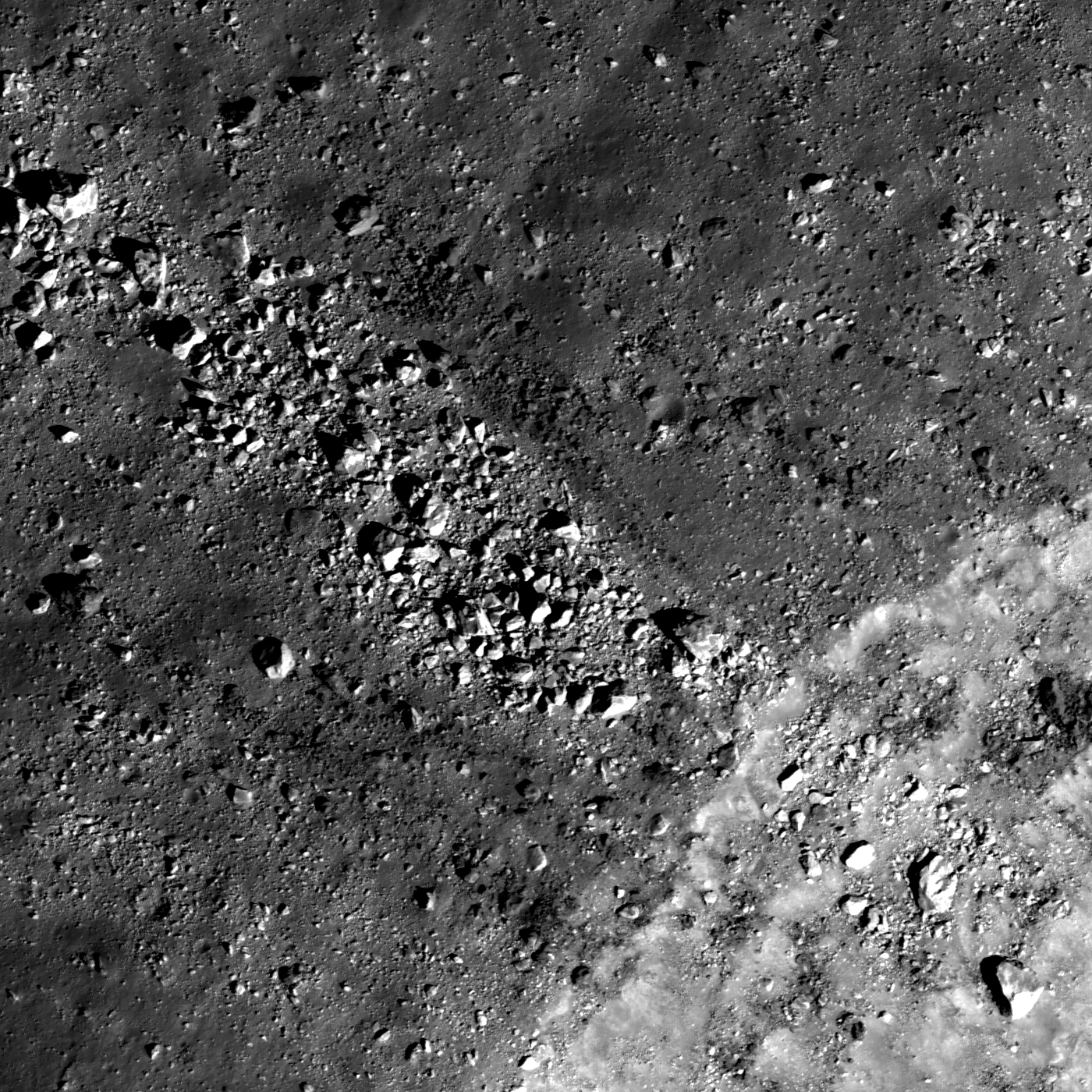
Dozens of boulders, ranging from 10 to more than 30 meter in diameter, are distributed within an ejecta ray close to a crater rim (lower right) located inside the Mare Moscoviense basin (32.52°N, 143.625E°). These boulders represent the deepest material excavated during the crater's formation. From a montage of LROC Narrow Angle Camera (NAC) observations M159013302L & R, field of view is roughly 850 meters; LRO orbit 8568, May 2, 2011. View the full-size LROC Featured Image HERE [NASA/GSFC/Arizona State University].

Lillian Ostrach
LROC News System

Northeast of Mare Moscoviense, an unnamed Copernican-aged crater has an extensive ejecta blanket (32.56°N, 143.53°E, diameter ~6 km). The ejecta blankets of impact craters provide a useful tool toward relative age dating and the formation of a geologic story for a region when using remotely sensed image data. The presence of a rayed, continuous ejecta blanket surrounding an impact crater indicates that the crater formed relatively recently in lunar geologic time. The distribution of ejecta around the crater can help predict whether the bolide impacted obliquely and from which direction it came. Moreover, if there are reflectance variations in the ejecta blanket, the impact may have exposed material of multiple compositions, and how bouldery or smooth an ejecta blanket appears may help scientists hypothesize the physical properties of the target material (e.g., solid rock, granular regolith, or a combination of both).


LROC Wide Angle Camera (WAC) monochrome mosaic context image of the unnamed crater, northwest of Mare Moscoviense. Asterisk designates the area of LROC Featured Image, released August 18, 2011. See the full-sized version HERE [NASA/GSFC/Arizona State University].


Another WAC image, a 604 nm band mosaic from September 12, 2010, when the local sun was higher and when relief gives way to finer albedo subtleties, demonstrates why this small crater is relatively easy to pick out in small-scale farside imagery. The north shore of "the Sea of Moscow" itself, the floor of the larger impact basin, is just beyond the hills etched by the impact, to the south [NASA/GSFC/Arizona State University].

Ejecta blankets can also provide human explorers an easy means to sample lunar material from depth. Because impact events displace material in a ballistic trajectory from the point of impact, the vertical stratigraphy of the rocks and regolith are exposed within the ejecta blanket in a horizontal manner. Does this make sense? Think about it: when a bolide impacts the surface, the surface regolith is the first material ejected and will travel the farthest. As the energy from impact is dispersed, more material is ejected from the rapidly-forming impact crater, continuing to form the ejecta blanket. The last bit of material ejected will be from the deepest part of the crater and deposited near the crater rim - exactly like those boulders seen in the opening image. What a concept - the ability to create a vertical cross section of an area simply by moving through an ejecta blanket on the surface!


In this smaller-scale, 400 kilometer field of view of a WAC montage released in 2010, stitched from observations at local afternoon illumination, a good mix of relief and albedo features can be seen. The bright crater and its rays, shaped by the anatomy of the landscape where it formed, begin to blend together at this scale [NASA/GSFC/Arizona State University].


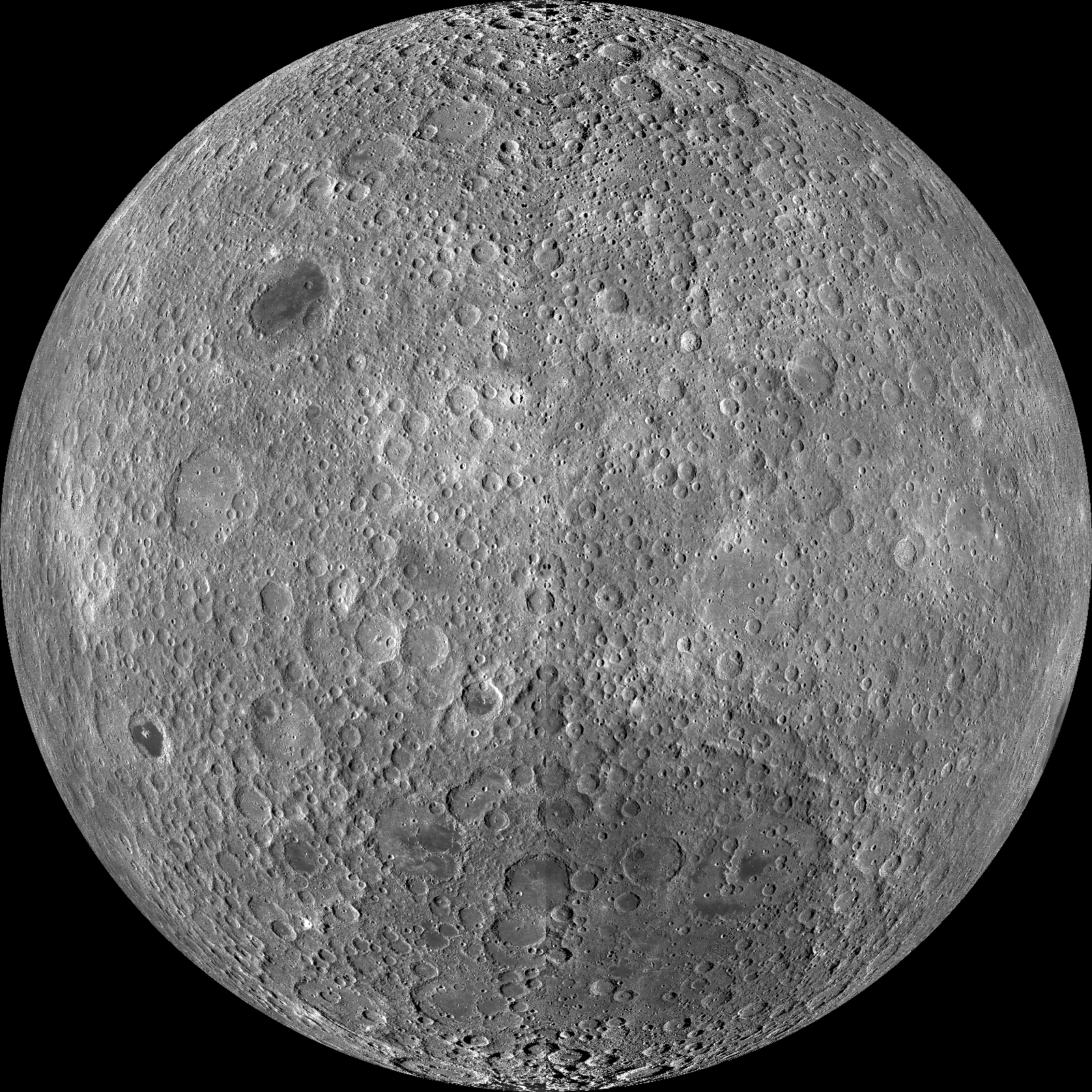
Even in this section taken from a full hemisphere-scale (1600 meter resolution) image of the Moon's farside the area affected by the bright crater's albedo stands out like a star, north of Mare Moscoviense. View the hemisphere-wide LROC WAC montage HERE [NASA/GSFC/Arizona State University].

This concept, using radial traverses of an ejecta blanket to sample vertical stratigraphy, was tested both in the laboratory during the 1960s and by Apollo 14 in 1971. Astronauts Alan Shephard and Edgar Mitchell attempted to reach the Cone crater rim and sampled the ejecta blanket at various locations during their traverse. Unfortunately for them, the gently undulating landscape around Cone crater obscured the crater rim from view and they were forced to return from their traverse without photographing the interior of the crater. However, later analysis of photography from the traverse, paired with orbital images, revealed that they had nearly reached the rim! The astronauts were closer than 30 meters from the crater rim, so their samples probably represent the deepest material excavated by the impact. This experience - and experiment - showed that a radial traverse of crater ejecta was an appropriate method to sample the vertical stratigraphy. The high-resolution LROC NAC images, coupled with derived DTM topography will ensure that future human lunar explorers make it to the crater rim when making a radial traverse of an ejecta blanket!

Take a peek at the full LROC NAC image - can you find reflectance variations within the ejecta blanket that may represent compositional differences from within the crater? Do you see any other bouldery ejecta rays around the rim?

Related Posts:
Ejecta Blanket Features
Scouring secondary ejecta
Dark haloed crater in Mare Humorum
Slice of Mare
Small crater in Oceanus Procellarum

Tuesday, June 15, 2010

LOLA: Moscoviense


Mare Moscoviense (GSFC - LOLA Image of the Week, June 14, 2010) is one of the few large maria located on the far side of the Moon.

LOLA data reveal the lowest point inside Titov crater to be about 2.7 km below the lunar datum. In contrast, the highest point on the rim of the basin rests about 3 km above lunar datum.

The total relief for the basin surrounding Mare Moscoviense is 5.7km. Although there are just as many impact basins on the lunar far side as the near, the extensive lunar volcanism seen on the near side is lacking on the far side of the Moon [NASA/GSFC/LOLA].


The spectacular Moscoviense Terrain Camera image from 2008, returned by Japan's first lunar orbiter Kaguya (SELENE-1). The yellow arrow indicates the location of a new and distinct kind of lunar rock discovered from data returned by India's first lunar orbiter Chandrayaan-1. The story from April 12 can be read here [JAXA/SELENE].


Figure 2, LROC News System Featured Image, January 8, 2010. LROC Wide Angle Camera color (Red=689, Green=566, Blue=415 nm) mosaic, with the location of the proposed Constellation Region of Interest (ROI) indicated with arrow [NASA/GSFC/Arizona State University].


Looking east over the Moscoviense Constellation ROI, LROC WAC M103531211, overlaid with LROC Narrow-Angle Camera image M105887165, atop the improving resolution of the lunar far side elevation map available in Google Moon. The arrow on the WAC image released by LROC is not completely covered, left center [NASA/GSFC/Arizona State University].


Stepping back from the false-color data in the LOLA Image of the Week, at the top, "bright is equal to relative height" in this look at Moscoviense in the global-scale, low-resolution LOLA data available through the Planetary Data System. Titov is just visible, and unlike visible imagery of the area, the multi-ringed nature of this impact basin is clearly visible along with a strong indication that the original inner ring may have been partially inundated with intrusive molten material, probably from within the Moon after it's original formation The obliquity of the "impact-forming event," retained in its present 'rectangular' shape also appears to have been a part of the formation from the instant it formed [NASA/GSFC/LOLA].

Some other postings related to Moscoviense:

Far Side was volcanically active
until 2.5 billion years ago

June 13, 2009

Far Side borderland landing site
October 6, 2009

Mare Moscoviense Constellation Landing Site
January 8, 2010

New spinel-rich lunar rock type
April 12, 2010