Showing posts with label NASA JPL. Show all posts

Thursday, May 30, 2013

Origin of lunar MASCONS found in GRAIL data - JPL

The Moon's elusive, uneven gravity is clearly seen in this Free-Air Gravity map produced from data returned in 2012 by the twin GRAIL orbiters. Mare Imbrium, for example, at upper right presents a significant anomalous profile, concentrated near what may have been the original "transitory" crater boundary but equally reduced from the lunar average (blue) between that boundary and the outer reaches of Imbrium's present boundary [NASA/JPL/MIT].
Pasadena -- Investigators combing through the huge treasure trove of data returned to Earth by NASA's GRAIL (Gravity Recovery and Interior Laboratory) twin spacecraft Ebb and Flow in 2012 claim to have "uncovered the origin of massive invisible regions that make the moon's gravity uneven, a phenomenon affecting the stability and longevity of lunar-orbiting spacecraft," JPL announced Thursday.

"GRAIL data confirm that lunar mascons were generated when large asteroids or comets impacted the ancient moon, when its interior was much hotter than it is now," said Jay Melosh, a GRAIL co-investigator at Purdue University in West Lafayette, Ind., and lead author of the new research. "We believe the data from GRAIL show how the moon's light crust and dense mantle combined with the shock of a large impact to create the distinctive pattern of density anomalies that we recognize as mascons."

The origin of lunar mascons has been a mystery in planetary science since their discovery in 1968 by a team at NASA's Jet Propulsion Laboratory in Pasadena, Calif. Researchers generally agree mascons resulted from ancient impacts billions of years ago. It was not clear until now how much of the unseen excess mass resulted from lava filling the crater or iron-rich mantle upwelling to the crust.

On a map of the moon's gravity field, a mascon appears in a target pattern. The bulls-eye has a gravity surplus. It is surrounded by a ring with a gravity deficit. A ring with a gravity surplus surrounds the bulls-eye and the inner ring. This pattern arises as a natural consequence of crater excavation, collapse and cooling following an impact. The increase in density and gravitational pull at a mascon's bulls-eye is caused by lunar material melted from the heat of a long-ago asteroid impact.

"Knowing about mascons means we finally are beginning to understand the geologic consequences of large impacts," Melosh said. "Our planet suffered similar impacts in its distant past, and understanding mascons may teach us more about the ancient Earth, perhaps about how plate tectonics got started and what created the first ore deposits."

"Mascons also have been identified in association with impact basins on Mars and Mercury," said GRAIL principal investigator Maria Zuber of the Massachusetts Institute of Technology in Cambridge. "Understanding them on the moon tells us how the largest impacts modified early planetary crusts."

Launched as GRAIL A and GRAIL B in September 2011, the probes, renamed Ebb and Flow, operated in a nearly circular orbit near the poles of the moon at an altitude of about 34 miles (55 kilometers) until their mission ended in December 2012. The distance between the twin probes changed slightly as they flew over areas of greater and lesser gravity caused by visible features, such as mountains and craters, and by masses hidden beneath the lunar surface.

Friday, May 24, 2013

Project Morpheus Tether Test 21


This was "the first tether test of the v1.5b," Project Morpheus Bravo vehicle. The video runs about 29 seconds.

"We had a good ignition and climb. However, as the vehicle attempted to stabilize itself it exceeded the internally set boundary limit causing a soft abort."

Monday, May 6, 2013

Morpheus Unit B first fully integrated hot fire test


Project Morpheus Hot Fire Test #8: On May 1, the Morpheus concept lander "Bravo Unit" was tested in a "hot fire" configuration, the first fully-integrated test of this second Unit. Built by Armadillo Aerospace, with the aim of developing a cutting edge vehicle for soft-landing 500 kg. payloads on the Moon, Unit A was lost following the failure of a real-time inertia measurement unit in August 2012.

Related Posts:
Morpheus and ALHAT teams, still hard at work (February 11, 2013)
Morpheus employs ALHAT in teather test #16 (June 13, 2012)
Project Morpheus lander - Soft Abort Test (May 11, 2012)
Morpheus Tether Test #10 (April 9, 2012)
Morpheus Tether Test #8 (March 14, 2012)
Project Morpheus methane Hot Fire Test #5 (February 29, 2012)
Morpheus lander in tethered flight tests (May 7, 2011)

Thursday, January 10, 2013

Parting shots from "Ebb" MoonKAM prior to impact

Three days prior to its planned impact on a lunar mountain, mission controllers activated the camera aboard one of NASA's GRAIL twins to take some final photos from lunar orbit.  The video, released by JPL January 10, is from the GRAIL MoonKAM (Moon Knowledge Acquired by Middle School Students) cameras aboard "Ebb," December 14, 2012. The spacecraft was winding down in its polar orbit, still approximately 10 km above the northern hemisphere of the lunar farside, in the vicinity of Jackson crater.  "This imagery was acquired as part of a final checkout of the spacecraft systems prior to the "Sally Ride" impact site, December 17." [NASA/JPL/Sally Ride Science].

Embedded video from JPL

Friday, December 14, 2012

Appearance of the Moon during the GRAIL impacts

GRAIL's Final Resting Spot.  These maps of Earth's moon highlight the region where the twin spacecraft of NASA's Gravity Recovery and Interior Laboratory (GRAIL) mission will impact on Dec. 17, marking the end of its successful endeavor to map the moon's gravity. The two washing-machine-sized spacecraft, named Ebb and Flow, will impact an unnamed mountain above of 75°N. [NASA/GSFC/Arizona State University].
Pasadena (JPL) -- Twin lunar-orbiting NASA spacecraft that have allowed scientists to learn more about the internal structure and composition of the moon are being prepared for their controlled descent and impact on a mountain near the moon's north pole at about 2028 UT (5:28 p.m. U.S. EST) Monday, December 17.

Ebb and Flow, the Gravity Recovery and Interior Laboratory (GRAIL) mission probes, are being sent purposely into the lunar surface because their low orbit and low fuel levels preclude further scientific operations. The duo's successful prime and extended science missions generated the highest-resolution gravity field map of any celestial body, providing a better understanding of how Earth and other rocky planets in the solar system formed and evolved.
Perspective on the Moon at the estimated time of the GRAIL impacts, projected at 2229 UT, 17 December 2012. Waxing between New and First Quarter (4.58 days 26.8% illumination), the distance between Earth and Moon will be increasing at roughly 10 km per minute from 372,628 kilometers. In eastern North America, the Moon will have transited, riding low and west from overhead Only the best equipped observers can hope to observe the actual release of kinetic energy, an extremely fast flash, near the horn of the north-northwest limb [Virtual Moon Atlas].
"It is going to be difficult to say goodbye," said GRAIL principal investigator Maria Zuber of the Massachusetts Institute of Technology in Cambridge. "Our little robotic twins have been exemplary members of the GRAIL family, and planetary science has advanced in a major way because of their contributions."

Lunar Heritage Sites and GRAIL's Final Mile. This graphic highlights locations on the moon NASA considers "lunar heritage sites" and the path NASA's Gravity Recovery and Interior Laboratory spacecraft will take on their final flight. Navigators on the GRAIL team have designed an end of mission plan that rules out the extremely remote possibility of either of the two GRAIL spacecraft impacting near any of these historic locations. The Apollo 11, 12, 14, 16 and 17 landing sites are indicated with green circles. The Surveyor sites are indicated with yellow squares. The Soviet Union's Luna and Lunakhod landing sites are indicated with red diamonds and red squares, respectively.  The ground track for the Ebb and Flow spacecraft during their final half-orbits is shown in black. The maps are color-coded by topography. Red and white indicate the high areas. Blue and violet indicate low areas [NASA/JPL-Caltech].

The mountain where the two spacecraft will make contact is located near a crater named Goldschmidt. Both spacecraft have been flying in formation around the moon since Jan. 1, 2012. They were named by elementary school students in Bozeman, Mont., who won a contest. The first probe to reach the moon, Ebb, also will be the first to go down, at 2:28:40 p.m. PST. Flow will follow Ebb about 20 seconds later.

Both spacecraft will hit the surface at 3,760 mph (1.7 kilometers per second). No imagery of the impact is expected because the region will be in shadow at the time.

Ebb and Flow will conduct one final experiment before their mission ends. They will fire their main engines until their propellant tanks are empty to determine precisely the amount of fuel remaining in their tanks. This will help NASA engineers validate fuel consumption computer models to improve predictions of fuel needs for future missions.

"Our lunar twins may be in the twilight of their operational lives, but one thing is for sure, they are going down swinging," said GRAIL project manager David Lehman of NASA's Jet Propulsion Laboratory in Pasadena, Calif. "Even during the last half of their last orbit, we are going to do an engineering experiment that could help future missions operate more efficiently."

Because the exact amount of fuel remaining aboard each spacecraft is unknown, mission navigators and engineers designed the depletion burn to allow the probes to descend gradually for several hours and skim the surface of the moon until the elevated terrain of the target mountain gets in their way.

Ebb and Flow's Final Moments. These side-by-side, 3-D comparisons depict the unnamed lunar mountain targeted by the NASA's Gravity Recovery and Interior Laboratory (GRAIL) mission for controlled impact of the Ebb and Flow spacecraft. They also include the ground tracks the spacecraft are expected to follow into the lunar terrain. These graphics were generated using data from the Lunar Orbiter Laser Altimeter instrument aboard NASA's Lunar Reconnaissance Orbiter spacecraft. On the left is the mountain with the ground track and mission termination point for the Ebb spacecraft. On the right is the mountain, ground track and mission termination point for the Flow spacecraft [NASA/JPL-Caltech/MIT/GSFC].

The burn that will change the spacecrafts' orbit and ensure the impact is scheduled to take place Friday morning, Dec. 14.

"Such a unique end-of-mission scenario requires extensive and detailed mission planning and navigation," said Lehman. "We've had our share of challenges during this mission and always come through in flying colors, but nobody I know around here has ever flown into a moon mountain before. It'll be a first for us, that's for sure."

During their prime mission, from March through May, Ebb and Flow collected data while orbiting at an average altitude of 34 miles (55 kilometers). Their altitude was lowered to 14 miles (23 kilometers) for their extended mission, which began Aug. 30 and sometimes placed them within a few miles of the moon's tallest surface features.

The published impact coordinates for the GRAIL twins has been well-surveyed by the Lunar Reconnaissance Orbiter Camera (LROC), at least nine times at high-resolution. LROC QuickMap 125 meter resolution [NASA/GSFC/Arizona State University].
JPL manages the GRAIL mission for NASA's Science Mission Directorate in Washington. The mission is part of the Discovery Program managed at NASA's Marshall Space Flight Center in Huntsville, Ala. Lockheed Martin Space Systems in Denver built the spacecraft. JPL is a division of the California Institute of Technology in Pasadena.

For more information about GRAIL, visit: http://grail.nasa.gov and http://www.nasa.gov/grail.

Tuesday, December 11, 2012

The surface of the Moon: What lies beneath?

The Moon's anisotropic composition is well represented in this Mercator projection of lunar gravity, mapped at unprecedented resolution by the twin GRAIL lunar orbiters and centered on the Moon's farside [NASA/JPL/MIT].
Paul D. Spudis
Smithsonian Air & Space

The NASA mission GRAIL (Gravity Recovery And Interior Laboratory) has been orbiting the Moon since last spring.  The mission consists of two identical small spacecraft (dubbed Ebb and Flow) that very carefully keep track of their relative position from each other.  By tracking both of these spacecraft with high precision from Earth, we can monitor any small variations (caused by variations in the Moon’s gravity field) away from their predicted orbital paths.  If the satellite is flying over an area on the Moon with less material than normal (for example, over a deep crater, a hole in the Moon’s crust), it will be less attracted to the Moon because of this mass deficiency and will therefore fly away from the Moon.  If, on the other hand, it flies over an area of excess mass, such as a thick stack of dense lava flows, the excess mass pulls the satellite slightly toward it, increasing its speed and pulling it downwards.  As Ebb and Flow orbit the Moon, they conduct a delicate “dance.”  These movements are caused by variations in the Moon’s gravity (largely a reflection of variations in the density of its crustal rocks).  When combined with the high-resolution, precision topography of the Moon (currently being gathered by the Lunar Reconnaissance Orbiter), we are able to reconstruct the structure and thickness of the lunar crust from orbit.

GRAIL has unveiled a new global gravity data set, very high in resolution and precision and greater than ten times better than our previous version of the global gravity from the Japanese mission SELENE (Kaguya).  One interesting result shows unusual structure – long, quasi-linear gravity features appear in a variety of locations associated with lunar impact basins.  Basins are very large craters that formed during asteroid collisions prior to 3.8 billion years ago.  Some of these linear features extend on great circles across the lunar globe for distances of more than 500 km. These results suggest that solidified intrusions of once-molten rock may form a dense, criss-crossing network within the upper crust.

In order to understand the significance of these gravity features, it is necessary to understand some elementary facts about planetary geology.  Planets generate heat and this heat must be dissipated.  Typically, the heat generated from both the original energy release during formation (accretion) and from the decay of radioactive elements (e.g., uranium) melts the interiors of planets, forming bodies of liquid rock called magma.  This magma is usually less dense than the rocks from which it forms and thus, rises upwards towards the surface.  Sometimes, the molten rock cannot ascend any higher from the deep locations where it comes from and freezes in place – geologists call this type of frozen rock body an intrusion, because it intrudes into pre-existing rock as a liquid and then solidifies by crystallizing.  When magma actually reaches the surface of a planet, it can erupt onto its surface as lava; this activity is called extrusive because the molten rock extrudes onto the surface and then solidifies as lava flows.

Clearly, all erupting lava must have at one time been an intrusive magma body, at least during the time it was ascending upwards toward the surface.  Although many magma bodies reach the surface and create lava flows (such as the dark, smooth maria of the lunar lowlands), sometimes this magma cannot reach the surface and freezes in place within the crust as a linear or tabular body.  Such features (called dikes) are an essential part of the underground, igneous plumbing of volcanoes on all of the terrestrial planets.  We knew that they must have formed on the Moon because we saw the evidence of vents and structures in the maria that are the surface expression of such features.

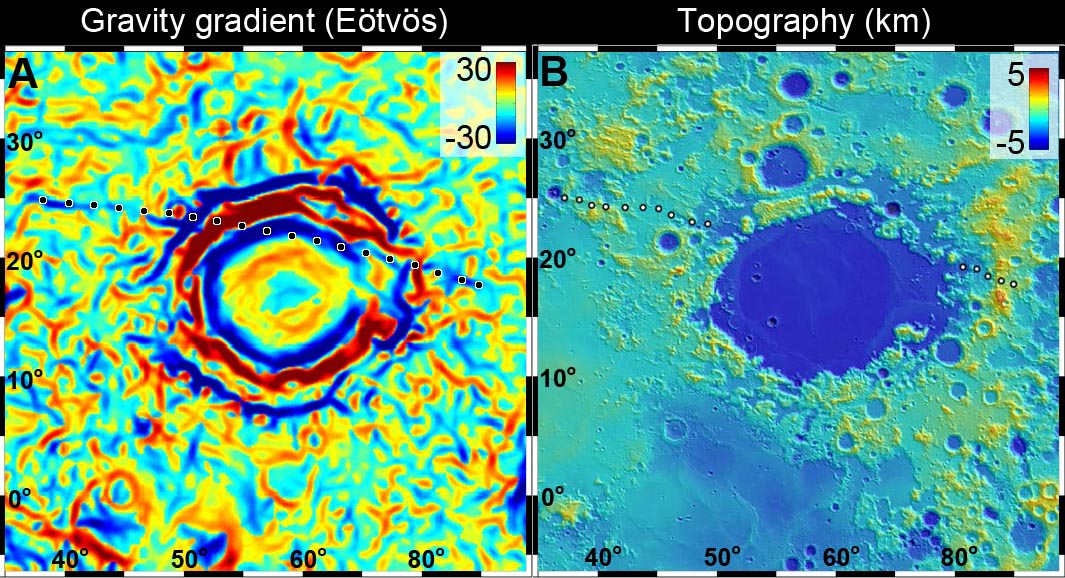
For the first time, the new GRAIL data show us direct evidence for these buried igneous dikes within the lunar crust.  One particularly prominent dike occurs near the Crisium basin, on the eastern near side of the Moon.  This dike extends over 1000 km in a quasi-radial direction northwest of the Crisium rim, disappearing beneath the mare lavas of that basin.  The fact that it is not clearly aligned with the basin structure suggests that it may predate it; we estimate that Crisium basin is older than 3.9 billion years.

Newly released GRAIL lunar gravity gradient map centered on Mare Crisium. An otherwise essentially invisible 300 km-long density of mass was detected buried under 3.9 billion year old Crisium (dotted line) [NASA/JPL/MIT].
Small scale topography of the Crisium basin, assembled from laser data points collected by the LOLA instrument aboard the Lunar Reconnaissance Orbiter [NASA/GSFC].
Mare Crisium and vicinity in a monochrome 1240 km-wide field of view from the LROC Wide Angle Camera 100 meter resolution global mosaic [NASA/GSFC/Arizona State University].
This long linear feature may have been formed when molten magma from the deep interior of the Moon oozed its way toward the surface, before “freezing” at some intermediate level.  Its presence, evident now only by a faint gravity signature (those denser areas “tugging” on the GRAIL satellites “Ebb” and “Flow”), is a tell-tale remnant of its existence deep inside the Moon’s crust.

The highly-detailed GRAIL lunar gravity gradient orthographic map, centered near 60° E meridian (and Mare Crisium, above center). The third of the hemisphere at right is on the Moon's farside. To view the spectacular new animations at their highest-available resolution by visiting the Science Visualization Studio (SVS) at NASA Goddard Space Flight Center, HERE [NASA/JPL/MIT/GSFC/SVS].
Many other linear and circular features are evident in the gravity gradient map produced by GRAIL.  Most of these seem to be associated with the large basins of the lunar highlands, the largest impact craters on the Moon. These features both excavate large amounts of crustal material during formation, and serve as topographic lows and structural traps for the accumulation of subsequent erupted lavas.  The gradient structures show a complex network of density patterns in the shallow subsurface of the Moon; this area is a morass of crushed rock, fractures, large faults and collapse features.  The entire outer portion of the lunar crust has been shattered and broken by an impact barrage of almost unimaginable violence.  The crust has since been partly annealed together by heat, re-fractured by additional impacts, intruded by large bodies of molten rock, resurfaced by the eruption of lavas from the deep interior, and finally has had its outermost surface pulverized into a fine powder by the micrometeorite bombardment.

The Moon may look like a silent, dead world but its past (which is Earth’s past) is testament to an early history of extreme violence and chaos.  The results from the GRAIL mission are helping us understand this complex story.

Originally published at his Smithsonian Air & Space blog The Once and Future Moon, Dr. Spudis is a senior staff scientist at the Lunar and Planetary Institute. The opinions expressed are those of the author and are better informed than average.

Saturday, December 8, 2012

GRAIL twins coax out the Moon's deeper history of the solar system's early, pulverizing bombardment

GRAIL primary mission global gravity map, centered on 0°N, 355°E, from animation released Dec. 5, 2012. Science Visualization Studio (SVS), GSFC [NASA/JPL/MIT].
Jennifer Chu
MIT

Beneath its heavily pockmarked surface, the moon’s interior bears remnants of the very early solar system. Unlike Earth, where plate tectonics has essentially erased any trace of the planet’s earliest composition, the moon’s interior has remained relatively undisturbed over billions of years, preserving a record in its rocks of processes that occurred in the solar system’s earliest days.

Now scientists at MIT, NASA, the Jet Propulsion Laboratory and elsewhere have found evidence that, beneath its surface, the moon’s crust is almost completely pulverized. The finding suggests that, in its first billion years, the moon — and probably other planets like Earth — may have endured much more fracturing from massive impacts than previously thought.

The startling observations come from data collected by NASA’s Gravity Recovery and Interior Laboratory (GRAIL) mission. Since March, the mission’s twin spacecraft, named Ebb and Flow, have been orbiting the moon and measuring its gravitational field.

From GRAIL’s measurements, planetary scientists have now stitched together a high-resolution map of the moon’s gravity — a force created by surface structures such as mountains and craters, as well as deeper structures below the surface. The resulting map reveals an interior gravitational field consistent with an incredibly fractured lunar crust.

“It was known that planets were battered by impacts, but nobody had envisioned that the [moon’s] crust was so beaten up,” says MIT’s Maria Zuber, who leads the GRAIL mission and is the E.A. Griswold Professor of Geophysics in the Department of Earth, Atmospheric and Planetary Sciences. “This is a really big surprise, and is going to cause a lot of people to think about what this means for planetary evolution.” 

Zuber and her colleagues detail their findings from GRAIL in three papers published this week in Science.

GRAIL’s lunar gravity map has also revealed numerous structures on the moon’s surface that were unresolved by previous gravity maps of any planet, including volcanic landforms, impact basin rings, and many simple, bowl-shaped craters. From GRAIL’s measurements, scientists have determined that the moon’s crust, ranging in thickness from 34 to 43 kilometers, is much thinner than planetary geologists had previously suspected. The crust beneath some major basins is nearly nonexistent, indicating that early impacts may have excavated the lunar mantle, providing a window into the interior.

Lifting a veil: In addition to mapping the Moon's anisotropic gravity with unprecedented granularity, the GRAIL primary mission uncovered deeper, essentially vertical dyke structures hundreds of kilometers long, the existence of which had been erased at the surface [NASA/JPL/MIT].

To generate the gravity map, GRAIL’s two probes measure the changing distance between themselves as they orbit in tight formation around the moon. As one of the probes flies over a large mass, such as a mountain or dense, underground rock, the stronger local gravity will pull that probe ahead, widening the space between the two spacecraft. Scientists can translate this changing distance into a gravitational map, representing the gravity produced by both the surface structures and the interior.

To find the gravitational field for the moon’s interior alone, Zuber’s team used topographic measurements from another of their instruments, a laser altimeter aboard the Lunar Reconnaissance Orbiter, a separate spacecraft in orbit around the moon. The scientists calculated the gravitational field expected to be produced by the moon’s topography — its surface structures alone — then subtracted that field from the field measured by GRAIL.

“It’s essentially like removing a veil to reveal the gravity due to the inside of the planet,” Zuber says. “And when we saw those maps, we were just speechless.”

The GRAIL primary science mission also succeeded in definitively mapping the thickness of the Moon's outer crust, shown in another global animation centered over the thickest zones on the lunar farside. The South Pole-Aitken basin, oldest and largest identified impact at 4.1 billion years, hosts some of the thinnest outer crust. The mission has increased the likelihood that fragments of the Moon's deeper zones will eventually be found on the surface, excavated by complex craters located on or near the basin's rim [NASA/JPL/MIT].
Compared to the surface, the map of the interior looked extraordinarily smooth. In fact, the team found that most of the moon’s local gravity is due to surface features, such as crater rims and mountains. Except for the large impact basins, the moon’s upper crust, largely lacks dense rock structures, and is instead likely made of porous, pulverized material.

The interior map did reveal long, linear structures of denser material, which Zuber and her team believe to be buried lunar dikes — formed from magma that seeped into large fractures in the crust, and then solidified into dense walls of rock. These dikes represent evidence for expansion of the moon in its earliest history. But overall, 98 percent of the lunar crust is fragmented — a clear remnant of very early, very massive impacts.

“This is interesting for the moon,” Zuber says. “But what it also means is that every other planet was being bombarded like this.” The resulting fractures, she says, affect the way a planetary body loses heat and also provide a pathway for the transport of interior fluids.

David Kring, a senior staff scientist at the Lunar and Planetary Institute in Houston, says knowing the extent of pulverization in the moon’s crust is an essential detail needed to determine the moon’s bulk composition. Such information would go a long way toward identifying the processes the formed the moon and other planets.

“The staggering quality of the data reported by Professor Zuber and her colleagues is amazing,” says Kring, who was not involved in the research. “The data are exciting because they foretell far more insights than are captured in these initial three papers.”
NASA has scheduled a news conference to discuss the planned deorbiting and impact of the GRAIL spacecraft, December 13.


In addition to GRAIL’s discoveries, Zuber says another major accomplishment has been the performance of the spacecraft themselves. To achieve the mission’s science goals, the two probes, which can travel more than 200 kilometers apart, needed to be able to measure changes in the distance between them to within a few tenths of a micron per second. But GRAIL actually outperformed its measurement requirements by about a factor of five, resolving changes in spacecraft distance to several hundredths of a micron per second — one twenty-thousandth the velocity that a snail travels. 

“On this mission, with two spacecraft, everything had to go perfectly twice,” Zuber says, adding proudly: “Imagine you’re a parent raising a twins, and your children sit down at the piano and play a duet perfectly. That’s how it feels.”

Wednesday, December 5, 2012

JPL releases most detailed map of lunar gravity

From JPL's newly released GRAIL Map of Moon's Crust, a still frame centered near 240° East, for comparison with the LROC WAC orthographic projection at the end of the previous post [NASA/JPL/MIT]
The GRAIL twin spacecraft, "Ebb" and "Flo," in close orbit around the Moon, have generated the highest resolution gravity field map of any celestial body.

The new map, created by the Gravity Recovery and Interior Laboratory (GRAIL) investigators, is allowing scientists to learn about the Moon's internal structure and composition in unprecedented detail. Data from the two "washing machine-sized" spacecraft also will provide a better understanding of how Earth and other rocky planets in the solar system formed.

The gravity field map reveals an abundance of features never before seen in detail, tectonic structures, volcanic landforms, basin rings, central peaks and numerous simple craters. Data also show the Moon's gravity field is unlike that of any known rocky planet.
These are the first scientific results from the prime phase of the mission, and they are published in three papers in the journal Science.

"What this map tells us is, more than any other celestial body we know, the Moon wears its gravity field on its sleeve," said GRAIL Principal Investigator Maria Zuber of the Massachusetts Institute of Technology. "When we see a notable change in the gravity field, we can sync up this change with surface topography features such as craters, rilles or mountains."

Zuber says the Moon's gravity field preserves the record of impact bombardment that characterized all terrestrial planetary bodies and reveals evidence for fracturing of the interior extending to the deep crust and possibly the mantle. This impact record is preserved, and is now more precisely measured, on the Moon.

The probes revealed the bulk density of the moon's highland crust is substantially lower than generally assumed.

From JPL's newly released GRAIL Gravity Map of the Moon [NASA/JPL/MIT].
This low-bulk crustal density agrees well with data obtained during the late Apollo "J" missions, that samples returned by astronauts are indicative of global processes.

"With our new crustal bulk density determination, we find the average thickness of the moon's crust is between 34 and 43 kilometers, about 10 to 20 kilometers thinner than previously thought," said Mark Wieczorek, GRAIL co-investigator at the Institut de Physique du Globe de Paris

"With this crustal thickness, the bulk composition of the moon is similar to that of Earth. This supports models where the moon is derived from Earth materials that were ejected during a giant impact event early in solar system history."

The map was created by the spacecraft transmitting radio signals to define precisely the distance between them as they orbit the Moon in formation. Orbiting over areas of greater or lesser gravity related to visible features, such as mountains and craters, and masses hidden beneath the lunar surface, the distance between the two spacecraft changed slightly.

"We used gradients of the gravity field in order to highlight smaller and narrower structures than could be seen in previous datasets," said Jeff Andrews-Hanna, a GRAIL guest scientist with the Colorado School of Mines. "This data revealed a population of long, linear gravity anomalies, with lengths of hundreds of kilometers, crisscrossing the surface. These linear gravity anomalies indicate the presence of dikes, or long, thin, vertical bodies of solidified magma in the subsurface. The dikes are among the oldest features on the moon, and understanding them will tell us about its early history."

While results from the primary science mission are just beginning to be released, the collection of gravity science by the lunar twins continues. GRAIL's extended mission science phase began August 30 and concludes December 17. As End of Mission nears, the spacecraft will operate at lower orbital altitude.

When launched in September 2011, the probes were named GRAIL A and B. They were renamed Ebb and Flow last January by elementary students in Bozeman, Montana, following a nationwide contest. Ebb and Flow were placed in near-polar, near-circular orbit at an altitude of approximately 55 kilometers, December 31, 2011 and January 1, 2012, respectively.

NASA's Jet Propulsion Laboratory in Pasadena, Calif., manages the mission for NASA's Science Mission Directorate in Washington. GRAIL is part of the Discovery Program managed at NASA's Marshall Space Flight Center in Huntsville, Ala. Lockheed Martin Space Systems of Denver built the spacecraft.

To view the lunar gravity map, visit http://bit.ly/grailtour . For more information about the mission, visit HERE .

Wednesday, May 30, 2012

Ebb & Flow complete primary mission

Ebb and Flow have completed their prime mission earlier than expected. The mission team of NASA's Gravity Recovery and Interior Laboratory (GRAIL) mission, with twin probes named Ebb and Flow, is now preparing for extended science operations starting Aug. 30 and continuing through Dec. 3, 2012.

The GRAIL mission has gathered unprecedented detail about the internal structure and evolution of the moon. This information will increase our knowledge of how Earth and its rocky neighbors in the inner solar system developed into the diverse worlds we see today.

Since March 8, the spacecraft have operated around the clock for 89 days. From an orbit that passes over the lunar poles, they have collected data covering the entire surface three times. An instrument called the Lunar Gravity Ranging System onboard each spacecraft transmits radio signals that allow scientists to translate the data into a high-resolution map of the moon's gravitational field. The spacecraft returned their last data set of the prime mission May 29. The instruments were turned off at 1 p.m. EDT when the spacecraft were 37 miles (60 kilometers) above the Mare Nectaris.

"Many of the measurement objectives were achieved from analysis of only half the primary mission data, which speaks volumes about the skill and dedication of our science and engineering teams," said Maria Zuber, principal investigator of GRAIL at the Massachusetts Institute of Technology in Cambridge. "While there is a great deal of work yet to be done to achieve the mission's science, it's energizing to realize that what we traveled from Earth to the moon for is right here in our hands."

"GRAIL delivered to Earth over 99.99 percent of the data that could have been collected, which underscores the flawless performance of the spacecraft, instrument and the Deep Space Network," said Zuber.

Both spacecraft instruments will be powered off until Aug. 30. The spacecraft will have to endure a lunar eclipse on June 4. The eclipse and the associated sudden changes in temperature and the energy-sapping darkness that accompanies the phenomena were expected and do not concern engineers about the spacecraft's health.

"Before launch, we planned for all of GRAIL's primary mission science to occur between lunar eclipses," said David Lehman, project manager of GRAIL from NASA's Jet Propulsion Laboratory (JPL) in Pasadena, Calif. "But now that we have flown Ebb and Flow for a while, we understand them and are confident they can survive these eclipses in good shape."

The extended mission goal is to take an even closer look at the moon's gravity field. To achieve this, GRAIL mission planners will halve their current operating altitude flying at the lowest altitude that can be safely maintained.

"Orbiting at an average altitude of 14 miles (23 kilometers) during the extended mission, the GRAIL twins will be clearing some of the moon's higher surface features by about 5 miles (8 kilometers)," said Joe Beerer, GRAIL's mission manager. "If Ebb and Flow had feet, I think by reflex they'd want to pull them up every time they fly over a mountain."

Along with mission science, GRAIL's MoonKAM (Moon Knowledge Acquired by Middle school students) education and public outreach program is also extended. To date over 70,000 student images of the moon have been obtained. The MoonKAM program is led by Sally Ride, America's first woman in space, and her team at Sally Ride Science in collaboration with undergraduate students at the University of California in San Diego.

The GRAIL mission is managed by JPL for NASA's Science Mission Directorate in Washington. The mission is part of the Discovery Program managed at NASA's Marshall Space Flight Center in Huntsville, Ala. NASA's Deep Space Network is an international network of antennas that supports interplanetary spacecraft missions and radio and radar astronomy observations for the exploration of the solar system and the universe. The network also supports selected Earth-orbiting missions. Lockheed Martin Space Systems in Denver built the spacecraft.

Tuesday, March 27, 2012

Flying Formation - Around the Moon at 5,800 KPH

An artist’s depiction of the twin spacecraft (Ebb and Flow) that comprise NASA’s Gravity Recovery And Interior Laboratory (GRAIL) mission. View full image and caption HERE [NASA/Caltech-JPL/MIT].
D. C. Agle
Jet Propulsion Laboratory

Pasadena - The act of two or more aircraft flying together in a disciplined, synchronized manner is one of the cornerstones of military aviation, as well as just about any organized air show. But as amazing as the U.S. Navy's elite Blue Angels or the U.S. Air Force's Thunderbirds are to behold, they remain essentially landlocked, anchored if you will, to our planet and its tenuous atmosphere. What if you could take the level of precision of these great aviators to, say, the moon?

"Our job is to ensure our two GRAIL spacecraft are flying a very, very accurate trail formation in lunar orbit," said David Lehman, GRAIL project manager at NASA's Jet Propulsion Laboratory in Pasadena, California. "We need to do this so our scientists can get the data they need."

Essentially, trail formation means one aircraft (or spacecraft in this case), follows directly behind the other. Ebb and Flow, the twins of NASA's GRAIL (Gravity Recovery And Interior Laboratory) mission, are by no means the first to synch up altitude and "air" speed  while zipping over the craters, mountains, hills and rills of Earth's natural satellite. That honor goes to the crew of Apollo 10, who in May 1969 performed a dress rehearsal for the first lunar landing. But as accurate as the astronauts aboard lunar module "Snoopy" and command module "Charlie Brown" were in their piloting, it is hard to imagine they could keep as exacting a position as Ebb and Flow.

"It is an apples and oranges comparison," said Lehman. "Lunar formation in Apollo was about getting a crew to the lunar surface, returning to lunar orbit and docking, so they could get back safely to Earth. For GRAIL, the formation flying is about the science, and that is why we have to make our measurements so precisely."

As the GRAIL twins fly over areas of greater and lesser gravity at 5,800 kilometers per hour, surface features such as mountains and craters, and masses hidden beneath the lunar surface, can influence the distance between the two spacecraft ever so slightly.

How slight a distance change can be measured by the science instrument beaming invisible microwaves back and forth between Ebb and Flow?

NASA/Caltech-JPL/MIT
› Full image and caption
How about one-tenth of one micron? Another way to put it is that the GRAIL twins can detect a change in their position down to one half of a human hair (0.00001 centimeters).  For those of you who are hematologists or vampires (we are not judging here), any change in separation between the two twins greater than one half of a red corpuscle will be duly noted aboard the spacecraft's memory chips for later downlinking to Earth. Working together, Ebb and Flow will make these measurements while flying over the entirety of the lunar surface.

This begs the question, why would scientists care about a change of distance between two spacecraft as infinitesimal as half a red corpuscle a quarter million miles from Earth?

"Mighty oaks from little acorns grow - even in lunar orbit," said Maria Zuber, principal investigator of the GRAIL mission from the Massachusetts Institute of Technology, Cambridge. "From the data collected during these minute distance changes between spacecraft, we will be able to generate an incredibly high-resolution map of the moon's gravitational field.  From that, we will be able to understand what goes on below the lunar surface in unprecedented detail, which will in turn increase our knowledge of how Earth and its rocky neighbors in the inner solar system developed into the diverse worlds we see today."

Getting the GRAIL twins into a hyper-accurate formation from a quarter million miles away gave the team quite a challenge. Launched together on Sept. 10, 2011, Ebb and Flow went their separate ways soon after entering space. Three-and-a-half months and 2.5 million miles (4 million kilometers) later, Ebb entered lunar orbit. Flow followed the next day (New Year's Day 2012).

"Being in lunar orbit is one thing, being in the right lunar orbit for science can be something else entirely," said Joe Beerer, GRAIL's mission manager from JPL. "The twins initial orbit carried them as close to the lunar surface as 56 miles (90 kilometers) and as far out as 5,197 miles (8,363 kilometers), and each revolution took approximately 11.5 hours to complete. They had to go from that to a science orbit of 15 by 53 miles (24.5 by 86 kilometers) and took all of 114 minutes to complete."

To reduce and refine Ebb and Flow's orbits efficiently and precisely required the GRAIL team to plan and execute a series of trajectory modification burns for each spacecraft. And each maneuver had to be just right.

More information about the GRAIL mission is online at: http://www.nasa.gov/grail or http://grail.nasa.gov .

NASA's Jet Propulsion Laboratory in Pasadena, California, manages the GRAIL mission for NASA's Science Mission Directorate, Washington. The GRAIL mission is part of the Discovery Program managed at NASA's Marshall Space Flight Center in Huntsville, Alabama. Lockheed Martin Space Systems in Denver built the spacecraft. JPL is a division of the Çalifornia Institute of Technology in Pasadena.

"Because each one of these maneuvers was so important, we did a lot of planning and testing for each," said Beerer. "Over eight weeks, we did nine maneuvers with Ebb and 10 with Flow to establish the science formation. We would literally be watching our screens for a signal telling us about an Ebb rocket burn, then go into a meeting about the next burn for Flow. Our schedule was very full."

Today, the calendar for GRAIL's flight team remains a busy one with the day-to-day operations of keeping NASA's lunar twins in synch. But as busy as the team gets, they still have time to peer skyward.

"Next time you look up and see the moon, you might want to take a second and think about our two little spacecraft flying  formation, zooming from pole to pole at 5,800 kph," said Lehman. "They're up there, working together, flying together, getting the data our scientists need. As far as I'm concerned, they're putting on quite a show."

Wednesday, March 7, 2012

GRAIL twins begin science mission

Ebb (GRAIL-A) in continuously measuring the distance between itself and Flow (GRAIL-B), when measured against time and place will enable mapping the lunar interior with high precision [NASA/JPL/MIT].
NASA's Gravity Recovery And Interior Laboratory (GRAIL) spacecraft orbiting the moon officially have begun their science collection phase. During the next 84 days, scientists will obtain a high-resolution map of the lunar gravitational field to learn about the moon's internal structure and composition in unprecedented detail. The data also will provide a better understanding of how Earth and other rocky planets in the solar system formed and evolved.

"The initiation of science data collection is a time when the team lets out a collective sigh of relief because we are finally doing what we came to do," said Maria Zuber, principal investigator for the GRAIL mission at the Massachusetts Institute of Technology in Cambridge. "But it is also a time where we have to put the coffee pot on, roll up our sleeves and get to work."

The GRAIL mission's twin, washing-machine-sized spacecraft, named Ebb and Flow, entered lunar orbit on New Year's Eve and New Years Day. GRAIL's science phase began yesterday at 8:15 p.m. EST (5:15 p.m. PST). During this mission phase, the spacecraft will transmit radio signals precisely defining the distance between them. As they fly over areas of greater and lesser gravity caused by visible features such as mountains, craters and masses hidden beneath the lunar surface, the distance between the two spacecraft will change slightly. Science activities are expected to conclude on May 29, after GRAIL maps the gravity field of the moon three times.

"We are in a near-polar, near-circular orbit with an average altitude of about 34 miles (55 kilometers) right now," said David Lehman, GRAIL project manager from NASA's Jet Propulsion Laboratory (JPL) in Pasadena, California. "During the science phase, our spacecraft will orbit the moon as high as 31 miles (51 kilometers) and as low as 10 miles (16 kilometers). They will get as close to each other as 40 miles (65 kilometers) and as far apart as 140 miles (225 kilometers)."

Previously named GRAIL A and B, the names Ebb and Flow were the result of a nation-wide student contest to choose new names for the spacecraft. The winning entry was submitted by fourth graders from the Emily Dickinson Elementary School in Bozeman, Montana. Nearly 900 classrooms with more than 11,000 students from 45 states, Puerto Rico and the District of Columbia, participated in the contest.

JPL manages the GRAIL mission for NASA's Science Mission Directorate in Washington. The GRAIL mission is part of the Discovery Program managed at NASA's Marshall Space Flight Center in Huntsville, Alabama. Lockheed Martin Space Systems in Denver built the spacecraft.

Tuesday, March 6, 2012

Community college scholars to design rovers

JPL Pasadena - Community college students will have the chance to design robotic rovers in cooperation with NASA. Ninety-two students from schools in 24 states have been selected to travel to a NASA center, including NASA's Jet Propulsion Laboratory, Pasadena, CA., to develop rovers through the National Community College Aerospace Scholars program. The initiative provides hands-on opportunities to inspire interest in science, technology, engineering and mathematics (STEM) disciplines.

Students will visit either JPL from May 1 to 3, or NASA's Johnson Space Center in Houston from May 9 to 11. The teams will establish fictional companies pursuing Mars exploration. Each team will develop, design and build a prototype rover, then use their prototypes to navigate a course, collect rocks and water and return to a home base.

"I am so proud of the Community College Aerospace Scholars program," said Leland Melvin, NASA's associate administrator for education. "Community colleges offer NASA a great pool of STEM talent critical to our scientific and exploration initiatives. They also serve a large portion of our nation's minority students. Engaging these underserved and underrepresented learners in STEM initiatives helps NASA build a more inclusive and diverse workforce for the future."
 
Participants were selected based on completion of interactive web-based assignments throughout the school year. The on-site experience this spring includes a tour of NASA facilities and briefings from agency scientists and engineers.

The program is based on the Texas Aerospace Scholars program, originally created in partnership with NASA and the Texas educational community. Aerospace Scholars programs are designed to encourage students to enter careers in science and engineering and ultimately join the nation's technical workforce.

For a complete list of the student participants, their states and the community colleges they represent, visit: http://go.nasa.gov/nccas. For more information about NASA's education programs, visit: http://www.nasa.gov/education

Monday, February 27, 2012

Research scientist openings at JPL

Clive R. Neal
LUNAR-L
University of Notre Dame

The Planetary Science Section at JPL, based in Pasadena, CA, is looking to fill two positions for researchers in areas relevant to future Martian sample return missions. The first position is for study in the area of mineralogy, petrology and/or meteoritics. The research is expected to further knowledge of petrogenetic processes throughout the Solar System. Advanced scientific knowledge of petrology, mineralogy, and/or meteoritics is expected. The ability to use analytical and theoretical approaches to solving problems related to the origin and evolution of igneous rocks and/or extraterrestrial samples is essential.

The second position is for a researcher within the area of organic geochemistry with a strong focus on geobiological and/or astrobiological investigations. The researcher will possess expertise in those areas related to the origin and significance of organic material in terrestrial and extraterrestrial geological samples. Themes of study are expected to include the origin and evolution of life on Earth, the study of extraterrestrial organic compounds, and/or the recognition of biosignatures in returned Solar System samples.

It is expected that both positions will pursue new mission and/or instrument opportunities through advocacy and outreach within the scientific and stakeholder community. This pursuit will involve working closely with science and engineering teams at JPL to design Solar System sample return and planetary exploration missions and instrumentation. The candidates are expected to have a PhD along with advanced knowledge and demonstrated experience in conceiving, defining, and conducting independent scientific research. Both positions include significant start up packages. Both positions offer a competitive salary and impressive benefits with a renowned leader in Planetary Science.

To view the full job descriptions and apply to these positions, please visit: http://careerlaunch.jpl.nasa.gov, (see Requisitions #10654 and #10655). Applications will be reviewed as they are received, and should include a curriculum vitae, a career statement with research objectives and contact information for three professional references. JPL/Caltech is an equal opportunity/affirmative action employer.

Friday, October 7, 2011

GRAIL twins 'going their own way'

Using a precision formation-flying technique, the twin GRAIL spacecraft will map the moon's gravity field, as depicted in this artist's rendering [NASA/JPL].
NASA/JPL (Pasadena, CA) - NASA's Gravity Recovery And Interior Laboratory (GRAIL)-B spacecraft successfully executed its first flight path correction maneuver Wednesday, Oct. 5. The rocket burn helped refine the spacecraft's trajectory as it travels from Earth to the moon and provides separation between itself and its mirror twin, GRAIL-A. The first burn for GRAIL-A occurred on Sept. 30.

"Both spacecraft are alive and with these burns, prove that they're kicking too, as expected," said David Lehman, GRAIL project manager at NASA's Jet Propulsion Laboratory in Pasadena, Calif. "There is a lot of time and space between now and lunar orbit insertion, but everything is looking good."

GRAIL-B's rocket burn took place on Oct. 5 at 11 a.m. PDT (2 p.m. EDT). The spacecraft's main engine burned for 234 seconds and imparted a velocity change of 56.1 mph (25.1 meters per second) while expending 8.2 pounds (3.7 kilograms) of propellant. GRAIL-A's burn on Sept. 30 also took place at 11 a.m. PDT. It lasted 127 seconds and imparted a 31.3 mph (14 meters per second) velocity change on the spacecraft while expending 4 pounds (1.87 kilograms) of propellant.

These burns are designed to begin distancing GRAIL-A and GRAIL-B's arrival times at the moon by approximately one day and to insert them onto the desired lunar approach paths.

The straight-line distance from Earth to the moon is about 250,000 miles (402,336 kilometers). It took NASA's Apollo moon crews about three days to cover that distance. Each of the GRAIL twins is taking about 30 times that long and covering more than 2.5 million miles (4 million kilometers) to get there. This low-energy, high-cruise time trajectory is beneficial for mission planners and controllers, as it allows more time for spacecraft checkout. The path also provides a vital component of the spacecraft's single science instrument, the Ultra Stable Oscillator, to be continuously powered for several months, allowing it to reach a stable operating temperature long before beginning the collection of science measurements in lunar orbit.

GRAIL-A will enter lunar orbit on New Year's Eve, and GRAIL-B will follow the next day. When science collection begins, the spacecraft will transmit radio signals precisely defining the distance between them as they orbit the moon. Regional gravitational differences on the moon are expected to expand and contract that distance. GRAIL scientists will use these accurate measurements to define the moon's gravity field. The data will allow mission scientists to understand what goes on below the surface of our natural satellite.

NASA's Jet Propulsion Laboratory, Pasadena, Calif., manages the GRAIL mission. The Massachusetts Institute of Technology, Cambridge, is home to the mission's principal investigator, Maria Zuber. The GRAIL mission is part of the Discovery Program managed at NASA's Marshall Space Flight Center in Huntsville, Ala. Lockheed Martin Space Systems, Denver, built the spacecraft. Launch management for the mission is the responsibility of NASA's Launch Services Program at the Kennedy Space Center in Florida. JPL is a division of the California Institute of Technology in Pasadena.

More information about GRAIL is online at: http://www.nasa.gov/grail and http://grail.nasa.gov.

Friday, September 9, 2011

Launch of GRAIL twins slips to Saturday

NASA's GRAIL twin spacecraft await launch atop a United Launch Alliance Delta II rocket at Cape Canaveral Air Force Station [NASA].
The launch of a Delta II vehicle carrying NASA’s Gravity Recovery and Interior Laboratory (GRAIL) was scrubbed once again to Saturday morning, to provide "additional time to review propulsion data from Thursday's detanking operation." The Delta II and GRAIL remains safe and secure, and the launch has now been tentatively rescheduled for September 10, from Space Launch Complex-17B at Cape Canaveral Air Force Station. There are two instantaneous launch opportunities at 12:29:45 and 13:08:52 UT.

Emily Lakdawalla of The Planetary Society quotes professional launch photographer Ben Cooper, "This is the final Delta mission from Complex 17 after nearly six decades of launches from this, the oldest active pad still in use at Cape Canaveral. Complex 17 saw its first launch in January 1957, from Pad B, and its first space launch in 1960 when Echo 1, the world's first communications satellite, failed to make orbit on what was the first Delta vehicle by name, having been transitioned from the Thor IRBM."

NASA's Jet Propulsion Laboratory, Pasadena manages the GRAIL mission, and the Massachusetts Institute of Technology, Cambridge, is home to the mission's principal investigator, Maria Zuber. Using a precision formation-flying technique, the twin GRAIL spacecraft will map the moon's uneven mass. The result should be the most accurate gravity map of the moon ever made. The mission also will answer longstanding questions about Earth's moon, including the size and nature of mass concentrations, "voids" of low desity materal and the Moon's possibly liquid inner core.

SpaceflightNow.com is sponsoring live streaming video of the launch. More information about GRAIL is online at: http://www.nasa.gov/grail and http://grail.nasa.gov .

Thursday, September 1, 2011

Jupiter-bound Juno captures Earth & Moon

Earth and Moon from NASA's Juno spacecraft, August 26, 2011, from 9.66 million kilometers away. Earth-Moon distance is foreshortened in this line of sight view, that true distance was around 370,000 km, and the Moon's phase was late crescent. Image was taken by the spacecraft's onboard camera JunoCam [NASA/JPL-Caltech].

Pasadena – On its way to the biggest planet in the solar system -- Jupiter, NASA's Juno spacecraft took time to capture its home planet and its natural satellite -- the moon.
"This is a remarkable sight people get to see all too rarely," said Scott Bolton, Juno principal investigator from the Southwest Research Institute in San Antonio. "This view of our planet shows how Earth looks from the outside, illustrating a special perspective of our role and place in the universe. We see a humbling yet beautiful view of ourselves."

The image was taken by the spacecraft’s camera, JunoCam, on Aug. 26 when the spacecraft was about 6 million miles (9.66 million kilometers) away. The image was taken as part of the mission team’s checkout of the Juno spacecraft. The team is conducting its initial detailed checks on the spacecraft’s instruments and subsystems after its launch on Aug. 5.

Juno covered the distance from Earth to the moon (about 250,000 miles or 402,000 kilometers) in less than one day's time. It will take the spacecraft another five years and 1,740 million miles (2,800 million kilometers) to complete the journey to Jupiter. The spacecraft will orbit the planet's poles 33 times and use its eight science instruments to probe beneath the gas giant's obscuring cloud cover to learn more about its origins, structure, atmosphere and magnetosphere, and look for a potential solid planetary core.

The solar-powered Juno spacecraft lifted off from Cape Canaveral Air Force Station in Florida at 9:25 a.m. PDT (12:25 p.m. EDT) on Aug. 5 to begin its five-year journey to Jupiter.

JPL manages the Juno mission for the principal investigator, Scott Bolton, of Southwest Research Institute in San Antonio. The Juno mission is part of the New Frontiers Program managed at NASA's Marshall Space Flight Center in Huntsville, Ala. Lockheed Martin Space Systems, Denver, built the spacecraft. JPL is a division of the California Institute of Technology in Pasadena.

More information about Juno is online at http://www.nasa.gov/juno and http://missionjuno.swri.edu . You can follow the mission on Twitter at http://www.twitter.com/nasajuno .