Showing posts with label NASA Stennis. Show all posts

Sunday, January 25, 2015

Palazzo to push lunar surface expeditions

U.S. Rep. Steven Palazzo's district includes NASA's John C. Stennis Space Center [Rollcall].
Deborah Barfield Berry and Ledyard King
Hattiesburg American

Rep. Steven Palazzo (R-MS) plans to use his chairmanship of a House panel on space this year to again promote a return-to-the-moon mission and lobby against President Obama's plan to use an asteroid as a stepping-stone to remote sensing Mars from martian orbit.

Palazzo also chaired the House Science, Space and Technology Subcommittee on Space in the last Congress, but this year he sees a possible boost for his priorities in the GOP's takeover of the Senate.

"With the expanded majorities, we're going to continue to put an emphasis on America remaining the leader in space," Palazzo said in a recent interview. "America's leadership in space is no longer just a matter of national pride, it's become a matter of national security."

US Senator Ted Cruz (R-TX), new chairman of the Commerce Subcommittee on Science, Space and Competitiveness, outlined plans to "focus NASA on its core mission, exploring Space and more of it," on January 14 [AP].
One pressing issue this year, he said, will be helping NASA craft a "road map."

"Right now, they say, 'We're going to Mars,'" Palazzo said of NASA officials. "Well, that's great, but they haven't said how we're going to get there. So no one knows what to build, how to build it, when to build it or how to pay for it."

He said the moon, which the U.S. last visited in 1972, is a more logical route to the Red Planet than an asteroid.
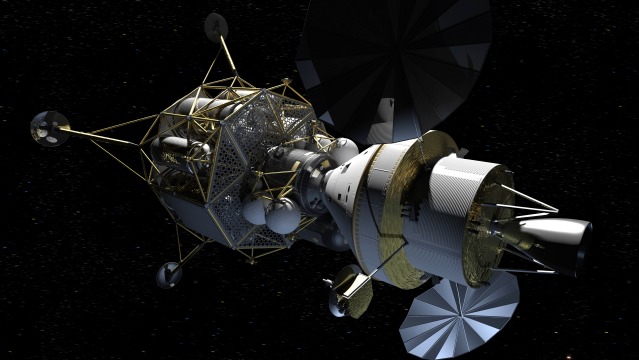
Orion and Altair: architecture envisioned within NASA in 2007, before Congress, acting on the recommendation the Obama administration, eliminated research and development for surface expeditions on the Moon and on Mars. Along with operations in Cislunar space or retrieving an asteroid NASA's leadership today proposes robotic exploration of the martian surface and of Phobos controlled from Mars orbit [NASA/Frassinito & Associates].
"I think most people agree, just because we've done it doesn't mean we can't do it again," Palazzo said.

Palazzo's district is home to Stennis Space Center, a rocket testing site that Palazzo said employs more than 4,000 workers.

But with limited funding for NASA, it will be harder for Palazzo and other supporters of a lunar mission to win support, said Stephen Rozman, a political scientist at Tougaloo College in Mississippi.

"They're going to have to show a real reason for rebuilding or taking the program to the next level right now," he said.

Read the entire article HERE.

Friday, May 24, 2013

Project Morpheus Tether Test 21


This was "the first tether test of the v1.5b," Project Morpheus Bravo vehicle. The video runs about 29 seconds.

"We had a good ignition and climb. However, as the vehicle attempted to stabilize itself it exceeded the internally set boundary limit causing a soft abort."

Monday, May 6, 2013

Morpheus Unit B first fully integrated hot fire test


Project Morpheus Hot Fire Test #8: On May 1, the Morpheus concept lander "Bravo Unit" was tested in a "hot fire" configuration, the first fully-integrated test of this second Unit. Built by Armadillo Aerospace, with the aim of developing a cutting edge vehicle for soft-landing 500 kg. payloads on the Moon, Unit A was lost following the failure of a real-time inertia measurement unit in August 2012.

Related Posts:
Morpheus and ALHAT teams, still hard at work (February 11, 2013)
Morpheus employs ALHAT in teather test #16 (June 13, 2012)
Project Morpheus lander - Soft Abort Test (May 11, 2012)
Morpheus Tether Test #10 (April 9, 2012)
Morpheus Tether Test #8 (March 14, 2012)
Project Morpheus methane Hot Fire Test #5 (February 29, 2012)
Morpheus lander in tethered flight tests (May 7, 2011)

Monday, February 11, 2013

Morpheus and ALHAT teams, still hard at work


The Project Morpheus team has been hard at work preparing for this year’s series of tests and building the new Morpheus 1.5B and 1.5C vehicles.  "We have been busy assembling the vehicle structures, wiring in all of our sensors, running integrated tests, continuing engine firings at Stennis Space Center, and more."

Before and after the catastrophic loss of what had been the primary unmanned Morpheus lander test platform, testing the next generation (and the generation after) fueling, hazard avoidance and guidance technologies at the Johnson and Kennedy Space centers. Built by Armadillo Aerospace with the aim of developing a cutting edge vehicle for soft-landing 500 kg on the Moon, this platform was lost following failure of a real-time Inertia Measurement Unit (IMU) last August.
The Morpheus and ALHAT teams are now a combined team, which enables a more integrated series of tests as we prepare for future flight tests.  One of these integrated tests took place at Kennedy Space Center in December.  We used a Langley Research Center Huey helicopter as a stand-in for Morpheus.  We mounted the ALHAT sensors under the belly of the helicopter pointed in the direction of the helicopter motion.  Other components such as sensor electronics, Morpheus flight computer, real-time communications equipment and support hardware were placed in the passenger/cargo area.  This allowed both onboard and ground support teams to monitor progress in real-time.  The helicopter was  flown repeatedly on Morpheus-type trajectories towards the hazard field.

Read the report HERE.

Moving Forward, Not Starting Over

"A ship in harbor is safe, but that is not what ships are built for."
-John Augustus Shedd

On Thursday we made our second free flight attempt with the Morpheus prototype vehicle.  As you can see in the video below, shortly after liftoff we experienced a hardware failure and lost the vehicle.  The root cause is still under investigation,  but what we do know is that at the start of  ascent we lost data from the Inertial Measurement Unit (IMU) that supplies navigation updates to the flight computer.  Without this measurement the vehicle is blind and does not know which way it is pointing or accelerating.  Since this data is needed to maintain stable flight, the vehicle could not determine which way was up and began to tumble and  impacted the ground about 50 feet from the launch site.  No one was injured, no property was damaged besides the vehicle and we have been able to recover significant data, which will give us greater insight into the source of the problem.

We have said it before and will continue to say, this is why we test.  We have already learned a lot from this test and will continue to learn as we recover data and evaluate the hardware.   No test article should be too precious to lose.  A spare vehicle was planned from the start and is just a few months away from completion.  The basic development approach is to quickly build, test and redesign the hardware to achieve many design cycles and maturity before building flight articles.

Read the report HERE.

Sunday, July 29, 2012

NASA's Space Launch System Passes Major Agency Review, Moves to Preliminary Design

Artist rendering of the various configurations of NASA's Space Launch System (SLS) together with a quick comparison with the Saturn V (1967-1972) [NASA].
The rocket that will launch humans farther into space than ever before passed a major NASA review Wednesday. The Space Launch System (SLS) Program completed a combined System Requirements Review and System Definition Review, which set requirements of the overall launch vehicle system. SLS now moves ahead to its preliminary design phase.

The SLS will launch NASA's Orion spacecraft and other payloads, and provide an entirely new capability for human exploration beyond low Earth orbit.

These NASA reviews set technical, performance, cost and schedule requirements to provide on-time development of the heavy-lift rocket. As part of the process, an independent review board comprised of technical experts from across NASA evaluated SLS Program documents describing vehicle specifications, budget and schedule. The board confirmed SLS is ready to move from concept development to preliminary design. 

Read the NASA announcement, HERE.

Wednesday, June 15, 2011

New and improved J-2 (J2X) is ready for live-fire testing


The J-2X, designed and built for NASA by Prat & Whitney Rocketdyne, is the new generation design for the engine that powered Apollo-Saturn V's Third Stage through Trans-Lunar Injection from 1968-1972. The complete redesign is ready for live-fire testing. Above a Shuttle main engine undergoes testing at Stennis Space Center two years ago [NASA/Stennis].

al.com

Bay St. Louis. Mississippi- NASA's new J-2X rocket engine is ready for its initial round of testing after being installed Saturday in the A-2 Test Stand at the space agency's Stennis Space Center in Mississippi.

The fully assembled engine will undergo a series of 10 test firings starting this month that will last several months.

"An upper stage engine is essential to making space exploration outside low-Earth orbit a reality," Mike Kynard, manager of the J-2X upper stage engine project at NASA's Marshall Space Flight Center in Huntsville, Alabama, said in a news release. "The J-2X goes beyond the limits of its historic predecessor and achieves higher thrust, performance, and reliability than the J2. We are thrilled to have the engine in the test stand to validate our assumptions about engine performance and reliability."

Monday, August 2, 2010

Cold Storage


A permanently-double-shaded crater near a lunar pole. Within the double-shaded crater, a suspended thermal shield reflecting 50 K gray body radiation back towards the lunar surface is shown. Extremely low heat conduction between the object and the lunar surface could additionally be produced using superconducting magnetic levitation to support the thermal shield and the principal object. The thermal shield would be shaped to block surface heat radiation from all directions [NASA/SSC].

NASA Tech Brief - Stennis Space Center - In the polar regions of the Moon, some areas within craters are permanently shadowed from solar illumination and can drop to temperatures of 100 K or lower. These sites may serve as cold traps, capturing ice and other volatile compounds, possibly for eons. Interestingly, ice stored in these locations could potentially alter how lunar exploration is conducted. Within craters inside craters (double-shaded craters) that are shaded from thermal re-radiation and from solar illuminated regions, even colder regions should exist and, in many cases, temperatures in these regions never exceed 50 K.

Working in these harsh environments with existing conventional systems, exploration or mining activities could be quite daunting and challenging. However, if the unique characteristics of these environments were exploited, the power, weight, and total mass that is required to be carried from the Earth to the Moon for lunar exploration and research would be substantially reduced.

In theory, by minimizing the heat transfer between an object and the lunar surface, temperatures near absolute zero can be produced. In a single or double-shaded crater, if the object was isolated from the variety of thermal sources and was allowed to radiatively cool to space, the achievable temperature would be limited by the 3 K cosmic background and the anomalous solar wind that can strike the object being cooled. Our analysis shows that under many circumstances, with some simple thermal radiation shielding, it is possible to establish environments with temperatures of several degrees Kelvin.

Read the full article, HERE.

Wednesday, August 12, 2009

Orion - Next Stop Stennis

Orion CEV Block One Mock-Up arrives in Pensacola, Monday, where it was viewed by enthusiastic crowds at the Naval Air Station museum. Next Stop, on its way to Kennedy Space Center, Stennisphere.

A full-scale mockup of NASA’s Orion crew exploration vehicle will be on display for free public viewing Wednesday from 10 a.m. to 2:30 p.m. at StenniSphere, the visitor center at NASA’s John C. Stennis Space Center.

The mockup is used in tests to study the environment for astronauts and recovery crews after an Orion ocean splashdown. It is being moved from Florida to Texas to continue its testing, but is stopping at Stennis and other locations for public viewing en route.

The first round of Post-landing Orion Recovery Tests (PORT) occurred in March in a controlled water environment at the Naval Surface Warfare Center in Bethesda, Md. Additional testing near NASA’s Kennedy Space Center in April took place in the rougher, uncontrolled waters of the Atlantic Ocean. The next testing phase, designated as PORT II, will be conducted at Johnson Space Center in Houston.

“The first portion of PORT testing was a great success, giving NASA an early look into the motions crews inside and outside Orion will feel after landing,” said Alan Rhodes, PORT testing lead at Johnson. “This will allow us to modify the design to aid in the recovery of the vehicle and crew.”

At Johnson, the PORT test article will be outfitted with seats, restraints and other items that may affect how crews get in and out of Orion. Engineers will evaluate the crew’s ability to get out of Orion in calm water at the Sonny Carter Training Facility’s Neutral Buoyancy Lab. NASA will also work with U.S. Air Force rescue and recovery experts to determine how parajumpers will assist crews in case of an emergency.

NASA’s Constellation Program is developing America’s next-generation human spaceflight system to carry astronauts to the International Space Station, the moon and destinations beyond.

NASA shows future of American Space Travel
Pensacola News Journal

Saturday, May 30, 2009

Stennis builds for the Moon

From Lunar Pioneer
Construction continues at Stennis Space Center in Hancock County, MS on the 235-foot A-3 engine test stand. The stand will be used to test engines on the next generation of NASA rockets, which are planned to take humans back to the Moon. - NASA (full image HERE.)

J.R. WELSH Sun Herald
Biloxi-Gulfport and South Mississippi

A massive steel structure jutting into the sky not far from Interstate 10 is sending the world a message: NASA is taking the next step in hurtling humans back to the moon.

Structural work was recently finished on the giant A-3 test stand. Now, things are moving further along in the construction phase.

In April Lafayette Steel Erector of Louisiana put the final steel beam on top of the towering test stand and bolted the beam in place, bearing the signatures of project team members. “We’re now 235 feet closer to going back to the moon,” A-3 project manager Lonnie Dutreix said.

The test stand has a final completion date of May 2011. Steel for the project began arriving at Stennis in October 2008 — enough to build 16 phases on foundations and footings that were placed in 2007. All told, four million pounds of fabricated steel were used.

With the steel skeleton erected, further work has begun. “We’re now working on general construction,” said Chris McGee, NASA’s news chief at Stennis.

The general construction package was awarded to Roy Anderson Corp., of Gulfport.

It cannot exceed $45 million, McGee said, and includes general mechanical and electrical support for the A-3. Work also is progressing on nearby canal docks that will allow materials to be brought to the test site, and work is under way on underground utilities.

When completed, the stand will be serviced by nine water storage tanks, each holding 35,000 gallons.

The test stand is an integral part of NASA’s new Constellation Program, which will take Americans back to the moon and possibly beyond. When completed, the A-3 stand will test J-2X engines that will propel the Ares I crew launch vehicle and the Ares V cargo launch vehicle.

NASA has tested space flight engines for many years, but the new stand was necessary to achieve the height simulations needed in the Constellation Program. The A-3 can simulate altitudes up to 100,000 feet and can withstand a million pounds of thrust. The J-2X is expected to produce less than 294,000 pounds of thrust; however, the extra capability was built into the A-3 to accommodate more powerful engines in the future.

Stennis, with its 125,000-acre acoustical buffer zone, was selected by NASA in the 1960s as an engine test site, specifically because of its space and isolation. The first test stand was used to test the Saturn V rocket for the Apollo Program. In the 1970s, Stennis began testing space shuttle main engines.

Aside from Steel Erector Inc., companies involved in the A-3 work have included prime contractor IKBI, of Choctaw, Miss., and Prospect Steel Co. of Little Rock. Prospect handled the steel fabrication work.