Showing posts sorted by relevance for query Giordano Bruno. Sort by date Show all posts

Saturday, July 7, 2012

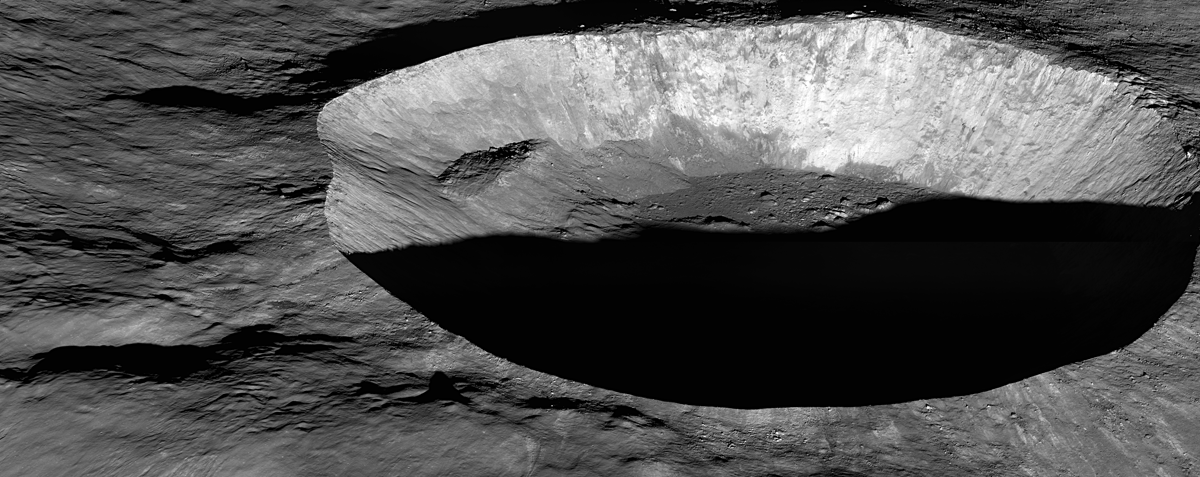
LROC: Sunset Over Giordano Bruno

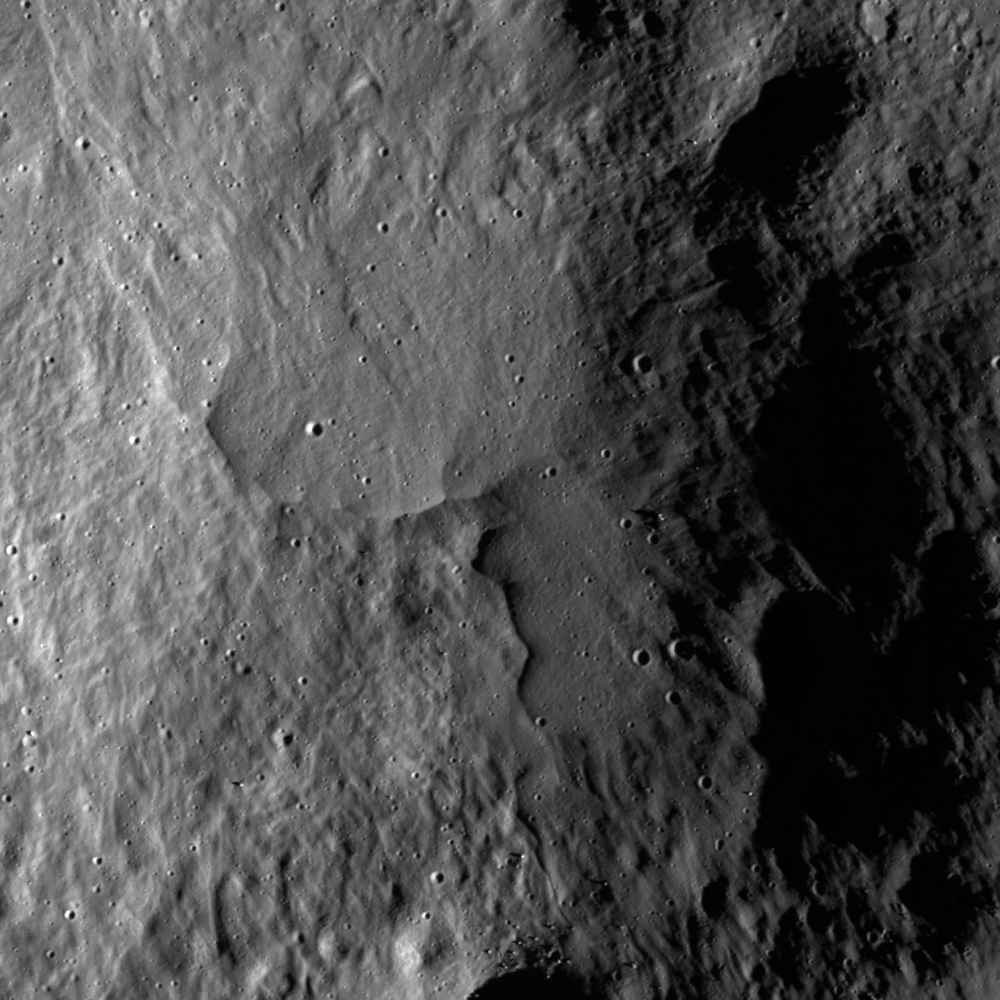
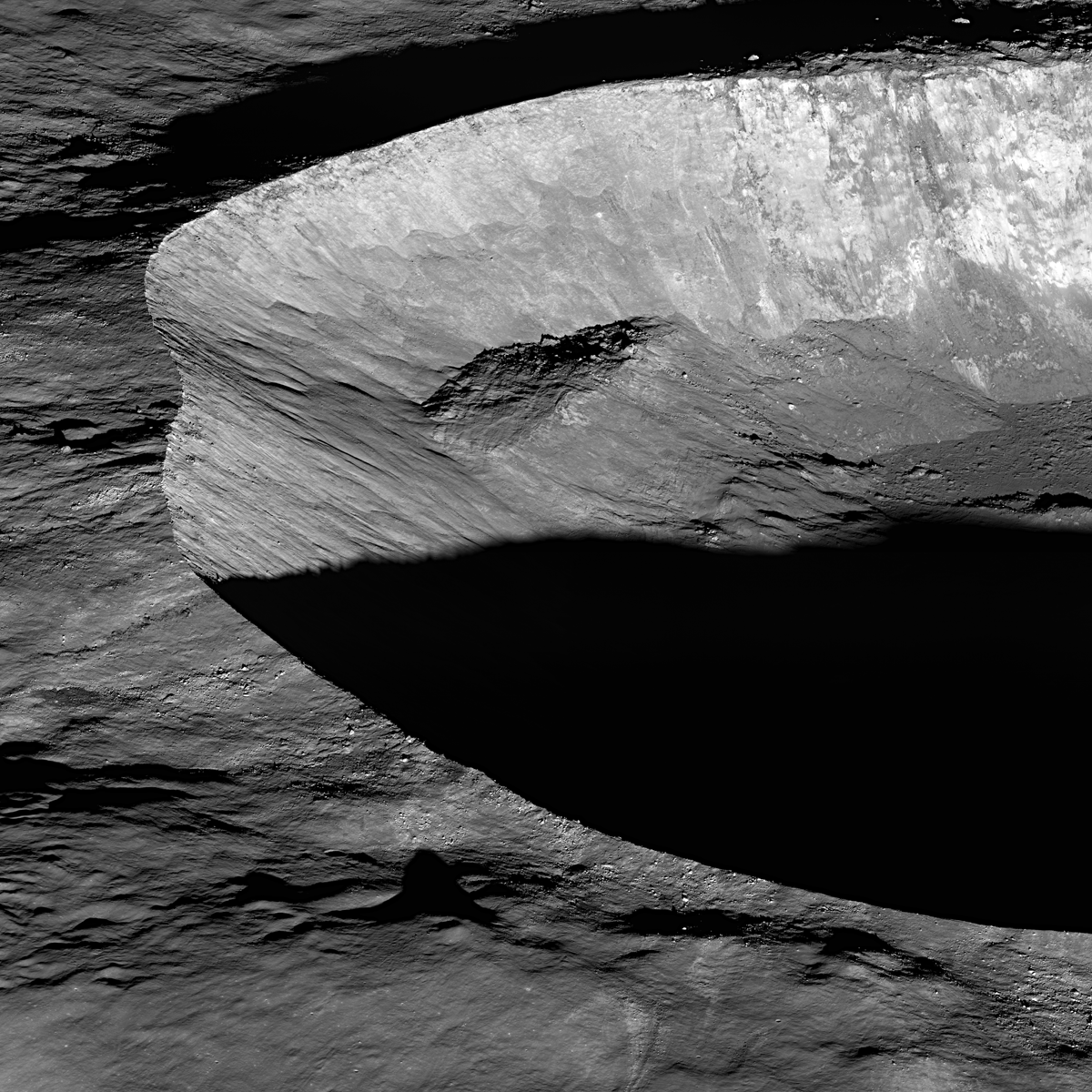
Slump terrace in the northern half of Giordano Bruno crater seen at sunset, from an altitude of 54 km. Terrace is 4800 meters wide, LROC Narrow Angle Camera (NAC) M165190579LR, LRO orbit 9478, July 13, 2011; spacecraft slew 60° at 1.37 meters resolution. View the full-size LROC image release, HERE [NASA/GSFC/ Arizona State University].
Mark Robinson
Principal Investigator
Lunar Reconnaissance Orbiter Camera
Arizona State University

The exact age of formation for Giordano Bruno crater is not known. Legend has it forming sometime in the 12th century, and more recent crater counts have this beautiful crater forming up to 10 million years ago.

Crater counts must be more accurate than legend, right?

Perhaps, but one of the new results from analysis of LROC images is that self-secondaries (sometimes called auto-secondaries) may be more pervasive than previously thought.

Subsampled version of NAC oblique view of Giordano Bruno crater (21 km diameter). View the full-size LROC image release, HERE [NASA/GSFC/ Arizona State University].
A self-secondary crater forms as late stage ejecta lands on top of early ejecta, all from the same impact event. In this case the impact that formed Giordano Bruno crater. So despite the best efforts of the lunar science community, all we know is that this fascinating crater formed no later than 10 million years ago and no earlier than 18 June 1178. How can we get to an unambiguous answer; what is the exact age of formation of Giordano Bruno? The answer is simple, radiometric age dating of rocks that melted during the impact! When a rock is melted and then recrystallizes its radiometric clock is reset, thus all we need to do is collect a sample of the abundant impact melt rocks either from the floor or flanks of Giordano Bruno.

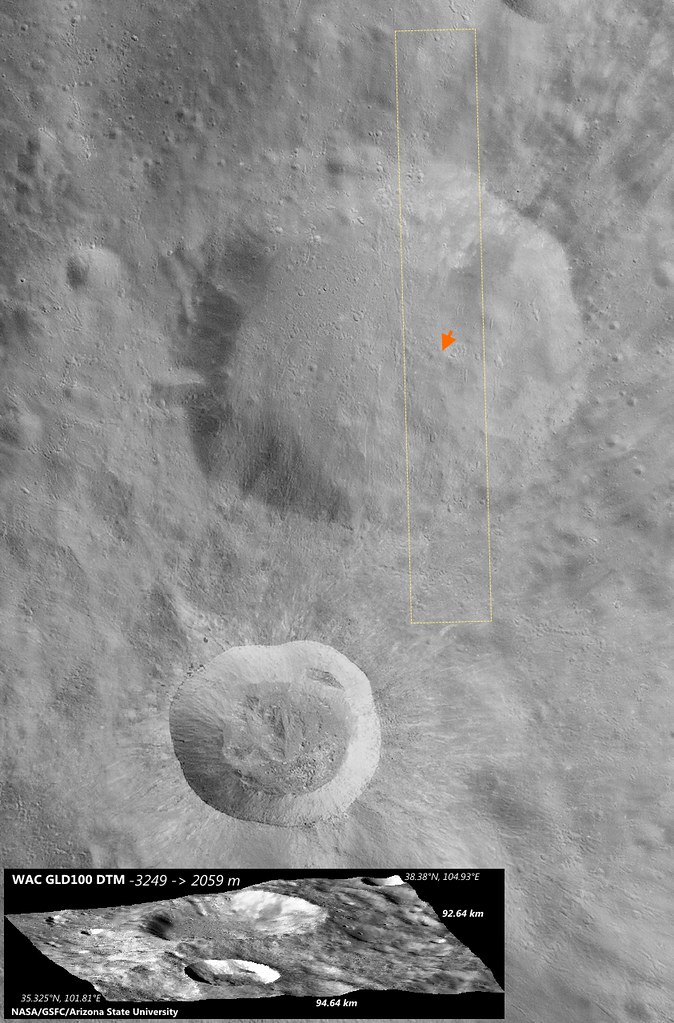
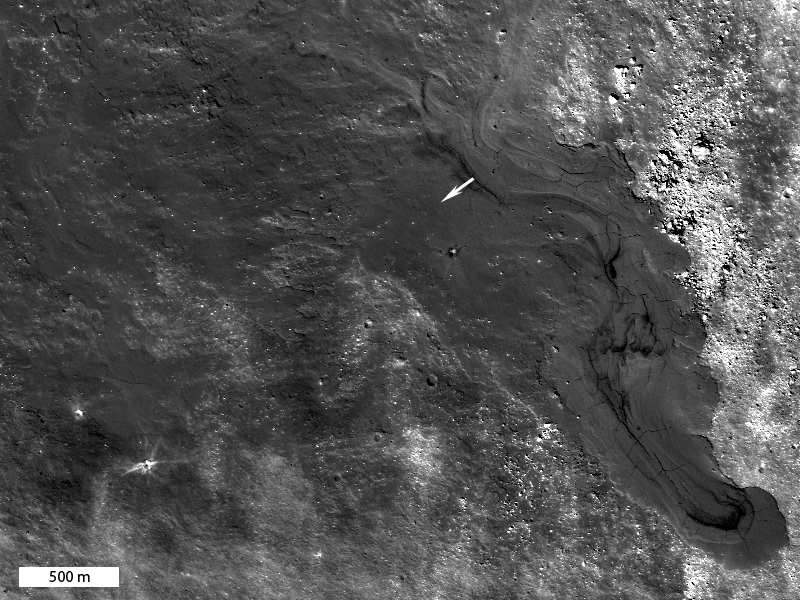
Impact melt deposit on south flank of Giordano Bruno crater, arrow indicates center of landing site (35.47°N, 102.86°E) shown at full resolution below. View the full-size LROC image release, HERE [NASA/GSFC/Arizona State University].
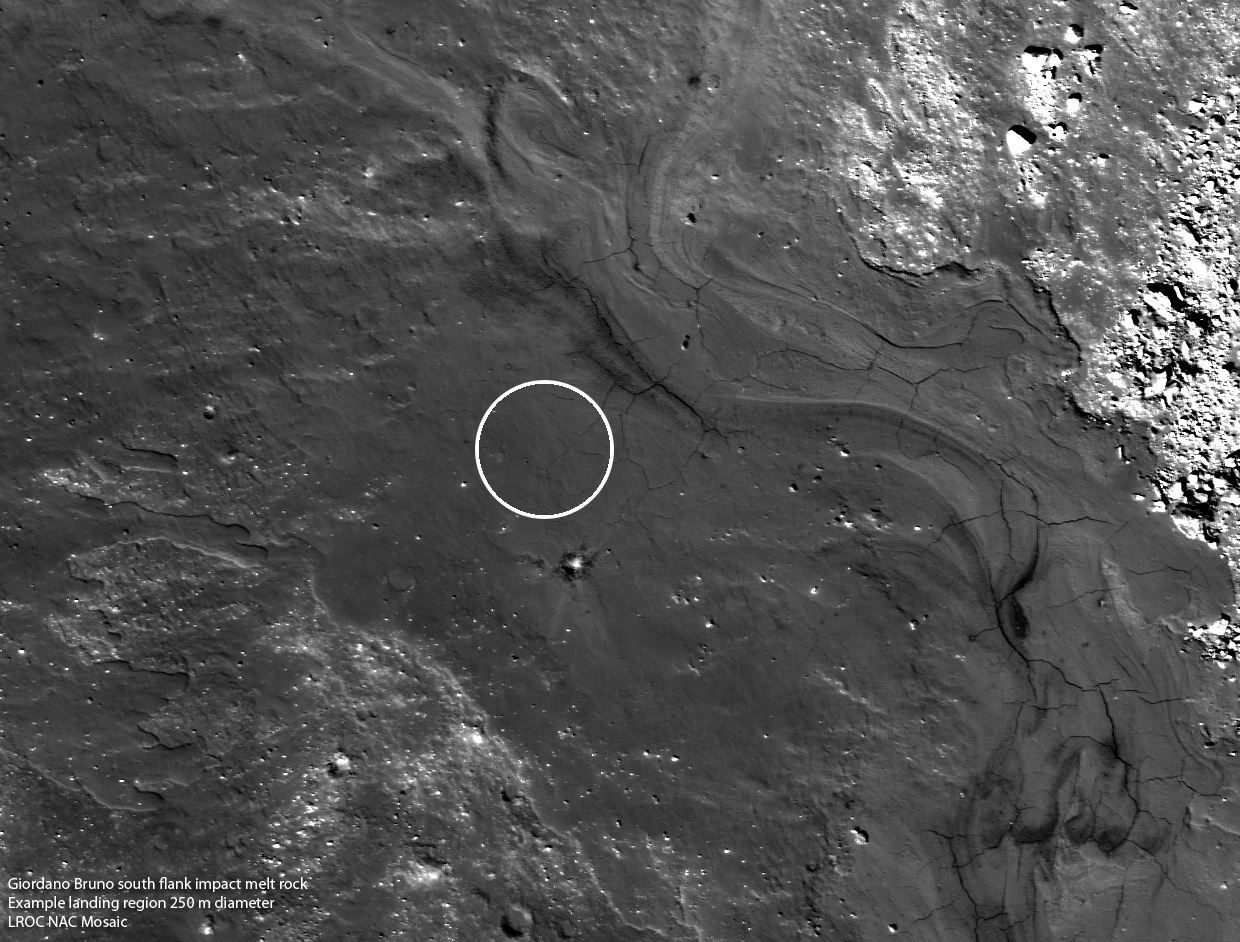
In terms of planetary missions, collecting such a sample is relatively straightforward (although no planetary spacecraft missions are simple): land, scoop, return. First scientists and engineers find the safest landing spot on an impact melt deposit. My favorite is just outside the crater, on the crater's southern rim (visit last week's Featured Image mosaic of Giordano Bruno crater). This large area provides numerous 100 meter size landing spots on now frozen deposit of impact melt. Next, you have to build the sample return spacecraft and land it safely on the Moon. This is no small feat, but keep in mind that the Soviet Union did this successfully three times almost four decades ago. While on the surface, key supporting measurements would be acquired; images, spectral measurements, magnetic properties, and perhaps information about surface radiation exposure to help design safer spacecraft and spacesuits for future astronauts. Finally, after no more than a lunar day on the surface, a sample is scooped up and then returned to Earth. What would we learn? Of course, we'd learn about the age of formation of Giordano Bruno crater, but also much more.

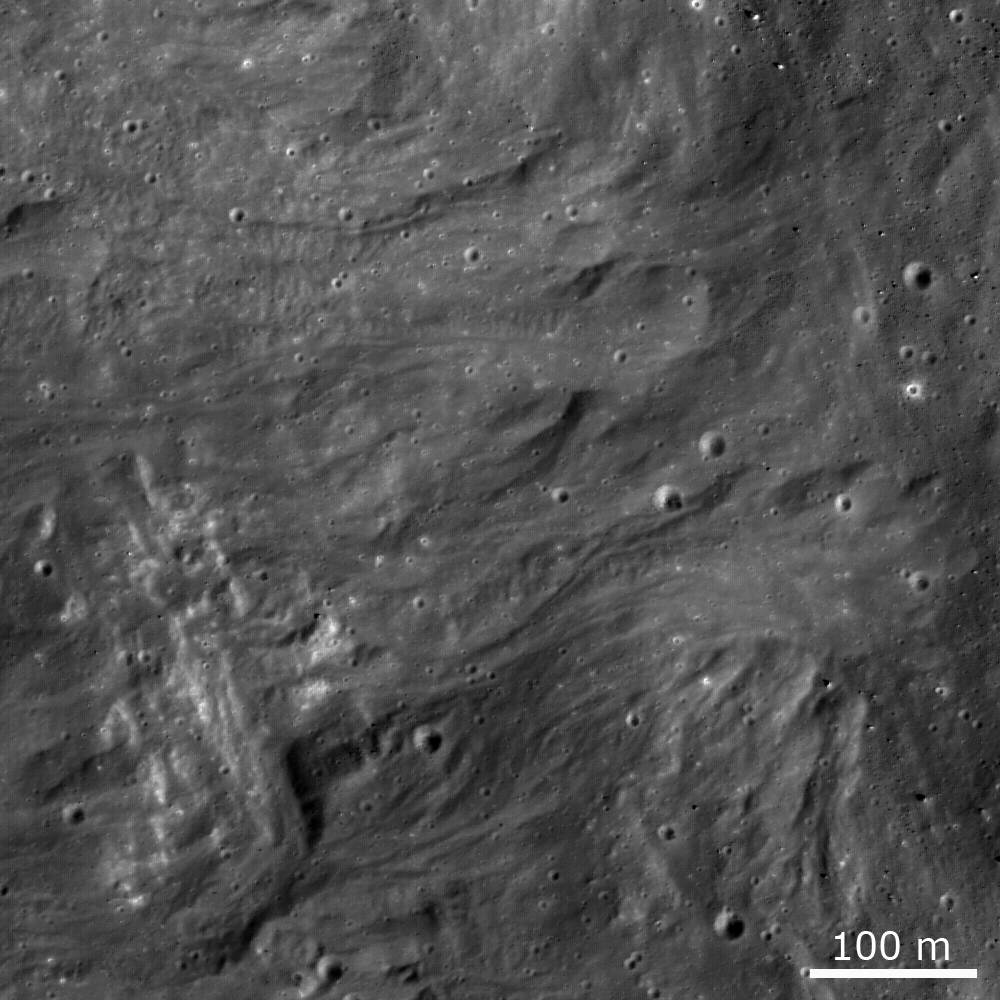
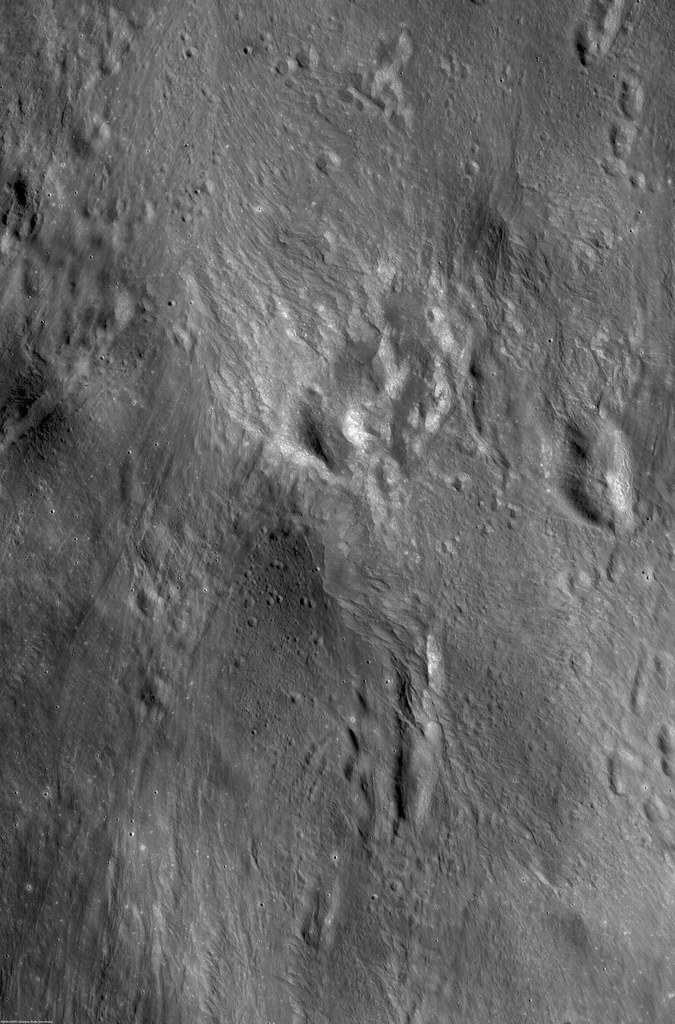
Example landing spot (250 meter diameter circle) on now frozen impact melt. View the full-size LROC image release, HERE [NASA/GSFC/Arizona State University].
This new knowledge will help crater counting experts understand the importance of self-secondary craters on very young craters. A new calibration for these youngest craters could be obtained, thus making age estimates for all other young craters on the Moon more reliable. Additionally this part of the Moon is far from the Imbrium basin and the KREEPy region from where all the Apollo and Luna samples were returned. So this precious sample would be our first look at unsampled highlands terrain, the oldest portion of the Moon's crust. All-in-all, this site is a prime candidate for an automated precursor sample return - lets go!

Be sure and check out the amazing details in the full resolution complete oblique mosaic of Giordano Bruno crater.

Previous LROC Giordano Bruno Featured Images
The Big Picture
Outside of Giordano Bruno
Fragmented Impact Melt
Delicate Patterns in Giordano Bruno Ejecta
Impact Melt Flows on Giordano Bruno
Young Giordano Bruno

A possible landing site on the south flank of the relatively fresh, much studied crater Giordano Bruno (22.13km, 35.92°N, 102.74°E) LROC Wide Angle Camera (WAC) mosaic from four sequential orbits, February 23, 2010, angle of incidence 49.62° at 76.2 meters resolution, from 54 km. [NASA/GSFC/Arizona State University].

Friday, August 26, 2011

Outside Giordano Bruno


Impact melt outside Giordano Bruno. LROC Narrow Angle Camera (NAC) observation M161646501R, LRO orbit 8956, June 2, 2011; illumination from the southwest, incidence angle 71° and resolution 55 centimeters per pixel. View the full-size LROC Featured Image HERE [NASA/GSFC/Arizona State University].

Sarah Braden
LROC News System

Giordano Bruno (35.9°N, 102.8°E) is a Copernican-age impact crater known for interesting impact melt features. The crater is named after the famous Italian philosopher Giordano Bruno who lived during the Renaissance.

Today's Featured Image shows an impact melt flow outside of the crater walls. This impact melt was thrown from Giordano Bruno and landed about 6 km away from the rim. Some of the material was hot enough that it continued to flow after being emplaced on the surface. The direction of flow is toward the top of the frame, away from the rim of Giordano Bruno. Although formed by a different process, impact melts flow in much the same way as lava flows, forming lobes and exhibiting channels and levees. Like lava flows, they cease to move when their source is depleted or the melt cools and freezes into solid rock.


Bright, relatively young Giordano Bruno impact melt, visible in LROC NAC frame M161646501R, in context of a crop from a 76 meter/pixel resolution, 604nm mosaic of four LROC Wide Angle Camera (WAC) observations swept up in orbits 3044-3047, February 23, 2011. See a wider field of view HERE [NASA/GSFC/Arizona State University].

Giordano Bruno is one of the youngest large craters (22 km diameter) on the Moon. How old is "youngest"? Most of the time, geologists classify the youngest craters into a group called Copernican-aged craters. However, if humans went back to the Moon they could sample some of the impact melt outside of Giordano Bruno, bring the sample back to Earth, and then use radiometric age dating to estimate the age of the rock. Impact melt rocks can be used to measure the age of an impact since the rock's "isotopic clock" is reset when it returns to a molten state.


One hundred meter per pixel LROC WAC context image of Giordano Bruno. The red box shows the extent of LROC NAC frame M161646501R. The impact melt outside of Giordano Bruno is in the lower end of the frame. See the full-size context image HERE [NASA/GSFC/Arizona State University].


Full width view of NAC frame M161646501R. The LROC Feature Image released August 25, 2011 focuses in on the lobe of flash-frozen impact melt from Giordano Bruno above left [NASA/GSFC/Arizona State University].

Explore the entire NAC frame for more impact melt flows outside of Giordano Bruno!

Related Images:
King crater ejecta deposits
LROC: Mare Undarum "Action Shot"
Fragmented Impact Melt
Impact Melt Flows on Giordano Bruno
Delicate Patterns in Giordano Bruno ejecta
Young Giordano Bruno


Giordano Bruno captured by the Planetary Camera onboard Japan's Kaguya (SELENE-1) lunar orbiter in 2007 [JAXA/SELENE].

Tuesday, July 17, 2012

'Barnstorming' Giordano Bruno

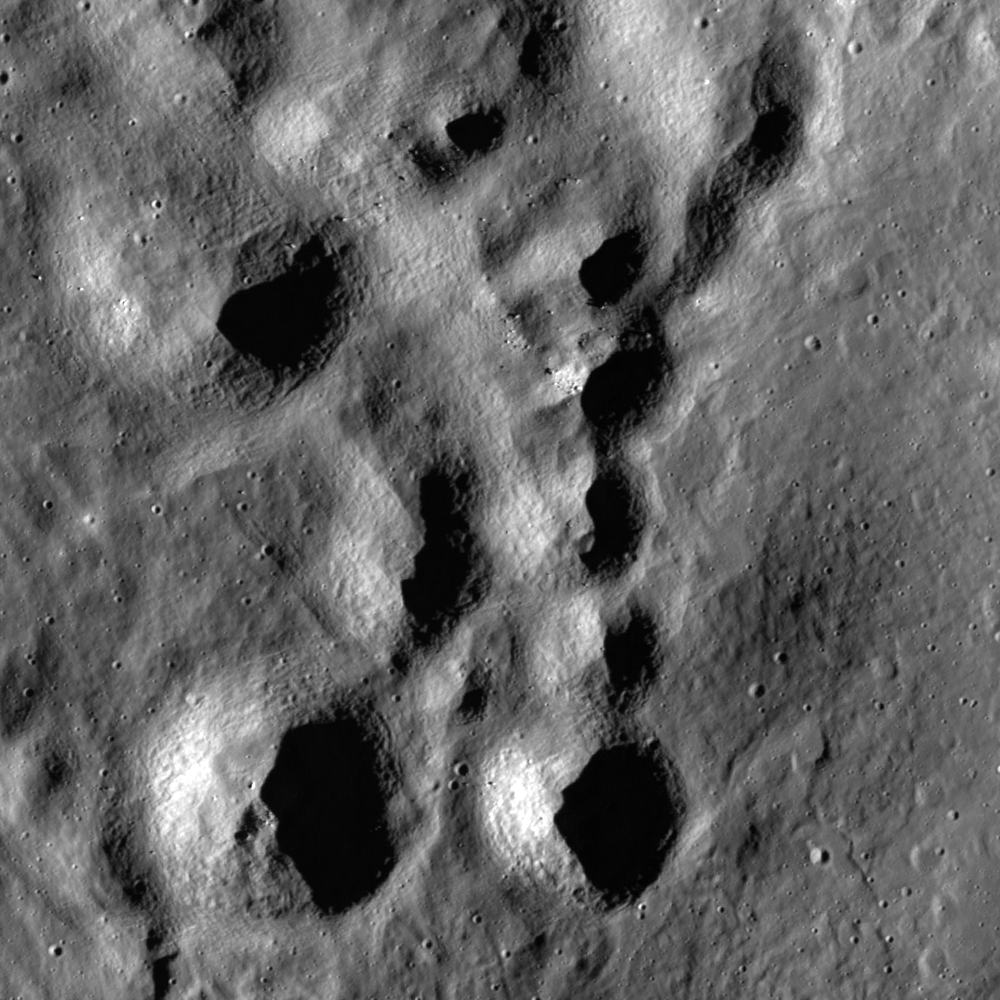
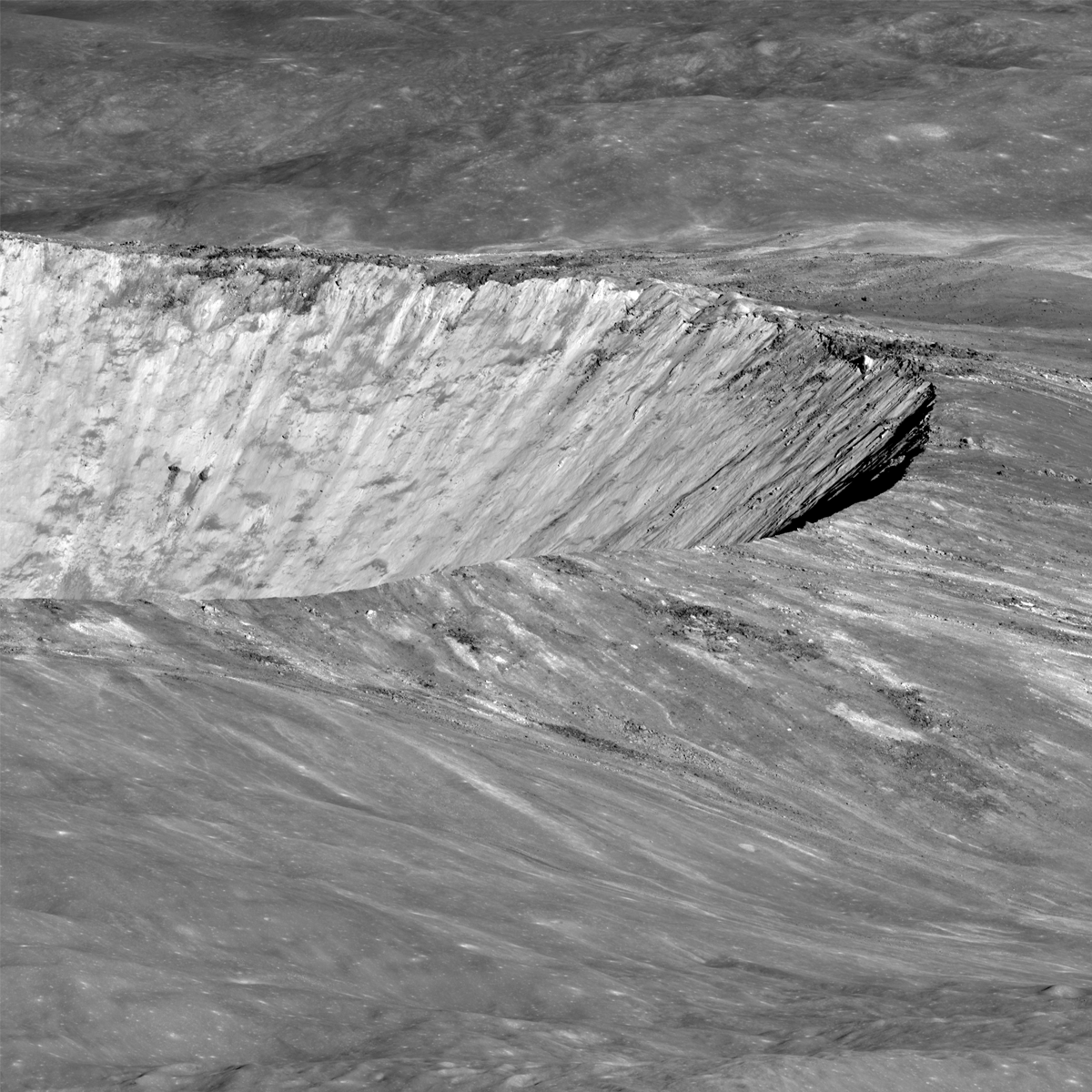
A Very Oblique View of Giordano Bruno - Southern rim of Giordano Bruno crater seen obliquely (79°) from 53 km altitude, small portion of mosaic of LROC Narrow Angle Camera (NAC) frames M119245930L & R (LRO orbit 2707, January 27, 2010; subsampled by a factor of three; Slew angle -74° 4.2 meters resolution). View the full size LROC Featured Image, HERE [NASA/GSFC/Arizona State University].
Marc Robinson
Principal Investigator
Lunar Reconnaissance Orbiter Camera (LROC)
Arizona State University

LROC has captured many sensational views of the crater Giordano Bruno. We return again and again to this rayed beauty because it is a nearly pristine example of the effects of impacts on the lunar surface. It displays an immense ejecta blanket with beautiful secondary craters and is an excellent illustration of how rocks melted by impacts flow and pond. The crater also exposes fresh highland material, with minimal effects from space weathering. Today's Featured Image, captured by slewing the spacecraft 79° to the east, provides another sensational view that helps us understand the impact process, and until astronauts visit Giordano Bruno, gives a view about as close as you can get to standing on the surface to the west of the crater.

Giordano Bruno south wall detail - Full resolution detail of the steep inward dipping wall of Giordano Bruno [NASA/GSFC/Arizona State University].
In the detail above, you can see the crater's steep wall and a flap of what appears to be impact melt that goes right up to, and over, the edge. In regions like this, it is likely that as molten rock was ejected from the crater and deposited on the exterior, the crater's shape was still changing. A portion of what was originally the rim has likely slumped down into the crater. Small debris slides continue to expose bright, fresh material on the walls. In the wider, reduced-resolution view below, the extent to which the impact event resurfaced its surroundings is clear. The foreground shows the detailed patterns left by the ejecta and secondary craters as they swept across the surface, smoothing and mantling the original topography. In the distance of the background, you can make out darker areas within the bright terrain - these are likely areas that the continuous ejecta blanket and rays did not completely cover, so the mature soil remains at the surface.

A wider, reduced resolution view of Giordano Bruno and its ejecta blanket. Click on the image above to enlarge, or below for a full resolution version of this image [NASA/GSFC/Arizona State University]
Scroll through all of the details of this beautiful impact crater - the full-resolution version of today's Featured Image is not to be missed, HERE.

Be sure to check out the YouTube video:


Check out the full resolution version of the movie.
Download it for yourself, HERE. (Barnstorming_Giordano_Bruno.mov - 85.0 MB)

Previous LROC Views of Giordano Bruno:
Sunset Over Giordano Bruno
The Big Picture
Outside of Giordano Bruno
Fragmented Impact Melt
Delicate Patterns in Giordano Bruno Ejecta
Impact Melt Flows on Giordano Bruno

Saturday, June 8, 2013

Giordano Bruno Whorl

Impact melt forms a swirled feature in Giordano Bruno crater. Field of view 1 kilometer. From LROC Narrow Angle Camera (NAC) observation M143947267L LRO orbit 6347, November 9, 2010; 53.08° angle of incidence, 57 centimeters per pixel resolution from 54.50 km [NASA/GSFC/Arizona State University].
Sarah Braden
LROC News System

The crater Giordano Bruno (22 km, 35.97°N, 102.89°E) is a favorite of lunar scientists due to its relatively young age and the amazing impact melt features found within and without the crater walls.

Previously, the LROC Featured Image gave a birds eye view of the whole crater in "Giordano Bruno, The Big Picture."

Today's Featured Image uses a 57 cm per pixel NAC frame to highlight the details of a giant swirl (or whorl) of impact melt within one of the larger impact melt pools inside Giordano Bruno.

M1102880536LR-NSJ-0110-58b-9587x13223
Under a much higher Sun, a lower angle of incidence, the 'whorl' (left of center, at the contact between the west crater wall and floor) can also be seen in this mosaic showing nearly the entire complex melt flows and interior of Giordano Bruno. View the full resolution (9587x13223) mosaic, HERE. LROC NAC mosaic M1102880536LR, orbit 14851, September 21, 2012; 37.55° angle of incidence, resolution 1.52 meters from 152.11 km [NASA/GSFC/Arizona State University].
The whorl formed in a clockwise direction and is about 1 kilometer in diameter. This spiral-shaped feature may have formed due to shear stress created when molten impact melt flowed at different speeds (probably caused by drag from the pool floor or an obstacle within the pool). This shear would modify flow directions in ways that could ultimately produce such a swirling pattern. Slumping material may have set the melt into motion within an otherwise calm impact melt pool.

hdtv_008_5_l
Giordano Bruno from south, looking ahead from Japan's Kaguya (SELENE-1) in polar orbit (2008), from roughly 100 km over the 102nd meridian. The crater is closely studied because it is strikingly fresh, perhaps less than 10 million years old and far less affected by the steady gardening of micrometeorites and the steady rain of energetic cosmic rays that turn over the top 3 mm of the Moon's surface every 2 million years [JAXA/NHK/SELENE]. View the full 1920x1200 original, HERE.
The more information lunar scientists can gather about how quickly impact melt cools, the more we will know about how this structure formed!

Explore the entire NAC frame for more amazing views of Giordano Bruno, HERE.

Related Images:
Very Oblique View of Giordano Bruno
Sunset Over Giordano Bruno
Outside of Giordano Bruno
Fragmented Impact Melt
Impact Melt Flows on Giordano Bruno

Tuesday, June 26, 2012

LROC: Giordano Bruno, The Big Picture

Mosaic of eight LROC NAC images provides this spectacular view of the interior of Giordano Bruno crater (21 km diameter). Resolution was reduced by 10 times to fit this Featured Image format, M185212646LR, M185219795LR, M185226944LR, M185234092LR. View the spectacular 1215 x 1215 px LROC Featured Image HERE [NASA/GSFC/Arizona State University].
Mark Robinson
Principal Investigator
Lunar Reconnaissance Orbiter Camera
Arizona State University
 
To conserve fuel, LRO was moved from its 50-km circular orbit into an elliptical orbit on 11 December 2012. As a result the spacecraft's altitude is now significantly higher in the northern hemisphere; the low point of the orbit is ~30 km over the south pole and 200 km over the north pole. This new orbit provides fantastic opportunities to acquire large area mosaics with nearly identical lighting across numerous orbits. For this Giordano Bruno crater mosaic, LROC acquired four NAC pairs (8 NAC images), from 4 orbits in a row, over a six hour period on 1 March 2012. Since LRO's polar orbits progress from east to west, the first image pair was acquired by slewing the spacecraft 6° to the west, on the next orbit only 1° to the west, on the third orbit LRO slewed 4° to the east, and the last orbit 9° to the east. The pixel scale of the images was about 1.6 to 1.8 meters, so the the images were reprojected to 1.8 meters.

How did Giordano Bruno (35.92°N, 102.74°E) crater form, how big is it, and when did it form? The first question is easy: it formed as the result of a hypervelocity impact of a comet or asteroid into the Moon. The crater is irregularly shaped, so its diameter ranges from about 20.9 km to 21.6 km (13.0 miles to 13.4 miles). Its walls are very steep and the floor is a mix of jagged boulders and pooled impact melt rock. Since LROC has an ability to collect stereo observations, we now have a high-resolution topographic map of the whole crater made from images acquired when LRO was in its lower orbit (50 cm resolution).

Northeast corner of Giordano Bruno crater with LROC NAC topographic contours (at 100 meter intervals) overlain. Explore the contour map of all of Giordano Bruno crater HERE and see the 900 px context image HERE [NASA/GSFC/Arizona State University].
The NAC topography reveals that the walls everywhere have over 2000 meters of relief, and the northwest side of the crater has more than 2800 meters of relief. Everywhere the wall slopes exceed 30°, which is very near the angle of repose. However, in the upper portions of the walls the slopes are 40° or more. Slopes this steep can only be supported by solid material, not loose debris. Over time smaller impacts will erode the upper walls, and all slopes will be at or less than the angle of repose as the walls literally crumble. In the topographic map (above) you can also see a large bench that represents a block of wall material that slumped into the crater, but stopped about two thirds of the way down. That bench used to be at the same level as the rim, some 1500 meters up the wall!

Impact melt flow on south flank. View the original field of view HERE [NASA/GSFC/Arizona State University].
How old is this beautiful crater? The answer is very young, but how young? We won't know the answer for sure until we obtain a sample of impact melt and can make precise radiometric age dates. The sharp, well preserved nature of the melt forms on the crater floor and flanks (above) and the sparsity of superposed craters show us that the crater is young. Scientists have counted the number of craters to estimate an age of 10 million years, or less. However with craters this young we do not know how many of the few craters that we can see were actually formed as self-secondaries: late stage material ejected from the event that formed the crater and fell back on the newly formed ejecta. These self-secondary craters, if they exist in abundance, would lead to an estimated age that is older than the true age, if not accounted for in the crater statistics.

Enigmatic dark ejecta on north flank. View the wider field of view, HERE [NASA/GSFC/Arizona State University].
Many fascinating details are revealed both inside and outside the crater in the NAC images. What is the dark rubbly material that occurs in discrete patches on the rim (above)? Could it be material from basaltic dikes excavated from depth and ejected up onto the rim? Or perhaps impact melt glass? This question may remain outstanding until astronauts traverse the rim of this spectacular crater. Imagine standing and looking across a 2500 meter (8200 feet) deep crater to the far wall some 21 km (13 miles) distant. For comparison the Grand Canyon is only 1800 meters (6000 feet) deep, but is a bit wider at 29 km (18 miles). Which would be more impressive? I am not certain, but I would certainly like to find out!

Examine this full resolution (1.8-meter per pixel scale) mosaic of Giordano Bruno HERE.

Giordano Bruno mosaic with NAC stereo derived contour lines, HERE.

Previous LROC Giordano Bruno Featured Images
Outside of Giordano Bruno
Fragmented Impact Melt
Delicate Patterns in Giordano Bruno Ejecta
Impact Melt Flows on Giordano Bruno
Young Giordano Bruno 

LROC Wide Angle Camera (WAC) Observation M121539469C (604nm), LRO orbit 3045, February 23, 2010; Angle of incidence 49.62° at 76.2 meters per pixel resolution, from 54 kilometers [NASA/GSFC/Arizona State University].

Wednesday, September 26, 2012

In the Wake of Giordano Bruno

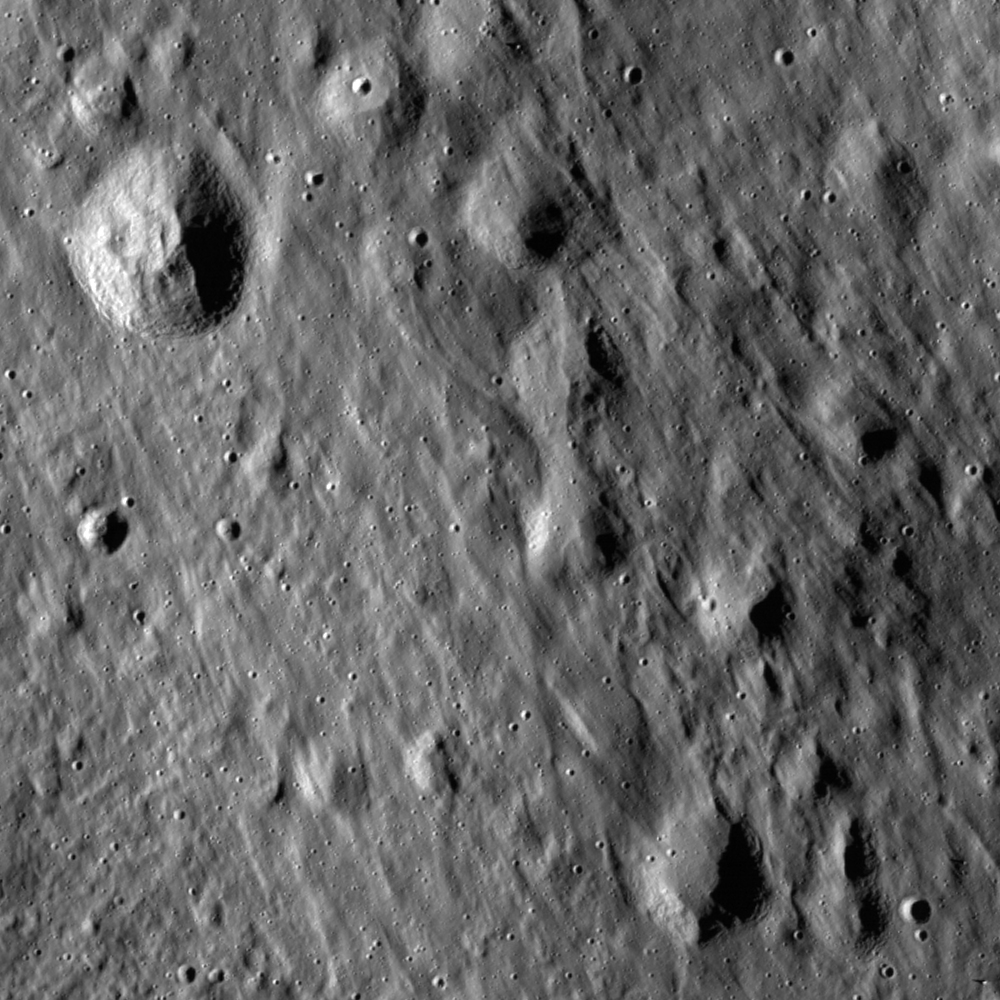
Fresh ejecta patterns the landscape outside Giordano Bruno (37.99°N; 101.62°E). Illumination is from the east at a 74.28° incidence, resolution over this approximately 840 meter field of view is 1.12 meters from 54.25 km; LROC Narrow Angle Camera (NAC) frame M146308704R. LRO orbit 6695, December 6, 2010 [NASA/GSFC/Arizona State University].
James Ashley
LROC News System

The landscape surrounding the very young impact Giordano Bruno gives us a sense for how widespread the effects of even moderate-sized impacts can be on a planetary body. The young age (perhaps less than 10 million years) of Giordano Bruno offers a marvelous opportunity to inspect some of the more subtle morphologic changes that occur in the extended and discontinuous ejecta blanket during impacts of this size. Eventually, after 10's of millions of years, the action of micrometeorite impacts will rework or "garden" the lunar surface and obscure much of what we see here. Several examples of extended ejecta features are included in this post, all collected from the same Narrow Angle Camera (NAC) image (M146308704R).

Low areas like crater floors become "sinks" for migrating debris to become trapped within. Field of view is approximately 840 meter across [NASA/GSFC/Arizona State University].
The apparent flatness of these crater floors suggest that the debris was behaving very fluid-like when it was emplaced. Determining the difference between impact melt and granular debris flows can be challenging, however. What clues would you look for to find out if the crater floors are truly flat? How would you decide between melt and granular deposits? If impact melt, what does it suggest about the temperature of the liquid and its cooling rate to find it having such a low viscosity this far-removed from its source?

Coalescing blobs of melt have frozen together on this small crater floor (Another 840 meter FOV) [NASA/GSFC/Arizona State University].
As might be expected, at some point during cooling the viscosity of melt becomes high enough to cause sluggishness, and develop steep-sloped margins. Interesting shapes can then result.

A secondary crater cluster creates a hummocky Moonscape (840 meter FOV) [NASA/GSFC/Arizona State University].
Ejecta can create hummocky patterns when ballistically emplaced, as with these secondary craters. Some of the appearance may also be due to ground-hugging debris that piles up as it encounters resistance from friction with the ground.

The NAC frame is outlined on this LROC Wide Angle Camera (WAC) mosaic, together with its orientation to Giordano Bruno and vicinity (Field of view approximately 200 km across) [NASA/GSFC/Arizona State University].
How do we know that these features come from Giordano Bruno and not some other crater in the region? The full NAC image can be inspected HERE for clues. Other information on the Giordano Bruno impact itself can be found in several recent Featured Image posts, including Very Oblique View of Giordano Bruno, Sunset Over Giordano Bruno, and Giordano Bruno, The Big Picture.

Monday, November 22, 2010

Delicate patterns in Giordano Bruno ejecta


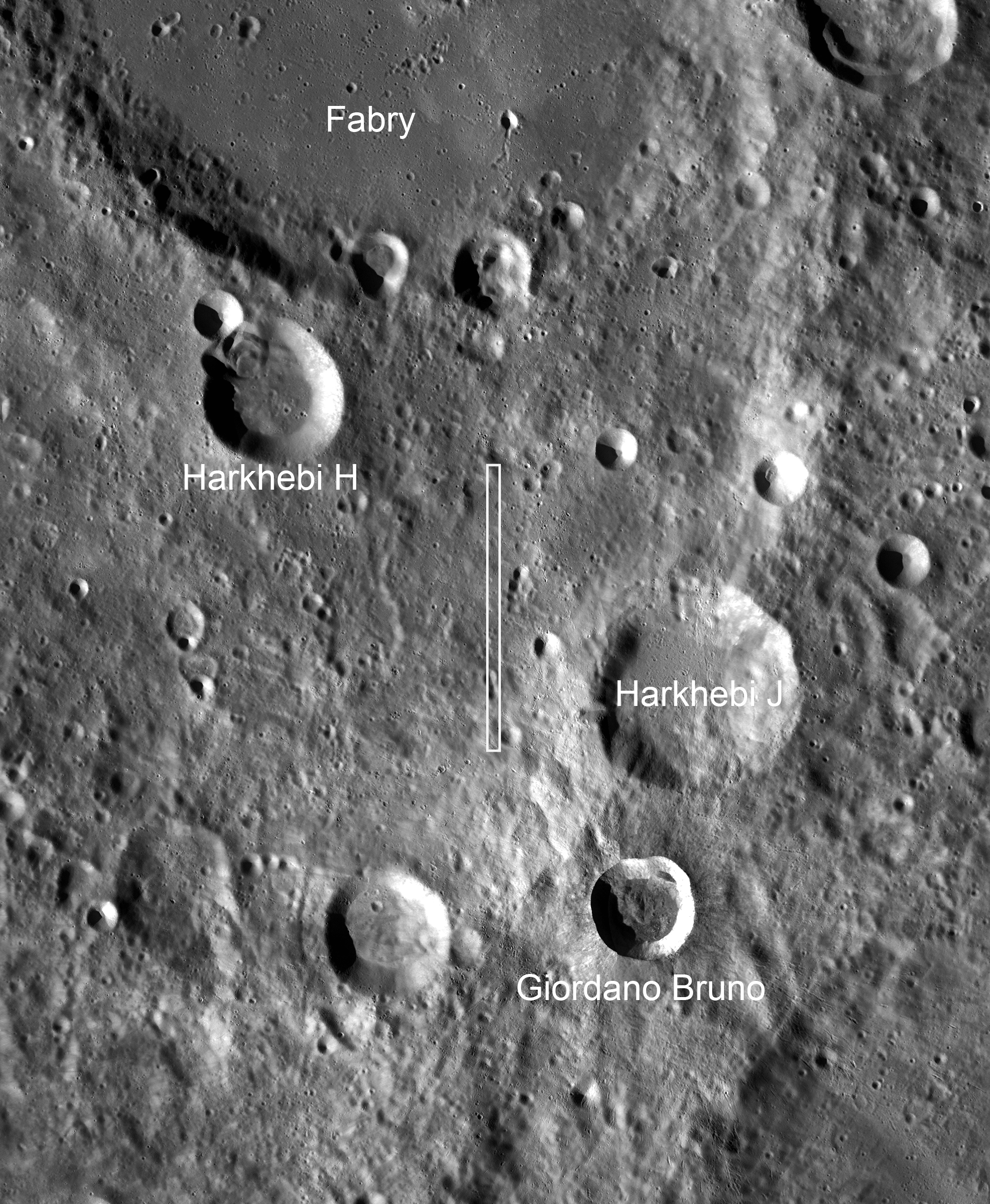
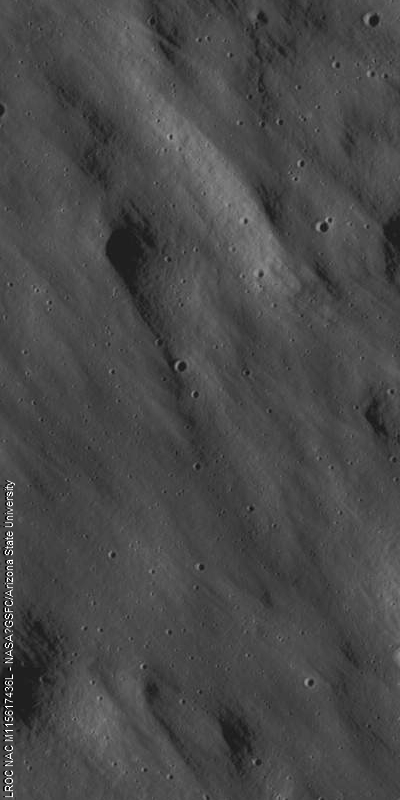
Pan of the LROC Featured Image released November 22, 2010 - Narrow Angle Camera (NAC) view of the "Far edge of the Giordano Bruno crater ejecta blanket." LROC NAC observation M115617436L, LRO orbit 2172, December 16, 2009; resolution 0.9 m/pixel, image field of view is 1.08 kilometer, the Sun's illumination is from the right. See the full-size original LROC Featured Image HERE. The famous young crater Giordano Bruno is to the northwest [NASA/GSFC/Arizona State University].

Hiroyuki Sato
LROC News System

Impact cratering is a common and universal phenomena on every planet and satellite. However, we still do not completely understand this complicated process. The Moon is one of the best libraries of impact craters in our Solar System because its surface is not modified by atmospheric weathering or water erosion. The dominant form of erosion on the Moon is indeed impact cratering.


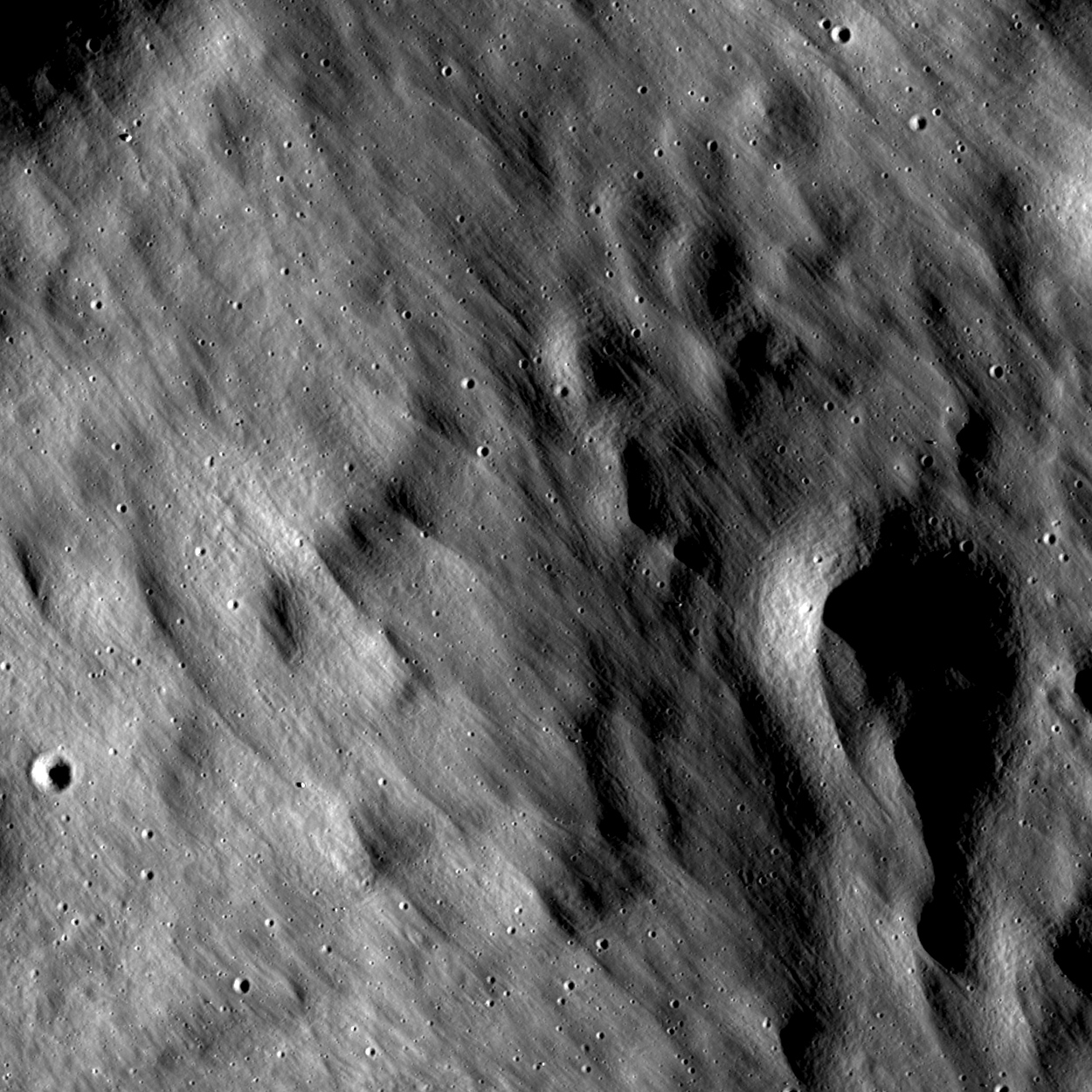
Full resolution (86 centimeters per pixel) close-up of LROC NAC observation M115617436L showing how the Giordano Bruno ejecta blanket scoured and partially erased the terrain it channeled and buried. The pattern is reminiscent of the "elephant skin" pattern characteristic of nearly all older lunar surfaces higher than surrounding elevations [NASA/GSFC/Arizona State University].

Today's featured image shows the edge of the Giordano Bruno crater ejecta (35.94°N, 102.91°E); upper-left of the WAC image (below). Here you can easily see the delicate patterns of ejecta overlying pre-existing terrain. The ejecta pattern points back to the crater, and gives the impression of a fast moving surface flow. Combining the morphology of the ejecta, and new topographic data from NAC stereo pairs, scientists will be better equipped to unravel the physics of ejecta emplacement.


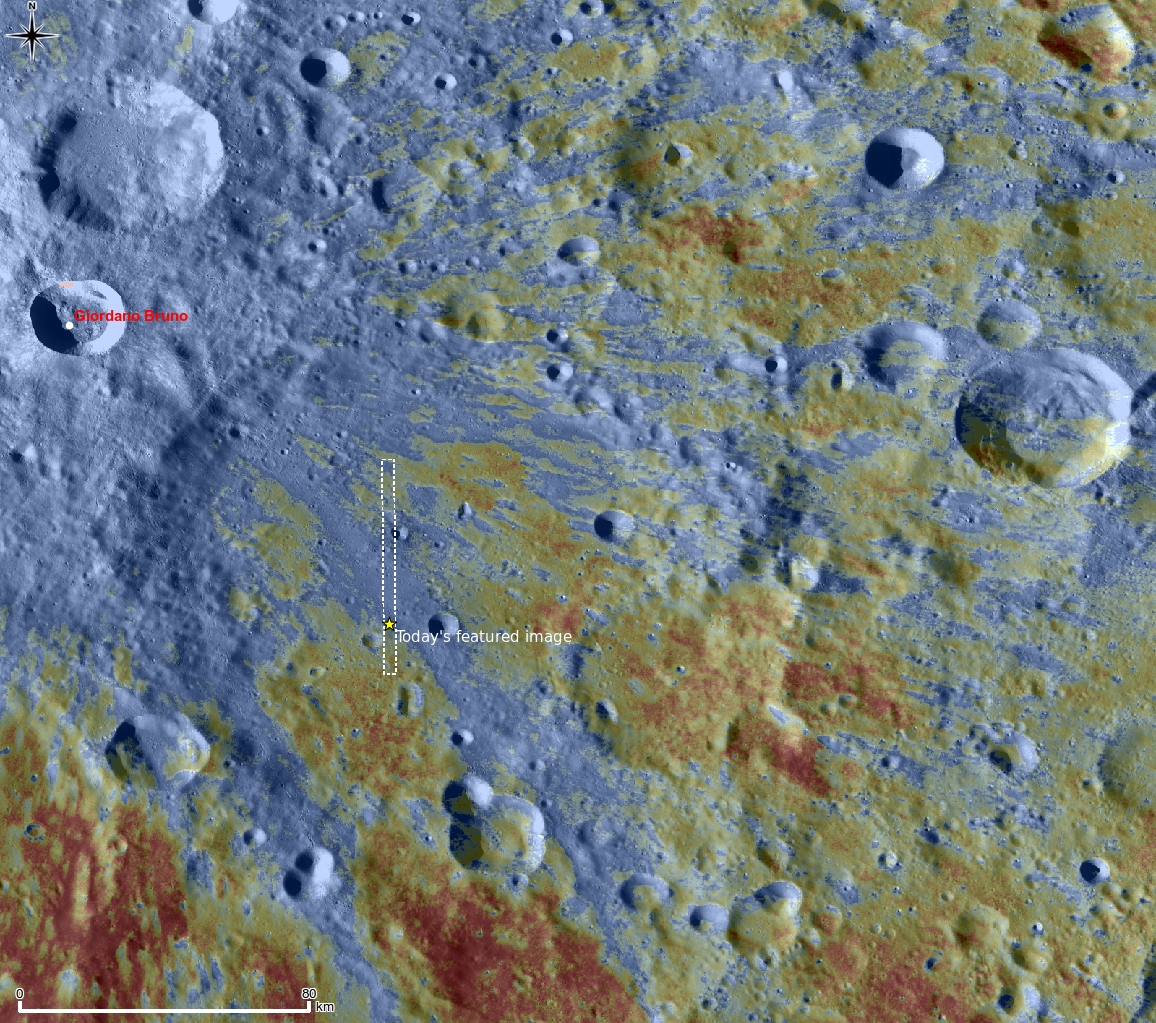
Context map around Giordano Bruno crater (centered 107°E, 34°N). LROC WAC 100 m/p monochrome mosaic overlayed by optical maturity (OMAT) parameter [Lucey et al, 2000], generated from Clementine Ultra-Violet/Visible wavelength (UVVIS) data, at 200 m/p. Blue corresponds to younger, "optically immature" material, and red is an older and more mature surface. The white dashed box corresponds to the footprint of the full LROC NAC observation from which the LROC Featured Image released November 22, 2010 was taken . See the full-resolution original of the above HERE [NASA/GSFC/Arizona State University].


Zooming in upon Giordano Bruno, using the LROC Planetary Data Base (PDS) Image Search interface now vastly improved with the new Wide Angle Camera (WAC) global mosaics, quickly unveils the brighter low OMAT influence the young crater's impact event has had on its surroundings, just beyond line-of-sight view from Earth past the Moon's eastern limb [NASA/GSFC/Arizona State University].

Explore the Giordano Bruno ejecta blanket NAC frame!

Reference: Lucey et al. (2000) JGR, v105, no. E8, p.20377-20386.

Previous post showing the floor of Giordano Bruno.

Wednesday, August 20, 2014

Frozen motion at Harbhebi J

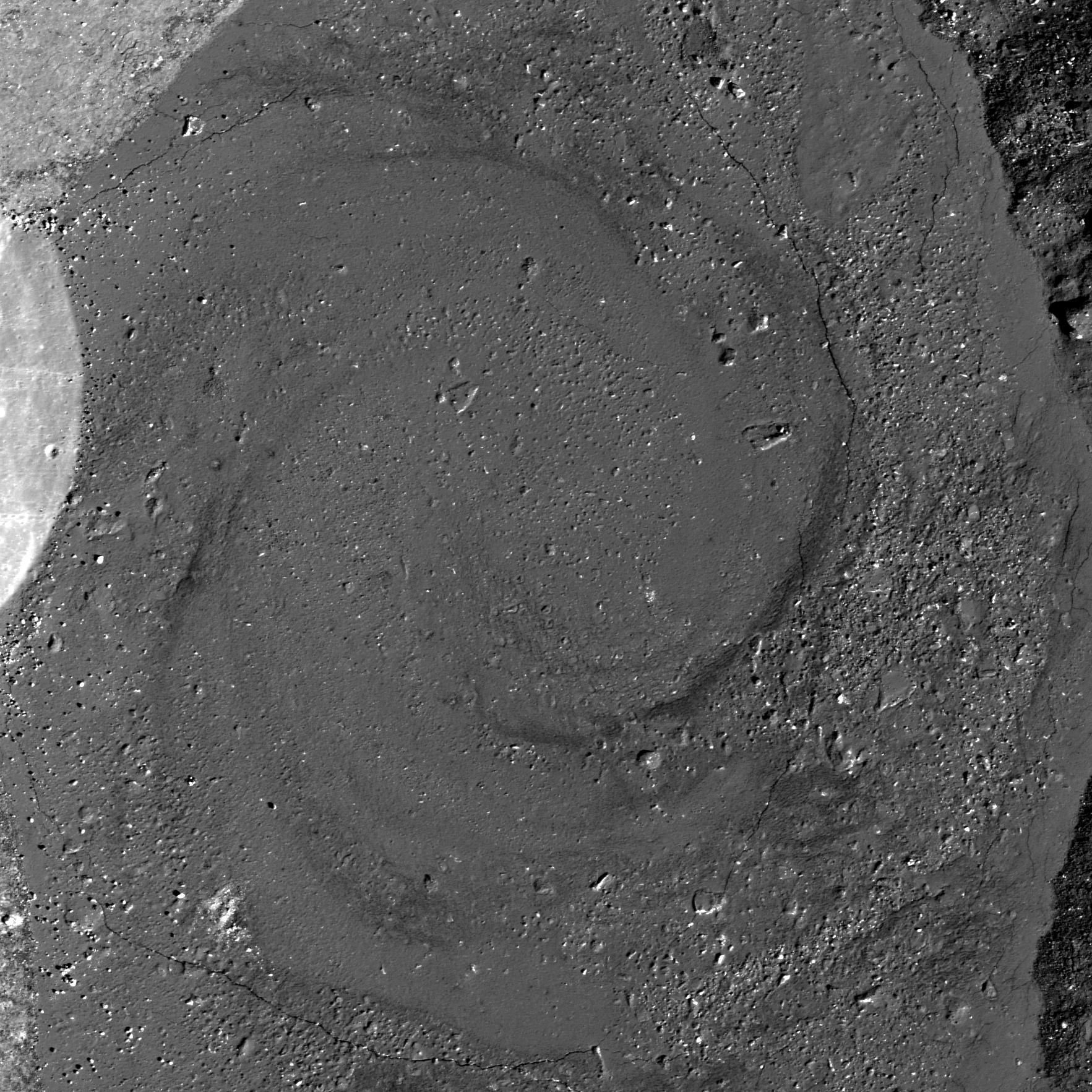
The scoured floor of Harkhebi J (43.1 km; 37.418°N, 103.356°E), near the young crater Giordano Bruno. Ejecta from Giordano Bruno flowed across the surface, leaving a record for us today. A 1570 meter-wide field of view from LROC NAC observation M1128791817L, LRO orbit 18492, July 18, 2013; incidence 60.58° resolution 1.35 meters, from 103.62 km over 37.52°N, 103.7°E [NASA/GSFC/Arizona State University].
Aaron Boyd
LROC News System

Giordano Bruno, the 22 km crater whose ejecta drapes Harkhebi J, is at most 10 million years old. Because these features are so young, they are preserved almost as though the ejecta ray landed here yesterday.

The Featured Image location is approximately 5 crater radii (55 km) away from the impact center, but the effects of the original impact are clearly visible; the momentum from the ejecta is visible as striations in the western half of the image.

The ejecta  was traveling upwards of 600 km/hr when it began to etch the surface, and when the materials finally came to rest, the evidence of the original motion was frozen in time.

Scaled and corrected 4.912 km-wide field of view from LROC NAC observation M1128791817L, July 18, 2013. View the full-resolution mosaic HERE [NASA/GSFC/Arizona State University].
Many patterns in ejecta from Giordano Bruno crater can be seen throughout the full NAC frame. These varied beautiful patterns relate to ejecta velocity and angle, as well as the material properties of the target.

Context for the LROC Featured Image released August 20, 2014. Footprint of LROC NAC observation M1128791817L. LROC WAC observation M121532675C, LRO orbit 3044, February 23, 2010; incidence 49.3° at 76 meters resolution, from 54 km [NASA/GSFC/Arizona State University].
What would blocky ejecta look like? What would fine granular ejecta look like? The blocky ejecta would pepper the ground with secondary craters, while the granular ejecta would blast the existing surface smooth and flow like an avalanche

View full-resolution LROC NAC mosaic, HERE.

Related Posts:

Wednesday, December 16, 2009

Young Giordano Bruno


Frozen impact melt flows on the ejecta blanket of the young impact crater Giordano Bruno (22 km diameter). The image is about 600 m across and the flows are about 50-100 m wide (NASA/GSFC/Arizona State University).

Mark Robinson
LROC News System

In many cases LROC has seen frozen flows of impact melt inside and on the flanks of Copernican aged craters. Giordano Bruno is one of the youngest large craters (22 km diameter) on the Moon. How old is "youngest"? Written accounts of twelfth century eyewitness reports of a bright flash on the Moon may record the event that formed Giordano Bruno crater. That idea was proposed after the first high resolution pictures of the crater were analyzed from the Apollo era of lunar exploration. Scientists could see that the crater was very young and was in the area of the Moon corresponding to the bright flash, so it seemed possible that the flash and crater were related. More recently a team of scientists analyzing high resolution images acquired by the Japanese lunar orbiter Kaguya estimated that the crater formed more than one million years ago. Very young by lunar standards, but certainly not consistent with the eyewitness reports. The Kaguya team (see below) determined the age by counting the number of craters that formed on the Giordano Bruno subsequent to its formation. Were some of the small impacts discovered on the crater actually formed as late stage ejecta rained down on the crater? If so the age may be younger than the current estimate.

The very high resolution images being returned by LROC are revealing impact crater features in exquisite detail. The deposits shown above are actually small distributary flows that emanated from a larger mass of impact melt that was thrown out onto the northwest rim by the impact. Although formed by a different process, impact melts flow in much the same way as lava flows, forming lobes and exhibiting channels and levees. Like lava flows, they cease to move when their source is depleted or the melt cools and freezes into solid rock. Impact melt is formed by the heat and pressure of the impact process. This particular area is at 36.34°N, 102.45°E. The scene is about 600 m across; image resolution is 0.6 m/pixel.

Hopefully, soon the true age of Giordano Bruno can be determined by radiometric age dating of impact melt rocks returned by future astronauts. In the meantime scroll around in the full image and see if you can determine how the small impact craters formed on this fascinating young crater.


(BELOW: Giordano Bruno from Kaguya in 2007 and 2008.
)


Wednesday, July 31, 2013

Melted Moon

Click for full resolution LROC mosaic
The fresh lunar crater Giordano Bruno -a wealth of fascinating landforms to study. (click image for full resolution view, or HERE for a wider, medium resolution field of view showing the entire crater) [NASA/GSFC/Arizona State University].
Paul D. Spudis
The Once and Future Moon
Smithsonian Air & Space


Prior to the Space Age, one of the longest running controversies in lunar science was over the origin of the Moon’s craters.  Two camps emerged, one favoring an internal (volcanic) origin and the other an external (impact by solid bodies) origin.  Although this debate was finally resolved in favor of impact, the argument was long and vehement, reigniting at one point during the flight of the last of the robotic precursor probes to the Moon, prior to the Apollo landings.  Although the basic physics of impact were well understood by the mid-1960s, this newest argument centered around high-resolution pictures obtained by Lunar Orbiter 5 (1967) of the fresh (and therefore young) crater Tycho.  These spectacular images showed a multitude of flows, smooth ponds, and fluid rock, seemingly draped over hills and hummocks (like a chocolate shell coating over a scoop of ice cream).

An asteroid possesses an enormous amount of kinetic energy when it strikes a planetary body at very high speeds.  On contact, the asteroid vaporizes and the surface target rocks are intensely compressed.   After the shock wave has passed, these rocks decompress and the release of this energy totally melts part of the crustal target.  This material is said to be shock melted, with the resulting liquid called impact melt.  Impact melt was first described from craters on the Earth, particularly some of the very large impact craters found on the ancient Canadian Shield.  These rocks superficially resemble some volcanic rocks, having both fine-grained textures and partly melted inclusions.  But unlike volcanic rocks, they have high concentrations of siderophile (“iron-loving”) elements, such as iridium.  These elements are extremely rare in the Earth’s crust, but are more abundant in meteorites and asteroids.  It is thought that they are added to the melt from the incoming projectile.

The newest chapter in the argument about the origin of craters came about because some landforms around Tycho look similar to small-scale volcanic features on Earth.  The idea proposed was that the craters had been formed by impact, with those collisions triggering volcanic activity and producing multiple episodes of eruption at Tycho and other craters.  At first glance, such a scenario seems plausible.  After all, impact is a catastrophic event and one can imagine churning seas of subsurface liquid rock, released suddenly through the creation of fractures deep in the crust.  But the Moon’s interior is relatively cool.  If interior melt exists, it is at a level much too deep for any reasonably sized impact to tap.  But these amazing landforms needed to be explained.  What might they represent?

We found abundant physical and chemical evidence for impact (including shock-melted rocks) by studying the Apollo samples.  They appear similar to volcanic lava, with inclusions, melt textures and even vesicles (holes), comparable to the ones produced by magmatic volatiles coming out of solution in basaltic lavas on Earth.  Although it took a bit of study (and many more arguments) to establish their origin, shock melting became recognized as an important lunar (and Earth) impact process.
M160029952LR-109-1160x1600
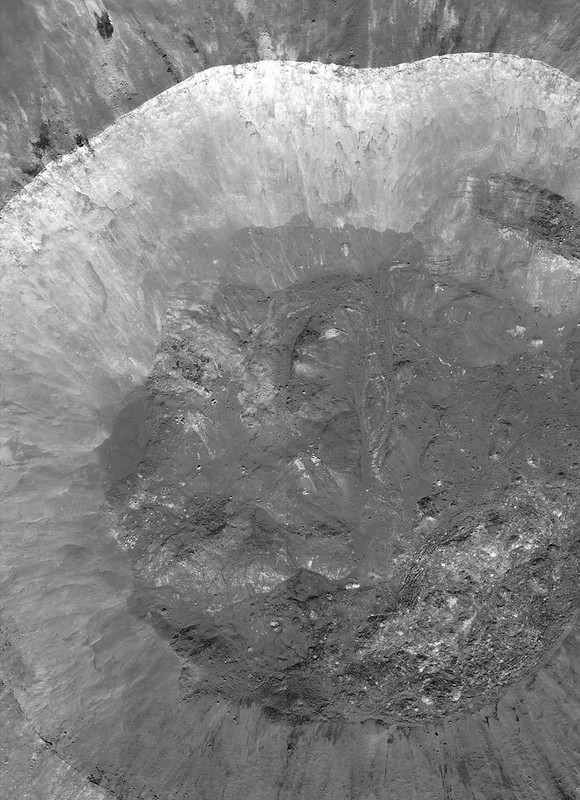
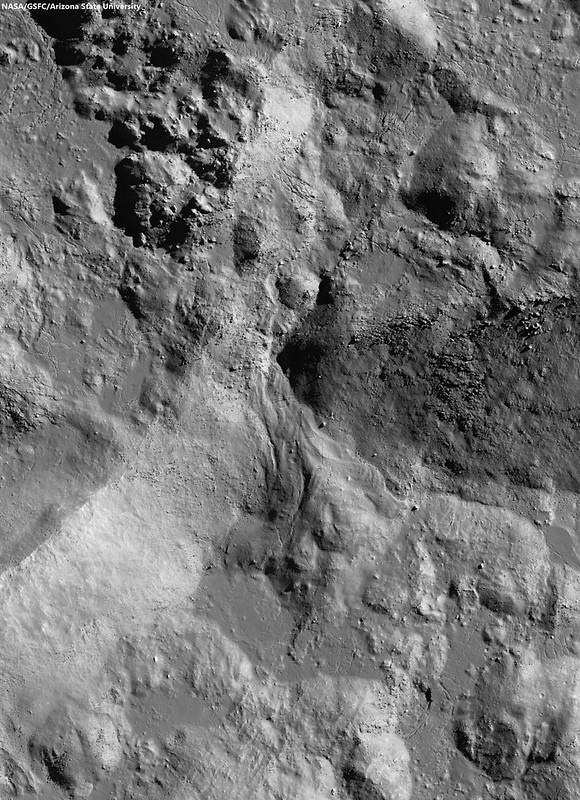
Breech in the northwest rim of Tycho connects to the spectacular melt ponds inside out outside of the 109 million year old landmark crater. Illustration originally from "Landing Site at Tycho North," March 20, 2013 [NASA/GSFC/Arizona State University].
The images of the flows and ponds seen around Tycho and other fresh lunar craters led to a better understanding of how these rocks formed.  Although we knew about impact melting from the study of Earth’s craters (and had found evidence of the same in lunar samples), some researchers still weren’t convinced that we were seeing flows of liquid impact melt on the Moon.  The leading non-volcanic alternative was that these features were flows of dry, fine-grained granular debris.  In part, this interpretation proceeded from the observation that the thermal signatures of some of these melt-like flows suggested the presence of fine debris rather than bare, jagged rock.  Yet other data, such as radar backscatter, suggested that rough surfaces were common, while extremely high-resolution images showed abundant blocky craters on the surfaces of the flows, suggesting they were composed of solidified rock.
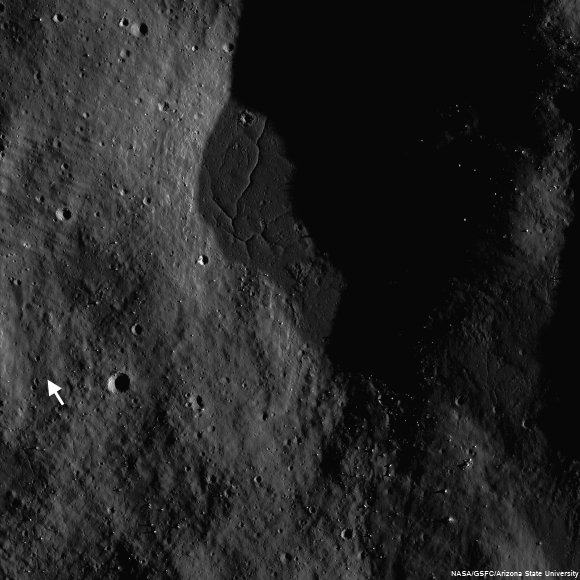
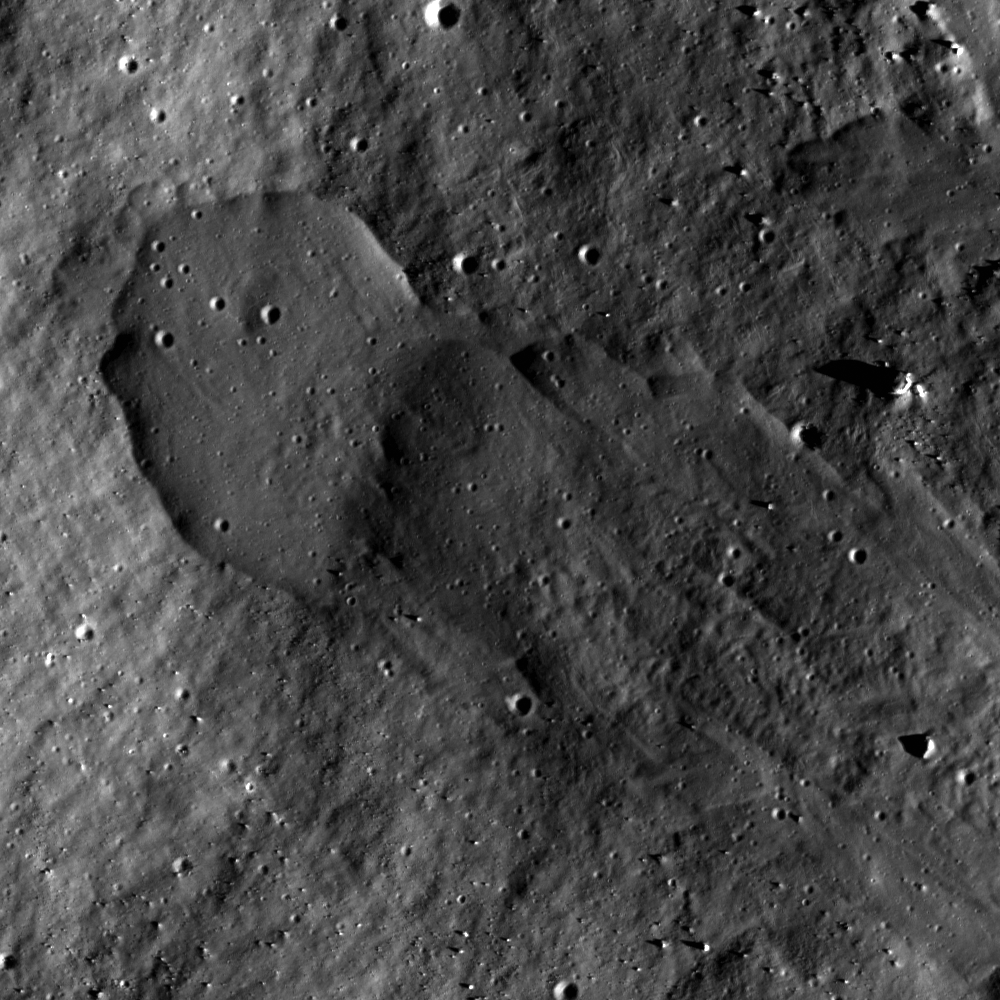
Landing site of Surveyor 7 (arrow) in relation to it's hoped for target, the kilometer-sized impact melt pond immediately to the northeast, part of the spectacular melt throughout the vicinity of Tycho [NASA/GSFC/Arizona State University].
Images from the robotic Surveyor 7 (1968) spacecraft, which landed on the rim of Tycho, revealed the thinnest regolith (soil) covering of any site on the Moon.  Visible in the surface panoramas were flow features covering the distant hills.  It took a great deal of painstaking, detailed work to establish that these flows and ponds were composed of liquid rock, created simultaneously with their host crater and likely originated by impact melting and subsequent solidification.

For the last several years, NASA’s Lunar Reconnaissance Orbiter (LRO) has been sending us new and astonishing views of the Moon’s impact melt flows.  Whereas fresh craters like Tycho, Aristarchus and Copernicus were well known from previous Lunar Orbiter frames, far side craters like the spectacular Giordano Bruno can now be seen with incredible clarity.  G. Bruno is one of the very youngest craters on the Moon.  A low density of craters overlying G. Bruno suggests an age of less than a couple million years (extremely young on a planet where most features count years in the billions).  It is an astonishing spectacle of melt shapes and deposits (cracked floors, pools, flow festoons and lobes); the crater floor has an amazing whirlpool of solidified melt. All these features indicate that after the crater formed, the impact melt was mobile, flowing and collecting, and ponding in low areas.

Impact melt forms a swirled feature in Giordano Bruno crater. Field of view 1 kilometer. From LROC Narrow Angle Camera (NAC) observation M143947267L LRO orbit 6347, November 9, 2010; 53.08° angle of incidence, 57 centimeters per pixel resolution from 54.50 km. Illustration from "Giordano Bruno Whorl," June 8, 2013 [NASA/GSFC/Arizona State University].
Impact melts are of great interest to geologists.  Unlike other crater ejecta, the radiometric clocks of impact melts are completely re-set by the melting.  Thus, if a sample can be obtained first-hand, directly from an observed flow or pool of melt around a host crater, the age of that rock specifically and unambiguously dates the impact event.  Unfortunately, we did not visit such deposits during the Apollo explorations.  What we do have are loose samples of lunar impact melt but not their scientifically important corresponding geological context.  It is for this reason that the age and sequence of early lunar history is so contentious – we must make educated guesses about where certain melt rocks come from.  If we get the context wrong, then our conclusions about the history of the Moon are incorrect.

Increased understanding of the generation and deposition of impact melt comes from the new images obtained by the LRO camera of the geologic setting of impact melts.  Future sample return missions to the Moon can be directed to landing sites that will provide us with samples of clear geological context (that they were from that area and not just flung there by an impact occurring elsewhere on the lunar surface).  As features age on the Moon, subsequent geologic events (such as superposition of new units) bury or erase the original event making the context less clear.  This problem is particularly acute for the oldest features on the Moon (multi-ring impact basins).  By studying the geology of the freshest lunar features (such as Tycho and other fresh craters), we understand how the older impact features looked immediately after their formation.  Thus, they serve as a guide to the interpretation of the older features.  On the Moon, as on the Earth, as Charles Lyell, the 19th century author of the classic Principles of Geology aptly put it:  The present is the key to the past.

Collection of spectacular impact melt features from LRO:
Giordano Bruno high-resolution full view
G. Bruno sunset
G. Bruno flows
G. Bruno cracked melts
Tycho oblique
Tycho floor
Tycho river of rock

Originally published July 31, 2013 at his Smithsonian Air & Space blog The Once and Future Moon, Dr. Spudis is a senior staff scientist at the Lunar and Planetary Institute. The opinions expressed are those of the author but are better informed than average

Thursday, February 9, 2012

Answering the riddle of Giordano Bruno

Relatively "fresh" Giordano Bruno (35.97°N, 102.86°E) and it's bright ejecta rays at local mid-day as seen through the HDTV camera on-board Japan's lunar orbiter SELENE-1 (Kaguya) in 2009. View the still frame as released, HERE [JAXA/NHK/SELENE].
Irene Antonenko
Universe Today

The Moon is covered with craters of various shapes and sizes, and in various states of preservation. Scientists have studied these spectacular features for over five decades, yet there are still many things about craters that we just don’t understand. The study of craters is important because we use them to determine the ages of planetary surfaces. Now, very high resolution imagery from the Lunar Reconnaissance Orbiter Camera (LROC) is allowing us to see lunar craters as never before. Under such scrutiny, one very fresh crater is revealing a host of secrets about the crater-forming process and revealing that it’s not as young as some people may have originally thought.

The crater in question is Giordano Bruno, a 22 km diameter crater located on the far side of the Moon, just beyond the eastern limb. Like all craters on the Moon, this one was named after a famous scientist, in this case, a sixteenth century Italian philosopher who was burned at the stake in 1600 for proposing the existence of “countless Earths.” Because of its position on the far side, Giordano Bruno crater was not seen by humans until it was photographed by the Soviet Luna-3 mission in 1959. But then, this crater was immediately recognized as one of significance, because of its very bright and extensive ray system.

Read the full UT feature story HERE.

Giordano Bruno has offered up to researchers a lifetime of detail about the morphology of lunar craters, not yet "gardened" away by space weathering, in both very narrow and wide angle imagery collected by the Lunar Reconnaissance Orbiter (LRO). This monochrome (604 nm) montage was stitched together from LROC WAC observations collected during four sequential orbital flyovers February 23, 2010 [NASA/GSFC/Arizona State University].
Related Posts:
Moon in UV sheds light on maturation and materials (October 12, 2011)
Fragmented Impact Melt (February 11, 2011)