Showing posts with label super position. Show all posts

Thursday, February 13, 2014

Overprinting Orientale

Overprinting Orientale
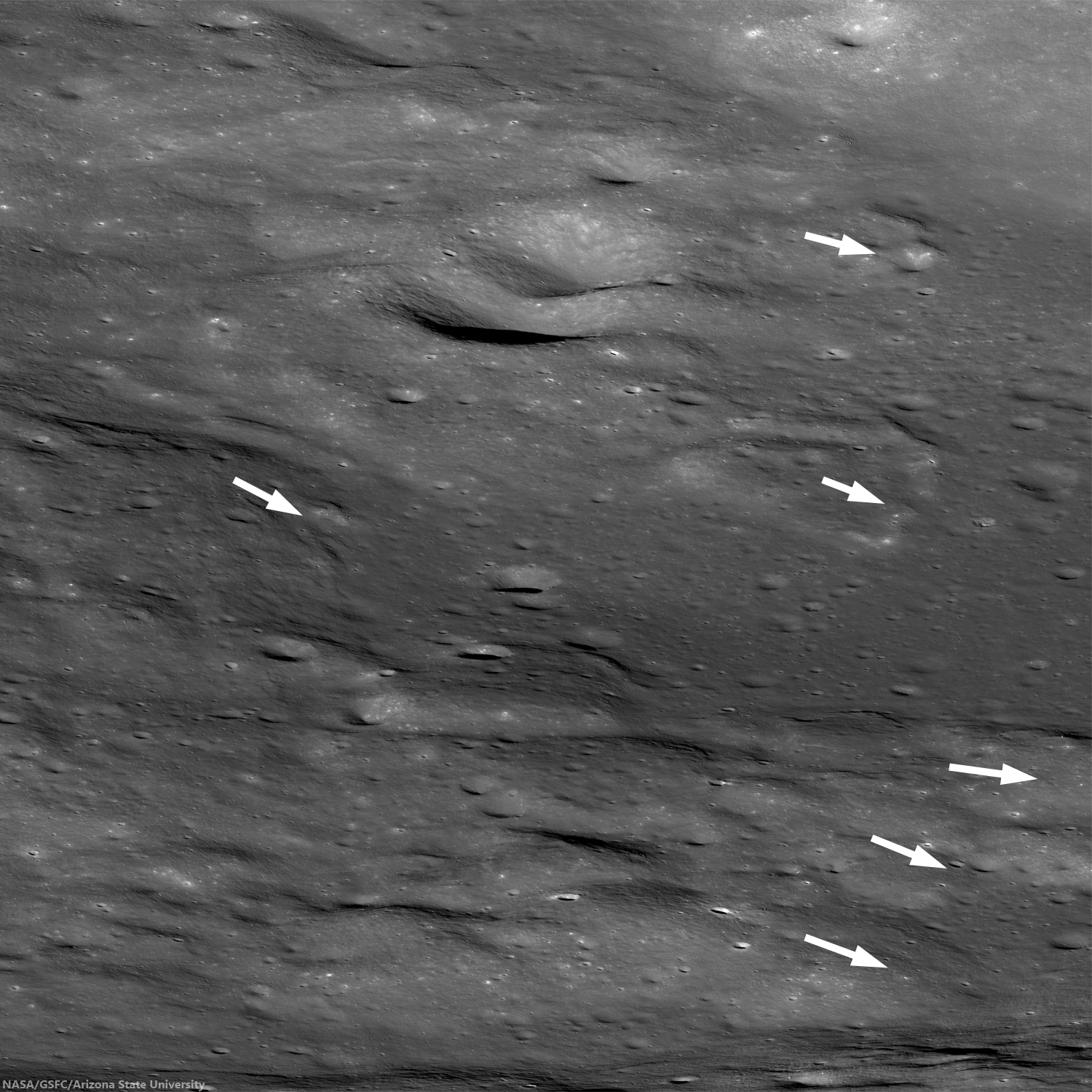
Fractured crater draped with ejecta from the impact event that created the Orientale basin, south of Buffon crater (downslope to the right). Crop from LROC NAC oblique mosaic M1128039712LR, LRO orbit 18386, July 9, 2013; 74.2° angle of incidence, resolution very roughly 2.3 meters, spacecraft and camera slewed 65.27° toward the east, from 58.43 km over 46°S, 222.48°E  [NASA/GSFC/Arizona State University].
J. Stopar
LROC News System

This spectacular oblique view looks from west to east across an area south of Buffon crater (45.715°S, 229.052°E) that is draped with impact ejecta from the Orientale Basin.

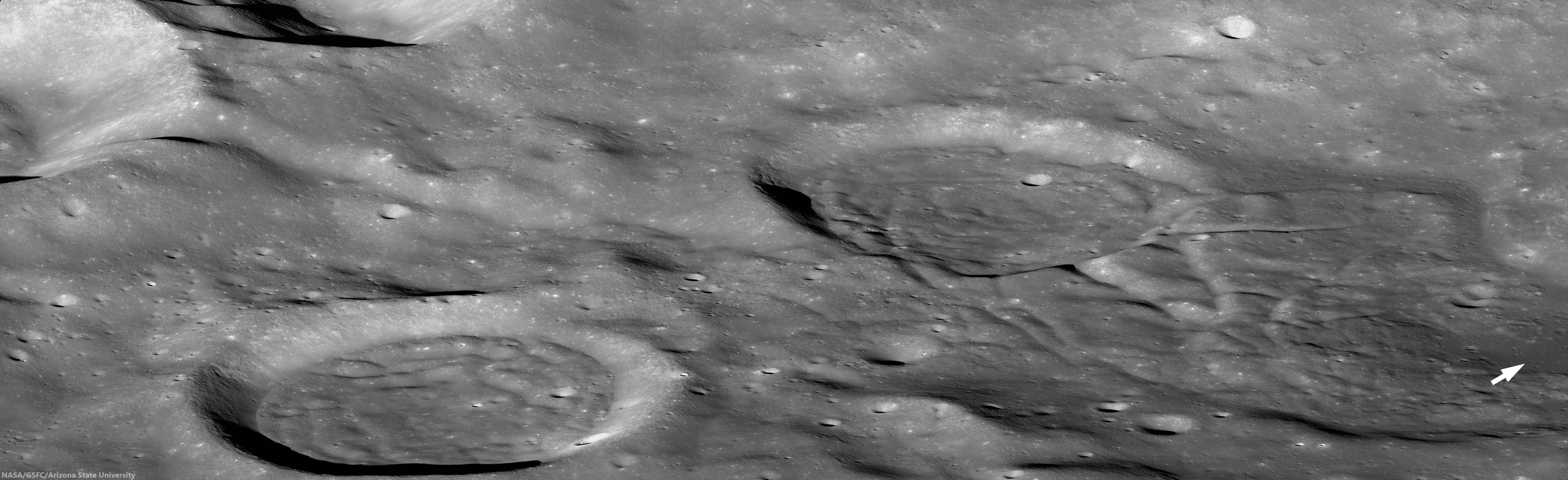
Orientale ejecta to have flowed over a pair of modified craters (each approximately 16 km in diameter, also see image at far bottom). Because the ejecta is superposed on top of the craters and appears to flow over much of the scene, the ejecta should be younger than the craters. However, these craters do not exhibit typical morphologies, and neither does the Orientale ejecta! Just how did this spectacular scene form?
Overprinting Orientale
Full width NAC oblique image of Orientale ejecta covering the local terrain. Ejecta and crater floors are lumpy and crisscrossed by numerous graben. A flat lying mare pond is located just below center on the right side of the image (arrow). Scene is approximately 41 km in height, oblique view, west to east. Click image or HERE to view larger image [NASA/GSFC/Arizona State University].
First, the pair of prominent craters seen above have concentric, mounded or lumpy looking floors. This morphology is atypical of impact craters of this size (see Steno Q or Burg crater for more typical examples), but is reminiscent of many floor-fractured craters (such as Atlas or Komarov), which are thought to form through uplift caused by magma intruding deep beneath the surface. However, the graben seen in the examples above are more subdued those in most floor-fractured craters, suggesting that they may be blanketed by the overlying Orientale ejecta.

There is also a small pond of basalt (darker and flat) exposed just below the center on the right side of the full width image (above). This is a tell-tale sign of volcanic activity in the area, lending support to the hypothesis that the lumpy craters were modified by magma from below. This, however, does not prove which occurred first: the volcanism or the emplacement of the Orientale ejecta.
Overprinting Orientale
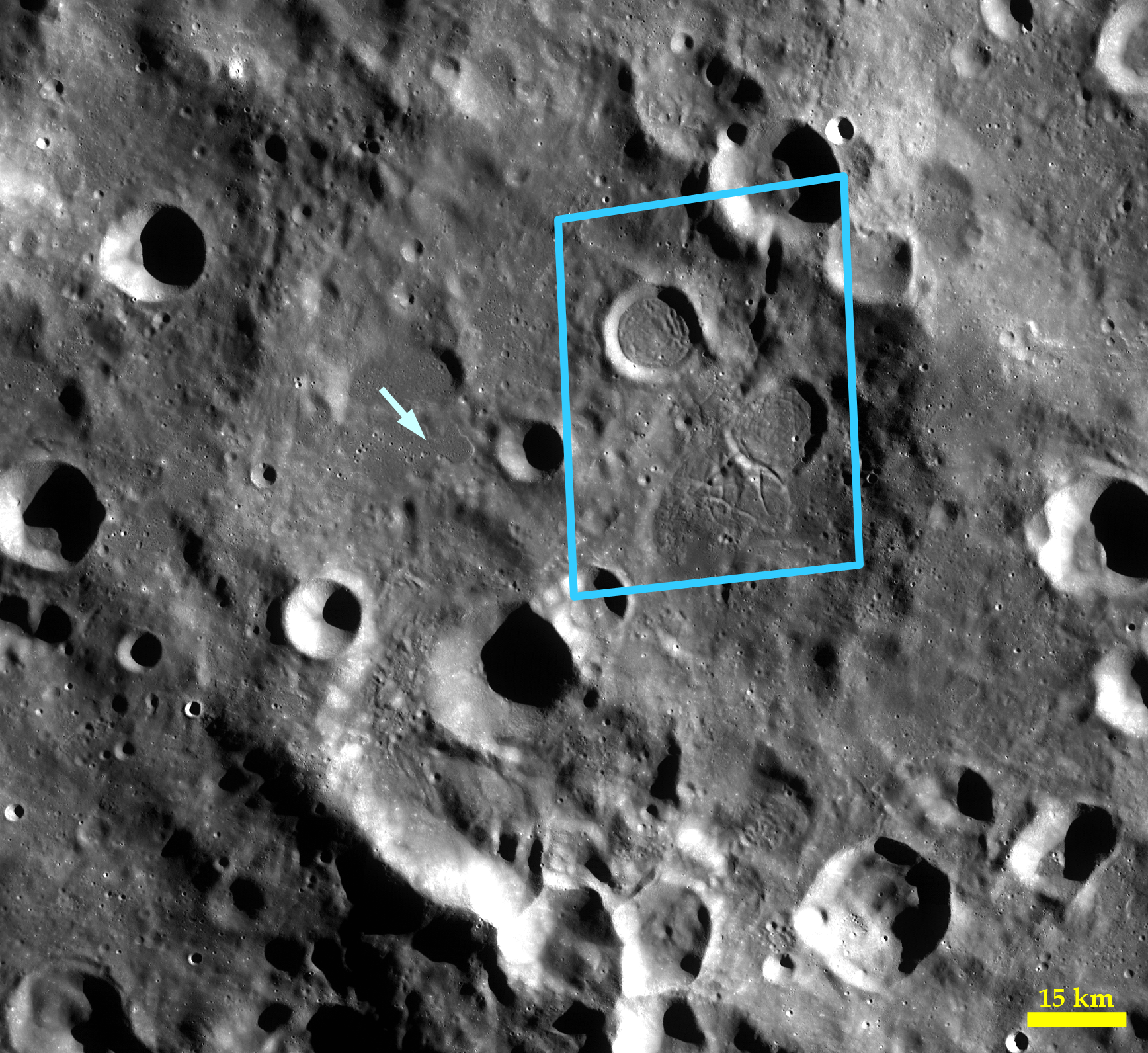
LROC Wide Angle Camera (WAC) mosaic of the area south of Buffon crater. Blue polygon highlights approximate boundaries of the area shown in the featured oblique Narrow Angle Camera (NAC) frame; arrow indicates location of impact melt flow featured in a previous post. The ejecta within the blue polygon is fractured and warped, but the ejecta indicated by the arrow is not [NASA/GSFC/Arizona State University].
The final observation that informs the sequence of events is the occurrence of similar graben in both the crater floors and the adjacent ejecta outside the craters that is not typical of Orientale ejecta in this region. The previous post Stopped in its Tracks featured a nearby Orientale ejecta deposit located only 30 kilometers west of today's spectacular image; that ejecta is not crisscrossed by graben like those seen in the opening image above! Thus, volcanic activity in this area may have occurred after the large impact event that formed the Orientale basin around 3.8 billion years ago. However, further analysis and age dating in this area are needed before we can say for certain that the Orientale ejecta was modified (or overprinted) by younger volcanism.

Overprinting Orientale
Detail of Orientale ejecta, showing inferred direction of flow towards the mare unit shown in the larger images above [NASA/GSFC/Arizona State University].
Try to unravel the sequence of events on display in the full oblique image, HERE.

Related Posts:
Ground Hugging Ejecta
Fall Out
Orientale Sculpture
The Fractured Floor of Compton
A Colorful History of Floor-Fractured Komarov

Thursday, December 20, 2012

Superposition: 'Crater on Crater on Crater'

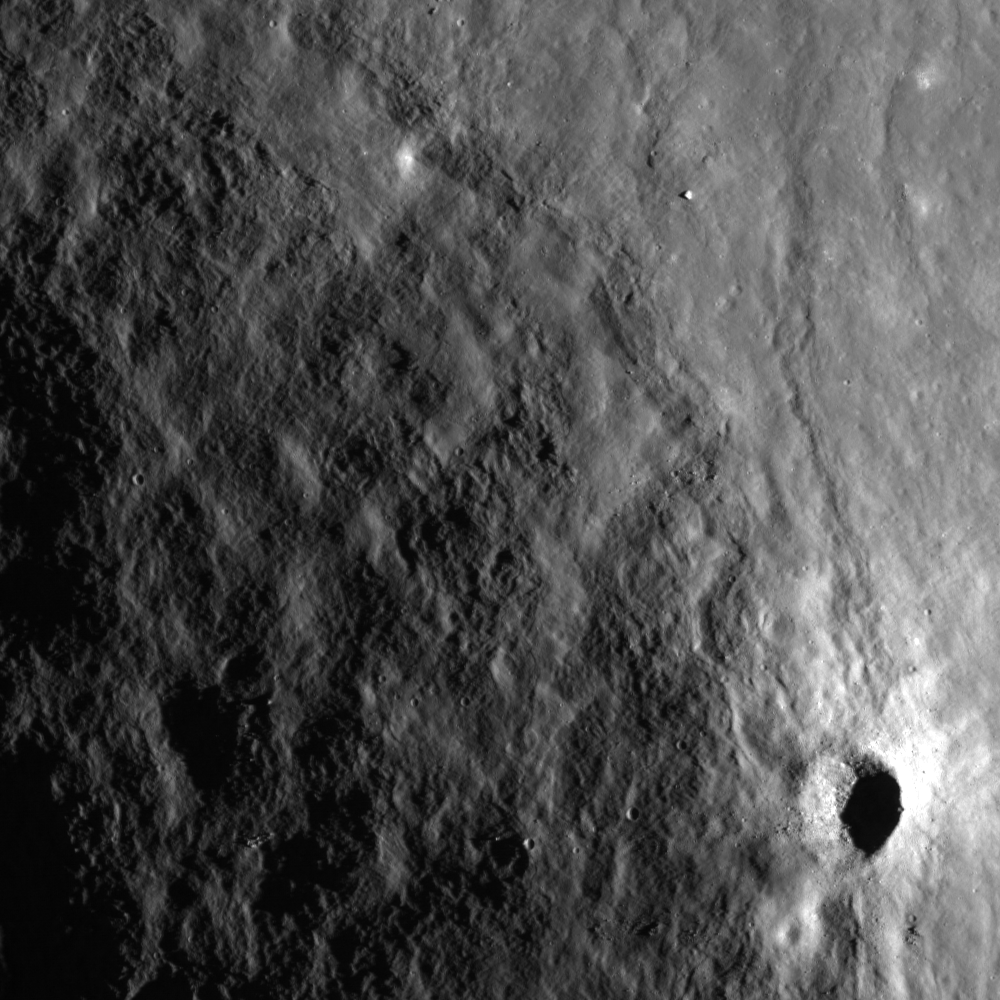
A small unnamed crater sits on the rim of a larger crater which, in turn, is itself nested on the rim of farside pre-Nectarian crater Buisson. LROC Narrow Angle Camera (NAC) observation M1107532088RE, spacecraft orbit 15502, November 14, 2012; field of view roughly 1000 meters, resolution 1.05 meters per pixel [NASA/GSFC/Arizona State University].
Drew Enns
LROC News System

The law of superposition is one of the earliest geologic laws, based on the observations of Danish scientist Nicholas Steno.

Originally formulated to describe relative ages of sedimentary rock units, the law of superposition works just as well on the Moon to describe relative age relationships of separate lunar terrains and craters.

What are the relative ages of the different craters in today's Featured Image?

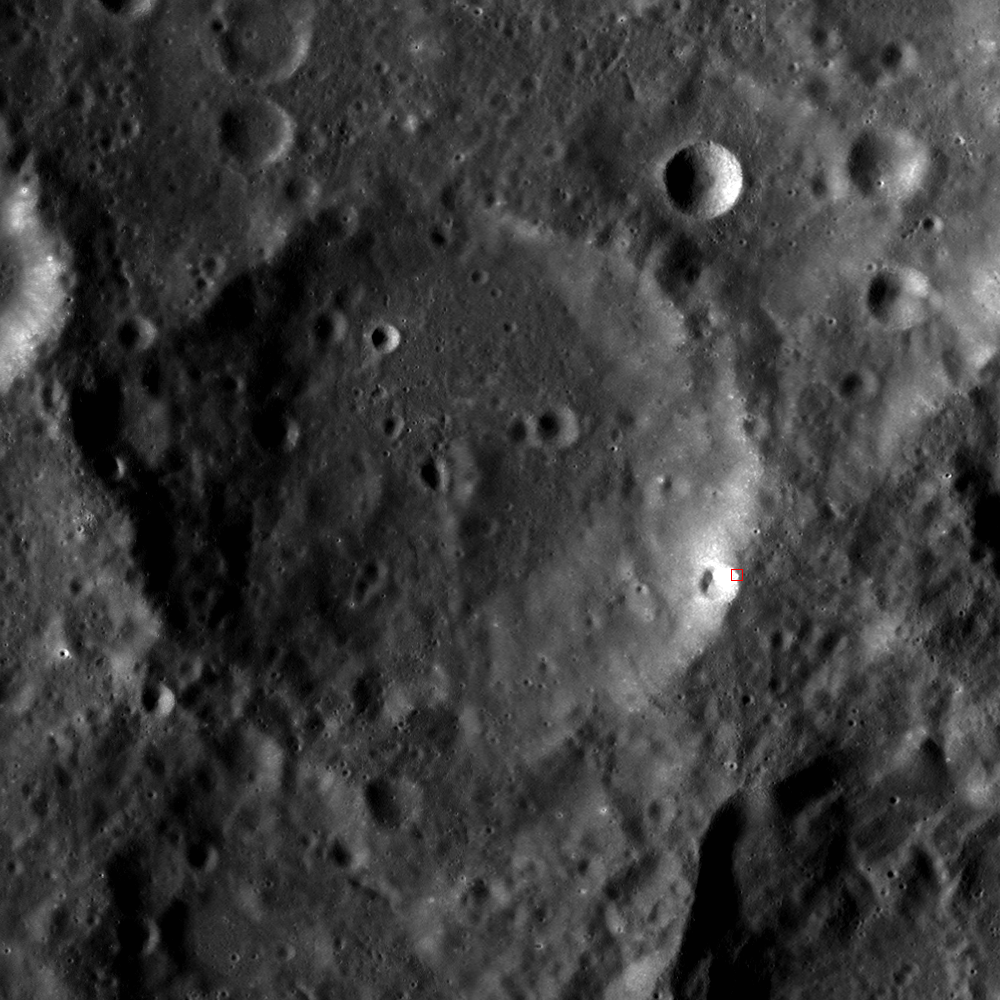
LROC Wide Angle Camera (WAC) mosaic of Buisson, context for the field of view above, showing the small crater at high resolution above (red box). Additionally, a relatively small crater sits on the rim of ancient Buisson, located at 1.42°S, 112.96°E. Field of view 100 km [NASA/GSFC/Arizona State University].
In today's Featured Image, we have three separate craters. Buisson crater is the largest at 57 km, with an approximately 4 km wide unnamed crater on its rim. 

Zooming in further, we see an even smaller crater, about 110 meters wide, in the 4 km crater rim. The superposition of these craters gives us a relative age relationship with the 110 m crater the youngest, followed by the 4 km crater, and finally Buisson crater.

Explore more of crater relationships in the full LROC NAC, HERE.

Related Posts:

Tuesday, July 17, 2012

'Barnstorming' Giordano Bruno

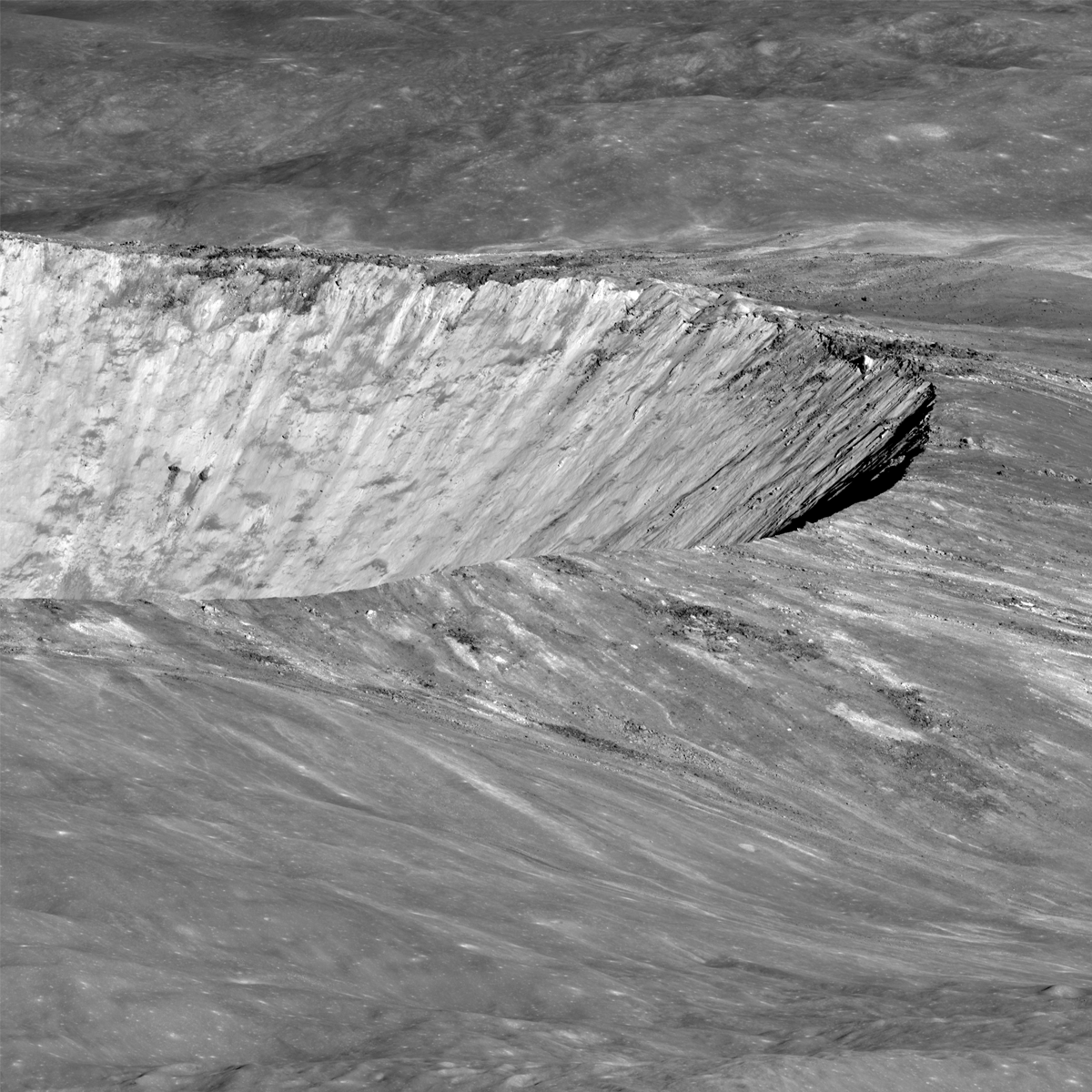
A Very Oblique View of Giordano Bruno - Southern rim of Giordano Bruno crater seen obliquely (79°) from 53 km altitude, small portion of mosaic of LROC Narrow Angle Camera (NAC) frames M119245930L & R (LRO orbit 2707, January 27, 2010; subsampled by a factor of three; Slew angle -74° 4.2 meters resolution). View the full size LROC Featured Image, HERE [NASA/GSFC/Arizona State University].
Marc Robinson
Principal Investigator
Lunar Reconnaissance Orbiter Camera (LROC)
Arizona State University

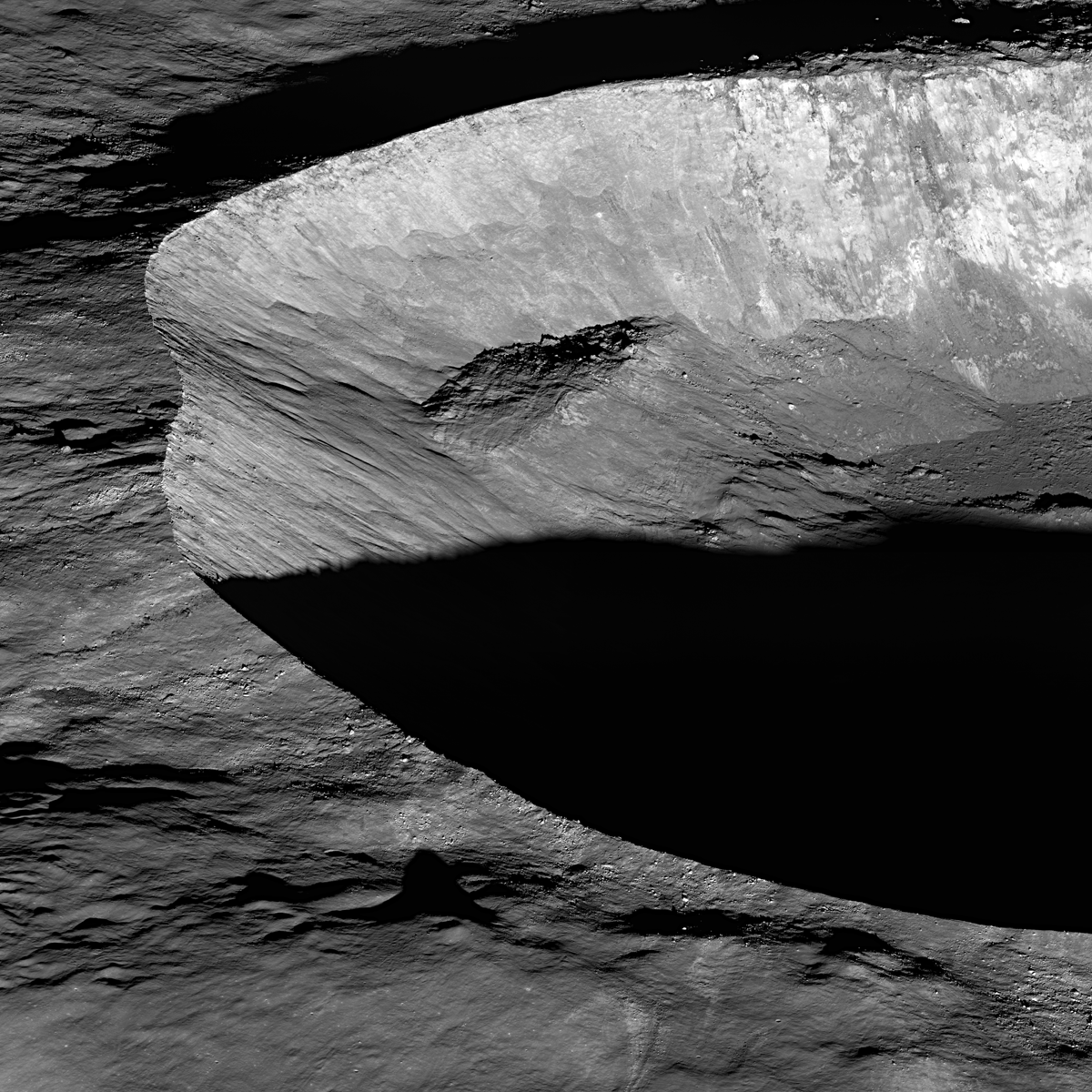
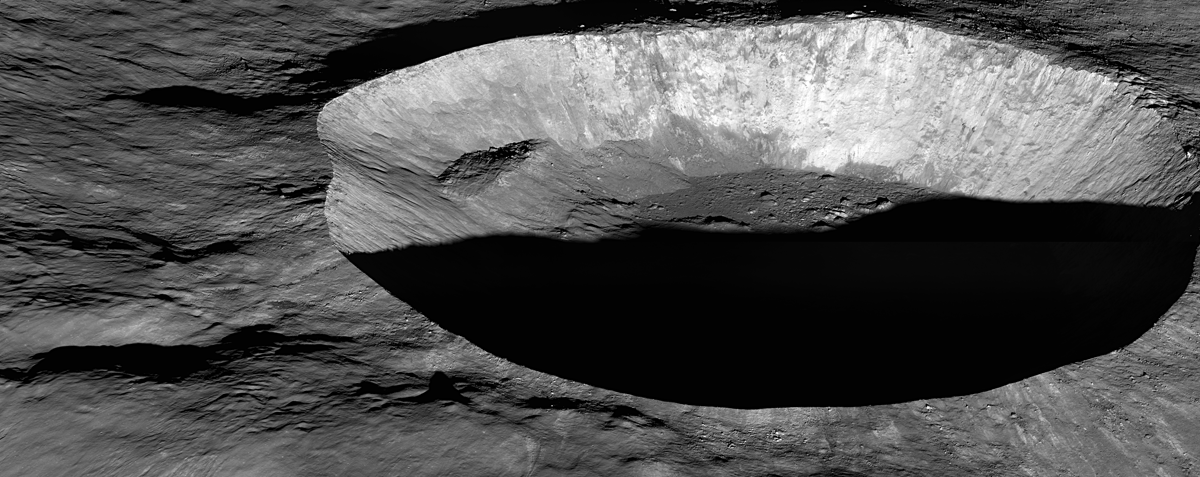
LROC has captured many sensational views of the crater Giordano Bruno. We return again and again to this rayed beauty because it is a nearly pristine example of the effects of impacts on the lunar surface. It displays an immense ejecta blanket with beautiful secondary craters and is an excellent illustration of how rocks melted by impacts flow and pond. The crater also exposes fresh highland material, with minimal effects from space weathering. Today's Featured Image, captured by slewing the spacecraft 79° to the east, provides another sensational view that helps us understand the impact process, and until astronauts visit Giordano Bruno, gives a view about as close as you can get to standing on the surface to the west of the crater.

Giordano Bruno south wall detail - Full resolution detail of the steep inward dipping wall of Giordano Bruno [NASA/GSFC/Arizona State University].
In the detail above, you can see the crater's steep wall and a flap of what appears to be impact melt that goes right up to, and over, the edge. In regions like this, it is likely that as molten rock was ejected from the crater and deposited on the exterior, the crater's shape was still changing. A portion of what was originally the rim has likely slumped down into the crater. Small debris slides continue to expose bright, fresh material on the walls. In the wider, reduced-resolution view below, the extent to which the impact event resurfaced its surroundings is clear. The foreground shows the detailed patterns left by the ejecta and secondary craters as they swept across the surface, smoothing and mantling the original topography. In the distance of the background, you can make out darker areas within the bright terrain - these are likely areas that the continuous ejecta blanket and rays did not completely cover, so the mature soil remains at the surface.

A wider, reduced resolution view of Giordano Bruno and its ejecta blanket. Click on the image above to enlarge, or below for a full resolution version of this image [NASA/GSFC/Arizona State University]
Scroll through all of the details of this beautiful impact crater - the full-resolution version of today's Featured Image is not to be missed, HERE.

Be sure to check out the YouTube video:


Check out the full resolution version of the movie.
Download it for yourself, HERE. (Barnstorming_Giordano_Bruno.mov - 85.0 MB)

Previous LROC Views of Giordano Bruno:
Sunset Over Giordano Bruno
The Big Picture
Outside of Giordano Bruno
Fragmented Impact Melt
Delicate Patterns in Giordano Bruno Ejecta
Impact Melt Flows on Giordano Bruno

Saturday, July 7, 2012

LROC: Sunset Over Giordano Bruno

Slump terrace in the northern half of Giordano Bruno crater seen at sunset, from an altitude of 54 km. Terrace is 4800 meters wide, LROC Narrow Angle Camera (NAC) M165190579LR, LRO orbit 9478, July 13, 2011; spacecraft slew 60° at 1.37 meters resolution. View the full-size LROC image release, HERE [NASA/GSFC/ Arizona State University].
Mark Robinson
Principal Investigator
Lunar Reconnaissance Orbiter Camera
Arizona State University

The exact age of formation for Giordano Bruno crater is not known. Legend has it forming sometime in the 12th century, and more recent crater counts have this beautiful crater forming up to 10 million years ago.

Crater counts must be more accurate than legend, right?

Perhaps, but one of the new results from analysis of LROC images is that self-secondaries (sometimes called auto-secondaries) may be more pervasive than previously thought.

Subsampled version of NAC oblique view of Giordano Bruno crater (21 km diameter). View the full-size LROC image release, HERE [NASA/GSFC/ Arizona State University].
A self-secondary crater forms as late stage ejecta lands on top of early ejecta, all from the same impact event. In this case the impact that formed Giordano Bruno crater. So despite the best efforts of the lunar science community, all we know is that this fascinating crater formed no later than 10 million years ago and no earlier than 18 June 1178. How can we get to an unambiguous answer; what is the exact age of formation of Giordano Bruno? The answer is simple, radiometric age dating of rocks that melted during the impact! When a rock is melted and then recrystallizes its radiometric clock is reset, thus all we need to do is collect a sample of the abundant impact melt rocks either from the floor or flanks of Giordano Bruno.

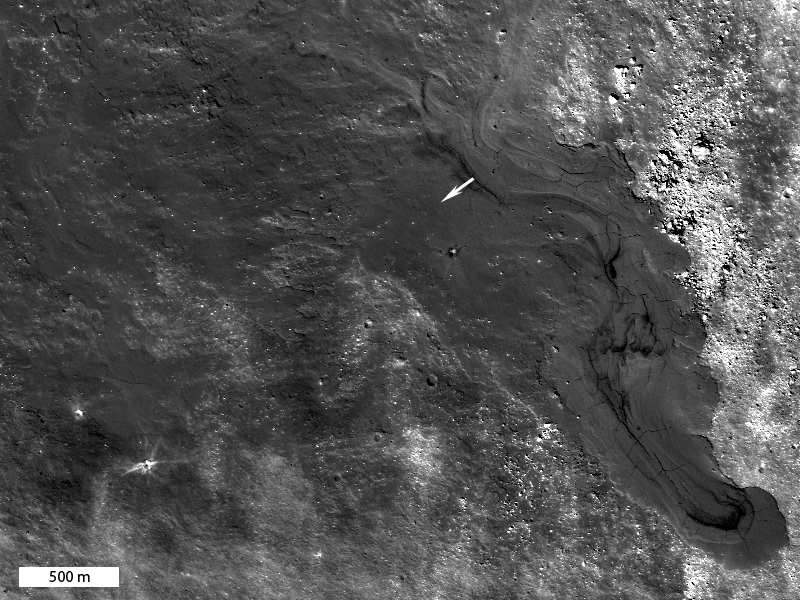
Impact melt deposit on south flank of Giordano Bruno crater, arrow indicates center of landing site (35.47°N, 102.86°E) shown at full resolution below. View the full-size LROC image release, HERE [NASA/GSFC/Arizona State University].
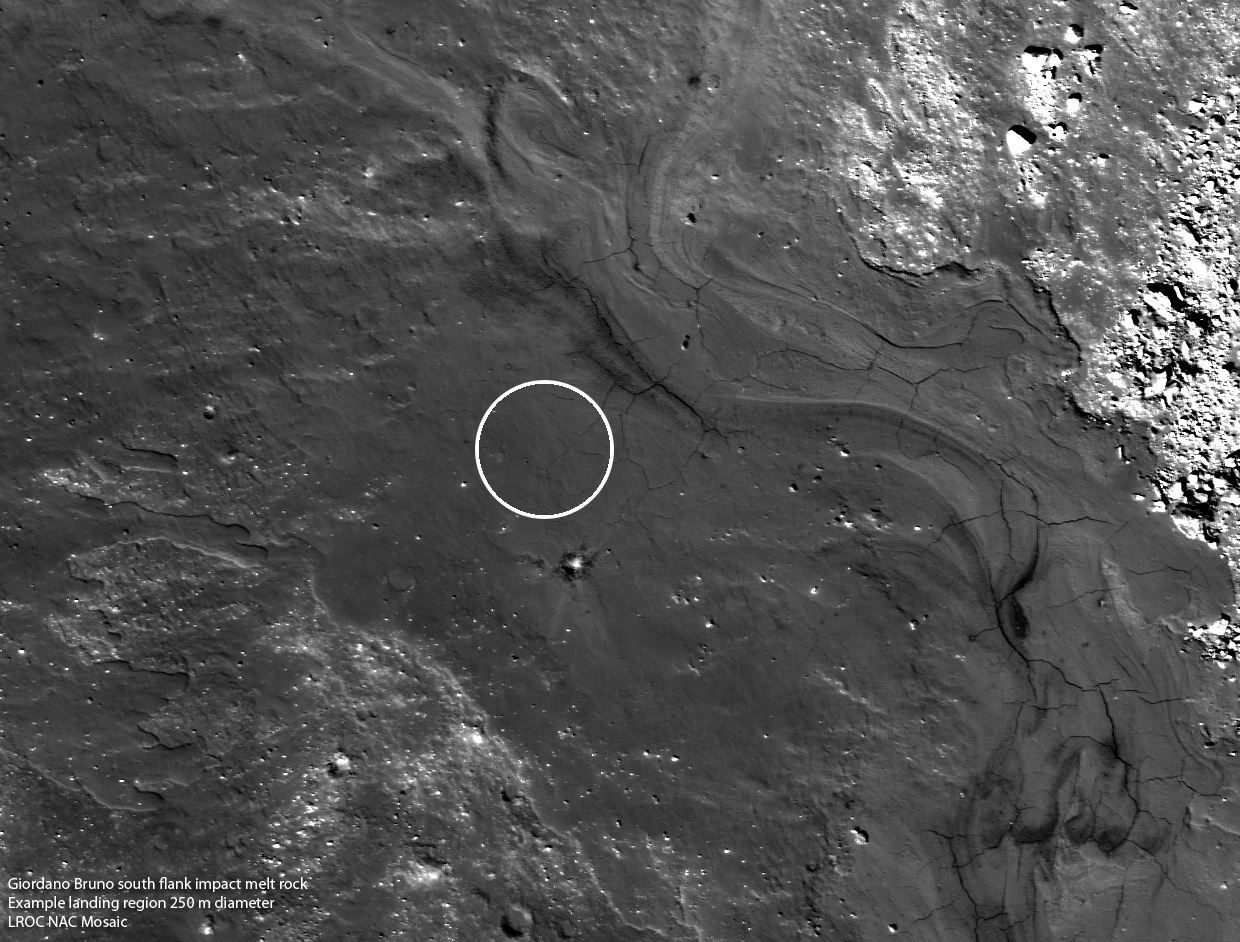
In terms of planetary missions, collecting such a sample is relatively straightforward (although no planetary spacecraft missions are simple): land, scoop, return. First scientists and engineers find the safest landing spot on an impact melt deposit. My favorite is just outside the crater, on the crater's southern rim (visit last week's Featured Image mosaic of Giordano Bruno crater). This large area provides numerous 100 meter size landing spots on now frozen deposit of impact melt. Next, you have to build the sample return spacecraft and land it safely on the Moon. This is no small feat, but keep in mind that the Soviet Union did this successfully three times almost four decades ago. While on the surface, key supporting measurements would be acquired; images, spectral measurements, magnetic properties, and perhaps information about surface radiation exposure to help design safer spacecraft and spacesuits for future astronauts. Finally, after no more than a lunar day on the surface, a sample is scooped up and then returned to Earth. What would we learn? Of course, we'd learn about the age of formation of Giordano Bruno crater, but also much more.

Example landing spot (250 meter diameter circle) on now frozen impact melt. View the full-size LROC image release, HERE [NASA/GSFC/Arizona State University].
This new knowledge will help crater counting experts understand the importance of self-secondary craters on very young craters. A new calibration for these youngest craters could be obtained, thus making age estimates for all other young craters on the Moon more reliable. Additionally this part of the Moon is far from the Imbrium basin and the KREEPy region from where all the Apollo and Luna samples were returned. So this precious sample would be our first look at unsampled highlands terrain, the oldest portion of the Moon's crust. All-in-all, this site is a prime candidate for an automated precursor sample return - lets go!

Be sure and check out the amazing details in the full resolution complete oblique mosaic of Giordano Bruno crater.

Previous LROC Giordano Bruno Featured Images
The Big Picture
Outside of Giordano Bruno
Fragmented Impact Melt
Delicate Patterns in Giordano Bruno Ejecta
Impact Melt Flows on Giordano Bruno
Young Giordano Bruno

A possible landing site on the south flank of the relatively fresh, much studied crater Giordano Bruno (22.13km, 35.92°N, 102.74°E) LROC Wide Angle Camera (WAC) mosaic from four sequential orbits, February 23, 2010, angle of incidence 49.62° at 76.2 meters resolution, from 54 km. [NASA/GSFC/Arizona State University].