Thursday, March 19, 2009

And a fair lay overview of ISRO's Chandrayaan

Chandrayaan and India’s space odyssey
Khabrein.info

Today, India is one of the very few countries that have significant achievements to their credit in the arena of space. The Indian Space Research Organisation (ISRO) has designed, developed and built a variety of satellites. And, it has successfully launched many of them into their intended orbits. More importantly, the country has used its satellites for the rapid expansion of its national infrastructure including telecommunications, TV broadcasting, weather monitoring, education, public health, agriculture and rural development. More recently, India has provided many space-based services including launch services to foreign customers on a competitive basis. With ample experience and many successes in Earth orbit, ISRO took up Chandrayaan-1, its first bold step beyond Earth orbit into deep space.

Chandrayaan-1: The Goals

The primary objectives of Chandrayaan-1 are:
1. To expand scientific knowledge about the moon
2. To upgrade India's technological capability
3. To provide challenging opportunities for planetary
research to the younger generation of Indian scientists
Chandrayaan-1 aims to achieve these well defined objectives through high resolution remote sensing of the moon in the visible, near infrared, microwave and X-ray regions of the electromagnetic spectrum. With this, preparation of a 3-dimensional atlas of the lunar surface and chemical mapping of entire lunar surface is envisaged.

Chandrayaan-1: The Payloads
Chandrayaan-1 spacecraft carried 11 payloads (scientific instruments) to achieve its objectives. The instruments were carefully chosen on the basis of many scientific and technical considerations as well as their complementary/supplementary nature.

Of them, five instruments were entirely designed and developed in India, three instruments from European Space Agency (one of which was developed jointly with India and the other with Indian contribution), one from Bulgaria and two from the United States. Thus, Chandrayaan-1 is a classic example of international cooperation that has characterised the global space exploration programmes of the post cold war era.

The Indian payloads are:
1. Terrain Mapping Camera (TMC): The aim of this instrument is to completely map the topography of the moon. The camera works in the visible region of the electromagnetic spectrum and captures black and white stereo images. It images a strip of lunar surface which is 20 km wide and resolution of this CCD camera is 5 m. Such high resolution imaging helps in better understanding of the lunar evolution process as well as in the detailed study of the regions of scientific interest. When used in conjunction with data from Lunar Laser Ranging Instrument (LLRI), it can help in better understanding of the lunar gravitational field as well. TMC was built by ISRO's Space Applications Centre (SAC) of Ahmedabad.

2. Hyperspectral Imager (HySI): This CCD camera is designed to obtain the spectroscopic data for mapping of minerals on the surface of the moon as well as for understanding the mineralogical composition of the moon's interior. Operating in the visible and near infrared region of the electromagnetic spectrum, it images a strip of lunar surface which is 20 km wide with a resolution of 80 m. The instrument splits the incident radiation into 64 contiguous bands of 15 nanometer (nm) width. HySI will help in improving the already available information on mineral composition of the lunar surface. HySI was also built by SAC.

3. Lunar Laser Ranging Instrument (LLRI): This instrument aims to provide necessary data for determining the accurate altitude of Chandrayaan-1 spacecraft above the lunar surface.It also helps in determining the global topographical field of the Moon as well as in generating an improved model for the lunar gravity field. Data from LLRI will enable understanding of the internal structure of the moon and the way large surface features of the moon have changed with time. The infrared laser source used for LLRI is Nd-YAG laser wherein Neodimium atoms are doped into a Yittrium Aluminium Garnet crystal. The wavelength of the light emitted by LLRI is 1064 nm. LLRI was built by ISRO's Laboratory for Electro Optic Systems (LEOS) of Bangalore.

4. High Energy X-ray Spectrometer (HEX): This is the first planetary experiment to carry out spectral studies at 'hard' X-ray energies using good energy resolution detectors. HEX is designed to help explore the possibility of identifying polar regions covered by thick water-ice deposits as well as in identifying regions of high Uranium and Thorium concentrations. Knowledge of the chemical composition of the various solar system objects such as planets, satellites and asteroids provides important clues towards understanding their origin and evolution. HEX uses Cadmium Zinc Telluride (CZT) detectors and is designed to detect hard X-rays in the energy range of 30 kilo electron Volts (keV) to about 270 keV. HEX was built jointly by Physical Research Laboratory (PRL) of Ahmedabad and ISRO Satellite Centre of Bangalore.

5. Moon Impact Probe (MIP): The primary objective of MIP was to demonstrate the technologies required for landing a probe at the desired location on the moon. Through this probe, it was also intended to qualify some of the technologies related to future soft landing missions. This apart, scientific exploration of the moon at close distance was also intended using MIP.

The 34 kg Moon Impact Probe consisted of a C-band Radar Altimeter for continuous measurement of altitude of the Probe above lunar surface and to qualify technologies for future landing missions, a Video Imaging System for acquiring images of the surface of moon from the descending probe and a Mass Spectrometer for measuring the constituents of extremely thin lunar atmosphere during its 25 minute descent to the lunar surface. MIP was developed by Vikram Sarabhai Space Centre of Thiruvananthapuram.

Chandrayaan-1 spacecraft carrying 11 scientific instruments weighed about 1380 kg at the time of its launch and is shaped like a cuboid with a solar panel projecting from one of its sides. The state of the art subsystems of the spacecraft, some of them miniaturised, facilitate the safe and efficient functioning of its array of scientific instruments.

The spacecraft structure was mainly built using composites and Aluminium honeycomb material. The Thermal subsystem consisting of paints, tapes, multi layer insulation blanket, optical solar reflectors, heat pipes, heaters and temperature controllers, ensures the proper functioning of the spacecraft by keeping its temperature within acceptable limits. The Mechanisms subsystem of Chandrayaan-1 spacecraft took care of the deployment of its solar panel and the steers of the dual gimballed antenna.

The spacecraft is powered by a single solar panel generating a maximum of 700 W. A 36 Ampere-Hour (Ah) Lithium ion battery supplies power when the solar panel is not illuminated by the sun. The Telemetry, Tracking and Command subsystem of Chandrayaan-1 working in S-band takes care of radioing the detailed spacecraft health information, facilitating the knowledge about spacecraft's position in space and allows the reception and execution of commands coming from Earth by the spacecraft.

Sun and star sensors as well as gyroscopes provide the orientation reference for spacecraft in space. The Attitude and Orbit Control subsystem, essentially the brain of Chandrayaan-1, consisting of a Bus Management Unit (BMU), reaction wheels and thrusters, ensures the proper orientation and stability of the spacecraft as well as in changing its orbit during different phases of its flight.

To make Chandrayaan-1 spacecraft to escape from orbiting Earth and to travel towards the moon, its liquid apogee motor (LAM) was used. Liquid propellants needed for LAM as well as thrusters were stored onboard the spacecraft.

Chandrayaan-1 spacecraft's Communications subsystem transmits the precious information gathered by its scientific instruments to Earth in 'X-band' through its Dual Gimballed Antenna.

Chandrayaan-1 spacecraft was built at ISRO Satellite Centre, Bangalore with contributions from ISRO/Department of Space (DOS) establishments like Vikram Sarabhai Space Centre (VSSC), Liquid Propulsion Systems Centre (LPSC) and ISRO Inertial Systems Unit (IISU) of Tiruvananthapuram, Space Applications Centre (SAC) and Physical Research Laboratory (PRL) of Ahmedabad and Laboratory for Electro-optic Systems (LEOS) of Bangalore.

The launch of Chandrayaan-1 took place at 6:22 am Indian Standard Time (00:52 UT) on October 22, 2008 from the Second Launch Pad at Satish Dhawan Space Centre, SHAR, Sriharikota in the Nellore district of Andhra Pradesh state. Sriharikota is situated at a distance of about 80 km to the North of Chennai.

Chandrayaan-1 spacecraft began its journey from Earth onboard India's Polar Satellite Launch Vehicle (PSLV-C11) and first reached a highly elliptical Initial Orbit (IO). In the Initial Orbit, the perigee (nearest point to Earth) was about 255 km and apogee (farthest point from the Earth) is about 22,860 km.

After circling the Earth in its Initial Orbit for a while, Chandrayaan-1 spacecraft was taken to five more elliptical orbits whose apogees were progressively higher a 37,900 km, 74,715 km, 164,600 km, 267,000 km and 380,000 km respectively. This was done by firing the spacecraft's Liquid Apogee Motor (LAM) at opportune moments when the spacecraft was near perigee. During this phase of the mission, the Terrain Mapping Camera (TMC), which is one of the eleven payloads of Chandrayaan-1 carried by spacecraft, was successfully switched ON and it took the pictures of the Earth and Moon. Additionally, Radiation Dose Monitor (RADOM), another payload of Chandrayaan-1, was also switched ON.

As it approached the apogee of its final Earth Bound Orbit at 380,000 km, the spacecraft passed at a distance of about 500 km from the Moon on November 8, 2008 since Moon had arrived there in its journey round the Earth.

At that time, the spacecraft's LAM was again fired. This slowed down the spacecraft sufficiently to enable the gravity of the moon to capture it into an elliptical orbit whose periselene (nearest point to the moon's surface) was at 504 km and whose aposelene (farthest point to the moon's surface) was at 7,502 km.

Following this, the height of the spacecraft's orbit around the moon was reduced in four steps. As a result of this, the periselene was reduced from 504 km to 200 km, and then to 182 km and finally to 100 km while the aposelene was reduced from 7,502 km to 255 km and then to 183 km and finally to 100 km. Thus, Chandrayaan-1 spacecraft reached its intended operational lunar polar orbit of about 100 km height from the moon's surface on November 12, 2008. After this, TMC sent excellent images of the lunar surface.

On November 14, 2008, the Moon Impact Probe (MIP), carrying the painting of Indian tricolor on its sides, was separated from the spacecraft and after a 25 minute journey, impacted the lunar surface near the South polar region of the moon at around
20:31 Indian Standard Time (15:01 UT). Following this, the switching ON of the remaining nine payloads began. By mid December 2008, all the payloads had been switched on and tested.

PSLV-C11, chosen to launch Chandrayaan-1 spacecraft, was an uprated version of ISRO's Polar Satellite Launch Vehicle standard configuration. Weighing 320 tonnes at lift-off, the vehicle used larger strap-on motors (PSOM-XL) to achieve higher payload capability.

PSLV is the trusted workhorse launch Vehicle of ISRO. During September 1993- April 2008 period, PSLV had twelve consecutively successful launches carrying satellites to Sun Synchronous, Low Earth and Geosynchronous Transfer Orbits. On October 22, 2008, its fourteenth flight launched Chandrayaan-1 spacecraft.

By mid 2008, PSLV had repeatedly proved its reliability and versatility by launching 29 satellites into a variety of orbits. Of these, ten remote sensing satellites of India, an Indian satellite for amateur radio communications, a recoverable Space Capsule (SRE-1) and fourteen satellites from abroad were put into polar Sun Synchronous Orbits (SSO) of 550-820 km heights. Besides, PSLV has launched two satellites from abroad into Low Earth Orbits of low or medium inclinations. This apart, PSLV has launched KALPANA-1, a weather satellite of India, into Geosynchronous Transfer Orbit (GTO).

PSLV was initially designed by ISRO to place 1,000 kg class Indian Remote Sensing (IRS) satellites into 900 km polar SunSynchronous Orbits. Since the first successful flight in October 1994, the capability of PSLV was successively enhanced from 850 kg to 1,600 kg. In its ninth flight on May 5, 2005 from the Second Launch Pad (SLP), PSLV launched ISRO's remote sensing satellite,1,560 kg CARTOSAT-1 and the 42 kg Amateur Radio satellite, HAMSAT, into a 620 km polar Sun Synchronous Orbit. The improvement in the capability over successive flights has been achieved through several means. They include increased propellant loading in the stage motors, employing composite material for the satellite mounting structure and changing the sequence of firing of the strap-on motors.

PSLV-C11 is 44.4 metre tall and has four stages using solid and liquid propulsion systems alternately. The first stage, carrying 138 tonne of propellant, is one of the largest solid propellant boosters in the world. Six solid propellant strap-on motors (PSOM-XL), each carrying twelve tonne of solid propellant, are strapped on to the first stage. The second stage carries 41.5 tonne of liquid propellant. The third stage uses 7.6 tonne of solid propellant and the fourth has a twin engine configuration with 2.5 tonne of liquid propellant.

The 3.2 metre diameter metallic bulbous payload fairing protects the satellites and it is discarded after the vehicle has cleared dense atmosphere. PSLV employs a large number of auxiliary systems for stage separation, payload fairing separation and so on. It has sophisticated systems to control the vehicle and guide it through the predetermined trajectory. The vehicle performance is monitored through telemetry and tracking. The main modification in PSLV-C11 compared to its standard configuration is the use of larger strap-on motors (PSOM-XL) containing more propellants.

Vikram Sarabhai Space Centre (VSSC), Thiruvananthapuram, designed and developed PSLV-C11. ISRO Inertial Systems Unit (IISU) at Thiruvananthapuram developed the inertial systems for the vehicle. Liquid Propulsion Systems Centre (LPSC), also at Thiruvananthapuram, developed the liquid propulsion stages for the second and fourth stages of PSLV-C11 as well as reaction control systems. SDSC SHAR processed the solid motors and carries out launch operations. ISRO Telemetry, Tracking and Command Network (ISTRAC) provides telemetry, tracking and command support during PSLV-C11's flight.

National Space Club announces award winners

National Space Club - Washington - The aerospace industry's premier awards were announced today by the National Space Club. Awardees are listed below and will be recognized by their colleagues from across government, industry and academia at the prestigious 52nd annual Dr. Robert H. Goddard Memorial Dinner, to be held this year on Friday, April 17 at the Hilton Washington. Awards are presented to a number of outstanding individuals for accomplishments in spaceflight, engineering, science, management and education.

* The pinnacle award, the Robert H. Goddard Trophy, will be presented to The Honorable Dr. Michael Griffin, former NASA Administrator, voted the individual who made the most significant contribution to space activity in the previous year. Dr. Griffin spearheaded NASA during a time of increasing demands, new directions and flat budgets, and has received industry-wide accolades for outstanding leadership, commitment and dedication to NASA and our nation's civil space program.

* The Dr. Joseph Charyk Award will be presented to Mr. Ralph S. Haller, Principal Deputy Director, National Reconnaissance Office, for distinguishing himself by his architecture and implementation of a comprehensive transformation in the history of the National Reconnaissance Office, achieving key goals and objectives of that organization's strategic vision and addressing national security and space mission challenges.

* The NOAA David Johnson Award will be presented to Mr. William J. Blackwell, Member of the Technical Staff, MIT Lincoln Laboratory, for his innovative and outstanding contribution to the improved performance of integrated hyperspectral infrared and passive microwave sounders on meteorological satellites.

* The Olin E. Teague Memorial Award will be presented to Alexander Rilee, High Performance Computing with Graphics Cards, Eleanor Roosevelt High School for his parallelizing phase retrieval running on a general purpose graphics card with a unified device architecture provides an inexpensive method for faster, more efficient scientific computing, essential in assessing and correcting misalignment and optical flaws in the James Webb Space Telescope.

* The Space Educator Award will be presented to Mr. Michael Weiss, Teacher, Yarmouth High School, Yarmouth, ME, for his work in inspiring, educating and developing the next generation of students in space science through creative programs, competitions and extensive participation of him and his students in NASA and other space education programs

* The Astronautics Engineer Award will be presented to Mr. Stephen C. Doering, Associate Program Manager, Constellation Program, NASA George C. Marshall Space Flight Center, for his personal leadership as the manager of the NASA Johnson Space Center's extravehicular programs involved with the Space Shuttle and International Space Station as well as for his work on the next generation of space flight. He now leads all NASA Marshall Space Flight Center's non-launch vehicle exploration efforts.

* The Goddard Scholarship will be awarded to Mr. Ross Finman, Student, Carnegie Mellon University for his commitment to excellence and desire to explore and develop space robotics technologies and systems to allow future exploration of the Moon and other planets.

* The Nelson P. Jackson Award for outstanding contributions to the missile, aircraft and/or space field. will be presented to the MESSENGER Spacecraft joint NASA and team. The MESSENGER (Mercury Surface Space Environment Geochemistry and Ranging) spacecraft was launched September 2004, flew by Mercury twice, January and October 2008, andwill fly by a third time in September, and then aim for a year long orbit of Mercury beginning March 2011. The mission is to gather information on the density, magnetic fields, geological makeup, volatile materials and take other measurements to better understand the structure and history of this inner-most terrestrial planet.

* The Press Award will be jointly presented to Jay Barbree, Correspondent for NBC News and Lon Rains, former editor-in-chief, Space News and director of communications for Northrup Grumman's Space Technology Sector, both for dedication and enthusiasm for the aerospace industry.

The Goddard Dinner is held each year to celebrate the anniversary of the first successful flight by Dr. Goddard of a liquid-fueled rocket. This black tie event brings together 2,000 members of the government, industry and educational space community.

Robotics teams goes for 'lunacy' in LA

William S. Hart Union High School District
Santa Clarita Valley, CA

The robotics team from West Ranch High School journeyed to Long Beach March 13 and 14 to compete in the Los Angeles Regional FIRST Robotics Competition.

Following a "lunacy" theme, 61 high school teams from Southern California, Arizona, Brazil and Chile challenged each other on a "lunar crater" roughly the size of a tennis court, scoring points by launching balls called "moon rocks," "empty cells" and "super cells" into the containers of the opposing teams' robots.

The West Ranch team placed 13th among 62 schools and made it to the first round of the elimination playoffs.

Wednesday, March 18, 2009

ESA's smallest, most precisely controllable engine ever built for space

European Space Agency researchers are preparing to test what they describe as the smallest, yet most precisely controllable engine ever built for space. It’s designed to be sensitive enough to counteract the force of sunshine.

Measuring 10 centimeters (4 inches) across and making a faint blue glow as it runs, the Field Emission Electric Propulsion, or FEEP, engine produces an average thrust equivalent to the force of one falling hair. But its thrust range and controllability are far superior to more potent thrusters, holding the key to future success of an ambitious mission of the agency, researchers declare.

“Most propulsion systems are employed to get a vehicle from A to B,” explained Davide Nicolini of the agency’s Scientific Projects Department, in charge of the engine research. But with this one, “the aim is to maintain a spacecraft in a fixed position, compensating for even the tiniest forces perturbing it, to an accuracy that no other engine design can match.”

Watching how objects behave when separated from all outside influences is a long-time ambition of physicists, but it can’t be done within Earth’s gravity field. So a next-decade mission called Laser Interferometer Space Antenna, or LISA, Pathfinder is to fly 1.5 million km (900,000 miles) to a place called Lagrange Point 1. There, the Sun and Earth’s gravities cancel each other out, so that the behavior of a pair of free-floating test objects can be precisely monitored.

But to detach the experiment fully from the rest of the Universe there will still be some remaining perturbations to overcome, most notably the slight but continuous pressure of sunlight itself. That’s where FEEP comes in. It operates on a basic principle followed by other so-called ion engines: the application of an electric field serves to accelerate electrically charged atoms, producing thrust.

But FEEP’s performance is measured using units called micronewtons, which are one-thousandth the size of the already small units used for other ion engines. The engine has a thrust range of 0.1—150 micronewtons, with a resolution capability better than 0.1 micronewtons and a time response of one-fifth of a second or less, according to project engineers.

The engine employs the liquid metal cesium as propellant. Through capillary action—a phenomenon associated with surface tension—cesium flows between a pair of metal surfaces that end in a razor-sharp slit. The cesium stays at the mouth of the slit until an electric field is generated. This causes tiny cones to form in the liquid metal, which have charged atoms shooting from their tips to create thrust.

Twelve thrusters would be mounted on the hull of LISA Pathfinder. Working together with a separate NASA-designed propulsion system, the thrusters should yield directional control at least 100 times more accurate than any spacecraft before it—down to a millionth of a millimeter, project engineers assert.

“We are overseeing the work here because we have previous knowledge of FEEP technology,” said Pierre-Etienne Frigot of ESA’s Propulsion Laboratory.

LISA involves three satellites up to five million km (three million miles) apart and linked by lasers, orbiting the Sun. The aim is to detect ripples in space and time known as gravitational waves, predicted by Einstein’s spectacularly successful theory of general relativity but so far undetected. The waves would cause tiny variations in the distance measured between the satellites.

Once proven, the FEEP technology has been earmarked for a broad range of other missions, including precision formation flying for astronomy, Earth observation and drag-free satellites for mapping variations in Earth’s gravity.

Barack Obama's Quest for a NASA Administrator

Opinion/Editorial from Mark Whittington - who asks...

Is Obama Being Rolled by Bill Nelson?

President Barack Obama has been having problems staffing his government and has had a number of embarrassments of nominees who have had to withdraw for various reasons, some having to do with nonpayment of taxes.

No greater illustration of President Obama's continuing woes can be seen than his quest to find a new NASA administrator.

Engage in speculation HERE.

Students photograph Earth from Balloon

Maybe the Romanian Google X-Prize team, ARCA, that reportedly wants to launch their entrant lunar rover from balloon, are on to something.

From FoxNEWS and the Daily Telegraph, this evening, comes news that the Meteotek team of IES La Bisbal school in Catalonia, Spain completed an "incredible experiment" at the end of February. Using $140 in equipment, the teens lofted a camera over 100,000 feet, over 20 miles into the lower stratosphere and, if you can believe your eyes, photographed the better part of Earth's atmosphere from the edge of space.

Of course, though they are being credited with having taken pictures from Outer Space itself, they are two-thirds shy of the official boundary of 100 kilometers, or 62 miles, but, none-the-less, it is no small achievement. It shows, at the very least, that bringing down the cost of one pound of material to the Moon or even into low earth orbit might be possible, some day, by and by.

After all, the U.S. and U.S.S.R. paid plenty to attain achievements like this one sixty years ago. Then again, the "cheap" CCD digital camera, radio control, the materials that made up the balloon, etc., would not have been available were it not for the expensive attainment of such everyday technology during the Apollo Era and afterward.

The story from The Telegraph

LCROSS brings divergent passions together

John Marmie, deputy project manager for LCROSS at NASA Ames
Photo: NASA Ames Research Center

MOFFETT FIELD, CA – Growing up in the rural Appalachian foothills of the Ohio Valley, John Marmie developed a passion for music. When he combined that passion with his enthusiasm for space exploration, he was inspired to write an original song, 'Water on the Moon.'

As the deputy project manager for the Lunar CRater Observation and Sensing Satellite (LCROSS) mission at NASA’s Ames Research Center, Moffett Field, California, Marmie is helping spearhead America's return to the moon. Scheduled to launch later this year, the LCROSS mission is designed to search for water by impacting one of the moon's permanently shadowed craters. Marmie's goal is to not only help write history with LCROSS, but also to inspire others.

"I learned in my early 20s about the power of music," said Marmie. "It entertained, it opened social doors, it inspired and music allowed me to relax, escape and to dream."

Knowing a career in music might be financially unstable, Marmie wanted a career path where he could be creative and still support his passion for music. Higher education opened doors and guided his path.

Marmie set out on his journey at the University of Ohio where he earned a Bachelors degree in electrical and computer engineering and a masters in electrical engineering with a concentration in computational electromagnetics. His hard work got him noticed by NASA. Contemplating a move to the home of country music, Nashville, Tenn., Marmie’s plans changed when he received an offer to work at NASA's Ames Research Center in Northern California. A new passion was born.

"When the opportunity to work for NASA was presented, I just couldn’t turn it down," he said "To this day, I still ask myself, 'how did I end up at NASA?’ It must have been divine guidance."

Read more HERE.
Watch the Video
HERE.

Tuesday, March 17, 2009

Lunar lander Altair office opened in Houston by Lockheed-Martin

With design competition underway to win the lion's share of the contract to build the long-sought successor to the Apollo lunar module, the Constellation Altair, defense and aerospace giant Lockheed-Martin is making an attempt to demonstrate their seriousness.

The company has announced the location of its Altair program office conveniently in Houston, in "it's bid to provide support for the next-generation human lunar lander system for NASA." Lockheed-Martin "submitted its proposal to NASA last month for the Altair Conceptual Design Contract and the agency is expected to award several contracts for the first phase of the program later this spring."

The announcement, by way of PR Newswire, reiterates the role Altair must eventually play, first as heavy-lift cargo, flying on-board the Ares V (probably) to rendezvous with a crewed Orion command-service module prior to Tran Lunar Injection. Lockheed-Martin is obviously anxious to be awarded the next phase in Altair's design, if not a bit transparent in the perhaps-premature gesture of opening an office so close to the Johnson Space Center.

"We recognize that locating key expertise and program management support in Houston adjacent to NASA's Johnson Space Center, where the Constellation Program and Altair Project offices are located, allows us to provide responsive and comprehensive support to NASA on the Altair Conceptual Design Contract," said Brian Duffy, vice president and program manager of the Altair Lunar Lander program for Lockheed Martin. "Utilizing the existing facilities and our experienced human space flight team in the Houston area provides significant synergy that we are bringing to bear for NASA's next-generation lunar missions."

Duffy, a four-time Shuttle astronaut and commander of two of the missions, executed four rendezvous maneuvers with other spacecraft and docked with the International Space Station. He also participated in the development and testing of displays, flight crew procedures, and computer software to be used on Shuttle flights, all of which have given him unique and valuable expertise that will be useful in assisting NASA in designing the elements of a new generation of Altair lunar spacecraft and successful lunar missions in the future.

Lockheed-Martin then reminds news writers and readers everywhere that the company is already prime contractor for the Orion CEV, schedule to take its first manned flight in 2015.

"Headquartered in Bethesda, Maryland, Lockheed Martin is a global security company that employs about 146,000 people worldwide and is principally engaged in the research, design, development, manufacture, integration and sustainment of advanced technology systems, products and services. The corporation reported 2008 sales of $42.7 billion.

EETimes Power Engineer - video interview with Ken Mattingly

You do not want to miss the multi-media opportunity presented by EETimes, put together by George Leopold, featuring modest giant of Apollo fame Admiral Ken Mattingly.

You may know him as the man played by Gary Sinese in Ron Howard's film Apollo 13 who "worked the problem" on the ground, tediously and repeatedly, to get Jim Lovell, Jack Swigert and Fred Haise back to Earth, searching for the last fraction of voltage from the crippled spacecraft to save the crew or the command module, but not both.

In the end, of course, he found the sequence that did save both, in April 1970, when trips to the Moon somehow became "routine." (Except for certain 13-year-old entusiasts who cried bloody murder when prime time was not interrupted for that last, casual trans-lunar coast television opportunity, minutes before all hell broke loose.)

In the course of explaining how he helped save the crew of Apollo 13, Ken Mattingly mentions, as an aside, that "in the process of going through all this [power-up procedures for the command module], somebody noticed that we could take any residual power we had in the [lunar module] batteries and run it backwards" to the Apollo command module. This was accomplished using a small-capacity power cable designed to provide power to the lunar module from the command module.

"We actually believe we topped off the [command module] batteries," Mattingly noted with understandable pride during an extended interview at his office here in mid-January

That "somebody" might have been Mattingly, and the estimated 4 amps of additional power provided by this kluge, along with a detailed power-up procedure developed by one of NASA's "steely-eyed missile men," John Aaron, allowed the Apollo 13 astronauts to restart a frozen command module that was their only means of getting home.

The off-handed manner in which Rear Adm. Thomas K. Mattingly, 73, presented this nugget of information is typical of his understated style, his modesty and his consummate ability as an engineer. These, along with the astronauts' dead-certain belief in their ability to overcome any technical hurdle, were precisely the traits that defined the Apollo program.

Referring to the painstaking development of the sequencing procedure needed to power up the hibernating Apollo 13 command module, Mattingly said, "You don't get technical answers by playing around."

The Apollo astronaut and Space Shuttle commander will be a keynote speaker on March 31 at the Embedded Systems Conference Silicon Valley 2009 (March 30-April 2) in San Jose, Calif.

Mattingly never got to walk on the Moon, and he acknowledged that every Apollo astronaut burned to do just that. "Everybody wants to go to the Moon. That means, go land on the Moon," Mattingly said. Hence, being a command module pilot was a bit like being a "bridesmaid."

Read the story HERE.

Direct Link to Video, Courtesy EETimes

Olympian on the Canadian Shortlist

Peter Giles, Physicist, Olympian, and now on the shortlist of 15, narrowed down from 5,300 applicants, of Canadians hoping to be among the next class of the Canada Astronaut Corp.

John Gillis, staff reporter for the Chronicle-Herald, offers an interesting backgrounder on Giles, "who along with his brother Steve was part of Canada's canoe-kayak team at the 1996 Summer Olympics in Atlanta.

"Reached in Toronto, the 38-year-old, who now lives in Hammond Plains, said he was having a pretty good day."

"I've dreamed about that for a long time," he said. "If you're interested in a career in science and technology, I kind of think if it as the pinnacle of that career. What could be more inspiring to other Canadians in terms of the power of science and the power of technology than manned spaceflight?"

Mr. Giles, who has a B.Sc. in physics from Dalhousie University and masters and doctoral degrees from Stanford, works as a systems engineer with General Dynamics in Dartmouth.

He said in that role, he has learned about the operations of military and naval vessels, skills that would be valuable as an astronaut.

The selection process, which began last May, is geared toward choosing people well-suited to fly to the International Space Station for extended periods.

Read the article HERE.

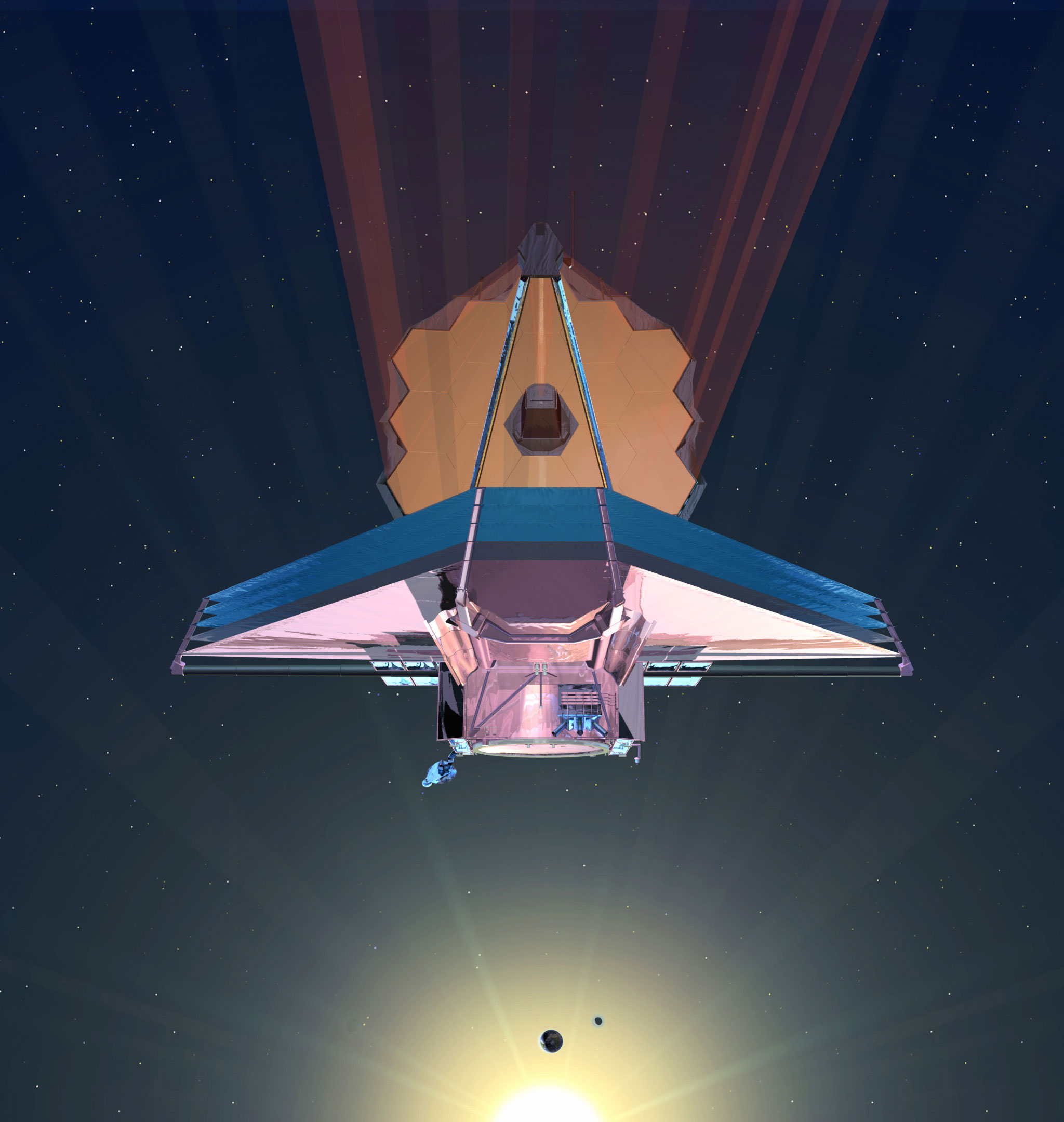
Webb Sunshield has SPF of 1.2 million

Wolfgang Gruener of TGDaily reports NASA's James Webb Space Telescope will be fitted with a new sunshield Northrup Grumman claims has the equal to 1.2 million Sun Protective Factor.

NG recently completed a preliminary design review of the sunshield membrane that's the size of a tennis court and shaped like a beach umbrella.

The shield is designed to block solar radiation and help the observatory operate at cryo temps. Schedule for launch in 2013. JWST should detail those galaxies that formed at the end of the Cosmic Dark Age, 300 million years after the Big Bang.

With its resolution of electro-magnetic frequencies largely unabsorbed by clouds and dust, JWST should solve enduring questions as to the true extent of extra-galactic dust, and why ground and space measurements of very energetic cosmic rays indicate less attenuation and more cosmic rays than there should be.

Exploring the region between the Cosmic Background heat and the emergence of galaxies, the so-called Dark Ages, awaits the radio quiet and large baselines possible for telescopes astronomers hope to build on the Moon's Far Side.

China Party Line - People's Daily says 'Space industry critical to global economic growth'

International space industry grows vigorously despite the sluggish global economy. Intensive space activities, particularly since March this year have repeatedly made headlines in global international media: China's lunar probe Chang'e-1 ended its 16-month mission with a controlled crash onto the moon; the US launched Kepler space telescope designed to discover Earth-like planets orbiting other stars; Russian and US astronauts completed a five-hour spacewalk; European Earth Gravity Field and Ocean Circulation Explorer will be launched soon…

Russia intensifies space exploration

Russia has put more efforts in its space programs in recent years, including the research and development of new transport tools such as carrier rockets and spaceships, as well as the construction of a space launch centre in Far East region. By the end of 2012, Russia will hopefully finish the spaceship that is specially designed for space travelers.

Russia's Space Agency chief Anatoly Perminov said that Russia will remain a leader in the international space industry in spite of the global financial meltdown. The Russian government has made it clear that Russia will continue to take on responsibility in international cooperation and the planning and operation of GLONASS will be completed within the year. It is reported that there will be 39 space launches this year, much more than in previous years.

EU pours 10 billion euros for space exploration

European Space Agency (ESA) will be busy this year. Three Earth probe satellites that will explore ice layers in the arctic areas, Earth gravity field and ocean circulation, soil moisture and salinity of oceans will be launched. Additionally, EAS also plans to send two scientific explorers into space, one for observing space radiation fields and the other for researching the formation of planets and galaxies.

ESA will also take part in the research and construction of the International Space Station (ISS). There will be six staff members in the space station by the end of this year. ESA will invest 10 billion euros for space exploration over the next few years and launch major projects including a manned spaceship and searching for life on Mars.

US increases budget on space exploration

US president Barack Obama raised the budget for NASA after he took office early this year. According to the fiscal budget for 2010, NASA will get a budget worth of 18.7 billion US dollars. If the one billion US dollars bonus from the government stimulus package is accounted, the total budget this year will be 2.4 billion, more than the previous year's level. The new budget aims to ensure US's leading position in the field of Earth and space research.

NASA plans to launch six spacecrafts to complete the missions of; sending provisions to ISS, repair Hubble space telescope, launch solar dynamics observatory, and search for the safe landing space for manned spaceship and so on. According to the original plan, US’ Irion spacecraft will be launched in 2015.

Japan puts forward the idea of manned space mission

Japan made substantial progress in the space industry last year, namely, Japan's Lab in ISS has been formed; Japan passed the Basic Law on Space on May 21, 2008, which laid the foundation for further development of its space industry.

The main purpose of Japan's space program is to monitor natural disaster and climate change, explore the mystery of space, and develop reliable and competitive technology. The Japanese government put forward the idea of sending robot and human beings to the moon by 2020 and 2030 respectively.

India researches into manned spacecraft

Indian Space Research Organization has sent its first unmanned lunar probe with a homemade carrier rocket on Dec.22 last year, which marked the beginning of India's lunar exploration. According to India's lunar project that has been made public, the south Asian country plans to launch the second unmanned lunar explorer by 2012 and the manned space mission by 2015. India is expected to complete its first space walk in 2020.

Currently, the manned space project in India has been helped by Russia’s Space Agency. Russian spacecraft Soyuz will carry Indian astronauts into space in 2013. Moreover, India also plans to launch an unmanned Mars observer in 2012.

ROK vows to be a power in space development

ROK sets the year 2009 as the beginning for the development of its space industry. ROK will send the homemade carrier rocket KSLV-I, a 100-kg little satellite into space in the second quarter this year. If successful, ROK will be the tenth country in the world that has launched the satellite.

ROK president LEE Myung Bak said after the first South Korean astronaut had gone into space the ROK was going to be one of the world’s top seven in space exploration. ROK plans to achieve this by sending astronauts into space with an ROK-made spacecraft in 2020.

International space industry develops by leaps and bounds

Yuan Minhui, director of Beijing Space Science and Technology Information Institute pointed out that the space industry points the way for economic development. According to statistics from US Space Foundation, the scale of global space industry hit 251 billion US dollars in 2007. The commercialization process of satellites such as telecommunication, navigation and remote sensing will be further accelerated.

International cooperation in the field of space exploration has further deepened and expanded. So far nine countries have inked a lunar probe deal. China has made great contribution in this regard. Cooperation between China and other countries and regions such as Brazil and Europe on satellite research and development facilitates as well as the development of related technology has improved.

By People's Daily Online

Surface Habitat Systems: JSC Tech 2009

2009 JSC Biennial Research and Technology Report
National Aeronautics and Space Administration
JSC Focused Investment Group
Surface Habitat Systems

Kriss J. Kennedy, Surface Habitat Systems FIG Lead
Johnson Space Center
Systems Architecture & Integration Office Engineering Directorate

The Surface Habitat Systems (SHS) Focused Investment Group (FIG) is part of the NASA Johnson Space Center effort to provide a focused direction and funding to the various projects that are working on human surface habitat designs and technologies for the planetary exploration missions.

The overall SHS-FIG effort focuses on directing and guiding those projects that: 1) develop and demonstrate new surface habitat system concepts, innovations, and technologies to support human exploration missions, 2) improve environmental systems that interact with human habitats, 3) handle and emplace human surface habitats, and 4) focus on supporting humans living and working in habitats on planetary surfaces. The activity areas of the SHS FIG described herein are focused on the surface habitat project near-term objectives as described in this document.

The SHS-FIG effort focuses on mitigating surface habitat risks (as identified by the Lunar Surface Systems Project Office (LSSPO) Surface Habitat Element Team; and concentrates on developing surface habitat technologies as identified in the FY08 gap analysis. The surface habitat gap assessment will be updated annually as the surface architecture and surface habitat definition continues to mature. These technologies are mapped to the SHS-FIG Strategic Development Roadmap. The Roadmap will bring to light the areas where additional innovative efforts are needed to support the development of habitat concepts and designs and the development of new technologies to support of the LSSPO Habitation Element development plan. Three specific areas of development that address Lunar Architecture Team (LAT)-2 and Constellation Architecture Team (CxAT) – Lunar habitat design issues or risks will be focused on by the SHS-FIG.

The SHS-FIG will establish four areas of development that will help the projects prepare in their planning for surface habitat systems development. Those development areas are the 1) surface habitat concept definition, 2) inflatable surface habitat development, and 3) autonomous habitat operations, and 4) cross-cutting / systems engineering. In subsequent years, the SHS-FIG will solicit a call for innovations and technologies that will support the development of these four development areas. The other development areas will be assessed yearly and identified on the SHS-FIG’s Strategic Development Roadmap. Initial investment projects that are funded by the Constellation Program Office (CxPO), LSSPO, or the Exploration Technology Development Projects (ETDP) will also be included on the Roadmap. For example, in one or two years from now, the autonomous habitat operations and testbed would collaborations with the Integrated Systems Health Management (ISHM) and Automation for Operations ETDP projects, which will give the surface habitat projects an integrated habitat autonomy testbed to test software and systems.

The SHS-FIG scope is to provide focused direction for multiple innovations, technologies and subsystems that are needed to support humans at a remote planetary surface habitat during the concept development, design definition, and integration phases of that project. Subsystems include: habitability, lightweight structures, power management, communications, autonomy, deployment, outfitting, life support, wireless connectivity, lighting, thermal, etc.

Download the (pdf) Report/Study HERE.

Russia officially aims for manned moon missions

For only the second time since the disintegration of the Soviet Union the Russian Federation is preparing to choose a new booster design, a heavy lift designed to carry 25 tons into Earth orbit and man-rated to ferry cosmonauts to Earth's Moon.

The only true heavy-lift boosters presently in operation are ESA's high-performiance Ariane V and the Space Shuttle, now only eight missions away from a scheduled retirement in late 2010.

According to a report from the Anatoly Zak, science reporter for BBC News, "Russian space officials say the yet-to-be-named rocket should carry its first manned spacecraft in 2018.

In 2008, Roscosmos finally started quietly soliciting proposals from the industry to develop a brand-new rocket which could support lunar expeditions. All major Russian space firms reportedly vied for the government contract to build the vehicle.

While Roscosmos had never publicised details of the bidding process, a number of Russian space officials hinted that they were close to choosing a winner at the beginning of 2009.

On 14 March, Alexander Chulkov, head of the rocket and launch facilities directorate at Roscosmos, told BBC News that the agency would pick a winner by March 25.

"We have a bidding procedure, under which we made a request for proposals and now will be reviewing those proposals to determine a prime developer, based on the most interesting project from the cost-effectiveness point of view," Mr Chulkov said.

Read the BBC Report HERE.

LO2 & LCH4 Storage on the Lunar Surface

Barsi, Moder & Kassemi, NASA Glenn, Cleveland, OH
AIAA Joint Propulsion Conference

Currently NASA is developing technologies to enable human exploration of the lunar surface for durations of up to 210 days. While trade studies are still underway, a cryogenic ascent stage using liquid oxygen (LO2) and liquid methane (LCH4) is being considered for the Altair lunar lander. For a representative Altair cryogenic ascent stage, we present a detailed storage analysis of the LO2 and LCH4 propellant tanks on the lunar surface for durations of up to 210 days. Both the LO2 and LCH4 propellant tanks are assumed to be pressurized with gaseous helium at launch. A two-phase lumped-vapor computational fluid dynamics model has been developed to account for the presense of a non-condensable gas in the ullage. The CFD model is used to simulate the initial pressure response of the propellant tanks while they are subjected to representative heat leak rates on the lunar surface. Once a near stationary state is achieved within the liquid phase, a multi-zone model is used to extrapolate the solution farther in time. For fixed propellant mass and tank size, the long-term pressure response for different helium mass fractions in both the LO2 and LCH4 tanks is examined.

Download the (pdf) Study HERE.

Arthur D. Code (1923 - 2009)

Pioneer of Orbiting Telescopes

Arthur D. Code, whose lifelong love of the stars and the night sky led to a meteoric career in astrophysics, died in Madison, Wis., on March 11 after a long illness. He was 85.

Code, who spent more than 40 years on the UW-Madison faculty, was a pioneer in space astronomy, leading initiatives to put astronomical telescopes and other instruments in space above the obscuring influence of the Earth's atmosphere. Long before the launch of the Hubble Space Telescope, Code built orbiting observatories and connived tirelessly to get telescopes into space, in one project placing a cigar box-sized photometer aboard an X-15, the rocket-powered planes of the early 1960s that were the first aircraft to fly high enough to pierce the atmosphere and soar, albeit briefly, in space.

In a long and distinguished career, Code would go on to build the world's first successful orbiting observatory, the Orbiting Astronomical Observatory, launched in 1968, and help establish the Space Telescope Science Institute as its founding acting-director. He also developed and operated a sophisticated space-shuttle-borne ultraviolet telescope known as WUPPE (Wisconsin Ultraviolet Photopolarimeter Experiment) in 1990 and 1995 as part of NASA's Astro missions. Code also founded UW-Madison's Space Astronomy Laboratory, a lab responsible for building intricate, but rugged, telescopes and instruments to fly in space.

"Art's career paralleled the advancement of space exploration, and his vision and brilliance contributed centrally to the development of space astronomy," says Robert Mathieu, chair of he UW-Madison Department of Astronomy.

From U. of Wisconsin-Madison Obit HERE.

Monday, March 16, 2009

Powering Exploration: The Ares I Crew Launch Vehicle and Ares V Cargo Launch Vehicles

Ares V places hypothetical monolithic 8 meter UV-visual telescope on a path to Sun.
With a shroud size dictated by the eventual size of the Altair lunar lander,
developers are investigating uses of Ares V unrelated to human space exploration,
e.g., 8 meter science telescopes in LEO of Lagrange orbits,
capabilities could exceed Hubble by an order of magnitute.

Stephen A. Cook, project manager & Teresa Vanhooser, deputy project manager, Ares Projects, Marshall SFC, Huntsville.

NASA’s Constellation Program is depending on the Ares Projects to deliver the crew and cargo launch capabilities needed to send human explorers to the Moon and beyond. Ares continues to make progress toward design, component testing, and early flight testing of the Ares I crew launch vehicle, as well as early design work for Ares V cargo launch vehicle. Ares I and Ares V will form the core space launch capabilities the United States needs to continue its pioneering tradition as a spacefaring nation.

Download (pdf) Study & presentation HERE.

Ares V: Progress Towards a Heavy Lift Capability for the Moon and Beyond

Steve Creech, integration manager, Ares V
Ares Projects Office, Marshall SFC

NASA's new exploration initiative will again take humans beyond low Earth orbit, to the moon, and into deep space. The space agency is developing a new fleet oflaunch vehicles that will fulfill the national goals ofreplacing the Space Shuttle fleet, completing the International Space Station, establishing a permanent outpost on the moon, and eventually traveling to Mars. Separate crew and cargo vehicles emerged from mission architecture studies - the Ares I to carry the Orion crew exploration vehicle and its crew of4 to 6 astronauts, and the Ares V to carry the Altair lunar lander or other supplies to support future exploration missions. (Figure 1) These vehicles will be designed to be safe, affordable, sustainable, reliable, operable with the safety, reliability, flexibility, and operability to serve this nation's manned and unmanned exploration programs for the coming decades. This paper discusses recent and current progress on the Ares V and planned future activities.

In its present configuration, Ares V stands 360 feet (l09.7m) tall, with a gross liftoffmass of 7.4 million pounds (3.3 kg). It will lift 138,000 pounds (62,596 kg) to trans lunar injection (TLI) in dual launch mode with Ares I or 287,000 pounds (130,000 kg) to low earth orbit (LEO) in single launch mode.

By comparison, The Apollo-era Saturn V was 364 feet (110.9m) tall, with a gross liftoffmass of 6.5 million pounds (2,948,350 kg), and could carry 99,000 pounds (44,906 kg) to TLI or 262,000 pounds (118,841 kg) to LEO.
Download the AIAA Study HERE.

Top 16 Canadian Astronaut Candidates Introduced

Canadian Astronauts Robert Thirsk and Chris Hadfiield posing with their Japanese
trainer during a training session taking place in Tsukuba, Japan. Credit:
CSA

Toronto, March 16 - Today, Canadian Space Agency (CSA) President Steve MacLean introduced the Top 16 candidates who are participating in the Agency's National Astronaut Recruitment Campaign. This announcement provides insight into the process of selecting the next two members of Canada's Astronaut Corps.

This group was selected from over 5351 online and screened applicants to the National Astronaut Recruitment Campaign, which was launched in May 2008. Over the last several months, the CSA has interviewed candidates and put them through a series of medical exams as well as physical and skills tests in what were sometimes extreme conditions. They have also been tested for their creativity, teamwork skills and physical fitness to determine their ability to meet the demands of astronaut training and space flight.

The tests were developed and executed in collaboration with the 5th Area Support Group Command, Saint-Jean Garrison, Department of National Defence in Saint-Jean-sur-Richelieu, Quebec (January 2009); the Canadian Forces Naval Engineering School, Damage Control Division in Halifax and Survival Systems Training Limited in Dartmouth, Nova Scotia (February 2009); and, Defence Research Development Canada in Toronto, Ontario (March 2009). In December 2008, tests were also conducted with Canadian Forces medical clinics in Halifax, Bagotville, Ottawa, Downsview, Winnipeg, Edmonton, Cold Lake, Esquimalt and Kandahar (Afghanistan).

"Canada is world leader in space exploration and space robotics. This diverse and highly qualified field is a testament to the skill and innovation of our citizens," said Industry Minister Tony Clement. "Our Economic Action Plan is committed to building on Canada's legacy of scientific and technological excellence. I congratulate all candidates who have made it this far in the selection process. With the talent and drive displayed by these fine candidates, the Canadian Astronaut Corps will be well served for years to come."

"The Top 16 candidates in the National Astronaut Recruitment Campaign represent an incredibly accomplished, well-rounded and diverse group of Canadians," said CSA President and former astronaut, Steve MacLean. "This is only the third Astronaut Recruitment Campaign held in Canadian history. As we proceed with our selection process, two of these highly talented individuals will be chosen for the opportunity of a lifetime."

The following is an alphabetical list of the Top 16 candidates:

Matthew Bamsey
Desmond Brophy
Christopher Denny
Peter Giles
Jeremy Hansen
Allyson Hindle
Ryan Hunter
Jameel Janjua
Joshua Kutryk
Mark McCullins
Stuart Rogerson
David Saint-Jacques
Geoffrey Steeves
Kenneth Welch
Keith Wilson
Bruce Woodley

The remaining steps of the campaign include a series of interviews and intensive medical exams to be completed over the next two months. The final two candidates will be selected as the newest members of Canada's Astronaut Corps in May 2009.

For more information about the National Astronaut Recruitment Campaign, visit the Canadian Space Agency Web site at http://www.asc-csa.gc.ca/. Resources on the site include biographies and photos of the Top 16 candidates, a campaign timeline and photos of the candidates throughout the evaluation process.

About the Canadian Astronaut CorpsCanada's astronauts embody the spirit of the Canadian Space Program. Their courage and commitment are a source of pride and inspiration to all Canadians. As astronauts, their core function is to support, train and fly on international space missions, and to use their unique experience to help further scientific research and advance technology development. They also play a key role in raising public awareness about Canada's achievements and activities in space, while inspiring Canada's youth to explore the fields of science and technology.

About the Canadian Space Agency

Established in 1989, the Canadian Space Agency coordinates all civil, space-related policies and programs on behalf of the Government of Canada. The Agency directs its resources and activities through four key thrusts: Earth Observation, Space Science and Exploration, Satellite Communications, and Space Awareness and Learning. By leveraging international cooperation, the CSA generates world-class scientific research and industrial development for the benefit of humanity.

For more information:CSA Media Relations OfficeCanadian Space AgencyTel.: 450-926-4370http://www.asc-csa.gc.ca/

International Partnerships and Interface Standards for Exploration

Kathy Laurini
ESMD/Directorate Integration Office
Constellation Associate Program Manager for
Lunar Formation
Presentation to the U.S. Chamber of Commerce
Programmatic Workshop on NASA
Lunar Surface Systems Concepts
February 25, 2009

Objective: Involve interested international agencies in a discussion of lunar surface system exploration scenarios and architectures in order to facilitate identification of interfaces benefiting from standardization andpossible contributions to multilateral exploration activity

Download the Presentation HERE.

As part of an ongoing collaboration, NASA and the U.S. Chamber of Commerce (USCC) Space Enterprise Council (SEC) conducted a workshop on NASA Lunar Surface Systems (LSS) Concepts. The objective was to provide a status of NASA's lunar surface exploration architecture, to share results of recent innovative lunar concept studies, and to seek feedback from U.S. industry and other interested parties.

The workshop included briefings on NASA, industry, and university analyses performed for NASA's Exploration Systems Mission Directorate (ESMD) and Constellation Program (CxP), with particular emphasis on a recently completed suite of lunar surface study contracts administered by the Constellation Program's LSS Project Office.
Other presentations online HERE.

What "Gap?"

With retirement for the Space Shuttle only eight (possibly nine) missions away, in late 2010, and with its ostensible replacement Orion Block One stretching into "the out years," with manned launches unlikely before 2016, talk of "The Gap," which began in space industry conferences years ago is just now reaching down to the level of conventional wisdom.

Fortunately NASA, ESA, JAXA, Roscosmos and the United States' commercial space industry all are already apparently moving on, in ways unimaginable to less attentive observers. News late last year, for example, only temporarily stayed by appeal, that SpaceX and Orbital Sciences Corporation had been awarded 20 autonomous transfer vehicle cargo flights in support of ISS went largely unreported.

With barely more notice from America's "legacy media" the outstanding mission of the European Space Agency's ATV Jules Verne didn't make the radar, even as the ESA's ATV performed exceptionally parking, docking and even boosting ISS orbit. What were whispers of the ESA ATV graduating into a service module for crew rotations suddenly became loud and proud policy.

Both SpaceX and Orbital Sciences are equally confident their American ATV's will eventually make the same leap, as Russia and ESA announced they will partner to launch the new generation of Soyuz and Progress vehicles from ESA's equatorial launch site at Kourou in French Guyana.

By the time congressional planners intend Orion to begin cargo and crew rotations to ISS in 2016, or so, it's likely that phase in its development as "replacement for the Space Shuttle" will no longer be needed. American scientists and crew will have already arrived at ISS, perhaps on American vehicles. Orion can "get ahead" supporting the next scientific outpost in Space by rotating crews and cargo to and from the Moon.

Hat Tip tp Spaceports for casting a light on ESA's growing confidence in a man-rated ATV, posted on YouTube, HERE.

Taylor Dinerman examines ISRO

The latest weekly essential weekly issue of The Space Review:

Taylor Dinerman takes a no-nonsense look at "Chandrayaan 2 and the evolution of India's space program," in the March 16 release of that 'periscope up into reality' called The Space Review:

India’s space program has come a long way since it was established in 1962 as the Indian National Committee on Space Research (INCOSPAR). Its successor, the Indian Space Research Organisation (ISRO), was set up in 1969, and six years later their first satellite, Aryabhata, was launched. Since then ISRO has matured into one of the “Big Three” Asian space agencies, alongside China’s CNSA and Japan’s JAXA. It is a significant partner in many international space projects.
Read more HERE.

Meanwhile: The Hindu reports ISRO's first Manned space mission in 2017 will likely be composed of Indian Air Force personnel: Article HERE.

LO2 & LCH4 Ascent Main Engine Technology

Joel W. Robinson & David D. Stephenson
NASA Marshall SFC - Huntsville

NASA has identified Luquid Oxygen (LO2/Liquid Methane (LCH4) as a potential propellant combination for future space vehicles based upon the Exploration Systems Architecture Study (ESAS). The technology is estimated to have higher performance and lower overall systems mass compared to existing hypergolic propulsion systems. The current application considering this technology is the lunar ascent main engine (AME).

AME is anticipated to be an expendable, pressure-fed engine to provide ascent from the Moon at the completion of a 210 day lunar stay. The engine is expected to produce 5,500 lbf (24,465 N) thrust with variable inlet temperatures due to the cryogenic nature of the fuel and oxidzer. The primary technology risks include establishing reliable and robust ignition in vacuum conditions, maximizing specific impulse, developing rapid start capability for the descent abort, providing the capability for two starts and producing a total engine burn time over 500 seconds.

This paper highlights the efforts at Marshall in addressing risk reduction activities for this technology.
Download the paper (pdf) HERE.

Considerations Regarding the Development of an Environmental Control and Life Support System for Lunar Surface Applications

Robert M. Bagdigian, NASA Marshall SFC, Huntsville
Department of Biological Sciences of the RAS Moscow
September 24 - 27, 2008

NASA is engaged in early architectural analyses and trade studies aimed at identifying requirements, predicting performance and resource needs, characterizing mission constraints and sensitivities, and guiding technology development planning needed to conduct a successful human exploration campaign of the lunar surface.

Conceptual designs and resource estimates for environmental control and life support systems (ECLSS) within pressurized lunar surface habitats and rovers have been considered and compared in order to support these lunar campaign studies. This summarizes those concepts and some of the more noteworthy considerations that will likely remain as key drivers in the evolution of the lunar surface ECLSS architecture.
Presentation Slides (pdf.) HERE.

Sunday, March 15, 2009

Low Impact Docking System (LIDS)

The EDU-54 unit undergoes latching test/fitcheck with the Hubble Space
Telescope (HST) Soft Capture Mechanism (SCM) at Goddard Space
Flight Center (GSFC)

Tobie E. LaBauve, NASA JSC
JSC Biennial Research and Technology Development
February 2009

Since 1996, NASA has been developing a docking system that will simplify operations and reduce risks associated with mating spacecraft. This effort has focused on developing and testing an original, reconfigurable, active, closed-loop force-feedback controlled docking system using modern technologies. The primary objective of this effort has been to design a docking interface that is tunable to the unique performance requirements for all types of mating operations (i.e. docking and berthing, autonomous and piloted rendezvous, and in-space assembly of vehicles, modules and structures). The docking system must also support the transfer of crew, cargo, power, fluid, and data. As a result of the past 10 years of docking system advancement, the Low Impact Docking System or LIDS was developed. The current LIDS design incorporates the lessons learned and development experiences from both previous and existing docking systems.

LIDS feasibility was established through multiple iterations of prototype hardware development and testing. Benefits of LIDS include safe, low impact mating operations, more effective and flexible mission implementation with an anytime/anywhere mating capability, system level redundancy, and a more affordable and sustainable mission architecture with reduced mission and life cycle costs.

In 1996 the LIDS project, then known as the Advanced Docking Berthing System (ADBS) project, launched a four year developmental period. At the end of the four years, the team had built a prototype of the soft-capture hardware and verified the control system that will be used to control the soft-capture system.

In 2001, the LIDS team was tasked to work with the X- 38 Crew Return Vehicle (CRV) project and build its first Engineering Development Unit (EDU).
Read the Report (pdf) HERE.

Enhanced Alabama Gravitational Lunar Effect

Rebecca England, a sophomore at Demopolis High School in Alabama
Operation E.A.G.L.E is not a military project. It is a scientific endeavor undertaken by 16-year-old Rebecca England, a sophomore at Demopolis High School in Alabama. While many teenage girls are focused on celebrity lifestyles, teen chat rooms and the latest trends in funky fashions, Rebecca has her eyes, well, on the moon.

Operation E.A.G.L.E. stands for Enhanced Alabama Gravitational Lunar Effect, a science project Rebecca developed for the International Science and Engineering Fair in Atlanta, GA.

Although Rebecca didn't beat out the competition at the science fair (there were 27 projects in the earth and planetary science category alone), her ambitious undertaking attracted the attention of several magazines and created a buzz across the exhibit hall floor.

The purpose of the project, said Rebecca, was to determine how far, if at all, the moon's gravitational pull could be measured on the surface of the earth, particularly in her hometown of Demopolis.

"I got the idea one day when I was on the Internet looking for ideas for a science fair project on ocean tides," she said. "I came across the Operation E.A.G.L.E idea at random when I saw something about how the moon's gravitational pull on the earth's surface in Russia, or someplace, had a fluctuation pull of 18 inches. I thought it would be cool to measure the lunar gravitational pull in Demopolis, Alabama."

Read the feature in American Surveyor HERE.
PDF of this article —complete with images—is available HERE.

Observing the Sun from the Moon

Prof. Edward J. Rhodes, Ph.D., of the Department of Physics & Astronomy at the University of Southern California (and Principal-Investigator for the 60-Foot Solar Tower at Mt. Wilson Observatory and the High Degree Helioseismic Network (HiDHN)), will talk about "Keeping Our Future Lunar Astronauts Healthy by Observing the Sun from the Moon" at 7 p.m. March 21 at the San Bernardino County Museum.

The free talk will be given during the San Bernardino Valley Amateur Astronomers Club meeting.

Rhodes will speak about the research he has carried out at NASA Jet Propulsion Laboratory on the feasibility of future lunar astronauts placing a solar observing instrument on a mountain peak near the lunar South Pole. The instrument could observe the sun to predict solar energetic particle storms, which could be hazardous to the astronauts.

The museum is at 2024 Orange Tree Lane, Redlands, CA. For further information:, call (909) 307-2669, ext. 229. --Julie Farren, San Bernardino, CA - The Press Enterprise

ARCA Live-Fire testing continues

Hat Tip to NEW SPACE:

Romania's Aeronautics and Cosmonautics Romanian Association (ARCA) recently conducted a propellant firing test for its Stabilo suborbital space vehicle.

In addition, the company also tested the lunar injection engine for its European Lunar Explorer - a vehicle that the company hopes will be able to soft land on the Moon's surface.

Read more HERE.

Saturday, March 14, 2009

NASA tests Ares "Super Chute"

NASA and U.S. Air Force test pilots have just dropped a 50,000-pound "dummy" rocket booster on the Arizona desert--and stopped it before it crashed.

It's all part of NASA's plan to return to the Moon.

"NASA's new Ares moon rocket is going to have a reusable booster stage that we plan to recover after each mission," explains James Burnum of Marshall Space Flight Center. "To 'catch' the booster before it crashes back to Earth, we need a super-reliable parachute system."

Chief pilot Frank Batteas of Dryden Flight Research Center helped a NASA-led team test one of the super-chutes on Feb. 28th, and he offers this account:

"We flew at 175 knots at 25,000 feet, and dropped one of the heaviest payloads a C-17 has ever carried – a 50,000 pound stand-in for the spent Ares booster," says Batteas. "A lot of things have to happen correctly for such a test to be successful. A great deal of teamwork, among NASA, the Air Force, the Army, Boeing, and others, goes into planning and executing events both inside and outside the plane."

Details from RedOrbit HERE.

Omaha Career Fair focuses on Space Industry

WOWT-TV Omaha

College students and transitioning military interested in exciting careers in the space industry can get tips from someone with real space experience.

It's happening at the Space Foundation's Space Career Fair on Thursday, April 2, at The Broadmoor Hotel in Colorado Springs, Colorado.

The first 300 job seekers to register and check-in will also attend a networking lunch featuring Anousheh Ansari, space ambassador and first female private space explorer.

The Space Career Fair, from 8:30 a.m. to 5:30 p.m. on April 2, is part of the Space Foundation's 25th National Space Symposium, which runs March 30 - April 2, at The Broadmoor.

The Space Career Fair features presentations about space employment and provides opportunities for attendees to hand out resumes and meet with more than 20 extraordinary space-age employers.

The outlook for landing a well-paid professional position in space and aeronautics is stronger than most other career fields - good news for job seekers in this difficult economy.

Open to college students and transitioning military with degrees or experience in science, technology, engineering, mathematics, or business administration, the Space Career Fair is the leading source of information regarding current and future career opportunities, industry trends, and upcoming space-related workforce needs.

To register or find out more about the Space Career Fair, visit www.SpaceCareerFair.org.

Read details HERE.

U. of Alabama / Huntsville team competes to design mobile lunar lab

Shelby G, Spires
The Huntsville Times

School group is one of 15 chosen by NASA

Astronauts could be roaming the lunar surface one day in a mobile moon base based on University of Alabama in Huntsville student designs.

A UAH student design team is one of 15 in the nation to be selected by NASA to proceed with advanced development studies that would push beyond lunar-base concepts the space agency already has on its computer drawing boards.

The undergraduate and graduate engineering teams won the right to compete against each other at the 2009 Revolutionary Aerospace Systems Concepts Academic Linkage, or RASC-AL, forum to be held in Cocoa Beach, Fla., June 1-4.

"The goal is to build a mobile, roving lab that would allow astronauts to travel 2,500 kilometers or about 1,500 miles and allow for stays up to 100 days," said Tom Percy, an aerospace engineer who works for SAIC and is advising the team. "It would be a true mobile base and lab."

Read the rest HERE.

Funnyman Colbert spams NASA pagoda node suggestion list

Shelby G. Spires
The Huntsville Times
Gerstenmaier tells host 'we'll see how voting comes in'

Comic Stephen Colbert continued his campaign to name a piece of the International Space Station "Colbert" when he jokingly grilled NASA's top spaceflight manager Tuesday night on "The Colbert Report."

"As it turns out, I'm at the top of the list for write-in suggestions, but NASA keeps a separate vote for their own suggestions," Colbert told his Comedy Central viewers.

In a playful exchange with Bill Gerstenmaier, NASA's associate administrator for space operations, Colbert bluntly asked if the space agency would honor the public suggestion list.

"Well, we are going to have to go think about that as we get all the votes and see where we are," Gerstenmaier said. "We still have until (March 20). We'll see how the voting comes in the next couple of days."

On Feb. 20, NASA asked for public suggestions to name the Marshall Space Flight Center-managed Node 3, which will be used to expand the space station and connect other pieces of the floating laboratory being built by 15 nations.

As of Wednesday, 555,511 votes had been cast for module names, according to NASA.
Read Spires piece HERE.

ISECG to study three scenarios for international manned and unmanned lunar exploration

Representatives of ten international space agencies, operating together as the International Space Exploration Coordination Group (ISECG) met in Yokohama March 10-12, and resolved to study three scenarios for coordinated robotic and human lunar exploration.

Chaired by JAXA, the meeting examined past progress of ISECG activities work "in the spirit of the Global Exploration Strategy (GES)."

The three lunar scenarios under study include short and extended duration missions and six months at the proposed Shackleton-Armstrong station at the lunar south pole. Scenarios cover development of infrastructure in space and on the lunar surface.

The ISECG conference discussed standardization of mission-critical system interfaces. Participants expect the scenarios discussed to ensure accomplishment of co-operative lunar exploration objectives while accomplishing individual national goals and expressed interest in building upon success to define an international architecture.

Meeting participants, claim reports, also made significant progress in other areas., including achieving GES objectives through cooperation, development of tools for sharing information on exploration capabilities and mission plans across agencies.

The ISECG issued its 2008 annual report describing world-wide exploration activities and a summary of the three scenarios.

The 3.0 Lunar Exploration Scenarios Workshop participants examined architectures for three major types of lunar exploration: (1.) establishment of a polar outpost (2.) sortie and (3.) extended-stay missions.

Each scenario requires provisions for crew and cargo transportation, ground communications from the Moon to Earth and support for extravehicular activity. Participants discussed key architecture elements.

3.1 Polar Lunar Outpost Scenario

A human lunar outpost at one of the poles can be described as the build up of capabilities and elements that enable the opportunity for continuous presence of astronauts on the Moon, with individual stays of up to 180 days. It is envisioned that a completed outpost can be accomplished with a relatively small number of missions. An outpost can begin satisfying science, public outreach and other objectives during its construction phase and upon completion. A major attribute of a lunar outpost is to allow the international community to develop the systems and capabilities with sufficient reliability to consider undertaking an international mission to Mars.

3.2 Lunar Sortie Mission Scenario

A lunar sortie mission can be described as one or more short duration flights to any location on the moon. These missions will satisfy a range of science objectives as well as public engagement and others. The main characteristic of this type of mission is that the crew lives out of the NASA Altair lander (or another human lunar lander) and can conduct up to seven days worth of scientific or other activities with the resources brought with them. Pre-deployment of resources is not necessarily precluded in this scenario.

3.3 Extended-Stay Mission Scenario

The participants recognized that significant enhancement of sortie mission scenarios can be achieved if elements in addition to a human lunar lander are in-place on the lunar surface. The participants characterized an extended-stay scenario by the pre-deployment of elements that may extend the sortie mission crew time, provide additional capability for crew habitation, science or demonstration of capabilities and technologies necessary for human missions to Mars.

Agencies involved in ISECG include ASI (Italy), BNSC (UK), CNES (France), CNSA (China), CSA (Canada), CSIRO (Australia), DLR (Germany), ESA (European Space Agency), JAXA (Japan), KARI (Republic of Korea), NASA (United States of America), NSAU (Ukraine), Roscosmos (Russia).

The Global Exploration Strategy, framework for Coordination (Framework document) was released on May 31, 2007 based upon the common interest of fourteen international space agencies to create a shared framework for space exploration to “enhance mutual understanding among partners and to identify areas for potential cooperation. To work collectively towards the further development and implementation of the global exploration strategy set out in the Framework document, the International Space Exploration Coordination Group (ISECG) was established in Berlin, Germany on November 6, 2007.

Flight of the Spider - The unsung triumph of Apollo 9

BBCNews: 'Ungainly' perhaps: The Spider, Apollo's First
Lunar Module never left Earth orbit.

Forty years ago this week, mankind's attempts to land on the Moon took a giant leap forward with the maiden spaceflight of the Apollo Lunar Module. Continuing his series of essays for the 40th anniversary of the Moon landings, Dr Christopher Riley reminds us of the importance of the often overlooked Apollo 9 mission and the momentous message one of its crewmen brought back to Earth.
Read the Tribute HERE.

Thursday, March 12, 2009

Charlies Duke to speak at San Marcos

He was the tenth and youngest man to walk on the Moon in April 1972, serving with Commander John Young as lunar module pilot on Apollo 16. His most famous role, oddly enough, may be one he is least credited with, the first human to talk with another human on the Moon while serving as capcom during the landing Apollo 11 landing, three years earlier.

"Roger, copy you down Eagle. You got a bunch of guys about to turn blue, we're breathing again," Duke said, acknowledging Dr. Armstrongs confirmation that, "the Eagle has landed."

A few days shy of the 37th anniversary of his and Young's exploration of the northern reaches of the Descartes Formation, Brig. General Charles M. Duke, Jr. (USAF, Ret.) is scheduled to speak on “The Adventure of the Apollo Moon Landings” April 7 on the campus of Texas State University in San Marcos.
Read more HERE.

Open letter to President Obama from Astonaut and Dr. Thomas D. Jones urges "unleash Commercial Space"

Scientist, author, pilot, and former NASA astronaut Dr. Thomas D. Jones has written an open letter to President Obama urging the unleashing of the Commercial Space industry, accelerated space exploration beyong low Earth orbit and the maintenance of the United States as preimminent among the growing number of space-faring nations.
The open letter appears on Popular Mechanics online, and can be read HERE.