Showing posts with label Tidal Lock. Show all posts

Tuesday, December 10, 2013

2014 lunar phase and libration video


NASA Goddard (SVS) - The Lunar Reconnaissance Orbiter (LRO) has been in orbit around the Moon since the summer of 2009. Its laser altimeter (LOLA) and camera (LROC) are recording the rugged, airless lunar terrain in exceptional detail, making it possible to visualize the Moon with unprecedented fidelity. This is especially evident in the long shadows cast near the terminator, or day-night line. The pummeled, craggy landscape thrown into high relief at the terminator would be impossible to recreate in the computer without global terrain maps like those from LRO.

The Moon always keeps the same face to us, but not exactly the same face. Because of the tilt and shape of its orbit, we see the Moon from slightly different angles over the course of a month. When a month is compressed into 24 seconds, as it is in this animation, our changing view of the Moon makes it look like it's wobbling. This wobble is called libration.

The word comes from the Latin for "balance scale" (as does the name of the zodiac constellation Libra) and refers to the way such a scale tips up and down on alternating sides. The sub-Earth point gives the amount of libration in longitude and latitude. The sub-Earth point is also the apparent center of the Moon's disk and the location on the Moon where the Earth is directly overhead.

The Moon is subject to other motions as well. It appears to roll back and forth around the sub-Earth point. The roll angle is given by the position angle of the axis, which is the angle of the Moon's north pole relative to celestial north. The Moon also approaches and recedes from us, appearing to grow and shrink. The two extremes, called perigee (near) and apogee (far), differ by more than 10%.

The most noticed monthly variation in the Moon's appearance is the cycle of phases, caused by the changing angle of the Sun as the Moon orbits the Earth. The cycle begins with the waxing (growing) crescent Moon visible in the west just after sunset. By first quarter, the Moon is high in the sky at sunset and sets around midnight. The full Moon rises at sunset and is high in the sky at midnight. The third quarter Moon is often surprisingly conspicuous in the daylit western sky long after sunrise.

Celestial north is up in these images, corresponding to the view from the northern hemisphere. The descriptions of the print resolution stills also assume a northern hemisphere orientation.

This video is public domain and can be downloaded at: http://svs.gsfc.nasa.gov/goto?4118

Wednesday, June 26, 2013

Earth's Nightlight

Henriksucla-20070102-2811
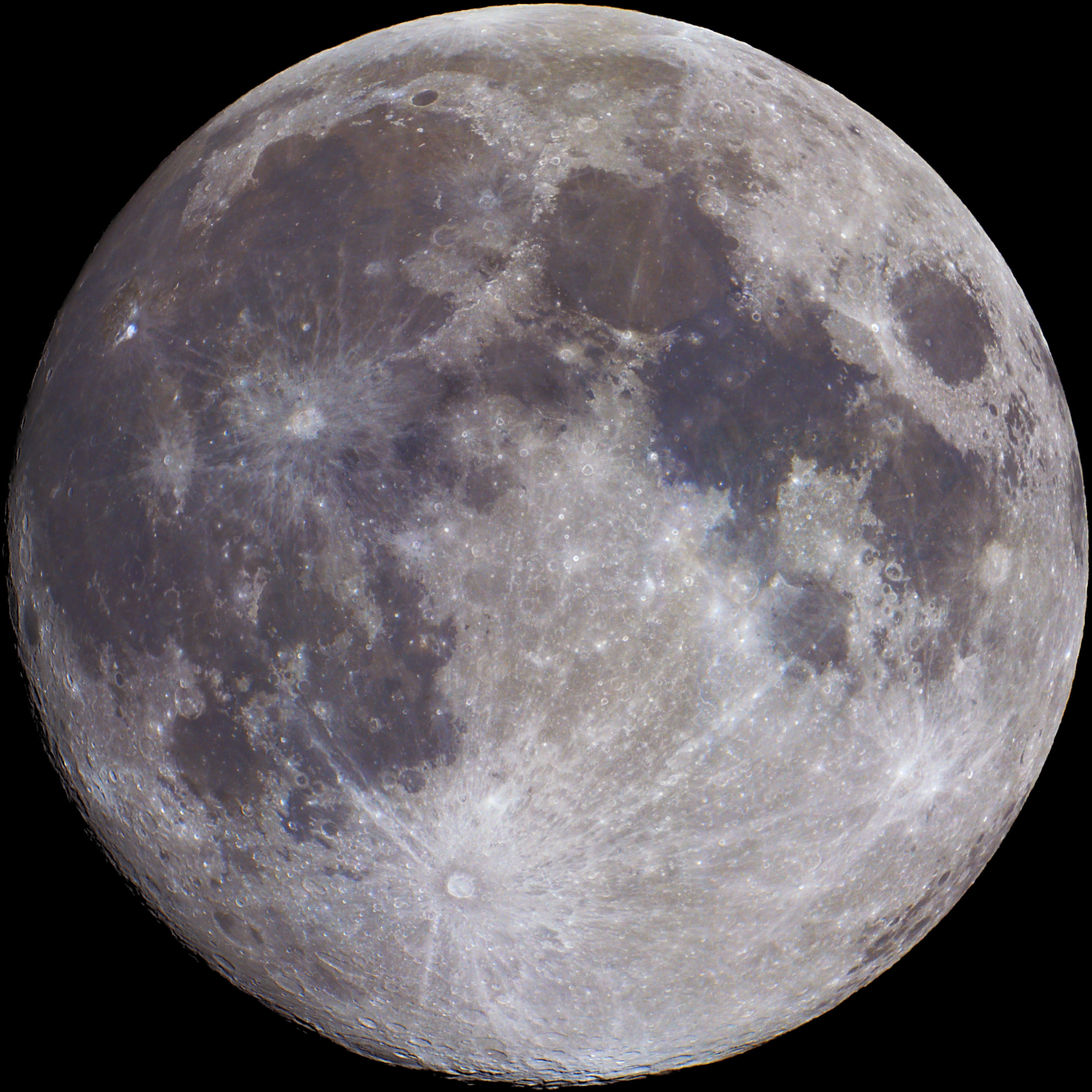
Full Moon in natural color, January 2, 2007
Paul D. Spudis
The Once and Future Moon
Smithsonian Air & Space


As a naturally orbiting object, the Moon orbits Earth in an elliptical path, with the center of the Earth at one focus – more precisely, both Earth and Moon orbit each other around what it called the barycenter, the imaginary point about 1800 km below the surface of the Earth that constitutes their mutual center of gravity.  Since the Moon is only about one percent the mass of Earth, the barycenter is much closer to the center of Earth than it is to the center of the Moon.

When the Moon comes closest to Earth in its elliptical orbit it is said to be at perigee.  If the Sun, Earth and Moon come into alignment along a straight-line, a condition occurs that astronomers perversely have named syzygy (a great word to keep in your hip pocket the next time you play Scrabble, though you’ll need a blank to get there).  Syzygy (alignment) is not the same as perigee (the closest approach of Moon to Earth) but on the occasion when syzygy and perigee coincide, we have what’s called a “Super Moon.”

During perigee, the Moon’s elliptical orbit causes it to be about 45,000 km closer to Earth than at farthest point (apogee).  As the average distance between the two is about ten times that distance, the visual effects of this variation, though not large, is measurable.  I’ve been skeptical about noticing this size difference by “eyeballing” the Moon at perigee (closest) and apogee (farthest).  However, during an early morning walk with the dog this last weekend, I was somewhat startled to see the full Moon low in the sky, definitely appearing larger than usual.

In part, this appearance results because of the “Moon illusion,” whereby the Moon appears much larger on or near the horizon than when it is overhead, near zenith.  The traditional explanation for this illusion is that when the Moon is near the horizon, we can compare the size of the Moon’s apparent disk to known objects on the Earth (such as a house, distant tree or hill).  When the Moon is directly overhead, there is no nearby object with which to compare it.  Many depictions in art show the Moon as an enormous lunar disc, glowing the night sky; it is to this optical illusion that such portrayals refer.

The Moon’s apparent diameter is about one-half of a degree of arc (same as the Sun), or roughly the dimensions of a small pea held at arm’s length.  Although the biggest object in our sky, that size is much too small for the naked eye to resolve most surface features (except for the vague markings of light and dark that comprise the lunar maria, the “Man in the Moon”).  In full phase, the Moon can be quite bright, illuminating the landscape at about -12 visual magnitude.  While no one would mistake such conditions with daylight (the Sun is about -26 visual magnitude, about 400,000 times brighter than the full Moon), full moonlight is bright enough to cast strong shadows and to read by.  This is one of the reasons astronomers “hate” the Moon – during full phase, the sky is typically too bright to reveal any but the very brightest stars and it interrupts their views of coinciding meteor showers.   However, they’ll “love” the views that await them from the far side of the Moon, the only place in our Solar System where radio noise from Earth is silent and at times, when Earth blocks the Sun, the sky-viewing would be unsurpassed.

The most important effect of a “Super Moon” is on tides, which can be extraordinarily high during perigee.  This effect can be especially significant in coastal areas that experience high tides, such as the famous Bay of Fundy in Canada.  In this area, the combination of shore depth and geometry, prevailing winds and position create tidal height variations as high as 16 meters (over 52 feet) in the course of a day.  At Super Moon, tidal variations are at their largest; during the passage of Hurricane Sandy up the East Coast last year, landfall occurred during full Moon (syzygy), resulting in both a storm surge (i.e., a large dome of water caused by low atmospheric pressure and wind) and high gravitational tides.  As witnessed with Hurricane Sandy, the combination of both occurring together can be devastating.

Contrary to an illusion of our Earth-bound perspective, the Moon does not orbit Earth's center, rather both Earth and Moon revolve around their common center of gravity, the barycenter of the Earth-Moon system. That moment of inertia, at any given time, is about one-third the distance from Earth's surface and its center GravitySimulator.com
Tidal effects are most notable in large bodies of water, but the solid Earth also deforms in response to the pull of the Moon’s gravity.  On both objects, a tidal bulge extends slightly above the mean radius of both Earth and Moon.  This bulge is not perfectly aligned with the geometric line that connects the centers of the two objects because both Earth and Moon are rotating, and it takes time for the solid bodies to deform plastically.  Thus, the tidal bulge of the rapidly spinning Earth slightly leads the Earth-Moon line, resulting in a constant increased tug at the Earth by the Moon, slightly slowing the rate of Earth’s rotation down.  At the same time, this leading tidal bulge attracts the Moon more, making it speed up in its orbital path slightly and thus, move outward, away from the Earth.  So over time, as the Earth spin rate slows, the Moon gradually recedes away from its grip; this rate of recession is about 4 cm per year.  The Moon is currently about 60 Earth radii away; it was once much closer, possibly as close as a few Earth radii.  It could not be closer than about 3 radii (the Roche limit) because at distances closer than the Roche limit, tidal forces would tear the Moon apart.  In a few hundred million years, the Moon will be too far away to permit a total solar eclipse to be seen from Earth.  A timely and good thing that we came along when we did!

Using information from a lunar seismic network deployed on the Moon during the Apollo missions, we know that “moonquakes” often correlate with the tidal flexing of the solid Moon induced by the Earth (which is much larger than the terrestrial bulge because Earth is much more massive).  In fact, although there is a slight suggestion that the Moon might induce the initiation of an earthquake, in most cases there is no obvious connection.  The Earth is an active, dynamic body and its great internal heat and complexity of configuration appear to be more important in determining when and where an earthquake occurs than by tidal effects caused by the Moon.  But if the proper tidal conditions and the alignment of stress and magnitude of effect coincided, there is no reason that either syzygy or Super Moon could not induce an earthquake.

Our Moon is much more than the familiar, comforting nightlight orbiting Earth.  Beyond touching us emotionally and affecting our planet physically, the Moon is also an orbiting treasure trove of, as yet unrealized (some imagined but mostly yet unimagined) scientific discoveries and technological breakthroughs.  But before we make it our goal to settle the Moon, we must make it our goal to sail beyond it.

Originally published June 26, 2013 at his Smithsonian Air & Space blog The Once and Future Moon, Dr. Spudis is a senior staff scientist at the Lunar and Planetary Institute. The opinions expressed are those of the author but are better informed than average

Tuesday, July 3, 2012

Lunar tide warps CERN's Large Hadron Collider

Watch out for that moon! Cross section of CERN's Large Hadron Collider, which contorts once a month.

Mark Halper
smartplanet
 

According to the website Talking Points Memo, the gravitational pull of a recent full moon tugged on one side of CERN’s Large Hadron Collider in Geneva more than on the other, “ever so slightly deforming the tunnel through which the proton beams pass.”

But never fear. This seems to have happened before, and CERN’s astute operators were on the case.

    “In order to keep the proton beams on track, the operator at the LHC’s control center had to subtly alter the direction of the proton beams to accomodate the Moon’s pull, ‘every hour or two,’ ” writes TPM’s Carl Franzen.

This all came to light because scientist Pauline Gagnon  from the University of Indiana had noticed an anomaly in her data while conducting an experiment at the LHC.  So she called the control room, and as she recalls in a blog post,

    “Oh, those dips?”, casually answered the operator on shift. “That’s because the moon is nearly full and I periodically have to adjust the proton beam orbits.”

    “The LHC is such a sensitive apparatus, it can detect the minute deformations created by the small differences in the gravitational force across its diameter. The effect is of course largest when the moon is full.”

CERN is using its $9 billion contraption to mimic conditions just after the Big Bang, and to try to find the elusive Higgs Boson many believe serves as the capstone to the Standard Model of Physics.

Read the article, HERE.

Thursday, March 8, 2012

A Tide for the Ages and a Night to Remember

An extreme lunar perigee nearly simultaneous
with the full moon of January 4, 1912, may
have played a significant role in bringing
the iceberg into the path of Titanic.
Because the evening of April 14, 1912 was
moonless the ship's lookouts did not spot
the iceberg until too late to avoid collision
[Russell Doescher].
Jayme Blaschke
University News Service
Texas State University - San Marcos

The sinking of the ocean liner Titanic 100 years ago is perhaps the most famous--and most studied--disaster of the 20th century. Countless books and movies have examined in great detail the actions, choices and mistakes that led to the Titanic colliding with an iceberg the night of April 14, 1912, and sinking within hours, with approximately 1,500 people losing their lives in the icy waters of the North Atlantic.

One question, however, has often been overlooked: Where did the killer iceberg come from, and could the moon have helped set the stage for disaster?

Now, a team of astronomers from Texas State University-San Marcos has applied its unique brand of celestial sleuthing to the disaster to examine how a rare lunar event stacked the deck against the Titanic. Their results shed new light on the hazardous sea ice conditions the ship boldly steamed into that fateful night.

Texas State physics faculty members Donald Olson and Russell Doescher, along with Roger Sinnott, senior contributing editor at Sky & Telescope magazine, publish their findings in the April 2012 edition of Sky & Telescope, on newsstands now.

“Of course, the ultimate cause of the accident was that the ship struck an iceberg. The Titanic failed to slow down, even after having received several wireless messages warning of ice ahead,” Olson said. “They went full speed into a region with icebergs—that’s really what sank the ship, but the lunar connection may explain how an unusually large number of icebergs got into the path of the Titanic.”
Read the original release HERE.

Thursday, December 24, 2009

Tidal forces may trigger earthquake swarms

Combined angles of stress on Earth from resonant events, such as a Full Moon at lunar perigee, etc., have a long and well-documented (and predictable) effect on Earth's ocean tides and upon certain behaviors seen among certain species of life on Earth. While long theorized as having a similar driving stress on Earth's dynamic lithosphere, perhaps even causing some earthquakes, these effects have been dismissed as too transitory and weak, even to "break the camel's back," as it were, by triggering earthquakes already set up to happen. Now a study has emerged bringing the idea's plausibility back to the forefront [DJ Jeffreys, UNLV 2003].

Matt Krupnick
The Seattle Times

Rumbles deep underground are caused by water being controlled by the sun and moon, University of California, Berkeley, seismologists concluded in a new study that could lead to a better understanding of earthquakes.

The study of a portion of the San Andreas fault revealed that underground fluids move like the tides, the scientists wrote in an article published Wednesday in the journal Nature.

Geologists had long wondered what caused the frequent rumbling 15 miles below the surface, said co-author Roland Burgmann, a Berkeley professor of earth and planetary science.

"People had looked for those kinds of relationships for decades," said Burgmann, who wrote the paper with seismologist Robert Nadeau and doctoral student Amanda Thomas. "Now, with these tremors, there's a very strong relationship."

Highly pressurized water essentially lubricates certain faults, including the San Andreas in California, far below the portion of the fault that causes measurable earthquakes, scientists found.

The relationship between the deep tremors and earthquakes remains unclear, Nadeau said.

Though scientists noted that a major 2002 Alaska earthquake set off deep tremors on other parts of the planet, it was not previously known the sun and moon could have a similar effect, said Kenneth Creager, a professor of earth sciences at the University of Washington.

"Seeing that (underground water) is sensitive to even smaller stresses is significant," he said.

Thursday, May 28, 2009

Low tide sparks tsunami fear in Caribbean

This representation of tidal oscillations at Vieques Island
after a classic resonance of Earth, Lunar and Solar tides
resulted in an extraordinary low tide on the southern
banks of Puerto Rico, May 2009
(tide-forecast.com)


Danica Coto, AP

"It's only the moon, emergency officials in Puerto Rico are telling nervous islanders who have feared that recent extreme tides portend a tsunami or biblical catastrophe."

"Waters receded up to 50 feet (15 meters) this week during low tide on Puerto Rico's southern coast, sparking a flurry of calls to seismology and geological agencies from people worried about natural disasters or supernatural events. Tsunamis are sometimes preceded by a dramatic drop in sea level."

"About 75 people have called Puerto Rico's seismological agency this week, including one woman who refused to believe the scientific explanation, said data analyst Harold Irizarry."

"She could not be convinced," he said."

"People in the southern coastal town of Ponce have been seen walking over areas normally covered by water, studying exposed rocks, coral and sea shells."

"The extreme-tide phenomenon has been noted across the Caribbean and in Central America."

"Some beaches along the Pacific coast of El Salvador have seen tides that are 10 feet (3 meters) lower than usual."

Sunday, March 15, 2009

Enhanced Alabama Gravitational Lunar Effect

Rebecca England, a sophomore at Demopolis High School in Alabama
Operation E.A.G.L.E is not a military project. It is a scientific endeavor undertaken by 16-year-old Rebecca England, a sophomore at Demopolis High School in Alabama. While many teenage girls are focused on celebrity lifestyles, teen chat rooms and the latest trends in funky fashions, Rebecca has her eyes, well, on the moon.

Operation E.A.G.L.E. stands for Enhanced Alabama Gravitational Lunar Effect, a science project Rebecca developed for the International Science and Engineering Fair in Atlanta, GA.

Although Rebecca didn't beat out the competition at the science fair (there were 27 projects in the earth and planetary science category alone), her ambitious undertaking attracted the attention of several magazines and created a buzz across the exhibit hall floor.

The purpose of the project, said Rebecca, was to determine how far, if at all, the moon's gravitational pull could be measured on the surface of the earth, particularly in her hometown of Demopolis.

"I got the idea one day when I was on the Internet looking for ideas for a science fair project on ocean tides," she said. "I came across the Operation E.A.G.L.E idea at random when I saw something about how the moon's gravitational pull on the earth's surface in Russia, or someplace, had a fluctuation pull of 18 inches. I thought it would be cool to measure the lunar gravitational pull in Demopolis, Alabama."

Read the feature in American Surveyor HERE.
PDF of this article —complete with images—is available HERE.

Thursday, March 5, 2009

Lunar Cycle Turns Hurricanes Into Beasts

Michael Reilly, Discovery News

Werewolves aren't the only terrors that follow the lunar cycle; hurricanes strengthen more often under a new moon than at any other time, according to a new study.

The moon's spooky influence on Earth and its denizens is legendary, and rightly so. From fertility to suicide, most phenomena attributed to Luna are almost exclusively superstition.

But Peter Yaukey (BIO-PDF) of the University of New Orleans has found what he thinks is real evidence that the phases of moon drive hurricane behavior. Storms that occurred in the Atlantic Ocean between 1950 and 2007 were more likely to form right after the new moon. They also intensified 49 percent more often after a new moon than at any other time in the 29.5-day lunar cycle.

Over the last century, Yaukey said, a smattering of scientific research has hinted that the moon may influence rain patterns, thunderstorms and other meteorological events. Explanations for why this is are many, but nothing conclusive has been shown.

"I had a lot of skepticism attributed to the moon, and I still do in a sense," he said. "It's not enough to have a pattern in the data. You need to have a mechanism to explain it."

There are a range of possibilities. Just as the moon pulls on Earth's oceans and creates the tides, it also tugs on the air above it. Lunar atmospheric tides are thought to be weak, but could create favorable conditions for storms to strengthen.

The moon's gravity may also pull cosmic dust into Earth's atmosphere in a cyclical fashion, perhaps seeding cloud formation and precipitation.

The most promising explanation is internal tides encouraged by the lunar cycle. The currents beneath the ocean surface could circulate warm water up underneath a storm, supplying it with the energy it needs to intensify.

But before scientists seek explanations for the connection they must make sure it's real, said Gabriel Vecchi of the National Oceanic and Atmospheric Association in Princeton, N.J.

"There's an easy way to do an independent test for this," he said. "Go back and look back at Atlantic hurricane data from 1878-1950 to see if there's still this pattern."

Only 13 percent of the world's hurricanes occur in the Atlantic Ocean. So if the moon is really influencing hurricanes, the signal should show up in Pacific and Indian Ocean storms, too.

If the pattern persists through those tests -- and if the data aren't biased by any human tendency to perform scientific measurements on a monthly cycle -- then Yaukey may be onto something.

"Those are two big 'ifs'," Vecchi said. "But if you get past those, then the subsurface ocean is where I'd look first -- internal tides do a lot of mixing."

Saturday, January 31, 2009

Feb. 9 Penumbral Lunar Eclipse prompts Spring Tide alert for Sumatra

They still have not arrived at a definitive count of the dead from the Boxing Day earthquake and tidal wave of December 26, 2004 in Banda Ache, the semi-autonomous province on the northern-most part of Sumatra in the Indonesian archipelago.

Observational evidence does not show any direct link between the tidal forces of the Earth-Moon system on tectonics or earthquake activity, though the barycenter of the Earth-Moon system is not at the center of Earth or in Space between the two bodies but rolls along roughly one third of the way from the outer crust to Earth's core. There's plenty of magma, essentially a liquid with far more density and, therefore, inertia than the saltwater covering the outer 70 percent of our planet.

On the disaster-created islands of greater Indonesia, however, hundreds of millions live with daily reminders of the dynamic nature of the Earth's outer layer.

Tidal lock holds the heavier Near Side of our Moon facing Earth and the Moon pulls back, constantly, most directly seen in the tides.

Tomorrow's Jakarta Post echoes warnings from the West Sumatra Natural Disaster Coordinating Unit to "fishermen and sea travel operators" that "the Lunar Eclipse of February 9 could summon violent waves up to five meters high. Unit head Ade Edward said Saturday that the gravitational effect of the eclipse would be accompanied by strong wind from the Indian Ocean heading towards seashores in Sumatra, creating beach abrasion and flood. “We have issued warnings for violent waves, flood, landslide and abrasion to all regency and cities in West Sumatra, so that they will be prepared for the extreme weather conditions which will peak in February,” Ade said. He also said fishermen were urged to watch over the sky before going to the sea, “if the clouds are dark, they better not go to sea."

The February 9 Lunar Eclipse will be prenumbral, meaning the Moon will only skirt Earth's shadow at the extreme southern edge, just before astronomical Full Moon. Unlike the Annual Solar Eclipse in January or the Total Eclipse of July 22, visible in Indonesia as respectable annular and partial eclipses of the Sun in the same area of the Far East, the February 9 "eclipse" barely rates a mention.

The combination of Moon and Sun overhead should cause a strong Spring Tide, heaping up waters largely during the time immediately after the Moon skirts Earth's shadow.

And, as Ade warns, the same effects should occur the day before and after, without much noticable difference, so his warning is accurate up to that point.

But what about those strong winds, landslides and the dark clouds being signs to stay ashore?

Perhaps there is some effect upon a heaping Indian Ocean on the sea breezes during February's Spring Tides near the equator, but I doubt it.

Landslides? Not unless you think erosion by high tides might be in store, again near the shore.

And "Dark clouds?"

Whether or not there are Dark Clouds in the sky, a Spring Tide in February is going to occur, and if you were a fisherman or a coastal dweller, still a little shell-shocked from the tidal wave and massive earthquake of late 2004, dark clouds are not going to mean that the Spring Tide in February will be any better or worse.

Perhaps this report loses something in the translation from Malay into English, but perhaps authorities would prefer the Sumatrans stay ashore, in and around February 9.

Monday, January 12, 2009

Perigee Full Moon blamed for rough waters off Trinidad and Tobago

Still looking for a more interesting take for those for whom January's Full Moon at Perigee is delightful but hardly news word has arrived from Dr. Maura Imbert, president of the Astronomical Society of Trinidad and Tobago.

From The Trinidad News:
Expert blames full moon for rough waters

As the moon moved to its closest point to the earth over the weekend, higher-than-usual tides were experienced, Dr Maura Imbert, president of the Astronomical Society of Trinidad and Tobago, said yesterday.

In a brief telephone interview, Imbert said:

"As the moon makes its orbit, there is a point when it comes its closest to the earth; this is called perigee."

"On January 11, the moon was at its closest to the earth; but what I think is important to know is that it causes very high tides. Extremely high tides were expected between yesterday, today and probably tomorrow."

Imbert said those out at sea should take precautionary measures, as should beach goers, as the tide is also expected to come very high up the beach during this time.

All of this, she explained, is due to gravity.

"The tides are pulled by the gravity of the moon and the sun; so when the moon is closest to the earth the tides are a lot higher."

This, she said, can also cause coastal flooding if accompanied by high winds and can even trigger earthquakes and volcanoes.

Imbert added that the tides are not expected to be as high again until June and July 22, when the moon will once again come very close to the earth.