Showing posts with label Jackson. Show all posts

Tuesday, October 22, 2013

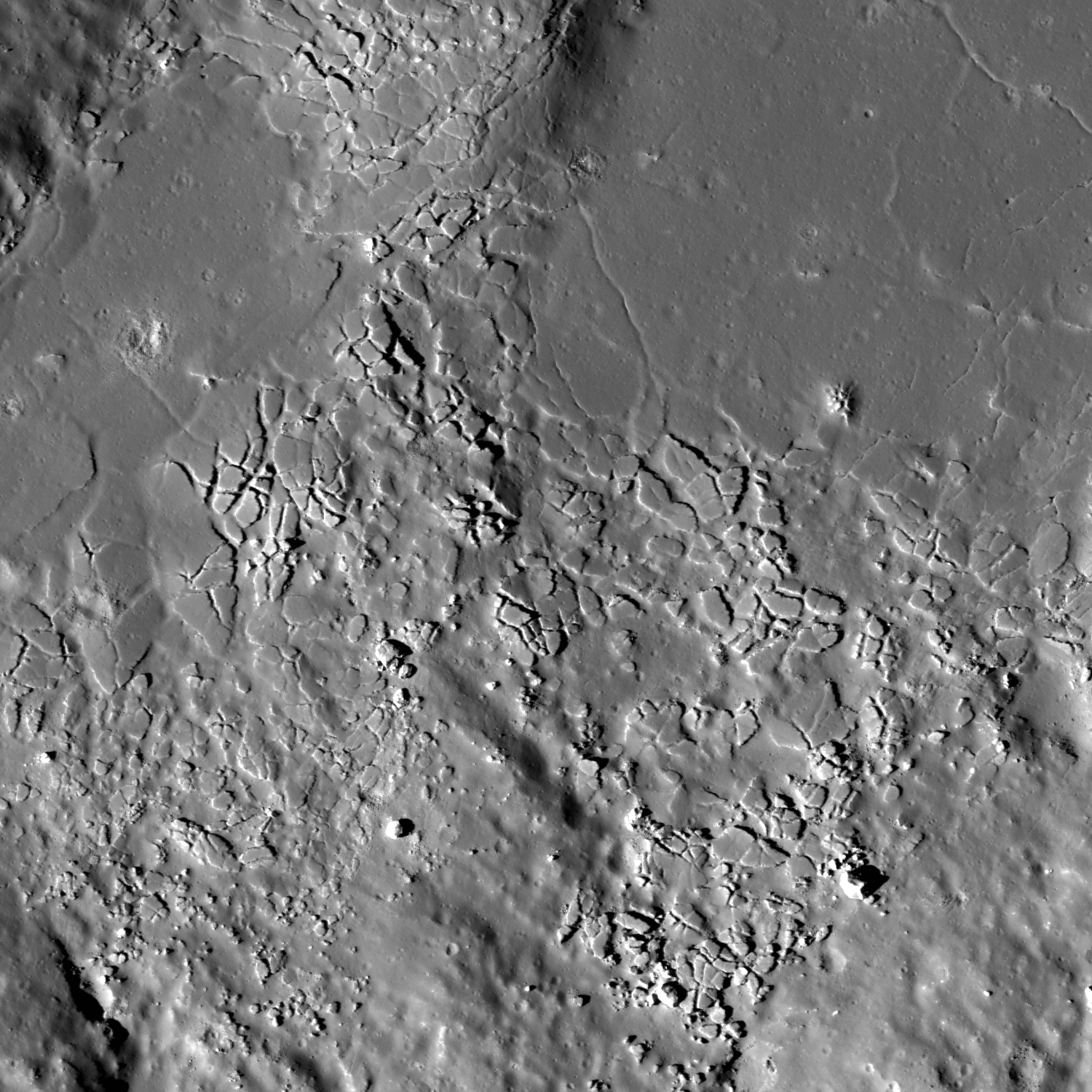
Fractured melt rock on Jackson's terraced wall

M182253065R_1500
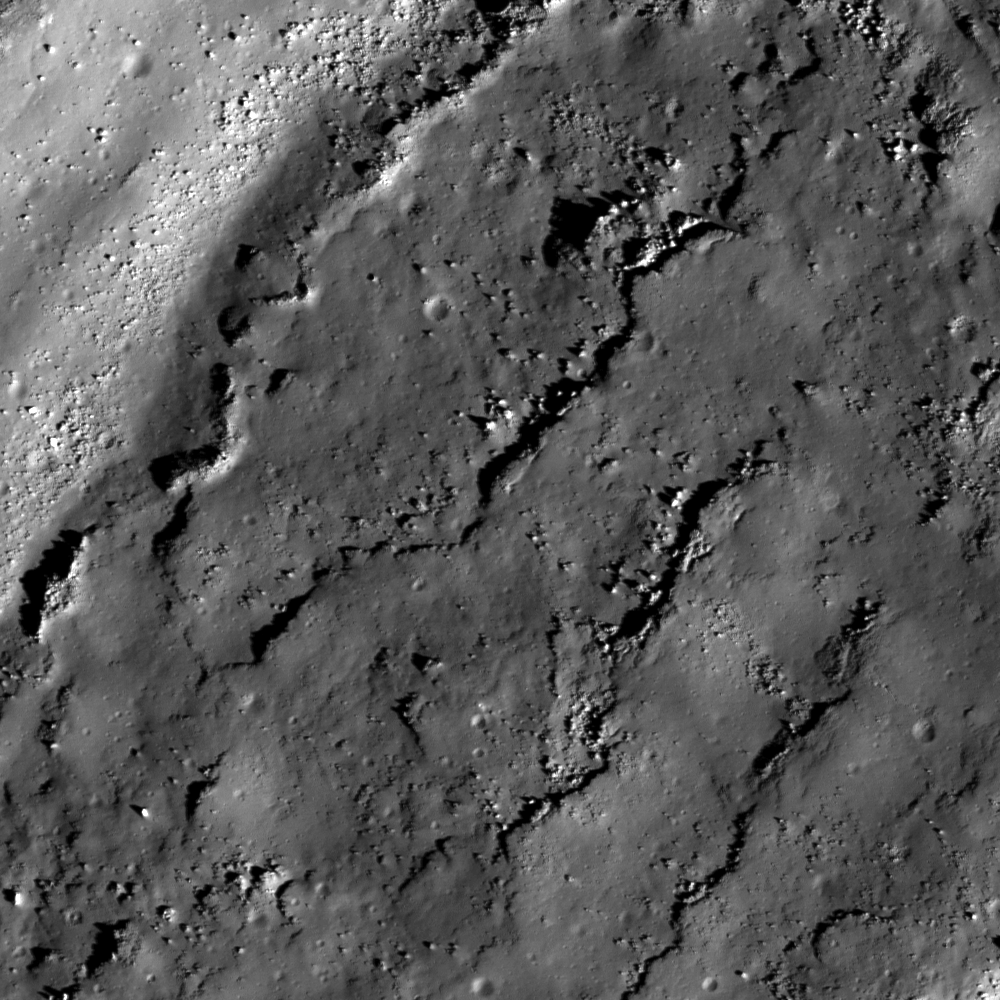
Close-up on fractured impact melt  ponding high on the west wall of Jackson crater. LROC LROC Narrow Angle Camera (NAC) M182253065R, LRO orbit 11965, January 26, 2012. Image 2130 meter-wide field of view centered on 22.534°N, 195.59°E, incidence angle is 57° at 1.47 meters per pixel resolution in the original [NASA/GSFC/Arizona State University].
Hiroyuki Sato
LROC News System

The opening image highlights a fractured pond of impact melt rock inside Jackson crater (72 km diameter). This prominent farside crater is known by its prominent ray system and large amount of impact deposits. Melt pooled not only at the bottom of the crater floor, but also on terraces of the interior wall.

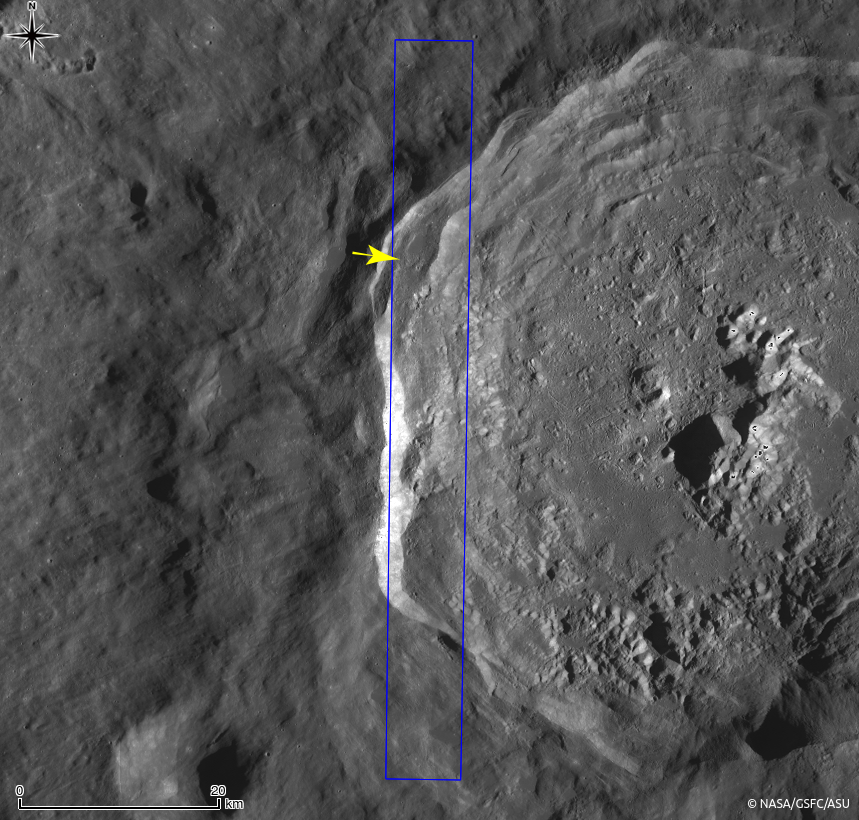
The fractured melt sheet in the opening image is found amongst a grouping of melt lakes on a western crater wall terrace (see WAC context image below).
M182253065R_context
Western part of Jackson crater and surrounding areas in LROC WAC monochrome mosaic (100 m/pix). The NAC footprint (blue box) and the location of opening image (yellow arrow) are indicated [NASA/GSFC/Arizona State University].
Detached fragments from the main body of melt sheet look like a jigsaw puzzle (upper smooth surfaced portion of the image). These fragments give an impression of the thin and brittle nature of solidified impact melt. Shadow lengths show these fractured pieces to be 5 to 8 meters thick. What caused the once level and smooth ponded surface to fracture? We don't know for sure, but by looking at the whole area a plausible story can be imagined. The south part of the melt lake with the fractured plates is connected to another melt lake at a lower elevation. Perhaps drainage of subsurface unsolidified melt might have dragged a crust toward the south and broken the it into many blocky pieces. Tectonic deformation of the crater wall, perhaps consisting of whole terraces deforming, also might have occurred which could deform the brittle crust of melt ponds.

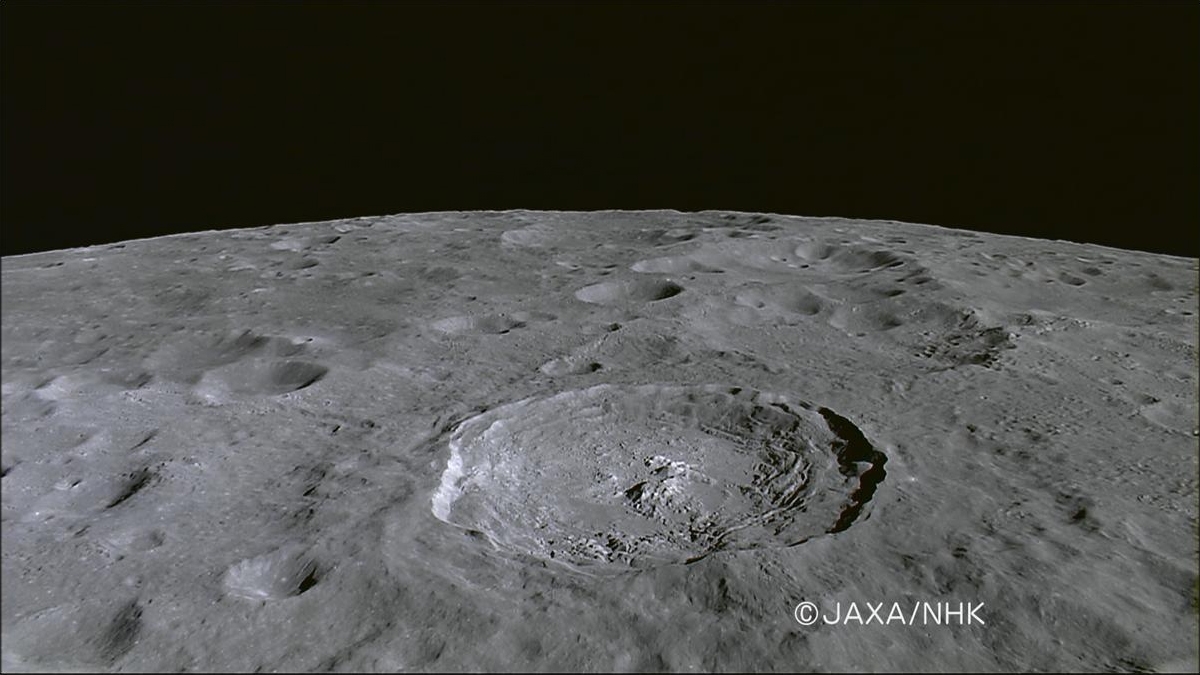
Jackson crater from Kaguya
Farside Copernican age landmark crater Jackson viewed through NHK's HDTV camera aboard Japan's lunar orbiter SELENE-1 (Kaguya) in late 2007. View the 1200 pixel-wide press release image HERE [JAXA/NHK/SELENE].
Explore this mosaic of fractured melt rock and surroundings to help unravel the complex history of Jackson crater in the full NAC frame HERE.

Related Posts:
Cracked mound (February 16, 2012)
Melt Fractures in Jackson Crater (January 20, 2012)
Tycho's flash-frozen inferno (November 2, 2011)
Waves (August 10, 2011)
Polygonal fractures on Tycho ejecta deposits (June 14, 2011)
Fragmented Impact Melt (February 25, 2011)
LOLA's Jackson crater (July 11, 2010)

Moore F Impact Melt (October 30, 2009)

Thursday, January 10, 2013

Parting shots from "Ebb" MoonKAM prior to impact

Three days prior to its planned impact on a lunar mountain, mission controllers activated the camera aboard one of NASA's GRAIL twins to take some final photos from lunar orbit.  The video, released by JPL January 10, is from the GRAIL MoonKAM (Moon Knowledge Acquired by Middle School Students) cameras aboard "Ebb," December 14, 2012. The spacecraft was winding down in its polar orbit, still approximately 10 km above the northern hemisphere of the lunar farside, in the vicinity of Jackson crater.  "This imagery was acquired as part of a final checkout of the spacecraft systems prior to the "Sally Ride" impact site, December 17." [NASA/JPL/Sally Ride Science].

Embedded video from JPL

Friday, January 20, 2012

LROC Melt fractures in Jackson crater

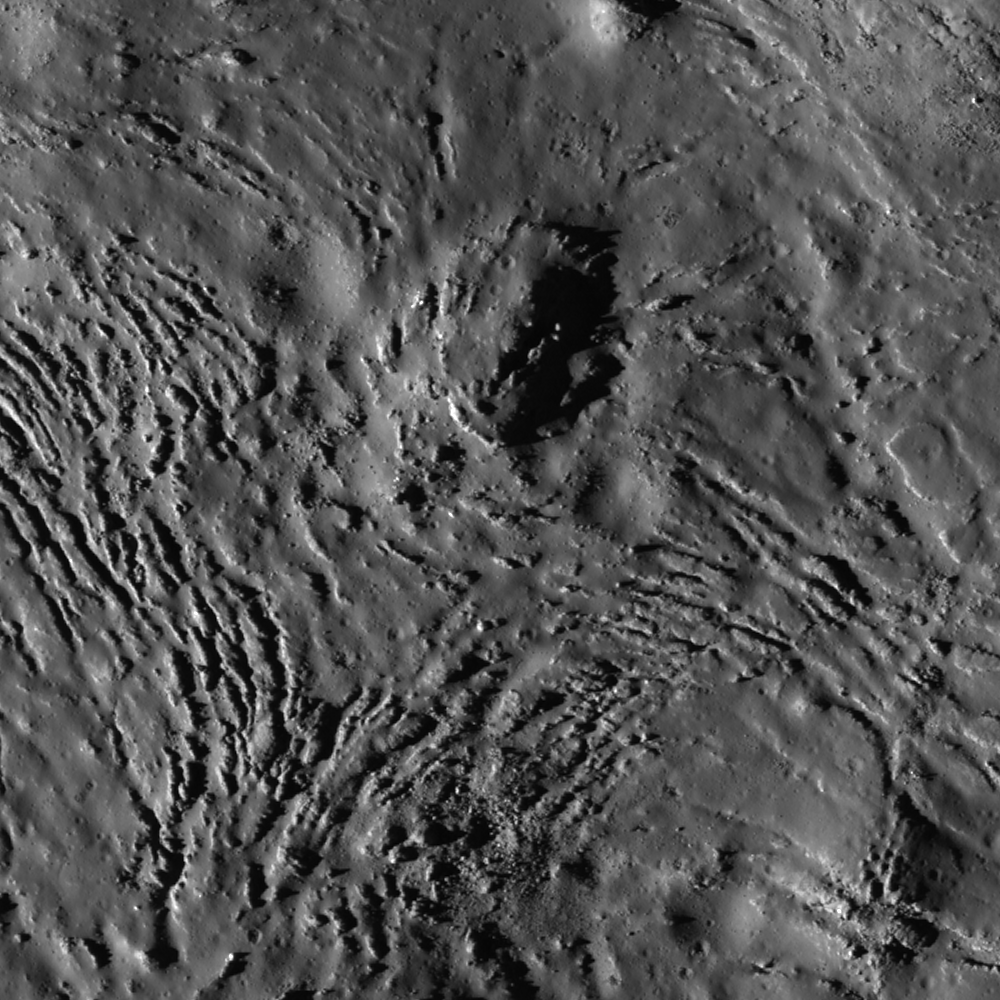
Fractures can be seen in profuse abundance on the Jackson crater melt pond surface. Illumination from west, a field of view roughly 700 meters across swept up at an incidence angle of 71.13° LROC Narrow Angle Camera (NAC) observation M118560367L, LRO orbit 2606, January 19, 2010; resolution 0.84 meters from 52.97 kilometers altitude. View the full-size Featured Image HERE [NASA/GSFC /Arizona State University].
James Ashley
LROC News System

As molten rock cools, it shrinks and often cracks. In this case of impact melt ponded within the Jackson crater floor (22.18°N, 197.24°E), the cracking rate was so high that unfractured melt is almost more of an exception than a rule!

Radial and divergent patterns can be seen among the fracture sets that tell a story of the cooling history. The context image below shows a portion of their wider distribution.

As context for the January 18, 2012 LROC Featured Image (field of view near where the impact melt inundating the crater floor emerges from eastern wall slump; the white box) a long view north and up the steep northeastern wall, nearly to the rim, courtesy of the digital elevation model combined in Google Earth [NASA/USGS/ASU/JAXA/Google].
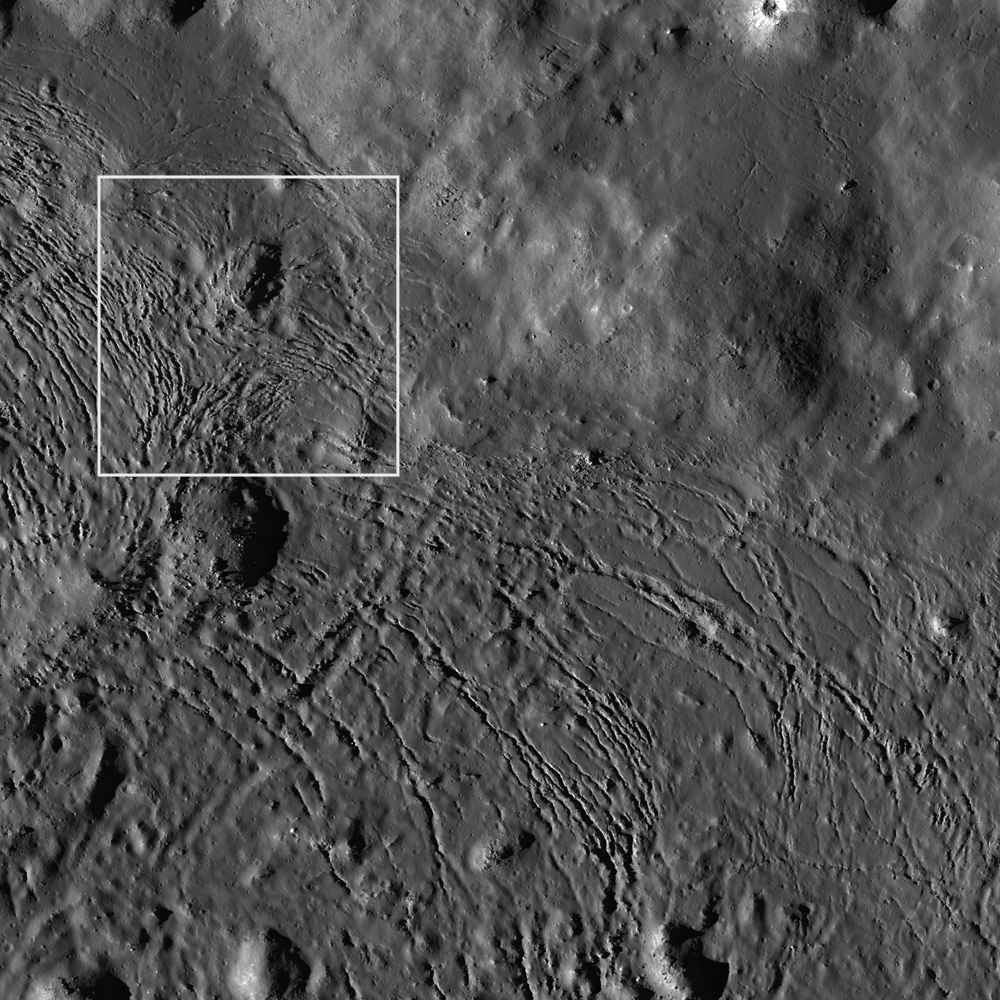
Overhead context for Featured Image, a field of view roughly 2.5 kilometers across from the wider LROC frame.View the full-size LROC context image HERE [NASA/GSFC/Arizona State University].
Solid objects in the melt, together with the 'shore' of the pond, appear to have influenced the way the cracks organized themselves as the melt cooled. Note how the fractures bend around or radiate from some of the positive relief features in the images above. These could be ejecta blocks or portions of the slumped crater walls in the melt that served to locally accelerate cooling. Their influence might thus be to 'seed' the stress field within the shrinking melt volume, helping some of the cracking to grow from these points, and ultimately resulting in the patterns we see today. Sagging along the shore can cause the cracking to parallel the shoreline. Any motion within the volume of melt, possibly influenced by late-stage additions of molten material, may also have contributed to the patterns observed here.

Further context, from 100 kilometers altitude, this square crop from a highly detailed HDTV still frame was captured by Japan's lunar orbiter SELENE-1 (Kaguya) in 2009 [JAXA/NHK/SELENE].
The extent and complexity of the melt pond features can be explored in the full NAC frame HERE. Additional examples of impact melt cracking include Polygonal fractures on Tycho ejecta deposits, fractured impact melt in Thales crater, and Moore F.

Ed Note: In a way opposite and contributing to the low optical visibility of the vast majority of similarly sized craters in the farside Highlands, Jackson is easier for the eye to see than most. Like Tycho on the nearside, there are a lot of craters of similar size and origin everywhere on the Moon. The difference is age. Like Tycho, the ray system of Jackson (and the materials its progenitor impact threw out) shows Jackson's "optical immaturity." To illustrate, below are two representations of the farside quadrant with the highest of the Highlands scoured by the Jackson impact, likely less than a half billion years ago.

Jackson stands out in this global montage of Clementine (1994) Ultra-Violet/Visible (UVVIS) wavelength photography designed to better map the Moon's albedo, more than a decade ago. Similar craters, basins and the Moon's highest elevations are nearly invisible [NASA/USGS/DOD].

A white arrow is needed to designate Jackson out from the pocked highlands and several otherwise invisible basins stand out with exceptional clarity in this view of nearly the same terrain as a representation of differences in elevation from the LROC Global Digital Terrain Model, developed using LROC Wide Angle Camera survey photography [NASA/GSFC/Arizona State University].

Saturday, August 13, 2011

Channelized impact melt


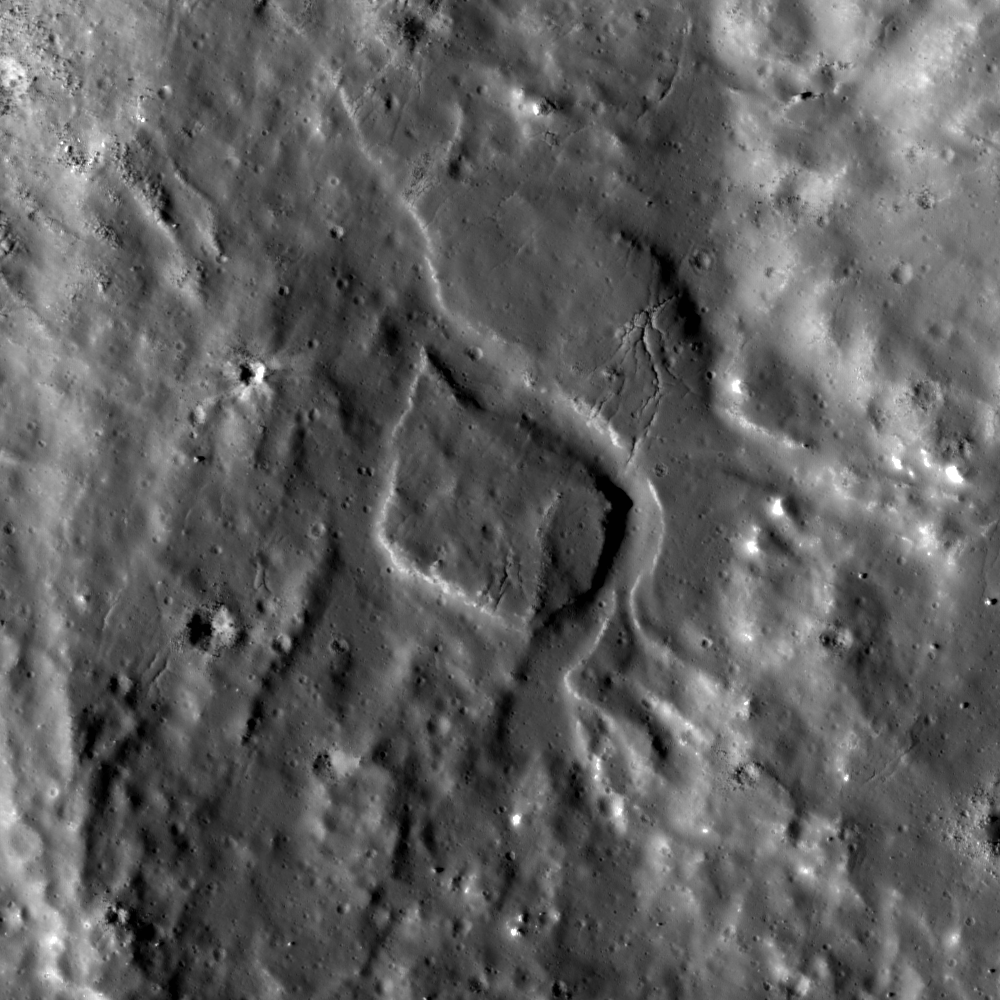
Channelized impact melt flow cut through pre-existing rock. LROC Narrow Angle Camera (NAC) observation M103216633L, LRO orbit 380, July 26, 2009, incidence angle 68°, scale 1.4 m/pixels, sunlight from the west-southwest. See the full Featured Image field of view HERE [NASA/GSFC/Arizona State University].

Sarah Braden
LROC News System

Although impact melt on the Moon was first observed in Apollo era images, the high-resolution LROC NAC images allow geologists to look at impact melt deposits in much more detail. Now we know that impact melt creates many young, spectacular features on the lunar surface: diverging flows, melt ponds, polygonal fractures, leveed flows, and fragmented blocks.


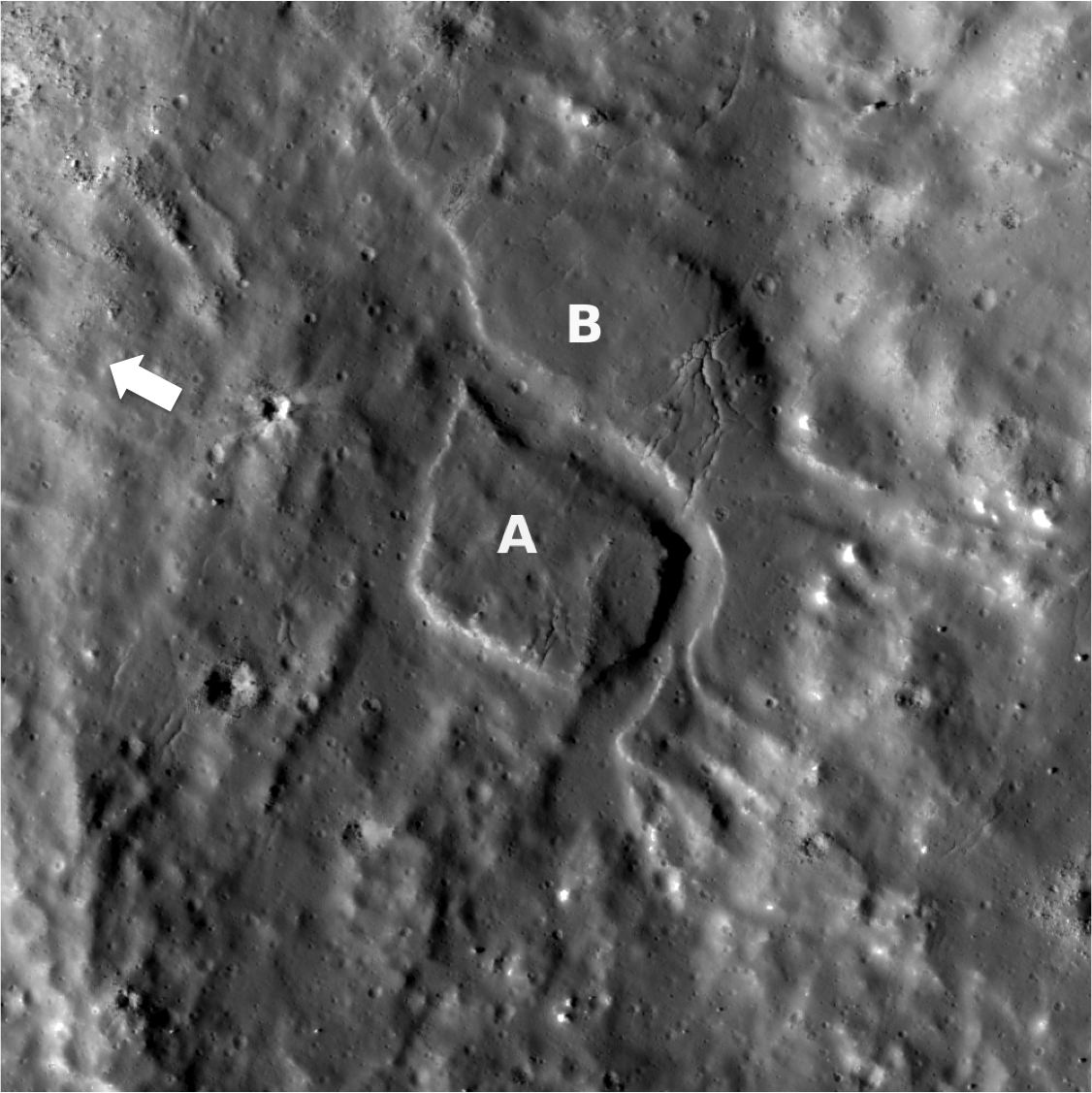
Annotated version of the Featured Image. The impact melt flow created a channel that separated rock section A from section B. The white arrow points in the downslope direction. View the full-size annotated Featured Image HERE [NASA/GSFC/Arizona State University].


Three-Dimensional oblique view, at an oblique southeasterly angle across both the left and right M103216633 frames shows the steep gradient and wider effect of the channeled impact melt flow down the eastern inner rim of Jackson. The featured channeled formation is left of center, at roughly 4500 meters elevation. The rim beyond is nearly 2 km higher up. As context, view the wider field of view in the full-sized image HERE [Google Moon - NASA/GSFC/Arizona State University].

Flowing impact melt may act erosively, removing rock from one location and depositing it in another. This Featured Image shows a section of rock on a terrace in the eastern wall of Jackson crater. The section "A" appears to be severed from the rest of the rock by a small channel. It is probable that fast-moving impact melt created this small channel (on average ~60 meters wide). As the impact melt flowed over the terraces, toward the center of the crater, it gathered enough momentum to flow turbulently and cut through the pre-existing rock. The pointed ends of the isolated section also hint at being eroded by a flow. The pre-existing rock appears to be impact melt as well (deposited by a previous flow), or is covered with a thin layer of impact melt. Usually we only see channels carved through rock in the case of sinuous rilles, which are caused by turbulent flow of basalt.


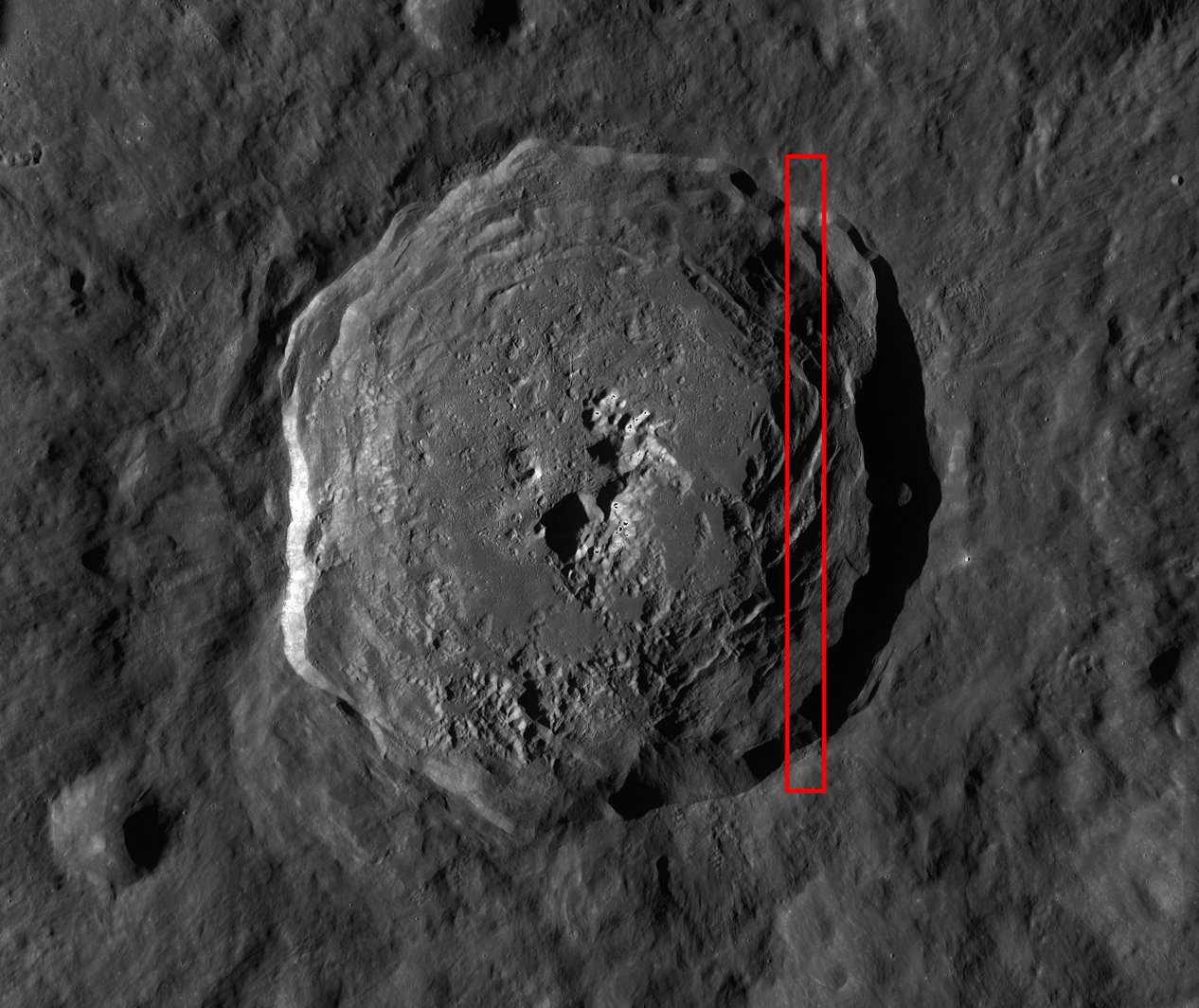
Jackson (22.4°N, 196.9°E), 71 km wide. View the full-size context image HERE The red box shows the location of the featured NAC frame [NASA/GSFC/Arizona State University].

Browse the entire NAC frame for more interesting views of Jackson crater!

Related Images:
Waves
Tendrils in Reiner Crater
Splash and Flow

Thursday, August 11, 2011

Impact melt tongue


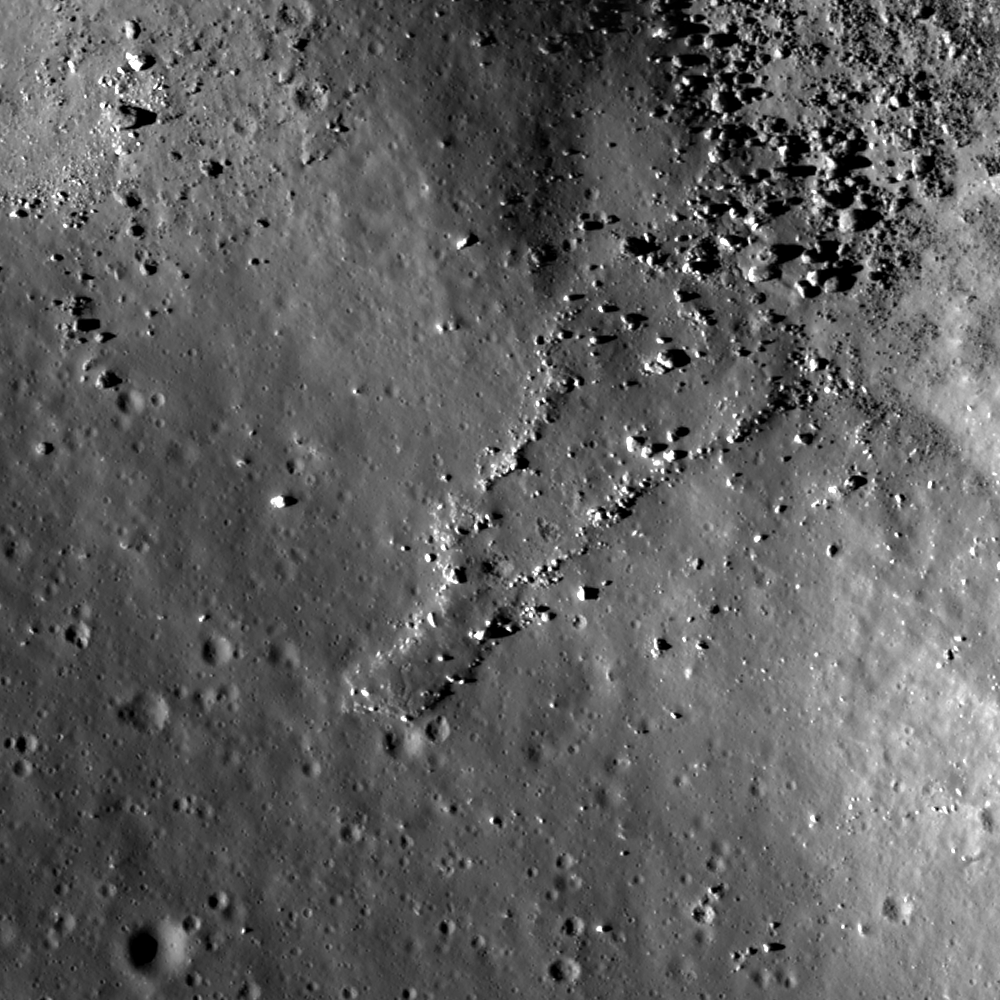
A bouldery tongue of impact melt spills over from a pool inside the ruined rim of a small crater inside Jackson, carrying along with it a debris field of house and car size boulders. LROC Narrow Angle Camera (NAC) observation M133892450L, LRO orbit 4685, July 16, 2010; incidence angle 75°, scale 83 centimeters per pixel. View the larger LROC Featured Image HERE [NASA/GSFC/Arizona State University].

Sarah Braden
LROC News System

Another beautiful impact melt feature found in Jackson crater! This thin flow of impact melt spreads across the surface of a terrace. The boulders around the edges of the flow may have eroded out of the flow, or were carried there by the impact melt. In the upper right hand corner of the image, there are many large boulders, as well as smooth areas which are impact melt. The impact melt flow seems to originate from that area. Since the large boulders are on top of the impact melt, the impact melt probably landed in the spot first, and the large boulders are a later addition, falling down from a point higher up on Jackson's wall.


Jackson crater, located at 22.4°N, 163.1°W. 71 km in diameter. The red box shows the location of the featured NAC frame; view the full-size LROC WAC context image HERE [NASA/GSFC/Arizona State University].

Look in the full NAC frame for more exciting impact melt flows!

Related Posts:
Out of the Shadows:
Impact Melt at Byrgius A Crater
Look at that flow!
Waves
Channelized Impact Melt

Wednesday, August 10, 2011

LROC: Jackson Waves


Waves of impact melt in Jackson crater, prominent in the farside lunar highlands. The Sun has risen high over the southeastern rim, beyond the lower right hand corner. LROC Narrow Angle Camera (NAC) observation M112658386R, LRO orbit 1736, November 16, 2009; illumination incidence at 46° resolution 54 centimeters per pixel. View the full-size LROC Featured Image HERE [NASA/GSFC/Arizona State University].

Sarah Braden
LROC News System

Within a terrace in Jackson crater impact melt formed a surface reminiscent of waves against the shore of a beach. The waves in today's Featured Image are cooled impact melt flow fronts, frozen in time on the lunar surface. The boulders are parts of the impact melt that have weathered out of the solidified rock over time. Jackson crater is a 71 km diameter impact crater located on the far side of the Moon (22.4°N, 163.1°W). A few milliseconds after the initial impact that formed Jackson crater, the crater walls slumped toward the center of the newly formed crater, creating a number of terraces. Next, impact melt (excavated, heated, and thrown above the crater) landed haphazardly over the lunar surface around and inside Jackson crater. If the melt lands on a slope it flows downhill as it cools. When melt lands on a relatively flat surface, like a terrace, it may slosh and flow for a while, but eventually it will create an impact melt pond. Impact melt ponds are found on crater floors, terraces, and in the surrounding area around a crater.


Jackson (22.4°N, 196.9°E) is 71 kilometers in diameter. The red box frames the full LROC NAC observation detailed above as the LROC Featured Image, August 8, 2011. View the full-size LROC WAC context image HERE [NASA/GSFC/Arizona State University].


Three LROC NAC observations swept up during various opportunities during the two-years LRO has spent in lunar orbit, are shown draped over a Wide Angle Camera 604 nm band mosaic stitched from overflights in LRO orbits 7819 through 7824, on March 5, 2011; Jackson crater as seen under a full Sun. See a larger version HERE [NASA/GSFC/Arizona State University].

Look in the full NAC frame for more exciting impact melt flow fronts!

Related Posts:
Melt and more melt
Splash and flow
Look at that flow!
LOLA's Jackson crater


Jackson viewed through NHK's high-definition television from the 100 km high vantage of Japan's lunar orbiter Kaguya in late 2007. See the full-size image release HERE [JAXA/NHK/SELENE].