Showing posts with label MoonKam. Show all posts

Thursday, September 4, 2014

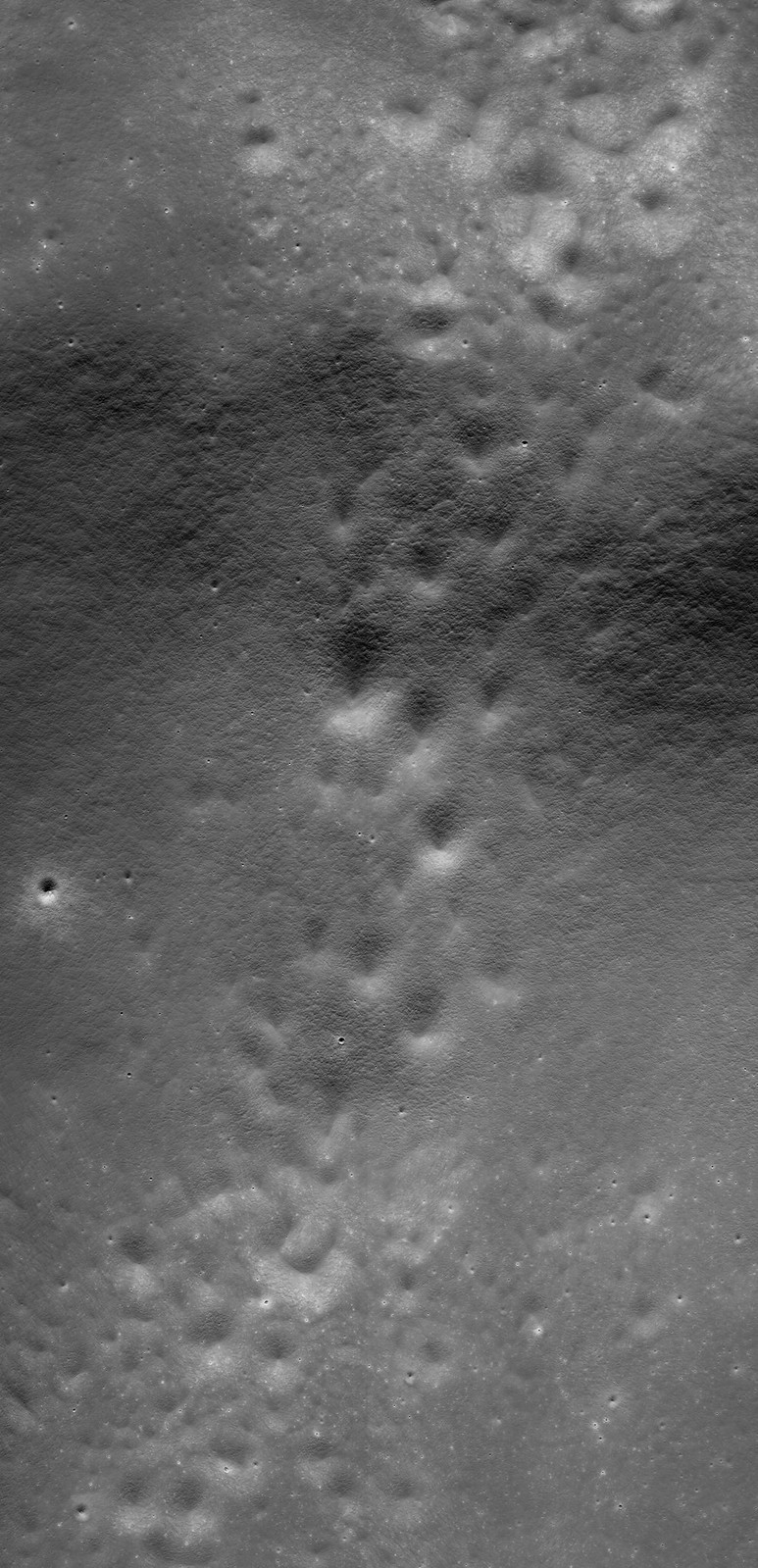
Secondary scatter over Haret C and the SPA interior

A stream of secondary craters crosses the rim of Haret C (28.47 km; 57.6°S, 186.3°E), stretching from the northeast exterior, southeast into the interior of the crater, deep within the South Pole-Aitken impact basin. 6.52 km-wide field of view from LROC NAC mosaic M1163623161LR, LRO orbit 23388, August 25, 2014; 56.75° incidence, resolution 68 cm from 63.63 km over 57.6°S, 185.26°E [NASA/GSFC/Arizona State University].
H. Meyer
LROC News System

Closely clustered or overlapping craters of similar size and morphology are likely secondary craters.

Secondary craters form when an impactor hits the surface (forming the primary crater) and throws out blocks of material that proceed to form their own craters (secondaries) as they hit the surface.

Sometimes, secondary craters can be difficult to identify if they do not occur in groups. Because craters are used to estimate the age of a surface (a process called crater counting), it is important that scientists are able to identify secondary craters.

Thankfully, in the case of Haret C, the secondary craters stand out from primary craters due to their proximity to each other. Random impacts typically do not form clusters like those draped over Haret C (28.47 km; 57.6°S, 186.3°E) .

A quick look at Haret C made possible by the international burst of lunar exploration briefly inspired by interest in the run-up to the Constellation program. The crater chain is easy enough to see in the medium resolution global albedo mosaic swept up from Chang'e-2. And the basics of the ranges and elevations of the region are displayed using the LROC Quickmap service.
Within high resolution images, smaller craters are used for crater counting. However, secondary craters become more common at smaller diameters introducing a problem for crater counters if the secondaries cannot be distinguished from primary craters. Secondaries counted as primaries result in higher crater counts per unit area, which in turn result in age estimates that are older than the true age of the surface.

Haret C does not dominate, but it is easy to pick out near the center of this HDTV still (larger view HERE) from Japan's lunar orbiter Kaguya (SELENE-1) in 2008. There are two other stills where Haret C and its crater chain are visible in context with central South Pole-Aitken basin and it's larger neighbors Bose (92.5 km; 53.95°S, 190.63°E) and Bhabha (70.52 km; 55.49°S, 194.69°E), HERE and HERE [JAXA/NHK/SELENE].
A key science goal is coming to a better understanding of the morphology or abundance of secondaries relative to primary craters so that more accurate age estimates can be made for smaller, younger terrains: especially important for panning at the scale of the NAC images for future missions to the Moon.

Seven minutes of video from GRAIL-A (Ebb) during orbit 1902 in 2012. Using the student-directed Forward MoonKAM video camera we can close in on the secondary crater chain at Haret C looking north from a perspective beginning at 30 km rising to 41 km over the surface at the end of the sequence. Starting in the polar latitudes of the southern farside the compressed view quickly passes up over the enigmatic interior of South Pole-Aitken basin, over Antoniadi (137.91 km; 69.3°S, 186.94°E, home of the Moon's lowest elevation) north 22° following the meridian that crater shares with Haret C [NASA/JPL/UCSD/SRSC].
Explore the full-width NAC mosaic HERE. Do you see any primary craters in the mix?

Related Posts:

Thursday, January 10, 2013

Parting shots from "Ebb" MoonKAM prior to impact

Three days prior to its planned impact on a lunar mountain, mission controllers activated the camera aboard one of NASA's GRAIL twins to take some final photos from lunar orbit.  The video, released by JPL January 10, is from the GRAIL MoonKAM (Moon Knowledge Acquired by Middle School Students) cameras aboard "Ebb," December 14, 2012. The spacecraft was winding down in its polar orbit, still approximately 10 km above the northern hemisphere of the lunar farside, in the vicinity of Jackson crater.  "This imagery was acquired as part of a final checkout of the spacecraft systems prior to the "Sally Ride" impact site, December 17." [NASA/JPL/Sally Ride Science].

Embedded video from JPL

Thursday, December 13, 2012

MoonKAM video of LRO in orbit, GRAIL twins to be deorbited Monday


Embedded video from NASA Jet Propulsion Laboratory California Institute of Technology, "first footage of one orbiting robotic spacecraft taken by another orbiting robotic spacecraft at Earth's moon."
 
NASA's Lunar Reconnaissance Orbiter (LRO) is captured by one of the MoonKAM cameras from GRAIL twin space craft "Flow," last May 3, from a distance of a mere 20 kilometers, turning the tables on the spacecraft that photographed so many artifacts of human exploration on the lunar surface since 2009.
GRAIL twins set for controlled impact near the Moon's north pole, around 2228 UT, Monday, December 17

LRO has orbited the Moon more than 15,800 times during more than three years in polar orbit, its flight directors having long ago smashed all previous records for maintaining any vehicle in lunar orbit, while each day continuing to set a new record for total data returned by all existing and previous deep space missions combined.

The somewhat less robust GRAIL twins, including "Flow," (nee GRAIL B), are to be deorbited around 2229 UT, Monday, December 17, somewhere near the Moon's north pole, following a successful mission lasting slightly under a year. But because of the remarkably detailed models of the Moon's anisotropic gravity fields, build up from the GRAIL survey, future lunar missions (including communications satellites relaying data from the Moon's farside), function more efficiently and stay in orbit longer.

An ironic high-water mark for the U.S. commitment to "precursor" missions ahead of establishing an "extended human presence" on the Moon begun in 2004, as of next Monday the number of American unmanned vehicles in lunar orbit will fall from five to three.

Thursday, May 31, 2012

Students to exhibit GRAIL MoonKAM images

Forward view from a MoonKAM camera on-board GRAIL Ebb looks down into 29.6 kilometer Titov and south-southwestward over surrounding floor of Mare Moscoviense, in the northern lunar farside. MoonKam image 8108, Robert McCall School, May 19, 2012 [NASA/Caltech-JPL/MIT/SRS].
Reporters have been invited to an exhibit of student-directed MoonKam images of the lunar surface captured by NASA's GRAIL twin spacecraft, Ebb and Flow, Friday, June 1, from 10 am until Noon, EDT, at the Ronald Reagan Building and International Trade Center, 1300 Pennsylvania Avenue NW, Washington, DC.

The event will showcase the MoonKAM (Moon Knowledge Acquired by Middle school students) education and public outreach project flying in lunar orbit on the GRAIL spacecraft. 

MoonKAM provides students around the world with an opportunity to identify and choose images of the moon's surface using small cameras aboard NASA's Gravity Recovery and Interior Laboratory (GRAIL) mission. Thousands of images of lunar targets have been selected by fifth to eighth-grade students since.the GRAIL twins arrived in lunar orbit with the New Year.

MoonKAM is operated by Sally Ride Science in collaboration with undergraduate students at the University of California in San Diego. 

Sally Ride, CEO of the science education company (and America's first woman in space) will host the event and provide opening remarks. Event presenters include NASA deputy administrator Lori Garver and GRAIL principal investigator Maria Zuber of the Massachusetts Institute of Technology, Cambridge, Massachusetts.

Meanwhile, it was announced earlier this week that the primary science mission of the GRAIL mission was completed ahead of schedule. An extended mission will continue at least through December.

Wednesday, May 30, 2012

Ebb & Flow complete primary mission

Ebb and Flow have completed their prime mission earlier than expected. The mission team of NASA's Gravity Recovery and Interior Laboratory (GRAIL) mission, with twin probes named Ebb and Flow, is now preparing for extended science operations starting Aug. 30 and continuing through Dec. 3, 2012.

The GRAIL mission has gathered unprecedented detail about the internal structure and evolution of the moon. This information will increase our knowledge of how Earth and its rocky neighbors in the inner solar system developed into the diverse worlds we see today.

Since March 8, the spacecraft have operated around the clock for 89 days. From an orbit that passes over the lunar poles, they have collected data covering the entire surface three times. An instrument called the Lunar Gravity Ranging System onboard each spacecraft transmits radio signals that allow scientists to translate the data into a high-resolution map of the moon's gravitational field. The spacecraft returned their last data set of the prime mission May 29. The instruments were turned off at 1 p.m. EDT when the spacecraft were 37 miles (60 kilometers) above the Mare Nectaris.

"Many of the measurement objectives were achieved from analysis of only half the primary mission data, which speaks volumes about the skill and dedication of our science and engineering teams," said Maria Zuber, principal investigator of GRAIL at the Massachusetts Institute of Technology in Cambridge. "While there is a great deal of work yet to be done to achieve the mission's science, it's energizing to realize that what we traveled from Earth to the moon for is right here in our hands."

"GRAIL delivered to Earth over 99.99 percent of the data that could have been collected, which underscores the flawless performance of the spacecraft, instrument and the Deep Space Network," said Zuber.

Both spacecraft instruments will be powered off until Aug. 30. The spacecraft will have to endure a lunar eclipse on June 4. The eclipse and the associated sudden changes in temperature and the energy-sapping darkness that accompanies the phenomena were expected and do not concern engineers about the spacecraft's health.

"Before launch, we planned for all of GRAIL's primary mission science to occur between lunar eclipses," said David Lehman, project manager of GRAIL from NASA's Jet Propulsion Laboratory (JPL) in Pasadena, Calif. "But now that we have flown Ebb and Flow for a while, we understand them and are confident they can survive these eclipses in good shape."

The extended mission goal is to take an even closer look at the moon's gravity field. To achieve this, GRAIL mission planners will halve their current operating altitude flying at the lowest altitude that can be safely maintained.

"Orbiting at an average altitude of 14 miles (23 kilometers) during the extended mission, the GRAIL twins will be clearing some of the moon's higher surface features by about 5 miles (8 kilometers)," said Joe Beerer, GRAIL's mission manager. "If Ebb and Flow had feet, I think by reflex they'd want to pull them up every time they fly over a mountain."

Along with mission science, GRAIL's MoonKAM (Moon Knowledge Acquired by Middle school students) education and public outreach program is also extended. To date over 70,000 student images of the moon have been obtained. The MoonKAM program is led by Sally Ride, America's first woman in space, and her team at Sally Ride Science in collaboration with undergraduate students at the University of California in San Diego.

The GRAIL mission is managed by JPL for NASA's Science Mission Directorate in Washington. The mission is part of the Discovery Program managed at NASA's Marshall Space Flight Center in Huntsville, Ala. NASA's Deep Space Network is an international network of antennas that supports interplanetary spacecraft missions and radio and radar astronomy observations for the exploration of the solar system and the universe. The network also supports selected Earth-orbiting missions. Lockheed Martin Space Systems in Denver built the spacecraft.

Friday, March 23, 2012

The first student-requested pictures from GRAIL

Orbiting 50 kilometers over the farside, the MoonKAM camera on-board the GRAIL twin spacecraft "Ebb" captured the subtle colors of the lunar highlands at the behest of Emily Dickinson Middle School, Bozeman, Montana on March 15, 2012. The 31 kilometer-wide crater in the northeast quadrant is Gadomski A (38.3°N, 213.5°E). For comparison, both LROC WAC and NAC images of the same area are presented further below. Ebb MoonKam IMAGE 84, HERE [NASA/JPL/MIT/MoonKAM].
NASA JPL: One of the two NASA GRAIL spacecraft orbiting the Moon has beamed back the first student-requested pictures of the lunar surface from its onboard camera. Fourth grade students from the Emily Dickinson Elementary School in Bozeman, Montana, received the honor of making the first image selections after winning the nationwide competition to rename the two spacecraft, "Ebb" and "Flow."

The images was taken by the MoonKAM, for "Moon Knowledge Acquired by Middle school students."

Previously named "A" and "B," the twin Gravity Recovery And Interior Laboratory (GRAIL) spacecraft are washing-machine-sized each equipped with small MoonKAM cameras. Over 60 student–requested images were taken by the Ebb spacecraft from March 15-17 and downlinked to Earth March 20.

"MoonKAM is based on the premise that if your average picture is worth a thousand words, then a picture from lunar orbit may be worth a classroom full of engineering and science degrees," said Maria Zuber, GRAIL mission principal investigator from the Massachusetts Institute of Technology (MIT) in Cambridge, Massachusetts.

"Through MoonKAM, we have an opportunity to reach out to the next generation of scientists and engineers. It is great to see things off to such a positive start," Zuber said.

Read the full news release
HERE.

For comparison with MoonKAM "IMAGE 84," above, here is a segment from a LROC Wide Angle Camera (WAC) monochrome (604nm) mosaic of Gadomski A, stitched from sequential orbital passes, May 7, 2010; incidence angle 53° - 64.4 meters resolution from 46.3 km. The yellow arrow designates the 300 meter crater on the south rim visible in both the MoonKAM image above and in the LROC NAC high-resolution image below [NASA/GSFC/Arizona State University].
A worn 300 meter-wide crater (37.78°N,  213.56°E), high on the south rim of Gadomski A, in a quick comparative study at native resolution with that of MoonKAM IMAGE 84, among the first returned to Earth from the GRAIL mission in low lunar orbit. - LROC NAC frame M136144934L, orbit 5197, August 11, 2011; resolution 0.65 meters per pixel from 63.32 kilometers [NASA/GSFC/Arizona State University].
To view the student-requested images, visit: http://images.moonkam.ucsd.edu

Thursday, February 2, 2012

GRAIL returns first video of Farside

Still of far southern farside returned by GRAIL twin spacecraft Ebb.
JPL-Pasadena:  A camera aboard one of NASA's twin Gravity Recovery And Interior Laboratory (GRAIL) spacecraft has returned a first unique view of the far side of the moon. MoonKAM, or Moon Knowledge Acquired by Middle school students, will be used by students nationwide to select lunar images for study.

GRAIL consists of two identical spacecraft, recently named Ebb and Flow, each of which is equipped with a MoonKAM. The images were taken as part of a test of Ebb's MoonKAM, January 19. The GRAIL project plans to test the MoonKAM aboard Flow at a later date. To view the 30-second video clip, visit: http://go.nasa.gov/zZXAPs

In the video, the north pole of the moon is visible at the top of the screen as the spacecraft flies toward the lunar south pole. One of the first prominent geological features seen on the lower third of the moon is the Mare Orientale, a 900 km-wide  impact basin that straddles both the moon's near and far side.

The clip ends with rugged terrain just short of the lunar south pole. To the left of center near the bottom of the screen is the 149 kilometer Drygalski crater with its distinctive star-shaped formation in the middle. The formation is a central peak, created many billions of years ago by a comet or asteroid impact.

"The quality of the video is excellent and should energize our MoonKAM students as they prepare to explore the moon," said Maria Zuber, GRAIL principal investigator from the Massachusetts Institute of Technology.

The twin spacecraft successfully achieved lunar orbit New Year's Eve and New Year's Day. Previously named GRAIL-A and B the washing machine-sized spacecraft received new names from fourth graders at the Emily Dickinson Elementary School in Bozeman, Montana following a nationwide student naming contest.

Thousands of fourth- to eighth-grade students will select target areas on the lunar surface and send requests to the GRAIL MoonKAM Mission Operations Center in San Diego. Photos of the target areas will be sent back for students to study. The MoonKAM program is led by Sally Ride, America's first woman in space. Her team at Sally Ride Science and undergraduate students at the University of California in San Diego will engage middle schools across the country in the GRAIL mission and lunar exploration. GRAIL is NASA's first planetary mission carrying instruments fully dedicated to education and public outreach.

"We have had great response from schools around the country; more than 2,500 signed up to participate so far," Ride said. "In mid-March, the first pictures of the moon will be taken by students using MoonKAM. I expect this will excite many students about possible careers in science and engineering."

Launched in September 2011, Ebb and Flow periodically perform trajectory correction maneuvers that, over time, will lower their orbits to near-circular ones with an altitude of about 55 kilometers. During their science mission, the duo will answer longstanding questions about the moon and give scientists a better understanding of how Earth and other rocky planets in the solar system formed.

The GRAIL mission is part of the Discovery Program managed at NASA's Marshall Space Flight Center in Huntsville, Alabama. Lockheed Martin Space Systems in Denver built the spacecraft.

For more information about GRAIL, visit: http://grail.nasa.gov/ and http://www.nasa.gov/grail.

Information about MoonKAM is available at: https://moonkam.ucsd.edu/ .