Sunday, May 10, 2009

Up in the air


With the shuttle program winding down, NASA’s future needs resolution

This weekend moviegoers are getting their first look at the reinvented Star Trek, the latest cinematic twist on a 43-year-old iconic TV series and subsequent set of feature films that helped hook several generations of Americans on the allure of manned space exploration.

Meanwhile, in real life down here on Earth, NASA’s plans to boldly go to the moon (where a handful of astronauts have gone before) and Mars (where humans have never been) face scrutiny and possible delays by a review committee set up by President Barack Obama’s administration. Former Lockheed Martin chief executive Norman Augustine will chair the effort, which aims to produce findings by the end of August. Houston, home to the Johnson Space Center and its 20,000 employees comprising the heart of the U.S. manned spaceflight program, has a lot riding on the outcome of that review.

With the space shuttle fleet to be mothballed after nine more flights, including Monday’s scheduled launch of Atlantis to service the Hubble telescope, the U.S. will face years without the capability to launch astronauts to the International Space Station. That will make the formerly dominant U.S. space program dependent on Russia for access to even low Earth orbit for five years or longer. Although congressional critics have called for an extension of shuttle operations, NASA is going forward with layoffs and program cuts to close out shuttle operations.

The review will take a top-to-bottom look at the progress of the Constellation program, which would replace the space shuttle with a new generation of Ares launch rockets and the Orion, an expanded version of the capsule-style craft that carried astronauts to and from the moon. Developmental issues with the Ares I and V have prompted some experts to suggest that existing Atlas and Delta rockets used to launch military satellites could be adapted for the Orion at a substantial savings.

Whether the review actually results in a substantive change in NASA’s future plans is uncertain. The space agency has spent $13.6 billion on the Constellation program so far, and will continue the work at a $300 million-a-month clip even while the audit goes forward.

The administration has proposed $18.7 billion for NASA’s 2010 budget, a 5 percent increase over current spending levels. The allocation for Constellation actually got a boost, at least in the short term.

Obama has yet to select a new NASA administrator, leaving agency veteran Christopher Scolese as acting chief. At a budget briefing, Scolese, who will choose the ten-member review panel in consultation with the White House, signaled his own preference for the manned exploration program. “Clearly if we are on the wrong path, we should change,” said Scolese. “If you are asking me if I think we’re on the wrong path, no, I don’t.”

It’s a positive sign that funding for work on the new launch system will continue during the review. Obama needs to name a permanent NASA chief who can forcefully articulate the agency’s future flight plans.

The United States must maintain a leading role in the exploration of space by manned and unmanned vehicles, for economic, scientific and national security reasons.

The Houston area has watched its residents walk on the moon. The fact that the space program has been allowed to muddle into a precarious situation where America will lack the capacity to even launch astronauts into orbit for a period of years is not only shameful, but dangerous to the national interest. It must be remedied as soon as possible.

Saturday, May 9, 2009

Minotaur 1 - Safed to launch another day

At slightly more than two minutes to go before launch,
Minotaur 1 launch with PharmSat payload for orbit
Launch Scrubbed. Near Full Moon shows welcome
weather, for a change, on 4th attempt.

Augustine & Griffin from Jeff Foust's Archive

Jeff Foust - Space Politics - As expected, the White House has ordered an independent review of Constellation to be chaired by Norm Augustine and be completed by August. That exploration architecture is at the heart of Mike Griffin’s legacy at NASA administrator. So it was interesting that someone reminded me that both Augustine and Griffin were witnesses at the same hearing of the House Science Committee back in March 2004, when the committee was taking an initial look at the Vision for Space Exploration announced two months earlier. Augustine appeared in his role as former chairman of the “Committee on the Future of the U.S. Space Program” (aka the Augustine Commission) in 1990, while Griffin spoke as president of In-Q-Tel and incoming head of the Space Department at APL (the hearing took place almost exactly one year before Griffin was nominated to become NASA administrator).

Read the Posting HERE.

Young Astronauts successfully complete their mission to the moon

The Young Astronauts from the Columbus Magnet School at their press conference, after the completion of their 24-hour mission to the moon and back

Norwalk Plus magazine - The Young Astronauts from Columbus Magnet School in Norwalk , Connecticut landed this morning a little before 10 a.m. after a 24-hour simulated mission to the moon and back.

Luna Redux” (from Latin, Back to the Moon) was a mission to bring mankind back to our natural satellite and jumpstart the exploration of the Solar System and beyond. (Read more about the mission here. To see photos from the press conference, click here.)

After the textbook splashdown, the Young Astronauts, both from Mission Control, as well as the space crew, were greeted by students and faculty as well as a number of local and state dignitaries. The astronauts were congratulated for the successful mission and attended a press conference.
Read the Article HERE.

Jeff Greason fitted for a Space Suit

Sneak Peak: XCOR CEO Jeff Greason performs a suit fit check in an
engineering mockup of the Lynx pressure cabin.


An Interview with Jeff Greason after he donned the latest version of the Orbital Outfitters pressure suit.

Q: Some call the suit a space suit, but you prefer the term “pressure suit.” Why?

At the altitude the Lynx will fly, where there is no atmospheric pressure, you need more than just an oxygen supply to stay alive. You need a pressure suit. There are many arguments about what a space suit is, some say that the term space suit only applies to those suits you would use for extra-vehicular activity, others call anything you wear in space a space suit. I prefer to avoid all those arguments and just call what we use pressure suits.

Q: Why did you personally wear the suit?

There are two reasons why I wore the suit as we checked out the Lynx cockpit. First, I am unusually tall when I am sitting down. My torso is in the 95 percentile. So that makes me a good model for height. On the other hand, our Chief Test Pilot, (former NASA Astronaut and retired USAF Col. Rick Searfoss), has unusually long legs. So between us, we span a very wide range of people that the cockpit has to fit.

The second reason I wore the suit is that I didn’t spend so many years of my life building this vehicle to find out just before first flight that I didn’t fit in it.

Read Interview HERE.
XCOR Newsletter


Friday, May 8, 2009

NOAA revises solar cycle prediction


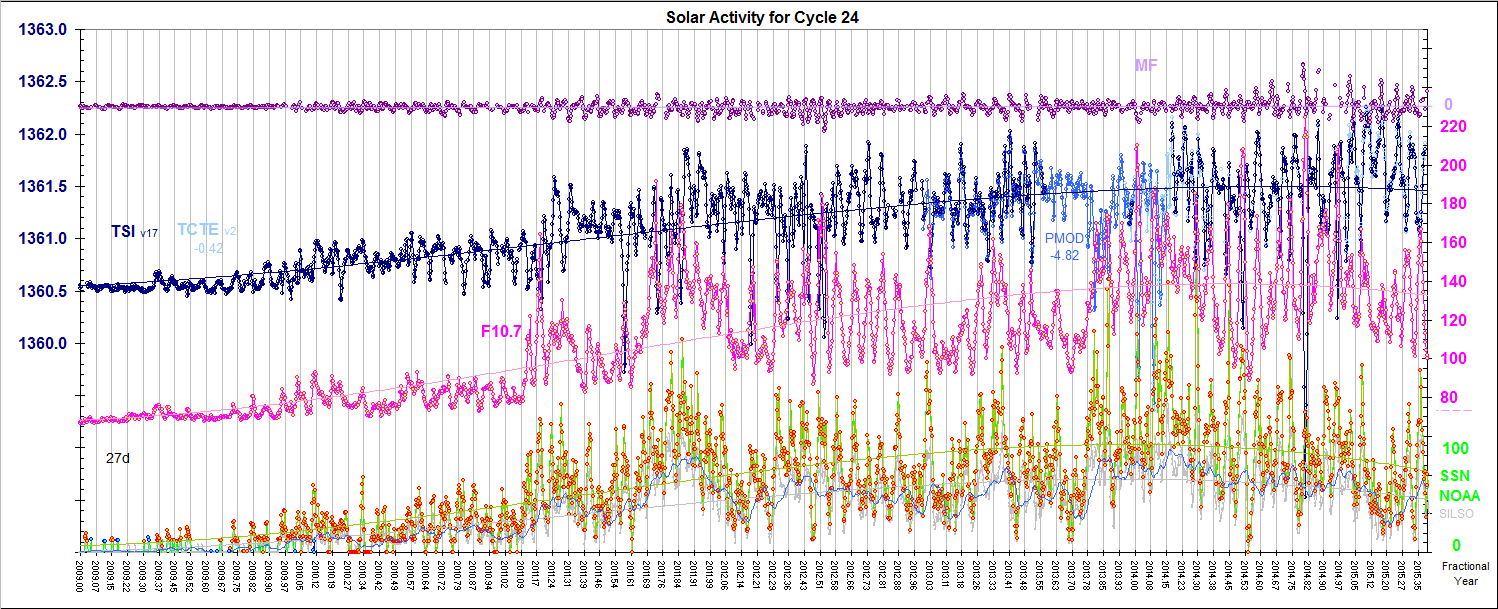
Dr. Leif Svaalgard's plot of Recent Solar Activity
appears to show a very gradual beginning
to Solar Cycle 24 may already be underway.
Englarge HERE.

Leif Svaalgard's Research Page HERE.

In March 2008, NASA heliophysicists could not agree on the likely magnitude of Solar Cycle 24, or on much else other than that Solar Cycle 23 was obviously on the decline. In the end, their prediction was bifurcated, with one camp predicting a sharp end and a "typical" fast upswing in solar activity and a reduction of Cosmic Ray incidence refracted from the Solar System by a renewed interplanetary magnetic field. A peak in Cycle 23 would happen, these experts agreed, in 2011.

The second camp predicted a bottoming out and beginning to Cycle 24 in early 2008, and a strong peak, but no so great as that predicted by the first group four years later. Both camps agreed "we would know by March 2008."

Indeed, in late February 2008 the Sun's activity was already below that of recent Solar Minima, but the first groupings of sunspots with Cycle 24's signature polarity had appeared and, almost as suddenly, faded away. Officially, Solar Cycle 24 was underway. Nevertheless, the Sun continues to remain mostly calm, Cycle 24 sunspots have occasionally sputtered into sight, though twice in the past year, Cycle 23 sunspots also appeared, and the present Solar Minimum now is officially longer and deeper than any recorded in more than a century.

Dr. Leif Svaalgard, a solar physicist of international standing, predicted the present behavior of the Sun with stricking accuracy. A look at the graph above shows his own research, which is groundbreaking, maps what he believes to have been a bottoming out of Cycle 23 and the slow beginning to Cycle 24 probably in July and August 2008.

Today, NOAA released a revised prediction, the summary of which appears below.

NOAA: Mild Solar Storm Season Predicted:

Although its peak is still four years away, a new active period of Earth-threatening solar storms will be the weakest since 1928, predicts an international panel of experts led by NOAA’s Space Weather Prediction Center and funded by NASA. Despite the prediction, Earth is still vulnerable to a severe solar storm.

Solar storms are eruptions of energy and matter that escape from the sun and may head toward Earth, where even a weak storm can damage satellites and power grids, disrupting communications, the electric power supply and GPS. A single strong blast of “solar wind” can threaten national security, transportation, financial services and other essential functions.

The panel predicts the upcoming Solar Cycle 24 will peak in May 2013 with 90 sunspots per day on average. If the prediction proves true, Solar Cycle 24 will be the weakest cycle since number 16, which peaked at 78 daily sunspots in 1928, and ninth weakest since the 1750s, when numbered cycles began.

The most common measure of a solar cycle’s intensity is the number of sunspots—Earth-sized blotches on the sun marking areas of heightened magnetic activity. The more sunspots there are, the more likely it is that solar storms will occur, but a major storm can occur at any time.

As with hurricanes, whether a cycle is active or weak refers to the number of storms, but everyone needs to remember it only takes one powerful storm to cause huge problems,” said NOAA scientist Doug Biesecker, who chairs the panel. “The strongest solar storm on record occurred in 1859 during another below-average cycle.”

The 1859 storm shorted out telegraph wires, causing fires in North America and Europe, sent readings of Earth’s magnetic field soaring, and produced northern lights so bright that people read newspapers by their light.

A recent report by the National Academy of Sciences found that if a storm that severe occurred today, it could cause $1-2 trillion in damages the first year and require four to 10 years for recovery, compared to $80-125 billion that resulted from Hurricane Katrina.

The panel also predicted that the lowest sunspot number between cycles — or solar minimum — occurred in December 2008, marking the end of Cycle 23 and the start of Cycle 24. If the December prediction holds up, at 12 years and seven months Solar Cycle 23 will be the longest since 1823 and the third longest since 1755. Solar cycles span 11 years on average, from minimum to minimum.

An unusually long, deep lull in sunspots led the panel to revise its 2007 prediction that the next cycle of solar storms would start in March 2008 and peak in late 2011 or mid-2012. The persistence of a quiet sun also led the panel to a consensus that the next cycle will be “moderately weak.”

NOAA’s Space Weather Prediction Center (SWPC) is the nation’s first alert of solar activity and its effects on Earth. The Center’s space weather experts issue outlooks for the next 11-year solar cycle and warn of storms occurring on the Sun that could impact Earth. SWPC is also the world warning agency for the International Space Environment Service, a consortium of 12 member nations.

As the world economy becomes more reliant on satellite-based communications and interlinked power grids, interest in solar activity has grown dramatically. In 2008 alone, SWPC acquired 1,700 new subscription customers for warnings, alerts, reports, and other products. Among the new customers are emergency managers, airlines, state transportation departments, oil companies, and nuclear power stations. SWPC’s customers reside in 150 countries.

“Our customer growth reflects today’s reality that all sectors of society are highly dependent on advanced, space-based technologies,” said SWPC director Tom Bogdan. “Today every hiccup from the sun aimed at Earth has potential consequences.”

NOAA understands and predicts changes in the Earth's environment, from the depths of the ocean to the surface of the sun, and conserves and manages our coastal and marine resources.


Bill Nelson's letter to Charlie Crist

Dear Charlie,

We have arrived at a critical juncture both for the future of human spaceflight and for Florida's Space Coast. Over the next two years, NASA will complete the Shuttle's nine remaining missions. Meanwhile, the President has ordered a complete review of the nation's human spaceflight program, to determine how we can best return to the moon while stimulating the development of commercial spaceflight capabilities.

This transitional period will pose unique challenges - and opportunities - for our state. As we look to the future, Space Florida must play a vital role in maintaining Florida's position as a world leader in aerospace research and space exploration.

With that in mind, I write to ask that you undertake a nationwide talent search for a world-class manager to lead Space Florida during this critical time. We need to attract the best and the brightest, and to make sure that they lead the organization in a direction that makes all Floridians proud.

Meantime, I have submitted two of Space Florida's funding priorities to the Senate Appropriations Committee. I will work with the committee to provide funding to renovate an abandoned launch complex near the Kennedy Space Center, which will be available for commercial launches, and to rebuild a cutting-edge vacuum chamber for testing the next lunar lander and future commercial satellites.

I will work my hardest to ensure that we fund these important projects. I hope that Space Florida's next leader will take advantage of that funding to attract new business and investment to the Space Coast, and I look forward to working with you toward that end.

Human spaceflight has provided some of our nation's proudest moments, from Neil Armstrong's first steps on the moon to construction of the International Space Station. Images of rockets arcing over Cape Canaveral still symbolize our nation's passion for exploration, and must continue to inspire future generations.

Sincerely,

Bill

What we think: Stop delaying on space

Orlando Sentinel Editorial, May 7: It's a critical time for the U.S. space program. The shuttle is scheduled to stop flying as soon as next year. NASA has started whacking jobs, and layoffs on Florida's Space Coast could reach 10,000. The United States is facing a gap of five years or more in sending astronauts into orbit, and problems plaguing NASA's next manned program mean a longer delay. Yet there's a maddening lack of urgency, and interest, among federal and state policy-makers.

After months of inaction, the Obama administration was expected this week to announce a review of the next manned program, Constellation. The review would include an examination of whether the Ares I rocket is the best design for Constellation.

This is long overdue. Serious doubts about Ares have been raging for more than a year. But former NASA Administrator Michael Griffin, who helped design the rocket, deflected the questions and insisted the problems were not unusual or unmanageable. But Mr. Obama's NASA transition team started asking pointed questions about Ares in December, and Mr. Griffin resigned in January.

Now that a review finally is coming, it needs to be thorough but quick. NASA can't afford to keep plowing money and time into Ares if it's going to get dumped in favor of another launcher.

But the review leaves a more important piece of unfinished business for the Obama administration: naming a new chief for the space agency. The president has said NASA is "adrift." What agency wouldn't be without a permanent leader in charge?

U.S. Sen. Bill Nelson of Florida, who says he has the president's ear on space policy, has resorted to publicly pleading for him to name a new administrator. With so much at stake for NASA and the nation, the delay from the White House is confounding.

Mr. Nelson had one bit of good news to report this week from the president. Mr. Obama told him he will complete all the shuttle missions that have been planned, even if delays push them past the program's scheduled retirement date in 2010.

The gridlock isn't just in Washington. Lawmakers in Tallahassee also act as if space policy isn't a priority. Legislators didn't pass even one of several space-related proposals during this year's regular session. And they let a turf battle between two universities doom a bipartisan bid to create a space-research institute.

Legislators also didn't commit any new money to help Florida keep up with the competition from other states for commercial space ventures, which would help offset the economic damage from losing the shuttle program. Their reluctance stemmed in part from an understandable lack of confidence in Space Florida, the agency charged with growing the industry in the state. It has few real accomplishments to show for the millions in taxpayer dollars it has received.

But the better approach from legislators would have been to extract a guarantee of reform at Space Florida in return for any additional money. Instead, they accepted assurances from Gov. Charlie Crist's administration that "improvements" would be made at the agency over the summer.

That's cold comfort, what with a lightweight like Lt. Gov. Jeff Kottkamp serving as Mr. Crist's right-hand man on space policy.

America's pre-eminence in space, billions of dollars in investment in science and technology, and thousands of jobs all hinge on decisions made by federal and state policy-makers. That's more than enough to demand more urgency.

Deep space missions may get new jolt of fuel

Apollo 12 lunar module pilot Al Bean unloads RTG
fuel cell from descent stage. With negligible power
loss, the mission's Apollo Lunar Surface Experiment
Packages (ALSAP) continued to return data, until
de-funded and shut-down in 1977.
(NASA Pete Conrad, Nov. 1969 - AS12-46-6790)

John Johnson, Jr. - Los Angeles Times - The Department of Energy plans to restart its program of making radioactive fuel for NASA's deep space missions, the agency announced Thursday, a decision that came only hours after the National Research Council warned that the nation is fast running out of the fuel.

Jen Stutsman, a spokeswoman for the Energy Department, said the agency has requested $30 million in its fiscal 2010 budget proposal to restart the fuel-making process. In its budget statement, the agency said it had "a long and successful history" of supporting NASA's needs. It said it welcomes the National Research Council findings.

In a 74-page report, entitled "Radioisotope Power Systems: An Imperative for Maintaining U.S. Leadership in Space Exploration," the National Research Council pointed out that American leadership in space has depended in part on the ability to power spacecraft on deep space missions, in which the sun's rays are too weak to make solar power.

For such research, which include the New Horizons mission now heading for Pluto and the Cassini mission now orbiting Saturn, the electricity that powers onboard instruments comes from devices called radioisotope power generators. The RPGs make electricity with the heat from the radioactive decay of small amounts of plutonium-238 carried on board.

Read the Article HERE.

Thursday, May 7, 2009

Making the Case for a Lunar Base

Paul Spudis refers us to "25 Good Reasons to Go to the Moon," by Ken Murphy from Selenian Boondocks via Out of the Cradle.

Darnell Clayton, writing at The Moon Society Blog earnestly and openly writes:
"Dear NASA, It's Luna or nothing (including Mars)"

Responses to his "Case for a Lunar Base" are picked up by Transterrestrial Musings.

Which, in turn, reminds us to download and re-examine: NASA's Exploration Systems Architecture Study 630 pages, (pdf) 2006, HERE.

Steve Kohler resigns Space Florida

Space Florida President Steve Kohler has resigned effective Friday. (Hat Tip Flame Trench)

The embattled administrator recently fought off an attempt to half the agency's $4 million budget over a controversy about paying a lobbyist.

Also, Kohler had been criticized by the head of SpaceX, Elon Musk, who complained that Kohler was trying to support a competing launch pad at Cape Canaveral.

"My capacity to serve effectively as president likewise has been damaged," Kohler wrote in a resignation letter to Lt. Gov. Jeff Kottkamp. "Therefore, in order to remove the unfair distraction and enable Space Florida to move forward with complete focus on space in Florida, I am resigning as president effective May 8, 2009."

Resignation Letter

Robert G. Piper, 74

Worked on Lunar Module for NASA Robert G. Piper, 74, of Copperas Cove, Texas has passed away.

Mr. Piper, born in Woodlawn, IL in 1934, died Tuesday, May 5, 2009 at his home.

He served in the Army and the Air Force, serving in Okinawa during the Korean War.

Survived by his wife of 54 years, Cleta, he is survived also by two sons, Joseph Piper and William C. Piper, both also of Copperas Cove, along with five grandchildren; and five great grandchildren.

Memorials may be made to the American Heart Association, 6801 Sanger Suite 102, Waco, Texas 76710.

NASA Ames unveils Virtual ISS Synth

Virtual International Space Station Photosynth, HERE.

W. Michael Hawes; NASA's liaison with Augustine Commission

W. Michael Hawes, Associate Administrator for Program Analysis and Evaluation - to be Liaison with Augustine Commission, Manned Space Flight review.

NASA Bio.

Augustine Commission II

Appointed by President Obama to head
Review of United States
Human Space Flight Plans
Commission

"Any task can be completed in only one-third more time than is currently estimated."
- Augustine Quotes

White House will review manned spaceflight

The Obama administration has formally announced the appointment of a "Blue-Ribbon" commission to "review" the Vision for Space Exploration, and more specifically the Constellation program, "with the goal of ensuring that the nation is on a vigorous and sustainable path to achieving its boldest aspirations in space. The review will be conducted by a blue-ribbon panel of experts led by Norman Augustine, the former CEO of Lockheed Martin, who served on the President’s Council of Advisors on Science and Technology under Democratic and Republican presidents and led the 1990 Advisory Committee on the Future of the U.S. Space Program and the 2007 National Academies commission that produced the landmark report, Rising Above the Gathering Storm: Energizing and Employing America for a Brighter Economic Future, as well as a number of other high-profile national commissions.

"The "Review of United States Human Space Flight Plans" is to examine ongoing and planned National Aeronautics and Space Administration (NASA) development activities, as well as potential alternatives, and present options for advancing a safe, innovative, affordable, and sustainable human space flight program in the years following Space Shuttle retirement. The panel will work closely with NASA and will seek input from Congress, the White House, the public, industry, and international partners as it develops its options. It is to present its results in time to support an Administration decision on the way forward by August 2009. “President Obama recognizes the important role that NASA’s human space flight programs play in advancing scientific discovery, technological innovation, economic strength and international leadership,” said John P. Holdren, Assistant to the President for Science and Technology and Director of the Office of Science and Technology Policy. “The President’s goal is to ensure that these programs remain on a strong and stable footing well into the 21st Century, and this review will be crucial to meeting that goal.

"In a letter to Acting NASA Administrator Christopher Scolese asking him to undertake the review, Holdren noted that it is prudent for the new Administration to obtain a fresh assessment of America’s human space flight program given its scale and scope—and especially given its importance for scientific and technological innovation and discovery. Scolese expressed confidence that the review would serve the nation, NASA, and its employees well. “The thousands of workers who have given so much over the years to bring human space flight to where it is today deserve nothing less than a full assurance that their commitment will be applied in the smartest and most practical ways,” Scolese said. “I appreciate the strong support that the President and Dr. Holdren have for NASA’s programs— including our human space flight program—and I look forward to working with Norm, the panel, and the Administration to ensure that NASA remains on the best path as it moves forward.” Scolese emphasized that work on Constellation will continue while the review is underway and that workforce issues will be an important factor assessed by the panel as it considers various options.

The review panel will assess a number of architecture options, taking into account such objectives as: 1) expediting a new U.S. capability to support use of the International Space Station; 2) supporting missions to the Moon and other destinations beyond low Earth orbit; 3) stimulating commercial space flight capabilities; and 4) fitting within the current budget profile for NASA exploration activities. Among the parameters to be considered in the course of its review are crew and mission safety, life-cycle costs, development time, national space industrial base impacts, potential to spur innovation and encourage competition, and the implications and impacts of transitioning from current human space flight systems. The review will consider the appropriate amounts of R&D and complementary robotic activity necessary to support various human space flight activities, as well as the capabilities that are likely to be enabled by each of the potential architectures under consideration. It will also explore options for extending International Space Station operations beyond 2016.

"Members of the panel are to be named soon. “It is an honor to be asked to lead this important human space flight review, and I am excited about working with my fellow panel members to examine these difficult, complex, and pressing questions,” said Augustine, a former aerospace industry executive who is a recipient of the National Medal of Technology, the Joint Chiefs of Staff Distinguished Public Service Award, the Department of Defense's Civilian Distinguished Service Medal, and has served as chairman of the American Red Cross and President of the Boy Scouts of America. “I am a believer in the value of this nation’s human space flight activities,” Augustine said. “And we will do everything we can to provide the information needed to help the country maintain the spectacular arc of progress that NASA has fueled for five decades.”

Unease at Kennedy Space Center

Robert Block - The Write Stuff - Orlando Sentinel The Obama administration’s pending announcement on Thursday of a comprehensive review of NASA's plans to return astronauts to the moon is causing growing anxiety among Kennedy Space Center workers and NASA contractors.

Companies are already starting to report some unease among their employees worried about what the study could mean for the future of NASA’s human space flight program and jobs in Brevard County. Managers are using words like “fear” and “disappointment” to characterize the mood of the workforce and their own ranks.

According to administration officials, NASA will announce it will convene a “blue ribbon” panel to examine, among other issues, whether the Ares I rocket and Orion capsule are the best option to send astronauts into orbit by 2015 after the shuttle retires next year. The panel will start as soon as this month and be finished by September.

Administration sources say the panel will be chaired by Norman Augustine, a retired chairman and CEO of Lockheed Martin Corp. and former president of the American Institute of Aeronautics and Astronautics.

The outcome of the study is critical for Kennedy Space Center, which is looking at as between 3,500 and 10,000 job losses when the space shuttle fleet is mothballed.

Read the posting HERE.

Whitehorn predicts point to point space flights

Virgin Galactic President Will Whitehorn has been making predictions about the future of travel this week. Doug Messier has the report at ParabolicArc

Space race or education?

Christopher Dawson - ZDNet Education -The US space program costs billions and billions of dollars. Wikipedia puts the figure at $17.3 billion for fiscal year 2008 and that number climbs to $18.7 billion in FY10. The US Department of Education has a budget just south of $70 billion (saying nothing of the state budgets, where the bulk of education funding falls in the States).

President Obama is ordering a review of the multibillion dollar of the Nasa Constellation program planned to return humans to the moon. This program is already over budget and running well behind schedule. Same goes for the Space Shuttle replacement program, which is now expected to cost $40 billion.

Am I suggesting that we should redirect this money to education? Absolutely not! On the contrary, I think its time for another Space Race. I dug up an interesting article posted at the University of Montana highlighting the effects of the Space Race on education in the 1950s.

On October 4, 1957, with the launch of Sputnik 1 by the Soviet Union, the world entered the Space Age, and the United States became quite concerned that the Soviet Union had a head start in the space race. A year later, realizing that the support of gifted and talented mathematics and science students was critical to national security, the United States federal government passed the National Defense Education Act (NDEA), providing aid to education in the United States at all levels, primarily to stimulate the advancement of education in science, mathematics, and modern foreign languages.

Obviously, our competitors now are a number of Asian and Eastern European nations (among others), but we are competing for much more than access to space or even to win the Cold War. This doesn’t need to be about getting to the moon before China; rather, it needs to be about inspiring students and creating the utter sense of urgency we need in education to push our students and improve what we do. It should be about inspiring students and teachers to embrace math, science, and engineering education. If it takes many billions more devoted to both NASA and education, then that’s a small price to pay to bring a new generation of brilliant scientists and mathematicians to the forefront of education, research, and industry.

Follow Chris Dawson on Twitter! Christopher Dawson is the technology director for the Athol-Royalston School District in northern Massachusetts. See his full profile and disclosure of his industry affiliations, but always keep in mind that the opinions expressed here are his own and not those of his daytime employer, even if he talks incessantly about his day job.

Wednesday, May 6, 2009

NASA FY 2010 Budget Briefings, May 7

The far-flung space community will be waiting impatiently, with snippets flying every which way, over the next 24 hours, as details as to the Obama administration's desire with regard to NASA and, in particular, the future of American manned space exploration. In February, the administration's preliminary outline called for $18.7 billion in spending for the space agency for the federal fiscal year, beginning Oct. 1, 2009. Congress has already heard testimony from acting administrator Chris Scolese, who will lead off a series of NASA Directorate briefings beginning Thursday afternoon, May 7, at 2:30 pm.

Already announced is the administration's intention to order a full review of the Ares 1 project, and recent reconfigurations of the Orion Crew Exploratotion Vehicle, a natural successor in configuration, if not in curcuitry, to the Apollo command and service module configuration, whose basic design first began testing in 1961.

NASA Acting Administrator Chris Scolese will brief the a news conference at NASA Headquarters, in the James E. Webb Memorial Auditorium, 300 E St., S.W., in Washington. He will be joined by NASA Comptroller David Schurr.
The news conference will be broadcast live on NASA Television and the agency's Internet homepage. Reporters at NASA Headquarters will be able to ask questions.

To watch the budget news conference on the Internet, visit: http://www.nasa.gov/ntv

After the overview briefing on NASA's fiscal year 2010 budget, the associate administrators of the mission directorates each will hold a teleconference to discuss the budget's impact on their specific area. The teleconference schedule:
Thursday (all times U.S. Eastern):
*4 p.m. -- Exploration Systems
*5 p.m. -- Science
*6 p.m. -- Space Operations
On Friday, May 8
9 a.m. -- Aeronautics

Each teleconference is scheduled to last 50 minutes. Live audio of the budget teleconferences will stream online at:http://www.nasa.gov/newsaudio
The NASA budget and supporting information will be available at 1:30p.m., May 7, at: http://www.nasa.gov/budget

Canada's space program, 'far to fly'

Honorary LP and CEO of Odyssey Moon Limited, Bob Richards reports he was glad Ottawa Business Journal made mention of the possibilities presented by the growing Commercial Space industry.

Elizabeth Howell, Ottawa Business Journal Staff

Years of non-direction from the Canadian Space Agency (CSA) caused by underfunding are putting the space industry at risk of stagnation in Canada, points out a report issued Wednesday by the Rideau Institute and the Secure World Foundation.

Although Rideau Institute president Steve Staples notes the appointment of former astronaut Steve MacLean to head the CSA has brought new blood into an agency plagued by short-term presidents, he fears the economic crisis may push MacLean's long-awaited Long Term Space Plan into the background.

As a solution, Mr. Staples and the institute propose moving from a space plan into a more wide-ranging space policy that could be adopted by other government departments with a strategic interest in space exploration, such as defence.

"A whole government approach towards space, I think, would be welcomed by many," Mr. Staples says.

"But in the meantime, the (space) sector is looking for direction from the government to guide CSA into the future, and then that needs to be followed up by some (financial) resources into the CSA."

The report, called "Looking Up: A Report on the State of Canada's Space Sector,"(Adobe pdf file) tracks the progress of the Canadian space industry.

Follow the rest of the article HERE.

Dusty Moon as problem and opportunity

On April 17, in Lunar Dust: Phenomena and Hazard, I attempted to sum up the state of science with regard to "the lunar dust phenomena." I won't repeat that summary except to add an idea regarding the "Moon-as-Rosetta Stone of the Solar System," notion.

This morning Eric Berger, "the SciGuy" at the Houston Chronicle, writes about some "really, really, really old dust" found by high flying collection experiments successfully sampling a comet's tail.

"Six years ago," Berger wrote, "Earth traveled through the tail of an obscure comet named 26P/Grigg-Skjellerup, and scientists thought it would be cool to fly a plane 12 miles into the atmosphere and capture some particles."

They probably did not expect to find dust grains from a large gaseous cloud that pre-dates the birth of our own star and probably served as its nursery.

It's a fascinating briefing, and I recommend it highly, but it reminded me once again of the wide variety of trace material there is to be found on the Moon and what it is likely to teach us about the history of the solar system, and perhaps long before.

If such dust grains sputter off a comet, one of hundreds that charge in from the outer solar system each year, and it can be gathered in lower stratospheric flight, what will we one day be able to gather on the Moon?

Catch Eric Berger's "really, really old dust" post HERE.

Editorial: 'NASA should abandon Ares 1'

Henry Spencer, computer programmer, spacecraft engineer and amateur space historian
New Scientist Blog


It looks like Ares I, the rocket being designed to carry NASA astronauts into orbit when the space shuttle retires, is in trouble. Actually, Ares I has been in trouble for a long time, but now the chickens (or are they vultures?) are coming home to roost: the Orlando Sentinel says that as early as Thursday, the White House may announce a review to look into whether to proceed with the rocket's development or switch gears and pursue other options.

As I wrote last summer, it's been clear almost from the start that Ares I was a very marginal, optimistic design, just barely adequate if everything went right. But there are always problems, and Ares I had no margin for problems.

As one underlying assumption after another has turned out to be wrong, requiring design change after design change, NASA has nevertheless clung to the same basic approach, unwilling to admit its mistake and hoping that sheer persistence would see the project through. Perhaps it could, but the price for such bullheadedness can be very high, and the budget projections are now starting to reflect that - the Sentinel says that its estimated costs through 2015 have swelled from $28 billion in 2006 to $44 billion today.

Some of us thought from the start that this was blatant empire-building. At first glance, the US's existing big rockets - Atlas V and Delta IV - seemed quite adequate for launching people and supplies into Earth orbit. (They wouldn't suffice for launching to the moon and beyond, but then, Ares I couldn't do that either - that job was assigned to its big brother, Ares V.)

NASA studied this option at some length, and decided that Atlas and Delta just weren't good enough. In particular, NASA thought it would be very expensive to modify them to meet NASA's official "human-rating" standard, which specified what a rocket had to do to be safe for launching people.

Even at the time, some of us had doubts about this. It's unlikely that there was any actual rigging of the analysis, but all too often, the devil is not in the details but in the assumptions.

The "human-rating" standard was very demanding - indeed, far more demanding than any previous specification of its kind. The shuttle couldn't possibly meet it; neither could Apollo or Soyuz. But since then, the standard has been revised, and the new one is a lot less specific and demanding (a cynic would suggest it was changed because Ares I couldn't meet the original standard - but some cynicism might be in order here).

Could NASA make do with Atlas V or Delta IV rockets if they really wanted to? Yes, I think so. Compared to the original hypothetical Ares I, these launchers can't carry as heavy a load and they do need some work on details . . . but compared to the real Ares I, their problems look a lot less serious.

It's true that the Orion crew capsule designed to sit on top of the Ares I rocket has turned out to be very heavy, but part of that weight growth is actually Ares I's fault! An escape rocket to pull an Orion away from a malfunctioning Ares I has to be very powerful, because Ares I's first stage can't be shut down. With a liquid-fuelled launcher like Atlas or Delta, the main engines would be shut down as the escape rocket fired. I'm told that this alone could cut as much as 3.6 tonnes (8000 pounds) off an Orion built to fly on an Atlas or Delta launcher.

NASA, predictably, is not happy about being forced to change. NASA's ex-administrator, Mike Griffin, has been a particularly vocal opponent of the idea, claiming that outsiders shouldn't try to second-guess NASA on technical decisions, and that it's cheaper to stay on course after four years of effort than to start over from scratch. Sorry, but that's not the way it looks to me.

I'd agree that it would be cheaper, if I thought NASA had made four years of progress. But Ares I is the International Space Station of rockets: redesigned again and again, justified using assumptions that no longer apply, and already escalating mightily in cost (and already well behind schedule). There comes a time when it really is cheaper to start over in some more sensible way, because banging your head against the wall harder and harder isn't getting you through it.

Back before Ares I had a name, it was sometimes known as "the Stick" because it was unusually long and thin (especially before its second stage started gaining weight). About three years ago, in an online discussion group, I coined a name that I thought suited it better: the White Cane.

It's time the folks at NASA opened their eyes

Spudis' periscopes up into Reality

Among the Truly Great Lunar Pioneers, Paul Spudis checks in at his Smithsonian blog "The Once and Future Moon," asking "Outposts or Sorties?"

Recently, the acting Administrator of NASA testified before Congress on his agency’s implementation of our National Space Policy, previously known as the Vision for Space Exploration (VSE). In the question and answer period, he made a rather startling statement to the effect NASA was still trying to understand what “lunar return” means - that an outpost would be “expensive” and that lunar return might instead entail a series of smaller scale sortie missions, similar to the later Apollo expeditions of the early 1970’s. He added that people should remember that the “original purpose” of the VSE was to prepare to go to Mars and other destinations.

I found this exchange fascinating because it suggests that NASA, as an executing entity, still doesn’t fully understand the nature of their mission to the Moon and to the extent that it is understood, they have transformed it into something very different from what the VSE actually said and what was intended.

To begin with, what did the Vision actually say about lunar return? The Vision consisted of both documents and speeches (all linked on this page) that included the following points:

Read the Article HERE.


Tight Tallahassee

For the first time in recent memory, backers of Florida's space industry walked away from the two-month legislative session utterly empty-handed.

With NASA already making the first of at least 3,500 layoffs — and as many as 10,000 — at Kennedy Space Center, the Legislature failed to pass a single space-related bill by the end of regular business last week. And lawmakers devoted no new money to averting the economic calamity that will strike when the space shuttle is mothballed.

Part of the problem was a dire economic picture that doomed any new spending. But internal turf fights and controversies over Space Florida, detailed by the Orlando Sentinel, also stalled efforts, officials said.

"There was a lot of talk, but no action," said Sen. Evelyn Lynn, R-Ormond Beach, whose bill to create a new space-research institute at Daytona Beach-based Embry-Riddle Aeronautical University died last week.
Read the Low-Down HERE.

Tuesday, May 5, 2009

Ares I inadequate?

Thursday is B-Day for NASA, as the Obama administration reveals more detail on it's $18.7 Billion budget wish-list for NASA during fiscal year 2010.

With a pliant Congress controlled by his own Party, whatever President Barack Obama's desires he is likely to get, especially as the new administration charts a course through monetary and fiscal policy toward depths unknown.

Jeff Foust at The Space Review has as a good a grip on the details as anyone, at this point. His article can be read HERE.

And from Mark K. Matthews and Robert Block at Orlando Sentinel's The Write Stuff, Tuesday afternoon, came word of "a major turnaround, the White House is expected this week to order a review of the fledgling spacecraft program that NASA had hoped would one day replace the space shuttle, the Orlando Sentinel has learned.

The decision follows months of critical reports questioning whether the new Ares I rocket and Orion capsule could meet a goal of sending astronauts into orbit by 2015. The review would examine whether Ares and Orion are the best options, or if the agency should pick another spacecraft.

The announcement is planned to coincide with the Thursday release of the president's budget.

Finally, deconstruction dust-up of the Vision for Space Exploration have begun, in blogging brushfires, here and there. It will get uglier.

Beautiful Baikonur

Baikonur Transitions Online - Abdujalil Abdurasulov To return to the era of Soviet-U.S. rivalry, it’s not really necessary to travel back in time. A visit to this town in southwestern Kazakhstan will do.

Baikonur, which since the 1950s has hosted the launch site for Soviet space missions and their Russian successors, is still a closed Russian enclave in this Central Asian country. Visitors enter only with permission, and soldiers guard a checkpoint at the entrance.

The town’s landscape has changed little since the time of the USSR. A silence hangs over the downtown of crumbling Soviet-era buildings. There are few street advertisements and billboards, no Internet cafes, no new high-rise buildings. This town of 70,000 hardly seems like the busiest space launch center in the world, but it is.
Read the rest HERE.

Eilene Galloway, 102

Space-Law Pioneer
Aviation Week via Parabolicarc

Monday, May 4, 2009

Stacking LRO-LCROSS

Moonbound

By Jack Pfaller (NASA) April 30, 2009 - Cape Canaveral Air Force Station Launch Complex 41. Crane lifts Centaur upper stage into the Vertical Integration Facility for installation onto Atlas V first stage,already in the tower.

The Atlas V/Centaur is the launch vehicle for NASA's Lunar Reconnaissance Orbiter, or LRO, and NASA's Lunar CRater Observation and Sensing Satellite, known as LCROSS. LCROSS and LRO are the first missions in NASA's plan to return humans to the moon and begin establishing a lunar outpost by 2020.

At the time of this posting, LRO/LCROSS is scheduled for launch "no earlier than" June 2.

Joseph S. Algranti, Former Chief of Aircraft Operations, JSC

NASA Watch

National Security Space Industrial Base Challenged from Three Fronts

A shrinking aerospace workforce, outdated export control rules and a cumbersome defense acquisition system all threaten the health of the U.S. national security space industrial base, Aerospace Industries Association President and CEO Marion Blakey said Thursday.

"The role of space in our security and economy is critical," Blakey said in testimony to the House Strategic Forces Subcommittee. "Space systems provide everything from high-fidelity intelligence on terrorists in the tribal regions of Pakistan to global positioning system information to millions of Americans."

Changes to U.S. export control law nearly a dozen years ago transferred commercial satellites to the U.S. munitions list with a devastating result: the U.S. share of the export market dipped from about 70 percent in 1995 to 25 percent in 2005. Adding more strain, more than 60 percent of the workforce today is 45 or older according to recent surveys.

Blakey pointed to the defense acquisition system as another critical challenge. While lauding the formation of the Joint Space Cost Council, which originated in 2006 as an AIA-government initiative, she acknowledged that defense acquisition needs more far-reaching changes.

"Budget and program stability along with solid cost estimating are the building blocks of world-class acquisition," said Blakey. "To achieve that goal will require a renewed partnership between the Defense Department, Congress and our industry."

AIA recommendations to improve the space industrial base include:

# Support investment in science and education national priorities, including STEM initiatives.

# Take concrete steps to re-evaluate export controls on commercial communications satellites and other space technologies.

# Embrace management practices that promote requirements stability and accurate cost estimating.

The text of Blakey's remarks can be found on the AIA Web site at www.aia-aerospace.org/newsroom/speeches_testimony/

Future may depend on Lunar Colonization

Journalist Andres Castellanos of My Conscience Explodes highlights a lecture April 23 by Eric Vanderhoot, Astronomy and Physics Lab Coordinator at Florida Atlantic University given at the South Florida Science Museum.

Clearly a coordinator after my own heart, Vanderhoot spoke in favor of a position almost precisely the same as that of the Lunar Pioneers, Castellanos reports.

"America’s future in space," according to Vanderhoot, "depends on its willingness to colonize the moon. And it’s not a far-off idea. The moon has energy resources not found on Earth and the technologies needed to harness these resources are mostly known."

Of course, LP strongly agrees, though we frame the point more starkly, e.g., "America's future may depend on its willingness to colonize Earth's Moon." (Never more true, but more difficult to sell when I first made that statement in 1976. And I was not alone, during that dreary first gap in manned spaceflight.)

Castellanos continues, "the head of (FAU's) observatory and physics lab presented all of his ideas regarding living on the moon in a lecture (that) sought to answer the question: Can we live in space?"

The short answer is we already do. But can we move into space aside from highly skilled astronauts?” Vandernoot says."

"He thinks America should strive to revive its frontier spirit, the same one that drove families in wagons toward the old west. This time, however, brave pioneers should settle the moon."

"Vandernoot was quick when his audience asked him about Mars. He warned of spending too much money on a manned mission there. “Absolutely not, we would blow through our budget and never go anywhere again,” Vandernoot responds. “The only way for the public to appreciate any endeavor is for America to get something back for its investment.”

"Vandernoot says resources on the moon can help alleviate Earth’s energy crisis. He also points out that no living ecosystem will be hurt by human presence."

If the reader is understandably skeptical of the Pioneer's more "extreme" position, one can hardly blame you. It has been a stormy season of dire predictions, the last half-century or so, we are so used to being unable to get a word in edgewise, we had kept our position to ourselves, the last quarter century or so. The soil has, however, never been more fully prepared.

It is in the context of those dire warnings, oddly enough, the Lunar Pioneers have often recommended a glance at one of many first class studies on the subject by former Senator Harrison Schmitt (R-NM), in particular those co-written with University of Wisconsin colleague Dr. G.L. Kulcinski.

Fusion Power from Lunar Resources; G.L. Kulcinski and H.H. Schmitt, October 1990 (revised September 1991) [presented at the 41st Congress of the International Astronautical Federation, Dresden, Germany, 6-12 October 1990. (pdf - 25 pages, 625 kB)

The better part of Castellanos excellent full report is HERE.

Sunday, May 3, 2009

Lunar touchstones continue tour

The rock that was on display Saturday at the Tulsa Air and Space Museum and Planetarium only weighs seven-tenths of an ounce. It measures an estimated 1 1/2 inches by a half-inch — and that assessment seemed a little generous.

One observer, Jim Niemeyer of Tulsa, said it could "probably be classified as a pebble."

What the stone lacks in size it makes up for in gravity, although it originated from a place where gravity isn't much of a factor.
It came from the Moon.

Read the Story
HERE.

Ugandan president wants East African space effort, to ask Americans "what are you doing here all alone?"

ENTEBBE, Uganda (AFP) — Africans must travel to the moon to investigate what developed nations have been doing in outer space, Ugandan President Yoweri Museveni said Saturday.

"The Americans have gone to the moon. And the Russians. The Chinese and Indians will go there soon. Africans are the only ones who are stuck here," Museveni said, addressing a meeting of the Uganda Law Society in Entebbe.

"We must also go there and say: 'What are you people doing up here?'."

Museveni urged the assembly of Uganda's top lawyers to support East African integration, arguing that one of the region's goals should be to develop a space programme.

"Uganda alone cannot go to the moon. We are too small. But East Africa united can. That is what East African integration is all about," he said. "Then we can say to the Americans: 'What are you doing here all alone?'."

Museveni has vocally campaigned for a common East African economic and political zone.

Negotiations to establish a tariff free trade zone including Uganda, Kenya, Tanzania, Burundi and Rwanda have been ongoing for months.

Museveni on Saturday also called for enhanced political integration among the East African nations, suggesting the region would be strengthened by becoming one country.

Saturday, May 2, 2009

Nelson, Shepherd and Wetherbee inducted in Astronaut Hall of Fame

George "Pinky Nelson, one of only six who have
carried out MMU-enabled unteathered spacewalks,
today among three veteran astronauts inducted into the
Astronauts Hall of Fame at KSC

As celebrated by the Seattle Post-Intelligencer 58-year-old George "Pinky" Nelson is being inducted into the U.S. Astronaut Hall of Fame at the Kennedy Space Center Visitor Complex on Saturday, May 2. Pinky was one of only six space shuttle astronauts to fly the Manned Maneuvering Unit untethered in space. He flew three space shuttle missions during the 11 years he was in the Astronaut Corps, 1978-1989.

According to a front page article in this morning's edition of The Bellingham Herald, Pinky and his wife Susie and their two daughters will attend the ceremony, along with his sister. The Nelsons lived in Clinton and were very involved people in the community: Susie worked for Island County and Pinky was in Farmer Bob's carpool to Seattle! These days, the couple lives in Bellingham, where he's director of the Science, Mathematics And Technology Education program at Western Washington University.

Pinky is among three astronauts to join the elite group of American space heroes who are inducted into the U.S. Astronaut Hall of Fame. The other two are William Shepherd and Jim Wetherbee. The trio is in very good company, with such legendary space pioneers as Neil Armstrong, John Glenn, Alan Shepard, Jim Lovell, Sally Ride and John Young. After today's ceremony, there will be 73 space explores in the prestigious group.
Heads Up Andrea Farmer
For these photographs
HERE.

LLTB completed in 14 weeks

Teledyne Brown Engineering and Orion Propulsion, Inc. (OPI) successfully demonstrated the Lunar Lander Test Bed today, capping the delivery of this unique hardware to the Von Braun Center for Science and Innovation (VCSI).

The LLTB was presented, complete with rocket engine firings, at the dedication of TBE’s Space Systems Manufacturing Center. The LLTB will be used to demonstrate and mature technologies required for future NASA robotic space exploration.

OPI conceived, designed, built, tested, and delivered the LLTB propulsion system in only 14 weeks, providing an innovative solution to customer requirements both on-schedule and on-budget. OPI designed the complete propulsion system, designed and fabricated new components not available commercially, managed vendors and subcontractors, tested all components and subassemblies, verified system performance against requirements, and delivered a complete acceptance data package with the hardware to TBE, the prime contractor and vehicle integrator.

OPI developed the propulsion system at its facilities in Madison, Alabama. TBE completed vehicle integration in Huntsville, Alabama. VCSI will conduct LLTB flight testing at Marshall Space Flight Center later this spring and summer.

Headquartered in Huntsville, AL, Orion Propulsion, Inc. (OPI), is a small woman-owned aerospace company specializing in spacecraft and rocket propulsion design and fabrication, testing services, ground support equipment, and launch operations support. For more information about OPI, visit www.orionpropulsion.com.

Hall Thrusters - Glenn Research Center

"Here's 'our baby,'" they say of this Hall Thruster
undergoing tests at NASA's Glenn Research Center

Superman is safe. This electric rocket is powered by Krypton, not kryptonite.

Astronauts pay respects to 'Space Chimps'

From Left to Right, Space Chimp Dana, used for U.S. Air Force research
in the 1960's; STS-1 co-pilot Bob Crippen and 'Aurora 7'
Mercury astronaut Scott Carpenter
on visit to Fort Pierce (FL) animal rescue facility


John Zarrella CNN - The chimpanzees could sense something was different.

Most days, the only people they see on their island habitats are their caretakers. But on Thursday afternoon, the chimps got a special visit from reporters and camera crews, along with two men who share a unique bond with the animals.

The place was a sanctuary run by Save the Chimps, a nonprofit dedicated to providing a permanent home for chimpanzees rescued from research laboratories, NASA facilities and other sources.

The men were astronauts Scott Carpenter and Bob Crippen, two heroes of the U.S. space program. And the chimpanzees -- some of them, anyway -- were veterans of early test flights by NASA and the U.S. military.

"We're paying them back for their service," said Carpenter, one of NASA's original Mercury Seven astronauts and the second American to orbit the Earth. He toured the sanctuary with Crippen, who piloted Columbia on the first space shuttle flight in 1981.

See the Story HERE.

Cost overruns, lack of oversight threaten DOD space programs, panel told

Government Computer News

William Jackson - The Defense Department has lost its way in its space programs with an outdated focus on large, one-size-fits all systems at the expense of smaller, more economical and flexible systems with a greater likelihood of success, a House panel was told on Thursday.

The result has been delays of critical capabilities in the military’s space-based communications and intelligence-gathering infrastructure, said Josh Hartman, senior adviser to the DOD undersecretary for acquisition, technology and logistics.

“Past performance in the development of space and intelligence systems has not given us great confidence in meeting our future challenges in a timely or affordable manner,” Hartman told the House Armed Services Subcommittee on Strategic Forces. “Today, in multiple mission areas we rely on systems that have lived long past their design lives. For tomorrow, we hope that systems designed with a Cold War mentality will be successfully delivered and able to meet the threats of the future environment.”

The Government Accountability Office, after studying the challenges faced by DOD and industry in developing new space systems, concluded that the United States risks not only falling behind in the race for new capabilities, but failing to maintain current capabilities.

Read he article HERE.

More Space Florida Questions

Space Florida gave no-bid deal to founding board member

Robert Block, Orlando Sentinel Space Editor, shined the light on more ethical strangeness on the economic development incentives NGO Space Florida and its head Steve Kohler, as the Florida legislature budget process continues. Earlier this week the NGO's funding was halved and later restored in committee meetings in Tallahassee.

Courtney Stadd, a former top NASA official indicted on charges of steering $9.6 million in agency funds to a consulting client, was chairman of the state committee in 2006 that selected Steve Kohler as president of Space Florida.

He also served as a member of the agency's board until Gov. Charlie Crist replaced him in 2007 because he was not a state resident.

A year later, Space Florida gave Stadd's company, Capitol Alliance Solutions of Bethesda, Md., a $25,000 no-bid contract for a study about the feasibility of building its own launch pad at Cape Canaveral.

Because the contract was under $100,000, the agency could sign the contract without board approval.

The deal with Capitol Alliance Solutions is another in a series of questionable so-called "sole source" contracts and no-bid deals that Space Florida has clinched since its creation three years ago.

One of them, a $195,000 federal lobbying contract with Blank Rome, a Pennsylvania-based law firm with close personal ties to Kohler, almost got the agency's budget this year slashed in half by a state legislator. The money was restored after the agency said the lobbying fees were not paid with state-appropriated money.

Another, a $250,000 grant to a Panhandle medical clinic to set up a "space tourism" program, was pulled back after an investigation by Crist's office. The investigation, prompted by questions from the Orlando Sentinel, found that a $70,000-a-year state employee who had worked on the contract resigned to take a $150,000-a-year job with the Andrews Institute, which won the contract. That probe found the former employee, Brice Harris, may have violated state revolving-door ethics laws. Harris resigned from the clinic, and Space Florida froze $200,000 of the grant money.
Block's full article HERE.

Space Shuttle Layoffs Begin

Despite frantic maneuvering in Congress by Florida lawmakers, the scuttling of the space shuttle program began in earnest May 1 with NASA announcing the first layoffs for the program scheduled to end in 2010. The first cuts were felt by manufacturing members of the space shuttle team.

"[May 1], we have a layoff of about 160 people on the team," Space Shuttle Program Manager John Shannon told reporters. "Between [May 1] and the end of September, we will reduce the program by about 900 people. We have delivered the last pieces of hardware that those team members produce and we don't keep them on the roles. And that is in order to get our budget down to the marks and the assumptions we made early on."

NASA's shuttle program has approximately 1,600 people on its payroll in addition to 13,800 contractors. The shuttle shutdown will involve layoffs, moving personnel to other projects and attrition.

The layoffs began even as Congress approved April 29 a budget provision to keep the shuttle flying until 2011, although the White House and NASA have stuck to 2010 as the end of the program. The agreement in Congress must still pass a number of hurdles before it would actually become reality.
Read the eWeek Article HERE.

OSEWG Workshop on Robotics

OSEWG 2009 Workshop on Robots
Supporting Human Science and Exploration
Head Up Robotics.Youngster.com

The Optimizing Science and Exploration Working Group (OSEWG) is conducting a workshop on Robots Supporting Human Science and Exploration in August.

"This workshop will investigate how robotics might best be used to support a sustainable program of human exploration and science on the Moon," announced Dr. Matthew Deans, of the Advanced Capabilities Division, Exploration Science Missions Directorate at NASA Headquarters in Washington.

"The objective is to identify areas where high-priority lunar science needs can be met with space robotics capabilities, while fostering improved understanding and communication between the communities. The workshop will engage the Lunar Science and Space Robotics communities to include expertise from both domains."

"We are not soliciting submissions," Deans said. "This will be a working meeting."

More information: from LPI HERE.