Showing posts with label Solar Cycle. Show all posts

Wednesday, September 30, 2009

"a perfect storm of cosmic rays..."

Joel Raupe
Lunar Pioneer

Though I've been nursing a bit of Cassandra Complex, accurate in making observations but cursed with having no one believe us, on September 3 we reported the Cosmic Ray flux seemed to be the "highest ever recorded. "

Thankfully, we did not have to wait much longer before someone more credible, in this case Dr. Tony Phillips, noted the same thing. Today, a month later, NASA's ScienceNews reports the same conclusion, noted also by ESA scientists last spring, at the official end of the long tour of Ulysses.

For the record, we continue to believe measurements of GCR flux in the inner solar system, so problematic to the future of manned space exploration and in furthering our understanding of the real-time mood of our own variable star is a better gauge of the Sunspot Cycle than are counts of the frequency of sunspots, as admittedly useful and visually stunning as they are.


Energetic iron nuclei counted by the Cosmic Ray Isotope Spectrometer on NASA's ACE spacecraft reveal that cosmic ray levels have jumped 19% above the previous Space Age high. [larger image]


Cosmic Rays hit Space Age high

Planning a trip to Mars? Take plenty of shielding. According to sensors on NASA's ACE (Advanced Composition Explorer) spacecraft, galactic cosmic rays have just hit a Space Age high.

"In 2009, cosmic ray intensities have increased 19% beyond anything we've seen in the past 50 years," says Richard Mewaldt of Caltech. "The increase is significant, and it could mean we need to re-think how much radiation shielding astronauts take with them on deep-space missions."

The cause of the surge is solar minimum, a deep lull in solar activity that began around 2007 and continues today. Researchers have long known that cosmic rays go up when solar activity goes down. Right now solar activity is as weak as it has been in modern times, setting the stage for what Mewaldt calls "a perfect storm of cosmic rays."

"We're experiencing the deepest solar minimum in nearly a century," says Dean Pesnell of the Goddard Space Flight Center, "so it is no surprise that cosmic rays are at record levels for the Space Age."

Galactic cosmic rays come from outside the solar system. They are subatomic particles--mainly protons but also some heavy nuclei--accelerated to almost light speed by distant supernova explosions. Cosmic rays cause "air showers" of secondary particles when they hit Earth's atmosphere; they pose a health hazard to astronauts; and a single cosmic ray can disable a satellite if it hits an unlucky integrated circuit.

The sun's magnetic field is our first line of defense against these highly-charged, energetic particles. The entire solar system from Mercury to Pluto and beyond is surrounded by a bubble of magnetism called "the heliosphere." It springs from the sun's inner magnetic dynamo and is inflated to gargantuan proportions by the solar wind. When a cosmic ray tries to enter the solar system, it must fight through the heliosphere's outer layers; and if it makes it inside, there is a thicket of magnetic fields waiting to scatter and deflect the intruder.

At times of low solar activity, this natural shielding is weakened, and more cosmic rays are able to reach the inner solar system," explains Pesnell.

Mewaldt lists three aspects of the current solar minimum that are combining to create the perfect storm:

1. The sun's magnetic field is weak. "There has been a sharp decline in the sun's interplanetary magnetic field down to 4 nT (nanoTesla) from typical values of 6 to 8 nT," he says. "This record-low interplanetary magnetic field undoubtedly contributes to the record-high cosmic ray fluxes." [data]

2. The solar wind is flagging. "Measurements by the Ulysses spacecraft show that solar wind pressure is at a 50-year low," he continues, "so the magnetic bubble that protects the solar system is not being inflated as much as usual." A smaller bubble gives cosmic rays a shorter-shot into the solar system. Once a cosmic ray enters the solar system, it must "swim upstream" against the solar wind. Solar wind speeds have dropped to very low levels in 2008 and 2009, making it easier than usual for a cosmic ray to proceed. [data]

3. The current sheet is flattening. Imagine the sun wearing a ballerina's skirt as wide as the entire solar system with an electrical current flowing along its wavy folds. It's real, and it's called the "heliospheric current sheet," a vast transition zone where the polarity of the sun's magnetic field changes from plus to minus. The current sheet is important because cosmic rays are guided by its folds. Lately, the current sheet has been flattening itself out, allowing cosmic rays more direct access to the inner solar system.

"If the flattening continues, we could see cosmic ray fluxes jump all the way to 30% above previous Space Age highs," predicts Mewaldt. [data]

Earth is in no great peril. Our planet's atmosphere and magnetic field provide some defense against the extra cosmic rays. Indeed, we've experienced much worse in the past. Hundreds of years ago, cosmic ray fluxes were at least 200% to 300% higher than anything measured during the Space Age. Researchers know this because when cosmic rays hit the atmosphere, they produce an isotope of beryllium, 10Be, which is preserved in polar ice. By examining ice cores, it is possible to estimate cosmic ray fluxes more than a thousand years into the past. Even with the recent surge, cosmic rays today are much weaker than they have been at times in the past millennium. [data]

"The space era has so far experienced a time of relatively low cosmic ray activity," says Mewaldt. "We may now be returning to levels typical of past centuries."

NASA spacecraft will continue to monitor the situation as solar minimum unfolds. Stay tuned for updates. - Dr. Tony Phillips, Science@NASA

Wednesday, September 16, 2009

Cosmic rays and manned space travel

Galactic Center as seen from Fermi Telescope (All-Sky, first light, 2008) "Cosmic rays were discovered in 1912 by Victor Hess. He was trying to test the theory that most of the Earth's radioactivity came from the ground, so he took three detectors up to 5300 meters in a hot air balloon, expecting a decrease in the ionization rate. Instead, he found an increase, indicating the primary source of radiation was coming not from below, but from above. Hess thought that he was observing high energy photons, hence the name "cosmic rays." When a cosmic ray strikes a molecule in the atmosphere, it produces a cascade of lighter particles. Initial collisions produce exotic particles like pions, but by the time the shower has reached the ground, these particles have decayed, and we're generally left with several common byproducts -- muons, electrons, neutrons, neutrinos, and gamma rays." (Icecube.wisc.edu) Beyond Earth's atmosphere, at the mercy of the Sun's interplanetary magnetic field and that of Earth, in "deep space," astronauts are assessed individually to determine their risk, over a lifetime, of Radiation Exposure Induced Death, or "REID." When that risk reaches four percent, they are grounded.

Too much radiation for astronauts to make it to Mars

David Shiga
New Scientist

"FORGET the risk of exploding rockets or getting sideswiped by a wayward bit of space junk. Radiation may be the biggest hurdle to human exploration beyond low-Earth orbit and could put a damper on a recently proposed mission to Mars orbit."

Read that story HERE, or...

Joel Raupe
Lunar Pioneer Research Group

Why Norm Augustine’s Review of Human Space Flight committee reportedly included in their report to the President a trip to Phobos, and lingering in Mars orbit twenty years from now, among their possible long-term alternatives to a more immediate return to the Moon is a mystery to us.

Like everyone else we will have to wait for a closer look at the Committee’s final report. This is because the Lunar Pioneers have been echoing conclusions affirmed and reaffirmed by experts over decades, that manned spaceflight beyond our Moon is unlikely to become safe anytime soon without the kinds of technological breakthroughs we believe only frequent travel to the Moon is likely to make possible.

There is no question of our capability of going to Mars, and the Pioneers estimate the trip would not have to be nearly as expensive as estimated. Returning safely from Mars, if by “safely” you mean “alive,” is also very doable. But there is one problem we have yet to learn our way around.

Radiation Exposure Induced Death, or “REID.”

If you want to go to Mars, you will need nuclear energy or something faster and more sustained than your grandfather’s chemical rockets. Otherwise the dangers posed by Galactic Cosmic Rays, or "GCR's," is both real and unavoidable.

One practical kind of shielding might be an 11-meter thick shell of lunar regolith.

This reality was explicitly highlighted in two reports chartered by NASA and delivered by the National Academy of Sciences following President George W. Bush’s establishment of the Vision for Space Exploration as national policy in 2004.

In the very influential "Scientific Context for the Exploration of the Moon" - Final Report (2007), and, in more detail, “Managing Space Radiation Risk in the New Era of Space Exploration” (2008), the Space Studies Board used NASA’s own measure of radiation exposure risk assessment as the gauge, and their conclusions were clear.

Every astronaut is individually assessed, based on their age and lifetime experience, living or flying at high altitudes, or how often they flew using polar routes, etc., and the probabilities are crunched to come up with that person’s own lifetime risk of Radiation Exposure Induced Death, or “REID.” Anytime a prospective space flight is estimated to take an astronaut beyond a 4 percent probability of REID, they are grounded.

In fact, your career is likely over long before reaching a 3 percent lifetime risk of REID.

Interestingly, the older you are, with only a moderate estimated time at high altitude during your lifetime, the lower the REID, because The Great Bird of the Galaxy is going to catch up with you a lot sooner from one of the many "manifold dooms" than when you were a adolescent. The risk is estimated on a cumulative basis, so an individual astronaut’s risk of REID is proportionally lower then if they had traveled in space beginning at a younger age.

Back in the Apollo Era the danger people at home worried about most was presented by the Sun and solar flares, and not without some reason. But the danger we can’t get around when traveling beyond the Moon is not coming from the Sun.

Solar radiation and solar particle events (SPEs) are hazardous to your health, but the kinds of shielding, comparable to hull materials measured in units of aluminum per square centimeter has proven to actually provide a high degree of protection from the Sun’s most common dangers.

The dangerous radiation that concerns scientists today when we talk about deep space travel and human health is far more energetic, even if it is less frequent, immediate, or even apparent to the human eye.

If you had gamma ray eyes, you could see the problem all over the sky, just like the Fermi Telescope launched in 2008; along the band of the Milky Way, from supernovae remnants like the Crab, or a curiously swath with no apparent origin coming at us from the area of sky northeast of Orion. Generally speaking, however, Cosmic rays rain down at us from every possible direction.

Astrobiology magazine discussed the culprit in a quick overview of recent advances in ground-based Cosmic ray shadow detection, and provocatively entitled “Death Rays from Space.”

"Cosmic rays are mostly high-energy protons, with some electrons, positrons and heavy nuclei mixed in. Their energies range over 14 orders of magnitude, with the most energetic cosmic rays flaunting a billion times more energy than is possible in man-made particle accelerators on Earth.

“The current understanding is that most cosmic rays originate in the shock waves that emanate from supernova explosions. We can't precisely trace where a cosmic ray came from because its trajectory is bent by magnetic fields. In fact, a typical cosmic ray will bounce inside the galaxy's magnetic field for millions of years before eventually colliding with something… like Earth.

"Every square centimeter on the top of the Earth's atmosphere is hit by several cosmic rays per second," and, "this is forever going on."

“None of these "primary" cosmic rays ever reach us on the ground. Instead, they collide with atoms in the upper atmosphere, creating a shower of lower energy "secondary" particles.

Secondary effects

“At sea level, the majority of cosmic ray secondaries are highly penetrating muons. About 10,000 muons pass through our bodies every minute. Some of these muons will ionize molecules as they go through our flesh, occasionally leading to genetic mutations that may be harmful.

“At present, the average human receives the equivalent of about 10 chest X-rays per year from cosmic rays. We shouldn't be alarmed by this, since it is just part of the natural background radiation under which humans and our ancestors have been exposed to for eons. Indeed, cosmic-ray-induced mutations may sometimes be beneficial,”
All of which is true, we suppose, if you think in terms only of your species, and never traveling beyond the blue sky. Our best estimates are that every person on-board a vessel traveling to Mars and back, however, using present-day shielding and our best possible speeds, return to Earth with a greater than 4 percent chance of eventually dying of radiation induced death.

To make things tougher, the hull design most likely to shield you from the Sun’s worst punches is very likely to worsen the danger posed by Cosmic rays. A metallic nucleon, atomic Iron or Beryllium, or whatever, would encounter the same degree of Aluminum per square centimeter and immediately become a shotgun spray of secondary and tertiary particles, about the size of your head, and multiplying the genetic risk proportionally.

It takes a lot to stop the highest energy Cosmic rays.

To make things even tougher still, although it is unlikely to last forever, we are presently experiencing the deepest solar minimum since 1913. At solar maximum, when the interplanetary magnetic field is at its greatest strength, incidence of Cosmic rays at Earth is reduced by as much as 60 percent.

Alternatively, we are at the present solar minimum, and after fifty years of monitoring the cosmic ray bombardment here at one-Earth distance from the Sun, we discover that the incidence of Cosmic rays today are at their highest sustained levels ever recorded. The last such peak recorded was of a far shorter duration and happened during the solar minimum of the middle 1960’s.

Obviously, now would not a good time to travel to Mars. So, what about the Moon?

For those who want to go to Mars the problem of REID must be tackled, and the Moon, as always, waits patiently to provide an excellent testing ground, with many necessary materials already in place.

Standing on the Moon, during those three-quarters of a lunar day periods when the Moon is not within trailing field lines of Earth’s magnetic field, half the incoming Cosmic radiation is blocked by the Moon itself, at your feet. To retreat entirely from this radiation would require, some estimate, at least 11 meters of lunar regolith, all around you. This is a difficult, but not impossible, proposition.

Transported through deep space surrounded by 11 meters of lunar quick-crete might seem prohibitive if launched from Earth. But, using rail-gun technology, such a feat might not seem so ridiculous beginning from the Moon.

Like the Moon, Cosmic rays presents the space wanderer with an immovable object,"so high you can't get over it, so low, you can't go under it, so wide, you can't go 'round it... must go through that door."

Friday, May 29, 2009

Yet another prediction for Solar Cycle 24

An international panel of experts led by NOAA and sponsored by NASA has released a new prediction for the next solar cycle. Solar Cycle 24 will peak, they say, in May 2013 with a below-average number of sunspots.

"If our prediction is correct, Solar Cycle 24 will have a peak sunspot number of 90, the lowest of any cycle since 1928 when Solar Cycle 16 peaked at 78," says panel chairman Doug Biesecker of the NOAA Space Weather Prediction Center.

It is tempting to describe such a cycle as "weak" or "mild," but that could give the wrong impression.

"Even a below-average cycle is capable of producing severe space weather," points out Biesecker. "The great geomagnetic storm of 1859, for instance, occurred during a solar cycle of about the same size we’re predicting for 2013."

The 1859 storm--known as the "Carrington Event" after astronomer Richard Carrington who witnessed the instigating solar flare--electrified transmission cables, set fires in telegraph offices, and produced Northern Lights so bright that people could read newspapers by their red and green glow. A recent report by the National Academy of Sciences found that if a similar storm occurred today, it could cause $1 to 2 trillion in damages to society's high-tech infrastructure and require four to ten years for complete recovery. For comparison, Hurricane Katrina caused "only" $80 to 125 billion in damage.

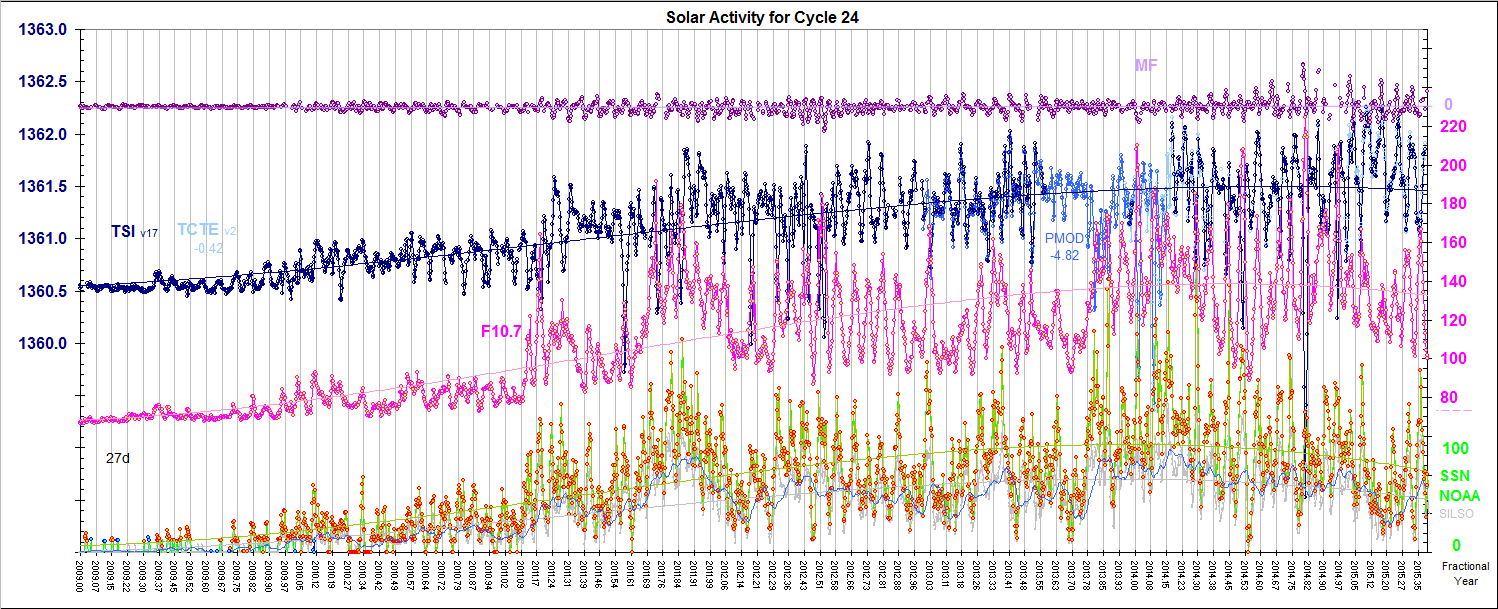
"Right now, the solar cycle is in a valley--the deepest of the past century. In 2008 and 2009, the sun set Space Age records for low sunspot counts, weak solar wind, and low solar irradiance. The sun has gone more than two years without a significant solar flare. In our professional careers, we've never seen anything quite like it," says Dean Pesnell of the Goddard Space Flight Center, NASA's lead representative on the panel. "Solar minimum has lasted far beyond the date we predicted in 2007."

"Meanwhile, the sun pays little heed to human committees. There could be more surprises, panelists acknowledge, and more revisions to the forecast."

"Go ahead and mark your calendar for May 2013," says Pesnell. "But use a pencil."

via NASA Science News
The full Article can be read or heard HERE.

Friday, May 8, 2009

NOAA revises solar cycle prediction


Dr. Leif Svaalgard's plot of Recent Solar Activity
appears to show a very gradual beginning
to Solar Cycle 24 may already be underway.
Englarge HERE.

Leif Svaalgard's Research Page HERE.

In March 2008, NASA heliophysicists could not agree on the likely magnitude of Solar Cycle 24, or on much else other than that Solar Cycle 23 was obviously on the decline. In the end, their prediction was bifurcated, with one camp predicting a sharp end and a "typical" fast upswing in solar activity and a reduction of Cosmic Ray incidence refracted from the Solar System by a renewed interplanetary magnetic field. A peak in Cycle 23 would happen, these experts agreed, in 2011.

The second camp predicted a bottoming out and beginning to Cycle 24 in early 2008, and a strong peak, but no so great as that predicted by the first group four years later. Both camps agreed "we would know by March 2008."

Indeed, in late February 2008 the Sun's activity was already below that of recent Solar Minima, but the first groupings of sunspots with Cycle 24's signature polarity had appeared and, almost as suddenly, faded away. Officially, Solar Cycle 24 was underway. Nevertheless, the Sun continues to remain mostly calm, Cycle 24 sunspots have occasionally sputtered into sight, though twice in the past year, Cycle 23 sunspots also appeared, and the present Solar Minimum now is officially longer and deeper than any recorded in more than a century.

Dr. Leif Svaalgard, a solar physicist of international standing, predicted the present behavior of the Sun with stricking accuracy. A look at the graph above shows his own research, which is groundbreaking, maps what he believes to have been a bottoming out of Cycle 23 and the slow beginning to Cycle 24 probably in July and August 2008.

Today, NOAA released a revised prediction, the summary of which appears below.

NOAA: Mild Solar Storm Season Predicted:

Although its peak is still four years away, a new active period of Earth-threatening solar storms will be the weakest since 1928, predicts an international panel of experts led by NOAA’s Space Weather Prediction Center and funded by NASA. Despite the prediction, Earth is still vulnerable to a severe solar storm.

Solar storms are eruptions of energy and matter that escape from the sun and may head toward Earth, where even a weak storm can damage satellites and power grids, disrupting communications, the electric power supply and GPS. A single strong blast of “solar wind” can threaten national security, transportation, financial services and other essential functions.

The panel predicts the upcoming Solar Cycle 24 will peak in May 2013 with 90 sunspots per day on average. If the prediction proves true, Solar Cycle 24 will be the weakest cycle since number 16, which peaked at 78 daily sunspots in 1928, and ninth weakest since the 1750s, when numbered cycles began.

The most common measure of a solar cycle’s intensity is the number of sunspots—Earth-sized blotches on the sun marking areas of heightened magnetic activity. The more sunspots there are, the more likely it is that solar storms will occur, but a major storm can occur at any time.

As with hurricanes, whether a cycle is active or weak refers to the number of storms, but everyone needs to remember it only takes one powerful storm to cause huge problems,” said NOAA scientist Doug Biesecker, who chairs the panel. “The strongest solar storm on record occurred in 1859 during another below-average cycle.”

The 1859 storm shorted out telegraph wires, causing fires in North America and Europe, sent readings of Earth’s magnetic field soaring, and produced northern lights so bright that people read newspapers by their light.

A recent report by the National Academy of Sciences found that if a storm that severe occurred today, it could cause $1-2 trillion in damages the first year and require four to 10 years for recovery, compared to $80-125 billion that resulted from Hurricane Katrina.

The panel also predicted that the lowest sunspot number between cycles — or solar minimum — occurred in December 2008, marking the end of Cycle 23 and the start of Cycle 24. If the December prediction holds up, at 12 years and seven months Solar Cycle 23 will be the longest since 1823 and the third longest since 1755. Solar cycles span 11 years on average, from minimum to minimum.

An unusually long, deep lull in sunspots led the panel to revise its 2007 prediction that the next cycle of solar storms would start in March 2008 and peak in late 2011 or mid-2012. The persistence of a quiet sun also led the panel to a consensus that the next cycle will be “moderately weak.”

NOAA’s Space Weather Prediction Center (SWPC) is the nation’s first alert of solar activity and its effects on Earth. The Center’s space weather experts issue outlooks for the next 11-year solar cycle and warn of storms occurring on the Sun that could impact Earth. SWPC is also the world warning agency for the International Space Environment Service, a consortium of 12 member nations.

As the world economy becomes more reliant on satellite-based communications and interlinked power grids, interest in solar activity has grown dramatically. In 2008 alone, SWPC acquired 1,700 new subscription customers for warnings, alerts, reports, and other products. Among the new customers are emergency managers, airlines, state transportation departments, oil companies, and nuclear power stations. SWPC’s customers reside in 150 countries.

“Our customer growth reflects today’s reality that all sectors of society are highly dependent on advanced, space-based technologies,” said SWPC director Tom Bogdan. “Today every hiccup from the sun aimed at Earth has potential consequences.”

NOAA understands and predicts changes in the Earth's environment, from the depths of the ocean to the surface of the sun, and conserves and manages our coastal and marine resources.