Tuesday, August 24, 2010

The Moon: Creating capability in space and getting value for our money

Paul D. Spudis
The Once & Future Moon
Smithsonian Air & Space


Of all the possible destinations in space, the Moon offers the proximity, accessibility, and materials necessary to learn how to use what we find in space to create new capabilities. Harvesting the resources of the Moon will allow us to make what we need in space, rather than carrying it with us from the Earth’s surface. The model currently used to pursue our national interests in space – design-launch-use-discard – restrains opportunity, affordability and capability. We can break the limits imposed on all of these factors by learning how to use the resources of space. The development of the Moon creates an extensible, flexible transportation system that opens up the new frontier for many possibilities. Acquiring this essential space faring skill requires investment and commitment, with the full understanding of what will be achieved by this paradigm shift – the beginnings of a new space-based economy. What price tag would you put on that?

A constant refrain in policy discussions is that the space program is too expensive. This verity is at the core of the Augustine report, which asserts that Project Constellation (NASA’s Program of Record to implement the Vision for Space Exploration) is too expensive and requires at least an additional $3 billion per year to implement. The “New Space” community is aggressively campaigning for commercial launch services, pronouncing any NASA-designed/NASA-built space system politically “unsustainable” due to the agency’s inability to receive adequate funding from Congress over the lifetime of a flight program.

The civilian space agency’s 2010 budget is about $19 billion. That’s a nice chunk of change but compared to what the federal government spends elsewhere, it’s not a head-turning sum. For comparison, the Department of Energy’s nominal funding currently stands at $26 billion, to which Congress recently added an additional “one-time” $35 billion for the next two years, averaging out to about $43 billion per year – more than double what NASA will receive.

Other federal agencies and departments are funded at even higher levels. The Department of Education’s FY 2010 budget is $68 billion, of which $56 billion is “discretionary” (meaning non-entitlement). This handsome outlay is for an agency whose principal mission is to influence and monitor public schools; in fact, educating tomorrow’s citizens is the responsibility of state and local authorities and is covered by those taxes, which make up approximately half of the states’ budgets. So in federal spending terms, NASA does not consume as much as most people believe nor is it even “expensive” when stacked up against the cost of other agencies. And when managed even moderately well, we get something for our investment in NASA.

What drives space costs? Advanced technology alone is not the cause. An iPod contains more advanced systems than any single piece of electronic equipment carried 40 years ago on an Apollo spacecraft and is available for a couple hundred dollars. An array of electronic boxes in our homes offer 500 channels of high-definition video in surround-sound stereo – a stunning visual and aural sensory assault – for only a couple thousand dollars. The family automobile contains sensory and monitoring computers, protective airbags, fuel injectors, catalytic converters, automatic parallel parking systems, GPS, satellite radio, DVD players, and a slew of other innovations only dreamed of 20 years ago. These vehicles are affordable enough that most families have more than one in their driveway and buy new models on a regular basis.

Building and launching space vehicles is expensive but the reasons why might surprise you. It’s not the equipment or even the infrastructure that drives up costs. It may well cost hundreds of millions to billions of dollars to build a launch pad and its associated facilities, but once constructed and maintained, it is used essentially forever (some facilities at the Cape have launched rockets for over 50 years). The propellant used to hurl payloads into space makes up only about one percent of the cost of launch. Rockets are built of shaped aluminum (along with a few other more exotic metals) and those pieces make up an additional 10% or so of the total cost.

Spaceflight costs remain high because it requires complex machines, with millions of parts working together in a precise order and in perfect coordination to put a payload into space. To assure that these events transpire as planned, we pay a large number of highly skilled technicians, engineers and scientists to design, build and operate space systems. These high demand people don’t work for minimum wage. It requires almost 10,000 people to operate the U.S. Space Shuttle launch vehicle system. Everyone has a critical job, from program design to inspecting and replacing thermal tiles on the orbiter airframe, to stacking and configuring the vehicle for launch –- everything and everyone necessary for the construction, operation and flight of the vehicle to and from orbit. It is a specialized machine that is custom-made and individually operated. Moreover, each individual piece of hardware has a paperwork trail so that part failures can be tracked back in time and space. Documenting these part histories and pedigrees requires many hours, all billed to some charge code.

Despite our best efforts, rockets are finicky and unpredictable. Sometimes, satellites don’t wind up in the proper orbit or fail to operate correctly. Customers who paid for the satellite need some kind of indemnification against these possibilities. Insurance rates are based on a careful assessment and determination of risk. For a launch system with a long history of reliable performance, premiums are relatively low (but still substantial). New rockets and new companies face higher insurance costs and it may take many years to establish a track record of enough resiliency and consistency so as to significantly lower insurance rates. These costs must be folded into the cost per kilogram to LEO.

Which brings us to the inescapable fact that a major obstacle to routine affordable spaceflight –what makes other high technology efforts affordable – is the lack of mass production and automation in the fabrication of space systems. If we could mass produce rockets and automatically assemble and check them out for launch, launch costs would drop dramatically. Commercial items are inexpensive because development costs are amortized over very large sales volumes. For space systems, development costs are very large and not easily hidden by amortization.

A way to make spaceflight cheap is to remove much of the highly paid human talent from the end-to-end processing stream. One possibility is to automate most of the process of rocket fabrication, assembly, checkout and launch. A wholly new approach to our launch service infrastructure and model of operations would be required and to my knowledge, no company or government entity is working on such an approach. Even SpaceX uses a skilled cadre of people to custom build, launch and operate their vehicles. The claimed goal of SpaceX is a factor of ten reduction in cost and increase in reliability. I hope they reach it. But even if they do, space travel is still a costly enterprise; reduction of cost from the current $10,000 per kilogram (Atlas 5) to $5400 per kg (the quoted current cost for a Falcon 9 launch, which is not yet operational) is progress, but is not the canonical “hundreds of dollars per pound” breakthrough sought by space fans everywhere.

Another way to lower costs is to do what others in high-technology fields have done: outsource the work overseas. The Indian PSLV rocket can put 3700 kg into low Earth orbit and costs about $20 million (at least, that’s what informed sources claim it cost to launch TECSAR, an Israeli radar imaging satellite). This price works out to be about $5400 per kg, exactly the same as the projected cost for the Falcon 9 – and the PSLV already has a proven track record. The Russian Proton rocket puts about 20,000 kg into orbit for an estimated $115 million, about $5700 per kg. Even the supposedly “costly” European/French Ariane V puts 18,000 kg into space at a cost of $120 million, or about $6600 per kg.

The cost of all these competing systems seems to be approaching a single value – $5000 per kilogram is achievable for launch within the existing engineering state-of-the-art. Is such a cost “cheap enough?” Commercial launch costs have hovered between $5000 and $10,000 per kilogram (constant dollars) for the last thirty years. This “expensive” price structure has given rise to a thriving commercial space industry, especially in global communications. And despite the hype about orders-of-magnitude decreases in the cost of launch, these numbers likely will persist for the indefinite future. SpaceX has no access to special physics, ULA cannot repeal the law of gravity and XCOR cannot change the rocket equation.

Space launch costs what it costs. Spaceflight is expensive because we employ and pay thousands of highly skilled and trained people to build and operate space systems. Despite decades of planning and talking, these costs have not decreased significantly and the dream of cheap space launch remains a chimera. We frequently get marginal improvements in the dollars per kilogram number, but never of the order-of-magnitude variety. The problem of small volume/high cost cannot be solved by factors of two or three decreases in launch cost. We need a new operational approach that severs the Gordian Knot problem of the cost of space launch.

The use of off-planet resources of materials and energy is that approach. Despite new launch vehicles, new companies and supposed new approaches, we have only marginal improvements in the cost numbers for launch. It is time for the new and fundamentally different approach of developing the Moon’s natural resources to build a space faring infrastructure that will create new capabilities and give us lasting value for our money.

Paul D. Spudis is a Senior Staff Scientist at the Lunar and Planetary Institute in Houston, Texas.

Too brief an expedition to a lobate scarp

Lee Lincoln Scarp – the only lobate scarp toured on foot surveyed from the Lunar Reconnaissance Orbiter (LRO), February 1, 2010. Roughly sketched is the path of Cernan & Schmitt (Apollo 17) during rushed visit (EVA 2) to Taurus-Littrow in December 1972. White dotted lines mirror the two elevation studies discussed by Smithsonian investigator Thomas Watters, August 19. (One sampling apparently intersects the path of EVA 2 on their way to Geology Station 3, Ballet crater, east of Lara.) The blue arrows note, again roughly, the directions of mission photographs discussed below. Mosaic from LROC Narrow Angle Camera (NAC) observations M119652859L & R; north is at top, from 42.73 km alt., resolution 0.51 meters per pixel, and illumination from the west by southwest (phase angle 37.76°) [NASA/GSFC/Arizona State University/Smithsonian].

Joel Raupe

In reviewing reports of “The Incredible Shrinking Moon,” the headline originated by Paul D. Spudis and afterward headlining news accounts seemingly everywhere (including here, until we changed it to the less poetic "Moon geologically active, cooling, shrinking") we were inspired to spend time this past weekend re-experiencing the second EVA of Apollo 17.

Of all the known or newly-discovered thrust faults, manifested at the surface of the Moon by lobate scarpes, surveyed by Thomas Watters, senior scientist for the Center for Earth and Planetary Studies at the Smithsonian, cited as evidence that the Moon had "radially contracted," by 100 meters or so, and more recently than generally believed possible, only one has been toured and directly sampled.

The Lee Lincoln scarp, as labeled on maps, was walked on and driven over by Apollo 17 cmdr. Capt. Gene Cernan (USN, Ret.) and geologist Dr. Harrison H. Schmitt, on the night of December 12-13, 1972. It was next to last time anyone walked on the Moon.

Like every deep space survey, even virtual journeys like ours, we found more than we planned, and little of that immediately related to the formation of these tectonic features.

Montage of four 500mm photographs by Captain Cernan, from Geology Station 3 (Ballet crater, east of Lara), and likely our only view along a length of any lunar lobate scarp. (See the full-sized montage at the Apollo Surface Journal, HERE.) This is a foreshortened view of the scarp where it overlaps an intersection of the valley floor, the steep slope of North Massif. The feature winds upward, immediately bend to the north and northwest, like a mountain road bed, highly visible from a great distance. The movement of the thrust fault seems to have encountered the Massif and, meeting resistance, crept more slowly. The field of view is includes an area ranging from four to more than seven kilometers away. At lower center-right, Hanover crater peaks over an intervening lip of the scarp, like a Cyclops gazing over the valley floor [NASA/Apollo Surface Journal].

Some recent, hopefully temporary, computer problems continue to hamper our ability to expand graphically in as robust a manner as we prefer on the latest additions to this digest of Moon news. We're essentially bound to one audio and video format, for the moment. So we were somewhat astounded to find that the audio and video clips sequentially linked to the Apollo Surface Journal pages devoted to EVA 2 of Apollo 17 included those in that same format. Oddly, this was the true of the history of that EVA only.

We took the time to download and stack all these EVA 2 audio and television clips and then played these back to back without interruption. The result was highly worthwhile, underscoring how correct, but highly understated we are when we say "we've barely scratched the surface" of the Moon.


"The boys in the backroom" in Houston had already shaved the EVA timeline to add fifteen minutes to the their earlier stay at Nansen, on the slopes of South Massif, and were hustling Cernan & Schmitt along, by the time they arrived at the rim of Shorty crater. Their traverse of the northwestern interior of Taurus Littrow was nearly at an end. Meanwhile, Dr. Schmitt's earlier excitement was dragging slightly, but picked up instantly when his geologists' eye happened upon one of the most important discoveries of the Apollo era, "orange soil," in a landscape dominated by three shades of gray-brown dust. It took ground controllers only moments to catch up with his understanding of the possible significance of the discovery, and time was added for a longer stay. Across the horizon, with the Western Family Mountains and Mare Serenitatis beyond, is a band of lighter material. This is the edge of the lobate scarp, which is more than two kilometers away, and much better experienced in high resolution, HERE) [NASA/Apollo Surface Journal].

Others will come away from such an experience with different impressions, of course. That’s a subject for another post, but we were strongly reminded that as much time has passed since the Apollo 17 expedition and today than previously passed between the invention of talking motion pictures and the Apollo era.

Remotely operated, micro color television of rudimentary fidelity can be understood and excused. Allowing so much time to pass before advancing that experiment and others on the lunar surface cannot be.

Watching EVA 2. in “real-time,” also underscored the ironic brevity of the whole thing. The Apollo surface mission, particularly the last three Science, or "J" missions, were high water marks of civilization, culminating a decade-long devotion by 100,000 people. As we watched Gene Cernan and Jack Schmitt scramble through their perishable consumables, precious time and air, to get to the actual geology or their mission, with so many voices chattering and cautioning, and also hustling them along, we simply wondered that they were able to accomplish what they did.

Captain Cernan credits training, years of preparation, for the safe productivity of their expedition. These last missions to the Moon, especially this very last one, were also successful because of the full body of training and, by then, the experience of everyone involved.


The orange soil discovered and trenched out by Dr. Schmitt was found on the rim of Shorty, and slumped down the inner walls of the crater, most likely excavated from the depths hollowed out by the impact event. The crater itself, and the surrounding terrain now appear to have been pushed up by the thrust faulting, manifested by the scarp. In turn, Shorty sits within a wisp of the Light Mantle, higher albedo dusting the crew had come to sample. Those samples would add evidence to Schmitt's earlier determination of the age of Tycho, which appeared to have blown debris over the heights of South Massif and down into Taurus Littrow 109 million years ago. High resolution image, HERE [NASA/Apollo Surface Journal].

"Oh, hey!" Schmitt pauses very briefly, in the transcript by Eric Jones. They have just arrived at Station 4. By his own admission, Dr. Schmitt was tired, and it can be heard in his voice. right up until something caught his eye after describing the "very intensely fractured rock, right on the rim (of Shorty crater)."

Schmitt has just seen the orange soil, but He's cautious, Jones writes, having been fooled by the play of sunlight when he and Cernan were back on the scarp.

"Wait a minute...," Schmitt said. "Where are the reflections? I've been fooled once. There is orange soil!"
Reluctantly, the almost tyrannical voices from the Back Room, heard by the CapCom in Houston agree to add time to their stay at Shorty crater. Already, they had added time to their first stay at Nansen, by shaving time from their planned stay on the scarp and here at Shorty. It took only a minute or so for them to catch up with Schmitt, and by now Cernan, in understanding the possible significance of the find.

These finest particulate samples were later explained as evidence of fire fountains, perhaps similar to those seen in Iceland recently, occurring late in the Moon's cooling, perhaps now better understood as having been elevated nearer to the surface by the thrust fault which raised the whole vicinity explored during the EVA near the scarp, eventually excavated to the crater rim by the Shorty "impact event."

Those orange glass particles proved rich in titanium, iron oxide and also zinc. It was tantalizing evidence of the greater unknown part of the Moon, lying about just out of reach, or just beneath its surface. Just as the slow changing landscape of Antarctica allows for the discovery of lunar and martian samples, it's inevitable very unique terrestrial samples will be found on the Moon.

We were reminded, once again, that no comprehensive understanding of Earth can happen before a proper exploration of the Moon.

Happening upon the orange soil was a lasting result of Apollo 17, though the greater impression, we agreed, begged a simple question: If this is an example of what can be found during an abbreviated, rushed geology "field trip" on the Moon what might a true geology Season there discover?


Offering some perspective on the Shorty experience, Cernan panned through this high resolution image over and behind the crater, allowing an excellent look at it's interior, slightly stained with orange fallout. Over the far rim, thousands of meters further away, is the bend at the contact of scarp with the valley floor and North Massif slope, gazed over by of Hanover. (A strongly recommended high resolution view is HERE.) Compare with the vertical view below, and, in context, with the montage at the beginning of this post showing the vicinity from 40 km overhead (37 years later) [NASA/Apollo Surface Journal].


Shorty, in this stretched 196 meter wide scene sampled from LROC NAC observation M119652859R, swept up February 1, 2010. Those darker markings at lower left are foot prints and tire tracks. The outcrop and trench in the views further above are poised on the crater rim nearby. Illumination is from the west by southwest, or late afternoon. Cernan & Schmitt made their all-too-brief, but historic, visit at mid-morning [NASA/GSFC/Arizona State University].

Monday, August 23, 2010

Rocketdyne-Lunar Ascent Engine


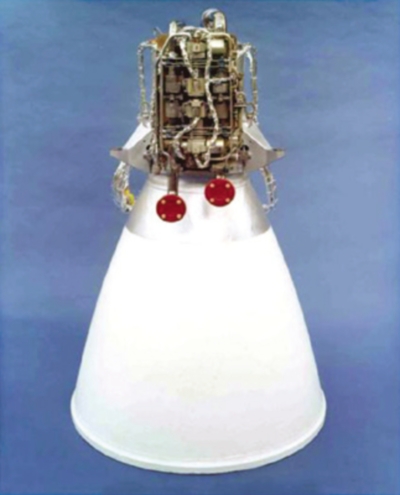
Scale model of the Apollo lunar module ascent stage engine, by an important small company. The story of this vital and non-redundant system, built by a subcontractor, illustrates how a project within a project can sometimes be made to work [Pratt and Whitney Rocketdyne].

Tim Harmon
Chapter 7, Remembering the Giants

First time, everytime, there was no second chance. The lives of two men on another planet hung on the flawless performance of a single engine. Frames by Kipp Teague from the video [Apollo Surface Journal].

Redundancy was really a major hallmark of the Apollo Program. Everything was redundant.

Once you got the rocket going, you could even lose one of the big F-1 engines, and it would still make it to orbit. And once the first stage separated from the rest of the vehicle, the second stage could do without an engine and still make a mission. This redundancy was demonstrated when an early Apollo launch shut down a J-2 second-stage engine. Actually, they shut down two J-2 engines on that flight. Even the third stage, with its single J-2 engine, was backed up because the first two stages could toss it into a recoverable orbit. If the third stage didn’t work, you were circling the earth, and you had time to recover the command module and crew.

Remember how on the Apollo 13 flight, there was sufficient system redundancy even when we lost the service module. That was a magnificent effort. TRW Inc. really ought to be proud of their engine for that.

We had planned for redundancy; we had landed on the moon. However, weight restrictions in the architecture said, “You can’t have redundancy for ascent from the moon. You’ve got one engine. It’s got to work. There is no second chance. If that ascent engine doesn’t work, you’re stuck there.” It would not have looked good for NASA. It wouldn’t have looked good for the country. There was a letter written that President Richard Nixon would read if the astronauts got stuck on the moon, expressing how sorry we were and so forth. It was a scary letter, really. The ascent engine was an engine that had to work.

Read the full presentation (pdf, 4 Mb), HERE.

Thursday, August 19, 2010

Moon geologically active, cooling and shrinking

Updated August 23, 2010 22:52 UT

Lunar Tectonism. LROC digital terrain model (DTM) of the Lee Lincoln lobate scarp, running through the Taurus Littrow valley's northern interior, northwest of the Apollo 17 landing site. (The face of the scarp can be seen in this website's logo at the top of this page. -Apollo 17 lunar module pilot Harrison H. Schmitt examines the orange glass deposit on the western rim of Shorty crater, and the bright wall running across the scene behind him is the direct face of the scarp's down-slope) [NASA/GSFC/ASU].


Corollary profiles to the above cross-sections A and B, showing the rapid change in elevation across Lee Lincoln scarp [NASA/GSFC/Arizona State University].

Joel Raupe

Investigators have discovered compelling evidence the Moon may still be geologically active.

A newly discovered global distribution of very young upthrust faults known as lobate scarps indicate the Moon has shrunk, demonstrating a radial contraction by 100 meters over a period well within the past 800 million years. The discovery definitively sets aside previously long-settled notions that the Moon is geologically dead. Instead, the Moon has been cooling very recently, and may cooling still.

The discovery announced by NASA comes after careful examination of Lunar Reconnaissance Orbiter (LROC) Narrow Angle Camera observations and the discovery of newly-identified upthrust faults and mapping their global distribution together with similar already known features.

The nature and distribution of crater counts overlapping and below these upthrust faults shows them to be relatively recent phenomena, forming as the Moon continued (or continues) to cool far later than previously believed possible.

Thomas Watters, senior scientist for the Center for Earth and Planetary Studies at the Smithsonian National Air and Space Museum, revealed these findings ahead of their publication in the Journal Science, during a NASA teleconference, Thursday, August 19.


Newly Discovered lobate scarps Rozhdestvenskiy 1 (above) and Shoemaker (below), are examples of high lattitude, thrust faults. "Seven of the fourteen newly detected lunar scarps are found at high latitudes (> ±60°). The distribution of newly detected and previously known scarps suggests that thrust faults are globally distributed; important implications for the thermal history of the Moon." - Mark Robinson, LROC principal investigator, Arizona State University [NASA/GSFC/ASU].


"Contrary to what many people, including many scientists, believe," Watters told reporters, "the Moon is not a dead, inactive planet. The Moon is truly a dynamic planet."

"This is only the beginning of our understanding of this phenomena," added John Keller, LRO deputy project scientist at NASA Goddard Space Flight Center. "As with all missions, we set off with LRO and a well-mapped plan on what to do at the Moon. Now, however, we have added another unexpected paradigm change, and something new to look for.

"It is compelling evidence of a geological process taking place over a very recent time, and one that is perhaps still under way."

The global distribution and prevalence of lobate scarps was also discussed the National Lunar Science Institute's 3rd annual conference in July, as part of the presentation of a summary of Lunar Reconnaissance Orbiter Camera (LROC) discoveries during the past year, by LROC principal investigator Mark Robinson. Robinson's presentation slides can be reviewed (PDF), HERE.


Figure 1: Thrust faults are formed when the lunar crust is pushed together, breaking the near-surface materials. The result is a steep slope on the surface called a scarp as shown in this diagram [Arizona State University]. › Larger image


Figure 2: The mare basalts that fill the Taurus-Littrow valley were thrust up by contractional forces to form the Lee-Lincoln fault scarp It is the only extraterrestrial fault scarp to be explored by humans. The digital terrain model derived from Lunar Reconnaissance Orbiter Camera (LROC) stereo images shows the fault extending upslope into North Massif were highlands material are also thrust up. The fault cuts upslope and abruptly changes orientation and cuts along slope, forming a narrow bench. LROC images show boulders shed from North Massif that have rolled downhill and collected on the bench [NASA/Goddard/Arizona State University/Smithsonian]. › Larger image


Figure 3: Over recent geologic time, as the lunar interior cooled and contracted the entire moon shrank by about 100 m. As a result its brittle crust ruptured and thrust faults (compression) formed distinctive landforms known as lobate scarps. In a particularly dramatic example, a thrust fault pushed crustal materials (arrows) up the side of the farside impact crater named Gregory (2.1°N, 128.1°E). By mapping the distribution and determining the size of all lobate scarps, the tectonic and thermal history of the moon can be reconstructed over the past billion years [NASA/Goddard/Arizona State University/Smithsonian]. › Larger image


Figure 4: This map illustrates the distribution of lobate scarp features located thus far. Black dots indicate previously known scarps while white dots depict newly detected scarps found in images from the Lunar Reconnaissance Orbiter Camera [NASA/Arizona State University/Smithsonian]. › Larger image


Figure 5: Another fault cut across and deformed several small diameter (~40-m diameter) impact craters (arrows) on the flanks of Mandel’shtam crater (6.5°N, 161°E). The fault carried near-surface crustal materials up and over the craters, burying parts of their floors and rims. About half of the rim and floor of a 20 m-in-diameter crater shown in the box has been lost. Since small craters only have a limited lifetime before they are destroyed by newer impacts, their deformation by the fault shows the fault to be relatively young [NASA/Goddard/Arizona State University/Smithsonian]. › Larger image

America's Lunar Reconnaissance Orbiter (LRO) was launched from Kennedy Space Center, June 18, 2009 and commenced it's Nominal Mission phase the following September. Since then LRO has orbited the Moon 5,300 times and will soon have returned more data to Earth than all previous (and on-going) Deep Space missions, combined. Though investigators will sift through this treasure for decades to come, LRO has already become a central player in a revolution in our understanding of Earth's nearest neighbor in Space.

Searching for Alaska's lost lunar treasure

Elizabeth Riker
Capital City Weekly
Juneau


On May 25, 1961, President John F. Kennedy challenged the United States space program to safely send an American to the moon by the end of the decade. NASA met this challenge, accomplishing the President's goal by launching Apollo 11. The Eagle lunar module landed on the moon July 20, 1969. Part of this mission included collecting lunar samples from the moon to bring back to Earth.

NASA prepared the moon rocks for presentation to all 50 states and 135 countries around the world by the Nixon Administration. Alaska received its very own Apollo 11 Moon Rock, which in reality is four lunar fragments displayed in a Lucite ball, yet priceless to collectors. So how did Alaska treat its treasure from space? It is currently lost, misplaced, or has been stolen. State government officials are clueless to the whereabouts of this priceless treasure and Alaska's law enforcement is doing nothing to find its moon rock that may command 5 million dollars on the black market. Sadly, America's biggest state has made a blunder proportionate to its size.

My professor, a retired NASA Office of Inspector General Senior Special Agent, assigns his students the task of investigating unaccounted-for moon rocks that were given to the states and nations of the world. This assignment is called the "Moon Rock Project." I was assigned the Alaskan Apollo 11 Moon Rock to investigate and I have been pursuing it for five weeks.

Throughout this investigation, I have encountered people who have never heard of the Apollo 11 Goodwill Moon Rock and do not understand its significance and value. However, I have been in contact with others who are intrigued and have offered their assistance in the search. In particular, Steve Henrikson, Curator of Collections at the Alaska State Museum, is working diligently on this investigation. He contacted other museums in Alaska, urging them to search through their records to see if there is any sign of the moon rock display. Henrikson also contacted local government officials, who have no recollection of the moon rock; some are not even aware of the moon rock or its value.

Tatyana Stepanova, an archivist from the Alaska State Archives, provided evidence dating back to October 9, 1970. This evidence proves the moon rock display was presented to Alaska and was lent out to various individuals to be displayed throughout the state. The last location on record where the Moon Rock was to be displayed is the Chugiak Gem and Mineral Society in Anchorage, scheduled to be shown from February 12, 1971 through February 24, 1971. There is no evidence of the moon rock display's location beyond this date.

Tatyana Stepanova, an archivist from the Alaska State Archives, provided evidence dating back to October 9, 1970. This evidence proves the moon rock display was presented to Alaska and was lent out to various individuals to be displayed throughout the state. The last location on record where the Moon Rock was to be displayed is the Chugiak Gem and Mineral Society in Anchorage, scheduled to be shown from February 12, 1971 through February 24, 1971.

There is no evidence of the moon rock display's location beyond this date.

The fact of the matter is this moon rock was a gift from the Nixon Administration to the state of Alaska. It was meant to be shared with the people. An artifact of this nature represents an important accomplishment of our space program, and I am committed to seeing this investigation through. With help from the good citizens of Alaska, I am confident we will be successful.

Elizabeth Riker is a criminal justice graduate student and member of the "Moon Rock Project" at the University of Phoenix. She may be reached at ecriker@att.net.

Tuesday, August 17, 2010

NASA update: ILN Anchor Nodes and Robotic Lunar Lander Project

Updated August 18, 2010 1648 UT
Global Lunar Conference, Beijing
May 31- June 3, 2010

Exploration configuration. Refinements continue on designs for NASA's multipurpose lunar lander bus, while a timetable for deploying an unknown number of Anchor Nodes for the International Lunar Network (ILN) and the fate of a recommended Lunar Polar Volatiles exploration mission to the lunar surface remain on hold, awaiting hints of what will appear in the next Planetary Science Decadal Survey (2013-2022), expected in January 2011 [NASA/MSFC].

Brian J. Morse, Cheryl L. B. Reed
& Karen W. Kirby
Johns Hopkins, Applied Physics Lab

Barbara A. Cohen, Julie A. Bassler, Danny W. Harris
& D. Gregory Chavers
NASA Marshall Space Flight Center

ABSTRACT: In early 2008, NASA established the Lunar Quest Program, a new lunar science research program within NASA’s Science Mission Directorate. The program included the establishment of the anchor nodes of the International Lunar Network (ILN), a network of lunar science stations envisioned to be emplaced by multiple nations. This paper describes the current status of the ILN Anchor Nodes mission development and the lander risk-reduction design, and test activities implemented jointly by NASA’s Marshall Space Flight Center and The Johns Hopkins University Applied Physics Laboratory. The lunar lander concepts developed by this team are applicable to multiple science missions, and this paper will describe a mission combining the functionality of an ILN node with an investigation of lunar polar volatiles.

INTRODUCTION:

NASA Robotic Lunar Lander development. One of the defining features of the U.S. Vision for Space Exploration, established by the former administration and studied by NASA for the past 4 years, is the goal of a human return to the Moon to live and work for extended periods. Whether that plan will be executed, however, has grown increasingly uncertain. Turbulent economic times, along with the need for the new administration to set its own priorities, have resulted in a complete review of U.S. space policy and NASA’s programs.

Many months remain before the process will be complete and new plans can be developed. But even in the face of this uncertainty, it is clear that the Moon is of significant scientific importance to NASA and many other nations and is a prime target for low-cost robotic missions that can be undertaken by most of the world’s space programs. Thus, it can be expected that lunar robotic missions will remain a high priority while the U.S. human exploration program is restructured; when humans begin to venture beyond low-Earth orbit to the Moon, near-Earth objects, and eventually Mars, the generic technological capabilities developed through lunar robotic missions will serve as important steps toward future achievements. The Moon contains a wealth of scientific information about planetary formation and the origins of Earth.

NASA has a rich portfolio of lunar flight projects, including two payloads on India’s Chandrayaan-1; the Lunar Reconnaissance Orbiter (LRO); the Lunar CRater Observation and Sensing Satellite (LCROSS); the Gravity Recovery and Interior Laboratory (GRAIL); the Acceleration, Reconnection, Turbulence and Electrodynamics of Moon’s Interaction with the Sun (ARTEMIS) mission; and the Lunar Atmosphere and Dust Environment Explorer (LADEE) mission.

Other nations, including China, Japan, and India, also have emergent lunar portfolios. During this exciting time for lunar science, many significant scientific discoveries are just being realized from these flights, including the likely orbital confirmation of trapped water-ice on the lunar surface.

In addition, the U.S. National Research Council (NRC) is in the early stages of its new Decadal Survey for Planetary Science, which establishes priorities to be incorporated into the roadmap for NASA’s Planetary Division of the Science Mission Directorate (SMD).

The final report will not be ready until January 2011, but the results of many current planetary studies will be publicized along the way, previewing expected planetary (and lunar) priorities for the next 10 years. Internationally, multiple space-faring nations are concurrently planning robotic missions to the Moon. To maximize the scientific return of these efforts, nine national space agencies signed a statement of intent to establish a set of robotic lunar landers in a geophysical network on the surface of the Moon.

This collaborative initiative is known as the International Lunar Network (ILN). ILN nodes will fly a core set of instruments, plus additional passive, active, in situ resource utilization (ISRU), or engineering experiments, as desired by each space agency. Participants’ contributions can be landers, orbiters, instrumentation, or other significant infrastructure contributions, including communications capabilities, which in total will comprise the ILN.

From Lunar Pioneer Album 2 --
Anchor node of the International Lunar Network (ILN), hosted by the multi-use lander, now well along in development. The new generation configuration is shown here in an unlikely spot, if ILN ultimately turns out to be a sparse seismographic network (i.e., south central Mare Imbrium, in sight of Mons La Hire) [NASA/MSFC/JHU-APL].

The envisioned U.S. contribution to the ILN was the Anchor Nodes mission to be implemented jointly by NASA’s Marshall Space Flight Center (MSFC) and The Johns Hopkins University Applied Physics Laboratory (JHU/APL).

The ILN Anchor Nodes mission would develop a broad lander capability and establish surface and embedded elements to better characterize the structure and composition of the lunar interior. The United States originally envisioned launching the first two nodes to the mid-latitude regions in the 2015–2016 time frame, with an option to launch two more nodes shortly thereafter.

Alternatively, NASA could launch all four nodes in the 2017–2018 time frame. However, the specific science to be conducted, and the payload suite to carry out these measurements, could change, given the recently published lunar water-ice discoveries and the forthcoming results of the Decadal Survey. Discussions continue with NASA’s international partners to provide additional nodes within this time frame to constitute the first lunar scientific network.

Regardless of the specific science objectives, the goals of the Anchor Nodes mission will remain technically and programmatically challenging. These goals include the placement of multiple nodes on the near side of the Moon, continuous operations through many years of lunar eclipse, low-mass and low-power subsystems and instruments, and a minimum 6-year lifetime. Future nodes are planned for the far side of the Moon, for which lunar–Earth communication and navigation solutions are under consideration by countries supporting the ILN.

From Lunar Pioneer Album 1 --
In September 2009, Marshall Space Flight Center in Huntsville, Alabama announced the beginning of tests of a new robotic lunar lander test bed to aid development of a new generation of multi-use landers for robotic space exploration. The Phase One Cold Gas Test Article is equipped with thrusters to guide the lander, one set to control the vehicle's attitude, altitude and landing and additional thrust to offset the effect Earth’s gravity to simulate a lunar environment. By June 2010, the CGTA has been put through its paces 150 times [NASA/MSFC].

After the completion of an extended pre-Phase A study, the implementation of an ILN Anchor Nodes mission was placed on hold pending the resolution of the above-mentioned uncertainties. The MSFC–JHU/APL team was renamed the Robotic Lunar Lander Development Project (RLLDP) with the scope to complete an array of lander technology risk-reduction tasks and to perform studies on other missions that address some of the key science and exploration priorities.

One such mission combined the functionality of a single ILN node with instruments to prospect for volatiles in a fixed location within a permanently shadowed lunar polar crater. The latest data from lunar orbiting observatories have further fueled interest in attaining “ground truth” for the presence of volatiles, including water-ice, in permanently shadowed craters.

The single-site approach is limited in its ability to fully satisfy key science goals associated either with the ILN mission or with a desire to fully characterize the volatile distribution, but it represents a much more affordable single mission that, combined with other missions, could more fully address these goals. The results of this study and the status of the risk-reduction tasks spanning technologies in propulsion; guidance, navigation, and control; power; avionics; thermal; and structures and mechanisms are documented in this paper.

SCIENCE. The Moon provides an important window into the early history of the Earth, containing information about planetary composition, magmatic evolution, surface bombardment, and exposure to the space environment.

Despite more than 4 decades of intensive study, many aspects of the Moon remain to be determined. One of the key motivations for studying the Moon is to better understand the origin of the planets of the inner solar system in general and that of Earth in particular.

The NRC report, New Frontiers in the Solar System: An Integrated Exploration Strategy (the Planetary Science Decadal Survey), is the principal roadmap for solar system exploration, providing a community-based weighting of science priorities across the solar system, including the Earth’s Moon. In this document, the Inner Planets Panel asserted that the inner solar system affords the opportunity to address broad objectives for understanding the history, current state, and potential future of habitable planets. Landed missions were recommended by the panel for all of the terrestrial planets—Mars, Venus, Mercury, and the Moon—in order to address multiple key aspects of inner solar system science.

The next Planetary Science Decadal Survey for the period 2013–2023 is currently under way. This report will not be ready until January 2011, but the results of many current planetary studies will be publicized along the way, previewing expected planetary (and lunar) priorities for the next 10 years.

In support of this activity, the lunar science community articulated and prioritized its science objectives in a set of 35 white papers, painting a coherent and compelling picture of the importance of lunar science to understanding differentiation of planets, the bombardment history of the inner solar system, and processes unique to airless bodies. Two candidate lunar lander missions—a geophysical network and an in situ polar volatile explorer—were studied and presented to the Decadal Survey by this team in order to address multiple key aspects of lunar and planetary science.

Lander technology developed for any of these missions will have significant feedforward to other missions to the Moon and indeed, to other airless bodies such as Mercury, asteroids, and Europa, to which many of the same science objectives are applicable.

Read the Report and Presentations (pdf), HERE.

From Lunar Pioneer Album 3 --
Warm Gas Test Article, currently slated for testing at Marshall Space Flight Center, takes the multi-use lander design testing beyond the maneuver, attitude control and landing thrust demonstrated using the Cold Gas Test Article began in 2009. Testing can now begin for critical maneuvers like Terminal Descent [NASA/MSFC].

Related:
Robot Landers for Science & Exploration
Chavers & Cohen, et.al. [JHU-APL/MSFC]
7th International Planetary Probe Workshop (IPPW-7)
Barcelona, June 12-18, 2010

Finalist MoonBots teams down to the Wire

Twenty finalist MoonBots teams continue preparations for their "final mission challenge" in the student competition, complimentary to the Google Lunar X PRIZE contest. More than two hundred teams from sixteen nations originally completed requirements for the first phase of the MoonBots Challenge before the final twenty qualified last April. The contest was open to students between the ages of nine and eighteen.

Using LEGO bricks and MINDSTORMS components, the MoonBots contest requires the teams to create simulated lunar rovers and use them to complete a series of predetermined tasks.

As the contest comes down to the last lap, teams are very busy blogging about their experiences, writing about obstacles overcome lessons learned. Some teams are completing their live missions a bit early to prevent any clash with school schedules.

Judges mentioned being impressed with results from all entries during earlier rounds. “Teams with little or no previous experience with robotics or with CAD software are engaging in this competition on equal terms with veterans,” said Steven Canvin, marketing manager for LEGO MINDSTORMS.

Surveys of participating students reveal nearly half report significant increases in understanding of the Moon and lunar exploration and skills gained using a variety of professional software applications.

“The students are learning to combine several challenging skills and to apply them in a new way. The MoonBots Challenge has required them to get creative, to find imaginative ways to express how they’ve used science, technology, engineering and mathematics to solve problems,” Canvin said.
The twenty finalists MoonBots teams are: ARES (Texas, USA); Coastal Quarks (California, USA); Cougar LEGO Robotics Team (Ohio, USA); Crandroids (Michigan, USA); G.I.R.L.S. (Missouri, USA); got robot? (Illinois, USA); Intergalactic Bacon (Florida, USA); Just Ducky (Minnesota, USA); Landroids (New Jersey, USA); LegoAces (Ohio, USA); Lunar Horizon (California, USA); Milkyway Monsters (Massachusetts, USA); Moonwalk (New Jersey/Connecticut, USA); New Hartford RoboSpartans (New York, USA); OABB 4-H Lego Robots (California, USA); Pushing Frontiers (Lovenjoel, Belguim); Team Tater Tot (Minnesota, USA); The Shadowed Craters (California, USA); WEBstormers (Cape Town, South Africa); and Yellow Jackets (Michigan, USA).
All twenty finalist teams will receive a LEGO MINDSTORMS kit, two-year subscriptions to WIRED and all of the LEGO bricks used to build the simulated lunar surface necessary in the final phase of the competition.

Something Bradbury This Way Comes

From Lunar Pioneer Album 3 -
Then-President George W. Bush and First Lady Laura Bush present the National Medal of Arts award to Ray Bradbury in 2004 [White House photo by Susan Sterner].

Joel Raupe

It should be interesting to see if the number or the tone of many enthusiastic birthday greetings being posted for a surviving Dean of the Golden Age of Science Fiction now become more muted over coming days. Ray Bradbury, who celebrates his 90th birthday August 22, has taken the opportunity to tell reporters we need a revolution. Since there are few American writers who are better masters of metaphor, we can safely believe he was being metaphorical.

Like Robert Heinlein (or Orson Scott Card, for that matter), Bradbury is not a fan of massive paternal government. He's also not a fan of halting work on putting a permanent manned presence on the Moon, and beyond. But because some lack confidence politically, something else Bradbury said that would otherwise be just amusing may now be used instead to ruin celebrations of his birthday.

Some more dogged fans of his writing are also strong supporters of President Obama's proposed changes in national space policy. It's likely too many will now be too quick to pick up on a malapropism from Bradbury, more specifically his having said "we have too many Internets."

That would be regrettable, however passionate one might be about space policy (or the undoubted benefits of more ready access to the Moon).

It would be foolish to mock Bradbury's age, his lack of familiarity with iPhones, or his politics, and mistake his for a slipping mind not worth listening too. Bradbury is not some kind of latter-day Ezra Pound.

This very small part of Bradbury's recent remarks in Los Angeles has already become the story in pieces originally about his coming birthday. And there are bound to be unseasoned writers, some of whom rushed already to extend tributes to Bradbury, who might now think they are required to regret their Best Wishes, perhaps fearing they might otherwise appear politically incorrect.

But consider this: That among the Lunar Pioneer posters we continue to try to stick to pieces related, at least in some way, to Earth's Moon. We're only too happy to leave to others the job of keeping us up to date on the Known Universe. So, it might be Bradbury has a point.

He has a point to the extent that some online writers feel a vain compulsion to appear comprehensive, the need to add a monologue to the Echo Chamber, adding pressure to today's firehose of opinion. While many might say this results in too high a noise level, Bradbury might instead say there are 'too many Internets.'

And, after all, the Real Story is Bradbury's birthday, the anniversary of an authentic legacy enduring across four generations of grateful readers.

From the Los Angeles Times:
Ray Bradbury is mad at President Obama, but it’s not about the economy, the war or the plan to a construct a mosque near Ground Zero in New York City.

“He should be announcing that we should go back to the moon,” says the iconic author, whose 90th birthday on Aug. 22 will be marked in Los Angeles with more than week’s worth of Bradbury film and TV screenings, tributes and other events. “We should never have left there. We should go to the moon and prepare a base to fire a rocket off to Mars and then go to Mars and colonize Mars. Then when we do that, we will live forever.”

The man who wrote “Fahrenheit 451,” “Something Wicked This Way Comes,” “The Martian Chronicles,“ ”Dandelion Wine“and “The Illustrated Man” has been called one of America’s great dreamers, but his imagination takes him to some dark places when it comes to contemporary politics.

“I think our country is in need of a revolution,” Bradbury said. “There is too much government today. We’ve got to remember the government should be by the people, of the people and for the people.”

LCROSS flight operations report


Impact Science Observations. The above diagram is a timeline of instrument data collection covering the five minutes prior to the impact of the LCROSS Shepherding Spacecraft. Label `A” shows downlink fully subscribed; `B” shows irregular ticks that reflect images dropped onboard because of downlink "over-subscription;" `C” shows the effect of a ground command sent to reduce camera sampling rates; `D” shows how a command sent to change an image exposure setting enabled imaging the Centaur crater in near-infrared (NIR).

The left image is the near-infrared spectrometers field-of-view just after the Centaur impact.

Paul D. Tompkins, et.al.
Stinger Ghaffarian Technologies
LCROSS Lead Flight Director, ARC


LCROSS (Lunar CRater Observation and Sensing Satellite) was conceived as a low-cost means of determining the nature of hydrogen detected at the polar regions of the moon. The mission presented several inherent challenges – planning for and achieving a precise impact at a lunar pole, guiding a Centaur upper stage far beyond its operational lifetime, co-launching as a secondary payload with the LRO spacecraft, and preparing for and operating such a mission under a highly constrained budget and short development cycle. Beyond these, the flight itself presented other hurdles in the path to success, including several anomalies, one of which was nearly mission-catastrophic.

Section I (of the AIAA report) provides the reader with background on the LCROSS project and components. Section II provides an overview of the flight mission. The remaining sections describe specific challenges encountered in planning and executing the mission and how they were overcome. The paper concludes by highlighting the key factors for the mission’s success.

Managed, partially developed, and operated from NASA Ames Research Center (ARC), LCROSS was selected under the Exploration Systems Mission Directorate’s (ESMD’s) Lunar Precursor Robotic Program (LPRP) as a secondary payload manifested with the Lunar Reconnaissance Orbiter (LRO), under a $79 million cost cap.

LCROSS was designated as a Class D mission, indicating NASA’s willingness to accept greater levels of programmatic and operational risk. Rather than incur the high cost and mission complexity associated with landing at a lunar pole, LCROSS precisely guided its Centaur Earth Departure Upper Stage (EDUS) to a lunar target as a kinetic impactor to raise a plume of polar regolith from the surface. After releasing the Centaur, the guiding Shepherding Spacecraft (S-S/C) employed a suite of nine science instruments to analyze the impact flash and plume materials at close range. Earthbased and orbiting assets, including LRO and the Hubble Space Telescope, acted in a supporting role for impact observations.

The LCROSS project remained on-budget and on-schedule, despite many programmatic and technical challenges. LCROSS launched with LRO on June 18, 2009, and on October 9, 2009, after 112 days in flight, the LCROSS team successfully delivered both the Centaur and S-S/C on-target within Cabeus crater and collected extensive data from all instruments during and after the Centaur impact.

After one month of post-impact analysis, the LCROSS science team announced the positive identification of water on the floor of Cabeus.

The LCROSS mission was faced with many challenges. Late-breaking predictions of possible Centaur gas leaks forced the operations team to revise or newly develop and test broad-reaching procedures and command sequences in the weeks prior to launch. Strict impact targeting precision requirements were made more challenging under the many perturbations to the LCROSS orbit, including from the spacecraft’s own (attitude control) thruster firings and volatiles escaping from the ice-laden Centaur exterior. LCROSS experienced two challenges to propellant reserves - a persistent Centaur gas leak and a propellant-intensive response to a very brief IRU fault. The LCROSS mission operations team, only barely large enough to staff the busy first week of flight, was taxed further by a series of anomalies that, while recoverable, stretched working hours well beyond original expectations.

Read the report (pdf), HERE.
SpaceOps 2010
Huntsville, 25-30 April 2010

Monday, August 16, 2010

1POV - The “Von Braun Paradigm”


Dr. Wernher von Braun (1912-1977), appearing in an episode of Walt Disney's enormously popular television program in December 1955. (The episode would later be re-shown in public schools throughout the U.S. as "Tomorrow the Moon.") Von Braun, like all working academics in Nazi Germany (1933-1945), was a Party member. In World War II he and his team of engineers are rightly credited with the remarkable design, development and successful deployment of Germany's advanced liquid-fueled ballistic rocket program, most famously the "V-2." As prisoners-of-war his team reconstructed that program in New Mexico for the U.S. Army. Regardless, Von Braun's eventual influence over the course of the American space program would be hard to over-estimate, as a very influential popularizer, visionary, rocket engineer and as administrator of Marshall Space Flight Center.

NASA's long-term planning for human spaceflight

Michael J. Neufeld
Smithsonian Institution

In 1994, political scientist and space historian Dwayne A. Day coined the term "von Braun paradigm*" to describe what he saw as an entrenched.and counterproductive.NASA long-term strategy for human spaceflight.1 Roughly speaking, he boiled that strategy down to: space shuttle->space station->Moon->Mars. Day was responding to the ignominious failure of President George H. W. Bush's Space Exploration Initiative (SEI) from 1989 to 1990, which he, like many others, blamed on the space agency's penchant for gigantomania in its human exploration program.

In response to the presidential announcement on the steps of NASM on the 20th anniversary of Apollo 11, NASA's 90-day study group advocated building, on the foundation of the Shuttle and then-projected space station, a lunar base and an ambitious spacefaring infrastructure that within 20 or 30 years would lead to a permanent human foothold on Mars. The cost turned out to be politically suicidal: several hundred billion dollars. The 90-day study reprised the Space Task Group report of 1969, which was an almost equally ignominious political failure. From that earlier proposal for a grand (or grandiose) post-Apollo space program, NASA salvaged only a scaled-back version of its first goal: a winged, reusable Space Shuttle.

Day traced this strategy back to the German-American rocket engineer Wernher von Braun, of course, specifically the series of articles the space visionary wrote or co-wrote in Collier s magazine between 1952 and 1954. These laid out his grand vision, which Day argued "had its greatest influence on how the U.S. space community envisions space. Von Braun convinced those who worked in the field that space was worthy of a concentrated, integrated human exploration effort." In fact, his vision was controversial from the start, drawing vigorous objections from many rocket engineers, but it was undeniably influential over the long run, especially on spaceflight true believers inside the movement and in the general public...

NASA's First 50 Years: Historical Perspectives
Page 325-347, (PDF) HERE.


March 5, 1969 - Newly inaugurated President Richard M. Nixon (1913-1994) announces NASA acting Administrator Thomas Paine’s nomination as NASA Administrator. Vice President Spiro T. Agnew (right) looks on. Agnew and Paine later pushed an ambitious Shuttle-Space Station-Moon-Mars strategy for the post-Apollo space program that Nixon and the U.S. Congress refused to support [NASA Image 69-H-225].

*Dwayne A. Day, “The Von Braun Paradigm,” Space Times (November–December 1994): 12–15; Day expanded that opinion piece in the AAS newsletter as “Paradigm Lost,” Space Policy 11 (1995): 153–159.

The impact history of the Moon

From 41st Lunar & Planetary Science Conference (2010) -

The history of the Moon is the history of Earth, and the testimony of the Moon is saturation bombardment. The history of the inner solar system is recorded there also, safe far from the dynamic lithosphere and atmospheric erosion ever-present here on Earth. Even before the preliminary glance (above) at laser altimetry from LOLA, on-board LRO, was presented, 300 impact basins were already identified on the Moon. Most are not as apparent as the familiar "basin-forming impacts" visible to the naked eye, clustered on the Moon's near side (on the left side of the projection of the Moon's eastern hemisphere above). Was a gradual fall-off in both the size and frequency of impacts on the Moon, preserved over 4.5 billion years, steady or were there peaks and valleys in that long process? If so, what caused those events, and how often? Are they cyclical? The Moon holds the answers, a convenient recording of Earth's past. Almost certainly, our companion Moon will tell us something about Earth's future, also [NASA/GSFC].

Barbara A. Cohen
NASA Marshall Space Flight Center (MSFC)

The bombardment history of the Earth-Moon system has been debated since the first recognition that the circular features on the Moon may be impact craters. Because the lunar impact record is the only planetary impact record to be calibrated with absolute ages, it underpins our understanding of geologic ages on every other terrestrial planet.

One of the more remarkable results to come out of lunar sample analyses is the hypothesis that a large number of impact events occurred on the Moon during a narrow window in time approximately 3.8 to 4.1 billion years ago (the lunar “cataclysm”).

Subsequent work on the lunar and martian meteorite suites; remote sensing of the Moon, Mars, asteroids, and icy satellites; improved dynamical modeling; and investigation of terrestrial zircons extend the cataclysm hypothesis to the Earth, other terrestrial planets, and possibly the entire solar system. Renewed US and international interest in exploring the Moon offers new potential to constrain the Earth-Moon bombardment history.

This paper will review the lunar bombardment record, timing and mechanisms for cataclysmic bombardment, and questions that may be answered in a new age of exploration.

View the presentation (pdf), HERE.

Caldwell-Dyson & Wheelock install pump module


Less noticed perhaps than it should be has been the urgent, impressive replacement of the arrant quarter-ton ammonia pump that caused failure to half the station's cooling system, requiring the third of four spacewalks from ISS, Monday, August 16. It's the 150th EVA since the first ISS section was carried to low-Earth orbit in 1998. Above, Expedition 24 Flight Engineers Dr. Tracy Caldwell Dyson (left) and Col. Doug Wheelock work to set up the spare ammonia pump module (stored on-board since 2006) after installation on the S1 Truss [NASA TV ].

Sunday, August 15, 2010

Congress as rocket designers


Creature of Congress: The Ares V heavy-lift, last seen in 2007 and as part of the Constellation program. Thrown out with the bath water in abandoning Constellation in FY2011, does the congressional consensus for NASA now call for the same vehicle, with no Altair to fly, or is Congress looking for something similar to the Saturn 1-B? [NASA]

Jeff Foust
Space Politics

While the Senate version of the NASA authorization bill, S. 3729, made it clear that the heavy-lift launch vehicle it calls for, the Space Launch System, should be developed by “extend[ing] or modify[ing] existing vehicle development and associated contracts”, it wasn’t specific beyond that in terms of vehicle design.

However, as Space News reported Friday, the report accompanying the bill goes into additional detail about their desired vehicle design.

Read the Post, HERE.

John New, 89, NASA GSFC pioneer

Matt Schudel
Washington Post

John New, an engineer at NASA's Goddard Space Flight Center who developed a series of methods and facilities for testing satellites during the early days of space flight, died July 28 at the Renaissance Gardens assisted living facility in Silver Spring. He had pneumonia.

In 1959, Mr. New joined the recently formed Goddard Space Flight Center in Greenbelt (Maryland) as the founding director of what became known as the Test and Evaluation Division. With meager resources, he set up a laboratory in a converted warehouse and soon expanded it to include dozens of buildings.

Much of the early equipment was borrowed or handmade, as Mr. New and his engineers developed facilities and tests to ensure that early satellites could withstand the intense sunlight, stress and gravity encountered in space.

Within two years, NASA had successfully launched three satellites, each of which had undergone rigorous testing by Mr. New's staff. The goal of the unmanned orbiting laboratories, in the words of NASA's first administrator, T. Keith Glennan, was "to expand human knowledge about space for the benefit and peaceful use of mankind."

Read the Obituary, HERE.

Friday, August 13, 2010

Model Lunar Lander Design for Emulating Space Flight and a Lunar Touchdown


"Flight Article," from Moidel's design for a lab-scale lunar landing flight simulator. (Carnegie Mellon University is an affiliate partner with the Astrobotics Google Lunar X-Prize team [Robotics Institute/Carnegie Mellon].

Justin B. Moidel
Robotics Institute
Carnegie Mellon University


Lunar landers are challenged to descend from a lunar orbit to the moon’s surface under a gravitational force of 1.62 m/s2, about one sixth the magnitude of earth gravity. The purpose of this research is to design and simulate a lunar lander model which will emulate the flight and landing of a robotic lunar spacecraft in order to test guidance, navigation and control (GNC) software.

Autonomous control will be developed for descent, soft landing and attitude control. An emulation can test lab-scale landing hardware in addition to GNC software and autonomy of a robotic lunar lander. This paper describes a design for a model lunar lander available for testing in two separate environments, one which constricts the lander models motion so a descent is not possible and another incorporates an innovative gravity offload mechanism to compensate for the lesser gravity of the Moon.

Read the (pdf) paper, HERE.

Processing LROC NAC Stereo Terrain Models


High-resolution 3D Digital Terrain Model (DTM) of a lunar crater created from a LROC NAC stereo pair. The scale bar on the left is the elevation in meters [NASA/GSFC/Arizona State University/Ohio State University].

Jordan Lawyer
LROC News System

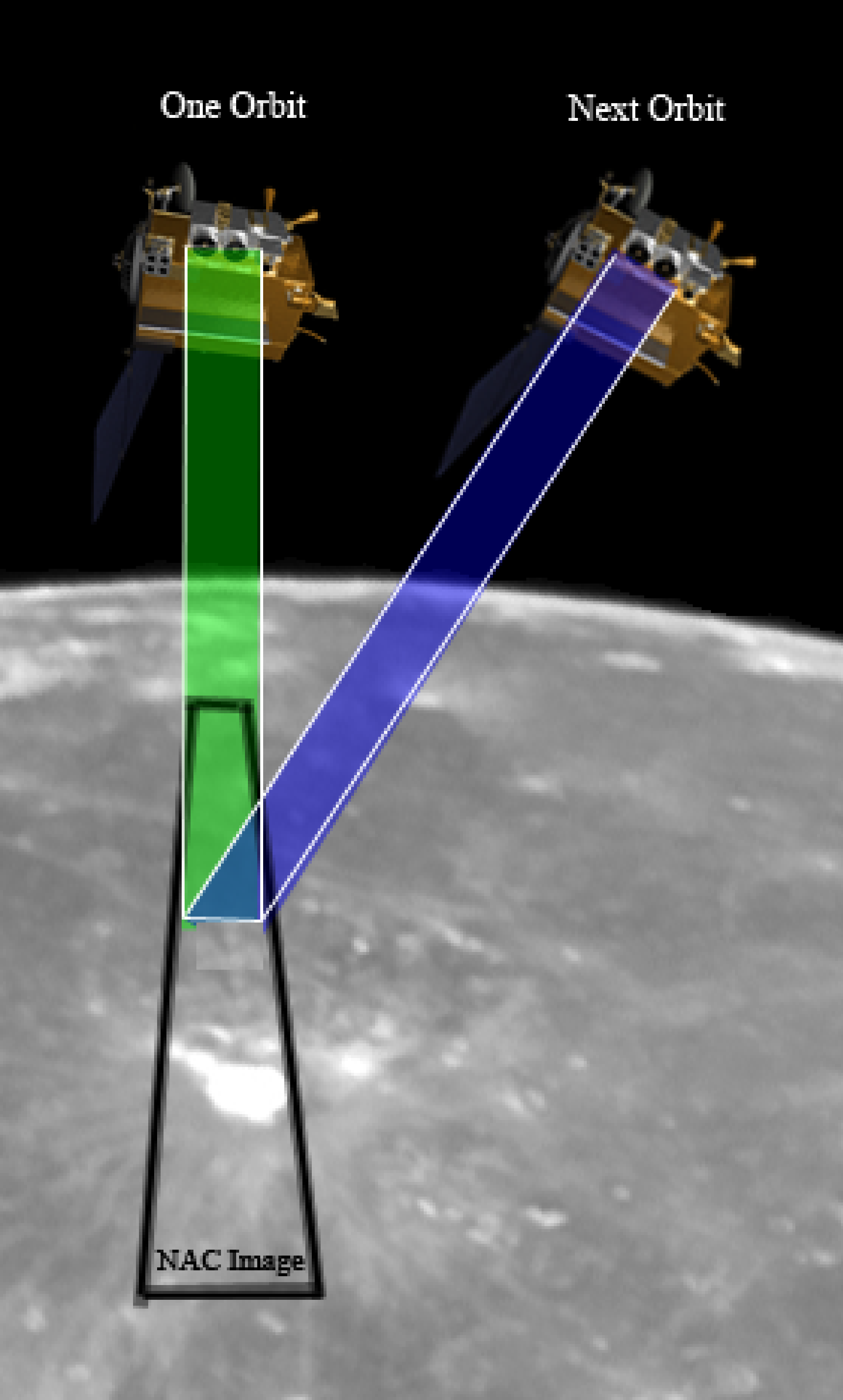
To produce a Digital Terrain Model (DTM) using LROC NAC images, you need at least two images of the same area taken from different orbits with off-pointing. The two oblique views result in parallax, which we can measure and convert into elevation measurements. Presto! You have a topographic map. Of course, it is not quite that easy. First, an analyst has to calibrate the images, pick absolute elevation points from LOLA laser profiles, pick a few points matching the images together, and then the automated software does the rest; almost, but analysts check the output and correct any errors that may have crept in during the automated processing.


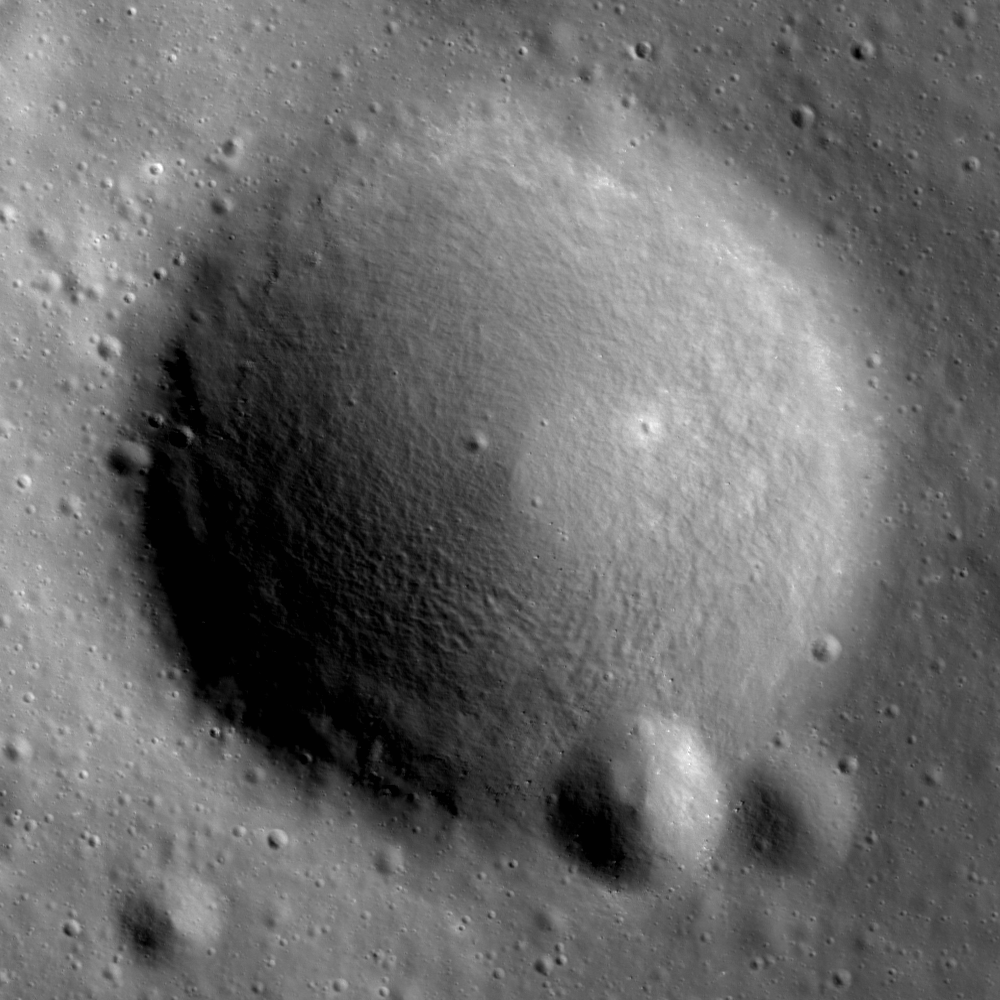
A stereo pair of LROC NAC images of this crater was used to derive the DTM shown in the opening image. Portion of LROC NAC M104776541R (near 36.41°N, 319.72°E, previously highlighted within the Gruithuisen Domes Constellation Region of Interest of north Oceanus Procellarum, LRO orbit 598, August 13, 2009; Alt. 159.78, Res. 1.61; field of view is 825 meters [NASA/GSFC/Arizona State University].

Jitter, which is caused by minuscule vibrations in the spacecraft, can cause the resulting DTM to show wave-like patterns (below). So far only a small set of LROC NAC images have been found to be affected by jitter and research efforts are being focused to reduce the effects of jitter on the handful of DTMs that show this effect.


DTM of Gruithuisen Domes (elevation in meters), generated using the stereo NAC image pair M104776541L/R and M104783697L/R. The wavy lines (arrows) are a result of the slight jitter of the spacecraft [OSU].

The final product, detailed topographic maps, provides scientists and engineers with a powerful tool to solve many problems. For example, when planning future human traverses at a specific site, topographic maps tell us where we can drive or walk, how much energy we will need, and what we can do at any given location. Over the next several years, LROC will collect hundreds of more stereo pairs over key exploration targets.

Proposed GLXP rule changes inspire concern

Updated September 15, 2010 1825 UT

Google Lunar X-Prize (GLXP) team SELENOKHOD in Russia demonstrates a test-bed prototype of the lunar rover the group hopes will win a minimum $20 million purse. However, Russian resources now committed to a planned 2013 joint Russian & Indian lunar mission has put a strain on their timetable [Selenokhod].

Peter J. Brown
Asia Times Online

Government space agencies are taking a closer look at the Google Lunar X Prize (GLXP) contest, an international competition to safely land a rover on the moon. Several GLXP teams include space researchers and engineers in Asia on their rosters, and NASA is rolling out a program that might provide US GLXP teams with a $30 million market for their mission data. Other countries may not sit still for long in light of this development.

That is the good news. The not so good news is that as the result of a proposed GLXP rule change, the $20 million GLXP grand prize could be reduced by $5 million if a government-backed lunar mission successfully lands and deploys a rover in advance of any of the 21 GLXP teams accomplishing the same feat. All GLXP teams must be 90% privately funded.

According to the original set of GLXP rules, the grand prize would be awarded to the team that first landed a rover on the Moon and subsequently able to travel at least 500 meters while simultaneously transmitting data and a live TV signal back to Earth. The deadline has been December 31, 2012. If that objective was not achieved, however, a GLXP team could still win a reduced grand prize of $15 million if it fulfilled all requirements by December 2014.

Now, under the proposed so-called GLXP "Master Team Agreement" (MTA), revised rules, including the $5 million cut described above, are taking shape. All remaining prizes, including a $5 million second prize and several bonus prizes, would be unaffected.

Under proposed changes to contest rules, the 2012 deadline is pushed ahead three years to December 31, 2015. However, even that deadline might be extended by the California-based X Prize Foundation (XPF).

Several countries, including the European Space Agency (ESA), are planning to conduct lunar landings over the coming decade. The joint Indian Space Research Organization (ISRO)-Russian Federal Space Agency (Roskosmos) Chandrayaan-2 orbiter and rover / Luna-Resource lunar lander scheduled for 2013, appears first in line.

"Almost every space agency is talking about missions to the lunar surface these days. Putting fixed calendar dates on them is very difficult, though," said William Pomerantz, senior director of space prizes at the XPF.

"We are excited about and are following developments on other fronts, including China's Chang'e 3, Japan's SELENE-2, The Indo-Russian Luna-Resource /Chandrayaan-2, ESA's MoonNEXT, a variety of potential NASA robotic missions and possibly the UK's MoonLite, along with eventual nodes of the proposed International Lunar Network (ILN)."

"At this point, it's difficult to say with certainty which will be which," said Pomerantz

Read the full article, HERE.

Thursday, August 12, 2010

NASA NEO Workshop & Downloads

Presentations from the NASA Exploration of Near-Earth Objects Objectives workshop, August 10-11, are now available online, HERE.

Though video of presenters selected from previous such events are also available, HERE, these are not yet posted for the NEO workshop.

Dr. Clive Neal, chair of the Lunar Exploration and Analysis Group (LEAG), presented Using the Moon to Facilitate exploration of Near Earth Objects, available (pdf) HERE.