Showing posts with label Earthrise Space. Show all posts

Saturday, January 18, 2014

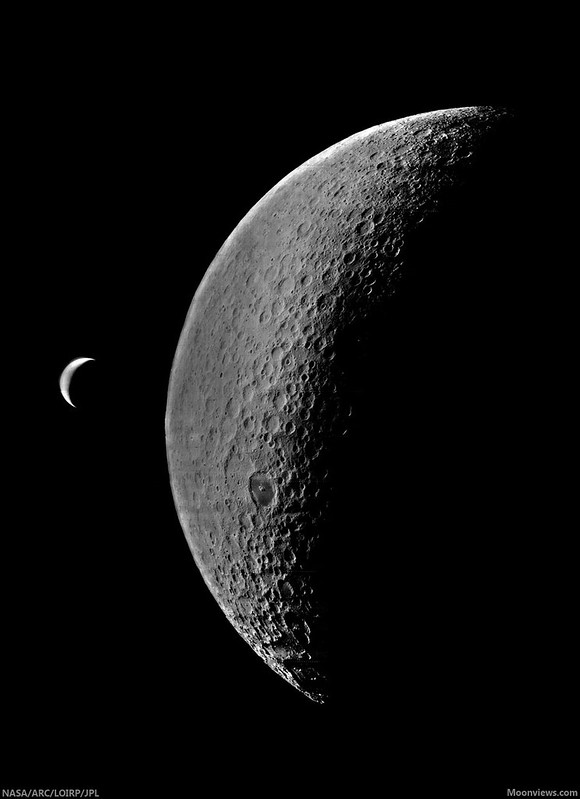
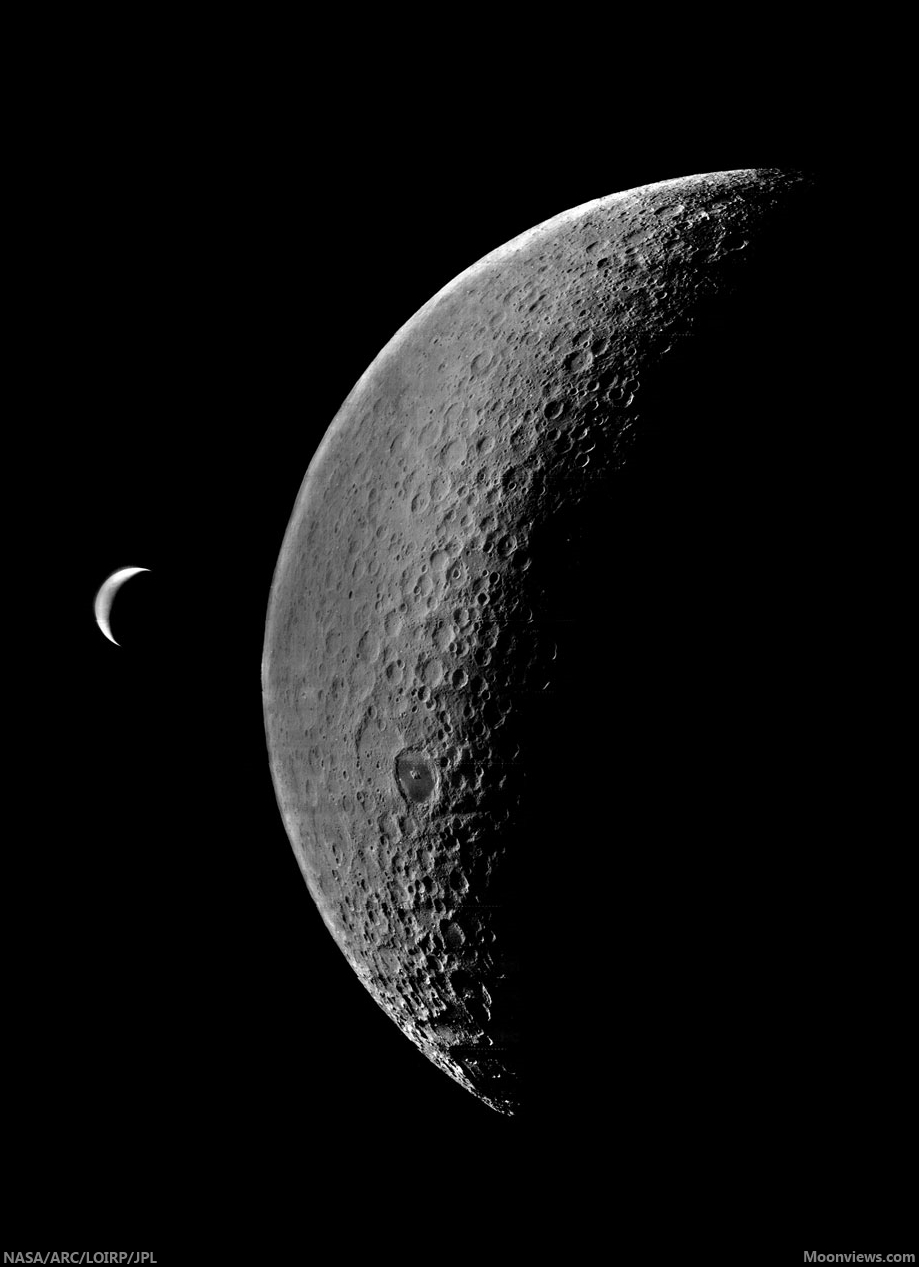
Another original earthrise, recovered

LOIRP-4123_M-19670517-20140117L
On the left is a newly recovered and enhanced image of the Earth and Moon taken by Lunar Orbiter IV on 19 May 1967. On the right is how the image has looked in NASA's records - until now [LOIRP/Moonviews.com].
Keith Cowing
Lunar Orbiter Image Restoration Project
Moonviews.com

The other day, as we were going through tapes from Lunar Orbiter IV we came across a picture of the Earth and the Moon - one that was not instantly familiar to us.

Read the full description,
and familiarize yourself with
the important work
of the LOIRP,
HERE.
Lunar Orbiter IV-123-M

Thursday, May 16, 2013

Dynamic Textures in the Farside Highland Terrain

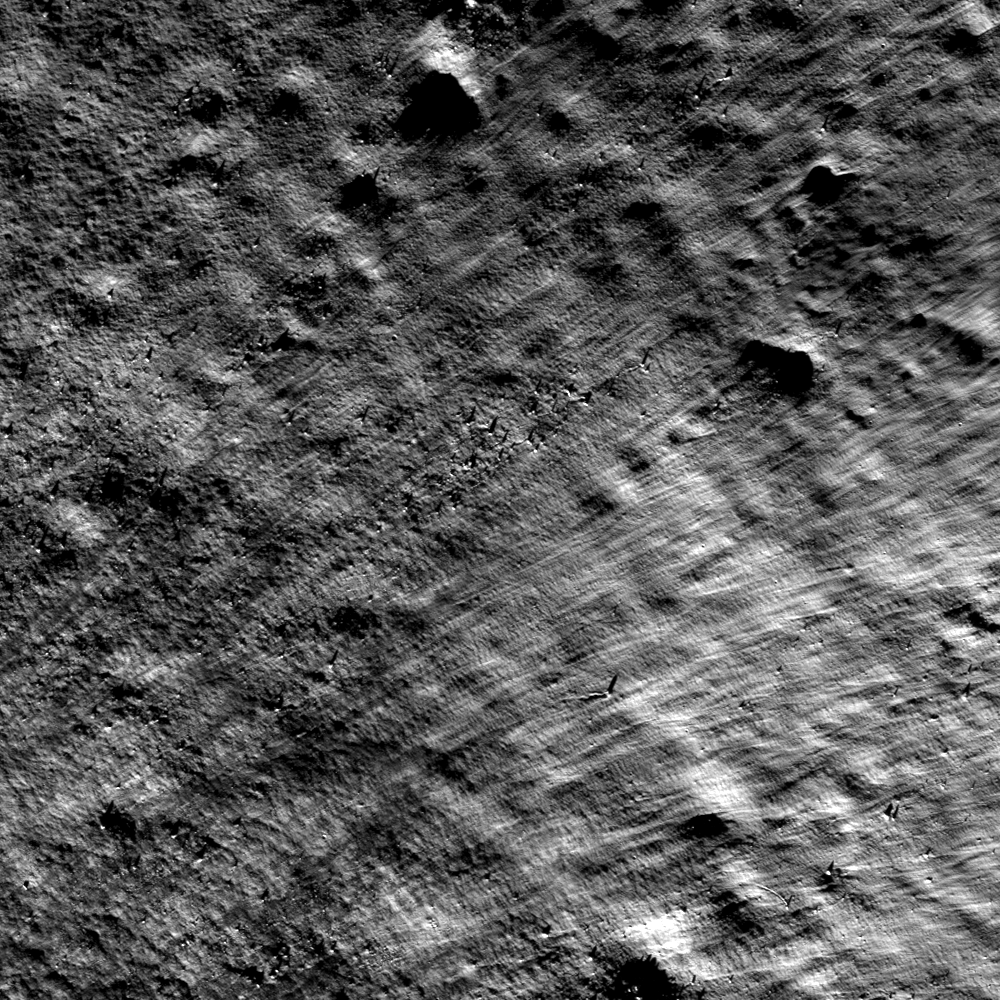
Northeastern portion of unnamed crater ejecta, above 77°N latitude, in the farside north. LROC Narrow Angle Camera (NAC) M138600267R, LRO orbit 5559, September 8, 2010; sunlight angle of incidence 80.3° over a field of view 1080 meters across, resolution 1.08 meters per pixel, from 51.96 km. Image center 77.086°N, 200.336°E, incidence angle is 80.3° [NASA/GSFC/Arizona State University].
Hiroyuki Sato
LROC News System

This far side high latitude (just above 77°N) fresh crater (roughly 1.1 kilometers in diameter) presents striking linear patterns in its ejecta.

Due to the high latitudes, the incidence angle is always very high in this area (including in this image), which enhances subtle topographic features.

The ejecta source crater is toward bottom left (outside the image field of view), thus the ejecta landed with the velocity component in upper right (northeast) direction, consistent with linear stripes dominating this whole area of this Featured Image.

LROC Wide Angle Camera (WAC) observation shows the whole crater of interest, at the center of this 46.2 km-wide field of view captured at 79.7 meters per pixel. North a smaller fresh crater almost immediately to the south-southeast. Both these crater's fresh, bright and optically immature ejecta fields are visible in the HDTV stills from Japan's SELENE-1 orbiter Kaguya, below. LROC WAC M173944659C (643 nm), spacecraft orbit 10768, October 22, 2011 [NASA/GSFC/Arizona State University].
Context for the LROC NAC frame outlined in this crop from LROC WAC monochrome mosaic (100 meters per pixel) of the unnamed crater and surrounding vicinity, centered near 77.46°N, 200.83°E, image width is about 142 km. NAC footprint (blue box) and the location of today's Featured Image (white arrow) are indicated here [NASA/GSFC/Arizona State University].
Interestingly, the lower left (closest to the rim) and upper left corners of this image show a craggy, rough surface, while the right portion shows only the striped pattern. What causes such texture differences within the same ejecta blanket?

Demonstration of just how far north the crater of interest resides in this three-HDTV frame animation, showing an Earthrise over Plaskett crater in the Moon's far north as captured from Japan's lunar orbiter SELENE-1 ('Kaguya') in 2007. The crater later photographed from overhead from LRO is designated with an arrow in the final frame. A large reproduction of the final still can be viewed HERE [JAXA/NHK/SELENE].
One possibility is the impact melt content was enriched near the rim, increasing the cohesion among the rock fragments and decelerating the flow inducing multiple pressure ridges perpendicular to the flow direction. Perhaps variations in roughness of the pre-existing surface controlled the final look of the ejecta. What else?

Explore this fascinating ejecta morphology in full NAC frame (HERE), and find your own hypothesis and answers!

Related Posts:
Ejecta sweeps the surface
Action Shot
Polka-dot Ejecta
Smooth Ejecta
In the Wake of Giordano Bruno
Scours and Ejecta Near Jules Verne Y
Lassell D Ejecta
Swept Surface
Ejecta Patterns

Tuesday, February 28, 2012

Additional ILDD contract awarded to Astrobotic

Prototype Astrobotic Scout Rover undergoes field tests in a
Big Island "lunar proxy" environment in 2011 [Astronbotic].

NASA has awarded Astrobotic Technology Inc. an additional task in its $10 million Innovative Lunar Demonstrations Data (ILDD) contract under which NASA buys information about the company’s commercial robotic expeditions to the Moon. The $100,000 task order brings total funding under the ILDD contract thus far to $610,000.

Astrobotic Technology will launch its first expedition on a Falcon 9 rocket under contract from Space Exploration Technologies (SpaceX).

 In May 2015, it will deliver a robot to the Moon’s south pole to prospect for water, methane and other minerals. Turned into rocket propellant, these resources will dramatically reduce the cost of space exploration by providing an off-planet refueling station.

“The number one challenge in space exploration today is the cost,” said David Gump, Astrobotic’s president. “Commercial robotic expeditions can serve space agencies at one-third the cost they traditionally spend with cost-plus contractors. And by prospecting for rocket fuel ingredients at the Moon’s poles, we can provide a much lower cost source for spacecraft propellant as they venture further away from Earth.”

Astrobotic is a spinout from the Robotics Institute at Carnegie Mellon University, which carries out lunar research funded by Astrobotic. 

In October 2010 NASA awarded first phase ILDD contracts to Astrobotic (Pittsburg, PA), The Charles Stark Draper Laboratory, Inc., Cambridge, MA, Dynetics Inc., Huntsville, AL, Earthrise Space Inc., Orlando, FL, Moon Express Inc., San Francisco, CA and Team FREDNET, The Open Space Society, Inc., Huntsville, AL.

Read the full Astrobotic news release HERE.