Showing posts with label ghost craters. Show all posts

Tuesday, September 24, 2013

On the edge of Lichtenberg

M1108660598RL-NSJ-0108-58b-9383x12942
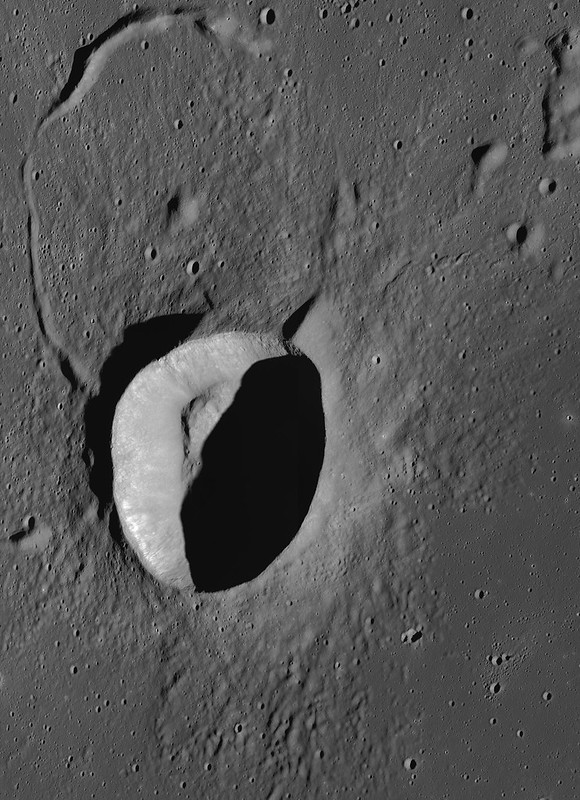
An oblique view of Lichtenberg crater (31.854°N, 292.284°E). LROC Narrow Angle Camera (NAC) M1108660598RL, a 9526x15400 mosaic, captures a side-glance view (spacecraft and camera slewed -53.22° off nadir) of the geologically anomalous Lichtenberg crater, on the northwestern side of Oceanus Procellarum. LRO orbit 15660, November 27, 2012; overall resolution above 3 meters per pixel, early morning angle of incidence 81.38° from 142.54 km over 32.1°N, 300.76°E [NASA/GSFC/Arizona State University].
H. Meyer
LROC News System

Lichtenberg crater (19 kilometers in diameter) is located in western Oceanus Procellarum (31.85°N, 292.28°E). Originally thought to be Copernican in age due to its visible ray system,

Lichtenberg is now thought to be Eratosthenian in age. It turns out that Lichtenberg rays are highly reflective due to their composition and not their relative youth (compositional ray vs maturity ray). Today's Featured Image is an oblique view of Lichtenberg crater and the surrounding terrain. Oblique images are similar to what an astronaut in orbit around the Moon would see looking out a window towards the horizon, and these views are different than most of the LROC NAC images that are taken at nadir (looking straight down).

Lichtenberg crater, super-positioned on the vast basalt flooded nearside plains of Oceanus Procellarum that are, in turn, superimposed nearly over a more ancient, larger "ghost crater" to the northeast. Lichtenberg was originally selected as a Constellation Region of Interest (ROI) for, among other reasons, a distinct younger flow of melt superimposed on the crater's southeastern frontier, demonstrating this part of Procellarum was inundated both before and after Lichtenberg's formation. LROC Wide Angle Camera (WAC) monochrome (604 nm) mosaic from observations collected in sequential orbits July 27, 2011, from approximately 43 km overhead. View a wider field of view in the original mosaic HERE [NASA/GSFC/Arizona State University].
Because oblique images are taken by looking at an angle, these images can enhance or reveal features that may not be evident when looking straight down. For example, Lichtenberg's raised rim is prominent in this image, as is the topographic high within the ghost crater beside it. The diameter of the ghost crater (29 kilometers) suggests that it is a complex crater with a central peak that was subsequently buried by mare basalts. Perhaps a now deeply buried central peak is reflected in the surface as a distinct topographic high in the center of the ghost crater? It is the presence of this flooded crater that caused Lichtenberg to form in an asymmetrical fashion. This viewing geometry also enhances Lichtenberg's textured ejecta blanket, revealing a partial embayment of the ejecta on the eastern side. By applying our understanding of the principles of stratigraphy, the history of this area can be unraveled. A complex crater formed on the surface and was buried by mare basalt. Then, Lichtenberg formed on part of the partially buried rim of the ghost crater. Finally, a new flow of mare basalt partially flooded the ejecta of Lichtenberg.

Explore the full NAC mosaic HERE.

Related Posts:
Ghost Crater in Southern Mare Crisium (June 21, 2011)

Thursday, July 11, 2013

Lunar Kipuka

A ghost crater, breached and filled with the lavas of Mare Imbrium (31.364°N, 334.217°E), the 3.2 km field of view from LROC Narrow Angle Camera (NAC) observation M193132768L, LRO orbit 13487, May 31, 2012; 74.94° angle of incidence, resolution 1.46 meters from 147.07 km [NASA/GSFC/Arizona State University].
Brett Denevi
LROC News System

The lunar maria were once "seas" of highly fluid lava, and within their margins small islands and shorelines can be found. Today's featured image highlights a classic example of a partially flooded impact crater within Mare Imbrium. The western wall of the crater, a low point in the rim, was breached by the flowing lava, and the crater was filled nearly to its rim. What remains of the rim is known as a kipuka, the Hawaiian word describing an island of older land surrounded by younger lava flows.

The shoreline can be seen within the crater as a terrace-like ring just inside the crater rim, particularly on the eastern side. This terrace is akin to the high-water mark of a flood, and marks the high-lava point along the crater wall. As the lava cooled, it contracted and subsided to a somewhat lower level. Similar features are seen in areas like Bowditch, within Lacus Solitudinis.

The kipuka of interest, out on the vast plains of Mare Imbrium, in the 48 km-wide field of view of LROC Wide Angle Camera (WAC) monochrome (643 nm) observation M177798520C, spacecraft orbit 11338, December 6, 2011; 76.25° angle of incidence, resolution 60.03 meters from 43.97 km [NASA/GSFC/Arizona State University].
The flooded crater in today's image is approximately 2.7 km in diameter, and was likely originally around 500 m deep. That gives a maximum lava thickness of a little less than 500 meters in this spot, though that does not require a single 500-meter thick flow. Lava likely pooled in the low of the crater floor from multiple individual flows, rather than one massive influx of lava. Layering exposed within sinuous rilles,  mare pits, and impact craters suggests individual lava flows were much thinner (on the order of 10 meters).

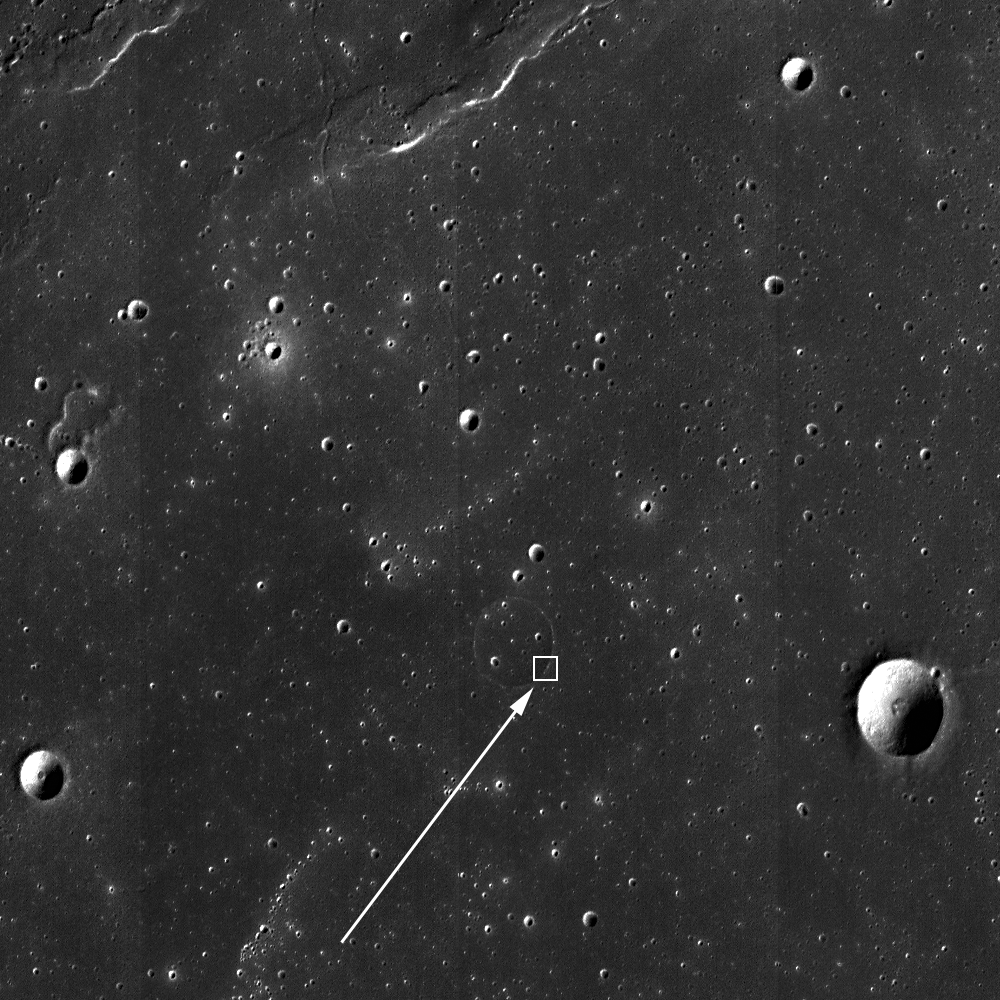
LROC WAC context mosaic showing the location of the flooded crater (arrow) within an outline of the footprint of NAC M193132768L [NASA/GSFC/Arizona State University
Note the small (250 meters in diameter) high reflectance crater nearly in the center of this flooded crater. An astronaut could descend its interior and inspect a cross-section of about the top 25 meters of the basalts and determine the thickness and frequency of the lava flows that filled the host crater. The rim of this impact crater is the only kipuka preserved in the area, and is the last local remnant of the surface before it was drowned in the lavas of Mare Imbrium several billion years ago.

Browse the full-resolution NAC image HERE.

Related LROC Featured Images:
The Swirls of Mare Ingenii
Remnants of the Imbrium Impact

Thursday, January 24, 2013

Almost submerged under Mare Imbrium basalt

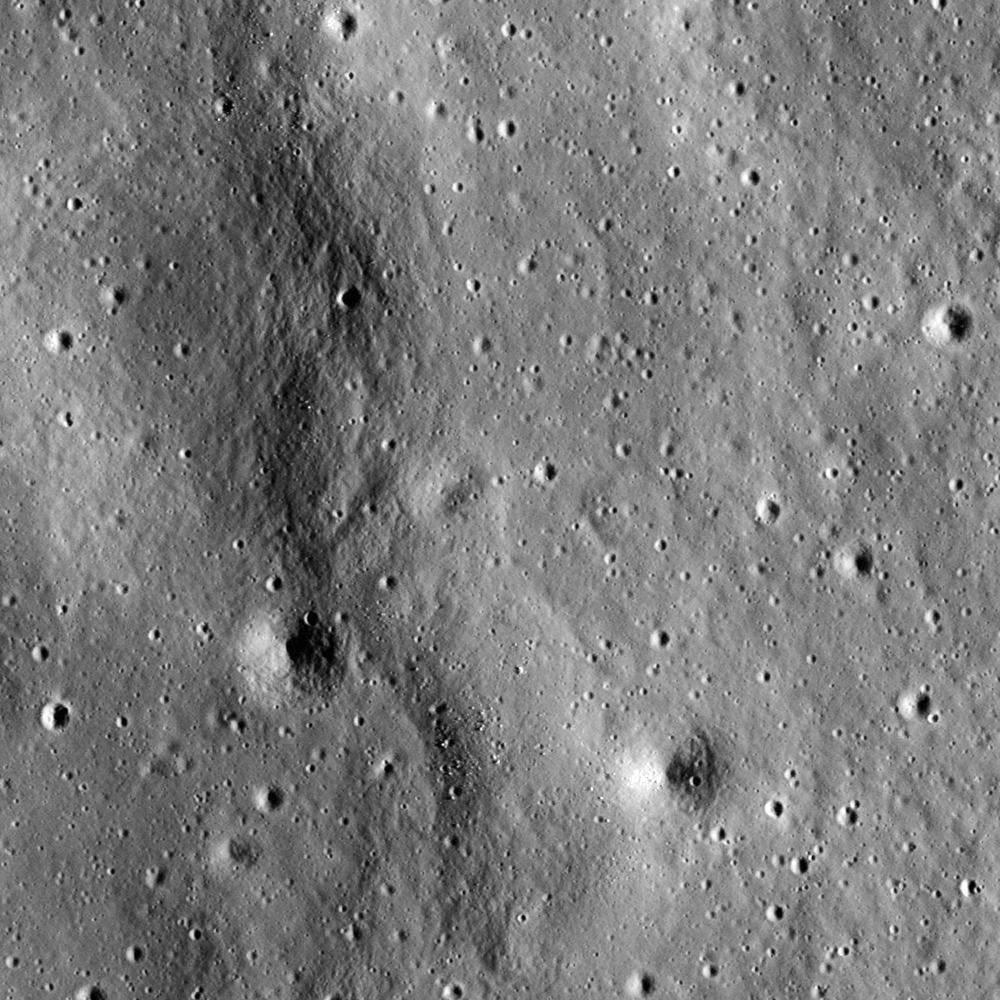
Lunar mare basalt flows partially cover a crater. LROC NAC M186105790L, LRO orbit 12504, March 11, 2012; under a high Sun (incidence angle 17.75°) field of view 580 meters, resolution 1.03 meters from 131.69 km [NASA/GSFC/Arizona State University].
Sarah Braden
LROC News System

A crater (located at 17.331°N, 326.544°E) is almost entirely submerged by mare basalt. The remains of the crater indicate that the original crater was about 650-700 meters in diameter. Along the interior crater wall there are materials of different reflectance: high reflectance where boulders cover the crater wall, and low reflectance where mare basalt has flowed down the wall. The relatively low incidence angle of this image, ~18°, makes it easier to see differences in the reflectance of materials. The mare basalt flows filled the crater interior and left a mantle of mare material on the walls. It is unclear if the boulders are from the original crater wall, or if they are boulders from the basalt flow created as the edges of the flow erode away.

Even when mare basalt flows completely submerge a crater evidence of the crater rim can persist. These are called ghost craters (and you can read more about them HERE).

The crater in the Feature Image is east of another mostly submerged crater, T Mayer W (see the WAC context image below). The eastern rim of T Mayer W is the most prominent section above the mare basalt flows. Areas of high reflectance in the WAC context image are actually rays of ejecta from the crater Copernicus, which is more than 470 km away. These rays are an excellent example of how impact processes can effect the geologic context of a site even from a great distance. 

The white box contains the crater in the LROC Featured image released January 24, 2012. LROC Wide Angle Camera (WAC) 100 m/pixel mosaic [NASA/GSFC/Arizona State University].
Explore the entire LROC NAC, HERE.

Related Images:
Young and Old
Ghost crater in Mare Imbrium
The Ghosts of Mare Fecunditatis
Ghost Crater in Southern Mare Crisium

Thursday, November 8, 2012

Ghost crater in Mare Imbrium

A high reflectance near-buried ghost crater rim curves through a flat portion of mare basalt in Mare Imbrium. The line is elevated relative to the basalt and is populated with bright boulders. A 986 meter-wide field of view from LROC Narrow Angle Camera (NAC) M1098979692LE, LRO orbit 14305, August 7, 2012; resolution in original 1.7 meters [NASA/GSFC/Arizona State University].
Dew Enns
LROC News System

Today's Featured Image is a portion of a larger structure - a ghost crater!

Last week we explained how ghost craters are formed - basalt fills in and covers an older crater. The curved structure above is made up of high reflectance boulders on a ridge, hinting at the 5 km crater underneath. Ghost craters aren't just cool to look at though, they also help answer some questions about the lunar surface!

We know that the maria cover only about 17% of the Moon's surface, but how deep are they really? One way to estimate their depth is to catalog ghost craters that have been covered by mare basalt.

Context for the LROC Featured Image, released November 7, 2012 (64m resolution from LROC QuickMap). The ghost crater is located at 45.67° N, 338.89°E. Nearby (Laplace F) crater has a similar diameter to the ghost crater, implying that they are both excavated similar depths of material [NASA/GSFC/Arizona State University].
Impact craters have consistent depth:diameter ratios that we can model. If we measure the diameters of a ghost crater, we can estimate its depth, and we can then infer a minimum thickness of much basalt filling in the crater. Cataloging craters throughout the maria can inform us of the regional variation in basalt thickness.
Explore more of Mare Imbrium in the full LROC NAC, HERE.

Related Posts:
Ghost Crater in Southern Mare Crisium!
Balcony Over Plato
Archimedes - Mare Flooded Crater!

Wednesday, October 31, 2012

Ghosts of Fecunditatis

A gentle but distinctive topographic high designates the location of an ancient crater rim, nearly covered by basin flooding by volcanism, inside the boundaries of Mare Fecunditatis. LROC Narrow Angle Camera (NAC) frame M146662326L, illumination is from the east, angle of incidence 72.34° ; an approximately 1 kilometers-wide wide field of view at 0.98 meters resolution (in the original) from 47 kilometers altitude [NASA/GSFC/Arizona State University].
James Ashley
LROC News System

Today's Featured Image focuses on ancient craters that predate mare basin flooding, and which are often recognized by subdued, sometimes discontinuous circular patterns best seen near local lunar sunrise and sunset (high solar incidence as measured from the surface normal). These circles mark the locations of once majestic excavations in the lunar crust. However the emplacement of volcanic deposits filling, surrounding, and overtopping the rims have buried these ancient craters in many instances. The presence of the near-surface rims produce local stresses in the deposits, which in turn deform the mare layers. The result is a wrinkle ridge-like topography with a circular pattern. They are thus often referred to as "ghost" craters, and can be found haunting many large, basin-filling mare deposits.

LROC Wide Angle Camera (WAC) mosaic centered on the Featured Image field of view. Note a second and more prominent ghost crater (Goclenius U) in the southeast corner of this approximately 120 km-wide frame [NASA/GSFC/Arizona State University.

At least two large ghost craters can be found here in the Mare Fecunditatis basin just south and southwest of the crater Ibn Battula. Some portions are simply unrecognizable as former crater rims without the large scale mosaic for context (see example below).

Another portion of the crater rim gives a muted appearance like that of a snow-covered park bench. Field of view width is ~700 meters.

Examine the full NAC frame (HERE) to see a greater length of ghost crater rim. Another example of a ghost crater is presented in the Ghost Crater in Southern Mare Crisium, a Tier 2 Constellation program Region of Interest. Contrast the appearance of a ghost crater to that of a flooded crater (e.g., as in Balcony Over Plato).