Showing posts with label Messenger. Show all posts

Saturday, February 21, 2015

The search for transient frost using laser altimetry

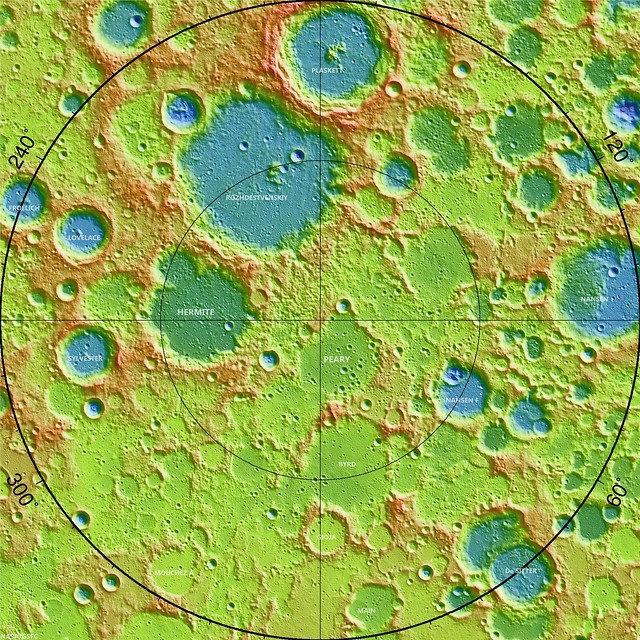
Laser altimetry map of the Moon's northern polar region, north of 80° at 20 meters resolution. The crater Lovelace (57.06 km; 82.08°N, 250.49°E), referenced below, is southwest of Hermite, where the lowest temperatures yet recorded in the Solar System have been measured on the pole-facing walls, in permanent shadow [NASA/GSFC].

A SEARCH FOR TRANSIENT WATER FROST
AT THE LUNAR POLES
USING THE LUNAR ORBITER LASER ALTIMETER

M. Lemelin, et.al.
University of Hawaii at Manoa


Introduction: The possibility of lunar polar ice was suggested by Harold Urey in the 1950's [1], and has likely been directly detected at the North Pole of Mercury by MESSENGER. That detection was based on the presence of reflectance anomalies seen by the Mercury Laser Altimeter (MLA) that occurred only where models of the surface temperature allow long-duration preservation of surface water ice against sublimation [2,3].

Anomalous reflectance is also seen at the lunar poles, revealed by laser measurements. The reflectance of permanently shadowed regions is systematically higher than nearby areas that receive at least some illumination [2,3,4] (Fig. 1). Models suggest that if the higher reflectance is due to the presence of water ice; up to 14 wt.% could be present depending on the distribution of frost within or on the regolith.

Figure 1. DIVINER maximum temperature (left) and LOLA reflectance (right) for the north polar crater Lovelace. The blue patch in the temperature image shows the location of a permanently shadowed region. The corresponding location in the reflectance image clearly show higher reflectance than the surroundings
Results of lunar observations by the Deep Impact High-Resolution Instrument – Infrared spectrometer (HRI-IR) in the 3 μm region and by the Lunar Reconnaissance Orbiter (LRO) Lyman Alpha mapping project (LAMP) in the far-UV region both show that spectral features consistent with hydration of the surface are diurnally variable. This indicates that water is pos-sibly mobile on the lunar surface [5,6]. Because the lifetime of water molecules in the lunar atmosphere is short against dissociation (~20 hours) compared to the lunar diurnal cycle, water must be continuously pro-duced to account for the observations. Mobile water will trap on cold surfaces during the lunar night and be released when surfaces are illuminated during the day.

In this study, we seek evidence for transient water frost on the polar surfaces using reflectance data from the Lunar Orbiter Laser Altimeter (LOLA), and temperature data from the DIVINER radiometer, both onboard the LRO. We aim to search for areas that may “load” with surface frost during the night causing in-creased reflectance, and unload during the day reducing the reflectance. Detection of transient surface frost constrains the rate of input into the lunar volatile system.

Methods and datasets: LOLA measures the backscattered energy of the returning altimetric laser pulse at 1064 nm. This data is used to map the reflectivity of the Moon at zero-phase angle with a photo-metrically uniform data set. The zero-phase geometry is insensitive to lunar topography and enables the characterization of subtle variations in lunar albedo, even at high latitudes where such measurements are not possible with the Sun as the illumination source. The DIVINER radiometer simultaneously measures the bolometric temperature of the lunar surface.

To find evidence of transient surface frost, we examined locations where reflectance data from LOLA exists at both low (less than 156 K, a loss of 100 μm of frost per month or less, sufficiently cold for ice to persist during a single lunar night [7,8]) and high temperatures (greater than 201 K, a loss of 1 mm of frost per month or more, no possibility of retaining surface ice [7,8]) using the DIVINER radiometer data, seeking changes in albedo with temperature. We search the LOLA reflectance dataset for locations that have reflectances measured at both low and high temperatures using DIVINER tem-perature measurements obtained simultaneously with LOLA data. For this initial search, we examined both polar regions at a spatial resolution of 2 pixels per degree (~15 km per pixel), within ±50-90º latitude.

Initial Results: For both polar regions (±50-90º latitude), we find that most of the pixels outside permanently shadowed regions are subject to both low (less than 156 K) and high (greater than 201 K) temperatures. Figure 2 shows the LOLA reflectance data for both poles when the temperature of a given pixel is either greater than 156 K (Fig. 2 left) or greater than 201 K (Fig. 2, right).

Methods and datasets: LOLA measures the backscattered energy of the returning altimetric laser pulse at 1064 nm. This data is used to map the reflectivity of the Moon at zero-phase angle with a photo-metrically uniform data set. The zero-phase geometry is insensitive to lunar topography and enables the characterization of subtle variations in lunar albedo, even at high latitudes where such measurements are not possible with the Sun as the illumination source. The DIVINER radiometer simultaneously measures the bolometric temperature of the lunar surface.

By subtracting the 1064 nm reflectance when the temperature is high (greater than 201 K) from the reflectance when the temperature is low (below 156 K), we find that the global difference in reflectance averages near 0 for both polar regions (Fig. 3). Therefore, we do not detect a general temperature dependent reflectance variation.

Figure 2. LOLA 1064 nm reflectance for (A) the North Pole and (B) the South Pole. The reflectance when the temperature is low (less than 156°K) is shown on the left and the reflectance when the temperature is high (greater than 201°K) is shown on the right.
Figure 3. LOLA 1064 nm reflectance difference between the reflectance when the temperature is high (greater than 201° K) and when the temperature is low (less than 156° K), for (A) the North Pole and (B) the South Pole.
Discussion and future work: We did not detect a general temperature dependent reflectance variation in our study for either polar region with a detection precision of about 1%. Using a simple model of a nonabsorbing layer over an absorbing substrate, a very small optical depth is required to raise the reflectance by 1%, only 0.045 ([9] Section 9.D.2). This corresponds to ~30 μg/cm2, a layer thickness of about 300 nm. In comparison, the observations of [5,6] require a layer thickness of at least 10's of nanometer to account for the observed band depths. This suggests that our current measurements are at the edge of detection of the source implied by the spacecraft observations. In contrast to the implications of the reported measurements, the solar wind can provide far less water; concentrated in a single layer, calculations by [10] suggest only 0.01 nm globally averaged per month.

Our current analysis did not take into account how long each surface element has been subject to cold temperatures (i.e., if it had time to accumulate frost). For example, based on a Monte Carlo model, Schorghofer (2014) [11] showed that a continuous source of water molecules arriving on the lunar surface (regardless of the source) would significantly accumulate near the morning terminator. Additional calculations show that the morning terminator should feature about 30 times the concentration of the average nightside abundance, improving prospects for detection. 

Future work includes reanalyzing existing data to include the time of exposure at low temperatures, and conducting targeted observations with LOLA to observe night time polar surfaces near the morning terminator in order to improve the upper limits of detection on transient water frost.

References: [1] Urey H. C. (1952) The Planets: Their Origin and Development. Yale University Press, New Haven, CT, 245 pp. [2] Paige D. A. et al. (2013) Science, 339, 300-303. [3] Neumann G. A. et al. (2013) Science, 339, 296-299. [4] Zuber M. T. et al. (2012) Nature, 486, 378-382. [5] Sunshine J. M. et al. (2009) Science, 326, 565-568. [6] Hendrix A. R. et al. (2012) JGR Planets, 117, E12001. [7] Zhang J. A. and Paige D. A. (2009) GRL, 36, L16203. [8] Zhang J. A. and Paige D. A. (2010) GRL, 37, L03203. [9] Hapke B. (1993) Theory of reflectance and emittance spectroscopy, Cambridge. [10] Hurley D. M. and Farrell W. M. (2013) LPSC 44, abstract #2015. [11] Schorghofer N. (2014) GRL, 41, 4888–4893.

Acknowledgments: This work is supported in part by the LRO LOLA experiment (David Smith PI), the LRO Diviner experiment (David Paige PI), and the Natural Science and Engineering Council of Canada (NSERC).

Monday, December 3, 2012

Reflecting on the ice of Mercury and the Moon

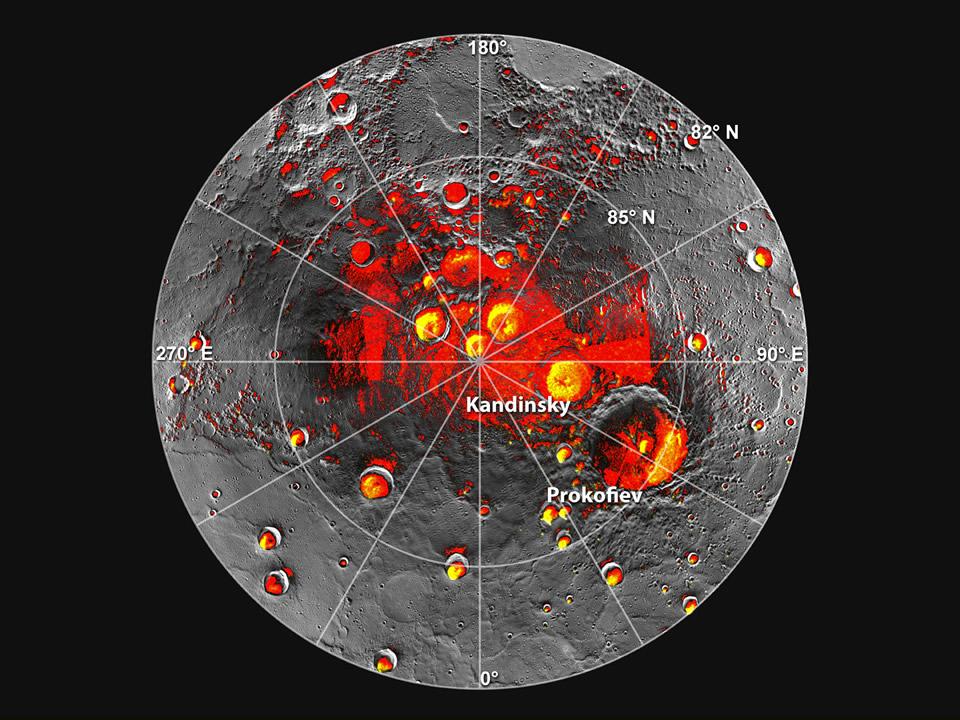
Composite image of the north pole of Mercury. Red are the areas of permanent shadow; yellow delineates radar bright deposits mapped from Earth. Data are plotted on a photomosaic of MESSENGER images [NASA].
Paul D. Spudis
Smithsonian Air & Space

Mercury – the planet, not the element – was in the news this past week.  For some time, we had suspected that the poles of Mercury might harbor deposits of water ice.  This – on a planet so close to the Sun that the surface temperature at the equator is hot enough to melt lead!

Yet like the Moon, Mercury’s spin axis is perpendicular to the plane in which it orbits the Sun.  This means that large craters near Mercury’s poles lie in permanent shadow (“shivering” around -170° C), unaffected by the Sun’s searing heat (equivalent to more than eleven times the solar flux we get on Earth).  As on the Moon, these permanently shadowed areas get heat from only two sources – the 3 K background heat of space, created during the Big Bang some 15 billion years ago, and whatever heat is being generated now from the deep interior (a quantity that geophysicists call the heat flow of a planet).

Large planets (like Earth) generate heat mostly from the decay of radioactive elements deep inside them.  This heat is lost largely through the phenomenon of volcanism, in which melted rock from the interior is erupted onto a planet’s surface as lava and ash.  Smaller planets and moons likewise experience this heating and volcanism, but because they are have lower overall contents of heat-producing elements, their volcanic episodes occurred in the distant past.  Much of the heat of these smaller planets has been largely dissipated.  Thus, on Mercury, we suspect that the overall heat flow is very low, resulting in extremely cold temperatures on the floors of its permanently shaded polar craters.

For many years, astronomers have studied Mercury with radio telescopes from Earth (using radar to make images of its surface).  Because the orbital inclination of Mercury is relatively high (about 7°), we can get a fairly good look into the interiors of the polar craters.  Interestingly, even though Mercury is much farther away than the Moon, we can see more of the mercurian polar areas because of this relatively high orbital inclination (the Moon’s orbital plane is inclined only 5°).  These radar pictures showed an amazing and unexpected feature – the dark areas are filled with material that is highly reflective at radio frequencies, properties similar to the surfaces of the icy moons of Jupiter (Europa, Ganymede and Callisto).

These results were so unexpected and startling that debate raged for many years whether these deposits really were what they appeared to be: water ice.  Facts are stubborn things and few materials have radio properties similar to ice.  Some suggested that sulfur might be an alternative explanation, but provided little evidence for such behavior.  Moreover, another moon of Jupiter, Io, which has a surface largely composed of sulfur, does not show the radar brightness or “glint” seen on the other, ice-rich Jovian moons.

The debate on the nature of the Mercury polar deposits has now been settled with the release of new data from the MESSENGER mission.  Launched on August 3, 2004, with insertion into obit around the planet on March 18, 2011, the spacecraft has been taking pictures and making measurements of Mercury for the last two years.  We have mapped the extent of darkness near the poles, measured the temperatures of the surface inside these regions, and detected the presence of significant amounts of hydrogen there.  All of these results are strongly supportive of the water ice interpretation.

The existence of ice near the poles of Mercury supports the case for water ice on our own Moon, although there are some significant differences between the two occurrences.  Like Mercury, the Moon’s spin axis is nearly perpendicular to the plane of its orbit around the Sun.  The similarity of the terrain of both bodies results in deep holes that hide large expanses of terrain from the glare and heat of the Sun.  Both objects have been volcanically active in the past, but not today, meaning that the average rates of heat flow on both are low.  These properties result in the creation of polar “cold traps” in which any entering volatile substance (such as water molecules) cannot escape.

The solid bodies of the inner Solar System are constantly hit by debris from comets and asteroids.  This material contains water, both in free form and bound within hydrous minerals.  On smaller objects (like the Moon and Mercury), most of this water is lost to space, but we suspected that some of it might be retained within these dark cold traps near the poles.  Now we know that such a process does occur.

Differences between the Moon and Mercury result in differing amounts and settings for their polar deposits.  Being much closer to the Sun, one might expect Mercury to contain less water ice, but a variety of evidence suggests that the opposite is the case.  The polar ice of Mercury appears to be greater in extent and thickness than comparable deposits on the Moon.  This probably results from two factors.  First, Mercury is a bigger object, with a surface gravity about twice that of the Moon.  Thus, it is more difficult for water to “escape” from Mercury.  Second, the closeness of Mercury to the Sun (the edge of biggest gravity well of the Solar System) results in a higher flux of cometary impacts there than experienced in the Earth-Moon system.  So more water is being added to Mercury, where it is more easily retained.

Nonetheless, both Moon and Mercury have similar polar environments and processes.  The long debate – a scientific controversy for over 50 years – about water at the poles of these objects has been resolved.  The next steps will be to characterize these deposits in situ using a soft lander and selected instruments to measure the amounts, states and distributions of water in the polar areas.  Because of the great difficulty in even getting into orbit around Mercury (let alone landing there), doing this first on the Moon will mostly likely happen first.  So, here again is another rationale for sending a robotic surveying lander and rover mission to the poles of the Moon – in addition to characterizing these areas for our future presence there, by inference, we will also learn about the polar processes on and environment of Mercury.

A planetary “two-fer.”  Let’s get on with it.

Originally published at his Smithsonian Air & Space blog The Once and Future Moon, Dr. Spudis is a senior staff scientist at the Lunar and Planetary Institute. The opinions expressed are those of the author and are better informed than average.

Saturday, October 8, 2011

It's a gas, man

"Ina," (18.65°N, 5.3°E) an extremely young and unusual 3 by 2 km depression that may represent a gas eruption site on the Moon. LROC Narrow Angle Camera (NAC) observation M119815703, LRO orbit 2791, February 3, 2010 [NASA/GSFC/Arizona State University]

Paul D. Spudis
The Once and Future Moon
Smithsonian Air & Space

There are times when seemingly unrelated discoveries about other planets come forward to enlighten us about the history and processes of the Moon. A recent paper, using data from the orbiting MESSENGER mission mapping Mercury, describes a number of newly discovered rimless pits and depressions.  These pits (called hollows by the mission team) are difficult to explain by impact processes and are hypothesized to be the products of outgassing from the planet’s interior.  They are often associated with color anomalies (which implies compositional differences from the surrounding terrain) and frequently found on the floors of impact craters and basins.

Impact craters come in a wide variety of sizes, but within selected size ranges, they all appear more or less similar.  Small craters are nearly perfectly round and bowl-shaped with smooth rims that are raised above the surrounding terrain.  Craters with irregular shapes and no raised rims suggest that processes other than impact might be at work.  It has been suggested that on Mercury, these “hollows” were created by the violent release of volatile substances.  Such a release of gas under pressure accompanies volcanic eruptions called pyroclastic, meaning “fire-broken” (fine liquid rock (magma) fragments spewed into space and cooled during flight).

We’ve known about pyroclastic eruptions on the Moon for many years, evidenced by the green glass of the Apollo 15 site and the orange-black glass from Apollo 17.  Careful search of the images taken from lunar orbit reveal the rimless pits that served as vents for the pyroclastic eruptions that produced these Apollo glasses.  They are distinct from impact craters and often are found on the floors of craters and basins along fractures, the conduit by which volcanic magma travels to the lunar surface.

Sometimes pit craters or “hollows,” found across the surface of the Moon, take unusual form.  The kidney-shaped feature shown above is named Ina; after its discovery in one of the Apollo orbital images, it was informally named the “D-caldera” after its shape and the interpretation that it represented a volcanic collapse feature.  Ina is about 3 km across and consists of a series of small platforms, mounds and holes within a larger irregular depression.  Other similar pits and hollows occur elsewhere on the Moon (e.g., on the floor of Rima Hyginis).  And while not major features, they have been found often enough to bother many lunar scientists, who had no good explanation for their origin.

About five years ago, we got a clue as to the possible origins of these features.  Pete Schultz and associates from Brown University published a paper showing Ina displayed unusual spectral reflectance characteristics.  The slow micrometeorite bombardment of the Moon adds craters to the surface and also makes small iron-rich glass particles that darken and redden the surface.  As these glass particles build up in the soil, a soil is said to “mature.”  Fresh surfaces are more “blue” in color (actually, less red) and become redder with time as the soil matures.  Most lunar features show age or “become mature” on timescales of millions of years.  Ina shows very few impact craters on top of it, meaning that geologically, it is very young.  Moreover, the soils associated with Ina are much bluer than surrounding areas.  Both of these observations suggest that Ina is young with immature surfaces.

Perspective view of Ina looking NW based on coaligned M3,
Kayuga and LOLA topographic data. Bright optically immature
deposits on the floor of Ina appear green in this M3
(Chandrayaan-1) color-ratio composite due to a strong 1 m ferrous
band relative to surrounding deposits (B=460/750, G=750/990,
R=750/460) [Fig. 3 from LPSC XLII, #2499].
How are these features created?  Significant volcanism on the Moon largely stopped at least a couple of billion years ago.  The Brown team thought that the combination of young age, low maturity and unusual morphology suggested a relatively uncommon pit-forming process.  They proposed that the explosive release of volatile substances from the lunar interior would have disrupted the surface, created a chaotic mixture of rock and soil, exposed fresh surfaces (creating the immature spectral signature), and formed a collapse depression caused by the instantaneous removal of mass from below.

Now we can see that the new Mercurian hollows have morphologies displaying spectral anomalies similar to the lunar collapse pits such as Ina.  The new data suggest that Mercury contains significant volatile substances.  These volatiles must be present at some depth, accumulated under high pressure until crustal failure ensues and a massive gas release results in an “eruption.”  This explosive event leaves behind a chaotic, disrupted surface (“immature,” with fresh bedrock and deep regolith “newly” exposed to space).

In the case of Ina on the Moon, its extreme youth is suggested both by the lack of overlying impact craters of almost any size, as well as the sharp preservation of topography in its cliff and pit interior morphology.  This extreme youth may be on the order of thousands to hundreds of thousands of years, not the millions and billions of years that typify most lunar landforms.  Such youth and the widespread distribution of Ina-like collapse pits across the lunar surface implies that outgassing events are occurring on the Moon now; it is highly unlikely that we were just lucky enough to find a singular or unique occurrence.

For context and depth of field, Ina is shown prior to local sunset north of Mare Vaporum, in this roughly 46 kilometer wide LROC Wide Angle Camera (WAC) color (689 nm) mosaic stitched from two sequential observation opportunities, from LRO orbits 2443 and 2444, January 6, 2010. Down slope from the feature, to the east by southeast, younger surface material may be a hint of pyroclastic flow [NASA/GSFC/Arizona State University].
What might these volatile substances be?  Before the recent lunar missions flew, it was common to declare that water was not a possibility.  However, we recently discovered from study of the lunar samples that water was present in the deep interior of the Moon during the epoch of mare volcanism three billion years ago; water could still be present in the subsurface.  There are many other volatile substances that could be responsible as well, including carbon monoxide, hydrogen sulfide, gaseous sulfur, as well as other more exotic gases.  Because the compositions on Mercury are poorly known, the possibilities for exotic materials there are even more extensive.

The explosive release of gas from the deep interior (without the eruption of magma) appears to be an ongoing lunar process.  This gas release could provide at least a partial answer to two vexing lunar problems: the accumulation of volatiles at the poles of the Moon (discussed in my blogging many times, most recently HERE) and the infamous phenomena of Lunar Transient Phenomena (LTP), described as glowing reddish “clouds” hovering over the lunar surface that mysteriously appear and disappear.  Telescopic observers have reported seeing LTP for many years.

Unfortunately, we have not been able to verify and document these events, largely because they are transient.  Now we have direct morphological evidence for the venting of gas from both planets, making it possible that at least some LTP might be related to gas release from inside the Moon.  Stay tuned – the book of the Moon continues to be rewritten and expanded with new and interesting discoveries.

NOTE: The latest version of the paper Tony Lavoie and I wrote on using lunar resources to create a cislunar space faring system has been published in the Proceedings of the AIAA Space 2011 Conference.  A copy is available for download HERE.

Originally published October 8, 2011 at his Smithsonian Air & Space blog The Once and Future Moon, Dr. Spudis is a Senior Staff Scientist at the Lunar and Planetary Institute in Houston. The opinions expressed are those of the author and are better informed than average.

Friday, March 18, 2011

Earth's Moon from MESSENGER


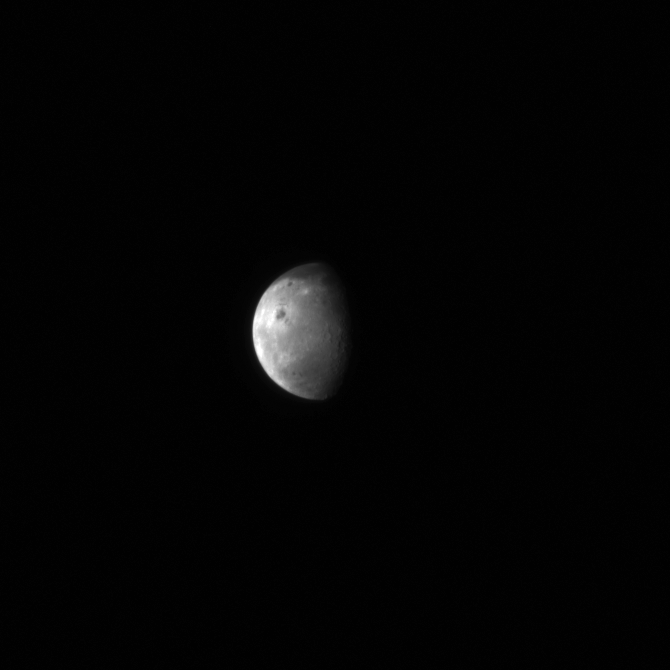
Image of Earth's moon from MESSENGER's Wide Angle Camera. The Moon's south pole, farside highlands, west Oceanus Procellarum and Mare Orientale are prominent [NASA/Johns Hopkins University Applied Physics Laboratory/Carnegie Institution of Washington].

Sarah Braden

LROC News System

The MErcury Surface, Space ENvironment, GEochemistry, and Ranging (MESSENGER) spacecraft became the first spacecraft ever to enter Mercury's orbit! The insertion burn occurred 18 March 2011 at 12:45 am UTC (17 March, 8:45 EDT). The MESSENGER spacecraft traveled about 4.9 billion miles to reach the point for orbital insertion. Read more about the successful MESSENGER orbital insertion!

Today's Featured Image is the Moon as seen from the MESSENGER spacecraft on July 31, 2005, less than a year after the spacecraft's launch from Cape Canaveral. The lunar image was taken by the MESSENGER Wide Angle Camera (WAC), which is part of the Mercury Dual Imaging System (MDIS). At the time when the image was taken, the spacecraft was about 992,814 kilometers (616,906 miles) from the Earth.

This image was not taken simply because the Moon is beautiful and inspiring; it serves to help the MESSENGER team calibrate the camera and spectrometer. The Moon is a good calibration standard because its reflectance and color have been measured with many instruments, so it is useful to make comparisons between instruments with different characteristics. In other words, it is a check on the quality of the Earth-based calibration.

LROC is an important new contributor to our understanding of how light interacts with the lunar surface especially in ultraviolet wavelengths. In particular, the new WAC color images will help to calibrate the MESSENGER MASCS spectrometer, which measured the Moon at the same time the MDIS camera snapped this picture.

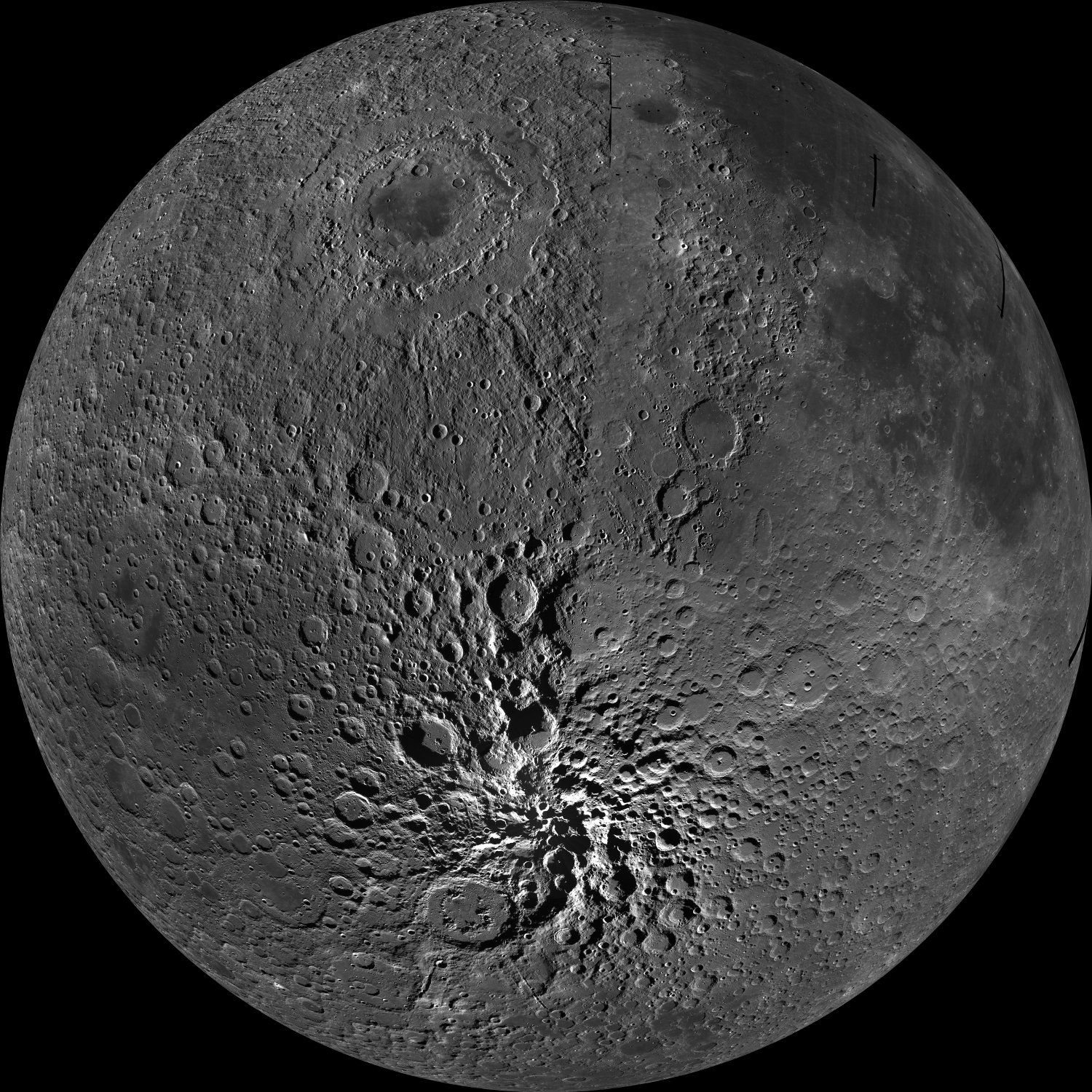
The MESSENGER MDIS view of the Moon is centered about -60°, 280°. Mare Orientale is the the small dark spot in the upper left. For a closeup of Orientale see the recent LROC Featured Image. The same viewpoint as the MESSENGER image was used to create a higher resolution view from the LROC WAC.


LROC Wide Angle Camera 400 meter/pixel orthographic projection, similar to the field of view captured from MESSENGER, July 31, 2005. View the full-sized contextual LROC WAC mosaic HERE [NASA/GSFC/Arizona State University].

After the orbital insertion, scientists will test the spacecraft systems to make sure that all the instruments are in good working order. It is important to verify that all the instruments operate well in the harsh thermal environment around Mercury (currently Mercury is only about 0.3 AU from the Sun!). On April 4, 2011, the science phase of the MESSENGER mission will begin and the orbital science data from Mercury will be returned to Earth almost every day for at least a year! For more news about the MESSENGER mission, visit the NASA news page.

Congratulations to the awesome MESSENGER spacecraft operations team at APL!

Check out the MESSENGER website to learn more about the mission goals!

Monday, March 10, 2008

Reporting in from LPSC

The Planetary Society Blog

Emily Lakdawalla
This is just a brief post from Houston to say I'm here and covering what I can from the first day of the Lunar and Planetary Science Conference. I've already taken lots of notes on the morning's session on MESSENGER at Mercury. (Here's a program and abstracts for that session in PDF format, about 6 MB.) There's nothing Earth-shattering (Mercury-shattering?) to report from the presentations given so far, but they are beginning to dig in to the details of trying to figure out the history of Mercury's geology from the wonderful new MESSENGER data set. Some of the best news of the morning was in Maria Zuber's talk on the Mercury laser altimeter. That instrument builds up topographic information on Mercury by firing a laser at the surface several times a second and watching for the return flash. They only had one profile on Mercury from the flyby, but during that profile they were able to detect return flashes from angles of up to 70 degrees off of nadir. Let me explain what that means.

More HERE.
Selene at the Moon (LPSC)
Star Stryder
It’s a day of missions. I just left the MESSENGER session to sit in on part of the SELENE mission session. This new craft on the block is a Japanese produced and is returned hi resolution images and movies back to Earth as it systematically acquires topographic maps of Earth’s moon. SELENE, which is also called KAGUYA is actually three space craft: a main orbiter, a Relay Satellite, and the VRAD Satellite.

The SELENE image gallery can be found here. One of the more visually interesting things they are doing is taking images with a Hi-Def Video camera. (image credit: 2007 JAXA/SELENE, click image above for hi res image)

In addition to the scientifically not so useful (but public attracting) hi-def camera there are roughly a data taking dozen instruments ranging from a Laser Ranging system (that is conceptually similar to the Mars and Mercury Laser ranging instruments), a stereographic imaging system that has produced 3-D movies (see image 3/3 on the TC tab of the gallery), a radar sounder, and much much more (see wiki page)

So far 4.8 million shots have been fired with their Laser, with cross path resolution of 15 km as of Feb. 29. This is very preliminary results. The laser’s first shot was fired Nov. 25, 2007 and everything is still being calibrated. While the MESSENGER Mercury data is even younger, they had a chance to calibrate when they went past Venus.

With the Lunar Radar System (LRS) they are mapping subsurface boundaries. They are finding subsurface layers that weren’t detected by Apollo 17’s ALSE radar that worked at the same wavelength. The newly detected layers are “nearly a factor of 2 shallower.” This raises the question of “Um, Why?” Well, in the Q&A the answer appears to be, we don’t know, but it’s probably a mistake in someone’s analysis. The SELENE LRS data is much higher resolution and much higher quality, and the suspicion is the factor of two comes out of mis-interpretation of the Apollo data (an example of a factor of two occuring somewhere else was mentioned). Again - all preliminary, and all very tantalizing.

From the gravity experiment (RSAT), the are filling in holes in previous data sets and they are mapping out the internal mass distribution of the Moon.
More HERE.