Showing posts with label Ernest Bowman-Cisneros. Show all posts

Thursday, January 9, 2014

The Sixteenth LRO PDS release

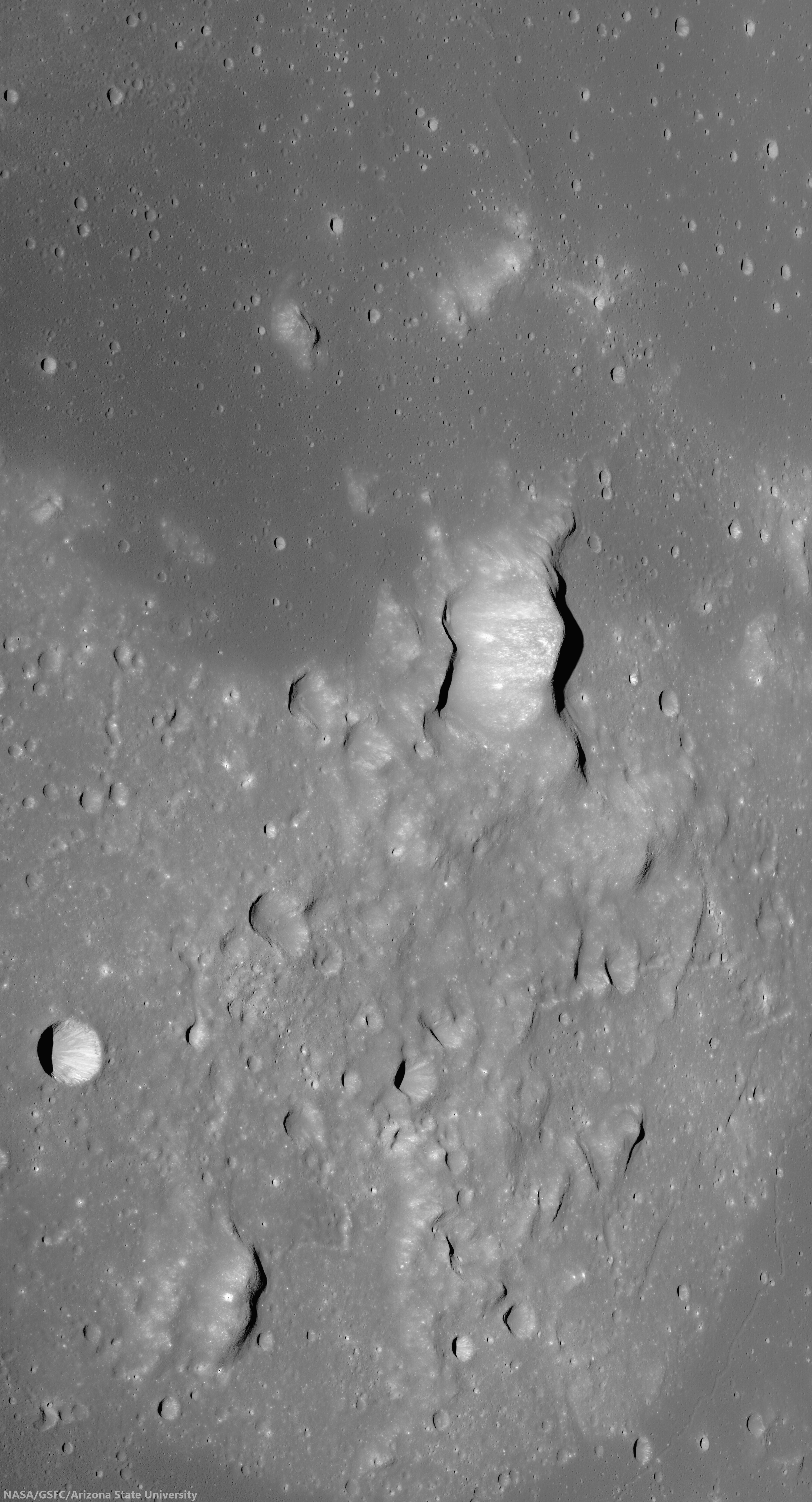
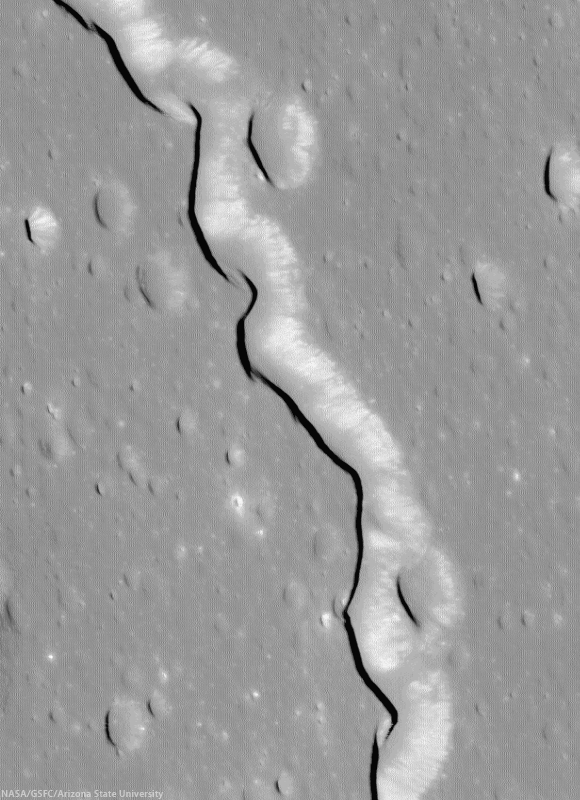
Rima Galilaei (Oceanus Procellarum)
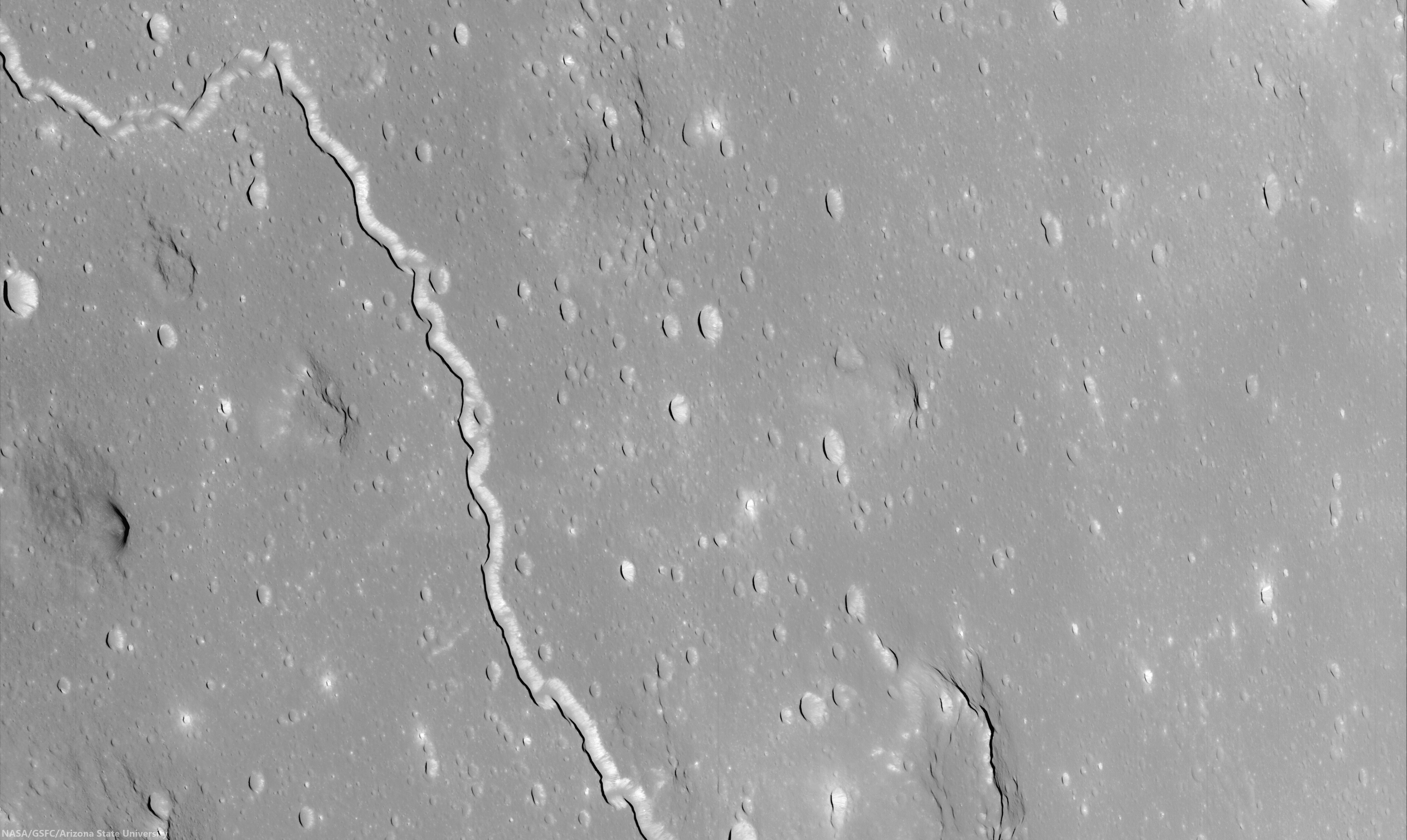
Immediately after sweeping up a splendid oblique view of Reiner Gamma, released previously, September 19, the narrow Rima Galilaei crossed into the LROC NAC view, creating a spectacular Target of Opportunity for the spacecraft and camera. LROC NAC M1127569198R, orbit 18320, July 4, 2013; slew 63° from nadir, averaging 3.9 meters resolution from 110.9 km over 11.85°N, 292.61°E [NASA/GSFC/Arizona State University].
Joel Raupe

The holidays and arrival of Chang'e-3 on the lunar surface delayed a number of posts here, before the New Year. China's first lunar landing and deployment of the Yutu rover at Mare Imbrium, for example, took place as LRO science teams delivered the latest and 16th trimonthly accumulation of data gathered from lunar orbit during three months, from the middle of June to September, last year.

Until today, however, we grievously failed to relay the only known announcement of the timely release to the Planetary Data System (PDS) of LRO observations, made by Ernest Bowman-Cisneros, on behalf of the Lunar Reconnaissance Orbiter Camera (LROC) team at Arizona State University.
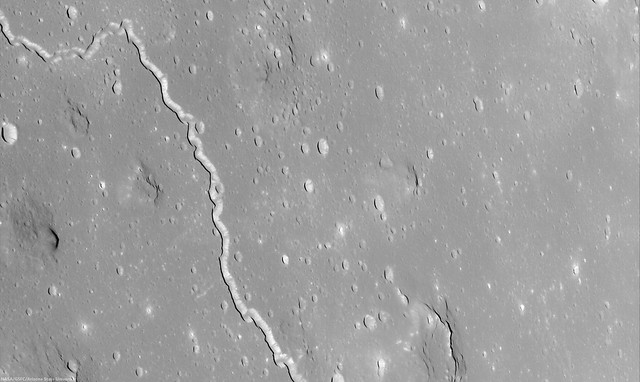
Rima Galilaei (Oceanus Procellarum)
Rima Galilaei winds 186 km, gradually descending northwest from the Marius Hills, meandering through a relatively featureless expanse of Oceanus Procellarum. The full oblique view above shows a small segment of the sinuous rille with several outlying Marius domes in a roughly corrected mosaic stitched from the entirety of LROC NAC observation M1127569198LR, released December 15. The straight-line distance from where the rille enters and departs this foreshortened field of view is 30 km (full resolution available HERE) [NASA/GSFC/Arizona State University].
No one's done a better job cataloging, standardizing, and steadily providing both the science community and public with access to the incredibly deep LRO database than Mark Robinson's team at ASU. They don't quite "make it look easy." In fact, their yeoman's efforts tend to conceal the colossal volume LRO has returned from the Moon since June 2009.

Again, coinciding with news of the Chang'e-3 landing, Bowman-Cisneros wrote, "The 16th LROC Planetary Data System release includes images acquired between June 16 and September 15, 2013.

"This release contains 69,168 EDR images - totaling 7.9 TB, and 69,168 CDR images - totaling 16 TB. An additional 48 NAC Digital Terrain Models (DTMs) and 7 NAC Region Of Interest (ROI) mosaics were also released as part our this LROC RDR volume, rounding out a total 171 NAC DTMs and 100 NAC ROI mosaics released to date."
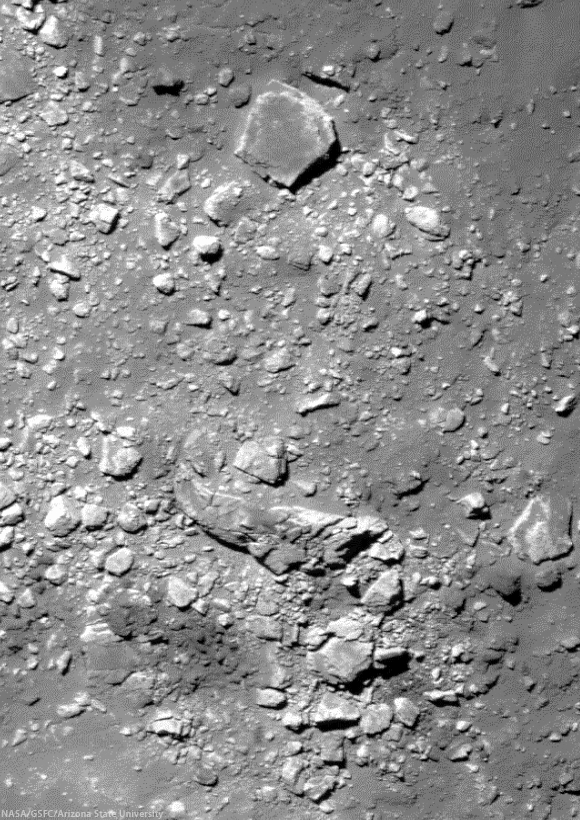
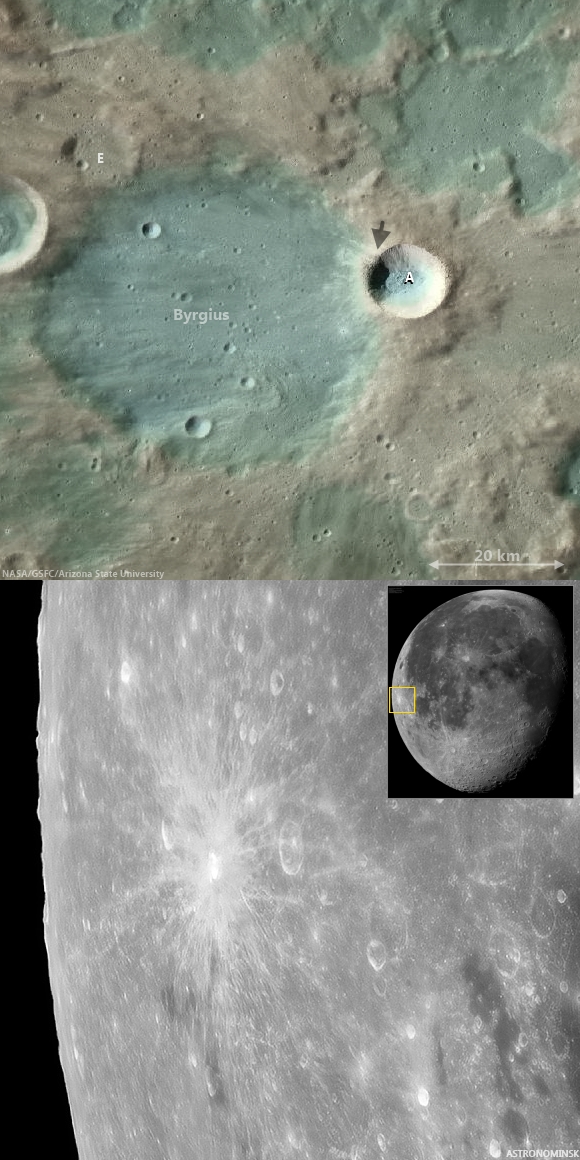
The rim and wall of bright Byrgius A
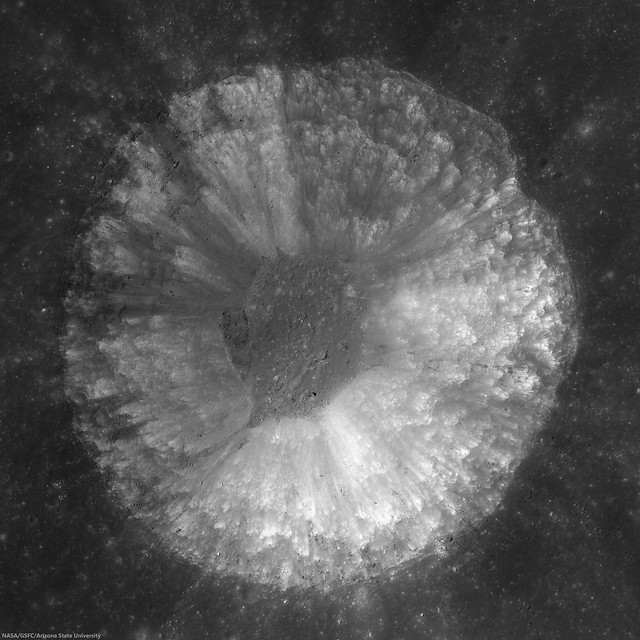
A 420 meter-wide full-resolution view of massive boulders in a field thrown up by the impact that created the bright crater Brygius A (18.45 km, 24.52°S, 63.81°W). The largest of the boulders in this view (at upper center, and visible as a reference in the wider field below) is about 75 meters across. LROC NAC M1132270283LR, orbit 18981, August 27, 2013; incidence 26.88° and 73 cm per pixel resolution from 69.7 km [NASA/GSFC/Arizona State University].
"As of December 15, 2013, EDR and CDR products for Volumes 1-5 were regenerated and released," Bowman-Cisneros announced, as he discussed the housekeeping work, standardizing and streamlining the record-breaking store of high resolution and wide-angle camera orbital images of of the Moon. "Additionally, EDR and CDR products for Volumes 6-12 were also regenerated and will be released by December 20, 2013."
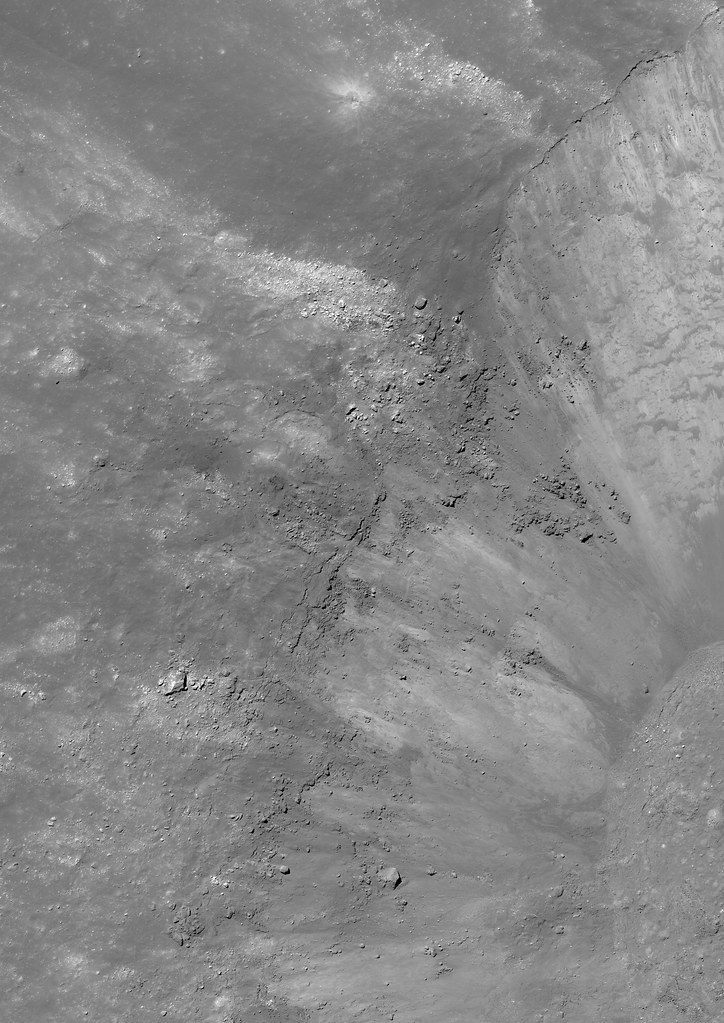
The rim and wall of bright Byrgius A
Full-width reduction of a 8925x12618 pixel mosaic showing a 6.5 km wide field of view, context for the rugged boulder field perched on the rim of Byrgius A, shown at full resolution further up. The boulders mark the beginning of one of among many very bright rays that contrast markedly with at least some darker material centered on Byrgius A. LROC NAC M1132270283LR. Wallpaper-aspect version HERE [NASA/GSFC/Arizona State University].
Byrgius A
Bright ejecta of Brygius A obscures its more ancient namesake, whose rim it has excavated. The arrow in the upper image marks the boulder field. Sharp-eyed earthbound observers often spot the brilliant and widespread rays of the younger. much smaller crater with the naked eye. Above: LROC Quickmap at 250 meters resolution, and, Below: inset and full-resolution segment from a truly dramatic mosaic made up of 100 telescopic images of the Waning Moon, September 4, 2012, by Astronominsk (Yuri Goryachko, Mikhail Abgarian, Konstantin Morozov) of Minsk, Belarus. (Hat tips and flowers to Charles Wood and his Lunar Picture of the Day (LPOD).)
(If this goes on much longer, soon might know as much about our Moon as we do about Mars.)
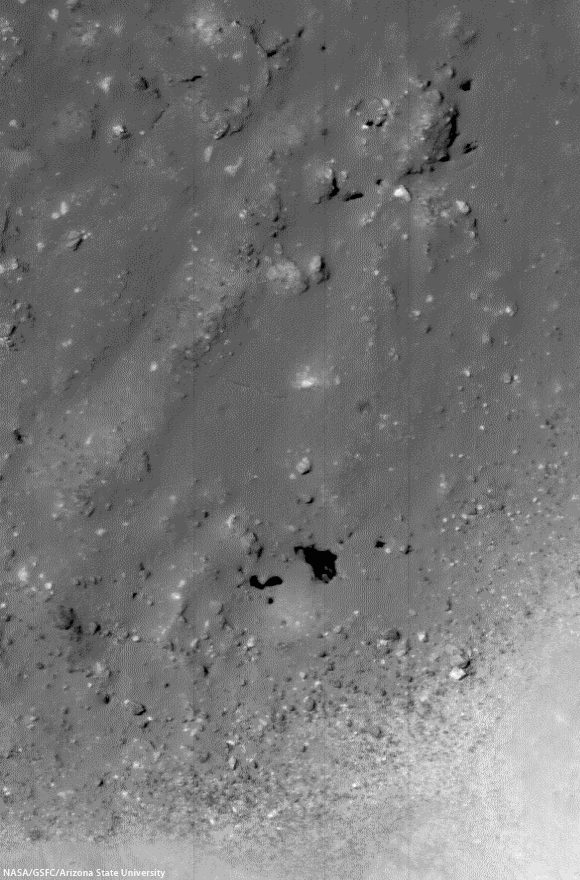
Crater floor Pits Dollond E
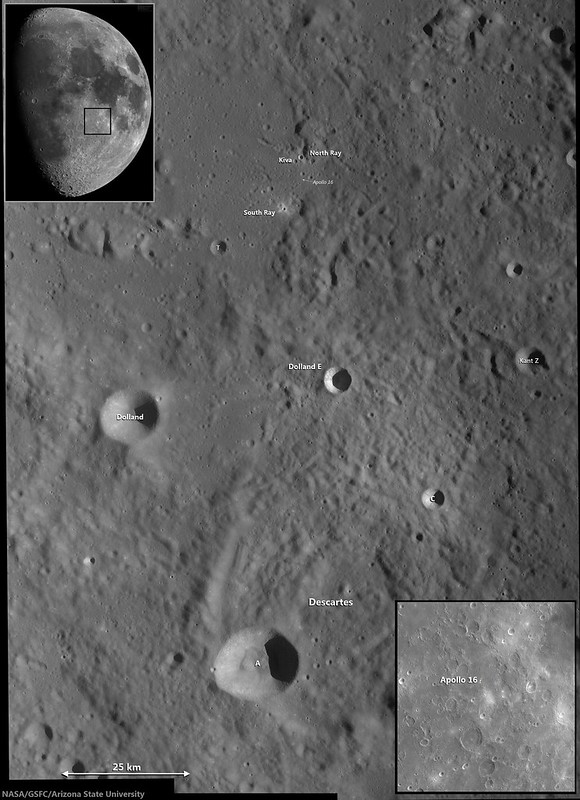
Apparent pits on the floor of Dollond E (5.22 km, 10.256°N, 15.7°E), a small and relatively fresh crater with a distinctive impact melt pooled. Dollond E is a natural excavation of the Descartes formation in the Southern Highlands, contiguous with the Stone Mountain area explored by Young and Duke of the Apollo 16 expedition and host for one of the Moon's most intense magnetic anomalies. A 400 meter-wide field of view from LROC NAC mosaic M1131744083LR, orbit 18907, August 21, 2013;  angle of incidence 21.49° at 70 cm per pixel resolution from 86.47 km [NASA/GSFC/Arizona State University].
Dollond E (Descartes formation)
All of Dollond E, in a reduced, full-width segment from LROC NAC M1131744083LR [NASA/GSFC/Arizona State University].
Another juxtaposition of Earth-bound and orbital views centered on Dollond E, with the nearby Apollo 16 landing site and the Descartes formation; context for the LROC NAC study. LROC Wide Angle Camera (WAC) mosaic from three sequential orbital passes in 2011 with telescopic inset by Astronominsk (Moon waxing Full on April 1, 2012) [NASA/GSFC/Arizona State University].
A newly-released stash of LROC data is always eagerly received. LRO's record-smashing time in polar orbit around the Moon has allowed nearly all the surface to be photographed at high-resolution, so each new PDS release offers first of a kind views and new angles, resolutions and angles of illumination for other areas. With so much offered, its hard to cast a theme characterizing any single release. As of last summer, the LRO's Extended Science Mission (ESM) has continued from a fuel saving high-side of low lunar orbit, collecting images in the 0.7 to 1.7 meters resolution range. This latest release, on first glance, features fewer dramatic oblique views and more of the kind of "value-added" high-resolution NAC DTM's which will continue to prove this spacecraft's value decades after its mission comes to a end a few years from now.
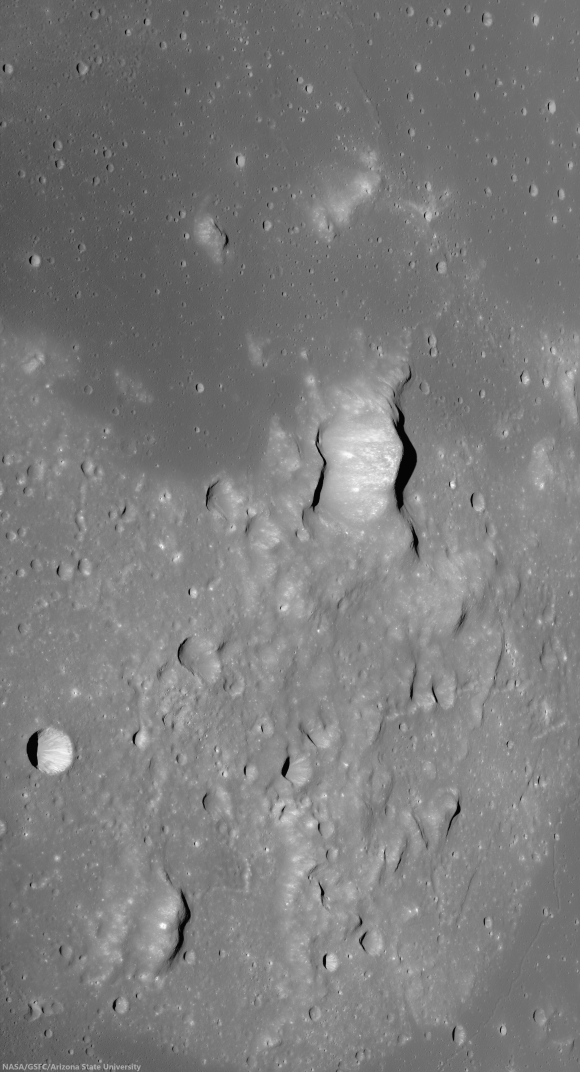
Dome of Agatharchides 1
The "Fireman's Helmet," Agartharchides 1, an intrusive volcanic dome, about 60 km across, and a relatively bright telescopic landmark of the southern Oceanus Procellarum. LROC NAC oblique mosaic M1127377730LR, LRO orbit 18292, July 2, 2013; angle of incidence 75.25° looking east with spacecraft and camera slewed 63.4° off nadir. Average resolution about 2.8 meters per pixel from 73.83 km over 16.58°S, 322.78°E. Click image or HERE to view at 40 percent full resolution [NASA/GSFC/Arizona State University].

Wednesday, July 3, 2013

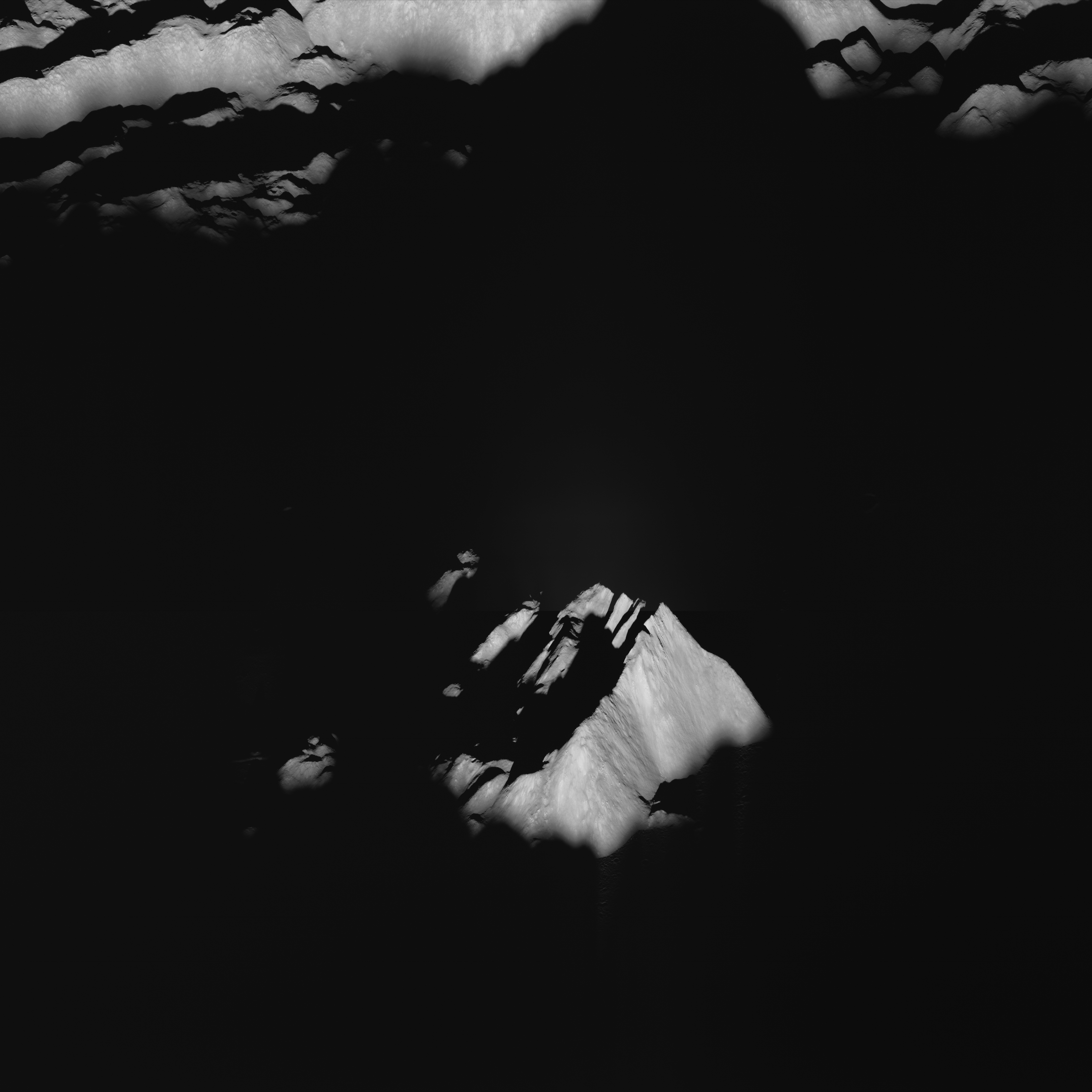
Tsiolkovskiy central peaks at sunset

LROC Narrow Angle Camera (NAC) oblique view of the central peaks of Tsiolkovskiy. (See the full-size mosaic assembled HERE.) LROC Narrow Angle Camera (NAC) mosaic M1111030948LR, from orbit 15992, December 24, 2012; 88.89° angle of incidence, long focus resolution roughly 8 to 10 meters per pixel from 89.44 km above 19.97°S, 119.15°E [NASA/GSFC/Arizona State University].
Tsiolkovskiy (184 km in diameter, 20.37°S, 128.97°E), the landmark mare-inundated crater in the lunar highlands south of the farside equator, was conspicuous in our first look at the Moon's farside in 1959.

Also compare this scene - rolling under the sunset terminator (as the Moon was Waxing Full from our standpoint on Earth with the fully-illuminated and closer oblique perspective of the same region from a similar angle six months earlier, HERE.)

This latest LROC Narrow Angle Camera observation is among the 141,630 NAC stills, 23,88 TB of data, released in mid June to the Planetary Data System by the LROC team at Arizona State University, according to Ernest Bowman-Cisneros.

"Additionally," Bowman-Cisneros announced, "the LROC team has been reprocessing data from early in the LRO mission. We have re-released Volume 1, 2 and 3 of the EDR and CDR data sets. Reprocessing will continue until Volumes 4 through 11 have been updated.

"To date, the LROC Team has delivered 1,041,298 LROC images - totaling 123 TB for EDR and 235 TB for CDR products, and over 8,743 derived (RDR) data products to the NASA Planetary Data System," Bowman-Cisneros said. "The complete LROC PDS archive can be accessed via the URL http://lroc.sese.asu.edu/data or one can search for specific images or mosaic products using the LROC WMS Browse interface.

"Also be sure and try out our Quickmap interface."

The full LROC NAC mosaic highly resampled down to the 580 pixel maximum width allowable with this blog format. Captured just before midnight (UT) on Christmas Eve in 2012, most of the interior of of Tsiolkovskiy had already entered the two-week long lunar night, and the high crater rim and central peaks, towering 3200 meters over the crater floor, were mere hours behind. See the mosaic at higher resolutions by right-clicking on the images HERE. [NASA/GSFC/Arizona State University].
The Lunar Reconnaissance Orbiter continues to re-shape the envelope of what was once believed to be possible for long-term lunar missions, having long ago doubled it's record of returning more data to Earth than all other deep space missions combined.It begins a fifth year in lunar orbit, no small achievement itself, having orbited the Moon 18,313 times, as of 3 July, 2013, 2100 UT.

This LROC QuickMap 3D WAC-derived topographical view of Tsiolkovskiy's central peaks has become, more or less, a regular feature, as this distinctive farside crater has been the subject of many interesting posts, some highlighted below [NASA/GSFC/Arizona State University].
Sample Posts regarding Tsiolkovskiy crater:

New oblique view of Tsiolkovskiy central peaks (December 26, 2012)
The Old and the Young at Tsiolkovskiy (October 31, 2012)
Weaving boulder trails on the Moon (July 11, 2012)
Bulging wrinkles at Tsiolkovskiy (January 11, 2010)
Regolith on Basalt (January 10, 2012)
Highland-Mare boundary of Tsiolkovskiy (September 29, 2011)
The Hummocks of Tsiolkovskiy (August 26, 2010)
More of Tsiolkovskiy's boulders and boundaries (August 26, 2010)
Small fractures in the mare floor of Tsiolkovskiy (August 25, 2010)
Tsiolkovskiy - Constellation Region of Interest (May 1, 2010)
Uplift, Boulders of Tsiolkovskiy (September 1, 2009)

Sunday, December 16, 2012

LRO teams deliver 12th quarterly release to PDS

The 8000 meter wide pyroclastic vent high on the second outer ring of Mare Orientale, at very high resolution, has nearly invariably been in shadow, or the LRO spacecraft has been at lower altitude and too close to catch this breathtaking view in one take. As it is, the full observation was repeated in sequential orbits, the makings of a spectacular stereo 3D anaglyph. From a mosaic including both the left and right frames of LROC Narrow Angle Camera (NAC) M1099502843, orbit 14378, August 13, 2012; resolution 0.75 meters from 72.12 km [NASA/GSFC/Arizona State University].
The Lunar Reconnaissance Orbiter Camera (LROC) team at Arizona State University, and investigation teams overseeing the other instruments on-board the robust LRO platform, are once again on time with their 12th quarterly release to the Planetary Data System (PDS). Its another impressive store, with more data gathered over three months than most deep space missions sweep up in an entire tour. All together, the LRO mission has again broken its own record, one unlikely to be surpassed for many years. LRO has returned more data than all present and past deep space missions combined.
 
To a widespread, devoted and grateful group unashamed to call themselves "lunatics," Christmas has arrived early once again this year.

Far to the northeast of the more familiar heart of the Reiner Gamma albedo swirl (and magnetic anomaly) in Oceanus Procellarum, the bright but thin layer of optically immature regolith meanders up into the Marius Hills. The higher altitude assumed by the LRO mission this year allowed the diffuse contact region to be photographed in one observation, under the same lighting conditions. The LROC Wide Angle Camera 100 meter global mosaic is used as context for that area, swept up in the NAC observation below [NASA/GSFC/Arizona State University]. 
Still at high resolution, the physical relationship at the surface between the Reiner Gamma swirl and the Marius Hills volcanism can be studied under similar lighting condition, and in one take, in this LROC NAC mosaic. LROC NAC M1099209032LR, orbit 14337, August 10, 2012; resolution in the original 0.98 meters from 118.85 km, angle of incidence 40.15° [NASA/GSFC/Arizona State University].
"The 12th LROC Planetary Data System release includes images acquired between June 16 to September 15," according to the announcement, posted by LROC team member Ernest Bowman-Cisneros.

This LROC release totals 16.54 TB, and includes ten more Narrow Angle Camera (NAC) Digital Terrain Models (DTM) and 6 NAC image mosaics of important Region of Interest (ROI).

"To date," Bowman-Cisneros writes, "the LROC Team has delivered 893,493 LROC images and over 8,653 derived (RDR) data products to the NASA Planetary Data System. The complete LROC PDS archive can be accessed via the URL http://lroc.sese.asu.edu/data or a search for specific images or mosaics can be made using the LROC WMS browser. Also be sure and try out QuickMap!"

The anatomical mix of dark and relatively bright featured tossed up by simple craters impacting the Marius Hills can also be examined from the unique perspective presented in the LROC NAC oblique images, this one being the first we stumbled across, a brief study of the shield volcano's interior. LROC NAC M1096851065LR, LRO orbit 14007, July 13, 2012 [NASA/GSFC/Arizona State University].

Thursday, September 27, 2012

LRO Release 11 to the Planetary Data System

The 'Cobra's Head' of the unofficially designated Sinuous Rille of the western Marius Hills volcanic shield formation of Oceanus Procellarum, in high relief (incidence angle 75.29°); LROC Narrow Angle Camera mosaic of left and right frames M193325282LR, spacecraft orbit 13514, June 3, 2012, resolution 1.26 meters per pixel from 125.78 kilometers altitude [NASA/GSFC/Arizona State University].
Ernest Bowman-Cisneros
LROC News System

The 10th LROC Planetary Data System release includes images acquired between 2011-03-16 to 2012-06-14. This release contains 76,715 EDR images totaling 9.4 TB and 76,715 CDR images totaling 20 TB. An additional 10 LROC NAC DTM and 3 NAC Region of Interest (ROI) products were also added to the LROC RDR Dataset.

To date, the LROC Team has delivered 817,358 LROC images and over 8,556 derived (RDR) data products to the NASA Planetary Data System. The complete LROC PDS archive can be accessed via the URL http://lroc.sese.asu.edu/data or one can search for specific images or mosaics using the LROC WMS browser. 

Also be sure and try out Quickmap!

Thursday, March 15, 2012

LROC 9th PDS Release

A favorite telescopic target, casting a long shadow at local sunrise, the 12-km long Galilaei M dome, along side Rima Galilaei, in Oceanus Procellarum west of the similar myriad Marius hills and north Reiner Gamma. LROC Wide Angle Camera (WAC) observation M178008514C (604nm), orbit 11369, December 8, 2011; incidence angle 76.82° - resolution 56.38 meters per pixel from 40.16 km [NASA/GSFC/Arizona State University].
Ernest Bowman-Cisneros
LROC Announcements

The 9th LROC Planetary Data System release includes images acquired between September 16, 2011 to December 15, 2011.

This release contains 69,687 EDR images totaling 8.5 TB and 69,687 CDR images totaling 17.5 TB.

To date, the LROC Team has delivered over 655,904 LROC images to the NASA Planetary Data System. The complete archive can be accessed via the URL http://lroc.sese.asu.edu/data or searched using the URL http://wms.lroc.asu.edu/lroc.