Showing posts with label Wood. Show all posts

Tuesday, June 19, 2012

Welcome new medium resolution views from LRO

Rich detail and context is seen in this "medium resolution" image of a familiar part of the complex Aristarchus Plateau from the Lunar Reconnaissance Orbiter (LRO). Prior to a recent mission-conserving transfer to higher orbit, capturing the entire width of the 165 kilometer-long Vallis Schroteri in a single Narrow Angle Camera (NAC) frame was not possible. The maneuver should add some years to the record-smashing mission following three years in an energy-taxing low lunar orbit, and welcome perspectives like this one in a 'middle range' between the best of the orbiter's narrow and wide angle camera catalogs.  LROC NAC frame M183861408R, LRO orbit 12190, February 14, 2012; angle of incidence 41.03° at 1.39 meters resolution from 140 kilometers [NASA/GSFC/Arizona State University].
Other nations can rightly boast of recent accomplishments in low Earth and lunar orbit, and its easy to lament the embarrassing length of time since America sent six manned expeditions to the lunar surface. It might seem a small thing in comparison, and easy to forget, but the United States presently has five vehicles in lunar orbit. Queen among them is the under-rated Lunar Reconnaissance Orbiter.

The LRO will soon celebrate three years in lunar orbit, far longer than any spacecraft in history, and by all accounts the vehicle is healthy and still shy of middle age. It's no small accomplishment maintaining close-lunar orbit precisely for the very reason the twin GRAIL gravity probes, "Ebb" and "Flo," were designed and subsequently dispatched to spy out. The Moon is "lumpy," with mass concentrations putting uneven drag on objects in orbit, and it also dances through a realm of space overwhelmed by the influences of Earth and Sun. To remain in lunar orbit requires skill and fuel, even over robust design.

After more than two years surveying the lunar surface from within 40 kilometers, close enough to photograph the forty year-old footprints of the Apollo astronauts and allowing more than half the Moon to be imaged at high resolution, in 2011 flight directors included two periods when LRO was swept through the 20 kilometer range. It was a last slow dance before the spacecraft was brought up above 100 kilometers. 

Eventually, planning requires LRO to be wound down tightly for more unprecedented close-ups before what is hoped will be a controlled impact, good to the last thruster fire. In the meantime, since late last year scientists have been enjoying a "medium range" perspective using the LROC Narrow Angle Camera from a higher altitude.

It difficult to disparage the quality of this LROC NAC frame of Rima Galilaei and the exposed layering of the surrounding floor of Oceanus Procellarum. This image is a full-resolution crop from LROC NAC M181552312R, orbit 11867, January 18, 2012; angle of incidence 62.51° at 1.25 meters resolution, from 125.4 kilometers altitude. For comparison, from 24.16 kilometers in orbit 9978 the previous August 21, two insets from LROC NAC frame M168584181R show half-meters resolution fields of view of the same region [NASA/GSFC/Arizona State University].
Soon after LRO arrived in lunar orbit and the first of Arizona State University's LROC Narrow Angle Camera images began arriving back on Earth, Charles Wood, who is the steadfast lunar observer and architect of the Lunar Picture of the Day (LPOD) website, was quick to point out the level of detail and small fields of view seen in those images seemed almost overwhelming. He looked forward to the time, still several months off, when LROC's Wide Angle Camera (WAC) catalog premiered on the Planetary Data System (PDS). He wasn't disappointed. That wider context showed familiar landmarks Wood had long witnessed under every available illumination and focus in ways that were truly new.

These are still high-resolution images, even at less than half their previous detail. A new range of medium resolution photography from the LROC NAC offers a welcome opportunity to continue the long process of digesting the incredible volume of data that's been returned to Earth from what may already be the most cost-effective deep space mission in history.

Sunday, April 15, 2012

Scientists at PRL suggest evidence of continued volcanism long after Tycho's formation

From "Tycho's flash-frozen inferno" (Lunar Pioneer/Lunar Networks), November 2, 2011: As impact melt briefly ran down the exterior side of the southeast brim of Tycho it pooled, cooled, and came to a halt in the cold vacuum of space long before 'finding its level.' PRL director Dr. Goswami and team suggest these and other melt pools are superimposed at positions suggesting extrusive volcanism at Tycho continued well after the impact event, 109 million years ago. LROC NAC observation M150578086R, LRO Orbit 7324, January 25, 2011; resolution 71 centimeters per pixel, incidence angle 69.84° from 44.74 kilometers [NASA/GSFC/Arizona State University].
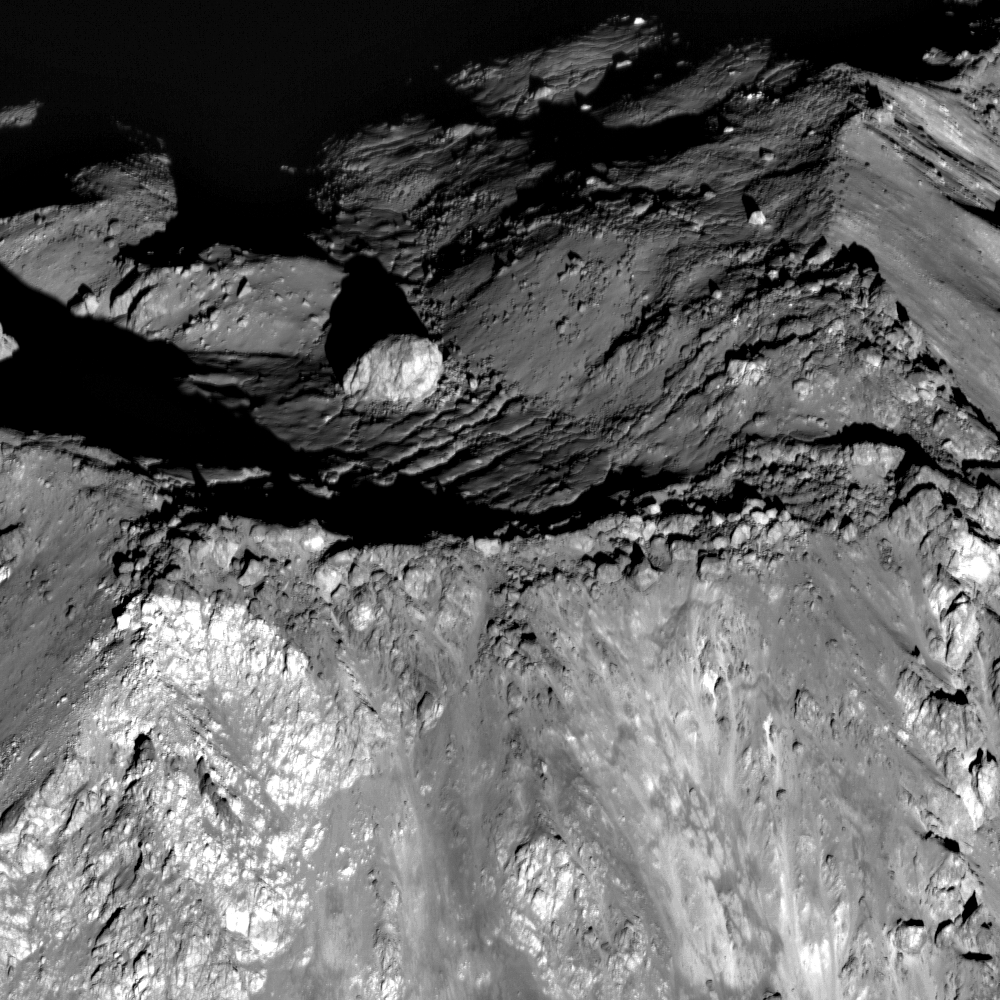
EDITOR'S NOTES: RE: "Claim supported by discovery of two-km high peak with boulders." Obviously the central peak of Tycho is not a recent discovery, though the nature of the large boulder situated near it's apex, discussed here last July, was a recently resolved feature, and before either Chandrayaan-1 or the on-going Lunar Reconnaissance Orbiter missions. That feature is plainly visible in Terrain Camera images returned by Japan's SELENE-1 (Kaguya) in 2009. Now without reading the full paper by Dr. Goswami, whose credibility is well established along with that of the PRL, we are left a bit confused by the report that follows which suggests 100 million year-old features related to a 100 million year-old impact should be thought of as unusual. Nevertheless, a hint that impact melt and other features superimposed upon Tycho might be evidence of volcanism continuing for an unusually long time after Tycho's formation is intriguing.
Addendum 1 - 201204141459 ut: Charles Wood discussed and linked to the abstract discussed below at his definitive website LUNAR PICTURE of the DAY (LPOD), April 14, 2012.
Addendum 2 - 201204152359 ut: Dr. J. N. Goswami, director of India's noted Physical Research Laboratory (PRL), who is quoted in the Deccan Herald news article below, was gracious enough to forward to our group a complete copy of the newsworthy research regarding the interesting possibility of an extended and dynamic period of volcanism near the central peak of Tycho. We will follow up on this shortly. - JR.

"Indian scientists find volcanic activity on moon"

Kalyan Ray
Deccan Herald

Breaking through a popular perception of moon being a geologically inert place for the last three billion years, Indian scientists have found new evidence of the recent volcanic activities inside a lunar crater, opening up a new window for research.

The discovery of a 2-km high peak with large boulders comfortably sitting atop inside a crater and signatures of strong volcanic activities all around the peak may eventually aid scientists to solve one of the long-standing lunar mysteries – what is the moon made of?

Analyzing data collected by Chandrayaan-I and USA’s Lunar Reconnaissance Orbiter, a team at the Physical Research Laboratory (PRL) in Ahmedabad, found evidences of volcanic vent, lava pond and lava channels as recent as 100 million years old inside the ‘impact crater’, thus implying that the moon was not a geologically quiet, rather, it was an active place.

From "LROC Featured Image, 'Tycho Central Peak Spectacular,'" July 5, 2011: Oblique view of summit area of the central peak of Tycho. The boulder resting inside a summit notch is 120 meters wide, and the image area is about 1200 meters across. LROC Narrow Angle Camera (NAC) observation M162350671L & R, LRO orbit 9059, June 10, 2011. Zoom in on the fill-sized NAC mosaic HERE [NASA/GSFC/Arizona State University].
The lunar volcano was different from the volcanoes seen on earth. Possibly, there was no explosive eruption. The magma may have oozed out silently through the vents. The discovery – if supported by further studies in future – has the potential to change the commonly held belief on geological history of moon, the team claimed.

Constantly bombarded by asteroids and meteors, moon has many scars on its face – the impact craters. The high-velocity collisions with lunar surface creates “impact-induced” mounds. The 2-km high peak in Tycho – a 110 million year old crater, is one such peak.

The fresh evidence of volcanic activity suggests magma may have been released from the interior as a consequence of the impact that led to the formation of the crater in the first place. This suggests that the moon was geologically active from inside when the carter was formed.

Additional illustration for Dr. Mark Robinson's "Tycho Central Peak Spectacular," From almost an entirely different angle and illumination, Japan's lunar orbiter Kaguya (SELENE-1) released a Terrain Camera image of Tycho's interior in 2009. Once again, the boulder, situated on a tiny melt plain near the very highest point of Tycho's central peak, is seen. Another large "melt plain" can also be seen at a lower elevation, above left center, a high valley between summits 600 meters above the jumbled, relatively fresh impact melt-based and chaotic Tycho interior floor [JAXA/SELENE].
“Either the signatures were made post formation of the crater or sub-surface solidified magma which was released due to the impact. We can’t be sure at this point, therefore, require more studies from other craters.

“But unlike on earth, we cannot have a deep drilling project on moon to understand its deeper crust,” Prof. J. N. Goswami, PRL director and lead scientist of Chandrayaan told Deccan Herald.

“We found the inner crustal material exposed on the central peak of Tycho,” said Prakash Chauhan, a PRL scientist. The study, he claimed, changed views about geological history of the moon and brought out details of more recent modifications of the lunar surface.

“A surprise findings revealed the  presence of large boulders–about 100 meter in size –on top of the peak. Nobody knew how did they reach the top,” Chauhan said. The findings were reported in the April 10 issue of ‘Current Science’.

Composition of lunar core and the nature of materials present on the surface remains one of the unsolved scientific problems. The evidence so far, has come mainly from the analysis of lunar rocks collected by Apollo missions, and analysis of images collected by a handful of spacecraft within the last six years including Chandrayaan-I.

Monday, August 9, 2010

Moon Summit: Stellafane


Left to Right: Chuck Wood (green), Richard Evans (blue-checked shirt), Ron Doel (blue), Pete Schultz (tie), Tom Dobbins (white) and Bill Sheehan (black), Bert Willard - not pictured [Ken Spencer/LPOD].

Chuck Wood
Lunar Picture of the Day (LPOD)

With the famous Hartness Turret Telescope in the background, this scene is immediately identifiable to (Amateur Telescope Makers) as being near the Stellafane telescope gathering at Springfield, Vermont.

John Briggs and Dan Lorraine organized a one day Moon Morphology workshop the day before Stellafane officially started and drew a fantastic set of speakers (above) and a very inquisitive and knowledgeable audience.

The balance of interest and experience of the speakers fed a continuing discussion of lunar science and history. I gave an introduction about learning to read the history of the Moon from evidence visible in the eyepiece and in images, and then a second talk about how LTVT, LRO topo data and other recent technologies brought great opportunities to amateurs.

Read the article, HERE.

Thursday, February 11, 2010

LPOD: In praise of 'Amateurs'

A mere thumbnail of an image of Copernicus, featured on Charles Wood's Lunar Picture of the Day (LPOD) February 7, was captured by Damian Peach of Barbados (C14 & SKYnyx 2.0M, August 28, 2009). Wood used the image to contrast and illustrate how observations of the Moon contributed by both professional planetary scientists and so-called 'amateurs.' The level of proficiency and technical skill demonstrated by those in the latter catagory continues to steadily improve and regularly astound.

Saturday, November 28, 2009

More Kaguya Terrain Camera images

Copernican crater Birt (22.4°S, 351.5°E) as deciphered from data collected by the Terrain Camera on-board Japan's lunar orbiter Kaguya (SELENE-1). A 400 pixel-wide reduction from the original still released November 26.

Hat tip once again to Chuck Wood and his diligent work at Lunar Picture of the Day (LPOD), even to the lengths of keeping tabs on the Japanese language-side of the Kaguya Image Gallery (where public releases usually appear weeks prior to their appearance on the English side).

A few weeks ago I made a valiant effort to rip stills from a Kaguya Terrain Camera survey of the same landmark territory near Rupes Recta, the famous "Strait Wall" among the most familiar features of the Moon's Near Side. This was done by downloading the video of that area posted up to JAXA's channel on YouTube, but the result (while interesting) can't hold a candle to the still JAXA posted to its own site earlier this past week.

Chuck linked to the Kaguya Gallery to his discussion of another of these spectacular new releases HERE.

(All of these latest shots have confirmed my long suspicion that at least one of the three more prominent collapsed "ramps" conveniently positioned along the 114 kilometer long fault line might one day serve as a short cut for ground vehicles moving east and west from the area around Birt to the higher elevation eastward beyond the wall.)

Wednesday, November 25, 2009

Game research brings lunar science to life

Keri Brown
West Virginia
Public Broadcasting

The Center for Educational Technologies® at Wheeling Jesuit University is using their research into cyber-based learning to develop computer video games about the moon.

In January, the CET will release its newest version called Selene.

Director of the Center for Educational Technologies® at WheelingJesuitUniversity, Chuck Wood said his team created the videogame Selene to help spark young people’s interest in science.

“We want to give kids a hands on experience using the tools they are familiar with to learn educational material and in particular, information about how something that is in their life every day by looking up in the sky and seeing how it was made and how it evolved over time, so part of our project is to have activities after they play the game that direct them outside to look at the moon with the naked eye, binoculars or a telescope,” said Wood.

In 2006, WJU researchers started working on CyGaMEs, which stands for Cyberlearning through Game-based, Metaphor Enhanced Learning Objects.

Read & hear the story, HERE.

Tuesday, September 15, 2009

Kaguya and the Lunar Magma Ocean

Color Me Anorthosite - Lunar Picture of the Day (LPOD), Sept. 13, 2009 (Chuck Wood) The Japanese lunar orbiter Kaguya is gone, but great science keeps coming from its data. These images show the global distribution of lunar craters whose central peaks are enriched in anorthosite. ... Central peaks are studied because they bring up material from 3-30 kilometers beneath the surface. The importance of anorthosite is that it is believed to have formed in the magma ocean at the tail end of the Moon's accretion. As a low density mineral it floated to the surface as a scum and presumably remains there, except where penetrated by later impacts or covered by mare lavas or megaregolith. ... The detailed image ... shows the central peak of the farside crater Jackson, revealing high resolution mapping on a 3-D perspective of the distribution of anorthosite in the peak. An intriguing observation - already known from terrestrial work - is that Aristarchus is anorthosite-rich, suggesting it is underying primordial magma ocean crust.

This has been offered as strong evidence against the existence of the putative Gargantuan Basin (that covers more than half the nearside, and may be centered northwest of Mare Tranquillitatis), because the anorthosite crust may have been largely removed by the giant basin's formation. Aristarchus is the only nearside crater within the (near side) maria fresh enough for anorthosite to be detected, which is not to me compelling evidence that the magma ocean crust is extant within most of the Gargantuan region. [Japanese language section of Kaguya Image Gallery, JAXA - Textural context highlights explanation by Wood from LPOD post, Sept. 13]


John Matson
Scientific American

The leading hypothesis for the moon's formation contends that a massive impact billions of years ago knocked a wealth of planetary material off of Earth, which coalesced into our lunar companion.

But that coalescence was not a serene process—the heat of formation left the nascent moon coated with an ocean of magma, researchers studying samples returned by Apollo 11 theorized in 1970. As that ocean cooled, its most buoyant components floated to the top, forming an outer shell over denser layers of rock.

Now, a geological survey of the moon conducted using data collected by the recently retired Kaguya spacecraft supports this magma-ocean hypothesis, finding that the upper layer of the moon's crust is indeed rich in low-density rock of exceptional purity. The results from the Japan Aerospace Exploration Agency's Kaguya, formerly known as the Selenological and Engineering Explorer (SELENE), are published in this week's Nature. (Scientific American is part of the Nature Publishing Group.)

The Kaguya orbiter looked for anorthosite, a type of rock enriched in the relatively low-density mineral plagioclase. The spacecraft's survey found that in fresh craters and basins across the lunar highlands, the terrain that constitutes the majority of the moon's crust, anorthosite was not only prevalent but was almost entirely pure—that is, the rock was nearly 100 percent plagioclase. The study's authors speculate that exceptionally pure anorthosite may make up a global layer of the moon's crust from roughly three kilometers to 30 kilometers below the surface.

The ubiquity of the buoyant crustal rock points to a formation process that worked the same way across the moon, such as a magma ocean. The Kaguya results show that anorthosite formation "is really a global process," says John Longhi, a petrologist at the Lamont-Doherty Earth Observatory of Columbia University and currently a visiting scholar at Duke University, who did not contribute to the study. "Forming it by any other means than a magma ocean seems very doubtful, even though I've proposed one of those models. This research seems to suggest that there's really no other way."

Read the full feature, HERE.