
 |
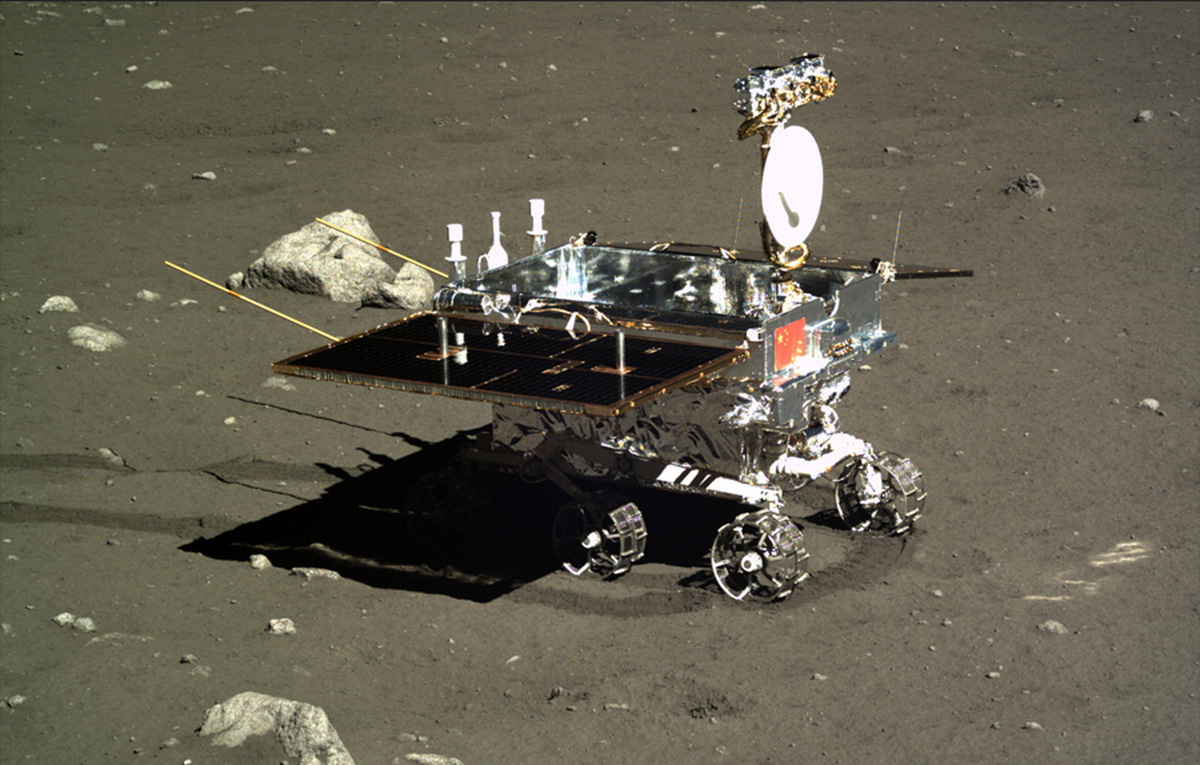
| Jade Rabbit, "Yutu," the first lunar rover since Lunokhod-2 explored Le Monnier crater for the first half of 1973, in profile, as seen from the Chang'e-3 Panoramic Camera soon after deployment and its first tantalizingly brief trip across a few square meters of Mare Imbrium. The twin dipole antenna extending behind the vehicle are its ground-penetrating array [CAS/CNSA/CLEP]. |

The Once and Future Moon
Smithsonian Air & Space
Another lunar day has come and gone on the barren plains of Mare Imbrium. How fares its most famous terrestrial inhabitant, the Chang’E 3 spacecraft and Jade Rabbit, the little Yutu rover? The fact is, we really don’t know and those that presumably do aren’t talking about it much.
The Yutu rover of the Chang’E 3 mission has experienced some “mechanic control abnormality due to the complicated lunar surface,” is how the Chinese phrased the situation. Details on the nature of the problem are impossible to come by, but one clear result is that the Yutu cannot move. It apparently spent the last lunar day (which lasted from about 10 February until last weekend) sitting in one place. For some scientific investigations, that is not necessarily a problem, but for Yutu’s primary scientific mission, it is fatal.
The goal of placing a rover on the Moon is to explore and examine multiple sites distant from each other. Additionally, the traverse between stations enables unique experiments, such as profiling the surface – the principal objective of the ground-penetrating radar on China’s rover. As the vehicle moves across the lunar surface, it emits radio waves of varying frequency into the surface.
Reflections from subsurface layers or boundaries are then received by the rover’s antenna, thereby allowing scientists to infer subsurface structure. To get a subsurface profile, these measurements must be taken while the rover is moving. Thus, an immobile rover makes this experiment impossible.
The rover’s other instruments operate during a stationary period. However, once a chemical measurement has been made or an image taken, there is little value in continually repeating it.
Reflections from subsurface layers or boundaries are then received by the rover’s antenna, thereby allowing scientists to infer subsurface structure. To get a subsurface profile, these measurements must be taken while the rover is moving. Thus, an immobile rover makes this experiment impossible.
The rover’s other instruments operate during a stationary period. However, once a chemical measurement has been made or an image taken, there is little value in continually repeating it.
If the Yutu rover is immobile, its scientific mission is effectively over.
News reports have stopped giving us data and information from the Chang’E 3 lander (which has a camera and an ultraviolet telescope) but assuming it is still operating, it may continue making observations. The lander spacecraft made a panorama of the landing site, so that objective was completed. Presumably, if the UV telescope is still operating, it can continue observing the sky but these observations are not significant to lunar science.
News reports have stopped giving us data and information from the Chang’E 3 lander (which has a camera and an ultraviolet telescope) but assuming it is still operating, it may continue making observations. The lander spacecraft made a panorama of the landing site, so that objective was completed. Presumably, if the UV telescope is still operating, it can continue observing the sky but these observations are not significant to lunar science.
 |
| Three LROC NAC views of the Chang'e-3 landing site in north Mare Imbrium (44.1214°N, 340.4884°E, -2630 m elev.), before landing, after deploying the Yutu rover (south of the lander) and after Yutu was moved just to the southeast of the lander, where it apparently failed (and remains) reportedly following a ground-operations error during preparations ahead a long lunar night [NASA/GSFC/Arizona State University]. |
So, how did Yutu do as a lunar explorer? For now, we really don’t know. Aside from a few color images and a chemical spectra that was released to the press, little scientific data has been revealed (a Google translate version of a Chinese web page describing the Chang’E 3 science to date can be read HERE). The data we have seen mostly show that the instruments were functioning. We do not know how many measurements were made, what they have told us, or the geological setting of the chemical analyses.
The Chang’E 3 lander set down very near the rim of a crater 450 meters in diameter, a feature whose walls are littered with angular blocks clearly derived from the local bedrock. The fact that the Yutu did not make an immediate beeline over to those blocks for a detailed examination and chemical analysis tells me one of two things: either those planning the rover’s exploration traverse are not geologists or they didn’t get to it before the rover stopped working.
Yutu has led a famous existence in cyberspace, with numerous “tweets” to the world. A public eager to anthropomorphize machines has responded in kind, including offering several admonitions to the rover to “pay attention to his wake-up calls.” All this rhetorical cuteness hides the fact that China has been less than forthcoming about this mission, as they are about all of their space missions. We hear only what they want us to hear. Successes (of which they have had many) are widely trumpeted with blasts of publicity, while difficulties and failures are buried in silence. It’s true that a space program run by the military (in the case of China, the People’s Liberation Army) will tend toward such an ethic. But the WALL·E-like image promoted by China early in the mission is not the image conveyed by their current posture with the world press.
I find the Chinese attitude both interesting and dismaying. It is similar to one that I experienced with Indian Space Research Organization (ISRO) during the Chandrayaan-1 lunar orbiter mission. When the Chandrayaan spacecraft was running into difficulties after a few months in lunar orbit, the organizational instinct was to deny any problems and be less than forthcoming with the press about the status of the spacecraft.
Spaceflight is inherently difficult and things break all the time. It is beyond ridiculous to cover up a problem by pretending that it doesn’t exist. Similar behavior patterns characterized the early Soviet space program, in which we never heard about mission failures, but successes were given widespread publicity. It seems that to date, China is adhering to that model.
Spaceflight is inherently difficult and things break all the time. It is beyond ridiculous to cover up a problem by pretending that it doesn’t exist. Similar behavior patterns characterized the early Soviet space program, in which we never heard about mission failures, but successes were given widespread publicity. It seems that to date, China is adhering to that model.
There has been much in the media about the non-welcoming posture of some towards engagement and possible cooperation with China in space – admonishing Congress and NASA to be open to cooperating with China on future space missions. There may come a time when this is possible but for now, it seems that reality is far away.
Dr. Paul D. Spudis is a senior staff scientist at the Lunar and Planetary Institute in Houston. This column was originally published by Smithsonian Air & Space, and his website can be found at www.spudislunarresources.com. The opinions he expressed here are his own, and these are better informed than most.
Related Posts:
Chang'e-3 lander still operational on 1st year anniversary December 16, 2014
China celebrates successful “Xiaofei” (November 2, 2014)
China launches lunar sample return test mission (October 23, 2014)
Chang'e-3 lander and rover from LRO (March 4, 2014)
Chang'e-3 and Yutu survive first lunar night (January 14, 2014)
China's Jade Rabbit, it's time in the Sun (December 15, 2013)
Jade Rabbit successfully deployed to the lunar surface (December 14, 2013)
It's not bragging if you do it (December 9, 2013)
"Lunar Aspirations" - Beijing Review (December 9, 2013)
Chang'e-3 safely inserted into lunar orbit (December 6, 2013)
Chang'e-3 and LADEE: The Role of Serendipity (October 31, 2013)
Outstanding animation celebrates China's Chang'e-3 (October 29, 2013)
China's grand plan for lunar exploration (October 11, 2012)
ILOA to study deep space from Chang'e-3 (September 11, 2012)
China's Long March to the Moon (January 14, 2012)
China plans lunar research base (May 11, 2011)
Chang'e-2 arrives in mission orbit (October 9, 2010)
Chang'e-2 takes direct approach (October 1, 2010)
Chang'e-2 sets stage for future lunar missions (September 3, 2010)
Chang'e-1 research reported published (July 22, 2010)


