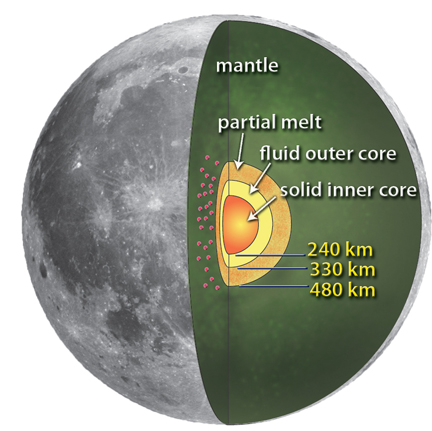
New interpretation of the lunar interior (from Weber et al., 2011, Science 331, 309-312)
Paul D. SpudisThe Once & Future Moon
Smithsonian Air & SpaceA recently published science paper presented results of a re-analysis of seismic (moonquake) data sent to the Earth from a network emplaced by the Apollo astronauts 40 years ago. The scientists processing the old data found that the Moon may have more than a simple core – it may have a layered, partly liquid metallic core.
Why is this important? Scientists have known for many years that the Earth has a layered interior structure. The outermost layer, called the crust, is the only part of the Earth directly accessible to us for study. The crust varies in thickness, ranging from a few kilometers in the ocean basins to over 20 km in continental areas. The next zone down is called the mantle. The mantle is very thick – almost 3000 km. It is made up of a dense, iron- and magnesium-rich rock type called peridotite. Partial melting in the mantle is the source of basaltic magma that erupts to make up the floors of ocean basins worldwide. The innermost part of the Earth is the core, comprised mostly of metallic iron and nickel, and over 3000 km in radius. The outer layer of the core is liquid, but the enormous pressure that contains the inner core keeps it solid.
The Earth’s core is electrically conducting as the rotation of the Earth induces currents within it. It is thought that these electrical currents are responsible for the dynamo that generates the magnetic field of the Earth. Because most of the Earth’s iron is contained in the core, we know that in bulk composition, the Earth is made from chondrites, the same stony material found as primitive meteorites in space. Thus, understanding the core is relevant to the origin of its magnetic field and the internal structure and bulk composition of the Earth.
For these reasons, we are interested in the possibility of a core within the Moon. Even before we went to the Moon, we understood that an internal structure similar to Earth was not likely. A property called moment of inertia told us in broad terms that, unlike the layered structure of Earth, the Moon was more or less homogeneous inside. The moment of inertia indicated that any core inside the Moon must be smaller than a couple of hundred kilometers at most (the Moon’s radius is 1740 km).

Seismometers, deployed on the Moon as part of a surface network during the Apollo missions, operated for over seven years collecting data on tremors within the Moon. Because certain rocks have known physical properties (e.g., density), we use the velocity of seismic waves in an indirect way to infer the presence of these rock types and physical structure. From our initial analyses of these data, we determined that the Moon had a fairly thick crust (from 50-80 km, more than twice the thickness of Earth’s crust) and a very thick mantle, almost the remainder of the lunar radius.
The question of the existence of a lunar core remained uncertain. One moonquake resulting from a fairly large impact on the far side of the Moon a couple of years after the Apollo missions had ended produced a signal that suggested the presence of a small core (less than 400 km radius). Moreover, because seismic waves come in two varieties – P-waves, or compression (or sound) waves and S-waves (shear waves, which cannot propagate through liquids) – the partial suppression of S-waves through the center of the Moon during this event suggested that the lunar core might be partly liquid.

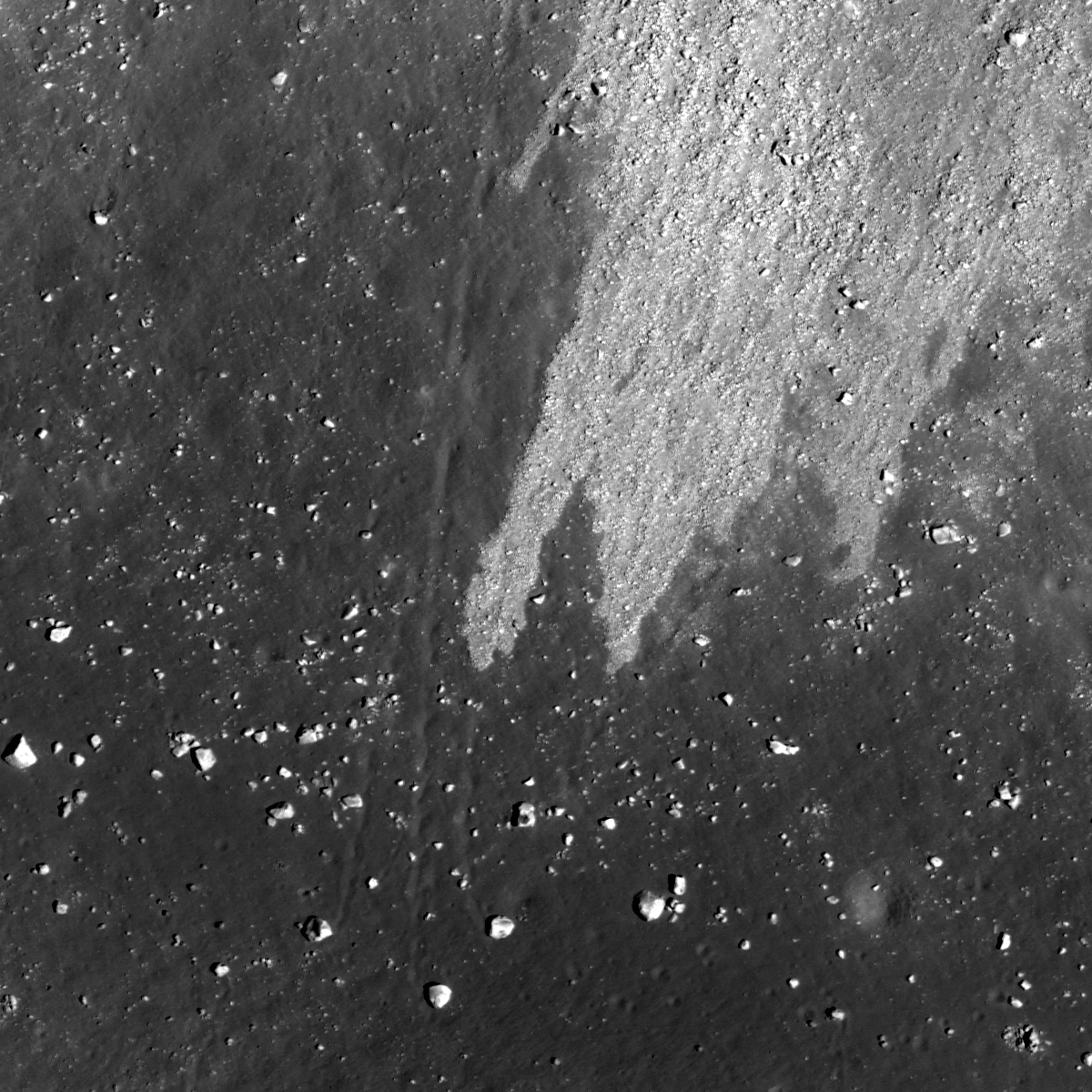
The Apollo 14 S-IVB booster (S-IVB-509) was 17.8 meters tall, 6.6 meters wide and weighed about 14,000 kg. It was launched January 31, 1971, and after extraction of the Lunar Module Antares, the S-IVB was directed to dump its remaining fuel directed toward an impact the Moon February 4, 1971. (From "Apollo 14 S-IVB Impact Crater," Mark Robinson, October 8, 2009) "The Apollo impact velocity was 2.54 km/sec at an angle of 69° from the horizontal along a heading of 103° (west to east). The S-IVB had a mass of 14,016 kg at the time of impact and impact energy was 5.54 x 10\10 Joules (equivalent to just over 10 tons of TNT). The signal from the impact was recorded on the Apollo 12 seismometer (PSE) and rebounded throughout the Moon for 3 hours." [NASA/ARC/NLSI].
But this result was so uncertain that few lunar scientists actually believed it. They proceeded to try and constrain the dimensions and composition of a lunar core through other means. A core may be important in the generation of an early global magnetic field that some of the lunar samples seems to indicate (the current Moon has no global field). By carefully measuring the ways in which the magnetic field of the Sun and Earth is modified when the Moon passes through it (as it does during its orbit around the Earth), it was thought that it might be possible to “sense” the
presence of a lunar core by measuring these deviations. Results indicated that the core of the Moon had to be small (less than 400 km in radius) and probably made of iron sulfide (FeS).
After seven years of operation, the Apollo seismic net was turned off to save money. Up until it was turned off, we had received a large amount of data but processing it was extremely difficult. The Apollo instruments, although sensitive, were very noisy and not well coupled to bedrock as are seismometers on Earth. Fortunately, faster and more capable computers, along with new techniques to process and analyze noisy data, were developed. And a new generation of scientists came forward to re-examine the old seismic data to see if anything could be discerned from it.
The new results are surprisingly detailed. Not only do these researchers think they have detected a core inside the Moon, but a core with three separate layers – an inner solid core and outer core, very similar in structure to that of the Earth, but with the added wrinkle of a partly molten outermost layer. The entire core is almost 500 km in radius, slightly larger than the diameter inferred from deep magnetic sounding.
LROC Observation M111762553R, LRO orbit 1604, November 2, 2009, from 43.5 km, resolution 49cm/p, solar incidence 31.3° Apollo 14 S-IVB impact at 8.179°S, 333.969°E (from from "LROC Coordinates of Robotic Spacecraft," Samuel Lawrence, April 5, 2010) [NASA/GSFC/Arizona State University].
The presence of currently molten core inside the Moon is rather startling; even the earlier idea about a partly molten zone was viewed askance by most lunar students. But this new idea has revived concepts about a magnetic core dynamo inside the Moon, generating a global field early in lunar history. Such a dynamo might explain a lot about the remnant magnetic fields measured in some of the returned lunar rocks. But there is no obvious reason why such a field would suddenly stop being generated.
Even though the old Apollo network data may still be mined for information, to fully understand lunar structure and history we must emplace a long-lived, global network of new instruments to fully characterize the interior of the Moon. Although studies are underway to determine how this might be accomplished, deployment of such a network is difficult to achieve by robotic spacecraft alone and long life on the Moon may require a nuclear power supply. Each and every time we start believing that we understand our Moon, a new discovery raises even more questions.