Showing posts with label intrusive. Show all posts

Thursday, March 14, 2013

Low reflectance deposits on Lassell Massif

Low reflectance deposits are seen along the margins of the double 'vent-like' depressions Lassell G and Lassell K (14.918°S; 351.065°E) in Mare Nubium. LROC Narrow Angle Camera (NAC) observation M1116585481R, LRO orbit 16774, February 27, 2013; Sun is overhead, north is up, field of view roughly 1.8 km across at 0.88 meters resolution [NASA/GSFC/Arizona State University].
James Ashley
LROC News System

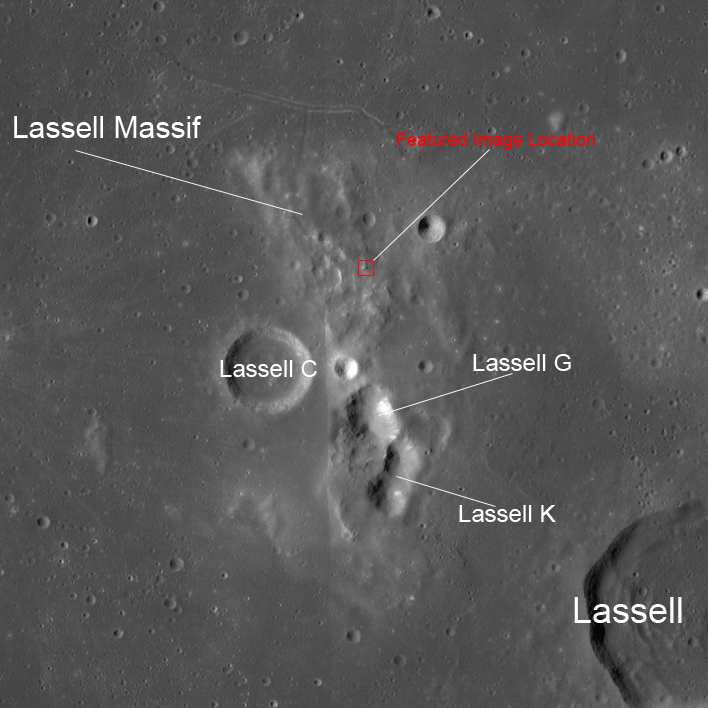
Today's Featured Image follows up on the two previous posts with another look at the Lassell Massif region of Mare Nubium. These prominent low reflectance deposits line the rims of the Lassell G and Lassell K pit features (see context image below). Their occurrence along the pit rims suggest a dark layer may be present just beneath the regolith surface, whose exposure has been encouraged by mass wasting in the pit walls. What caused such steep walled pits, and what are these low reflectance materials?

Our geologic train of thought continues from yesterday's post. We were discussing the geochemical differences between iron-rich, silica-poor (basaltic) and iron-poor, silica-rich (rhyolitic) magmas in the inner Solar System. But why should this matter, and what does it have to do with our images this week? The short answer is that basaltic lavas (and basaltic impact melts) have low viscosity, where rhyolitic lavas have relatively high viscosity. Basaltic extrusions filled mare basins like lakes, cascaded over fault blocks like waterfalls, and flowed like molten rivers on the Moon. On Earth and Mars they form flood basalt deposits and low-topography shield volcanoes. By contrast, rhyolitic lavas can be visualized as having a pasty or sticky consistency. They form steeper slopes, flow more sluggishly, develop high constructs, and can erupt explosively.

Mt. St. Helens and other Cascade volcanoes are good examples for Earth.
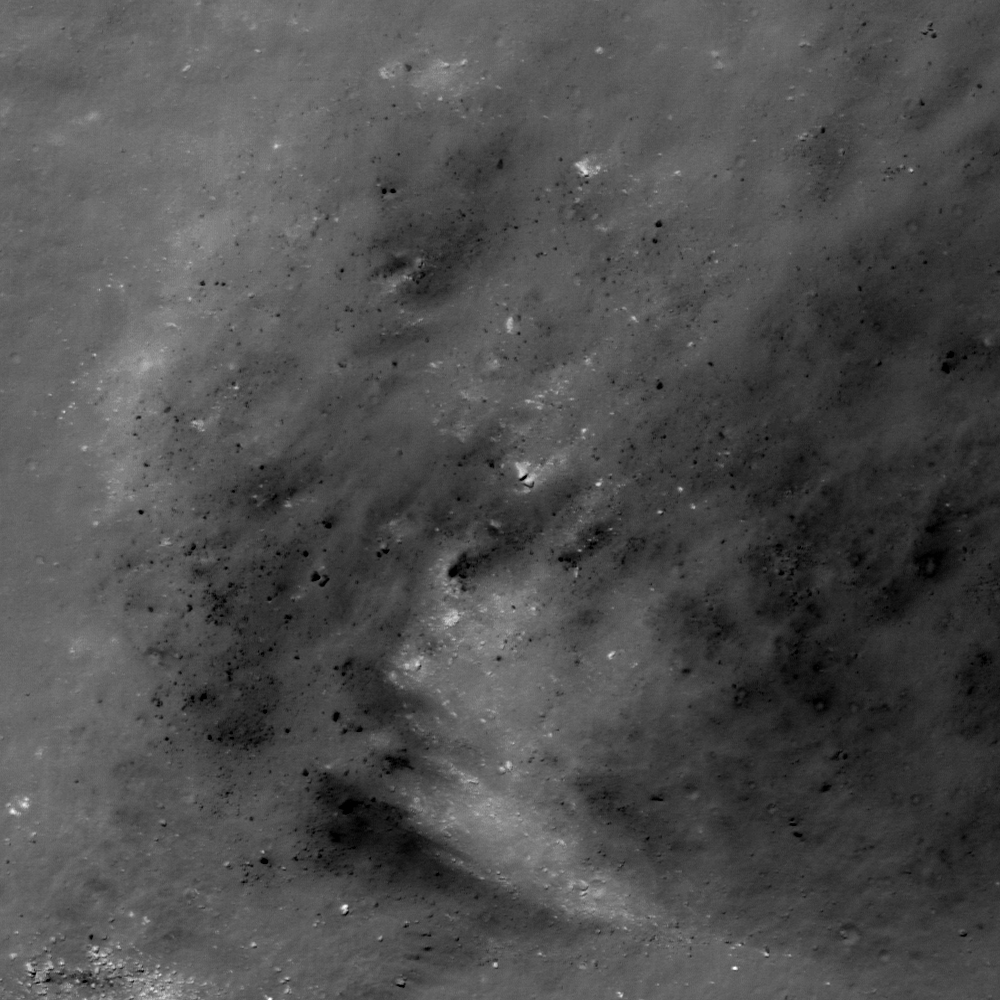
Another portion of NAC frame M1116585481R shows fragmented dark deposits [NASA/GSFC/Arizona State University].
A story of complex volcanism is emerging for the Lassell Massif region. The dark deposits may be pyroclastic in origin, and may have come from the massif source magmas themselves, or from adjacent volcanic fountaining (the floor of Lassell crater out of frame to the lower right of the context image is suspected to contain pyroclastic deposits). Based on LRO Diviner data the massif itself is silica-rich, which accounts for its topography, and suggests that Lassell G and Lassell K may be collapse calderas. They have very steep slopes and V-shaped profiles, in contrast to impact features.

LROC Wide Angle Camera (WAC) mosaic context image, outlining the areas spotlighted in this and two other LROC Featured Images, released the week of March 11, 2013 . The light yellow square encloses the area in today's Featured Image [NASA/GSFC/Arizona State University].
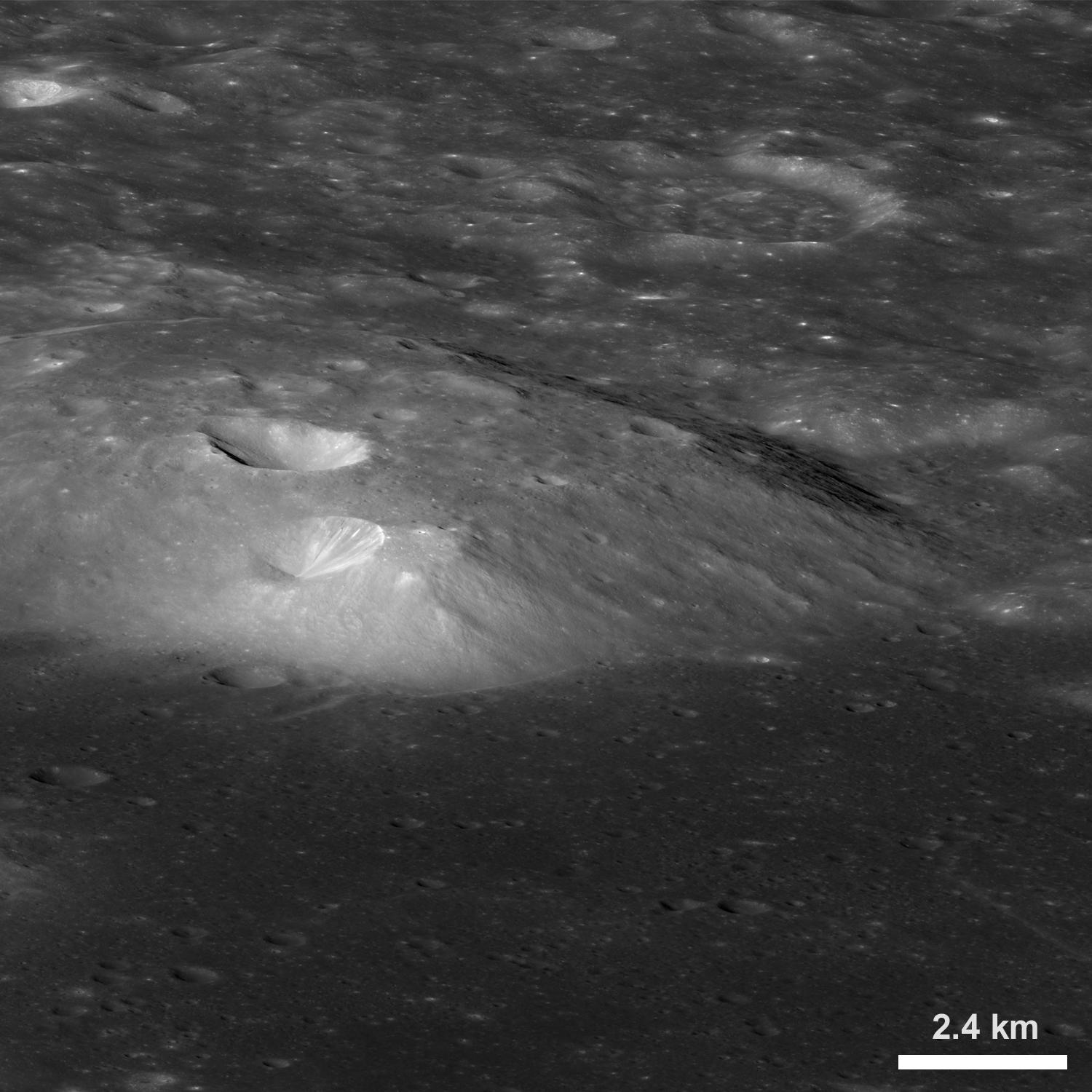
Another look, from another angle, at the south Lassell complex, allowing some perspective of the topography - steep drops on either side of a shared wall - of the area highlighted in the Featured Image - from the newly-released LROC NAC oblique mosaic M1108311369LR, linked HERE [NASA/GSFC/Arizona State University].
Explore the full NAC frame HERE. Other examples of silica-rich, so-called 'intrusive' lunar volcanism may include the Gruithuisen Domes, features in Compton-Belkovich and the Hortensius Domes.

Tuesday, March 12, 2013

Not your average crater

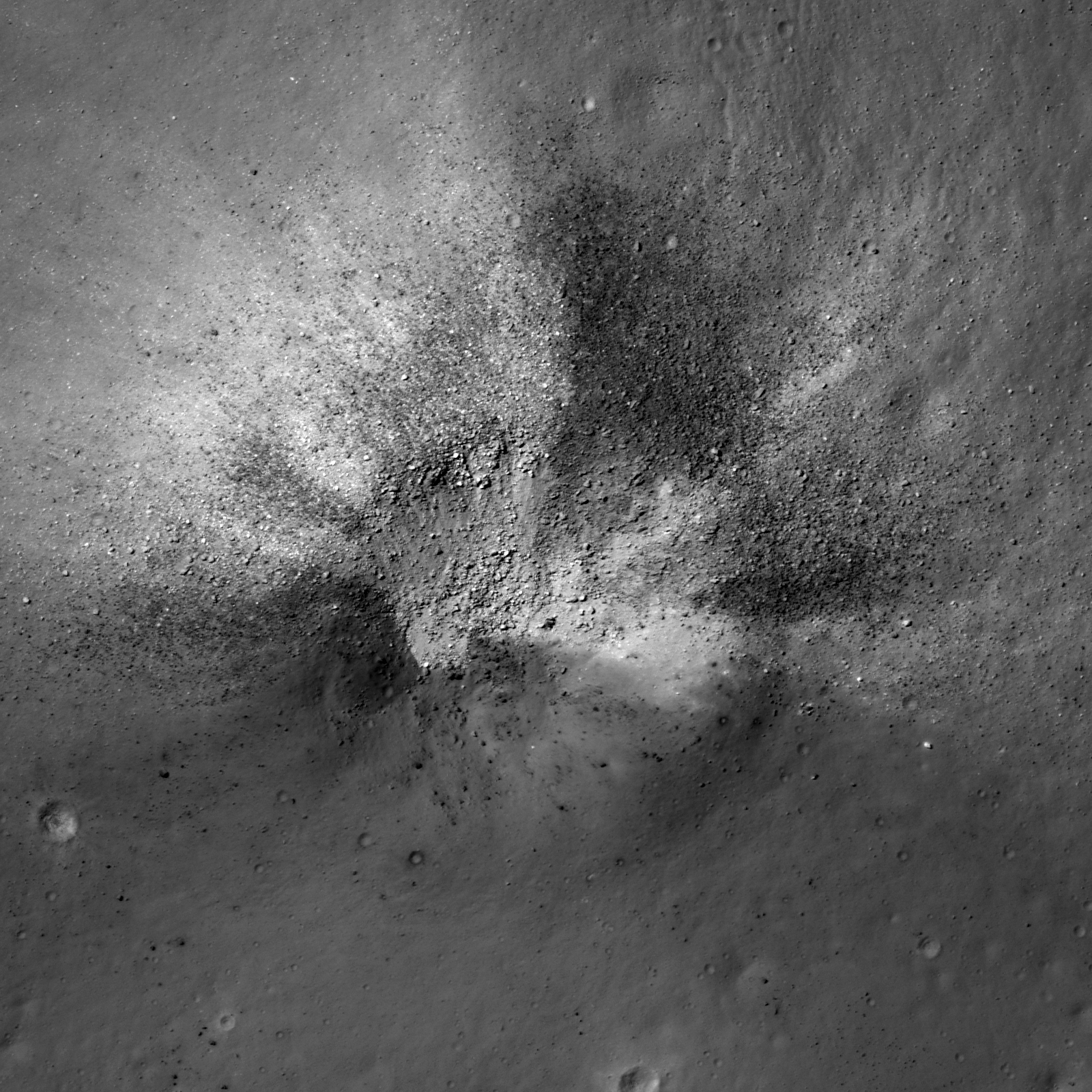
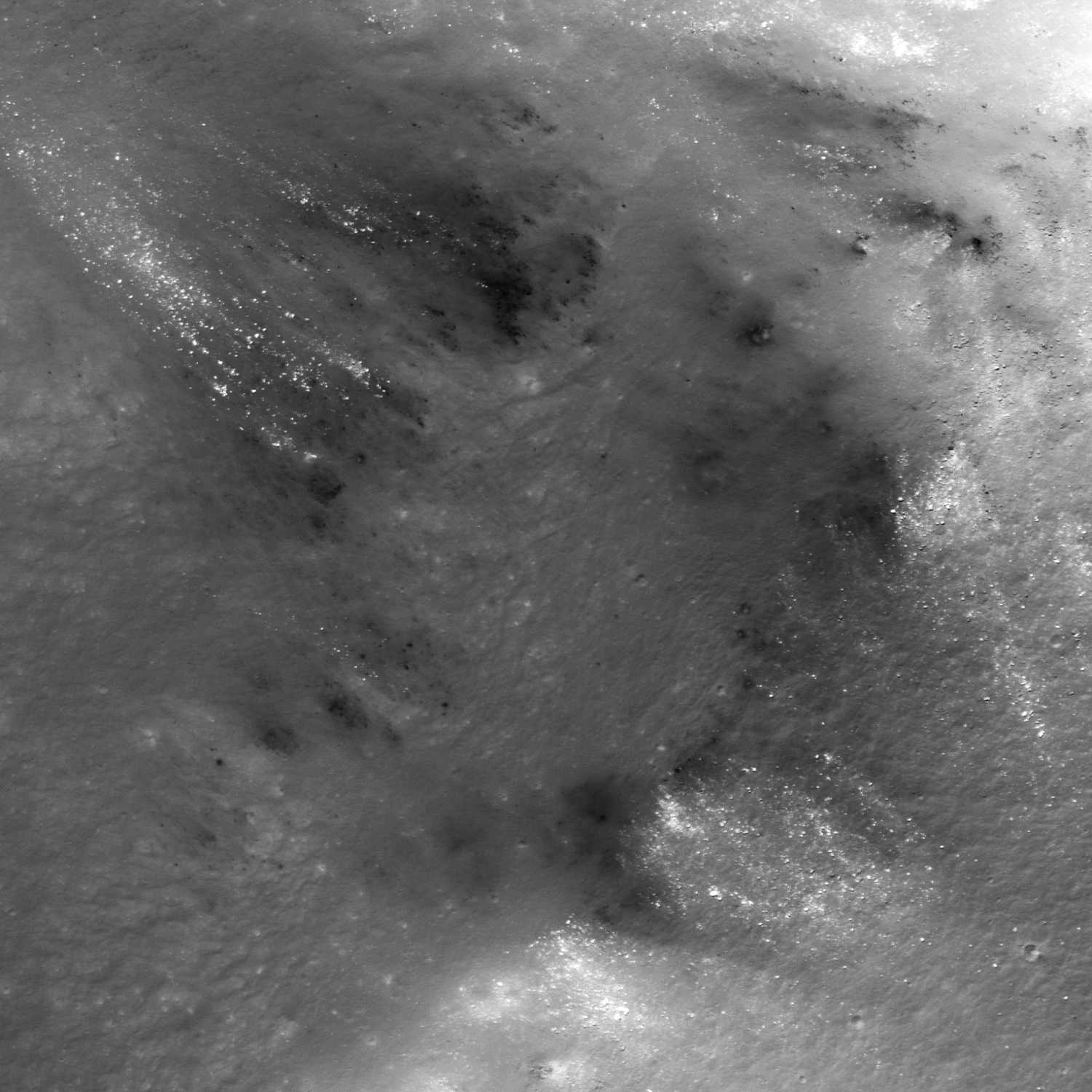
An asymmetric impact crater (14.349°S, 350.977°E) on the Lassell Massif revealing low reflectance material. NAC frame M152939732L, LRO orbit 7672, February 21, 2011; incidence angle 17.58° from the northwest, resolution 0.49 meters per pixel over a field of view approximately 820 meters across, from 39.65 km [NASA/GSFC/Arizona State University].
James Ashley
LROC News System

This week's Featured Images focus collectively on a region of the Moon known to present a ruddy discoloration through the eyepiece of ground-based telescopes (and also directly to the eyes of Apollo Command Module pilots). Known colloquially as "lunar red spots," such areas include the Gruithuisen Domes, Mons Hansteen, and the Helmet region. The red spot under observation this week is the Lassell Massif. This fascinating feature is a highstanding region of the Lassell Complex, located within the Alphonsus A basin in northeastern Mare Nubium, and consists of a rugged (though somewhat muted), hilly terrain, and several large, steep-walled depressions.

Today's Featured Image shows a striking impact crater in the northern hills of the massif. The crater exhibits an asymmetrical ejecta pattern, suggesting it to be the result of an oblique impact. The crater outline and ejecta distribution may also have been influenced by the uneven local topography. More geologically intriguing than this crater's shape, however, are the intermixed high and low reflectance materials excavated by the impact.

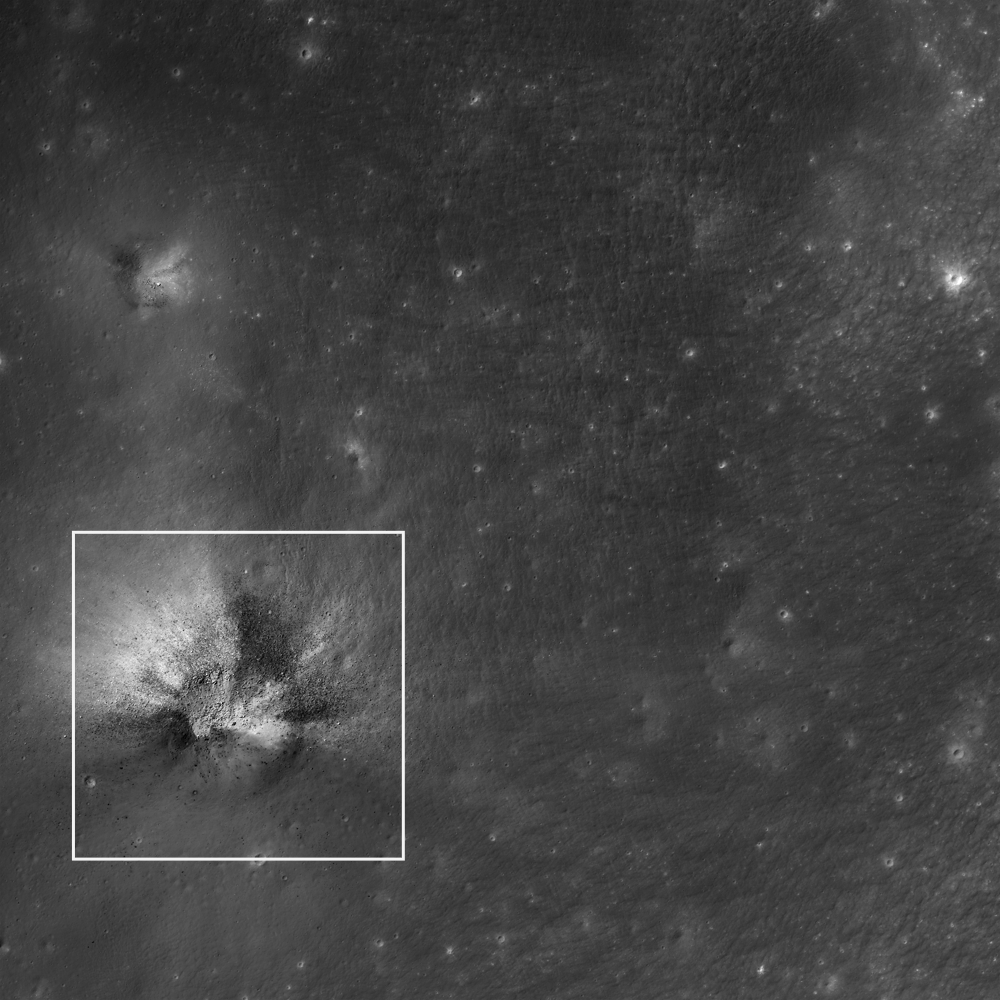
This wider field image from the same NAC frame shows an adjacent impact (northwest quadrant) to have excavated similar dark materials in the region; white square is the Featured Image location. Image is ~2.2 km wide [NASA/GSFC/Arizona State University].
The low reflectance materials (here seen as blocky) are suspected to be pyroclastic in origin, which speaks to the volcanic history of the Moon. Lassell crater itself (lower right in context image above) was described as being a source of pyroclastic materials since telescopic mapping efforts of the 1960s and '70s. The Lassell Massif is arguably close enough to this (and potentially other mare sources) to have received a share of these materials on the summits of its hills. Alternatively the central depressions on the massif may themselves be volcanic vents.

WAC mosaic context image. The white box outlines the area shown in the second image following above, field of view roughly 67 kilometers across [NASA/GSFC/Arizona State University].
While most lunar volcanism produced basaltic rocks, recent evidence is suggesting that Lassell Massif and other red spot areas are silica-rich, iron-poor volcanic deposits -- perhaps similar to the kind of volcanism we see with the Long Valley Caldera on Earth. While darker deposits tend to indicate an iron-rich material, their presence among silica-rich materials (which might seem like a geologic contradiction) may actually be suggestive of complex volcanism, where a variety of volcanic deposits are possible, and for which the Long Valley volcanics remain a good example.

What are the high reflectance materials seen distributed outward from the crater? Likely we are seeing ancient highland anorthositic material excavated from beneath an overlying volcanic deposit(s). What a fascinating spot for a future explorer!

From a 2010 demonstration, animation of separate LROC WAC observations of the geologically interesting Lassell Massif and crater group east of Lassell D, showing the latter's fresh ray system intruding from the west. This is more easily discerned under a high Sun while topography is easier to view under a mid-morning Sun in the east-northeast. The bright, widespread ejecta streamers from Lassell D alternates with a visible chevron affect by the Lassell D pressure front [NASA/GSFC/Arizona State University].
The next two Featured Image posts will include a brief discussion of this type of volcanism on the Moon, and explore some of the clues scientists are using to probe the Lassell Massif area. See the full NAC frame HERE. Other examples of pyroclastic deposits include DMD Excavations, Pyroclastic Trails, and Pyroclastic Excavation.

Monday, March 4, 2013

New oblique views of Gruithuisen Domes

An oblique view of the northern portion of the Gruithuisen Gamma volcanic dome, from the northwest. From a new LROC Narrow Angle Camera (NAC) mosaic M1106087898LR, LRO orbit 15300, October 28, 2012; overall resolution 4.9 meters per pixel [NASA/GSFC/Arizona State University].
Sarah Braden
LROC News System

The last LROC Featured Image post on the Gruithuisen Domes featured some of the earliest Narrow Angle Camera (NAC) coverage of this amazing region.

Now LROC brings you an even more dramatic view of these volcanic domes from an oblique angle (viewing from East to West), from an altitude of 154 km (96 miles) above the lunar surface.

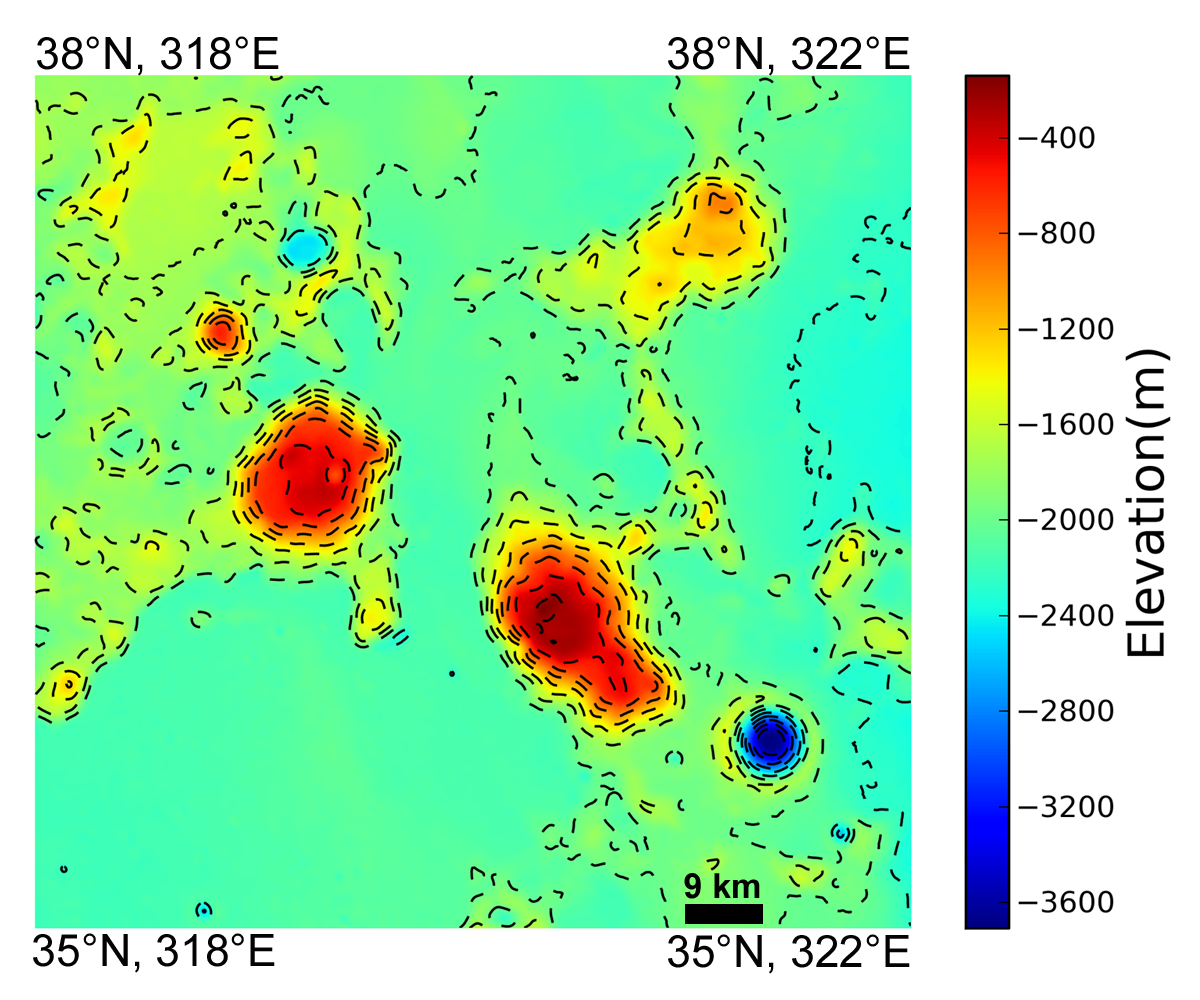
Located along the mare/highlands boundary, on the northeast border of Oceanus Procellarum (36.6°N, 319.9°E), the three Gruithuisen domes Gamma, Delta, and Northwest (NW) are primary examples of lunar silicic volcanism.

A thumbnail image of the 20376 x 6728 oblique NAC montage users can zoom into HERE. The crater Gruithuisen B is 9 km in diameter (north is to the right) [NASA/GSFC/Arizona State University].
Field of view seen at an oblique angle sketched out (arrows) on a photometric work-up of an LROC monochrome Wide Angle Camera (WAC) overview by Maurice Collins, originally presented as a Lunar Picture of the Day (LPOD), September 27, 2010 [NASA/GSFC/Arizona State University].
Silicic volcanism is relatively rare on the Moon. The Gruithuisen Domes pre-date the lunar mare in this region, so some portion of these domes has been covered by mare basalt, although there are also contacts with the older highlands material. Silicic volcanism might have been more widespread during the Moon's early history, however, any evidence for that may be buried beneath the maria. We know that the composition of the Gruithuisen Domes are different from that of the mare and the highlands from Earth-based telescopes, Lunar Prospector gamma-ray spectroscopy data, and Clementine multispectral data. The Gruithuisen Domes are characterized by relatively high reflectance and strong absorptions in the visible and ultraviolet. The Domes are also low in iron and titanium abundance compared to the lunar maria. New data from the Diviner instrument on the LRO spacecraft confirmed that the Gruithuisen Domes are silicic.

Colorized topography of the Gruithuisen Domes region derived from the 100 m/pixel LROC WAC DTM. Contour line interval is 220 meters [NASA/GSFC/Arizona State University].
Experience the full resolution oblique image HERE.

Related LROC Featured Images:

Gruithuisen Domes - Constellation Region of Interest
Morphology of lunar volcanic domes
LROC NAC DTM Viewer Gruithuisen Domes (ROI) 1 - 2 - 3 - 4 - 5
Hansteen alpha yields some of its secrets
Silicic volcanism on the Moon
Compton Belkovich - Constellation ROI
Hortensius Domes - Constellation ROI