Showing posts with label eclipse. Show all posts

Saturday, November 2, 2013

Sunday's hybrid solar eclipse, across Atlantic and Africa

Jeff Aguilar, eclipse, November 2009
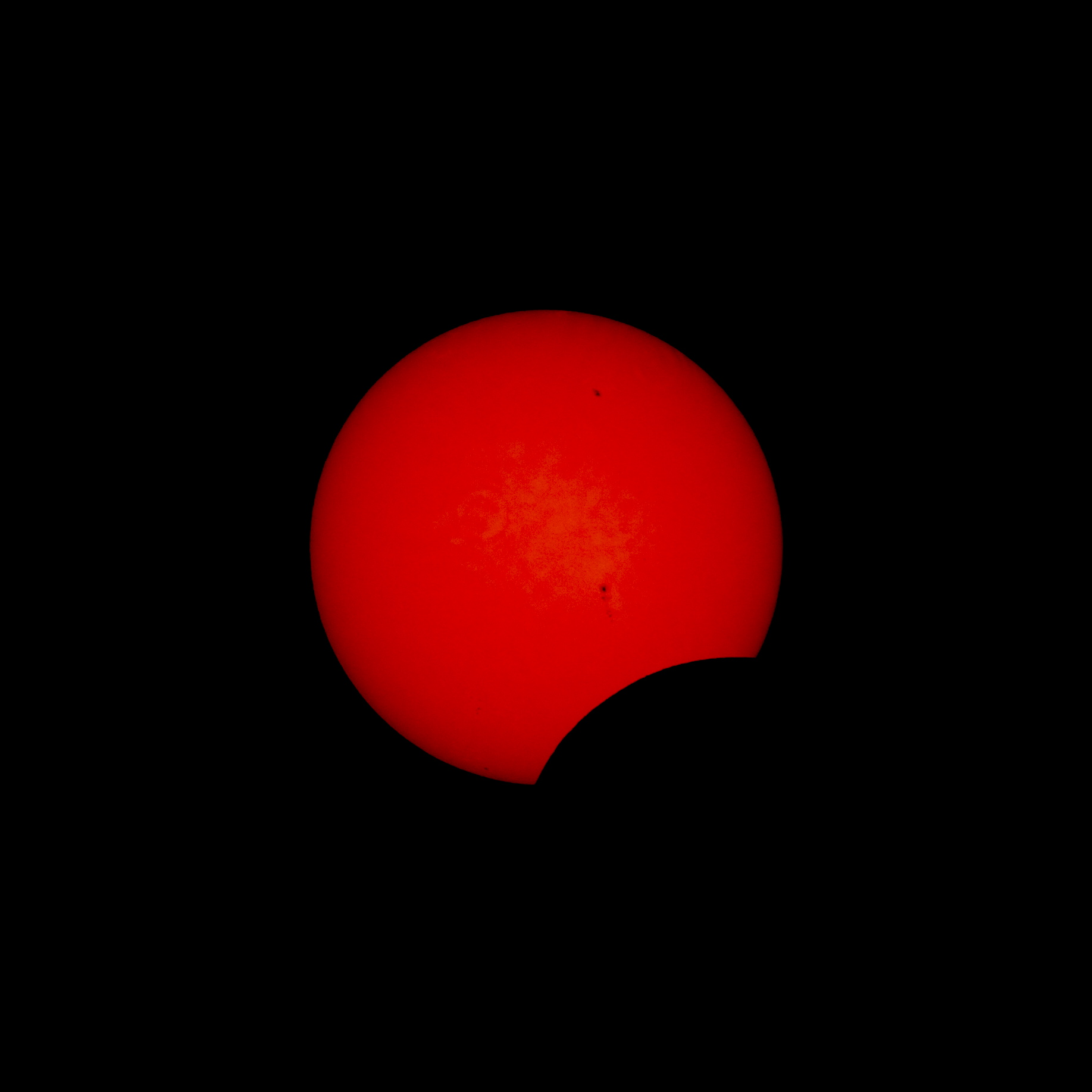
The eclipsed sun appeared like a fat, flaming sickle as it set behind a large cargo ship in this portrait obtained by Jett Aguilar from Manila Bay, Philippines, January 26, 2009. Early risers on the American eastern seaboard, on their first full day following an annual return to standard time (UT - 5 hours), will have an opportunity to observe the beginning of a hybrid solar eclipse beginning at sunrise Sunday morning.[Jeff Aguilar/SPACE.com].
On Sunday, November 3 early risers on North America's eastern seaboard will be treated to the beginning of a spectacular sunrise eclipse.

An unusual "hybrid" solar eclipse, combining aspects of both an annual and total eclipse, the Moon's diffuse penumbral shadow first encounters Earth surface at 10:04:34 UT (5:04 am EST) when the Moon will 372,934 km away and closing in distance at a relative speed of less than a kilometer per second. The tip of the Moon's cone-like umbra will reach Earth's surface less than an hour later south of Bermuda.

Though the event will be visible across a much wider area, The Path of Central Eclipse will track east and peak southeast of Liberia two hours later, finally making landfall on the African mainland near the equator, bisecting the continent nearly to Somalia at early evening.
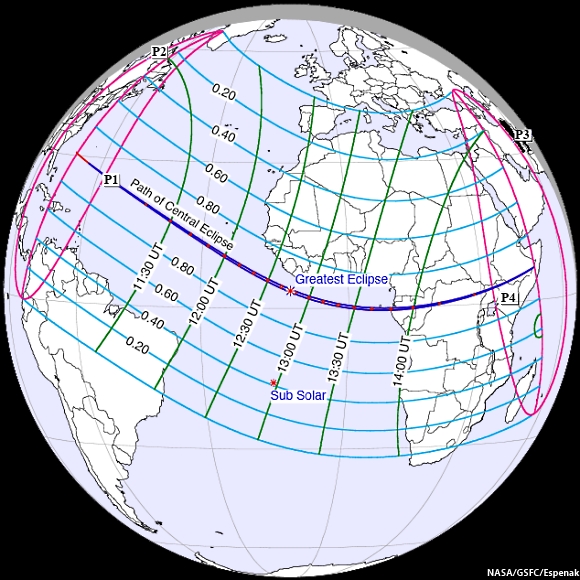
Schematic of Solar Eclipse November 3, 2013
Schematic of the Hybrid Solar Eclipse, Sunday, November 3, 2013, by Fred Espenak of NASA's Goddard Space Flight Center.
"The final (eclipse) of 2013 is the most interesting eclipse of the year," writes Fred Espenak of NASA's Goddard Space Flight Center in Greenbelt, Maryland. "It is one of the rare hybrid, both an annular and total eclipse, where some sections of the path are annular while others are total. The duality comes about when the vertex of the Moon's umbral shadow pierces Earth's surface in predictable areas but falls just shy of the surface elsewhere, leaving a ring, or annulus, of the Sun's disk still visible on that path."

Espenak's authoritative prediction of eclipse details can be read HERE. The last solar eclipse widely visible in the U.S. was an annular eclipse, May 20, 2012. The next partial solar eclipse won't be seen in the United States until October 23, 2014.

And eager preparations are already underway for a spectacular total solar eclipse, visible across all the continental United States, with totality peaking at 2 minutes, 40 seconds on in a pathway of totality 115 km wide in western Kentucky, August 21, 2017.

Important safety precautions for viewing even a brief partial eclipse of the Sun are discussed in an article by Imelda Joson and Edwin Aguirre at Space.com.

Similar important precautions, a diagram showing predicted eclipse percentages at locations in eastern North America and tips for viewing the event online have been written up by David Dickinson at Universe Today.

Saturday, May 11, 2013

"An Awesome Annular Eclipse!"

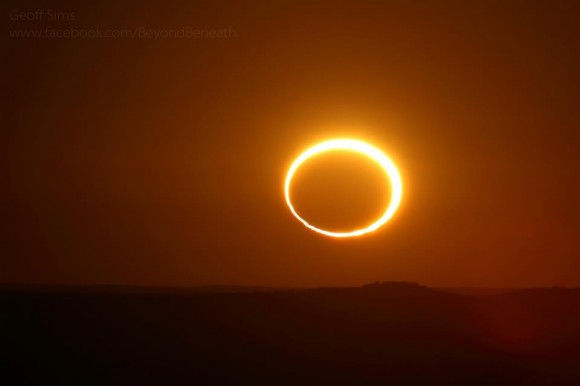
A rising annular eclipse as witnessed by Geoff Sims (@Beyond_Beneath) from the Plutonic Gold Mine in Western Australia [Geoff Sims/Universe Today].

Images and Videos from Earth and Space

David Dickinson
Universe Today

A spectacular annular eclipse of the Sun was witnessed across Australia and the southern Pacific region early today. Morning dawned mostly clear across the Australian continent, and those who journeyed out to meet the antumbra of the Moon as the Sun rose across the Great Sandy Desert and the Cape York Peninsula were not disappointed. The rest of us watched worldwide on as Slooh and a scattering of other ad-hoc broadcasts delivered the celestial event to us via the web.

This was a challenging one. Although partial phases of the eclipse was visible across the entirety of Australia, Hawaii, and as far north as the Philippines and as far south as New Zealand, the track of annularity passed over some very remote locales. Stable Internet connections were scarce, and many photos and videos are still trickling in as die-hard eclipse chasers return “from the Bush.”

Read the full article, HERE.

Thursday, April 25, 2013

A Very Partial Eclipse, 25 April 20:08:36 UT

Apparitions like the Partial Lunar Eclipse April 25, 2013 demonstrate the miraculous improbability of lunar and solar eclipses on Earth actually are, because an exceptionally sensitive light meter will be needed to detect any apparition at all [NASA/GSFC].
They don't come more partial. In line of sight from Earth the Partial Lunar Eclipse of April 25 may serve to demonstrate the ephemeral depth of the umbra of Earth's long shadow.

As carefully mapped out in Espenak's schematic from Goddard Space Flight Center (PDF and HERE) The penumbral phase first contact (P1) occurs at 18:03:38 UT and terminates (P4) at 22:11:26 UT, totalling 4 hours, 7 minutes and 47 seconds.

The Umbral first contact (U1) occurs at 19:54:08 UT and ends (U4) at 20:21:02 UT, darkening the Moon's far north 26 minutes, 55 seconds. Maximum occurs at 20:08:36 UT.

The capstone of the International Year of Astronomy 2009, the Blue Moon Partial Eclipse New Years Eve, 31 December 2009 captured by Jean Paul Roux and featured as NASA's Astronomy Picture of the Day, 2 January 2011.

Tuesday, December 11, 2012

The Sweeping Shadow, Australia, November 14


The Sweeping Shadow - Total Solar Eclipse, Nov 14 2012,The Granite, FNQ, Australia. from Colin Legg on Vimeo.

I was fortunate to view the eclipse from "The Granite' in far north Queensland this November. Inspired by Joe Cali's short but spectacular footage of the 2008 event (https://vimeo.com/51646602), I sought a high vantage point to capture the sweep of the shadow. Clear views north and east proved difficult to find, so I had to hike an 850m peak the night before and sleep on a rock ledge.

The clip includes 3 timelapses at various focal lengths. The first used a constant exposure, while the latter 2 tracked the light in the final 2 minutes either side of C2/C3, using bulb scripting. Eclipse Orchestrator software managed the light curve, while the cameras were triggered by a custom microcontroller built by Thomas Bethel. Many thanks to Fred Bruenjes and Thomas Bethel.

You can find out more about my eclipse experience here: https://www.facebook.com/ColinLeggPhotography

- Colin Legg
Astronomy Picture of the Day
December 10, 2012

Another incredible demonstration of the apex foci of the Moon's umbra shadow, subtending a cone 1700 km-wide at the lunar limb, stretching 362,000 km and arriving at a point miraculously near the surface of Earth, where it is barely 80 km across.

Friday, November 30, 2012

Solar eclipse from 37 kilometers up


Jason Major
Universe Today

"By launching a weather balloon carrying a wide-angle camera into the stratosphere above Queensland, eclipse hunter and amateur astronomer Catalin Beldea and her team were able to obtain their incredible video of the November 14 total eclipse from high enough up that the shadow of the Moon was visible striking Earth’s atmosphere. Totality only lasted a couple of minutes so good timing was essential… but they got the shot. Very impressive!"

Read Jason's article, "In the Shadow of the Moon," at Universe Today, HERE.

The video was organized with and for Romania’s Stiinta&Tehnica.com by editor-in-chief Marc Ulieriu and assembled by Daniel Toma. Music by Shamil Elvenheim.

Friday, November 16, 2012

APOD: "Moon Shadow Sequence"

On the morning of November 14, the Moon's umbral shadow tracked across northern Australia before heading into the southern Pacific. Captured from a hilltop some 30 miles west of the outback town of Mount Carbine, Queensland, a series of exposures follows the progress of the total solar eclipse in this dramatic composite image. The sequence begins near the horizon. The Moon steadily encroaches on the on the reddened face of the Sun, rising as the eclipse progresses. At totality, lasting about 2 minutes from that location, an otherwise faint solar corona shimmers around the eclipsed disk. Recorded during totality, the background exposure shows a still sunlit sky near the horizon, just beyond a sky darkened by the shadow of the Moon.
- NASA "Astronomy Picture of the Day" (APOD) - 16 November 2012

Monday, June 4, 2012

The partial eclipse of the Moon from lunar orbit

The view from low lunar orbit. The partial eclipse of the Moon June 4, 2012 may not have seemed very dramatic, for those living along the Pacific Rim fortunate enough to see it, but this line up of nodes and crossings became a solar eclipse when viewed from the Moon using Martin Schweiger's priceless Orbiter Simulator (2010 P1) program. On the left Venus closes in for it's June 5 transit. The angle above was weaved from a perspective 70 kilometers over the Moon's western limb timed at 0946 UT, June 4, 2012 [Orbiter 2010 P1/Martin Schweiger].
Sequential HDTV stills capture a total eclipse of the Sun (a dramatic 2009 total eclipse of the Moon for those of us still on Earth), from Japan's lunar orbiter SELENE-1 (Kaguya) [JAXA/NHK/SELENE].

Friday, May 25, 2012

LROC captures Earth "In the Shadow of the Moon"

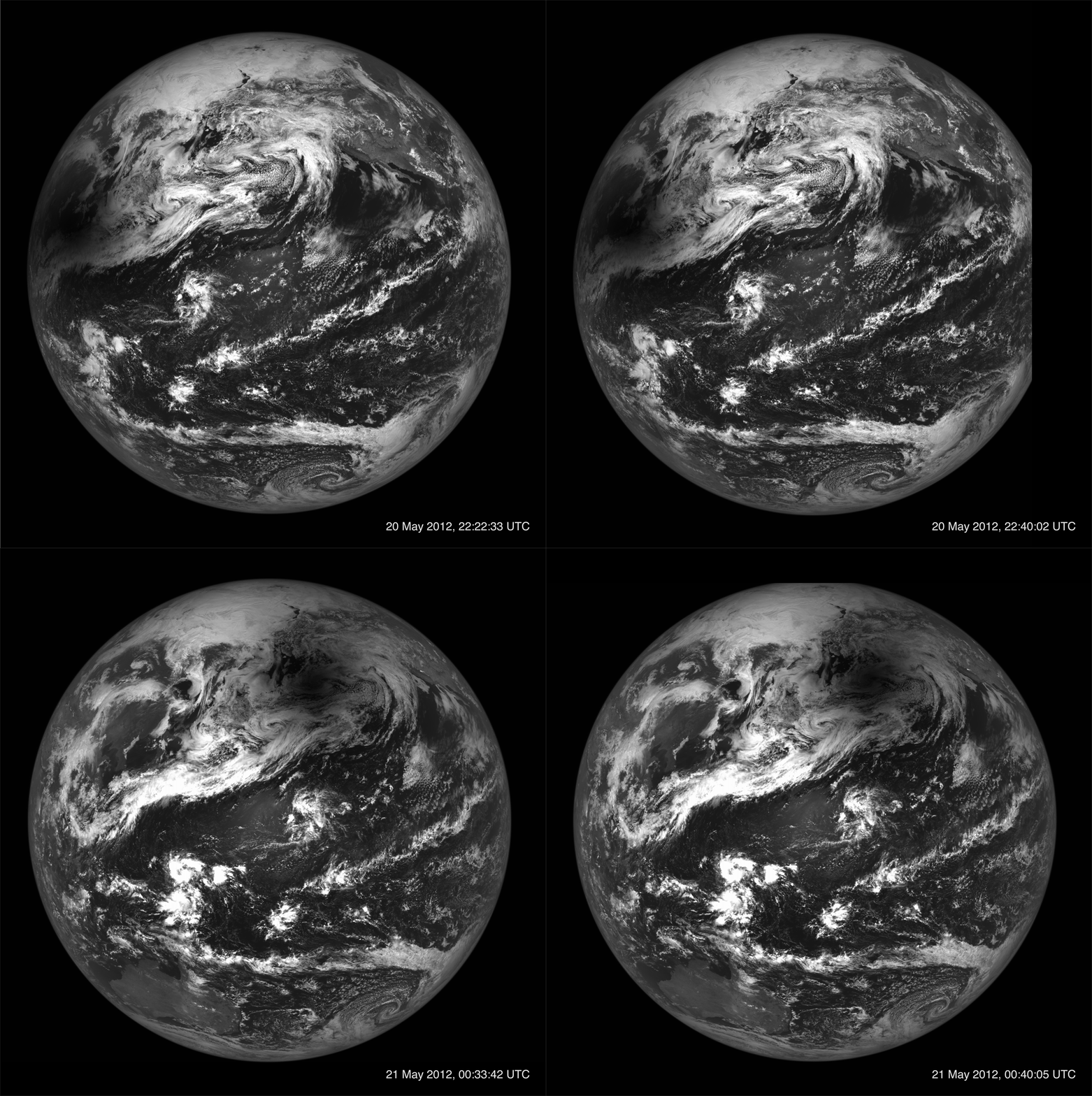
Animated compilation of the four images collected by the LROC NAC during the Annular Solar Eclipse of May 2012. Two images were collected during each of two successive orbits. (NAC images E192192490L, E192192869L, E192199689L, E192200072L) View the full size image accompanying the LROC release HERE [NASA/GSFC/Arizona State University].
Brett Denevi
LROC News System

A solar eclipse occurs, from the Earth’s perspective, when the Moon passes directly between the Earth and the Sun. This alignment results in a shadow of the Moon passing across the Earth. In a total eclipse, the Moon blocks the entire disk of the Sun, and viewers on Earth witness only the the Sun's faint corona that extends thousands of miles into space. However, in an annular (or "ring of fire") eclipse like the one that occurred on 20-21 May 2012, the apparent size of the Moon is smaller than that of the Sun, so terrestrial viewers can see a bright ring or annulus of the Sun around the Moon. Which type of eclipse you experience, total or annular, depends on where the Moon is in its orbit. The Moon's orbit isn't perfectly circular, so sometimes it is closer to the Earth, and bigger in the sky (resulting in a total eclipse), and sometimes it is farther from the Earth and smaller in the sky (an annular eclipse).

The Annular Eclipse, by E. Speyerer, from Kanarraville, Utah, May 20, 2012 (UT) View the spectacular 1667 px original accompanying the LROC image released May 25, 2012 HERE.
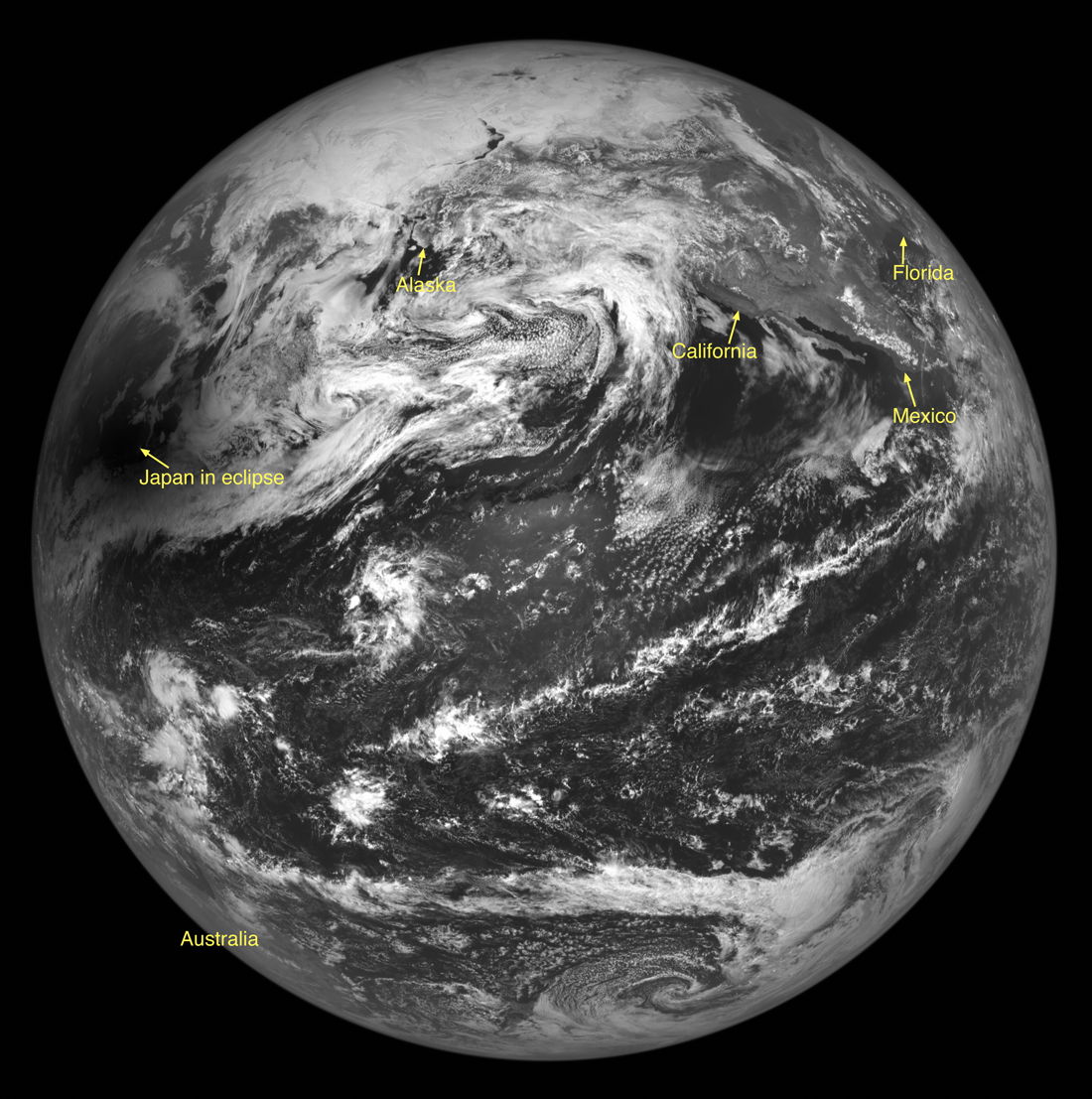
What does a solar eclipse look like from the Moon? The LROC NAC captured four images of the Earth, two on each of two successive orbits, during this solar eclipse. In these images you can see the Moon's shadow passing over the Earth over a period of about two hours. The image above shows the eclipse as it progressed over the Aleutian Islands, below you can see it a bit earlier as the Moon's shadow passed over Japan.

The first of four images captured by the LROC Narrow Angle Camera (NAC) during the Annular Eclipse of May 2012, as the Moon's shadow passed over Japan. Annotated NAC image E192192490L. View the original image accompanying the LROC release HERE [NASA/GSFC/Arizona State University].
The LROC NAC cannot easily acquire images of the Earth, and acquiring Earth views requires a significant amount of planning. The NAC is a line scanner, meaning that it has only one row of 5064 pixels per camera. Instead of snapping a single frame, an image is built up by the motion of the spacecraft in orbit about the Moon (about 1600 meters per second). To obtain an image of the Earth the spacecraft is turned 180° to face the Earth, then the spacecraft is pitched as quickly as possible (one-tenth of a degree per second), so that the image is built up line by line. You can see that two of the frames in the animated image below are slightly clipped, because LRO's timing wasn't perfect and the NAC ran out of lines before completing the scan (the NAC buffer is filled up after 52,240 lines, which is 256 Mbytes of data).

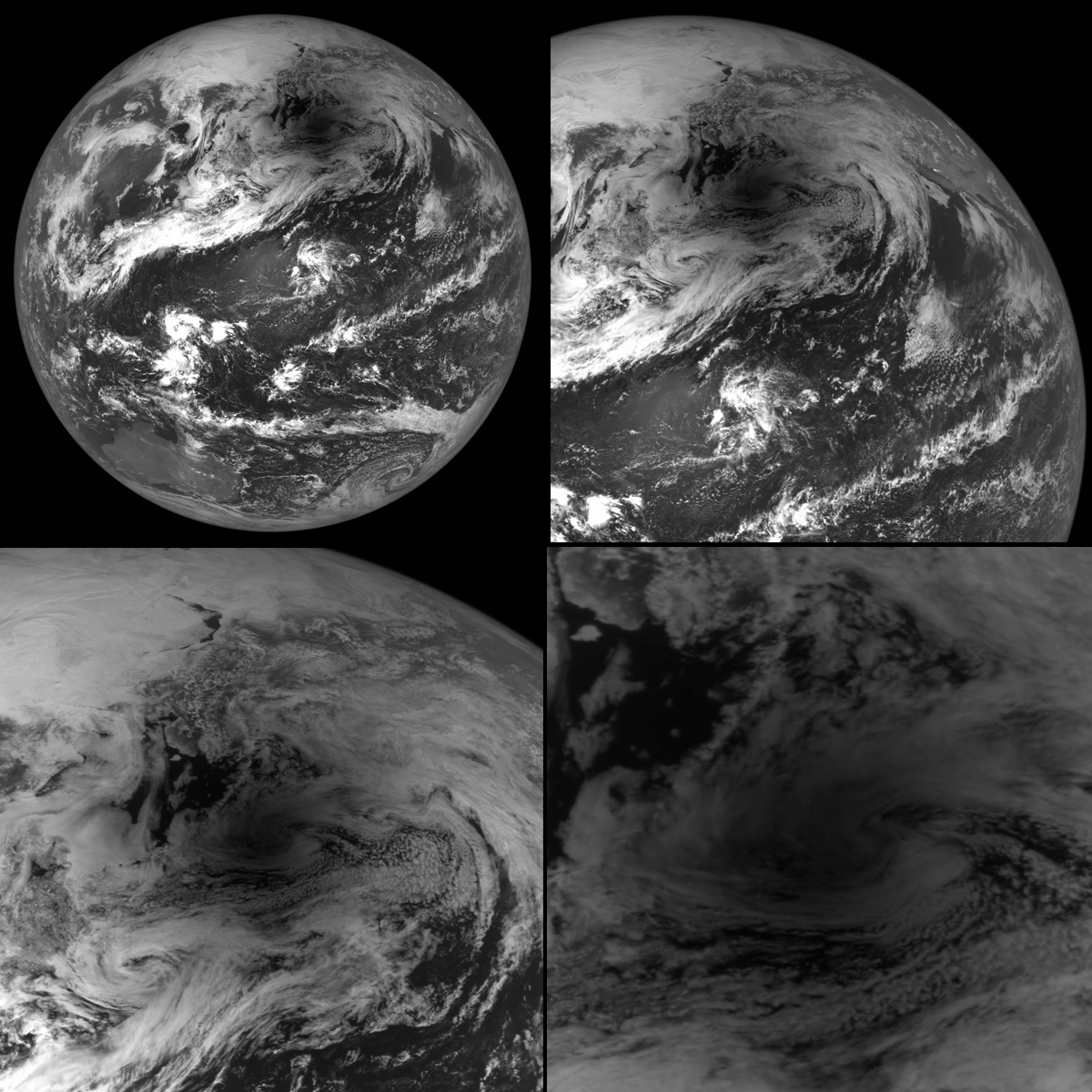
Zooming in on the Moon's shadow during the solar eclipse. NAC Image E192199689L. View the full size assembly HERE [NASA/GSFC/Arizona State University].
Because it was an annular eclipse, the shadow isn't totally dark; some sunlight still made it down to viewers of the eclipse as it passed over. The image below provides a zoomed in view of the Moon's shadow.

The eclipse was spectacular from the Moon, but it was also quite a view from within the Moon's shadow!

"Just barely," by E. Speyerer. A partial eclipse captured at the same moment as the LROC Featured Image "first of four," above (2012-142 00:33:41.036) from Kanarrville, Utah. The full eclipse had not quite reached Utah, thus the Moon is seen blocking only a small portion of the Sun. View the full size original accompanying the LROC image release HERE [E. Speyerer].
View the full resolution NAC eclipse image, HERE.

Revisit Earlier NAC images of the Earth from the Moon:

Sunday, May 20, 2012

Ring of Fire manifests through Japan's cloudy sky

Panasonic carried twin live solar powered remote feeds through totality. The view above, about two minutes shy of maximum, was captured through breaks in Hokkaido's cool, wet Monday morning clouds (~2229 UT, May 20) [Panasonic/USTREAM].

Annular Solar Eclipse, May 20-21, 2012

Annual Solar Eclipse in Taurus. The Moon crosses the descending node of its orbit meeting the apparent pathway of the Sun through Earth's sky just as the Sun moves through the very same line of sight, back-dropped by the familiar Hyades and Pleiades star clusters of the constellation Taurus. Because the Moon will have passed apogee only a day before, it's greatest distance from Earth, the apparent size of its disk will not not quite match the Sun's photosphere, and the result at totality is an annulus, a spectacular "ring of fire." The simulation above, showing the event from a perspective 12,700 km over South America, hints at the parts of North America, past sunset, where the celestial show will be invisible [Celesta].

Fred Espenak
NASA GSFC

The first solar eclipse of 2012 occurs at the Moon's descending node in central Taurus. An annular eclipse will be visible from a 240 to 300 kilometer-wide track that traverses eastern Asia, the northern Pacific Ocean and the western United States. A partial eclipse is seen within the much broader path of the Moon's penumbral shadow, that includes much of Asia, the Pacific and the western 2/3 of North America.


Path of Annularity, traced out on the sun-facing hemisphere of Earth, straddling the International Dateline in the North Pacific Ocean [F. Espenak/ NASA/GSFC].

The annular path begins in southern China at 22:06 UT. Because the Moon passed through apogee one day earlier (May 19 at 16:14 UT), its large distance from Earth produces a wide path of annularity. Traveling eastward, the shadow quickly sweeps along the southern coast of Japan as the central line duration of annularity grows from 4.4 to 5.0 minutes.


Tokyo lies 10 kilometers north of the central line. For the over 10 million residents within the metropolitan area, the annular phase will last 5 minutes beginning at 22:32 UT (on May 21 local time). The annular ring is quite thick because the Moon's apparent diameter is only 94% that of the Sun. Traveling with a velocity of 1.1 kilometers/second, the antumbral shadow leaves Japan and heads northeast across the Northern Pacific. The instant of greatest eclipse [1] occurs at 23:52:47 UT when the eclipse magnitude [2] reaches 0.9439. At that instant, the duration of annularity is 5 minutes 46 seconds, the path width is 237 kilometers and the Sun is 61° above the flat horizon formed by the open ocean.

The shadow passes just south of Alaska's Aleutian Islands as the central track slowly curves to the southeast. After a 7000 kilometer-long ocean voyage lasting nearly 2 hours, the antumbra finally reaches land again along the rugged coastlines of southern Oregon and northern California at 01:23 UT (May 20 local time).

Figure 2. [Fred Espenak / GSFC].
Redding, California lies 30 kilometers south of the central line. Nevertheless, it still experiences an annular phase lasting 4 1/2 minutes beginning at 01:26 UT. It is already late afternoon along this section of the eclipse path. The Sun's altitude is 20° during the annular phase and decreasing as the track heads southeast. Central Nevada, southern Utah, and northern Arizona are all within the annular path.

By the time the antumbra reaches Albuquerque, New Mexico (01:34 UT), the central duration is still 4 1/2 minutes, but the Sun's altitude has dropped to 5°. As its leading edge reaches the Texas Panhandle, the shadow is now an elongated ellipse extending all the way to Nevada. Seconds later, the antumbra begins its rise back into space above western Texas as the track and the annular eclipse end.

During the course of its 3.5-hour trajectory, the antumbral track is approximately 13,600 kilometers long and covers 0.74% of Earth's surface area. Path coordinates and central line circumstances are presented in Table 1.

Partial phases of the eclipse are visible primarily from the USA, Canada, the Pacific and East Asia. Local circumstances for a number of cities are found in Table 2 (Canada, Mexico and Asia) and Table 3 (USA). All times are given in Universal Time. The Sun's altitude and azimuth, the eclipse magnitude and obscuration are all given at the instant of maximum eclipse.

The NASA JavaScript Solar Eclipse Explorer is an interactive web page that can quickly calculate the local circumstances of the eclipse from any geographic location not included in Table 1:

This is the 33rd eclipse of Saros 128 (Espenak and Meeus, 2006). The family began with a series of 24 partial eclipses starting on A.D. 984 Aug 29. The first central eclipse was total and took place A.D. 1417 May 16. After three more totals and four hybrid eclipses, the series changed to annular A.D. 1561 Aug 11. Subsequent members of Saros 128 were all annular eclipses with increasing durations, the maximum of which was reached on Feb 1, 1834 and lasted 8 minutes 35 seconds. The duration of annularity of each succeeding eclipse is now dropping and will reach 4 minutes with the last annular eclipse of the series on July 25, 2120. Saros 128 terminates on November 1, 2282 after a string of 9 partial eclipses. Complete details for the 73 eclipses in the series (in the sequence of 24 partial, 4 total, 4 hybrid, 32 annular, and 9 partial) may be found HERE.

Additional details for the 2012 annular solar eclipse (including tables, maps and weather prospects) can be found HERE.

"Making eclipse magic," Emily Lakdawalla
The Planetary Society

Where to See the Annular Eclipse Online
Sky & Telescope

Monday, January 3, 2011

Quanrantid stream followed by partial eclipse

From 41st Lunar & Planetary Science Conference (2010)

After the meteor shower, observers in Europe, northern Africa, the Middle East and parts of Asia can witness a partial eclipse of the sun.

In western Europe, as much as 86% of the solar disk will be covered by the Moon at dawn, producing a fantastic crescent sunrise on Jan. 4th. Follow the links for a live webcast, an animated map, and details from NASA

Read the story at SpaceWeather.com

Tuesday, December 28, 2010

Rollback


From NASA/KSC high-definition video taken during the Winter Solstice lunar eclipse, December 21, as seen over Launch Pad 39A at the Kennedy Space Center in Florida, as Discovery was being prepared for rollback to the Vehicle Assembly Building. Technical issues have forced a postponement of its scheduled final mission until at least March 2011. Justin Ray of SpaceflightNow "took some frame grabs from that video to create" a photo gallery. [HT: RLV and Space Transport News]

Wednesday, October 20, 2010

A first lunar transit for SDO


Close up on a solar prominence, with startling clarity, the New Moon's disk slides between the new Solar Dynamics Observatory in geosynchronous orbit and it's constant view of the Sun. The inconstant Moon is our humbling reminder how comparatively little things often obscure our view of a much bigger picture [NASA/GSFC/SDO].

Sun and Moon - A first for the Solar Dynamics Observatory (SDO), and it was visually engaging too. On October 7, 2010, SDO observed its first lunar transit when the new Moon passed directly between the spacecraft (in its geosynchronous orbit) and the Sun. With SDO watching the Sun in a wavelength of extreme ultraviolet light, the dark Moon created a partial eclipse of the Sun.

These images, while unusual and cool to see, have practical value to the SDO science team. Karel Schrijver of Lockheed-Martin's Solar and Astrophysics Lab explains: "The very sharp edge of the lunar limb allows us to measure the in-orbit characteristics of the telescope e.g., light diffraction on optics and filter support grids. Once these are characterized, we can use that information to correct our data for instrumental effects and sharpen up the images to even more detail."

The image below shows a full disk version, view the larger story here.

Monday, July 12, 2010

As New as a New Moon can get

Astronomers and astro-tourists traveled to Chile, French Polynesia and the southeastern Pacific Ocean to experience the solemn magnificence of a Total Eclipse of the Sun, July 11.

SpaceWeather.com and other sites can be counted on to post images as they circulate in coming days, like the above by Constantinos Emmanouilidis, imaged through intermittent cloud cover over the Cook Islands, Sunday.

Preliminary stills at Totality, often through thin cloud cover, reveal a respectable Earthshine bringing Near Side features into view along with perhaps distinctive blue added one might suppose from two-thirds of the Pacific illuminating Grimaldi, Imbrium, Procellarum and Crisium, etc.

Issac Asimov once noted that this occasional intersection, with predictable regularity, of the very outermost of last 100 kilometers or so of the cone of our Moon's central umbra with Earth's outermost surface seemed to him so improbable as to be impossible. Considering the real distances versus the apparent distances to the Moon, the relative sizes and angular momentum of the Three Bodies in play, his point is well taken; adding to rather than detracting from the awesome beauty of this phenomena.

Saturday, March 20, 2010

Detailed view of a Solar Eclipse Corona

Astronomy Picture of the Day for March 16, 2010: "Only in the fleeting darkness of a total solar eclipse is the light of the solar corona easily visible. Normally overwhelmed by the bright solar disk, the expansive corona, the sun's outer atmosphere, is an alluring sight. But the subtle details and extreme ranges in the corona's brightness, although discernible to the eye, are notoriously difficult to photograph. Pictured above, however, using multiple images and digital processing, is a detailed image of the Sun's corona taken during the 2008 August total solar eclipse from Mongolia. Clearly visible are intricate layers and glowing caustics of an ever changing mixture of hot gas and magnetic fields. Bright looping prominences appear pink just above the Sun's limb. The next total solar eclipse will be in July but will only be visible in a thin swath of Earth crossing the southern Pacific Ocean and South America." Full Image [Miloslav Druckmüller, Martin Dietzel, Peter Aniol, Vojtech Rušin].

Saturday, January 2, 2010

Blue Moon Eclipse


The International Year of Astronomy 2009 ended with a Blue Moon and a partial lunar eclipse, as the second Full Moon of December grazed the Earth's shadow on December 31st. The New Year's Eve Blue Moon eclipse was visible throughout Europe, Asia, Africa and parts of Alaska, captured in this two exposure composite in cloudy skies over Saint Bonnet de Mure, France. Playing across the Moon's southern reaches, the edge of Earth's umbra, or dark central shadow, appears on the right side along with the prominent ray crater Tycho. At maximum eclipse, the umbra covered only about 8 percent of the diameter of the lunar disk. Read More

Wednesday, August 19, 2009

Solar Eclipse as seen by Hinode

The Hinode satellite observing our sun captured images of the moon traversing the face of the sun during a solar eclipse this week. On Wednesday, July 22, 2009, a total eclipse of the Sun was visible from within a narrow corridor that traverses half of Earth. The path of the Moon's umbral shadow began in India and crossed through Nepal, Bangladesh, Bhutan, Myanmar and China. After leaving mainland Asia, the path crossed Japan's Ryukyu Islands and curved southeast through the Pacific Ocean where the maximum duration of totality reached 6 minutes and 39 seconds. A partial eclipse is seen within the much broader path of the Moon's penumbral shadow, which includes most of eastern Asia, Indonesia, and the Pacific Ocean.

Image credit: NASA/JAXA View larger image

Saturday, August 15, 2009

Totality


Totality of a lunar eclipse, as witnessed in Sidney, Australia, by way of fizzenergy.com, a sample of Photography that is Out of This World. "The moon gradually glides into the Earth’s shadow, until the normally pale white colour disappears and is replaced by an orange and red hue," accurately enough, though this fails to mention the intervening stage. Because before the blood-red appears at totality, the curve of Earth casts the darkest evidence of our home planet's curvature, and the relatively enormous distance to the Sun, can be deduced, also, when only a few simple facts are already known. The blood red of totality, "is caused by sunlight being refracted around the edge of the Earth, through the atmosphere. Blue light from the sun tends to be scattered by the atmosphere so the light that reaches the surface of the moon during a lunar eclipse is predominantly red."