Showing posts with label APOD. Show all posts

Wednesday, October 14, 2015

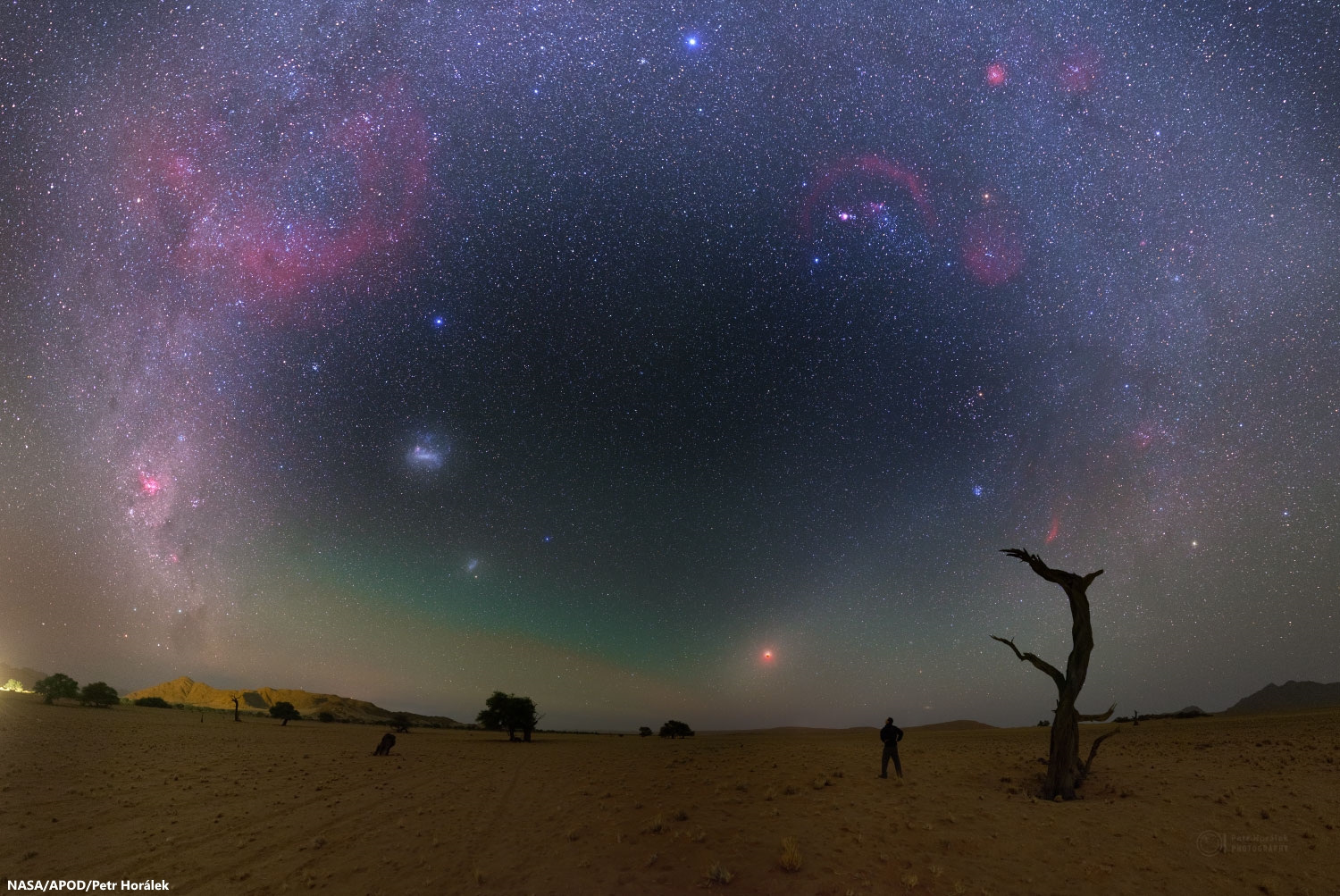
APOD: A Gegenschein Lunar Eclipse

Lunar Eclipse through elusive Gegenschein light from Namibia [Petr Horálek/NASA/APOD].
Explanation: Is there anything interesting to see in the direction opposite the Sun? One night last month, there were quite a few things. First, the red-glowing orb on the lower right of the original image is the full moon, darkened and reddened because it has entered Earth's shadow. Beyond Earth's cone of darkness are backscattering dust particles orbiting the Sun that standout with a diffuse glow called the gegenschein, visible as a faint band rising from the central horizon and passing behind the Moon. A nearly horizontal stripe of green airglow is also discernable just above the horizon, partly blocked by blowing orange sand. 

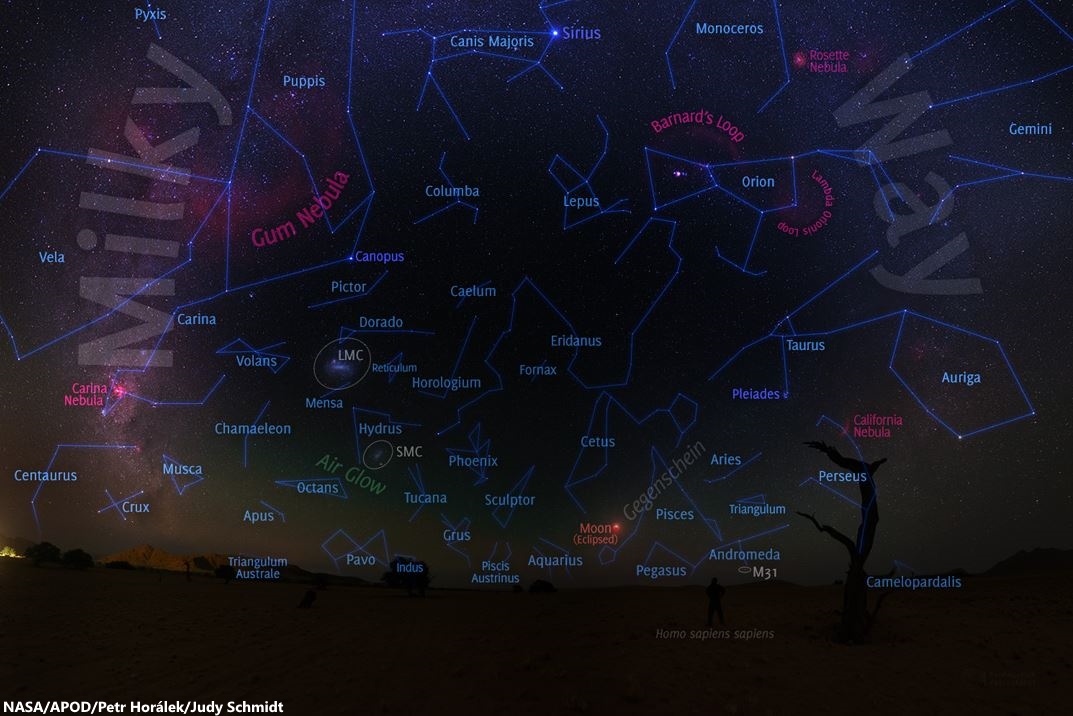
View of Petr Horálek's original "dark Namibian eclipse in the Gegenschein," featured NASA ASTRONOMY PICTURE of the DAY," October 14, 2015 [NASA/APOD/Petr Horálek].
Visible in the distant sky as the blue dot near the top of the image is the star Sirius, while the central band of our Milky Way galaxy arches up on the image left and down again on the right. 

The fuzzy light patches just left of center are the Large and Small Magellanic Clouds. Red emission nebulas too numerous to mention are scattered about the sky, but are labelled in a companion annotated image. In the image foreground is the desolate Deadvlei region of the Namib-Naukluft National Park in Namibia, featuring the astrophotographer himself surveying a land and sky so amazing that he described it as one of the top experiences of his life.
Context, by  Judy Schmidt.

Saturday, January 10, 2015

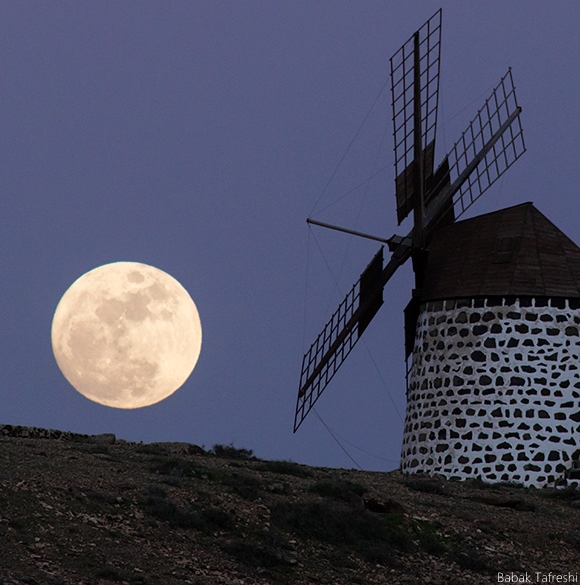
The Windmill's Moon (APOD)

Babak Tafreshi (TWAN)
Explanation: APOD, January 10, 2015: Seen from the Canary Island of Fuerteventura, this bright Full Moon rose at sunset. Reaching its full phase on the night of January 4/5, it was the first Full Moon of the new year and the first to follow December's solstice. Of course, in North America the first Full Moon of January has been known as the Wolf's Moon. But this Full Moon, posed in the twilight above an island of strong winds and traditional windmills, suggests another name. The telephoto image, taken at a distance from the foreground windmill, creates the dramatic comparison in apparent size for windmill and Full Moon.

Thursday, April 25, 2013

A Very Partial Eclipse, 25 April 20:08:36 UT

Apparitions like the Partial Lunar Eclipse April 25, 2013 demonstrate the miraculous improbability of lunar and solar eclipses on Earth actually are, because an exceptionally sensitive light meter will be needed to detect any apparition at all [NASA/GSFC].
They don't come more partial. In line of sight from Earth the Partial Lunar Eclipse of April 25 may serve to demonstrate the ephemeral depth of the umbra of Earth's long shadow.

As carefully mapped out in Espenak's schematic from Goddard Space Flight Center (PDF and HERE) The penumbral phase first contact (P1) occurs at 18:03:38 UT and terminates (P4) at 22:11:26 UT, totalling 4 hours, 7 minutes and 47 seconds.

The Umbral first contact (U1) occurs at 19:54:08 UT and ends (U4) at 20:21:02 UT, darkening the Moon's far north 26 minutes, 55 seconds. Maximum occurs at 20:08:36 UT.

The capstone of the International Year of Astronomy 2009, the Blue Moon Partial Eclipse New Years Eve, 31 December 2009 captured by Jean Paul Roux and featured as NASA's Astronomy Picture of the Day, 2 January 2011.

Friday, November 16, 2012

APOD: "Moon Shadow Sequence"

On the morning of November 14, the Moon's umbral shadow tracked across northern Australia before heading into the southern Pacific. Captured from a hilltop some 30 miles west of the outback town of Mount Carbine, Queensland, a series of exposures follows the progress of the total solar eclipse in this dramatic composite image. The sequence begins near the horizon. The Moon steadily encroaches on the on the reddened face of the Sun, rising as the eclipse progresses. At totality, lasting about 2 minutes from that location, an otherwise faint solar corona shimmers around the eclipsed disk. Recorded during totality, the background exposure shows a still sunlit sky near the horizon, just beyond a sky darkened by the shadow of the Moon.
- NASA "Astronomy Picture of the Day" (APOD) - 16 November 2012

Wednesday, February 3, 2010

APOD: Mars & Lunar Bow from Haleakala

Mars and a Colorful Lunar Fog Bow: Even from the top of a volcanic crater, this vista was unusual. For one reason, Mars was dazzlingly bright two weeks ago, when this picture was taken, as it was nearing its brightest time of the entire year. Mars, on the far upper left, is the brightest object in the above picture. The brightness of the red planet peaked last week near when Mars reached opposition, the time when Earth and Mars are closest together in their orbits. Arching across the lower part of the image is a rare lunar fog bow. Unlike a more commonly seen rainbow, which is created by sunlight reflected prismatically by falling rain, this fog bow was created by moonlight reflected by the small water drops that compose fog. Although most fog bows appear white, all of the colors of the rainbow were somehow visible here. The above image was taken from high atop Haleakala, a huge volcano in Hawaii, USA. [NASA Astronomy Picture of the Day, February 2, 2010/Wally Pacholka (AstroPics.com, TWAN)]

Saturday, January 2, 2010

Blue Moon Eclipse


The International Year of Astronomy 2009 ended with a Blue Moon and a partial lunar eclipse, as the second Full Moon of December grazed the Earth's shadow on December 31st. The New Year's Eve Blue Moon eclipse was visible throughout Europe, Asia, Africa and parts of Alaska, captured in this two exposure composite in cloudy skies over Saint Bonnet de Mure, France. Playing across the Moon's southern reaches, the edge of Earth's umbra, or dark central shadow, appears on the right side along with the prominent ray crater Tycho. At maximum eclipse, the umbra covered only about 8 percent of the diameter of the lunar disk. Read More

Tuesday, January 23, 2007

Volcanic deposits may aid lunar outposts

Washington (UPI) Jan 23, 2007 A U.S. study of radar images of the moon suggests deposits from early lunar volcanoes might be useful to astronauts at lunar stations.

Bruce Campbell and associates at the National Air and Space Museum said ancient volcanic eruptions on the Moon produced deposits of fine-grained, often glass-rich, pyroclastic material. In some places, such as at the Aristarchus Plateau, the deposits can be up to nearly 100 feet thick.

Campbell said the pyroclastics are of interest as possible sources of materials for lunar outposts.

The scientists used longer wavelength radar images from Earth-based radio telescopes that penetrate the mantling layers to "see" underlying terrain and details of the geologic events, including the extent of lava flows that shaped the plateau.

When struck by relatively small meteorites, the lava flows are broken into rocks and mixed into the fine-grained layers above, the researchers said, noting such abundant rocks might complicate the use of the pyroclastics as a resource for future lunar explorers.

The new radar data can be used to identify thick, rock-poor areas of the pyroclastic deposits best suited for resource recovery.

The study is reported in the journal Geology.