|
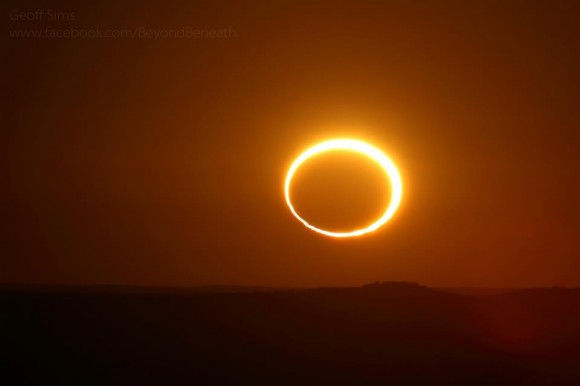
| The eclipsed sun appeared like a fat, flaming sickle as it set behind a large cargo ship in this portrait obtained by Jett Aguilar from Manila Bay, Philippines, January 26, 2009. Early risers on the American eastern seaboard, on their first full day following an annual return to standard time (UT - 5 hours), will have an opportunity to observe the beginning of a hybrid solar eclipse beginning at sunrise Sunday morning.[Jeff Aguilar/SPACE.com]. |
On Sunday, November 3 early risers on North America's eastern seaboard will be treated to the beginning of a spectacular sunrise eclipse.
An unusual "hybrid" solar eclipse, combining aspects of both an annual and total eclipse, the Moon's diffuse penumbral shadow first encounters Earth surface at 10:04:34 UT (5:04 am EST) when the Moon will 372,934 km away and closing in distance at a relative speed of less than a kilometer per second. The tip of the Moon's cone-like umbra will reach Earth's surface less than an hour later south of Bermuda.
Though the event will be visible across a much wider area, The Path of Central Eclipse will track east and peak southeast of Liberia two hours later, finally making landfall on the African mainland near the equator, bisecting the continent nearly to Somalia at early evening.
"The final (eclipse) of 2013 is the most interesting eclipse of the year," writes Fred Espenak of NASA's Goddard Space Flight Center in Greenbelt, Maryland. "It is one of the rare hybrid, both an annular and total eclipse, where some sections of the path are annular while others are total. The duality comes about when the vertex of the Moon's umbral shadow pierces Earth's surface in predictable areas but falls just shy of the surface elsewhere, leaving a ring, or annulus, of the Sun's disk still visible on that path."
Espenak's authoritative prediction of eclipse details can be read HERE. The last solar eclipse widely visible in the U.S. was an annular eclipse, May 20, 2012. The next partial solar eclipse won't be seen in the United States until October 23, 2014.
And eager preparations are already underway for a spectacular total solar eclipse, visible across all the continental United States, with totality peaking at 2 minutes, 40 seconds on in a pathway of totality 115 km wide in western Kentucky, August 21, 2017.
Important safety precautions for viewing even a brief partial eclipse of the Sun are discussed in an article by Imelda Joson and Edwin Aguirre at Space.com.
Similar important precautions, a diagram showing predicted eclipse percentages at locations in eastern North America and tips for viewing the event online have been written up by David Dickinson at Universe Today.
An unusual "hybrid" solar eclipse, combining aspects of both an annual and total eclipse, the Moon's diffuse penumbral shadow first encounters Earth surface at 10:04:34 UT (5:04 am EST) when the Moon will 372,934 km away and closing in distance at a relative speed of less than a kilometer per second. The tip of the Moon's cone-like umbra will reach Earth's surface less than an hour later south of Bermuda.
Though the event will be visible across a much wider area, The Path of Central Eclipse will track east and peak southeast of Liberia two hours later, finally making landfall on the African mainland near the equator, bisecting the continent nearly to Somalia at early evening.
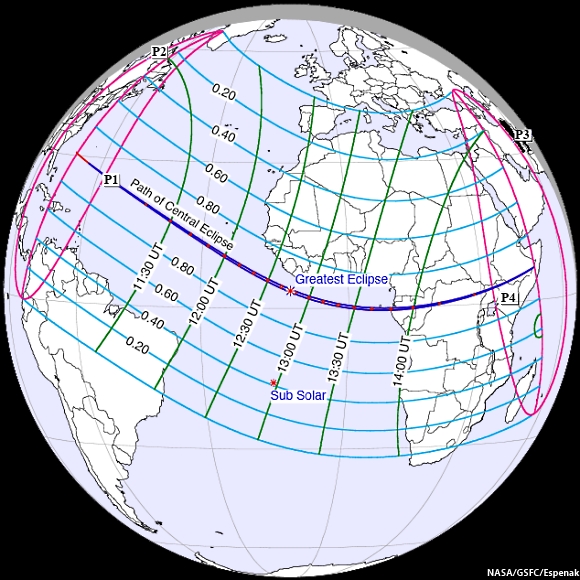 |
| Schematic of the Hybrid Solar Eclipse, Sunday, November 3, 2013, by Fred Espenak of NASA's Goddard Space Flight Center. |
Espenak's authoritative prediction of eclipse details can be read HERE. The last solar eclipse widely visible in the U.S. was an annular eclipse, May 20, 2012. The next partial solar eclipse won't be seen in the United States until October 23, 2014.
And eager preparations are already underway for a spectacular total solar eclipse, visible across all the continental United States, with totality peaking at 2 minutes, 40 seconds on in a pathway of totality 115 km wide in western Kentucky, August 21, 2017.
Important safety precautions for viewing even a brief partial eclipse of the Sun are discussed in an article by Imelda Joson and Edwin Aguirre at Space.com.
Similar important precautions, a diagram showing predicted eclipse percentages at locations in eastern North America and tips for viewing the event online have been written up by David Dickinson at Universe Today.