Showing posts with label debris. Show all posts

Wednesday, May 1, 2013

Debris on the slopes of Benedict crater

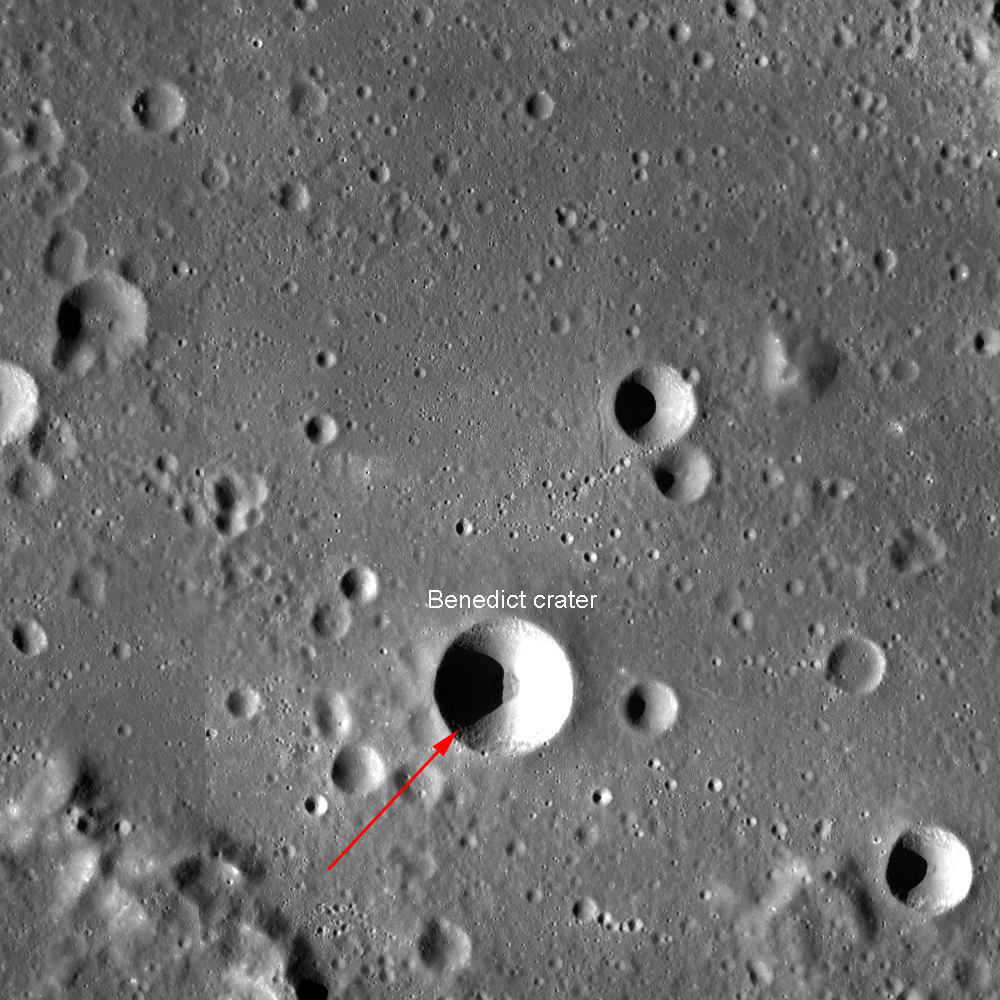
Debris flows on the slope of Benedict crater. Note material collected in small depressions, where boulders stand out as bright dots on the landscape. Recent LROC Narrow Angle Camera (NAC) observation M1120314888R, LRO orbit 17300, April 11, 2013; field of view 1200 meters resolved at 1.2 meters per pixel, downslope toward the upper right [NASA/GSFC/Arizona State University].
Drew Enns
LROC News System

Debris flows occur naturally on most sloped surfaces. This type of 'mass wasting' is actually very common on the Moon. In this case why are small piles of debris accumulating in clumps? This clumping is quite different from other debris flows which are sometimes misidentified as impact melt flows.

Perhaps the debris doesn't have enough energy to make it all the way down, or maybe the surface is not smooth.

Or perhaps the crater wall is not a smooth surface perhaps there are little bumps and depressions. We can see a hint of such undulations from looking at the 'texture' of the surface of the crater wall (and others).

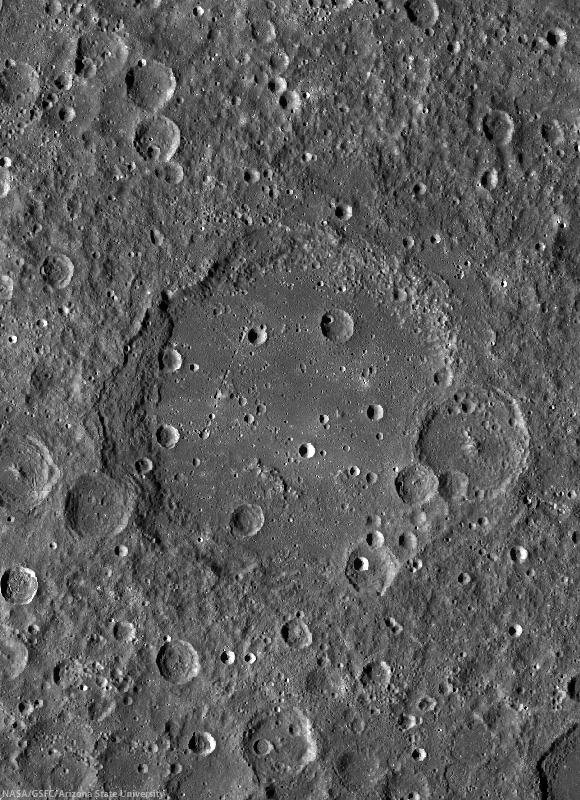
Highly-resampled mosaic of scaled 25000 lines from the center of LROC NAC mosaic M1100280950LR, at a slightly higher resolution and narrower angle of illumination in the original, shows most of Benedict crater with the field of view shown at high resolution in the LROC Featured Image, released May 1, 2013 outlined by the yellow box. Note the asymmetry of the crater floor, an indication of a collapse, or slumping, of the crater's west wall.  Spacecraft orbit 14487, August 22, 2012; scaled from 0.96 meters resolution at 26.77° angle of incidence, from 116.04 km [NASA/GSFC/Arizona State University].
LROC Wide Angle Camera (WAC) context view of 14 km diameter Benedict, well inside the interior of 210 km Mendeleev crater, at 4.345° N, 141.544° E. Field of view 58 km. [NASA/GSFC/Arizona State University].
Smaller scale LROC WAC context image shows Benedict, near center, and its place within 210 km Mendeleev [NASA/GSFC/Arizona State University].
Labeled oblique HDTV view of Mendeleev from the south, captured from Japan's lunar orbiter SELENE-1 (Kaguya) in 2007. View a full-size unlabeled, closer SELENE HDTV still HERE  [JAXA/NHK/SELENE].
We can also see this uneven wall surface in Digital Terrain Models of young craters. The bumpy surface acts to trap debris in shallow depressions, inhibiting growth of the spectacular debris flows seen elsewhere. Mass wasting is a continuous process and in a few tens of millions of years perhaps the interior of Benedict crater will look more like some other craters we have featured.

Look for more debris along the crater wall of Benedict in the full LROC NAC, HERE.

Related Posts:
Dichotomy
Melt or Rubble
Crater Debris
Inside Catena Mendeleev
Mendeleev in full

Wednesday, August 22, 2012

LROC: Looking over a four-leaf clover..

Several shallow depressions, secondary craters, dot the surface of Mare Imbrium, in this case near a rocky ext Mons la Hire (near Euler and Lambert), and giving the impression of a four leaf clover. LROC Narrow Angle Camera (NAC) M190780929RE, spacecraft orbit 13158, May 4, 2012; resolution 1.5 meters and field of view 1500 meter across. View a larger cropped image HERE.  [NASA/GSFC/Arizona State University].
Drew Enns
LROC News System

These large, ~500 m diameter, depressions are characteristic of secondary impacts on the Moon. When a bolide (asteroid or comet) hits the surface of the Moon a crater forms at the impact site. To create a secondary crater material is ejected from the impact site at about a 45° angle. If the ejecta travels less than the escape velocity, it falls back down to the Moon. Since the escape velocity on the Moon (~2.4 km/s) is much lower than that at which bolides typically impact the Moon (10-20 km/s) secondary craters often have a distinctive appearance. These lower velocity impacts result in irregularly shaped craters. Sometimes secondaries land in clumps and create distinctive patterns, such as the "four leaf clover" whimsically identified in today's Featured Image.


Smaller scale context image shows the relationship of the out-cropping above with the larger Mons La Hires 30 km to the southeast.  Image width is 650 km, LROC WAC mosaic [NASA/GSFC/Arizona State University].
If the secondaries featured today were formed in another impact, which impact created them? The number of craters in our secondary group is fairly large, so the parent crater cannot be small. In the context image covering a slightly broader field of view below, other secondary chains (red arrows) appear to point to the southeast. Maybe zooming out further will reveal the mystery parent crater!

A quick look over the 605 kilometers from the southwestern tip of  the northwest Mons La Hire outcrop and the center of Copernicus, courtesy of the ILIADS application released by NASA/LMMP. The immediate and long-range legacy of the Copernicus event was lasting.
It looks like Copernicus is the parent crater! That makes sense. Copernicus fits our criteria. These secondary chains have been previously identified, but the fact that they were sourced from Copernicus crater hundreds of kilometers away is remarkable. The impact cratering process really is amazing.

Can you identify other secondary craters in the full LROC NAC frame, HERE?

Related Posts:

Thursday, April 5, 2012

LROC: Trapped at the Bottom

A mound of debris has piled up at the bottom of a small impact crater (26.9°N, 56.37°E) in the lava deposits of the 129 kilometer-wide "walled plain" Cleomedes, north of Mare Crisium. Field of view is approximately 500 meters in LROC Narrow Angle Camera (NAC) observation M121844756R, orbit 3090, February 26, 2010; resolution 0.5 meters from 45.08 km [NASA/GSFC/Arizona State University].
James Ashley
LROC News System

Examine the larger craters on the Moon and you will find that many of them have a tall mountain in their centers. These are known as "central peaks" in the vernacular of impact crater morphology, and are the result of a rebound effect that can accompany an impact after compression and excavation of the central region.

However, rebound peaks do not form in small craters where the strength of the target rock does not permit that kind of plastic deformation.

Smaller craters tend to be more bowl-shaped without prominent structures on their floors.

Early in November 2011, in the course of a series of low orbital passes, LROC captured the subject crater a second time 614 days later, from only 24 kilometers overhead. LROC NAC frame M174901788R, LRO orbit 10909, November 2, 2011 [NASA/GSFC/Arizona State University].
A wider context view for the Featured Image (white box), showing the entire impact feature from the October 26, 2010 NAC frame. Image field of view is roughly 1400 meters [NASA/GSFC/Arizona State University].
The small subject crater is dwarfed in an even wider context of the plain-like floor of Cleomedes, featuring the Rimae Cleomedes network. The 1-km-wide crater is situated halfway between 13 km-wide Cleomedes B and the older 12 km-wide Cleomedes J, inundated nearly to the point of becoming a "ghost crater," J was overrun by lava at some point after Cleomedes originally formed. LROC WAC M177256912C, orbit 11258, November 30, 2011; incidence angle 71.21° at 52 meters resolution from 37.93 kilometers [NASA/GSFC/Arizona State University].
Why then do we see a positive relief feature at the bottom of this small (1.4 km diameter) crater (26.697°N, 56.352°E) inside Cleomedes crater near the Sea of Crises? There are several processes that a planetary scientist will consider when tackling a problem like this. In addition to its role in the formation of large impact structures, NAC images show that impact melt is created in much smaller impact events than previously thought. If enough impact melt is generated during impact, it can accumulate on the floor to form a pond. Subsequent mass wasting and regolith development can hide the original melt deposit. However dry debris alone is unlikely to produce a positive relief structure, and is unlikely to flow radially and smoothly so that the deposit has even contributions from the full circumference of the crater walls.

The morphology of impact craters can be influenced by the target material and properties. For example, when a weak layer of material (a thin regolith layer, for example) overlies a stronger layer (mare basalt flows), a central mound can form due to the strength discontinuity between target materials. So instead of a bowl-shaped crater, the crater that forms has a positive relief mound on the crater floor. Many crater morphologies observed during the pre-Apollo and Apollo eras were reproduced by impact experiments completed in the 1960s and 1970s!

As is common on many planets, our small crater can be found hiding within a much larger one. LROC WAC monochrome mosaic from Planetary Data Base interface, image width is ~105 kilometers [NASA/GSFC/Arizona State University].

Ultimately, the mound on the crater floor may have formed from a combination of several factors and processes, not all of which are fully understood. Certainly once at the bottom of such a closed depression, any loose debris will find it difficult to escape unless ejected by another impact! What additional clues would you look for to learn the true cause of this structure?

In a near hemispheric, regional context, the small crater is still visible in this LROC WAC global mosaic overlaid upon laser altimetry (LOLA) based topography in the NASA LMMP ILIADS application. [NASA/GSFC/LMMP/Arizona State University].
Several additional similar features can be found when examining the full NAC frame, HERE. The following posts show examples of other small craters: Brayley G, Fresh Bench Crater in Oceanus Procellarum and Crater Covered with Boulders!

Friday, February 10, 2012

LROC Shattering Consequences

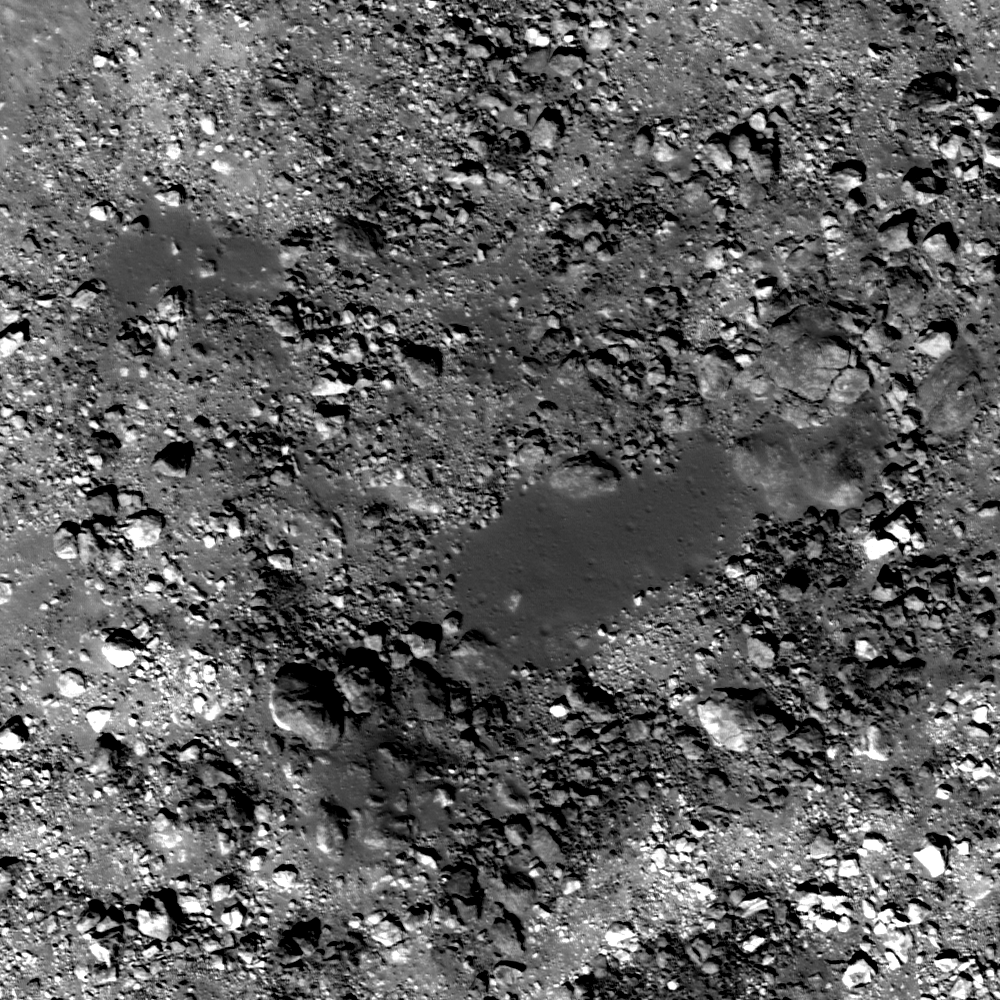
Debris of variable reflectivity and size litters the floor of a small crater in the nearside lunar highlands (31.3°N, 34.45°E). Illumination is from the south, image field of view is approximately 410 meter across; from LROC Narrow Angle Camera (NAC) observation M170334512L, orbit 10236, September 10, 2011, native resolution 0.47 meters per pixel from 38.77 kilometers. View the full size (1000 x1000) LROC Featured Image HERE [NASA/GSFC/Arizona State University].
James Ashley
LROC News System

What causes such an astonishing range in textures and tones as we find in this image? Here we see a jumbled mixture of light and dark, blocky boulders (many the size of small buildings), finer deposits between and around the boulders, and dark (low albedo), flat zones that are almost completely free of boulders. A landscape formed in an instant - ground zero for one of the most violent processes found in planetary studies.

The tremendous energy released when an asteroid or comet slams into the Moon results in compression, shattering, accelerating, melting, and even vaporizing of target and impactor. Why so much energy? Hypervelocity is the answer - the bolide (comet or asteroid) is typically traveling greater than 15 km/second; scientists estimate the energy of impact in terms of megatons equivalent of TNT because the interaction is truly explosive. Hyperveolcity is different from a low-velocity impact, which might displace some rock and make a thud, but will not produce an explosion and larger crater. Hypervelocity craters are many 10s of times the diameter of the bolide that creates them.

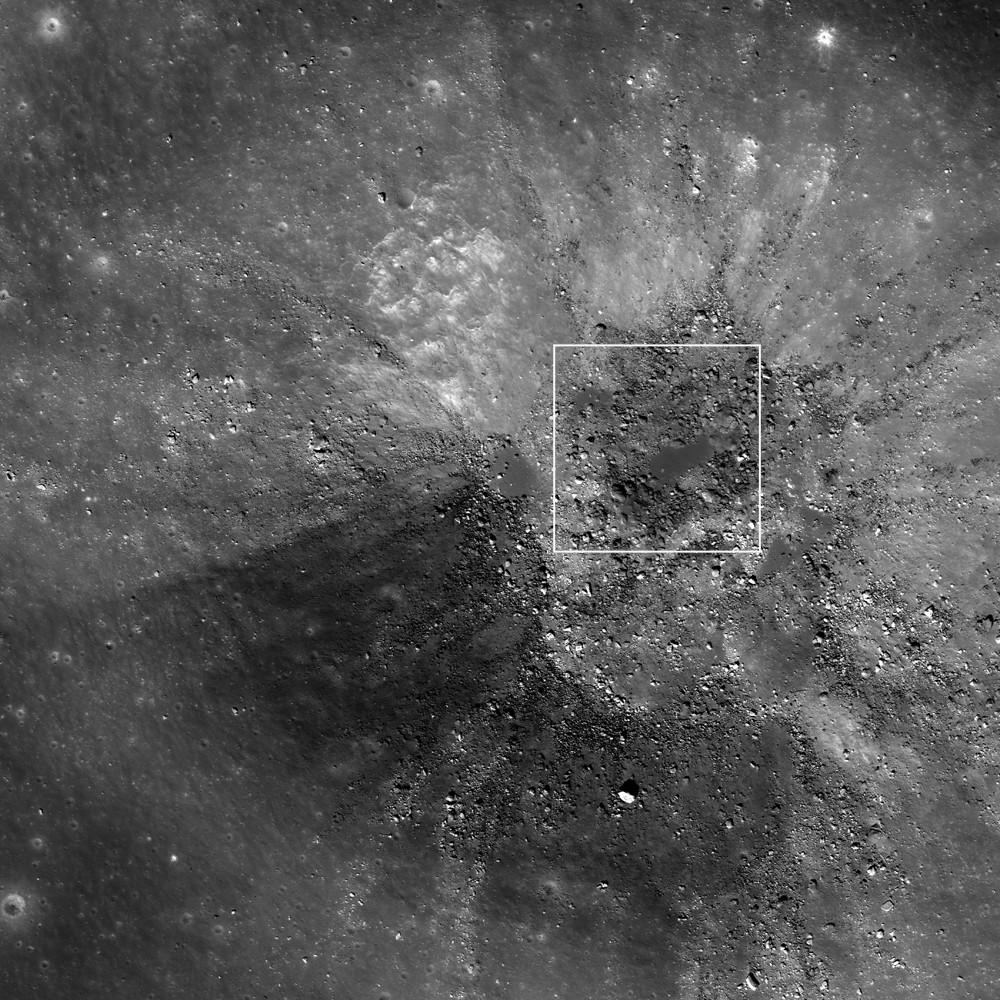
A wider view across the width of the LROC NAC frame provides context for the featured area deeper within the impact crater (image field of view roughly 1800 meters across. View the larger (1000 x 1000) context image release HERE [NASA/GSFC/Arizona State University].

Following an impact, some material falls back into the cavity, either as mass wasting off the crater walls or as direct in-fall from the ejecta plume. Depending on the velocity of the impactor, the impact angle, the size of the impactor, and gravity, the amount of material that is ejected or stays within the crater varies widely. Impact melt, which tends to be a darker deposit than many types of bedrock because of its glass content, will flow and pool in low-lying areas and also coat some of the boulders in encounters on its way. This accounts for the range in reflectivity and the smooth, flat areas on the crater floor in this Featured Image. This crater also has a high-reflectance ejecta blanket that can be seen in the regional WAC mosaic, provided below. Exploration of craters like this provide subsurface samples to future explorers, which in turn provide insights into the local three dimensional geology and the impact process that formed the crater.

WAC monochrome (604 nm) mosaic from four sequential orbital observation opportunities (LRO orbits7281-7284) January 21, 2011 reduced from an original resolution averaging 60 meters per pixel from 43.5 kilometers. The image shows some of the complex region in the vicinity of the small crater. A light ejecta blanket surrounding the impact is easier to see in the original context image accompanying the LROC Featured Image HERE. (FOV above is approximately 110 kilometers across [NASA/GSFC/Arizona State University].

Examine the full NAC image for additional occurrences of impact melt and other features. More examples of small, young craters can be found in Featured Image postings Brayley G, Recent Impact in Oceanus Procellarum, and Farside Impact!