|
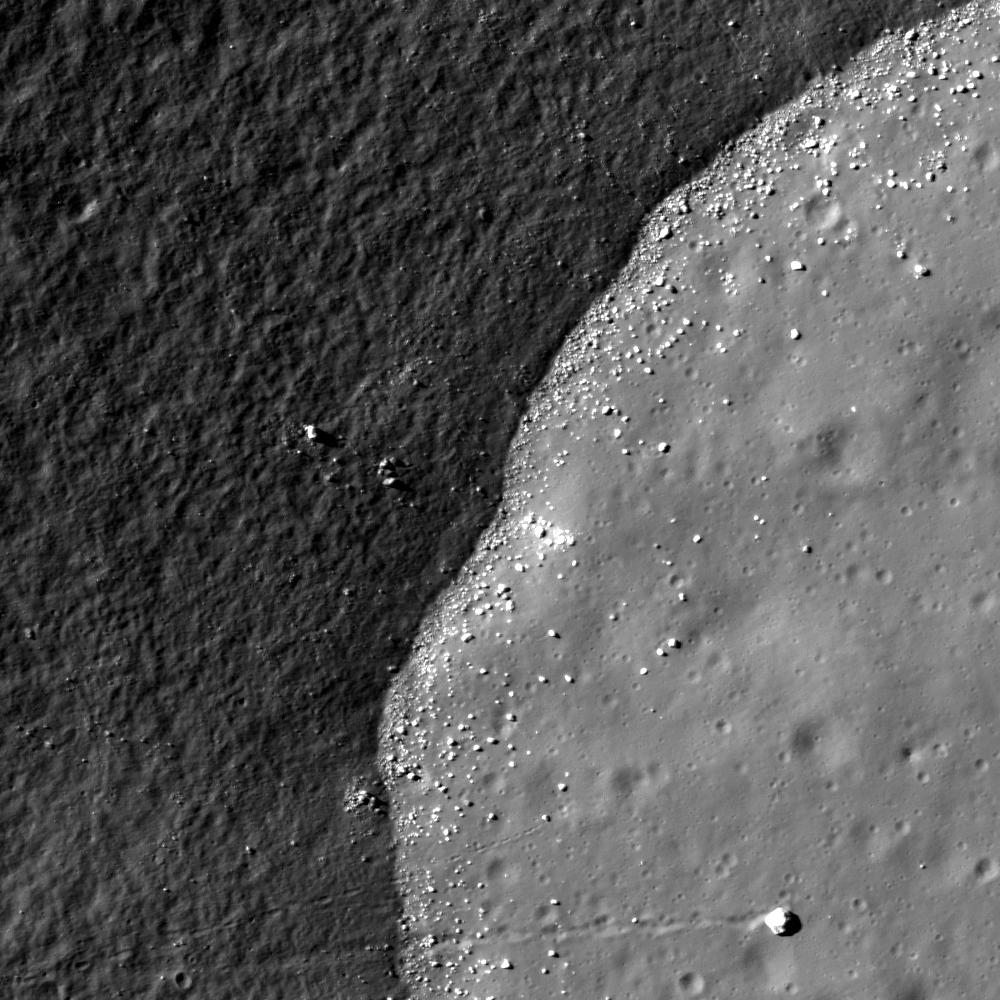
| Overlapping views of the same 1 km-wide area of the lunar surface, immediately southwest of a fresh impact crater near Buisson V; 68° morning shadow and 8° mid-day albedo, respectfully. LROC NAC observations M146255155R (LRO orbit 6687, December 6, 2010; incidence 67.86° at 62 cm resolution from 60.47 km) and M187520776L (orbit 12701, March 27, 2012; 8.35° incidence, resolution 97 cm from 116.95 km) [NASA/GSFC/Arizona State University]. |

Hiroyuki Sato
LROC News System
Today's Featured Image highlights differences in how the surface appears as the Sun angle changes. As seen in the opening image, the two images show the exact same area, but their appearances are remarkably different. Both images show the southern portion of the ejecta from an unnamed fresh 1 km crater (0.4933°S, 110.7156°E, 9.8 km west by northwest of Buisson V, an ancient equatorial crater just beyond the east limb.
The darker image, highlighting the granularity and elephant skin texture of the surface, was acquired when the Sun was low on the horizon (incidence angle = 68°), and the image characterized by bright swaths of ejecta was acquired when the Sun was nearly overhead (incidence angle = 8°). Both were acquired with the cameras looking straight down. The small crater (about 27 meters in diameter) in the upper-middle each segment is a good landmark to confirm both images show the same location.
The darker image, highlighting the granularity and elephant skin texture of the surface, was acquired when the Sun was low on the horizon (incidence angle = 68°), and the image characterized by bright swaths of ejecta was acquired when the Sun was nearly overhead (incidence angle = 8°). Both were acquired with the cameras looking straight down. The small crater (about 27 meters in diameter) in the upper-middle each segment is a good landmark to confirm both images show the same location.
 |
| Context view of ejecta blanket, source unnamed fresh crater (0.4933°S, 110.7156°E) 9.8 km west by northwest of Buisson V. LROC NAC footprint fields of view designated, area shown at high resolution indicated with an arrow. 46.1 km-wide field of view from LROC WAC monochrome (604 nm) observation M176905846C, LRO orbit 11206, November 26, 2011; 62.67° incidence, resolution 58.44 meters from 43.14 km [NASA/GSFC/Arizona State University]. |
When the Sun is high no resolvable shadows are cast, and surface brightness (albedo) variations stand out. The low Sun image has sharp shadows, highlighting the surface texture. Due to these drastic changes caused by the Sun angle scientists use NAC images at specific lighting conditions for different studies, of morphology, composition, optical and molecular maturity, topographic mapping, etc).
Related Posts:
LROC Coordinates of Robotic Spacecraft - 2013 Update
Polka-dot Ejecta
Ejecta sweeps the surface
Dynamic Textures
Action Shot
Peary Crater: Greetings from the North Pole of the Moon
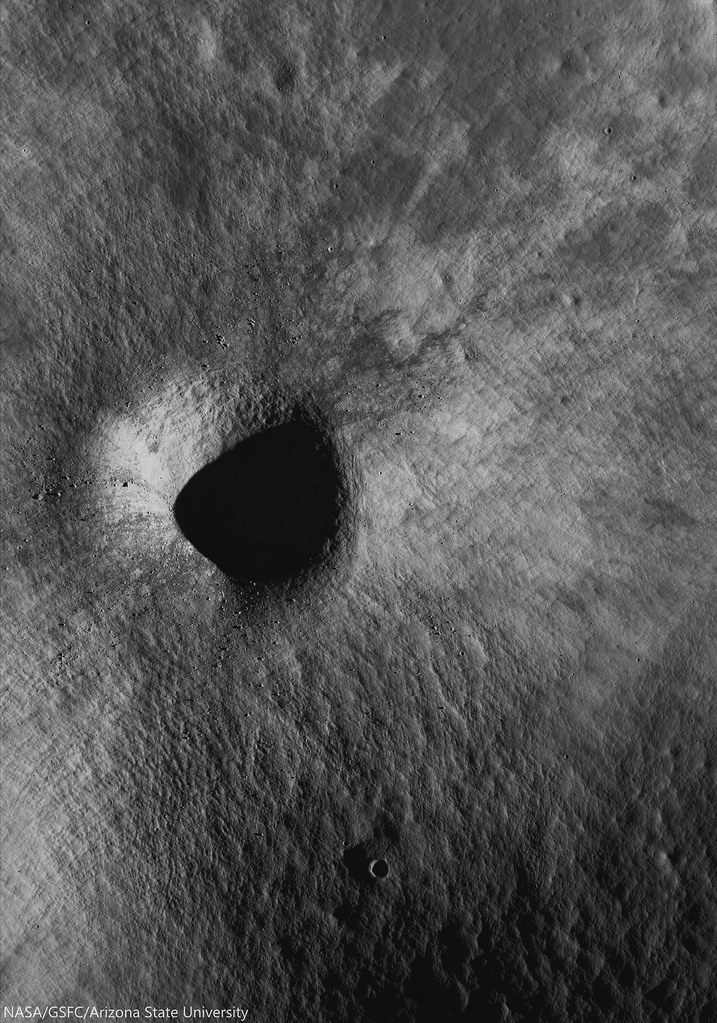 |
| Granularity, at the expense of albedo, becomes visible at relatively low sun (high incidence angles). See the image at higher resolution HERE. |
LROC Coordinates of Robotic Spacecraft - 2013 Update
Polka-dot Ejecta
Ejecta sweeps the surface
Dynamic Textures
Action Shot
Peary Crater: Greetings from the North Pole of the Moon