|
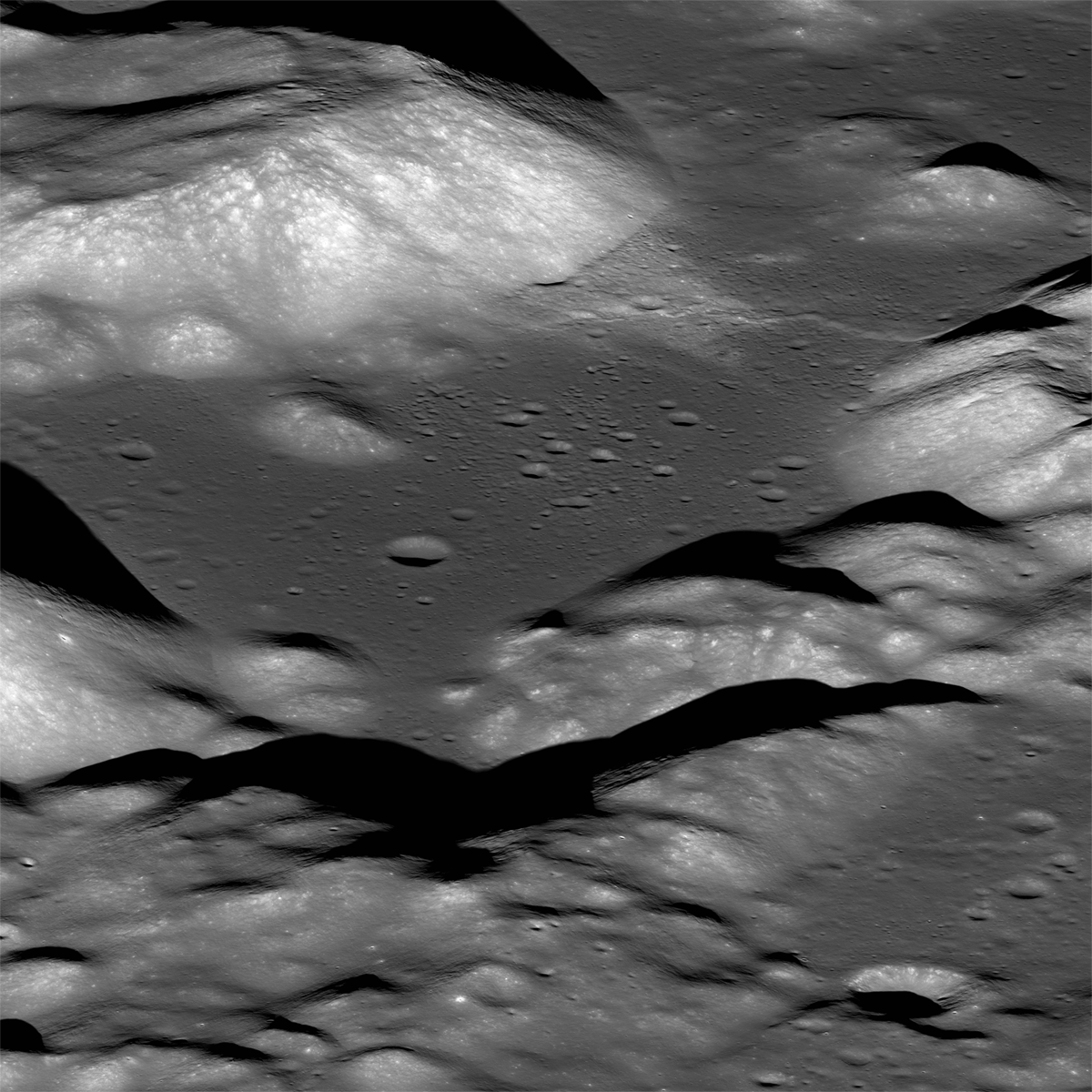
| Taurus Littrow Valley from the east. View similar to what the
Apollo 17 astronauts saw as they approached their landing in the
magnificent Taurus Littrow Valley. (See "Taurus Littrow Oblique,"
September 29, 2012) LROC Narrow Angle Camera (NAC) east-to-west oblique
image pair, about 18 km wide field of view at center, M192703697LR, LRO
orbit 13427, May 26, 2012; spacecraft (and camera) slewed 56.09° west
from nadir, native resolution 2.79 meters, from 131.29 km over 20.01°N,
38.78°E [NASA/GSFC/Arizona State University]. [NASA/GSFC/Arizona State
University]. |
Mark Robinson
Principal Investigator
Lunar Reconnaissance Orbiter Camera (LROC)
Arizona State University
The Apollo 17 astronauts landed in the Taurus Littrow Valley forty years ago today. One of their key science goals was to collect impact melt from the Serenitatis basin rim so an
age date for this important basin could be established. Before the samples were returned most lunar geologists believed this basin to be relatively old amongst all lunar basins. When the age dates came in from the Apollo 17 highland impact melt samples it appeared that the Serenitatis basin was younger than previously thought (3.86 billion years), nearly the same age as the mighty Imbrium basin (young in terms of lunar basins!).
Jack Schmitt and
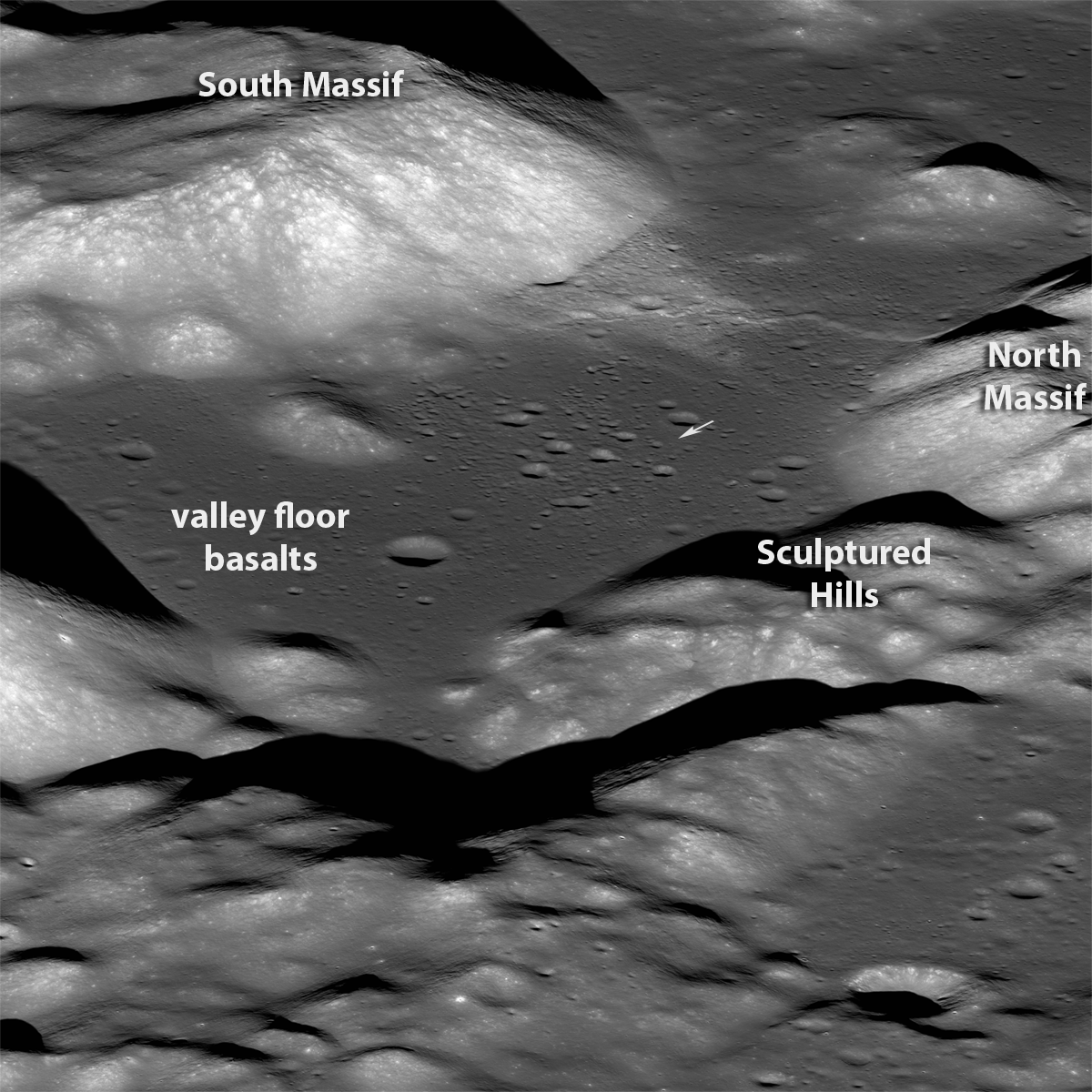
Gene Cernan sampled rocks from South and North Massifs and the Sculptured Hills, all three thought to be formed as part of the Serenitatis basin impact event.
 |
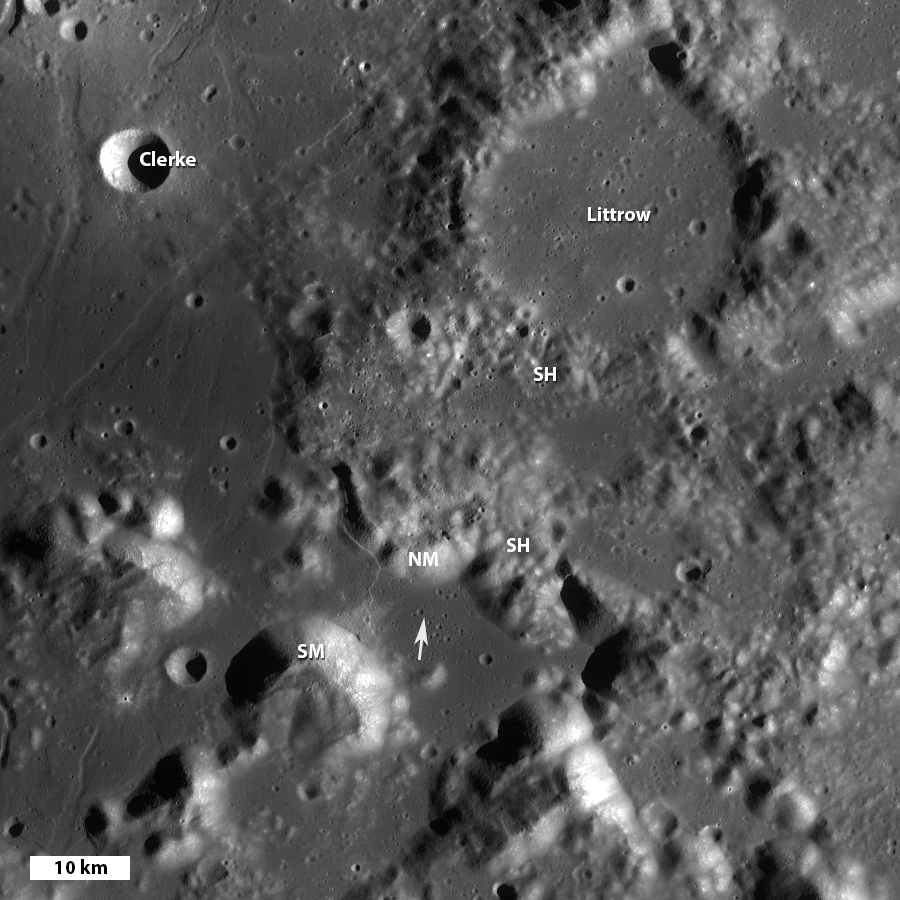
| Taurus Littrow valley to Taurus crater, the upper left corner
(NW) is the eastern edge of the mare flooded Serenitatis basin. LROC Wide Angle Camera (WAC)
mosaic: SM = South Massiff, NM = North Massif, SH = Sculptured Hills,
arrow indicates Apollo 17 landing site, north is up, image field of view is 90 km wide
[NASA/GSFC/Arizona State University]. |
The wisdom at the time was that the old relative age assignment of the Serenitatis basin derived from remotely sensed image data must be wrong. Perhaps the confidence of that interpretation was undermined by the relatively poor resolution of the then-existing orbital image data for much of the eastern portion of the nearside of the Moon.
The new WAC global mosaic and NAC high resolution views are allowing scientists to reevaluate many previously held ideas with much clearer data. A new look at the area around the Serenitatis basin using the geologic
rule of superposition (
Spudis and coworkers, 2011) with LROC images resulted in a confident determination that the Sculptured Hills are actually far flung ejecta from the Imbrium basin, and not Serenitatis basin material. In the WAC mosaic above you can see the hummocky Sculptured Hills formation on top of Taurus crater. Taurus crater in turn was formed on the rim of Serenitatis basin. Thus the Sculptured Hills formed after the Serenitatis basin formed, likely as ejecta from the Imbrium basin impact event.
 |
| Annotated version of the LROC Featured Image of Taurus Littrow valley,
in a field of view about 18 km wide in center, small arrow indicates
landing site, M192703697LR [NASA/GSFC/Arizona State University]. |
What does this new finding mean? First, if the Sculptured Hills are really Imbrium ejecta it is possible (or even likely) that the Apollo 17 impact melts do not represent the formation age of the Serenitatis basin, but rather that of the Imbrium basin. If so, the evidence that there was a late cataclysm (a big short spike in impact events) just got a lot weaker. On the other hand, if those impact melts do indeed come form the Serenitatis formation event, the fact that Serenitatis is relatively old amongst lunar basins means the late cataclysm was even more compressed than previously thought! In fact, it would suggest that 13-25 of the larger basins all formed within a short period of 50 million years (short in geologic time). Either way, the new determination of the relative age of the Serenitatis basin results in a radical new evaluation of the sequence of events early in lunar history!
 |
| Apollo 17 CM above Taurus Littrow - Hasselblad
frame shuttered from the LM Challenger as it passed over the Taurus
Littrow Valley, note the command module America just visible in front of
South Massif in the middle ground, from AS17-147-22464 [NASA]. |
Reflecting back on the fortieth anniversary of the last human landing on the Moon, and the new results of LRO and other recent missions, we can see that the Apollo landings were a fantastic start to our exploration of the Moon. Many questions were answered from data and samples collected during the Apollo era. Since then, many new discoveries about the Moon have arrived, and more key science questions have appeared. The work begun by Schmitt and Cernan is now being extended by LRO in preparation for the next generation of lunar explorers. With the LROC data we can now map out the best places to search for outcrops of Serenitatis rock (especially impact melt) and obtain a confident age date for this key basin, which in turn places many of the other the other large basins in their proper absolute age.
Here we have seen one example of how new observations are overturning previously held lunar ideas; there are many more examples! It is certainly an exciting time in lunar science as we more forward in this new era of lunar exploration and pave the way for a future human return to the Moon and then beyond.
Zoom in and examine the full resolution NAC oblique perspective of Taurus Littrow, and find key stratigraphic relations,
HERE.
Download the Spudis
et al (2012),
HERE.
Previous LROC Apollo 17 Featured Images
Shorty Crater
Skimming the Moon
Exploring the Apollo 17 Site
Recent Posts:
Apollo 17 lands, ending the Apollo era, 40 years ago (December 11, 2012)
The last manned launch to the Moon (December 7, 2011)
Taurus Littrow Oblique (September 29, 2012)
Significant change in bombardment timing (January 6. 2012)
Just another crater? (December 13, 2011)