Showing posts with label Mare Insularum. Show all posts

Thursday, June 13, 2013

Revealed Surface, eastern Mare Insularum

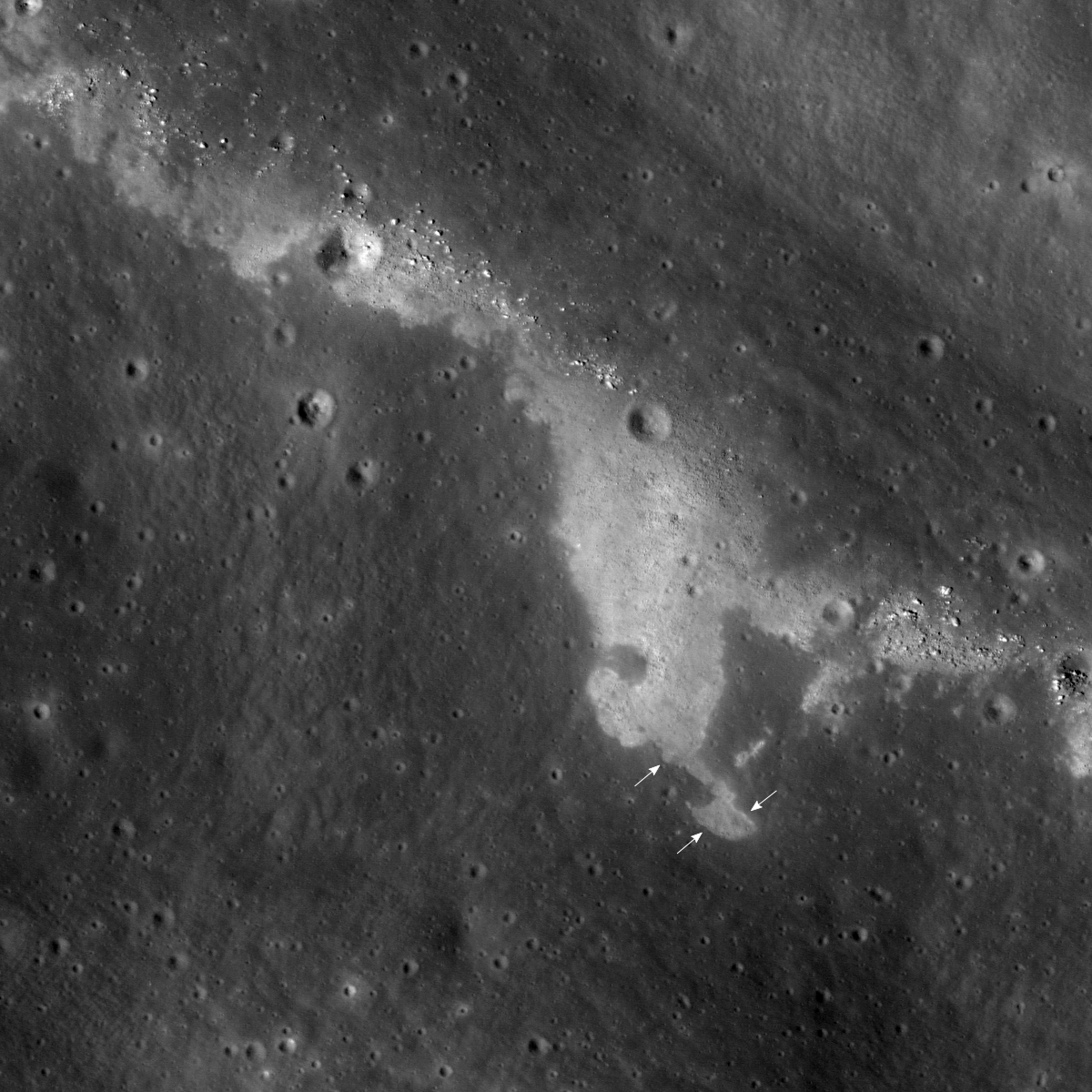
Southern slope of unnamed fracture along the eastern mare/highland boundary of Mare Insularum. LROC Narrow Angle Camera (NAC) frame M1114199297R, LRO orbit 16439, January 30, 2013; 1147.2 meter field of view centered on 13.135°N, 355.638°E, 42.94° angle of incidence, resolution 0.96 meters per pixel from 114.18 km. (Downslope toward upper-right, north at top) [NASA/GSFC/Arizona State University].
Hiroyuki Sato
LROC News System

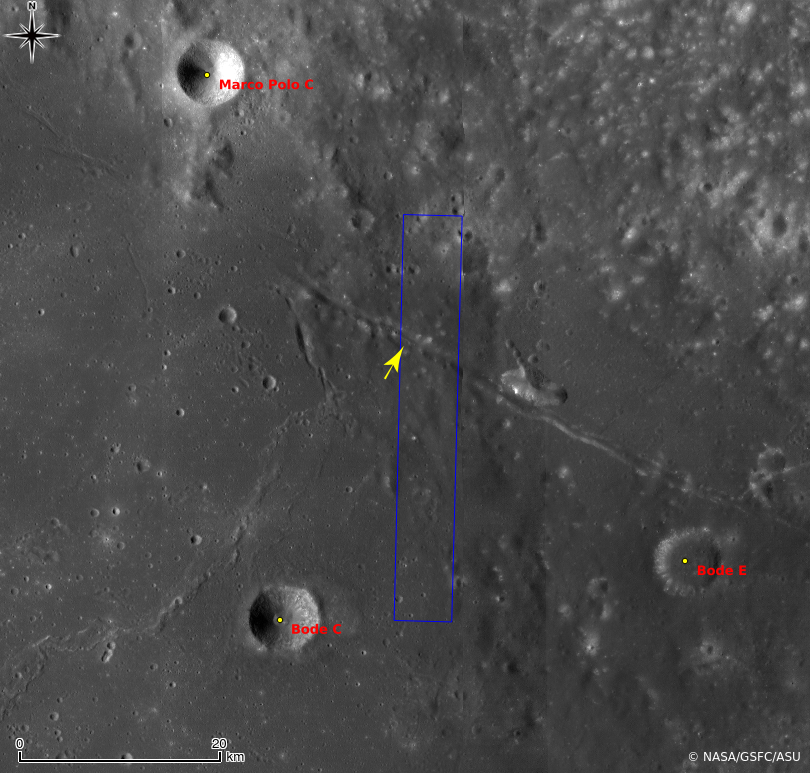
Today's Featured Image highlights a portion of an unnamed linear fissure located along the eastern edge of Mare Insularum, near the mare/highland boundary.

The width of this fissure varies from about 1.5 to 2 km, its  length is about 90 km, and it extends in the northwest-southeast direction.

The upper-right portion of the opening image, showing a shallow groove extending from up to middle right of the image, corresponds to the bottom of the fissure. Thus most of the image reveals the southern wall of the fissure.

The LROC Featured Image field of view rendered approximately in elevation data from the LROC WAC DTM. Local slopes in the vicinity of the fracture of interest can be difficult to otherwise see. LROC QuickMap [NASA/GSFC/DLR/Arizona State University].
On this slope, there is a high reflectance area with sinuous boundaries. This unit is hard to interpret in terms of what is on top and what is below, stratigraphically. The sunlight is from left side, highlighting what appears as a slightly raised boundary between the two units (arrows). Elsewhere it looks as if the high reflectance material overlies the lower reflectance material. Which unit is younger? Try counting craters between the two, but be careful, if the units have different hardnesses, then the more coherent unit may preserve craters better. 

Unnamed fracture running northwest to southeast on the eastern side of Mare Insularum and surrounding vicinity in LROC WAC monochrome mosaic (100 meters per pixel), centered is 13.12°N, 355.66°E. The LROC NAC footprint (blue box) and location of the field of view in the Featured Image (yellow arrow) are marked [NASA/GSFC/Arizona State University].
Since this whole area is on a slope, slope failure may have revealed an underlying immature surface. Indeed multiple higher reflectance boulders are sitting at the downslope side of this high reflectance unit. But the upper complicated shapes are difficult to explain by this simple story. Or perhaps low reflectance materials could have slumped and covered portions of the high reflectance material? A high resolution NAC DTM would help scientist unravel this complicated morphology.

Explore this enigmatic patterned surface in full NAC frame yourself, HERE.

Related Posts:
Inside Hyginus Crater
Bright ridge near Mons Hansteen
Wrinkle Ridge vs. Impact Crater
Really Wrinkled
Boulders In The Sea Of Serenity
Ghost crater in Mare Imbrium
Zebra Stripes
Aitken Central Peak, Seen Obliquely
Constellation Region of Interest at Mare Tranquillitatis

Wednesday, November 30, 2011

LROC: Layered basalt on the wall of Marius A

Layered basalt on the wall of Marius A crater partially covered by debris flow. The crater rim is to the right and the crater floor is to the left. LROC Narrow Angle Camera (NAC) observation M137848463R, LRO orbit 5448, August 30, 2010; field of view of the original LROC Featured Image (HERE) 460 meters, at an illumination incidence angle of 33° from an altitude of 44.37 kilometers [NASA/GSFC/Arizona State University].
Sarah Braden
LROC News System

Marius A (12.58°N, 46.05°W) is an approximately 15 kilometer crater located in Mare Insularum. The Featured Image shows basalt layering partially covered by streaks of granular material that slid down from higher up on the wall. Craters with visible basalt layers like Marius A are windows to the history of basalt deposition. 

Each thin layer seen in the wall of Marius A is probably a single flow or flow lobe, each spreading out across the lunar surface due to the low viscosity of mare basalt (basalt has a viscosity similar to that of ketchup). How much time passed between each layer is still an unanswered question. By studying many craters with visible basalt flows, however, scientists may be able to piece together a more detailed, local history for the various mare on the lunar surface. Not all craters in the mare have visible mare basalt layering, though. Additionally, over time post-impact processes like the debris in today's Featured Image and slumping of the crater walls reduce the visibility of basalt layers.

Marius A at 62 meters resolution from LROC Wide Angle Camera (WAC) observation M135493956C, orbit 5101, August 3, 2010 in a field of view roughly 42 km across; incidence angle 57.09° from 44.1 km above. The much small field of view shown in detail in the Featured Image released November 29, 2011 is located at just shy of "3 o'clock" on the east crater rim wall [NASA/GSFC/Arizona State University].
LROC WAC context image of Marius A crater. The image is 59 km across and the rectangle indicates the area of the whole NAC frame from which the Featured Image is taken. View the full size and original LROC WAC context image HERE [NASA/GSFC/Arizona State University].

There are many craters with visible basalt layers and LROC has given us our first look at these incredible details of the lunar surface. Check out the NAC frame of Marius A and then explore the rest of the lunar maria!

Related Posts:
Layering in Euler Crater
Lava Flows Exposed in Bessel Crater
New Views of Lunar Pits

Marius A in a wider oblique context view from a virtual point 254 kilometers over the bright landmark crater Kepler, showing some of the more famous landmarks also nearby. One of the wispy rays of material and reflective secondary craters, superimposed upon Marius A by the Kepler impact event crosses directly upon Marius A and beyond, a distance of 280 kilometers from crater center to crater center [NASA/LMMP/GSFC/ARC/ASU].

Tuesday, September 22, 2009

LROC: Milichius A (Mare Insularum)

The inner rim of Milichius A crater in Mare Insularum from the Narrow Angle Camera aboard the Lunar Reconnaissance Orbiter. Top Image does not do this Copernican Age (> 100 million years) crater justice, and the inset is taken from the full-sized representation showing the bolders thrust upward with the relatively recent impact. [NASA/GSFC/Arizona State University].

Samuel Lawrence
LROC News System

Milichius A is a Copernican-aged crater found in the middle of Mare Insularum (upper left). There are many different sizes of impact craters in this view, from 9 km in diameter (Milichius A) all the way down to craters that are just a few meters across. The "cracked" appearance of the rim exterior is a result of impact melt flowing after emplacement, and is fairly common in other similarly-sized, relatively young Copernican-aged craters. You can also see that while there are numerous smaller craters on the surrounding ejecta blanket, the interior of the crater seemingly has far fewer craters than the exterior. Does this mean that there have been no impacts on the inner wall of Milichius A? Probably not - there have almost certainly been many small impacts on the steep surface. Instead, the streaks that you see on the crater walls are places where materials have simply slumped into the crater, covering and obscuring the smaller craters as it slides down the walls of the crater, although some of the darker, low-albedo streaks may actually be impact melt flows.

Uncalibrated LROC NAC data; north is up; image width is 6 km. Browse the whole NAC Image. (From NAC Archive - Featured Image Sept. 20, 2009)