|
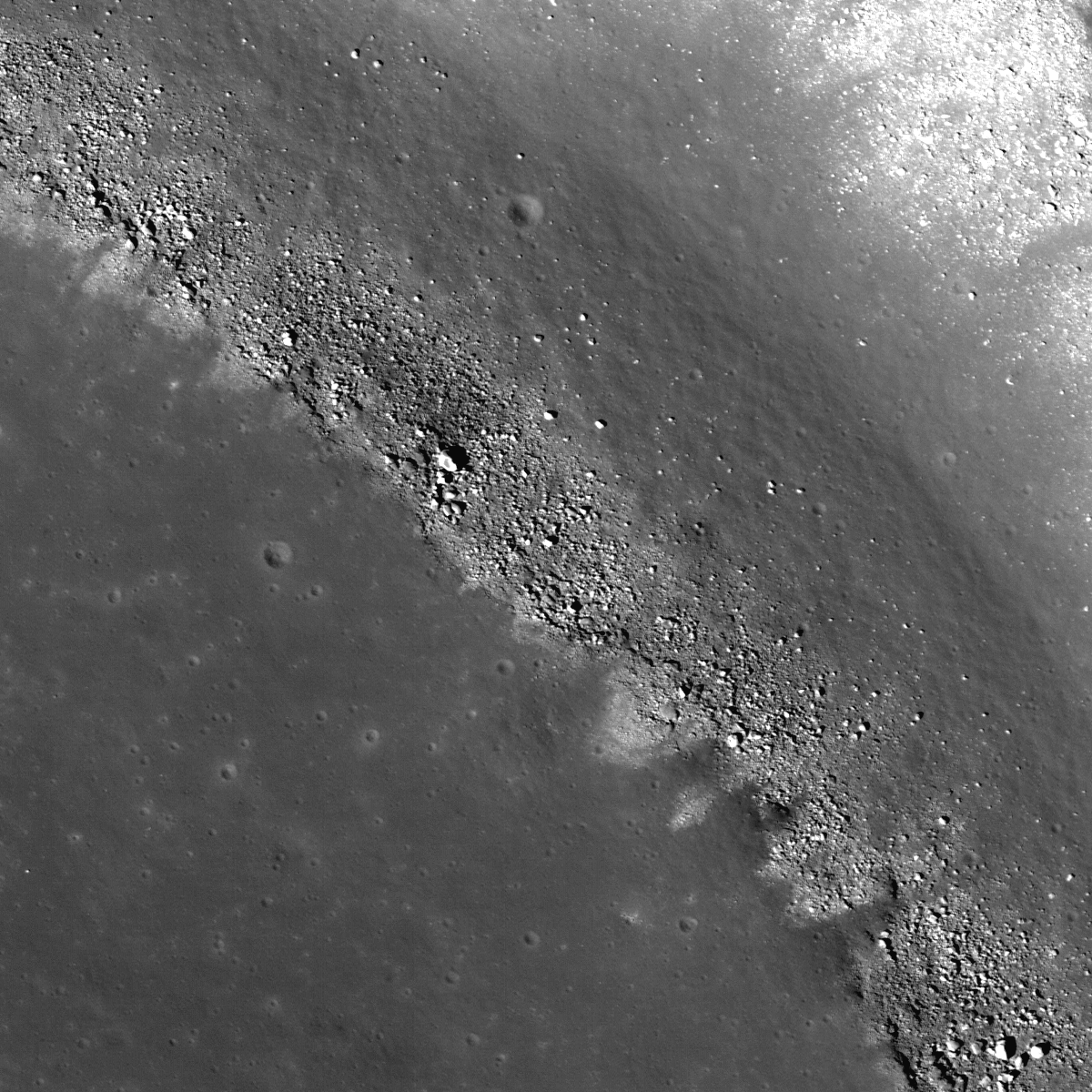
| Layered basalt on the wall of Marius A crater partially covered by debris flow. The crater rim is to the right and the crater floor is to the left. LROC Narrow Angle Camera (NAC) observation M137848463R, LRO orbit 5448, August 30, 2010; field of view of the original LROC Featured Image (HERE) 460 meters, at an illumination incidence angle of 33° from an altitude of 44.37 kilometers [NASA/GSFC/Arizona State University]. |

LROC News System
Marius A (12.58°N, 46.05°W) is an approximately 15 kilometer crater located in Mare Insularum. The Featured Image shows basalt layering partially covered by streaks of granular material that slid down from higher up on the wall. Craters with visible basalt layers like Marius A are windows to the history of basalt deposition.
Each thin layer seen in the wall of Marius A is probably a single flow or flow lobe, each spreading out across the lunar surface due to the low viscosity of mare basalt (basalt has a viscosity similar to that of ketchup). How much time passed between each layer is still an unanswered question. By studying many craters with visible basalt flows, however, scientists may be able to piece together a more detailed, local history for the various mare on the lunar surface. Not all craters in the mare have visible mare basalt layering, though. Additionally, over time post-impact processes like the debris in today's Featured Image and slumping of the crater walls reduce the visibility of basalt layers.
 |
| Marius A at 62 meters resolution from LROC Wide Angle Camera (WAC) observation M135493956C, orbit 5101, August 3, 2010 in a field of view roughly 42 km across; incidence angle 57.09° from 44.1 km above. The much small field of view shown in detail in the Featured Image released November 29, 2011 is located at just shy of "3 o'clock" on the east crater rim wall [NASA/GSFC/Arizona State University]. |
 |
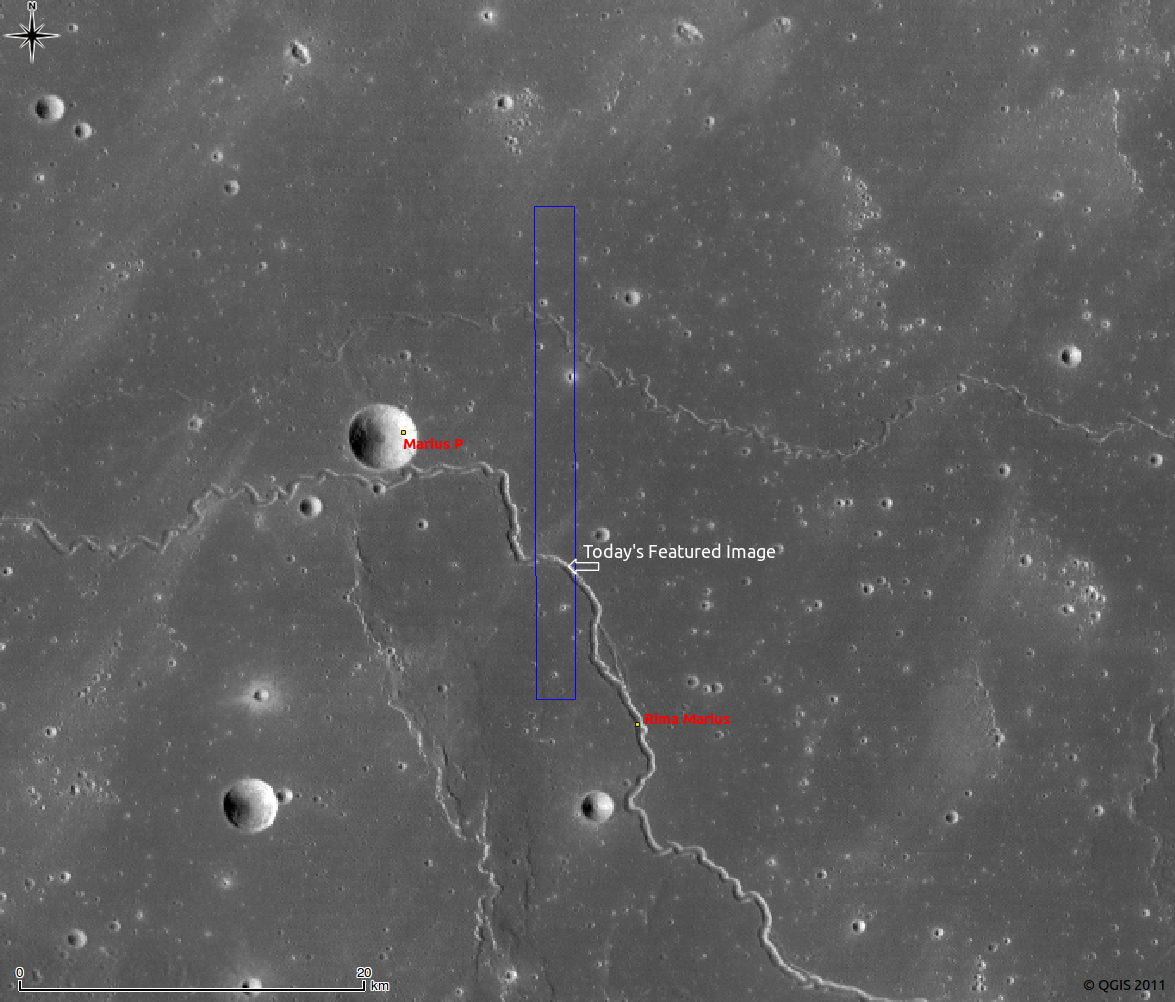
| LROC WAC context image of Marius A crater. The image is 59 km across and the rectangle indicates the area of the whole NAC frame from which the Featured Image is taken. View the full size and original LROC WAC context image HERE [NASA/GSFC/Arizona State University]. |
There are many craters with visible basalt layers and LROC has given us our first look at these incredible details of the lunar surface. Check out the NAC frame of Marius A and then explore the rest of the lunar maria!
Layering in Euler Crater
Lava Flows Exposed in Bessel Crater
New Views of Lunar Pits
 |
| Marius A in a wider oblique context view from a virtual point 254 kilometers over the bright landmark crater Kepler, showing some of the more famous landmarks also nearby. One of the wispy rays of material and reflective secondary craters, superimposed upon Marius A by the Kepler impact event crosses directly upon Marius A and beyond, a distance of 280 kilometers from crater center to crater center [NASA/LMMP/GSFC/ARC/ASU]. |