Showing posts with label Columbia. Show all posts
Friday, February 1, 2013
Monday, January 31, 2011
IAU names craters to honor Columbia crew
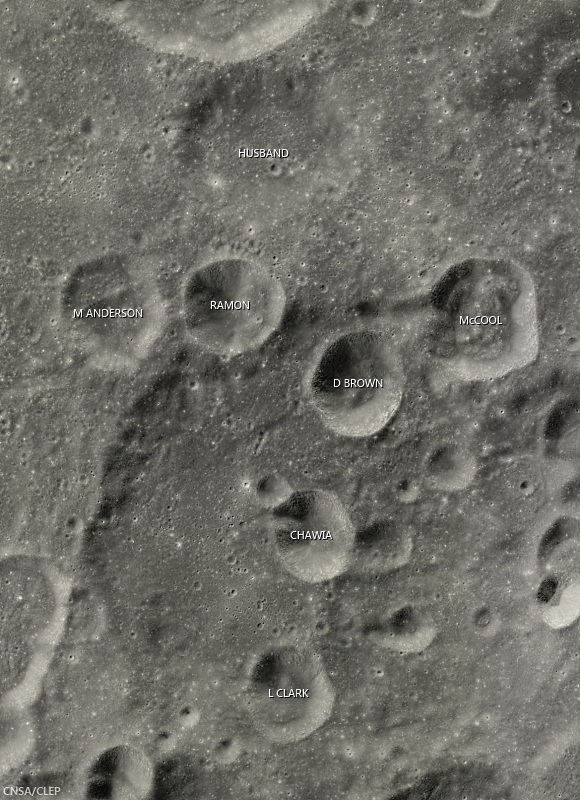
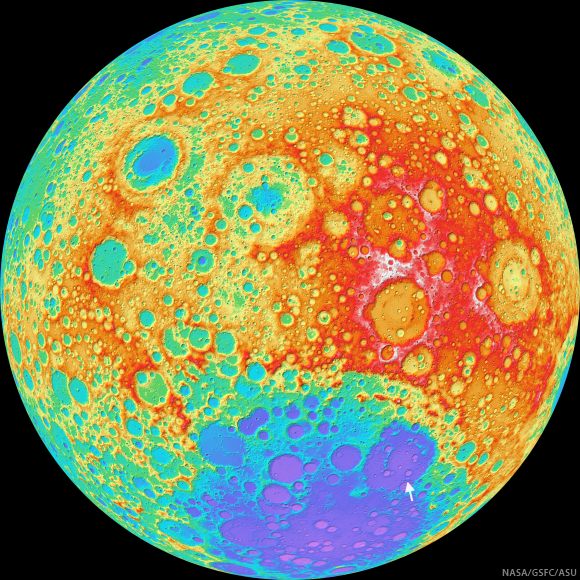
Keith Cowing, at the Lunar Orbiter Image Recovery Program (LOIRP) website "Moonviews" reports a crater grouping in Apollo basin (35.7°S, 208.0°E) has been provisionally designated by the International Astronomical Union to honor of each of the seven astronauts who died in the catastrophic failure of Space Shuttle Columbia February 1, 2003.
Sunday, February 14, 2010
The Vision Thing
July 20, 1989, National Air & Space Museum, Washington, DC - Celebration of the 20th Anniversary of Apollo 11 and chosen venue for then-President George H.W. Bush's announcement of a proposed Space Exploration Initiative. (Left to Right, Chair of the National Space Council Vice President Dan Quayle, President Bush, Dr. Neil Armstrong, Buzz Aldrin and Michael Collins, the crew of Apollo 11 [NASA Image 89-H-382].
Wayne Hale
NASA Blogs
George Herbert Walker Bush, the 41st President, calls Houston home. He and Barbara can be frequently seen at Astros baseball games, he made his early career in business here, was a congressman from here, even once taught a course as an adjunct professor at my alma mater, Rice University.
As you may recall, Mr. Bush failed in his re-election bid; there were a number of reasons for his loss, but one of the frequently cited reasons was “the vision thing”. The critics felt that he had not clearly articulated his vision for the future of the nation, which is a vital function that an effective chief executive must do. Keep that in mind.
On July 20, 1989 – the 20th anniversary of the first lunar landing – President G. H. W. Bush had made a speech proposing what would come to be known as the Space Exploration Initiative (SEI). This proposal included a permanent return to the Moon and human missions to Mars. In spite of the bold and visionary words, this initiative quickly failed.
Thor Hogan has written an excellent book on the history of the fiasco. His book is “Mars Wars, The Rise and Fall of the Space Exploration Initiative” NASA SP-2007-4410, August 2007. I highly recommend this book for those who are interested in how national space policy is made and how federal agencies can be dysfunctional at times. Dr. Hogan is a Professor of Political Science at the Illinois Institute of Technology in Chicago. Let me reiterate – I highly recommend this book if you are interested in these topics.
When “Mars Wars” was first published in 2007, it was widely circulated in NASA management and caused considerable discussion. Everyone was trying to make sure to avoid the mistakes made in 1989 and create a successful program. There are many lessons to be learned from that earlier experience, and Dr. Hogan hit many of them.
The most frequently cited lesson from SEI is the need to build a “sustainable” program. That is a shorthand way of saying stay within an affordable budget. One of the principle reasons the Space Exploration Initiative failed was its price tag. The SEI package was dead on arrival at Congress because of the high cost. Trying to apply this lesson, the NASA program of the last five years to send crews to the Moon and Mars strove mightily to remain within the budget line announced in 2004.
The notional Lunar Exploration Vehicle that arose from NASA's sketching out, in broad strokes, a frame work for the 1989 Space Exploration Initiative [Report of the 90-Day Study on Human Exploration of the Moon and Mars, November 1989].
But back to 1989, because there are other lessons to be learned there. That year I was a rookie Space Shuttle Flight Director, learning the ropes in Mission Control, and I had no time to be involved in SEI. But I was immersed in the NASA culture of the day and I remember that time with great clarity. Dr. Hogan’s “Mars Wars” book does a wonderful job of capturing the motivations of agency personnel in those days.
It was a bare three years following the Challenger accident and the wound was still raw. Challenger was a driving factor in the SEI story. Remember that widely held beliefs are important whether they are accurate or not. That is because what people believe to be true motivates them. So take the following paragraph not necessarily as historical truth but as the mythos which psychologically undergird folks running SEI.
NASA was not allowed to build the shuttle the “right” way, that is, to make both engineeringly elegant and safe. Lives were lost in Challenger due to basic design choices forced on the agency by severe budgetary restrictions. In the early 1970s, when NASA was authorized to design and build a revolutionary reusable winged space vehicle, the Office of Management and Budget capped the total development cost of the shuttle at $5 billion. (Money went further back then.) This cap was far too low to allow development of several of the more innovative design options. Fly back liquid fueled boosters were out of the question, for example. Operational costs were higher because of choices required to keep the development costs low. Safety was lower. So we got an aero-space plane with a big dumb drop tank and two scaled up JATO bottles.
Read Wayne Hales post, HERE.
Labels:
Challenger,
Columbia,
George H.W.Bush,
ISS,
SEI,
Space Shuttle,
VSE
Thursday, November 5, 2009
Preventing Columbia-Class disaster with photogrammetry and high-flying projectile ballistic analysis
Technology Review
arXiv Blog
When and if the Large Hadron Collider finally rumbles into action, it will produce a firehose of data like nothing physicists have ever seen. Ths data will consists if the tracks from the debris from roughly a billion collisions per second, as measured by particle detectors clustered around the collision sites.
That's far too much data to analyse in detail, so most of will be simply discarded using a simple filtering system that looks for trajectories of interest and stores them. That process should end up filtering roughly a hundred events per second for later detailed analysis. And all this must be done in real time, since any delay would rapidly overwhelm what buffering facility the accelerator has.
So what's all this got to do with the space shuttle? It turns out that a group of engineers at NASA want to use a similar mechanism to analyze the trajectory of debris around the space shuttle as it takes off. Their goal is to use the trajectory of these debris particles to work out their mass and density and also to trace their origin. With the right kind of analysis, it ought to be possible to flag up potentially damaging trajectories as they occur.
There's no need to to spell out why that's important, but here goes. In 2003, the impact of debris with the space shuttle Columbia during launch, so damaged the vehicle that it was unable to survive re-entry. A better analysis of that incident might have identified the extend of the damage and so prevented the loss of that shuttle.
Philip Metzger at the Kennedy Space Center and buddies have built the first stage of a filtering system that could do that job in real time using a pair of cameras that take high resolution of the launch from different angles. Together,this footage gives a 3D view of the launch allowing a computer to reconstruct the trajectory of any debris.That's not rocket science but, strangely, it has never been used to analyse launches.
Metzger and co have put their idea through its paces by analysing a piece of debris thrown up during the launch of STS-124, in May 2008. At the time, NASA engineers worried that this debris was a brick from a flame trench beneath the shuttle. A brick hitting the shuttle during launch could have caused significant damage.
The new technique, however, shows that the debris particle is low density foam, almost certainly from the solid rocket booster throat plug. This would have posed little threat to the shuttle.
Of course, coming to that conclusion, a year later is of little use to the shuttle crew who need to assess the conditioning of their vehicle almost immediately and certainly before they embark on re-entry.
That's where the LHC-like filtering mechanism comes in. Metzger at al say the data is easy to collect using their two cameras but the trouble is combing through it for interesting and useful insights. An LHC-like filtering system would simply comb through it during the launch and filter out only those debris tracks that are dense and massive enough to pose a threat.
That could save lives and although the Shuttle is due to be retired by this time next year, the process could easily be applied to future rocket launches anywhere round the world.
Ref: arxiv.org/abs/0910.4357: Photogrammetry and Ballistic Analysis of a High-Flying Projectile in the STS-124 Space Shuttle Launch
Thursday, May 21, 2009
Mike M carries friendship token on STS-125
Kathryn BaronVOA
Mike Massimino carries with him on STS-125 a replica of the mezuzah carried by astronaut Ilan Ramon, who died on-board Columbia February 1, 2003.
"It's fairly small," Massimino says, "and it's got the Star of David on it, and it's got the barbed wire that represents the concentration camps, around it."
Ramon's parents were survivors of the Nazi Holocaust. He and Mike Massimino had become close friends during their early training days at NASA.
Monday, April 27, 2009
Shuttle's past: Time is not on its side
John Kelly
Florida Today
Florida Today
The two dates seem arbitrary because they are. They may seem unrelated, but they're not.
Sept. 30, 2010, is technically the deadline for finishing the last shuttle mission and retiring the fleet.
Feb. 19, 2004, was the deadline for finishing the construction of the International Space Station. But that was before Columbia.
Under intense pressure to keep space station assembly on schedule and within budget, managers harped on that date to the point of installing screensavers on workers' computers counting down the seconds. The message: hurry up, time is running out on your program.
Then, we lost the Columbia astronauts. Investigators blamed the accident in part on schedule pressure, saying it drove people to make bad tradeoffs favoring on-time flights over safety. They wrote, "Most of the shuttle program's concern about Columbia's foam strike were not about the threat it might pose to the vehicle in orbit, but about the threat it might pose to the schedule."
Fast forward to 2009. NASA's shuttle program is again working against the clock. I think managers, engineers and front-line shuttle workers learned the agonizing lessons of Columbia and will not repeat those mistakes on purpose. But, the influence of schedule pressure can be subtle.
In a business demanding perfection, it's the little unnoticed decisions that can add up to a catastrophe. Subtle pressure is there in the form of the 2010 deadline. NASA needs to complete nine more flights to complete the shuttle's mission, which is to finish building and outfitting a space station that can stay in orbit a decade or so.
That's as many as nine missions in about 19 months, or almost six launches per year. Since the return to flight, NASA has flown about three times a year. Even that has required nearly flawless preparation by crews at Kennedy Space Center and some (recent) good luck with the weather.
Nothing is impossible, but flying shuttles every other month or so is as close as it gets. With three orbiters left, stricter safety rules and slim budgets, flying these last missions is going to be difficult enough without the tick-tock of the clock booming in the background. Making matters worse: an exodus of talented people fleeing for more secure jobs.
Sunday, January 25, 2009
At the cost of the lives of seventeen extraordinarily brave and courageous astronauts
Alamogordo Daily NewsBy Michael Shinabery
New Mexico Museum of Space History
The tragedies that killed three Apollo astronauts and two space shuttle crews have anniversaries during less than one week's time: Apollo 1 on Jan. 27, 1967; Challenger on Jan. 28, 1986; and Columbia on Feb. 1, 2003.
Apollo 1
Commander Gus Grissom, Ed White and Roger Chaffee were 5 1/2 hours into a simulated countdown at the Kennedy Space Center when White cried, "Fire!"
Chafee shouted, "We're burning up."
In the oxygen-saturated cabin 218 feet in the air atop the Saturn IB rocket at Pad 34, White's hand was seen trying to blow the hatch.
"If Ed couldn't get that hatch off, no one could," Robert Zimmerman quotes astronaut Frank Borman in "Genesis" (Four Walls Eight Windows/1998).
Astronauts and their loved ones were in shock.
"Test pilots died while in the air, which was what all the astronauts and their families braced themselves for. No one at NASA had prepared them for an accident on the ground," Zimmerman wrote.
In "Moon Shot" (Turner Publishing/1994), Alan Shepard and Deke Slayton attributed a chafed wire underneath Grissom's seat as sparking the inferno. Newsweek (Feb. 6, 1967) reported: "With a great whoosh, like the sound of an oven being lit, the pure O2 in the cabin made every combustible item in the ship burn with super intensity. At the same time, no O2 was left to breathe."
"The three astronauts were trapped in their melted suit material, fused with the charred nylon from the inside of the spacecraft," Buzz Aldrin and Malcolm McConnell wrote in "Men From Earth" (Bantam/1989). To remove the hatch, the Web site, www.nasa.gov, states five men struggled in thick smoke, "each forced to make several trips in order to reach breathable air."
Borman, a member of the investigating team, listened to the tape of his friends' screams and crawled into what he called the "fire-blackened charnel house," Zimmerman said. "Borman felt himself getting increasingly angry. Everywhere he and the rest of the investigation committee looked, they found sloppy workmanship by both the contractor and by NASA. Borman decided that he was going to do whatever it took to make sure the Apollo spacecraft flew again. And when it did, it would be the safest spacecraft ever built."
As a result, NASA abandoned the oxygen-rich atmosphere and, Zimmerman cited, "more than 2,500 different items were removed, replaced with nonflammable materials." Engineers redesigned the hatch to open in 10 seconds. The old hatch, according to Zimmerman, took 90 seconds to remove and involved "laboriously unscrewing some lug nuts."
Borman, in his book "Countdown," (Silver Arrow Books/1988), described each NASA staff member who suffered depression, guilt or a breakdown as a "victim of Pad 34."
One man during a meeting suddenly drew an organizational chart of Heaven on a blackboard.
He flew home in a straitjacket. A "NASA official drove onto a Houston expressway and raced his car at speeds of more than 100 mph until the engine caught fire," Borman wrote. "He explained later that he'd seen a metaphysical connection between the pad fire and the one that destroyed his automobile."
The final "victim," Borman said, was White's wife. She "committed suicide" in 1984.
Labels:
Apollo 1,
Apollo History,
Challenger,
Columbia
Subscribe to:
Posts (Atom)