Saturday, April 12, 2008

More than the Moon

December 1972: Gene Cernan, the last man to set foot on the moon, back inside the Apollo 17 Lunar Module after that last EVA - NASA image by Senator Harrison Schmidt

Washington Times April 11: Editorial by Eric Sterner - When he left his footprints at the edge of the Sea of Serenity in 1972, Gene Cernan became the last man on the moon. By the time he departed, spending on the civil space program had already peaked for a simple reason. In 1969 the United States won the space race, demonstrating the American commitment to peaceful exploration of space and the technological superiority of its political and economic system.

America's civil space program has always served a broad international agenda. The Apollo-Soyuz linkup of 1975 had more to do with détente than the exploration and development of space. Russia's successes in orbiting space stations created a perception that they "owned" low earth orbit, leading President Reagan to launch a U.S. station program, inviting allied democracies to join. Again, the civil space program would contrast freedom and tyranny, capitalism and communism.

Ironically, human spaceflight's international visibility probably saved it from near extinction when the Clinton administration invited Russia to join the station program, symbolizing Russia's emergence as a democracy. More practically, it enabled the administration to provide significant indirect aid to the Russian aerospace industry in the hope of turning it away from proliferation activities.

This year, during its 50th anniversary, the space program finds itself at a crossroads. In 2004, President Bush announced a plan to return Americans to the moon and send them to Mars. The vision has since been codified in statute and reinforced through national policy, but finds itself under-funded, over-constrained, and subjected to programmatic second-guessing. The presidential campaigns viewed it through the lens of job impacts in key electoral states. Nevertheless, due to its international visibility, the space program is intimately tied to the reality and perceptions of America's global leadership. To ignore this and focus merely on the programs, or parochially on the jobs, is to underestimate the importance of space exploration.

The space program has long contributed to the development of new technologies and created opportunities for scientific research. President Bush's science advisor noted that "the technology development necessary to carry out this vision will accelerate advances in robotics, autonomous and fault tolerant systems, human-machine interface, materials, life support systems, and spur novel applications of nanotechnology and micro-devices." More generally, a reinvigorated space program stimulates professional education in science, technology, engineering, and mathematics — critical to the long-term competitiveness and national security of the United States. Returning to the moon will replace the retiring generation of scientists and engineers inspired by Apollo. The nature of science and technology mean that those benefits eventually make their way to everyone on Earth, but they accrue primarily to the states creating and deploying the technologies. Thus, the United States has a practical interest in international leadership.

Unlike Apollo, which wore the label "made in the USA," the new space exploration program is designed to accommodate and welcome international participation. By inviting other states to join it, the United States demonstrates a commitment to their progress and well-being. It encourages them to commit their resources to peaceful scientific and technological activity and demonstrates the positive value of following America's lead. It can do so in a framework that will also transmit U.S. values, including respect for the rationality, transparency, and openness that successful scientific and technical cooperation demands. Finally, successful execution can build confidence in American leadership. In short, the high visibility of returning to the moon offers an opportunity to build the kind of "soft-power" that serves America's long-term national interests.

The reverse is also true. Having made the commitment, laid out a plan, and started to develop capabilities, changes in direction can only send a message of American inconstancy. Procrastination, especially for short-term budget considerations, can only undermine faith in American leadership and priority setting. Failure to execute can only send a message of incompetence.

Amidst the turmoil of the 1960s and 1970s, planting the flag on the moon reminded the world that the United States possessed a depth of spirit, wealth, ingenuity, and technical prowess that made it a leader still worth following. In 1972, Gene Cernan proclaimed, "we leave as we came, and God willing, as we shall return, with peace and hope for all mankind. As I take these last steps from the surface for some time to come, I'd just like to record that America's challenge of today has forged man's destiny of tomorrow." Today, many ask whether those words are still true. Returning will prove them so.

Eric R. Sterner held senior staff positions on the House Armed Services and Science Committees and served in the office of the secretary of defense and as associate deputy administrator for policy and planning at NASA.

MarsDrive-Moon Society collaborate

"Recently the Moon Society and MarsDrive started a new project to collaborate with each other more and this started with the "Railroading On The Moon and Mars" project. Transportation on these new worlds could greatly accelerate the process of human settlement so if you have a passion for trains or future transportation systems feel free to join the Moon Society and MarsDrive in this project. MarsDrive agrees with The Moon Society when they say- " An organization that is much smaller than its goals and ambitions can magnify and accelerate its effectiveness by collaborating with other organizations on issues and goals that they share in common."

"MarsDrive calls again on all space organizations to more effectively join together so that we can better achieve our goals no matter how diverse they are because while we differ on specifics and locations, we remain a relatively small interest group when compared to the larger "causes" today such as community charities and environmental groups."

Read more HERE.

'Apollo 13' History becomes legend

Vanja Deželić Javno

This Day in History:

Only 9 months after Neil Armstrong and Buzz Aldrin stepped on the Moon`s surface, giving the United States of America their first space triumph over Russia, it was decided that Apollo 13 expedition is to head for the Moon.

The crew members were: Jim Lovell, Fred Haise and Jack Swigert and they were launched for the Fra Mauro Lunar crater on April 11 from Cape Kennedy, Florida.

Their space flight became most famous for the tragedy which followed. The problems began at 320,000 km away from Earth, as Apollo 13 started coming closer to the Moon`s trajectory.

Houston, we`ve had a problem!

Okay, Houston, we've had a problem here! – Swigert said as an oxygen tank exploded and gas started leaking out. His sentence remained history and is used today when we want to tell someone about an event that has happened or is happening.

Read more HERE.

Friday, April 11, 2008

Only a month late, MSNBC finds negative in LPSC

It's a good thing many of us interested in last month's annual Lunar and Planetary Science Conference in League City, sponsored by the NASA's Lunar and Planetary Institute, didn't wait for MSNBC to report in on the happenings there.

If, as most people are, we were depending on this news source instead of Pam Stryder or the Bad Astronomer, we might have concluded things were pretty grim in the Lunar Sciences. Do you find yourself wondering whether the News-Readers at this feeble "network" will report on JAXA's new laser altimeter map?

Feeling 'Fully Dissipated?'


Lunar science community needs rebuilding

Researchers say return to moon will require new cadre of specialists

GOLDEN - NASA's plan to return to the moon — first by robotic missions scheduled to start this year, followed by the replanting of human footprints there by 2020 — will require a new cadre of lunar research and exploration specialists.

That talent largely was dissipated after the Apollo lunar landing program ended in 1972. As a result, several steps need to be taken to recuperate both the scientific and technical expertise that will be needed to investigate and understand the moon.

And scientists are enthusiastic about the prospect. Many of those who attended the recent Lunar and Planetary Science Conference March 10-14 in League City, Texas, said Earth's closest celestial neighbor is far from being a "been there, done that world" that offers no unknowns worth solving. And several sessions dedicated to lunar science clearly showed a rebound of interest in the moon.
Read the rest HERE.

Trip of a lifetime for space fan

The Ledbury Reporter: "Space fan from Worcester visits NASA;" Some are satisfied merely with a glimpse.

A SPACE fan will be taking one giant leap when he travels to the USA to carry out research on lunar landings.

David Cotterill, who lives in Ledbury and is the head of design and technology at the RGS Worcester and The Alice Ottley School (RGSAO) will spend five weeks Stateside in June after successfully applying for funding from the Winston Churchill Travelling Fellowship Chance of a Lifetime awards.

His research into the human and engineering perspective of lunar landings will first take him to the Cradle of Aviation museum in New York, then the Smithsonian museum in Washington, the Kennedy Space Centre in Florida, and the Manned Spaceflight Centre in Houston.

He had originally hoped to shadow staff at NASA, but had to change his plans after they were inundated with similar requests.

Mr Cotterill, 51, said it was the trip of a lifetime.

"Since I was a child I have had an interest in the space industry. As a design and technology teacher I have become interested in the engineering aspects of space flight," he said. "I aim to produce some educational material for use in secondary schools and to produce a number of articles to be featured in magazines for schools."

Wonder why they didn't mention GCR's?

Lunar surface charging and electric fields caused by sunlight and solar wind. Credit: Jasper Halekas and Greg Delory of U.C. Berkeley, and Bill Farrell and Tim Stubbs of the Goddard Space Flight Center. [Larger image]

NASA Moondust is dry, desiccated stuff, and may seem like a dull topic to write about. Indeed, you could search a ton of moondust without finding a single molecule of water, so it could make for a pretty "dry" story. But like the dust in your mother's attic, moondust covers something interesting – the moon – and even the dust itself has curious tales to tell.

A group of NASA and University of Alabama researchers are what you might call "active listeners": Mian Abbas, James Spann, Richard Hoover and Dragana Tankosic have been shooting moondust with electrons, levitating moondust using electric fields, and scrutinizing moondust under an electron microscope. All this is happening at the National Space Science and Technology Center's "Dusty Plasma Lab" in Huntsville,

"Moondust was a real nuisance for Apollo astronauts," adds Abbas. "It stuck to everything – spacesuits, equipment, instruments." The sharp-edged grains scratched faceplates, clogged joints, blackened surfaces and made dials all but unreadable. "The troublesome clinginess had a lot to do with moondust's electrostatic charge."

Dust on the moon is electrified, at least in part, by exposure to the solar wind. Earth is protected from the solar wind by our planet's magnetic field, but the moon has no global magnetic field to ward off charged particles from the sun. Free electrons in the solar wind interact with grains of moondust and, in effect, "charge them up."

Read more HERE.

Meanwhile, GenCorp's Aerojet gets contract from NASA Glenn to continue beyond RCS with low-weight methane

SACRAMENTO Aerojet, a GenCorp Inc. company, announced a contract award today from NASA Glenn Research Center for the development of a 5,500lb thrust Liquid Oxygen-Liquid Methane engine.

NASA's Altair lunar lander program and the NASA Exploration Technology Development Program have partnered to create the NASA Propulsion Cryogenic Advanced Development project to support methane technology maturation and advancement. The project is managed jointly by NASA Glenn Research Center in Cleveland, NASA Marshall in Huntsville and Johnson Space Center in Houston.

The time sensitive engine development effort will provide the NASA Altair lunar lander program with validated methane engine performance and technology risk reduction data prior to the Altair propulsion System Requirements and Preliminary Design Reviews. The objective of the new contract is to design, fabricate and begin testing an Aerojet 5,500lb thrust methane engine by January 2009 to support the data needs of the Altair SRR.

The NASA Exploration Systems Architecture Studies along with other NASA study activities, has identified Liquid Oxygen-Liquid Methane propulsion systems as a promising option for future space vehicles. These systems create the potential for substantial savings in overall systems mass when compared to conventional hypergolic systems.

"Aerojet is well positioned to accomplish this rapid development effort because of our research and development investments in Liquid Oxygen-Liquid Methane and other green propellant technologies," said Julie Van Kleeck, Aerojet's vice president of Space Systems.

The new contract will extend Aerojet's Liquid Oxygen-Liquid Methane development expertise beyond the 100lbf RCS contract already delivered to White Sands Test Facility for altitude testing.

The 100lbf engine program, which has been highly successful in RCS development, can operate on Liquid Oxygen-Liquid Methane rather than hydrazine, and it has demonstrated very fast pulsing capability in a flight prototype. This technology development activity will provide NASA with timely methane ascent main engine technology data to support its system design studies and decision making.

SOURCE Aerojet - 04/10/200

CECE by Pratt & Whitney: NASA awards contract extension

"Pratt & Whitney Rocketdyne is pleased that NASA has continued development of the CECE," said Graham Webb, general manager, Pratt & Whitney Rocketdyne Florida & Mississippi operations. "We look forward to competing to power the first lunar landing of the 21st Century."

In a flurry of contract awards, with more to follow, NASA granted the contract extension on CECE, or Common Extensible Cryogenic Engine, as expected Thursday.

The CECE development contract, originally awarded in June 2005, extends now through March 2009.

During this next phase of the program, Pratt & Whitney Rocketdyne will design, manufacture and test a new, enhanced injector to support stable combustion at very low thrust.

"In tests to date, the CECE has made significant progress to meet the mission," said Victor Giuliano, Pratt & Whitney Rocketdyne CECE program manager. "Test highlights included the CECE demonstrating repeated throttling operability from 100 percent of its 13,800 pounds of thrust down to as low as 9.5 percent of full power. Additionally, the engine has demonstrated throttle acceleration and deceleration transient capabilities. The next phase of testing will focus on combustion stability at the lower thrust range."

A throttling range from full power down to 10-25 percent is believed to be sufficient for human-rated spacecraft landing on the moon. Deep throttling, or a wide variation of thrust, enables a vehicle to maintain adequate thrust during in-space travel, yet have a controlled descent at its final destination. Fast-reaction throttling transients will be necessary to smoothly descend to the lunar surface.
  Bryan Kidder
Pratt & Whitney Rocketdyne
818 586-2213
bryan.kidder@pwr.utc.com

Nancy Colaguori
Pratt & Whitney Rocketdyne
561 796-2219
nancy.colaguori@pw.utc.com
Pratt & Whitney Rocketdyne

Thursday, April 10, 2008

More on the JAXA Moon Map

By Kazuki Shiibashi/Aerospace Daily & Defense Report

The Japanese SELenological and ENgineering Explorer (Selene) team revealed its first preview of the world's first-ever global topographic map of the moon April 9.

The preview map includes two weeks of data taken by the Laser Altimeter (LALT) instrument, which was then analyzed by the National Astronomical Observatory of Japan (NAOJ) and processed into map form by the Japanese Geographical Survey Institute (GSI).

The map already contains 1,127,392 point measurements of the lunar surface, which dwarfs similar past maps of the moon, such as the one compiled by United States Geological Survey's 'Unified Lunar Control Network 2005,' which used 272,931 points.

Selene scientists say they had already collected more than 6 million measurements by the end of last month (since the beginning of the mission) and expect more than 30 million points to be obtained within in one full year of observation. Topography data is essential for the mission as they need to be combined with other instrument data - e.g. in conjunction with the gravity field measurements to reveal details of the lunar crust.

Links to the map can be found at http://www.jaxa.jp/press/2008/04/20080409_kaguya_j.html.

Support you local LPOD

Watching history in the Making...

Most of us Groundpounders have been privileged to witness knowledge being compiled and redocumented in Real Time in the realm of space exploration. By contrast, more than one millennium had to pass before Ptolemy's tidy model finally shattered under accumulated observation of planetary movements. Whereas today, cosmological Grand Theories seem to rise and fall with Earth's rotation. It's not correct, any longer, to say 'rarely do we see a day,' when we see such dramatic data arrive from probes circling two different worlds that boggle not just the mind or the mathematics, but the eye.

To take nothing away from the spectacular, truly breathtaking photographs of Mar's moon Phobos coming from HiRISE, JPL and the University of Arizona released yesterday, this site tries to limit our scope to Earth's Moon, and the things happening that get us from here to there, and Lunar Science, or Selenology. That, in itself, is like sipping water from a fire hose. We're likely as not to be driven to, well... lunacy, quite soon, if that scope is not narrowed still further.

In following that mission, however, few things can grab our attention faster than the delivery of more than just the promise of things to come from the newest generation of lunar orbiters, in this case JAXA, the Japanese Space Agency, has just released the results of the first two weeks of data from the laser altimeter experiment on-board the lunar orbiting Kaguya (Selene) platform.

LPOD, and the Moonipedia are busy correcting one another's work trying to arrive at that impossible consensus on what best describes the significant improvements suddenly available over data on lunar topography discovered by Clementine in 1999. You can watch history in the making, as the history book is scratched out and re-written literally before your eyes.

The long time when many of us had to satisfy ourselves with the Lunar Orbiter images, now forty years old. Long before the thirteenth human to walk on the moon arrives, Dr. Jack Schmidt assures us, we may feel we have been there.

Space Foundation Reveals $251 Billion Global Space Economy in 2007

11 percent growth in one year

COLORADO SPRINGS - The Space Report 2008: The Authoritative Guide to Global Space Activity, released by the Space Foundation today, revealed more than $251 billion in global space activity in 2007. The Space Report 2008 is a publication that thoroughly examines and analyzes the state of the space industry. The flagship product of the Space Foundation's Research and Analysis division, The Space Report 2008 covers primarily 2007 data, contains information on global space budgets and revenues, a yearly summary and analysis of the Space Foundation Index, and, for the first time, addresses United States (U.S.) labor and workforce issues. Total global space industry budgets and revenues reached $251.16 billion in 2007, representing a single-year increase of 11 percent from 2006.

"We are pleased to announce that since the original publication of The Space Report 2006, the global space economy has grown significantly, with double-digit increases each year," said Space Foundation President and Chief Executive Officer Elliot G. Pulham. "It is an exciting time to be part of the space industry. The Space Report 2008 and the Space Foundation Index clearly illustrate that, in a business climate full of uncertainty and cutbacks, all sectors of space continue to grow and provide value to the global economy." For the first time, The Space Report 2008, in a thorough and objective manner, looks at the role of space jobs within the overall United States workforce. Using the most recent statistics available from the federal government, The Space Report 2008 shows that U.S. space industry employment is growing and that the average annual wage within the industry is more than double the broader private sector average wage. In 2006, U.S. space industry workers were paid an average annual wage of $88,200 versus $42,400 for average private sector employees.

The Space Report 2008 also reveals that satellite-based products and services and U.S. government spending on space again comprise the two largest segments of the space industry at 55 percent and 25 percent of total revenues, respectively. Direct-to-home television and Global Positioning System equipment and chipsets, the two largest sub-segments of the commercial space industry, also posted the strongest growth numbers in 2007, with 19 percent and 20 percent increases, respectively.

The original edition, The Space Report 2006, looked at the global space industry in its entirety for the first time and established a value for the industry in terms of budgets and revenues, as well as creating a market index for space. "As we learn more about the evolving global space industry," said Pulham, "the Space Foundation is committed to providing the most comprehensive, transparent, and accurate assessment of the impact of established and emerging space markets on our daily lives and financial markets."

A key component of The Space Report 2008 is the Space Foundation Index. Now in its third year, the Space Foundation Index is a weighted index that tracks the market performance of 31 public companies that derive a significant portion of their revenue from space-related assets and activities. From its inception in June 2005, through December 2007, the Space Foundation Index increased by more than 29 percent, on pace with the NASDAQ Composite Index and outpacing the S&P 500 Index.

The early April release of The Space Report 2008 contains data for calendar year 2007, and will provide timely and useful information throughout the calendar year. For more information, or to purchase a copy of The Space Report 2008: The Authoritative Guide to Global Space Activity, visit www.TheSpaceReport.org.

About the Space Foundation

Founded in 1983 and celebrating its 25th anniversary this year, the Space Foundation is an international nonprofit organization advancing space-related endeavors to inspire, enable, and propel humanity. A leader in space awareness activities, major industry events, and educational enterprises that bring space into the classroom, the Space Foundation is headquartered in Colorado Springs, Colo. It conducts research and analysis and government affairs activities from its Washington, D.C., office, and has field representatives in Houston and Cape Canaveral, Fla. The Space Foundation conducts the premier annual gathering of the global space community, in Colorado Springs. The Space Foundation will also conduct the inaugural Space Business Forum: New York, on June 18, in New York City, and along with partnering organizations, Strategic Space and Defense 2008, scheduled 6-8 October in Omaha, Neb.

For more information, visit www.SpaceFoundation.org.

Small LADEE will skim for lunar dust in September 2011

As secondary payload with GRAIL, LADEE will join a short-lived flotilla of Discovery satellites sampling the tenuous sodium-ion atmosphere of Earth's Moon and help solve the mysteries of the Mascons

NASA is preparing to send a small spacecraft to the moon in 2011 to assess the lunar atmosphere and the nature of dust lofted above the surface.

Called the Lunar Atmosphere and Dust Environment Explorer (LADEE), the mission will launch before the agency's moon exploration activities accelerate during the next decade. LADEE will gather detailed information about conditions near the surface and environmental influences on lunar dust. A thorough understanding of these influences will help researchers understand how future exploration may shape the lunar environment and how the environment may affect future explorers.

"LADEE represents a low-cost approach to science missions, enabling faster science return and more frequent missions," said Ames Director S. Pete Worden. "These measurements will provide scientific insight into the lunar environment, and give our explorers a clearer understanding of what they'll be up against as they set up the first outpost and begin the process of settling the solar system."

LADEE is a cooperative effort with NASA's Ames Research Center at Moffett Field, Calif., Goddard Space Flight Center in Greenbelt, Md., and Marshall Space Flight Center in Huntsville, Ala. The total cost of the spacecraft is expected to be approximately $80 million.

Ames will manage the mission, build the spacecraft and perform mission operations. Goddard will perform environmental testing and launch vehicle integration. The mission will be established within Marshall's newly created Lunar Science Program Office. Marshall will draw upon experience gained from managing a larger suite of low-cost, small satellite missions through NASA's Discovery and New Frontiers Program.

LADEE will fly to the moon as a secondary payload on the Discovery mission called Gravity Recovery and Interior Laboratory (GRAIL), which is designed to take ultra-precise gravity field measurements of the moon. Current plans call for the GRAIL and LADEE spacecraft to launch together on a Delta II rocket and separate after they are on a lunar trajectory. LADEE will take approximately four months to travel to the moon, then undergo a month-long checkout phase and begin 100 days of science operations.

LADEE is one of many activities to support lunar exploration planned by NASA's Science Mission Directorate in Washington. Last year, NASA also established a lunar science institute at Ames. Research teams will address current topics in basic lunar science and possible astronomical, solar and Earth science investigations that could be performed from the moon. In addition, NASA is preparing for scientific investigations following the planned launch later this year of the Lunar Reconnaissance Orbiter (LRO). After a 30-year hiatus, LRO represents NASA's first step toward returning humans to the moon.

No Retreat from Tomorrow

Without question, the best commentary inspiring of perspective, meditation, and sound thought on present day space exploration is The Space Review. It makes no claim of being the repository of the best archives or science, but what it does provide is didactic in the form of good writing and timely, well-informed commentary. It is always difficult to recommend which article of the week needs to be read first. But for entertainment's sake, I turned first today to They were warned, by Taylor Dinerman.

Mr. Dinerman's piece reminded me that Congress was not the only group to be warned, over and over, of the inevitable end of the Space Shuttle, and "The Gap" looming ahead for workers at KSC and JSC particularly. The rest of us were warned, also. And ultimately, Congress derives its power from you and me. We, too, were warned, and the fate of NASA's worker and plant investments are ultimately our responsibility, and not only the responsibility of the next president or, more importantly, the Congress.

One rare example of representative government being successful at long-term planning was the Apollo program, and it's sustained, persistent and ultimately successful manned lunar landings.

Political Will (without which, nothing is ever accomplished) combined with the Cold War's "battle for men's minds" and kept real funding for NASA's missions going steady through an escalating and expensive Vietnam War and a general social upheaval not seen since before Appomattox, rivaling Depression and World War, through three presidential administrations from 1961 until 1972.

It is astounding this funding was sustained from the 86th Congress through the 92nd, through six congressional elections.

Those of us experienced with this sorts of things often say your average legislator "has the attention span of a circus monkey."

It was not always this way, but in modern times, as you might expect of what is still the most productive nation on Earth, Congress has "a lot on its plate," and, for good or ill, they are required to be extraordinary people (or must surround themselves with extraordinary people) just to keep their reception schedule straight.

Congress costs us more than a billion dollars per year to operate, prioritizing new and more clever ways to define their generosity by its prior claim on our paychecks.

So, as cringing as it has been to hear the cries of outrage from Florida's impacted federal representatives over the arrival, at long last, of a long-overdue end to the experimental platform called the Space Shuttle, it is understandable.

Not because it plays well at home. The folks back home, especially those impacted by the loss of real jobs, their own jobs, ahead, with the $500 million retirement of Atlantis, Discovery and Endeavour, have seen it coming for a long time.

As hard as it might be to believe, the outrage and squeals you've been hearing from the Florida delegation in Washington reflects genuine surprise, or at very least a purposeful tone of rhetoric those using it hope will arouse their colleagues and boost the signal over the unprecedented noise level to be heard in the marketplace.

NASA is a creature of Congress, after all. For the rightful credit given John Kennedy for Apollo, Lyndon Johnson was more influential in his desire not to "sleep by the light of a communist moon" when he lead the U.S. Senate in 1957 that gave birth to NASA fifty years ago. He was the reason the Vice President, serving in that role under President Kennedy, is still chairman of the National Space Council (and why Dan Quayle, in that same role sixteen years after Johnson's death, prevailed upon NASA to restore the traditional blue "meatball" as its logo, setting aside the "snake" of the 1980's).

Lyndon Johnson was the most successful president in history in getting his agenda passed in Congress, even if his Civil Rights initiative required Republican votes to win out over the opposition of southern Democrats. Mercury, Gemini and through the Apollo 1 fire in January 1967, in 1968, less than a month before he left office, the crew of Apoll0 8 became the first men to leave Earth orbit and return from the Moon.

I credit President Johnson not to raise sympathy for an admittedly enigmatic historic figure or to claim this friend of my father was misunderstood or his historic role under-appreciated, though with regard to Apollo, it clearly was and is.

I'm as ambivalent toward this man as the next guy.

My point is to cast light on an often hidden reality about the exercise of real political power, the kind that escalates an increasingly unpopular war, declares another "unconditional war on poverty," and shepherds Civil Rights legislation, bill after bill, through an increasingly hostile Congress.

Ronald Reagan understood the principle, having on his desk the engraved words, "Anyone can get anything done if they don't care who gets the credit."

Ronald Reagan was a product of Labor and Hollywood, however. Lyndon Johnson was a creature of Congress, like NASA, and he never really quit being the Senate's majority leader until he left Washington physically and politically exhausted and handed it all over to the neo-socialist anti-communist and equally complex Richard Nixon in January 1969.

In the "vesting clause" of the U.S. Constitution, we read, "All legislative Powers herein granted shall be vested in a Congress of the United States..."

For all the concern united in the election of the American President, it is just a president, after all, that will also be elected this year, along with the next Congress, where all the money and power originates. Divided as it is among 538 accidents and Alphas, both men and women, it is the embodiment of the apparent chaos of representative government.

"Find a better country," as they say. (Good luck with that.)

When decisions are made about "ramping up" or eliminating Constellation after the election in November, it will not be an expression of the charisma of the next president. The decision will be made by the lumbering sausage factory on Jenkins Hill in the Potomac swamp.

No building inside the limits of the District of Columbia can be built higher than the U.S. Capitol Dome for a reason. That's where decisions are made about what should actually be done, and how, with that prior claim on your wages.

Rather than ask Senators Obama, Clinton or McCain their positions on Constellation or COTS or the very real threat of regulation of NewSpace when you exercise the responsibility of casting your federal ballot, it might be a better idea to know what your congressional representatives plan to do when the 111th Congress convenes next January.

Better still, why not clue them in on what you want them to do.

Wednesday, April 9, 2008

Minton wins 2008 Kuiper Memorial Award

Science Centric

David A. Minton, a third-year planetary sciences graduate student, will receive the 2008 Kuiper Memorial Award. The award is presented to University of Arizona students in the field of planetary sciences who have excelled in academic work and research.

'David is smart, enthusiastic, imaginative and hard working,' planetary sciences professor Renu Malhotra, Minton's graduate adviser, said. 'He has a genuine enthusiasm for planetary science, has strong technical skills and plunges into research projects with great energy.'

Minton enrolled in the UA's planetary sciences department in 2005, after graduate work at the University of Maryland and earning a degree in aerospace engineering at North Carolina State University. At North Carolina State, Minton led teams that designed a wind-powered Mars rover called Tumbleweed and a Mars climate orbiter with deployable balloons.

Minton is currently publishing an innovative analysis of small planetary bodies that resemble 'sand piles.' This work, which is a generalization of centuries-old mathematical theories, may provide an explanation for the 'flying saucer' appearance of objects like two of Saturn's satellites, Atlas and Pan.

Minton's paper will appear in the international planetary science journal Icarus.

Read more HERE.

Astrium to acquire SSTL

Space Ventures
Europe's largest satellite manufacturer has announced an agreement to purchase a majority stake in the continent's leading developer of smallsats. EADS Astrium will acquire 80 percent of Surrey Satellite Technology Ltd. (SSTL) for an estimated £40-50 million (US$80-100 million), the companies reported Monday. Astrium is best known as a manufacturer of large government and commercial satellites, including GEO communications satellites. SSTL, by contrast, builds small satellites weighing no more than a few hundred kilograms. SSTL was spun out of the University of Surrey in the UK, and it is university that is cashing out its stake in the company. SSTL will remain a separate operating entity with with access to the greater resources of Astrium. The deal is subject to regulatory approvals.

Tuesday, April 8, 2008

Colony Worlds: Video: Did Benson Space Go Kaputt?

Colony Worlds: Video: Did Benson Space Go Kaputt?

Boston's iSHOE wins Lunar Ventures Eighth Continent Business Plan Competition

On March 30, Lunar Venture's 8th Continent Blog featured a posting critical of the Denver Post for lumping NewSpace organizations with political player powerhouses in being "busy behind the scenes" lobbying presidential candidates to support NASA after the November elections in the United States.

This morning, the Post's dBusinessNews features a press release announcing the Colorado Springs-based Lunar Ventures had awarded Boston's iSHOE had won their Second Annual $50,000 prize for younger NewSpace teams. It's the local Power Daily newspaper, anyway, so what can anyone say but, "down one day, up the next."

Even so, iSHOE faces immediate problems with Apple and Nike, two OldInnerSpace giants for branding rights to the name "iSHOE." Both multi-nationals joined recently to create a designer sneaker than might actually be worth the name brand price, which include - an iPod, apparently. That sure is a stinky computer, you've got -- can you put them back on?

GOLDEN Boston start-up iShoe wins $50,000 in cash and support services in the 8th Continent Project’s second annual Lunar Ventures business plan competition and secures a spot in the Global Moot Corp Competition for the potential to win $100,000 in prizes.

iShoe builds on NASA-developed technology originally created to help detect balance problems in astronauts returning from space. Theresa Tribble from Harvard University, and Erez Lieberman from the Harvard-Massachusetts Institute of Technology Division of Health Science and Technology, created the iShoe insole to detect balance disorders for everyday people, potentially preventing serious falls. Besides tracking balance inequities, iShoe’s technology serves an even greater purpose for the elderly or disabled – the ability to automatically signal a caregiver in case of an accident such as a fall or slip.

"iShoe represents an important component to the Space 2.0 equation – taking existing space derived technology developed by NASA and making it viable for emerging, Earth-based applications," said Burke Fort, director of the 8th Continent Project at the Colorado School of Mines. "Each Lunar Ventures team provides a glimpse of what the coming era of space business is going to look like, and the very real possibilities for the next wave of development and practical applications of existing and emerging technologies."

Pyramid Technologies, the runner-up in the 2008 Lunar Ventures competition, is the MIT-based developer of a revolutionary, cost-effective space propulsion system for Earth-orbiting satellites. Its Electrospray technology also is immediately useful for high-precision semiconductor production. Pyramid currently is a semifinalist in the esteemed MIT $100K Entrepreneurship Competition.

This year’s competition featured finalists from Massachusetts Institute of Technology, Harvard University, Utah State University, Purdue University, Johns Hopkins University and Boston University. Business plans employed space technology that varied from satellite-derived positional data applications, biomass-to-electricity technology, low-water-content concrete for lunar and arid location Earth construction, and an unparalleled digital library of satellite data and telemetry.

“iShoe and Pyramid Technologies join the 2007 Lunar Ventures winner Lumedyne Technologies as well as the many 8th Continent Project Founding Sponsors in defining Space 2.0 and leading the vision of our future,” Fort added.

Competing university teams from around the world developed their concepts during the 2007 fall semester, and submitted their business plans to a panel of judges with both technical and business expertise. The judges selected 6 finalist teams to compete for the cash prize and additional services, including legal advice from the IP law firm Townsend and Townsend and Crew, to help launch their ventures, and an automatic entry in the $100,000 Global Moot Corp Competition.

About the 8th Continent Project

"Based out of Golden, Colorado, the Colorado School of Mines’ 8th Continent Project is the world’s most comprehensive effort to integrate space technology and resources into the global economy. The 8th Continent provides the infrastructure and resources to solve a wide range of challenges from renewable energy development to biomedical advances to global security. Located in Colorado, home of one of the most concentrated entrepreneurial, investor and aerospace talent communities in the world, the 8th Continent Project brings space down to Earth with the industry’s first trade association, business incubator, funding network and research center, all working together to develop the next generation of space-related business ventures. More information can be found at www.8cproject.com."

For more information on Lunar Ventures, please visit www.8clunarventures.com.

Korea Heads to Outer Space

Digital Chosunilbo

Korea's first astronaut Yi So-yeon embarks on her important mission into outer space Tuesday. At 8 p.m. on April 8 (Korea Standard Time), a Russian Soyuz spacecraft carrying Yi will begin its final countdown at a launch site in Kazakhstan. Following a 50-hour flight into space, Yi will stay for 10 days at the International Space Station, orbiting the Earth at an altitude of 350 km, where she will conduct various scientific experiments.

With the launch, Korea will become the world's 35th country to produce an astronaut. It's a bit late for a country boasting the world's 13th largest economy, but the significance of the event is huge nonetheless. Yi was chosen as the final candidate after a nationwide search. The entire 49 million population of South Korea has come together in heart and mind, watching the full process of Yi's selection to her ascent aboard the spacecraft. She carries with her the dreams and ardent wishes of her people toward space.

In June of this year, the Naro Space Center opens in Goheung County, South Jeolla Province. And come December, a homegrown rocket will deliver Korea's second scientific satellite into orbit. If successful, Korea will become the ninth country in the world to launch a satellite using its own technology. 2008 will open a new era in space exploration for Korea.

But we still have a long way to go. Our neighbors Japan and China launched lunar exploration satellites into orbit last year. India will soon follow suit. China is also the third country in the world to succeed in launching a manned spacecraft using its own technology. Korea plans to send a lunar exploration module in 2020, while a launch of a manned Korean spacecraft is unthinkable thus far.

Countries around the world are joining the space race for reasons that go beyond national pride. It's because of the spill-over effect such endeavors have on a country's economy, as well as its science, technology, military and national security.

Most of all, Yi will be the best teacher who can widen the dreams of Korean children, so they may expand them into outer space. Her will to take on new challenges, to explore new things and to accomplish the mission set before her will leave an indelible mark on the minds of our children, so they may have the courage to take on new challenges and realize infinite new possibilities.

Wired Science "Americans find out NASA's going back to the moon"

Wired still watches 60 Minutes.
(Is Mike Wallace older than the Moon?)

It's difficult to judge which is more annoying, or disturbing. The unabashed cheerleading from someone who hasn't apparently experienced a program shutdown (and thinks the United Nation's will somehow help) or the cynical and smarmy 60 Minutes crew. (Pssst. Leslie. 1970 just called... they want their news of record back...)


Linda Hidalgo Whitesides
SpaceGen

Sunday night 60 Minutes ran an 11-minute piece on NASA's new Constellation program to return men to the moon — and send women for the first time — and how those missions will help prepare for eventual trips to Mars. (O.K., 60 Minutes didn't talk about sending the first women to the moon but it is true.)

Though we won't see Americans returning to the moon till at least 2020, the program said that new "space suits are being tested, rockets are being fired, and capsules are being designed."Gene Cernan, the last man to walk on the moon, said that NASA is returning to the "romance of space." Extra points to Gene for bringing love and emotion to space exploration.

The new Ares rocket won't be ready till 2015. Without both the Ares I (for crew) and the larger Ares V (for cargo), America does not have the rocket power to go back to the moon. Why? Because the mighty Saturn V (think circa-1985 MTV interstitial) was mothballed during the Nixon administration. NASA administrator Michael Griffin said, "That has to rank as one of the colossal mistakes in history." He also said something that was music to my ears: "Americans are bored by the space program, because NASA has run a boring space program."

Continue reading "Americans Find Out NASA Is Going Back to the Moon" »

"A Bigger Leap for Mankind" (60 Minutes)

Lunar Science Institute readies for Grand Opening April 11 at NASA Ames

The dedication ceremony for the NASA's Lunar Science Institute at NASA Ames Research Center will take place Friday, April 11.

The NASA Lunar Science Institute is modeled after the NASA Astrobiology Institute, also managed at Ames, and will features teams of scientists across the country collaborating in lunar science and future lunar exploration.

The dedication will take place at Building 17, located on South Akron Road at McCord Avenue, NASA Ames Research Center, Moffett Field in California begining 2130 UT, the ribbon cutting ceremony will be at 2330.

Media invited will have access to NASA Ames Research Center Director S. Pete Worden, NASA Lunar Science Institute Interim Director David Morrison, and James Green, director of the Planetary Science Division at NASA Headquarters in Washington.

Also expected to attend are three members of the U.S. House: U.S. Reps. Anna Eshoo (D-CA), Michael Honda, (D-CA) Zoe Lofgren, (D-CA).

By late 2008, about 50 researchers around the U.S. could be working under NLSI's banner. By 2010, that number could double. Funds for this effort are part of the president's proposed 2008 NASA budget for the lunar science project within the planetary research program, now under consideration in Congress.

"We're delighted NASA Ames was chosen to lead this exciting new lunar science research office," said S. Pete Worden, Ames center director. "This will complement the agency's ongoing lunar research and further the implementation of the nation's exploration efforts."

http://lunarscience.arc.nasa.gov/

Monday, April 7, 2008

Venture capital dries up for high-tech

(UPI) -- High-tech entrepreneurs in the United States and elsewhere are finding that investors have turned off the venture-capital spigot, analysts said.

"This is the first time since the Internet bubble burst that Internet companies are facing serious challenges," Jessica Canning, global research director for Dow Jones VentureSource, told the Los Angeles Times.

New Web sites and other startups are finding that they must become viable within months.

"It's more cutthroat now," said Adeo Ressi, of thefunded.com, a site that tracks venture firms. "If you don't show hockey-stick growth, you don't make it in this market."

The downturn is likely to affect Los Angeles, a center for advertising and entertainment startups. Edgeio, BrightSpot, TripUp and FireBrand are all recent casualties, the newspaper said.

Ares I "shakes are manageable"


Carolyn Gramling
GeoTimes
A potentially serious design hitch that could have set back NASA’s plans to return astronauts to the moon by 2020 appears to be resolved. In January, NASA Watch, a group that keeps an eye on space agency issues, revealed that NASA scientists have been carefully studying why the planned moon rocket Ares I — which will propel a moon-bound crew into space — is likely to have a serious case of the shakes when it takes off. But last Thursday, NASA scientists announced that months of investigation suggest the problem is very manageable.

NASA’s Constellation team, which is still completing designs for the spacecraft that will take astronauts back to the moon, discovered the problem last October. Computer models of the propulsion system for Ares I showed that it was likely to shake violently during takeoff. How powerful the vibration would be was unclear — but the shaking could cause structural problems for the rocket and the crew vehicle, and could also be hazardous to the astronauts’ health.

On Thursday, however, NASA scientists had good news: The shaking problem is “a significant but very manageable issue,” said Steve Cook, the manager of Ares Projects at NASA’s Marshall Space Flight Center in Huntsville, Ala.

The problem itself — called “thrust oscillation” — is not unique to Ares I; it was also an issue in the design of the rockets used to launch the space shuttles. “It’s characteristic of solid rocket motors,” and occurs as a pulsing of the thrust late in the burn of the rocket's first stage, said Garry Lyles, the associate director for technical management at NASA’s Marshall Space Flight Center. Within the motor, swirling blasts of air create eddies. Those eddies then vibrate at a certain frequency, which is related to how long it takes for a pressure wave to travel from one end of the motor to the other. The vibrating phenomenon is similar to a musician blowing a horn: When done just right, the horn will resonate with sound.

That’s a known phenomenon. But problems arise when the rocket itself happens to naturally resonate at the exact same frequency as the motor, Lyles said. One way to describe their combined effect is like pushing a child on a swing, he said: “As the swing starts to go, if you push your child at just the right [point], you can really get him going high. If you time it wrong, he won’t go as high.” Similarly, when a motor and vehicle both resonate at the same frequency, it takes very little force for the vehicle to vibrate.

To study the issue, NASA assembled a team to first determine whether the problem was as serious as it appeared, and second to determine how to mitigate it. They found that the thrust oscillation didn’t strongly affect the structure of the rocket, which was sturdy enough to withstand stronger forces, Lyles said. The worst impact would be on the crew, which is “the most sensitive,” he said. Although the oscillation period would last only a few minutes, “we have to get the crew vibration down to a level well below the health limit.” Ideally, he added, the vibration would be low enough that the crew would be able to perform tasks during the launch, including being able to read the console.

To do that, the team proposed two plans. The first would be to determine whether it is possible to alter the design of the rocket enough to change its own natural frequency. Adjusting the design so that the motor and vehicle don’t resonate at similar frequencies would bypass the problem altogether. The second mitigation option would be to add some “mass dampers” into the design — essentially, shock absorbers that would counteract the vibrations of the vehicle. That gets tricky, however, because engineers don’t want to add additional mass to the rocket; therefore, including shock absorbers could mean removing some mass elsewhere within the vehicle. For now, NASA plans to include the mass dampers, while still tinkering with the vehicle’s design to “detune” it — hopefully altering its natural frequency so that it no longer matches the frequency of the motor. If that works, it may be that the shock absorbers won’t end up being necessary, and at that point they’ll be taken out, Lyles said.

“We have a set of solutions to move forward,” Cook said. “We have a great understanding of [the problem] and we know how we want to deal with it. It’s not a showstopper.”

For more on NASA’s return to the moon, check out Geotimes next month.

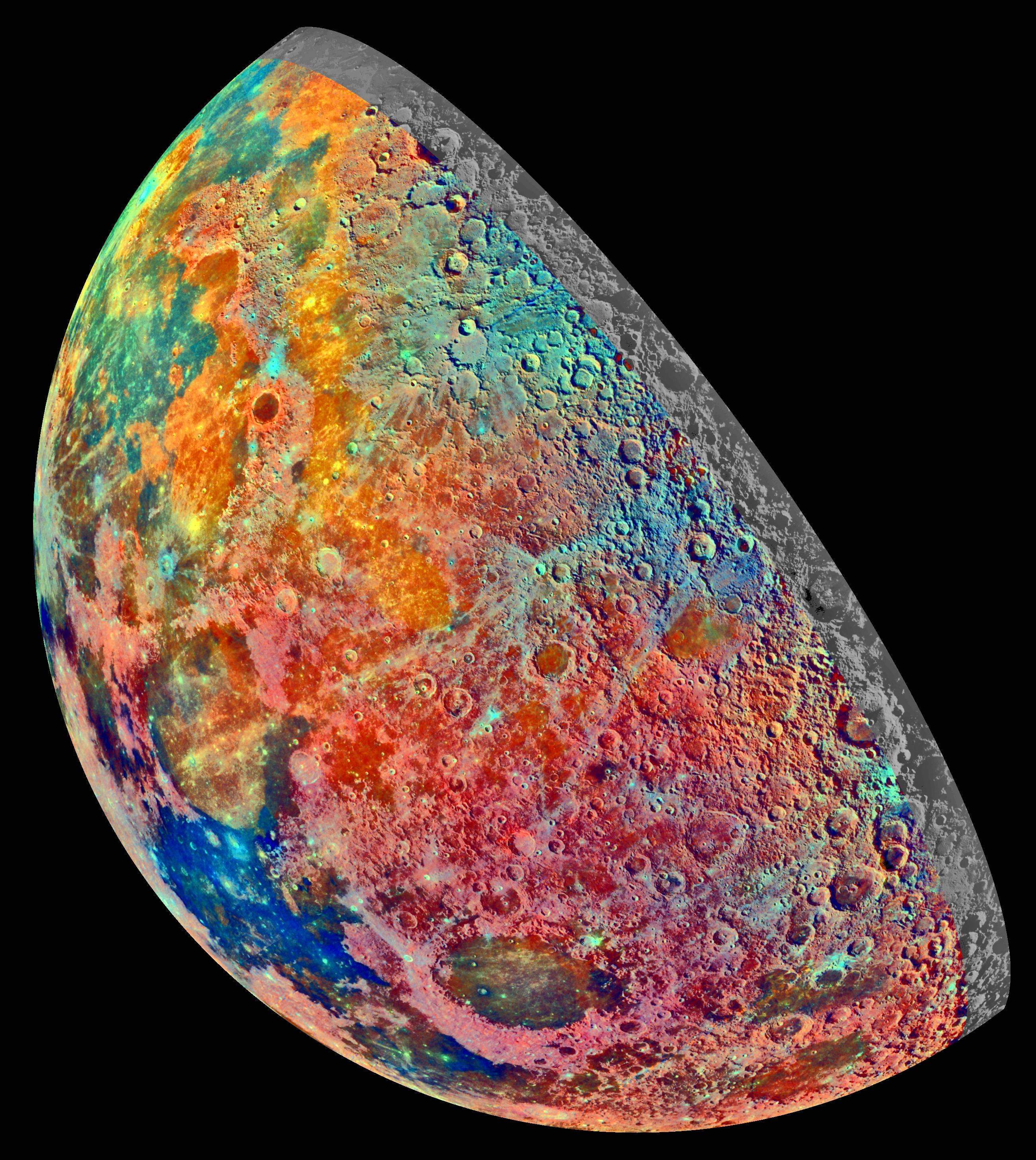
Wikipedia POD: April 4

This false-color mosaic was constructed from a series of 53 images taken through three spectral filters by Galileo's imaging system as the spacecraft flew over the northern regions of the Moon on December 7, 1992. The part of the Moon visible from Earth is on the left side in this view. The color mosaic shows compositional variations in parts of the Moon's northern hemisphere. Bright pinkish areas are highlands materials, such as those surrounding the oval lava-filled Crisium impact basin toward the bottom of the picture. Blue to orange shades indicate volcanic lava flows. To the left of Crisium, the dark blue Mare Tranquillitatis is richer in titanium than the green and orange maria above it. Thin mineral-rich soils associated with relatively recent impacts are represented by light blue colors; the youngest craters have prominent blue rays extending from them. The monochrome band on the right edge shows the unretouched surface of the moon. The Galileo project, whose primary mission is the exploration of the Jupiter system in 1995-97, is managed for NASA's Office of Space Science and Applications by the Jet Propulsion Laboratory.

Source: http://photojournal.jpl.nasa.gov/jpeg/PIA00131.jpg
TIFF Version: http://photojournal.jpl.nasa.gov/tiff/PIA00131.tif
NASA Photojournal Catalog Page: http://photojournal.jpl.nasa.gov/catalog/PIA00131

Sunday, April 6, 2008

Athletic Teamwork

More excellent YouTube video of Naval Research Laboratory's Athlete in action, cooperating in heavy lifting


Of a Garden on the Moon, Part 1

Ken Murphy
Out of the Cradle
Archives
One of the key questions for early Lunar selenologists was whether or not the regolith of the Moon could support life. The results were pretty conclusively no, as most of the elements that we consider important for life such as carbon and nitrogen are scarce to be found. This would seem to make the Moon a pretty rotten place to try to grow plants, but there’s a strong likelihood that the Moon could turn out to be a fantastic place to grow the plants of Earth.

Early settlers are going to be looking to go deep underground on the Moon, with lots of rock above them to protect them from the vacuum and radiation. This does not mean that Moon dwellers will end up as troglodytes, as modern technology has given us many tools to work with that can help us create a subselenian paradise on the Moon.

While early plans for a Moonbase typically settled for an near-equatorial location to help keep the orbital mechanics easy and resupply cheap, newer ways of looking at how we return to the Moon, such as using an Earth-Moon L-1 platform as a staging location, are giving increasing consideration to polar locations. The difficulty of access is offset by what appears to be large supplies of hydrogen (in some form, currently unknown but hoped to be water) in the everdark craters at the North and South poles. There appears to be more at the North pole, but the more rugged terrain of the South pole, perched on the rim of the Aitken Basin, offers more interesting opportunities.

Read more HERE.

Irish Students preview Kaguya (Selene) HD

'In the Shadow of the Moon' shown

Leo Enright, radio broadcaster and chairman of the government’s Discover Science and Engineering programme, said the Japanese pictures were ‘‘stunning’’ and would capture the imagination of young people.

‘‘
"When (Harrison ‘Jack’) Schmitt saw this new Japanese footage, he said that, since he walked on the moon, this screening was as close as he’d experienced to being on the moon,” he said.

'Irish students will be over the moon'
Sunday Business Post, Dublin

Saturday, April 5, 2008

Evansville, IN students take college division in the Great Moon Buggy Race

Angela Storey
Marshall Space Flight Center, Huntsville
(256) 544-0034
angela.d.storey@nasa.gov

Student racers from the University of Evansville in Evansville, Ind., speed to victory in the college division of NASA's 15th annual Great Moonbuggy Race. HUNTSVILLE, Ala. – Student innovators from the University of Evansville in Evansville, Ind., sped past 23 teams from around the globe to win the college division of NASA's 15th annual Great Moonbuggy Race today at the U.S. Space & Rocket Center in Huntsville.

The Evansville team posted the day's fastest race time, completing the harrowing course -- which simulates surface conditions found on the moon -- in just 4 minutes and 25 seconds.

Finishing in the top three along with Evansville were second-place winners from Murray State University in Murray, Ky., and third-place racers representing Canada's Carleton University in Ottawa, Ontario.

NASA's Great Moonbuggy Race is inspired by the original lunar rover designed by engineers at NASA's Marshall Space Flight Center in Huntsville. A hardy, lightweight exploration vehicle, the first rover trundled across the moon's surface during the Apollo 15 mission in 1971, and continued to chart new lunar territory during two subsequent Apollo lunar missions.

Student racers faced challenges similar to those overcome by Apollo-era rover engineers. Last October, the student teams began designing their own buggies, capable of withstanding the challenges of the course: craters, gullies and ridges made of plywood and tires and covered with a realistic layer of gravel and sand.

The Marshall Center presented the first-place team with a trophy depicting NASA's original lunar rover, and gave plaques and certificates to the two runners-up. The first-place team also received $5,700 in cash from Northrop Grumman Corp. Individuals on all three winning teams received commemorative medals and other prizes.

Read more HERE.

Friday, April 4, 2008

Google X-Prize Update

March was a great month for the Google Lunar X PRIZE. We’ve highlighted some of the prize’s recent successes below, but, as always, check out www.googlelunarxprize.org for team updates and other information.

Space Florida – New Preferred Partner

The X PRIZE Foundation has announced that Space Florida will be a new preferred partner and the first preferred launch site for the $30 million Google Lunar X PRIZE competition. As the first preferred launch site, Space Florida will award an additional prize of $2 million to the Grand Prize winner of the Google Lunar X PRIZE competition upon confirmation that the winner has complied with all competition rules, provided the winner launched the winning flight from the State of Florida. This award creates a powerful incentive for all Google Lunar X PRIZE competitors to strongly consider Florida as the launch site for their entry.

Space Florida was created by the Florida Legislature to sustain Florida's position as the global leader in space exploration and commerce, and is the principal organization charged with promoting and developing Florida's aerospace industry.

Space Education

National Science Teachers Association National Conference on Science Education

We kicked off the 2008 Pete Conrad Spirit of Innovation Award competition at the National Science Teachers Association annual conference, held this year in Boston, Massachusetts. Teachers from around the country learned about the two Conrad Award themes – Personal SpaceFlight and Lunar Exploration – and also how to get their students involved in the Google Lunar X PRIZE by adopting a team and following the competition with online education activities. Teachers from all over the U.S.A. – and a few other countries – visited the X PRIZE booth to talk about our education opportunities.

2008 Botball Design Challenge

This year, the X PRIZE Foundation proudly partnered with the KISS Institute for Practical Robotics to create the 2008 Botball Design Challenge. Students studied the Google Lunar X PRIZE, conceptualized a winning entry, and developed a webpage to promote their ideas. Though the students did not build actual hardware, they were required to understand the underlying technological issues, present a rover design, select a landing spot, et cetera. The winners were announced earlier this month. In the high school division, the winners were: Nease High School; Evergreen Valley High School; and Greater Lowell Technical High School. In the middle school division, the winners were: Desert Robotics Team #4; Highlands Intermediate; and Whittier Middle School.

Team Summit

The first ever Google Lunar X PRIZE Team Summit will be held May 20-21, 2008, at the campus of the International Space University in Strasbourg, France. Representatives from all of our teams will be joined by others interested in forming teams of their own, as well as potential partners and suppliers, and the world’s leading experts on space travel and lunar exploration. Stay tuned to our website for registration information.

If you would like to form a team and be announced as an official Google Lunar X PRIZE competitor at the Team Summit, you must complete your registration by April 18, 2008.

The Google Lunar X PRIZE Online Presence

Interested in finding out what the Google Lunar X PRIZE team did at NSTA? Or seeing the latest development from your favorite team? You can find the Google Lunar X PRIZE on YouTube, Facebook, Twitter and, of course, our very own website. Part of what makes these online communities work is your participation – join in and tell us what you think!

India planning manned moon flight ~ 2015

Khabrein.info is confidently reporting late this evening of plans for a manned expedition to the moon by the Indian Space Research Organisation. The unconfirmed time frame places Indian astronauts on the lunar surface before the proposed Ares I booster manages to place its first Orion CEV in Low Earth Orbit in 2015.

This will certainly come as a surprise given India's present lack of any present manned space capabilities, unless a further cooperation agreement with Russia allows for a launch of a Soyuz from Sriharikota. It isn't clear whether Roscosmos might be willing to part with an Energia heavy-lift or just exactly what New Dehli's plans might be.

"A report with regard to manned mission to moon by 2014-15 is being submitted to the government for approval and budgetary allocation," Khabrein posts.

"The Space Commission, headed by Indian Prime Minister Manmohan Singh, will meet soon to review the report and take a decision," ISRO chairman G. Madhavan Nair told reporters in the Southern Indian city of Bangalore today.

"The report also speaks about collaborations and creating teams for coordinating the mission," Nair told reporters, Indo-Asian News Service reports.

"On India's space programmes," Nair said "ISRO would undertake 70 missions during 2007-2012."

"The proposed missions will be a combination of satellite launches with transponders for enhancing communications, education, health, remote sensing, observatory and exploratory." (sic)

"We will also undertake projects for re-entry vehicles and recovery capsules," Nair said."

All of which sounds to me like a good idea, if you plan to go to the moon anytime soon.

More on NRL's Lunar Athlete Rover

While I've written before of the U.S. Navy's Athlete, a dexterous, long distance and freight-handling robotic walking lunar rover, under development by the Naval Research Laboratory in cooperation with the Massachusetts Institute of Technology, I thought I'd be reading of something quite different when teased by a passing headline a short time ago.

The Athlete test-bed robots are gangly-looking enough, I thought, than to read New Scientist describe them as "giant, six-legged robots," that can "pick up and move a future Moon base thousands of kilometres across the lunar surface.."

They're certainly big, but hardly the 50 Foot Woman, not able to to lift a single-wide mobile home, let along an entire moon base, except perhaps in pieces and many trips.

And whether they are able to handle "thousands of kilometers" even over the course of any one unit's lifetime remains to be seen.

Athlete has been developed with MIT's farside Dark Age Lunar Interferometer, or DALI, which the Institute hopes can be deployed over a thirty-five mile wide area of the Tsiolkovsky, and in relative radio quiet a decade from now. DALI would listening for faint, highly red-shifted wavelengths from the so-called Dark Age, between 200 million years after the Big Bang and the first eras of star formation hundreds of millions of years later, when the structure of the present state of the known Universe began.

As I posted previously, the Naval Research Laboratory shares a $500,000 grant with MIT to design and test the logistics of deploying the proposed array. Plans call for deploying a nearside radio array to perform some actual science and to test the concepts behind DALI and its construction, already well along in planning.

NRL proposes using Athlete to patiently and persistently, as a robot should, haul components from a landing zone and eventual hub to sites clustered over a 50 kilometer wide area in Tsiolkovsky's southeastern third.

Each collector, 250 meters in size, would then need to be deployed and tuned. I've suggested they might then become integral to the full array itself by offering tuning mobility as the rails for the Very Long Baseline Array in Socorro, New Mexico performs, changing the size of a massive virtual aperture.

AIAA Lunar Architecture (September 2007) - Adobe Reader

Dumbed-down summary of thrust oscillation fix, GAO criticisms for Ares I

Dead center of this image taken by ESA's SMART-1 is a good spot for landing, if you want to investigate that swath of acreage along the one-quarter of the depths of Shackleton Crater that isn't ever touched by the sun. I really hated the stock images that have accompanied these dumbed down articles about the Ares 1, so I decided to post this important, if stark, CCD still instead.

The Houston Chronicle ("The Orlando Sentinel of the Johnson Space Center") has a pretty good story for the deliberately ignorant summing up NASA's apparent problems in the past few days, on today's front page, written by By Mark Carreau and Bennett Roth.

Who actually uses a term like "moonship," nowadays, anyway? At least they didn't make the mistake CNN did, in it's faux sophisticated piece on this thread published yesterday. Ares 1 isn't a moon-ship, it's supposed to be a LEO crew launcher.

From The Chronicle Story, April 4:

"NASA officials said Thursday that they are developing special shock absorbers for a new moonship to stop potentially fatal vibrations.

"The design of the space shocks, theoretically similar to the equipment used to lessen the shake, rattle and roll on an off-road pickup, should be ready by fall for the Ares 1 rocket. The rocket, which also is in the design stage, will carry the Orion moon capsule into orbit by March 2015.

"Space agency officials outlined their strategy to dull the vibrations Thursday following congressional hearings in Washington and the release of a critical report by the Government Accountability Office. Lawmakers at a House subcommittee's hearing joined GAO auditors in expressing new concerns about the rocket's design and development. Some questioned whether the agency can realize its goal to return astronauts to the moon by 2020.

"In the Senate, some Republicans joined Democrats in calling for a $1 billion increase in the space agency's budget. They said the funds were needed to help NASA overcome technical obstacles and ensure the agency maintains a focus on climate studies, robotic science missions and aeronautics."