Sunday, May 18, 2008

NASA considers removal of US from ISS following Soyuz incident

NASASpaceflightNOW - NASA managers have been meeting today to debate the option of removing the US presence from the International Space Station (ISS) when Discovery undocks at the latter part of STS-124.

Meanwhile, STS-124 processing continues to pick up the pace, following the recent replacement of a faulty MDM (Multiplexer/Demultiplexer) card (FA2), and a Russian re-supply ship (Progress 29P) has successfully docked with the ISS.

The discussions relate to confidence levels in the Russian Soyuz - that is currently docked on Station as a rescue vehicle in the event of an evacuation - while an ongoing investigation into Soyuz TMA-11's ballistic re-entry continues.

The 'down moded' option taken by the Soyuz TMA-11's flight computers - commanding the vehicle into a ballistic re-entry - is still in the midst of a Russian investigation, which is not likely to come to a conclusion ahead of STS-124.

The debate focuses around US confidence in the Soyuz as a 'solid rescue vehicle' - as previously reported by this site. The docked Soyuz is the only means of evacuation from the ISS during an emergency in-between shuttle missions.

The options being discussed relate to either changing the crew size riding up on Discovery to six - minus expedition 17's Gregory Chamitoff - and returning Garrett Reisman as planned, or launching with Chamitoff, before bringing him home with Garrett on Discovery.

These options - noted as 6 up/7 down and 7 up/8 down - have been debated since Wednesday, with Friday's meeting relating to the latter option of bringing eight crewmembers home with Discovery. Orbiters are capable of bringing home 10 astronauts - if required
Read more HERE.

Tim Bendel's off-the-shelf powerplant

From the Silo and Frontier Astronautics
Bill Stone, president of Stone Aerospace, an Austin company that makes robots, space suits and other space-exploration equipment, thinks the Viper could become “a tool for smart, nimble, small aerospace companies. Rather than going to Lockheed, we just go to Tim and say, ‘I want a Viper’ or ‘10 Vipers.’ ” A company that wants to enter the space-tourism market could build a craft around the Viper instead of designing its own engine. Similarly, a lunar-lander mission could use a few Vipers to handle the variety of tasks—leaving orbit, landing, taking off again—that now require 10 engines.

Bendel’s company, Frontier Astronautics, is even applying for an FAA permit to turn the Wyoming missile complex into a spaceport. “It’s kind of a gold rush,” Bendel says of the current era. “Everyone’s trying to get their stake in the market. And we’re selling shovels.”
Read more HERE.

Initial Ares I JX-2 tests complete

NASASpaceflightNOW As the Constellation Program prepare to update the media on the current status of Ares and Orion next week, NASASpaceflight.com acquired an expansive synopsis of the current data on the new vehicles.

Meanwhile, the opening series of tests for the J-2X Ares Upper Stage engine have been completed at NASA's Stennis Space Center, which utilized J-2 components used from the Apollo program through the X-33 program.
Read more HERE.

Saturday, May 17, 2008

Congress to make NASA International?

Members of the House Science and Technology Committee will radically reshape President Bush and NASA's Vision for Space Exploration, requiring NASA to seek international help in completing the International Space Station, by putting far more emphasis on Earth sciences, particularly "climate change," and founding any further exploration beyond low Earth orbit on future international agreements.

Rep. Mark Udall (D-CO), chairman of the Science and Technology Subcommittee on Space and Aeronautics has introduced House Bill 6063, the "NASA Authorization Act of 2008" persuading bipartisan co-sponsors in veteran Republican Ralph Hall (R-TX) and the full committee chairman Rep. Bart Gordon (D-TN).

Mark-up of NASA's reauthorization for FY 2009 was set to continue May 20, but it remains unclear how radical a change in national policy Udall's bill represents.

Negotiations were underway to enable NASA to keep its schedule to retire the Space Shuttle in late 2010, complete the International Space Station and continue design and testing already well-underway of Orion, the first manned component of the Constellation program, and the Ares I booster, currently scheduled to fly no sooner than 2015.

It is also not clear whether Congress intends for NASA to keep a 2020 appointment to begin construction of a permanent manned lunar base near the moon's south pole.

In recent days, NASA reportedly scrapped yet another recommendation by Vision planners, a problematic dry landing system for the Orion crew module, saving time and funding overcoming thorny engineering problems and 500 kilograms of vehicle weight, enabling NASA, planners agreed, to keep its long-term time line.

NASA and Congress sacrifice radiation shielding flexibility by removing dry landing hardware

As money at federal budget time comes down to crunch time in House Appropriations, 500 kilos of dead weight and an unecessary need to establish the credibility of the timeline as a selling point for NASA, the Program has been forced to abandon dry land landings for Orion Block One.

It's back to splashdowns, and a forced long-term cost-per-mission is squeezed into the "out years" of the program by the Will of Almighty Congress. Penny-wise and pound foolish, the mission directorates congressional liasons have made safety a more difficult problem for engineers, and ultimately more expensive.

Forcing a larger cost into the out years for a micro-managed short-term "gain" is congressional traditional, however, and like it or not, NASA - just like every federal agency - is a "Creature of Congress."

In the long run, dropping 500 kilos from Orion's design will save the future timeline only at its very beginning, in 2015. Future safety delays, future "Hydrogen Summers," will delay missions in an out year domino effect. If NASA has learned anything from the long Space Shuttle experiment, that should be obvious.

Cost to the Department of Defense for what is essentially Sea Search and Rescue may or may not be a hidden cost to future taxpayers, but dependence made into a necessity, and sacrificing an advance into precision terra firma landings never a feature of NASA capsule-type missions, but a staple of Soviet/Russian missions for almost fifty years is deliberate ignorance.

The most important reason for NASA not to abandon what appears to a clever congressional staff to be merely 500 kilos of "dead weight" is not so obvious and not so easy to communicate in budget hearings.

If only Congress bothered to read the carefully written, easy to follow reports on deep space radiation hazards so carefully and respectfully laid out by the National Academies in two recent reports commissioned by NASA.

That 500 kilos of "dead weight" was integral to flexibility vehicle designers will now be forced to part with in accounting for essential shielding against Galactic Cosmic Rays and Solar Particle Events.

In two well-crafted, peer-reviewed studies the National Academies repeated an generous allowance given designers of the Constellation's Altair lunar lander and Orion CEV to incorporate shielding into the placement of components in the very design of those vehicles.

NASA safety protocol allows an astronaut only a 3 percent probability, over the course of that individual's lifetime, of "Radiation Exposure Induced Death," or REID. Even when incorporating shielding into the design of Orion's components and hull, a nominal trip to Mars guarantees a greater than 3 percent probability, over the course of a Human lifetime, of REID.

That assessment by the National Academies made brief headlines when their latest report, in draft form, was made public at the beginning of this year's budget rounds. The news about Mars being outside the REID protocols was highlighted while similarly nominal trips to the Moon being within those same safety demands did not.

Either way, testimony blasting NASA for having any kind of manned program whatsoever, and in favor of JPL's ground-pounding vision of pure robotics, quickly absorbed the National Academies circumspect report. Apparently neither congressional staff or NASA's lobbyists had time to read their important report.

With the loss of shielding flexibility, design difficulties and safety demands will make the timeline less credible, and not more. In the end, it will make for either a more dangerous Orion, future Liberty Bell Sevens, or, more likely, the addition of another 500 kilos of aluminum inside and outside the Orion command module - without the ability to land on dry ground.

Moon over Bangalore

It's been said the further from the source, the "weirder" the story, as when the small city paper in Stephenville, Texas reported on unidentified flying objects nearby, last year. The story was almost casual, "matter-of-fact" when compared to the frightful shouting of Shep Smith on FoxNews - who is incapable of understatement.

The opposite seems true of stories from India, where apparently, amidst thousands of American customer service call-centers in Bangalore the Chandrayaan lunar probe is finally being assembled by contractors for the Indian Space Research Organisation (IRSO).

As exotic as curry powder, a taste of IRSO's website is strange enough, but those interested, as I am, in the success of the Indian's lunar mission and its eventually getting off the pad at nearby Sriharikota later this year, you shouldn't miss the chance to sample the local news.

It's the next best thing to being there.

From The Times of India, no less:
BANGALORE: Mission Moon is being given the final touches in Bangalore. All payloads and instruments, including five from overseas (from US and Europe) in Chandrayaan-1 spacecraft on India's PSLV are currently being assembled at the ISRO satellite integration centre here, the biggest in Asia.

All satellites and instruments from India or abroad have to be tested followed by assembly and integration onto the spacecraft at this centre.

The instruments will be assembled and finally integrated onto Chandrayaan-1 before launch in a couple of months time. Engineers have already conducted vibration tests, temperature tests at high and low frequencies, tests with thermal sub-systems and all electrical and mechanical functioning.

"The testing of five international instruments is complete. The engineers are very happy with the results and the instruments have come through the different atmospheres in which they are tested. The entire working is very delicate and involves highly careful and sensitive handling. They are happy that all testing parameters have been met. The engineers from abroad too are naturally happy," scientists told The Times of India.

The vibration and temperature tests are particularly important as Chandrayaan-1 as well as the instruments experience conditions in the lunar orbit radically different from those closer to Earth. The success of the tests indicates that the instruments will perform as planned in lunar orbit.

The centre is also taking care of the entire microelectronics of the instruments and the spacecraft with the help of ISRO.

"Tests apart, we put together cameras, antennae and sensors of all instruments that would relay information on spacecraft's health. In fact, we're assembling the very brain of Chandrayaan-1. The spacecraft takes its final form here," an official explained.

Chandrayaan-1 is a 1.5 m cuboid-shaped body with a dry weight of 525 kg in lunar orbit. The spacecraft, which has a mission life of two years is being built with a series of new technologies - lithium-ion batteries, gimballed antenna system, miniaturised communication system, miniaturised star sensor and spacecraft bus management.

"The Deep Space Network at Bangalore will monitor the spacecraft and the data it generates.

"The national science data centre in the DSN will process raw data into user-friendly format. The data ultimately will generate new knowledge about the Moon," a scientist said.

Friday, May 16, 2008

Russians, ESA ink Lunar vehicle agreement

These announcements are always a little optimistic, but negotiators are at least planning to beat NASA back to the Moon by two years.

The Russian Federal Space Agency and European Space Agency are reportedly just past inking a cooperative space vehicle deal, and with form following function, like the Soviet Буран suspiciously looking like a 3/4 scale Columbia, this new vehicle is concepted to resemble Orion but with planned room for a sixth star-traveler.

An ambitious schedule and short-sighted politicians preparing to reap wins from a bitter harvest mostly fueled by confidence-killing gas prices in the U.S., and you begin to wonder if the United States is gradually being left in the dust.

ESA-Roscosmos plan the next visit to the moon by a human being for 2018, or two full years prior to NASA's.

(Of course, the Jules Verne ATV was many years overdue when it finally took flight, weeks ago, docked now to the Russian segment of the ISS. The Space Shuttle was six years overdue when Columbia first flew in 1981.)
More HERE.

Tuesday, May 13, 2008

Ronald Parise (1951-2008)

Former space shuttle payload specialist Ronald Parise died at his home in Silver Springs, Md., Friday after a three-year battle with brain cancer. He was 56.

An astronomer and computer specialist, Parise was one of the developers of the Ultraviolet Imaging Telescope. He flew on two space shuttle missions in 1990 and 1995 that used the telescope to study stars and other celestial objects.

He was born May 24, 1951, in Warren, Ohio. He earned a bachelor's degree in physics from Youngstown State University and master's and doctorate degrees in astronomy from the University of Florida.

Always interested in science and technology, he first earned his amateur radio license at age 11 and remained active in radio using the call sign WA4SIR, his wife, Cecelia, said Sunday.

As a teenager, he became active in the Mahoning Valley Astronomical Society and built two telescopes. He also learned to fly and enjoyed piloting small aircraft until his disease became advanced, his wife said.

In 1984, he became a NASA payload specialist, working on several technical projects in addition to spending 614 hours in orbit and traveling 10.6 million miles in space. He spent 12 years with NASA before moving on to several other space, astronomy and computer-related jobs.

He and the former Cecelia Sokol met at Youngstown State University and married in 1973. Their son, Nicholas, is in the Air Force. Their daughter, Katherine, lives in Silver Springs.

The funeral is scheduled for 10 a.m. Friday at Resurrection Catholic Church in Burtonsville, Md., with burial at Burtonsville Union Cemetery under the direction of Collins Funeral Home in Silver Springs, Md.

His family requested that in lieu of flowers, contributions be made to the Youngstown State University Foundation's Dr. Ronald A. Parise Scholarship fund, One University Plaza, Youngstown, Ohio 44555.

richard.stewart@chron.com

Monday, May 12, 2008

Has Mike Griffin given in to the commercial manned spaceflight solution?

The Lunar Pioneer asks, "why stop there?" (Return to Taurus Littrow)

The rumor mongers would have you believe NASA administrator Mike Griffin is steadfastly opposed to NASA funding for commercial space beyond cargo.

And then, only as a stop-gap for a worrisome impending dependence on Roscosmos to keep the International Space Station actually doing science after the retirement of the Shuttle in 2010; plans that call for a Gap in manned spaceflight - after only eight more flights (with two contingencies), and then nothing for our astronauts to do but busy themselves until Orion Block One is ready to fly on the problematic "Stick," the Ares 1, in 2015.

COTS, the Commercial Orbital Transport System, is presently dominated by SpaceX, and the vendor is far along in development of commercial boosters Falcon 1 and 9, but claims readiness to convert America's commercial version of ESA's ATV into a manned vehicle.

And its budget time, once again, with a Congress controlled by a generally-hostile post-modern Democrat Party ready to trade NASA in for an apparently already inaugurated "President Obama's" federal child care dreams, and indefinitely delaying the Vision for Space Exploration while generally driving a stake through the most evident symbol of American Exceptionalism.

Bureaucrats everywhere are delaying badly needed systemic changes in anticipation of November's election and NASA is no exception.

Unilaterally, however, Mike Griffin may be floating a sudden willingness to support commercial competition in manned spaceflight, talking of an offer of $500 million to boost development of a manned commercial orbiter, the next Space Shuttle, with a smaller design following after the post-Columbia separation of cargo and crew.

It would be taking up where the first space shuttle designs left off, before the mouse designed by a committee became the never-fulfilled promise an elephant-sized Space Shuttle, and more the natural successor to the original dreams for a manned and reusable manned LV, from the era before Apollo.

From London and The Times Online, we have this hint given in a speech by NASA's Admin given in Jo'berg, South Africa, and an idea Griffin may have wished floated well off the beaten track.

If this is a new willingness on the part of Griffin and NASA's directorates, not to mention the FAA, to consider further commercialization and competition in American manned spaceflight, here's hoping it's not "too little, too late."

Beyond this, as the above illustration suggests, why stop there?

Sunday, May 11, 2008

Who will own the moon and the worlds?

Yes, but... What about the "International Star Registry?"

Such was the power of the Will of Pope Alexander VI that in 1493, barely a year after the European discovery of the Americas, while still exceptionally ignorant of their true extent, their range or even their location, let alone their golden Empires, at that moment manifested in the Inca and Aztec, that he could still set upon the Globe a longitudinal Line of Demarcation separating the future claims of both loyal Portugal and Spain in the "New World."

Five centuries later, east of that Line is Portuguese-speaking Brazil while generally west of that Line, in the far larger part of South America, Spanish is spoken, even by descendants of the Inca and Aztec.

Such was the power of a man who, beginning with an abstraction, and who would never visit those lands or know more than next-to-nothing about their extent, could still have a very lasting effect on the course of history.

The law may be a metaphor, but it is "a metaphor with teeth."

This Demarcation, however, also included an area we know (and by the power of one mapmaker) as North America - which was included inside the Division given to Spain. One tribe of the hundreds of millions of aboriginal Indios, nomads of the North American Plains who had been Mountain Utes who would later learn the power of the horse and become known to the Spanish as Comanche, or "those who are always against us," kept the Spanish out of Texas for two centuries. Meanwhile, the Protestant English gradually became de facto owners of the eastern seaboard of North America.

Both groups simply failed to reconcile themselves to foreign ecclesiastical supremacy, and their long conflict, between Iron and Stone Age peoples, had its inevitable result. In the United States, English predominates, despite the Pope's declaration. The bloodiest battles in the subsequent history of all the Americas would be fought between English-speaking descendants and over the status of slaves imported from Africa.

Still further north, the French held sway, and in Quebec their language is spoken today. Thus, the range of Alexander VI's influence was indeed lasting, but it had its practical limits also, as did the dictates of European Empires over their colonies.

Now, in deciding who "owns" the myriad New Worlds in this star system alone, there are lessons to be learned from history about the long arm of recognized authority and the limitations of symbolic abstractions on ink on paper thousands of miles away, in both space and time.

The Winter 2008 Journal of Space Law & Commerce from Southern Methodist University School of Law, delivers a scholarly review of the notion of private claims on Lunar and other extraterrestrial Real Estate.

The authors make the case that an earth-bound authority could encourage space settlement by recognizing the apportionment of lands as incentive for people to act, a method used to hasten the completion of the Trans- Continental Railroad in the United States, and helped along by the recognition of parcels and townships on either side of the easement while deeding their Mineral Rights to private Trusts and corporations.

Claims that might have been made by some of my Indio ancestors were crippled, naturally, by their lack of any cultural understanding of a Chain of Title and by their genuine horror even at the thought of Mineral Rights.

There are other ways, more chaotic perhaps than may be comfortable to the authors or to the United Nations. In North Carolina, for example, the unchallenged squatting upon someone else's property for 17 years or more can become ownership when a claim is afterwards simply filed at the county courthouse. (The reparation later awarded Aboriginal Americans, however, after millennial "squatting" on parts of North America is apparently the right to operate a Casino.)
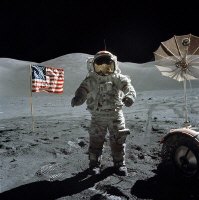
Gene Cernan at the beginning of the last EVA on the moon, in the Taurus-Littrow Valley, December 1972. (Image Credit - Jack Schmitt)

Selling the moon, like EM spectrum auctions which have netted the U.S. federal government $64 Billion, is also asking for trouble.

Extraterrestrial land transactions in general are almost certain to lead to ridiculous conflicts and/or impossible or expensive-to-enforce litigation, between absent owners, or nations and nationals, who mine anothers claim.

The Outer Space Treaty puts signatories under an obligation to share data collected by exploration, but no one said this would have to be done in "real time." This creates a market for "insider trading."

And so on... Frustration over such problems, however, along with the persistant, ancient illusions of a Collective, rationalized by terrestrial pressures to "share resources" with the less intrepid may eventually lead to such "hands-off" disincentives to settlement as is seen today in Antarctica, a terrible model for exploiting off-world resources - which might one day prevent the sale of minerals taken from the asteroids, for example, in the only market in this star system, down here in Earth's Gravity Well.

Putting outer space Real Estate in the hands of the United Nations would accomplish the opposite intented by the authors. It would be a disincentive.

The only incentive model that may be workable, in both the short run and the long run, is real people on real property, Boots on the Ground, and mutual agreements made in "township" by those parties in situ - with written agreements made on the land itself, by people who wear spacesuits, not suits and ties, to get to the bargaining table.

Agreements in Townships may exclude absent "authorities" from de facto Eminent Domain or specifically exclude claims by absent owners, and be accompanied by agreements to mutual defense. The latter may seem ridiculous today, but humans are adept at innovating warfare.

You may already see a "War for Lunar Independence" may occur and sooner rather than later. It may have already begun.

Authority, presumed or otherwise, on the part of any Nation-State or International Body, with a Monopoly of Force and written on paper to extend off-Earth must diminish in inverse-proportion to the square of its distance. Earth's Moon may, therefore, be too close for intrepid pioneers.

While the nations of Earth spend relatively little to "explore," history shows they will spend $10 Trillion to enforce proven claims to resources valuing $100 Trillion. When it comes to Power, "Zero-Sum Economies" are quickly tossed aside.

Declaring Space Entrepreneurs to be "privateers," and enforcing Trade Restrictions, preventing access to free markets, may be the best and perhaps the only practical way they might enforce their future treaties - a ball and chain on the speed of our becoming a space-faring species.

Then again, one other way would be to restrict access to Launch and Re-entry windows before they can foresee a loss of bureaucratic control over potential off-world resources; something already well-established in existing Space Law and Regulation.

Florida passes space incentive bills

No surprise there.

Film reviews AeroJet era

Miami Herald - It happened nearly half a century ago: Florida City was once part of the fight to beat the Russians in space as home to a solid fuel space rocket project.

Doug LaRue has created a documentary on the space-era AeroJet solid fuel rocket project southwest of Florida City. The project began in 1963 with the awarding of a large contract for construction of the facility.

During the early years of the U.S. space program, NASA explored both solid and liquid fuel for the rockets which boosted men into space. General Tire won a contract to manufacture solid fuel rockets.

The concept was to assemble the rockets at the South Dade facility, fuel them and transport them by barge up the inland waterway to Cape Canaveral. This required the digging of the AeroJet Canal from the ocean to the site, but with the space race on with the Russians little got in the way of NASA.

Read more HERE.

Toronto threatens Canada's Space industry

VANCOUVER -- A few months ago, John MacDonald got a call from an executive at MacDonald Dettwiler and Associates Ltd., the company he'd co-founded in 1969 and that had gone on to become the heavyweight of Canada's space sector.

MDA had bid for - and won - a contract to build the chassis for a Mars rover that would be part of the European Space Agency's ambitious ExoMars mission, the caller said.

But the Canadian government was dragging its feet on funding its share of the work as required by ESA policies. Would Mr. MacDonald intervene?

Mr. MacDonald, who'd left the company a decade ago but remains close to management, says he picked up the phone and contacted a senior official at Industry Canada who promised to see what he could do.

It was too late. The contract, involving $40-million over three years, went to the runner-up.

For MDA, the lost contract is part of a pattern of inaction on Canadian space policy by successive governments over many years. That lack of direction, say Mr. MacDonald and others, now threatens the viability of the Canadian space sector.
Read more HERE.

Saturday, May 10, 2008

Columbia disk drive recovered

The recovered disk drive from Columbia had been used to capture data
from an experiment on Xenon gas flows.

Kansas City Star - Jon Edwards often manages what appears impossible. He has recovered precious data from computers wrecked in floods and fires.

Now Edwards may have set a new standard: He found information on a melted disk drive that fell from the sky when space shuttle Columbia disintegrated in 2003.

“When we got it, it was two hunks of metal stuck together. We couldn’t even tell it was a hard drive. It was burned and the edges were melted,” said Edwards, an engineer at Kroll Ontrack Inc.

Like other Columbia debris, the mangled disk drive turned up in Texas.

Beginning the Retirement: NASA rolls out space shuttle tires for loan

A space shuttle main landing gear tire is prepared for its first and only
space flight at the Kennedy Space Center in Florida.

When space shuttle Discovery touched down in December 2006 after spending 13 days in space traveling 5.3 million miles, it came to rest on four main landing gear and two nose gear tires. Although not much larger than a truck tire, just one of Discovery's main gear tires could carry three times the load of a Boeing 747 tire or the entire starting line-up of a NASCAR race -- 40 race cars -- all hitting the pavement at 250 miles per hour.

The rear tires that brought the STS-116 crew to their safe end of mission, like all orbiter main gear tires, were rated for only one use and were replaced before Discovery flew again nearly a year later. The orbiter's nose gear met the same fate after only their second landing.

Discovery's spent tires and those of 50 other past flights dating as far back as 1986 were moved to NASA surplus yards and storage centers. The Kennedy Space Center in Florida began the process to auction more than 60 of the retired tires as scrap in February 2005 before the agency reconsidered and pulled the tires from the sale. Instead, NASA said, they would be set aside for then-unspecified "outreach and educational activities."

Three years later, NASA announced this week their flown tires fate: they would be rolled out as the pilot for a new artifact loan program targeted at museums, planetariums, and other organizations.

Prior to the new Artifact Loan Opportunities Program, the space agency made its spent space flown items available to the Smithsonian and to other museums. Educational institutions could borrow artifacts for short term display or in-classroom use but long-term loans were primarily only available to credentialed museums that could satisfy the preservation requirements set by NASA.

Given the ample supply of shuttle tires and the desire to reach new audiences, NASA has invited proposals for the long-term loan of the tires by organizations traditionally excluded from such programs, such as civic groups and schools. To facilitate the process, the agency has waived some of their requirements for the care of flown artifacts, permitting outdoor display as well as the option to drill or cut, as well as paint the tires, though whether intact or in pieces, all the material will remain the property of NASA.

Announcing the program, NASA suggested example uses of the tires, including as art, sculpture, furniture, building structures, or exhibits.

To qualify for a three-year renewable loan, organizations need to submit a proposal by June 11 as well as provide proof of insurance in case of loss for the retail value set by NASA of $250 per tire. Due to U.S. State Department regulations, the tires may not leave the country.

The organization must also provide a guarantee to cover the shipping costs associated with the transportation of the tires, which average a weight of 500 pounds and are approximately 3.5 feet in diameter, from either Florida or Washington, DC.

In addition to the STS-116 tires, NASA also has listed as available tires from the 2005 "Return To Flight" mission of STS-114; the 1998 STS-88 flight, which gave birth to the International Space Station; STS-95, that featured former U.S. Senator John Glenn's return to space after 36 years; and STS-61C, that landed 10 days before the loss during launch of space shuttle Challenger in 1986, among many other tires from other missions.

According to the program's website, loans will be awarded on the basis of the creative and innovative merit of the proposal, past experience, technical knowledge, outreach potential, educational potential, both fiscal and schedule soundness, alignment with NASA's educational goals and the attraction of "nontraditional" audiences.

NASA estimates the announcement of the granted loans will be made on or around July 18, 2008.

Though NASA has yet to announce additional artifacts it may make available through the program, the agency is preparing for the 2010 scheduled retirement of the space shuttle fleet, which accounts for hundreds of thousands of items beyond the three remaining vehicles themselves.

Betatronix gets space kudos

Gary Dymski
NEWSDAY

Betatronix LLC, a Hauppauge-based custom builder of potentiometers, received a thank-you from NASA yesterday for its work on the Mars Rover project about four years ago.

The company built potentiometers for the Rover project, which in January celebrated a fourth anniversary on Mars, said Joseph Yanosik, Betatronix's director of sales engineering. Potentiometers are position indicators that monitor feedback on movable parts in space. Betatronix makes the devices for the space and defense industries.

Humna Khan, NASA supplier outreach administrator, presented Betatronix chief executive Michael Ryan with a panoramic photo of the Mars surface with the Betatronix name in the foreground, Yanosik said.

The company was started in 1966 by Joseph Yanosik Sr., who was in charge of Betatronix when it supplied the Rover program.

Reisman trades jokes with Colbert

By MARK CARREAU
Houston Chronicle

NASA astronaut Garrett Reisman, who is currently orbiting the Earth aboad the international space station, matched wits today with Stephen Colbert, who pokes fun nightly at world events from the anchor desk of The Colbert Report.

Read more HERE.

"Are you saying you are janitor with a Phd?" asked Colbert.

"I'm a bit of a glorified janitor. That is probably a pretty good decription. I do a lot of cleaning," Reisman acknowledged.

The two men discussed the challenges of using the space station's waterless toilet, fitting in socially with two Russian crewmates, and living for weeks without a refrigerator to chill ice cream and beer.

Reisman, who is scheduled to return to Earth in mid-June after two weeks on the space station, explained his preparations for the flight included a two-week stay in an undersea habitat off of Florida's Atlantic Coast in 2003.

"What do you have against the rest of humanity that you have to flee from us every so often," asked Colbert.

"I think it's more what the rest of humanity has against me. I keep being sent off to these far places. I try not to take it personally," Colbert's space guest responded.

Swedish Space Gym Being Tested By Astronauts

The crew of the International Space Station (ISS) is presently testing a Swedish space gym. The gym was developed by Per Tesch, a professor at Mid Sweden University in Sweden. The aim is to counteract muscle atrophy and osteoporosis in astronauts.

Astronauts who spend a long time in space can face problems when they return to earth. Weightlessness atrophies the muscles and decalcifies the skeleton. It doesn’t help to “pump iron.” Barbells and dumbbells are also weightless on a space voyage.

But Per Tesch and his colleagues have found a solution that functions like a reverse yo-yo. The inertia of a rotating flywheel is exploited to create resistance. The astronaut velcros him/herself in place and pulls a cord that is connected to the flywheel. The wheel only weighs a couple of kilos, but its diameter makes the inertia considerable, and the load on the muscles and skeleton is at least as great as in weight training.

Per Tesch has researched the topic for 15 years on commission from both the Swedish National Space Board and its American counterpart, NASA. The “yo-yo” is now being tested in space for first time. It was recently delivered by the U.S. space shuttle Atlantis to the ISS, which is part of a European laboratory.

“It’s fantastic. I have been working a long time for this,” says Per Tesch.

He hasn’t received any reports about how it’s going.

“It’s still secret, but we’ll know in a few months.”

Per Tesch was appointed professor of sports science at Mid Sweden University last autumn. The findings from his research in space physiology will be put to use in developing training methods for sports, exercise, and rehabilitation.

Adapted from materials provided by The Mid Sweden University, via AlphaGalileo.

The Mid Sweden University (2008, May 10). Swedish Space Gym Being Tested By Astronauts. ScienceDaily. Retrieved May 9, 2008, from http://www.sciencedaily.com­ /releases/2008/05/080508142121.htm

India's Space Program May Help Fix Land Market:

Andy Mukherjee

A rocket head being carried on the backseat of a bicycle.

That's how French photojournalist Henri Cartier-Bresson's camera captured the initial years of India's space program, which began in the early 1960s.

Many of the program's critics noted at the time that Prime Minister Jawaharlal Nehru was squandering the country's severely limited budgetary resources on an elitist reverie far removed from the realities of the newly decolonized, poor nation.

Author and former United Nations diplomat Shashi Tharoor described the tension in his 2003 biography of Nehru. ``There was no limit to his scientific aspirations for India,'' Tharoor wrote in ``Nehru: The Invention of India.'' ``And yet the country was moored in the bicycle age at least partly because of his unwillingness to open up its economy to the world.''

Four decades after Nehru's death, his economic legacy, especially a dangerous flirtation with Soviet-style state planning, stands largely discredited.

Yet his scientific aspirations are coming to fruition in an India that is twice as open to the world as it was just a decade ago, judging by the flow of trade and overseas investments in relation to the size of the economy.

Last week, India put 10 satellites into orbit in a single mission, creating a new world record.

Among the payloads was Cartosat-2A. It's an indigenously developed remote-sensing satellite that has already begun beaming high-resolution pictures of the Indian hinterland, setting the stage for what may be a revolution in the nation's finance.

Satellite Communication

India has already made extensive use of domestically developed communication satellites.

In the mid-1980s, satellites made it possible for India to export computer software written in Bangalore to the U.S. In the 1990s, the same technology enabled India to set up a modern, nationwide, electronic stock market circumventing the lack of a robust, terrestrial communication network.

In the southern Indian state of Andhra Pradesh, students in remote villages get access to an English teacher in the city via a satellite link. Later during the day, the same link may be used to set up a video conference between an urban doctor and his rural patients.

Indian scientists have also effectively used images from outer space to map the missing nutrients in barren land so it can be reclaimed for agriculture. The next step is to combine satellite pictures of landholdings with field surveys and create a unified register of property titles.

Land Titles

That's going to be a key use of the images obtained from Cartosat-2A. These will have a resolution that's 36 times sharper than that of the images clicked by India's first remote-sensing satellite in 1988.

``Land is probably the single most valuable physical asset in the country today,'' a government-appointed committee on financial-sector development noted last month. ``Unfortunately, the murky state of property rights to land makes it less effective as collateral than it could be,'' said the panel headed by University of Chicago economist Raghuram Rajan.

Improving the collateral value of land will mean more bank credit to more entrepreneurs at cheaper rates.

The first stumbling block to achieving this goal in India is the absence of reliable visual representations of what a landholder actually owns; surveys in India have traditionally covered farmland because the British rulers had a strong revenue interest in it.

Rural and urban dwellings have largely been left out. Not just that. A survey in Andhra Pradesh found that 9 percent of village maps were either torn or faded; an additional 29 percent were missing from official records.

Gains Forgone

``Unless alternative options -- for example, use of satellite imagery -- can be explored, reconstituting village maps in the 30-40 percent of cases where these are either missing or not usable will require huge amounts of fieldwork,'' noted a 2007 World Bank study. ``Given the cost involved, it isn't surprising that this has rarely been done in practice.''

More than five years ago, McKinsey & Co. warned that India was losing as much as 1.3 percentage points of economic growth because of distortions in the land market, including titles that weren't legally foolproof.

One of the indirect costs shows up in very small farmers not leasing out their land to those who actually have the stomach for taking the risks associated with agriculture.

`No Assurance'

If the owners of small strips of land were assured that by handing possession of their holdings to someone else they weren't diluting their ownership rights, they would gladly do so and come to cities to supplement their rental incomes. Urbanization will accelerate; manufacturing industries will gain a competitive advantage from cheaper labor. None of this is happening now because of dodgy property rights.

``Land title in India is uncertain and there is no assurance of clean title,'' Ascendas India Trust, a Singapore-based owner of office property in India, told potential investors last year. ``Title records provide for only presumptive title rather than a guaranteed title to the land.''

All that may change. The Indian government is planning a mammoth resurvey of all land -- partly using satellite imagery -- with the ultimate objective of creating a digital repository of all land records.

The spirit of private enterprise that was stymied during Nehru's rule -- and crushed under his daughter Indira Gandhi's reign -- is already witnessing a surge. And it's getting a boost from Nehru's insistence on inculcating a scientific temper among his countrymen. Even when the last of the state-owned companies in India is sold off, this aspect of Nehru's legacy will endure.

(Andy Mukherjee is a Bloomberg News columnist. The opinions expressed are his own.)

To contact the writer of this column: Andy Mukherjee in Singapore at:
amukherjee@bloomberg.net

The Vision for Space Exploration and the retirement of the Baby Boomers (part 2)


Is this the beginning of the end, or the end of the beginning?
THE SPACE REVIEW
by Charles E. Miller and Jeff Foust

In part 1 of this article, we documented the projected significant impact to the federal budget of the retirement of the baby boomers, which will begin in the next few years. We suggested that this pending financial pressure is a major threat to the Vision for Space Exploration (VSE), since the VSE has been designed with the assumption of flat budget increases that keep pace with inflation. We pointed out that the last time there was a national consensus to make balancing the budget a high priority—in the 1990s—NASA’s budget was cut 18.6% in real terms.

Our core assertion from Part 1 of this article is as follows:

Read more HERE.

Time to fix the Canadian space program

DR. JOHN S. MACDONALD
Globe and Mail Update

As a Canadian, and as a principal founder of MacDonald Dettwiler and Associates some 40 years ago, I have, in recent years, been appalled by the increasing difficulties of the Canadian Space Agency. It has been consistently underfunded by a long succession of federal cabinets from both major parties. It has lacked visionary leadership in recent years and has seemingly become incapable of making significant decisions due to restrictions imposed by the cabinet. The Canadian Space Program in its present state is not capable of sustaining a space capability at the top level.

The resultis that when MDA was in the final phases of the Radarsat-2 and Dextre programs, the country's major space company was faced with a dilemma: Find other customers to support its capability at the highest level of the space game, or begin to lay off one of the best space teams in the world. MDA's solution was to gain access to the U.S. space market by arranging for its space business to be owned once again by a U.S. company, as it was when the Radarsat-2 project began. Being U.S. owned is the only way Canadian space companies can access the U.S. market. So MDA made a deal to sell its space business to U.S.-based Alliant TechSystems Inc. [ATK-N]

I am not active in MDA any more and have not been since 1998, but I watched with interest as the drama unfolded. Now that Ottawa has intervened to block the transaction, I fear that the government will be responsible for creating a new Avro Arrow disaster, unless it either reverses the decision or rapidly increases funding for Canada's space program.

The root cause of the Avro Arrow debacle was lack of government support at the cabinet level for state-of-the-art jet fighters. Similarly, today we have a lack of cabinet support for, or even interest in, a sustainable, top-level space program.

In the case of the Arrow, the highly skilled engineers and scientists responsible for a monumental technical achievement scattered to the four winds. The most precious resource in any endeavour of this kind – a truly remarkable team of people – disintegrated and most of them left Canada. That was the real loss. It took our aerospace industry about four decades to recover. In contrast, as MDA crafted the sale of its space group, care was taken to hold the team together and keep it in Canada, to be able to access a bigger market and hence grow stronger while at the same time being available to execute advanced space projects for Canada if the government ever got around to such things.

If the government maintains its current stance and fails to take rapid action to fix the National Space Program, the situation will become analogous to the Avro Arrow debacle. MDA will be forced to scale back its Canadian work force and rebuild in the U.S. and possibly elsewhere. The company has spent more than 35 years assembling one of the best radar satellite and space robotics teams the world has ever seen. Currently, the team has 1,900 members, of which some 1,500 are employed in Canada and the remainder mostly in the U.S. Not long from now, unless Canada fixes its broken space program and does it quickly, or allows the sale to go ahead, I believe that ratio is likely to be geographically reversed. Ottawa will have left MDA with no other strategic option.

In rejecting the sale to Alliant, Industry Minister Jim Prentice cited concerns about sovereignty and guarding our coasts, about being a space-faring nation and having control over our space assets. He said he wants Canada to own the technology and intellectual property that comes with space projects. But technology has a limited shelf life, and resides mostly in the minds of the people who created it. Unless they have the opportunity to practice and advance this technology, those people move on and the expertise and therefore national capacity in space slips away like sand through an hourglass.

At this time, Canada possesses industrial space technology and expertise at the highest level. If the minister is serious about what he says, he must take immediate measures to strengthen the Canadian Space Program and make it sustainable. To maintain the leadership we have achieved, Ottawa must increase the Canadian Space Agency budget immediately by a factor of at least two and further increase it as we go forward.

I don't know if taxpayers are prepared for that. But there is no getting around the fact that cutting-edge space technology is expensive. The only alternative to spending more is to allow MDA to strike a practical partnership with a U.S. company so the burden of the cost to maintain and advance our Canadian capabilities is shared by bringing in U.S. work. If Mr. Prentice and the Harper government do not want to go down in history as the authors of the second Avro Arrow disaster, they have much work to do, and little time to do it.

John S. MacDonald, O.C., is currently chairman and chief executive officer of Day4 Energy Inc. of Vancouver, a manufacturer of solar electric modules. He is also an MDA shareholder.

Lockheed on track for its own trip to the moon

Bethesda company working on $4.3 billion NASA contract

Gazette.Net

While the number of privately funded space flights increases, only projects funded mostly by public agencies such as NASA have actually reached the moon.

(Now honestly... What kind of statement is this? Is this what happens when a Journalism student dips too shallow into the unconscious in search of an opening line? Then again, is this a clue to the audience, composed mostly of federal bureaucrats?

Was the District of Columbia carved from Maryland or the other way around? Future historians may have a hard time deciding which is which.)

Under a 2006 contract, Bethesda aerospace and defense giant Lockheed Martin Corp. is working on the Orion spacecraft, part of NASA’s Constellation Program, whose goal is to land astronauts back on the moon by 2020. NASA’s Apollo 17 project in 1972 was the last involving humans on the moon.

The Orion project is going well and is on schedule, said Joan Underwood, a spokeswoman for Lockheed Martin Space Systems Co., a unit based near Denver. The current plan calls for the retirement of the space shuttle in 2010 and manned flights through Orion to the International Space Station starting as late as 2015.

‘‘We are flushing out a lot of the designs,” Underwood said. ‘‘We could technically start [manned] launches as early as 2013. If NASA receives more funding from Congress for the program and can move up the schedule, we could be ready by 2013.”

Lockheed’s Orion contract is worth $4.3 billion and extends through 2013, after NASA upgraded the initial phase last year. Options could raise the total value to more than $8 billion through 2019, according to NASA.

Some observers say the cost of the program will increase well beyond that.

‘‘By the time it’s done, it could be up to $1 trillion,” said R. Patrick Bahn, CEO of TGV Rockets, a small Maryland private space exploration company.

Orion is planned to be similar in shape to the Apollo spacecraft, but the module should be significantly larger at 16.5 feet in diameter, compared with 12.8 feet for Apollo’s module. The larger size will allow Orion to carry four crew members on moon missions and six to the space station or Mars, according to NASA. Apollo had room for three astronauts, and Orion will have more than twice the habitable volume as its predecessor.

Orion is named for one of the brightest and most recognizable constellations in the sky, the Hunter, with his easily discernible belt of three stars.

Lockheed is also involved in other NASA programs, including building the Polar craft, which started studying radiation and particles above the polar regions in 1996. NASA recently decommissioned the project, which was originally scheduled to run for a minimum of two years.

Another spacecraft in NASA’s Global Geospace Science program, called Wind, was also built by Lockheed. Launched in 1994, Wind continues to orbit around the L-1 libration point, where the gravitational pull of the sun and Earth, and centrifugal force, balance to allow an orbit of exactly one Earth year.

‘‘We are enormously pleased with the performance and longevity of both Polar and Wind,” Mark Valerio, vice president and general manager of special programs at Lockheed Martin Space Systems, said in a statement. ‘‘The name Lockheed Martin typically is associated with large spacecraft, yet the company has a long heritage as a nimble, responsive source for smaller, cutting-edge satellite systems.”

(And where did they get this terrible graphic?)

Friday, May 9, 2008

Space Nazis fall from an Iron Sky

Just when you thought it was safe to return to Earth's Moon, though you hopefully knew it was not going to be easy, it turns out German National Socialists will be returning from their exile there "on the Dark Side," from where they've been plotting their return since May 1945.

Straining your sense of humor, "not so long ago, on a continent not so far away," the same Finn Internet movie makers who slammed the web with "Star Wreck" are building an Open Source Collective to fulfill their dream of creating another unlikely Cult Classic, guaranteed to strain your tolerance for scientific as well as historic inaccuracy.

In a world where "straight to DVD" is considered a triumph, I prefer to call this yet another proof of the Triumph of John Dewey's Progressive Education. It's easier than thinking.

Tanzania: Space Subjects Set to Get Higher Priority

The Citizen (Dar es Salaam)
By Zephania Ubwani Arusha

The teaching of space science in Tanzania schools and colleges will be given special emphasis from now on, it was announced here yesterday.

The programme would be supported by the United Nations Educational, Scientific and Cultural Organisation (UNESCO).

The UNESCO national commission executive secretary, Prof Elizabeth Kiondo, told The Citizen that up to now space science has not been sufficiently taught in schools, leave alone other science subjects.

She said as from now the subject would be included in the school curriculum because space technology was vital for the country's development.

She was speaking at the start of a space education workshop aimed to orient teachers and students on new subjects to be included in the school curriculum soon.

Prof Kiondo, until recently an information studies expert at the University of Dar es Salaam (UDSM), said Tanzania must catch up with the rest of the world by embracing science and technology programmes taking place elsewhere in the world.

The training attracted 25 science teachers and 25 students from schools in and around Arusha. Two similar workshops have taken place in Dar es Salaam and Zanzibar.

According to her, the project to promote the teaching of space science would be implemented on a pilot basis for selected schools and teachers in Dar es Salaam, Zanzibar and Arusha.

On Monday Unesco donated nine telescopes to the Ministry of Education and Vocational Training as part of its support to the programme.

Prof Kiondo said although space science was increasingly becoming important to human beings, especially in communications, remote sensing and climate change, there is little interest in it in developing countries, including Tanzania.

"The main problem is that we have not explored the potential of space science towards poverty alleviation and sustainable development.

"It is, therefore, important to stimulate interest and awareness of the importance of space science and technology to improve the quality of lives and support sustainable development of our society", she observed.

Unesco has designated 2009 as the International Year of Astronomy. Its main aim is to stimulate worldwide interest, especially among young people, in astronomy and science.

Activities to mark the year in Tanzania would be coordinated by a renowned space scientist and astronomer based in Dar es Salaam Dr N. Jiwaji.

Japan's Parliament Considers Bill Authorizing Space for Defense

By Sachiko Sakamaki and Takashi Hirokawa

Japan's parliament is considering a bill to authorize the use of outer space for self defense, legislation that would mark a break from a resolution restricting activities outside the earth's atmosphere to peaceful uses.

A lower house committee comprised of ruling and opposition lawmakers approved the bill today. The full lower house may vote on the legislation as early as May 13, Takeo Kawamura, the ruling Liberal Democratic Party's chairman for space development, said.

Approval of the bill would signal a departure from how Japan has previously approached space exploration under its pacifist constitution. Japan's parliament passed a resolution limiting its use of outer space to ``peaceful uses'' in 1969.

``The significance of the bill is enormous,'' said Fujio Nakano, author of two books on Japan's space program, including, ``Japan-China Space War.'' The legislation may allow Japan to operate higher-resolution spy satellites for the first time, he said.

Japan's consideration of the space bill follows China's shooting down of a defunct weather satellite with a missile last year. Japan's top government spokesman today downplayed the bill's potential significance.

``We don't see this as a fundamental change in policy,'' Chief Cabinet Secretary Nobutaka Machimura said during a regular press briefing.

To contact the reporter on this story: Sachiko Sakamaki .

The Race for the Moon: Asia’s Space Race

Adam C. Castillo, Asia Contributor
The Diplomatic Courier
For the better part of the last half-century Japan has reigned supreme as the preeminent regional power in Asia. Its world-class economy—the world’s second largest in terms of GDP—sustained miraculous growth with little interruption from the 1960’s to the present day, resulting in a trajectory of development unequaled during that period. Japan has thus managed to achieve a unique level of global power based solely on its economic prowess, technological innovation, and ability to adapt to changing markets. With no usable military to speak of, Japan’s influence is effectively demonstrated in terms yen, which to this point has been significant enough to cement them firmly as a top tier international actor. Yet, Japan’s influence has been challenged as of late. With the emergence of other Asian economies, most notably those of China and India, many have suggested Japan to be losing a grip on its stronghold of regional power.

In the midst of this power jockeying a new challenge seems to arise. The past has shown us that space exploration provides a measurable indicator of earthly influence. The United States outpacing the Soviet Union in the Cold War’s space race left a vacuum, so to speak, in man’s celestial ambition. As the sole world power and with no competitive motivation NASA’s programs seemed to lose global validity.

The vacuum is now quickly being filled by nations that are coming of age developmentally and recognize this void as an opportunity to demonstrate their maturation. Russia, India, China, and South Korea, all burgeoning economic forces, have thrown their proverbial hats into this generation’s race for space.
Read more HERE.

Thursday, May 8, 2008

Presidential Candidates Too Quiet on Space Policy

By Loretta Hidalgo Whitesides Wired
NPR ran a story yesterday on the presidential candidates' views on space. Indiana, home of Purdue University, which has graduated 22 astronauts, and North Carolina go to the polls today and take us one step closer to our next president.

But a question that is of increasing concern among space scientists, engineers and supporters is what will the new president's space policy do? For many space voters there is a deep fear that the industry may face yet another deep re-evaluation of priorities, program "deferrals" or cancellations. In my 12 years in the work force I have seen little but that and there has been a huge cost financially, technically, and culturally that we are still bearing.

NPR's Jeremy Hobson went to the candidates to get their plans -- er, "initial thoughts."
Read more HERE.

Tuesday, May 6, 2008

Astrobotic teases with Lunar Lander shot

Yes, it looks like an updated Surveyor, just as proposed. I like it, and it resembles the ESA and JAXA long-term plans and proposals, for a reason. It will probably work.

Lander Platform with minimal solar power-in-flight and ground ops, and Four-legged, not five legged or three, with Rover deployed from on-top and, wisely perhaps, little seen of that ground vehicle from this angle.

Expect a lot of similar designs because, for the Google Lunar X-Prize mission, the vehicle-team that wins will build around the mission, and that means no need for a return flight, of course, among other things.

Mirror, Mirror on the Moon

Dumb ideas: flashing aliens AND covering Earth's Moon with mirror.

Like some presidential candidates in the United States, Earth's Moon's Near Side presents an apparent blank face to the naked eye, and every individual Human who has bothered to contemplate it has projected upon that blankness their dreams and often silly notions, sometimes paid for by taxpayers.

The same could be said of the pragmatic lunar explorers who wouldn't hesitate to grab one of the last rides on the Shuttle, or who is driven to become one of NASA's newly beloved "entrepreneurs," (like me) without stopping to pay homage to regulatory hurdles as formidable as timing a trans-lunar insertion burn. But sometimes the ideas presented even among the pragmatists is just plain dumb, and you know your tax money went to pay for developing the dumb idea, too.

Whether or not the proposal to cover "half" of Earth's Moon with mirrors (half the land area of the continent of Africa, by comparison) is dumber than the purpose being to flash light into the eyes of presumed benevolent extra-solar civilizations is hard to say. On the surface, so to speak, there is a certain logic to the idea; if not in engineering, than in flashing a very large area of the distant neighborhood with a periodicity that would be apparent to distant "eyeballs" to the point where they might even guess the upper and lower limits to the host Moon's relationship with a larger Earth, if it can be separated from the glare from the Sun.

The Sun is invisible to the naked Human eye only 50 light years away. (That's a stark testimony to our sun's real smallness in even the neighborhood's scheme of things. How much less obvious would be the glare from a mirror, mirror on the Moon.

Anyway, if the romantic side of lunar lore is your bag, than you can read more about this Dumb Idea here and here. Personally? I like to think that I'm among the more pragmatic who have hopes a culture of authentic, stark reason and reality will eventually emerge with the fulfillment of the actual and true Space Age ahead for our grandchildren, if we can help rather than hurt their cause in the present. As I never tire if saying, real space exploration is about what works and what doesn't work.

Most window seals on Earth are increasingly Silicone-based, but it's a deadly contaminant in the cold and hot, rarefied, foaming and hostile vacuum barely 100,000 feet over your head. Even if Silicone on the fingers gets into the window seal, you're likely to be sucked out the window hole after 100 hours or so of Real Space. Those who make it to the stars will be not be romantics, unless of course, they give first place to practical engineering.

Monday, May 5, 2008

Transparency Crucial to Chinese International Space Role

"Space is fundamentally a government business..."

Aviation Week and Space Technology

Craig Covault

China's secrecy-bound space program, increasingly capable of advanced operations, risks becoming an impediment to international, cooperative lunar and planetary exploration unless it becomes far more open, say top international space policy managers meeting with their Chinese counterparts here.

Control by the People's Liberation Army of virtually all Chinese space development will be a counterproductive factor "as the center of gravity for space exploration is beginning to move from the Atlantic to the Pacific," according to the Center for Strategic and International Studies (CSIS).

As a result, John Hamre, CSIS chairman, says his organization is beginning a major initiative to promote better international coordination of exploration - starting with China, given the growing Asia-Pacific-region interest in lunar and planetary missions. To that end, CSIS hosted an invitation-only Global Space Development Summit here Apr. 23-25 with about 100 participants, half of them top Chinese officials and half U.S., European and Asian space policy experts or key managers.

"We hope we can start a discussion that will lead at first to ad hoc exploration cooperation for missions beyond Earth and ultimately to the creation of governance structures that will be critical to make exploration sustainable," says Hamre.

Jacques Blamont, a French pioneer in early planetary mission collaboration, especially between France and Russia on Venus missions, recommends that a relatively informal international space governance forum be created to keep pace with new international mission concepts.

Chinese participants said the CSIS forum was one of the highest-level gatherings of civil and military Chinese space officials ever assembled with international counterparts.

The CSIS team offered some pointed advice to the Chinese. Among other things, the team says, China needs to realize that the secrecy and anti-news-media tone used in business deals cannot apply to the international space cooperation planning. In fact, Francois Auque, CEO of EADS Astrium, stressed that space is fundamentally a government business, involving national policy issues that demand broader transparency than the Chinese have been willing to allow whenever cooperation is involved.

Read more HERE.

Sunday, May 4, 2008

Libertarian Low Point: Please don't help commercial space stay minimally regulated

Jeff Foust on SpacePolitics dares to suggest the presense of Richard Hoagland holding a Seminar associated with the Memorial Day Weekend Libertarian National Convention fails to weigh heavily enough with a better choice in attending a venue for his beloved Baseball at that hour, instead.

Elsewhere, I've suggested seriously that Hoagland being anywhere near the Libertarian confab is dangerously irresponsible, a nadir in Libertarianism altogether. They're even charging money, and inviting attendees with the breathless over-use of exclamation points. As a way of escaping the picture of their Convention appearing on C-SPAN as a poorly planned and poorly attended Babylon-5 convention on Tuvalu, this was not a wise decision.

More importantly, those of us who hope to have the Libertarians in our corner should the day come when the political winds blow in favor of the federal government clamping down on commercial space development, would just as soon they stay home and concentrate on a Flame War, somewhere, and not attend that congressional hearing. Please.

Some Libertarians must know this UFO thing is a bit silly. They may even understand that it's irresponsible and doesn't suit the purpose of building a rich literature worthy of The Law, by Bastait, for example. Or, at least that's what we've been led to believe.


Consider the column inches of laughter devoted to this ridiculous situation in the Sarasota Herald-Tribune written by Billy Cox. It's been backlinked all over the 'Sphere, creating a minor stir.

Transfer lunar ruins to private sector

Gotta love the Libertarians. Maybe a dozen contenders for the party’s presidential nomination, from Republican Bob Barr to Democrat Mike Gravel. A genuine floor fight at the upcoming convention, no rote ceremonial coronation. No sacred cows, no taboos. Hell, you can even propose legalizing marijuana without getting caned.

Well, almost no sacred cows. Ix-nay on the FOs-Uay. No foolish UFO talk. That’s the message the Libs recently sent Vero Beach rez Dom Armentano.

In January, Armentano, an adjunct scholar with the Libertarian Cato Institute, was terminated with extreme prejudice by Cato for reiterating — in op-ed pieces for a Vero Beach daily — what 72 percent of Americans told Roper Poll researchers in 2002, that the feds are withholding UFO data from the taxpayers.

Anyhow, when the Libertarians convene in Denver from May 22 through 26, they’ll be — wait, yo, hold up, hold up. Who’s that speaker on the May 23 agenda? Dude. It’s Richard C. Hoagland, co-author of “Dark Mission: The Secret History of NASA.”

According to the program summary, “He will ... reveal — with official NASA imagery — startling scientific discoveries by NASA, by law, has deliberately withheld from the American people for more than 40 years!”

Sweet.

Read more HERE.

Discovery rolled out to 39A

Access platforms at Launch Pad 39A are moved into position against Space Shuttle Discovery. Discovery arrived at its seaside launch pad and was "hard down at 11:06 UT May 3. (NASA/Troy Cryder) › View High-res Image

Space Shuttle Discovery made the long, slow trek out to Launch Pad 39A at NASA's Kennedy Space Center. The 3.4-mile trek is one of the last major milestones leading up to the launch of Discovery on the STS-124 mission. Launch is targeted for May 31.

United Space Alliance Executive Inducted Into Astronaut Hall of Fame

United Space Alliance Executive Inducted Into Astronaut Hall of Fame

Saturday, May 3, 2008

West Valley commercial space continues growth

The Arizona Republic takes notice of the fundamentals

A Snapshot of the Delivery Entrance of the New Space Economy

Erin Zlomek
The Arizona Republic
Increased cargo traffic on Interstate 10 and the BNSF Railway tracks mean 24 million square feet of new commercial and warehouse space could be built in the West Valley by 2010, according to a report by the brokerage firm Colliers International.

Most of that construction probably would take place in Surprise, Goodyear and Buckeye.

In the northwest Valley, the BNSF's Ennis railroad spur originates in El Mirage and stretches west about 9 miles. The spur is ideal for industrial tenants looking to ship products by rail, but is used by few customers. Surprise and Glendale have about 3,000 acres of rail-served property near the spur available for sale and development, the report says.

In Surprise, the spur has generated about 900 acres of commercial development to date.

"Warehouse space is constantly going up in that area because Luke Air Force Base is prominent there, and once you start getting close to the base, you can't build any kind of residential or housing components because the noise contour lines don't allow it," said Mike Ciosek, Colliers associate vice president.

Ciosek said the housing slowdown would likely translate to a slowdown in Surprise's commercial real-estate sector but not to the point where residents might notice.

Construction continues at Westcor's retail project, Prasada, near the future Loop 303 and Waddell Road, as well as at the 290-acre mixed-use Surprise Pointe complex near Litchfield and Waddell roads.

"Regardless, those projects will get built because right now in Surprise so many people are underserved in a retail and commercial capacity," Ciosek said.

Residential and commercial construction should pick up again in Surprise once construction begins on Loop 303, he said. When that happens, Surprise could start to see high-end housing go up on the cusp on the White Tank Mountains, similar to how residents in the East Valley have built into the McDowell Mountains, Ciosek said.

In the southwest Valley, low property taxes, proximity to I-10 and California, and competitive prices have drawn several commercial developers to the area.

The cost for ready-to-build commercial sites jumped from $2.10 per square foot in 2001 to $8 per square foot in 2008, according to the Colliers report.

Construction has stayed strong in Goodyear because of the city's proximity to Phoenix and high number of building sites already served by infrastructure, said Payson MacWilliam, Colliers senior vice president.

However, the commercial market in Buckeye has softened because of the housing slowdown and the town's lack of infrastructure-served sites, he said.

Overall, sales prices and lease rates for commercial property in the West Valley are less expensive than elsewhere in metro Phoenix, according to Colliers. Those prices are expected to rise and be on par with Phoenix and the East Valley by 2020. At that time, the cost for ready-to-go West Valley sites is expected to reach $14 per square foot, MacWilliam said.

Dr. Whitson's Wild Ride

After her second busy six-months weightless on Station, Peggy Whitson's return to Earth begins with "smoke and crushing force - Tells the story to reporters Friday

Mark Carreau - Houston Chronicle

The 400,000-foot plunge lasted about 23 minutes. It seemed longer.

American Peggy Whitson can't recall whether she was right-side-up or upside-down in the Russian Soyuz capsule as it dived violently through the atmosphere, smoke wafting from the controls, communication lost with the ground.

What the 48-year-old astronaut recalls are the waves of nausea that engulfed her as the Soyuz neared the Earth's surface. And the crushing force of gravity — eight times normal — that lasted, she said Friday, for about 60 seconds.

The capsule fell until the lower atmosphere slowed it down, with the friction causing the vehicle to glow red-hot as outside temperatures soared several thousand degrees.

Finally, the first of four parachutes deployed. As the craft closed on the surface — about three feet from it — small rockets fired in an attempt to cushion the impact.

But it was a rough landing on the central Asian plains of Kazakhstan, about 300 miles from the target area, Whitson said at Johnson Space Center, like a rolling car crash.

"It was just one big hit and a roll," she told a CNN reporter.
Read more HERE.