|
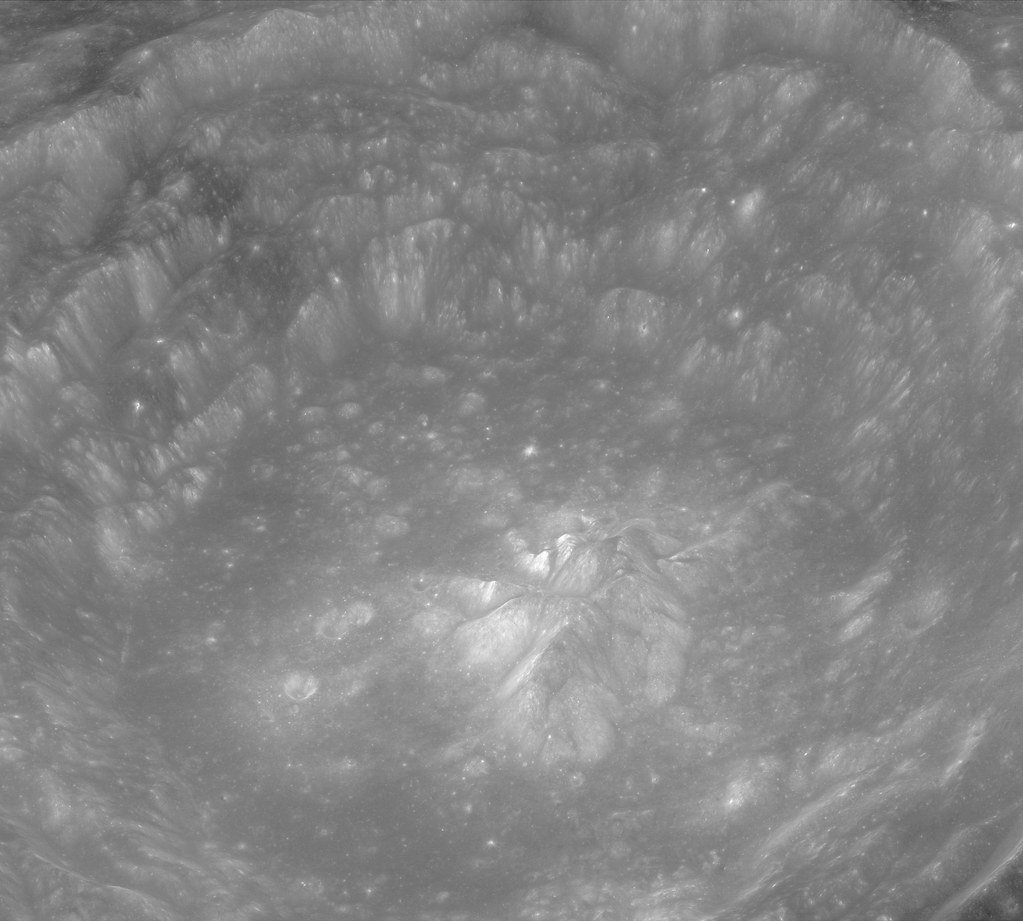
| The lunar crater Bullialdus (20.7° S, 22.2° W; 60 km diameter), with water-bearing minerals identified in the central peaks. Clementine false-color composite over LROC WAC monochrome mosaic base [NASA/DOD/GSFC/ASU]. |
Paul D. Spudis
The Once and Future Moon
Smithsonian Air & Space
Smithsonian Air & Space
Generally speaking, I hate “mop up” posts wherein stories, anecdotes, factoids and announcements are lumped together solely for the purpose of clearing the writer’s desk. But that’s what I have here, so let’s get on with it.
Despite being written off by many as a dead letter topic, the Moon (an object of scientific and commercial interest and utility) continues to confound experts and frustrate naysayers.
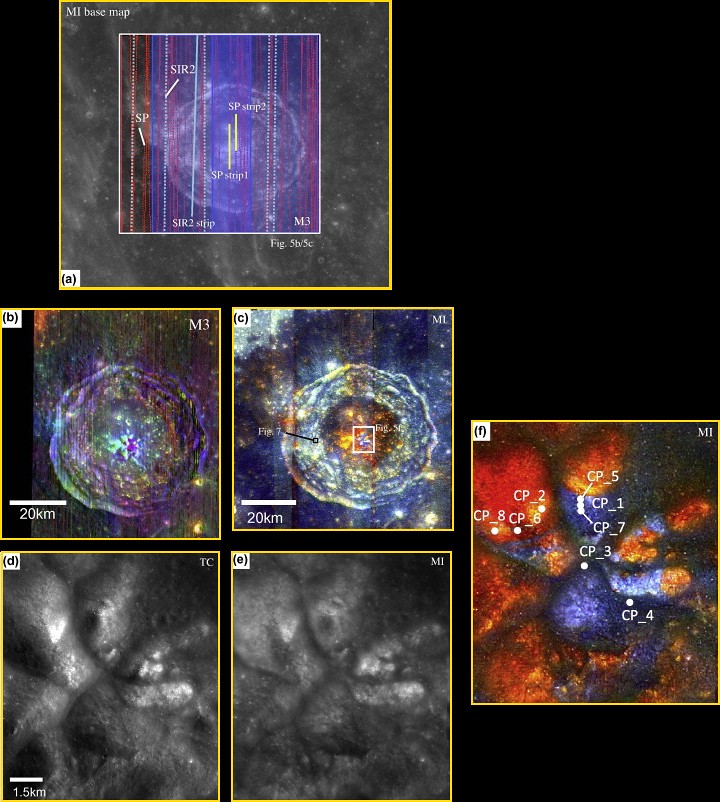
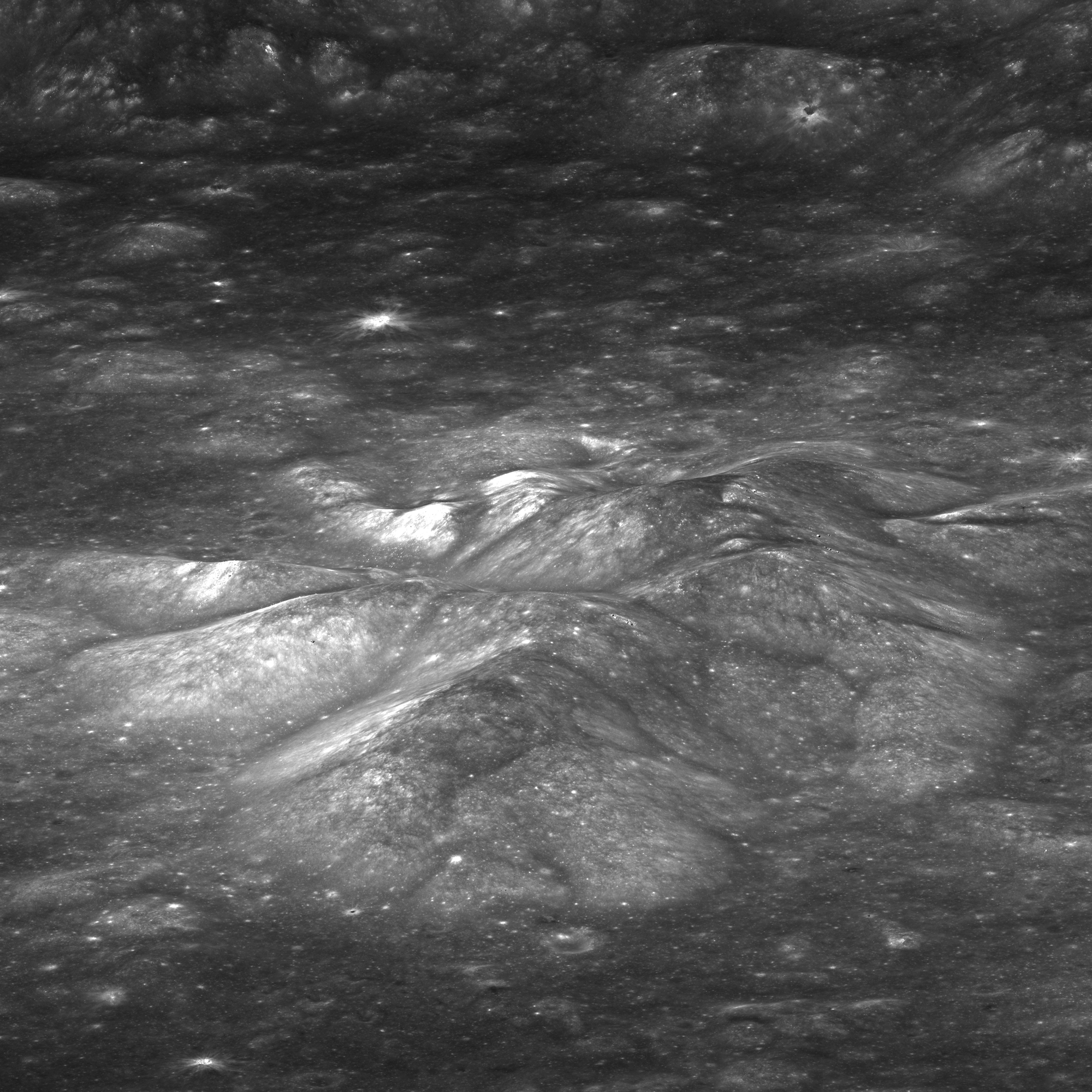
You may have recently learned about yet another discovery of lunar water. The “new” this time around is that we have apparently succeeded in identifying a form of hydration (i.e., the OH molecule) present in mineral structures in the central peak of the mid-latitude crater Bullialdus (20.7° S, 22.2° W; 60 km diameter). Past identifications of lunar water involve either the polar dark regions or high-latitude, solar wind implanted OH and H2O molecules.
We’ve known about water-bearing minerals in the lunar samples for the past couple of years, but this is the first time we have identified them using remote sensing. This water is present in extremely minute amounts (tens of parts per million); it has nothing to do with the possibility of extracting water for human use, but rather, is a clue to the hydration state of the deep interior, and ultimately, the origin of the Moon.
We are finding that the early Moon had its own indigenous water, not an obvious consequence of the giant impact origin model, and that this water participated in early melting events. Water is an important compound in these processes by lowering the threshold temperatures of various significant reactions and creating an environment in which explosive, volatile-charged volcanic eruptions may occur. Work continues on understanding the meaning and significance of this interior water to the geological processes of the Moon.
The latest edition of the Global Space Exploration Roadmap has been released and to the astonishment of the press and many other observers, human lunar return is still prominently featured (minus NASA) in the strategic pathways considered by the world’s space agencies. This shouldn’t really surprise anyone – the international partners were taken aback (and angered) by the unilateral renunciation of lunar return by the U.S. in 2010. They have remained firm and consistent in their belief and knowledge that the Moon is a critical step toward developing genuine space faring capability, a path which they have no intention of abandoning. In this, our partners show more insight and sophistication than we do. There are simply too many advantages in developing technology and practicing operational skills on the Moon, all applicable to future human missions beyond low Earth orbit. In a sop to the reluctant Americans, human near-Earth asteroid missions are mentioned. But in the minds of the international partners, the benefits of human lunar return will not be subsumed by a domestic political agenda.
I am an occasional member and contributor to the Lunar Exploration and Analysis Group (LEAG), an informal working group of lunar scientists, engineers and developers who have devised a “roadmap” (i.e., a sequenced, strategic plan) for lunar exploration. This roadmap has been completed and we have developed a couple of ancillary products – an executive summary booklet (being readied for distribution), which will describe the major findings of the three-year road mapping exercise. It will be illustrated by wonderful Technicolor artwork of missions and surface activities (the creation of pretty pictures and graphics we have down pat), and a one-page “fact sheet” describing the value and rationale for human lunar return. The compact fact sheet is particularly good. It summarizes the main points about lunar return, its value to the nation and to science and society in general. This roadmap follows a lot of the concepts about which I write. If you visit Develop Cislunar Space Next, you will recognize many of the same themes and ideas. I am very happy with this product; it is concise and well crafted. I thank my LEAG colleagues for their scientific insight and technical acumen.
About 15 years ago, I wrote a reasonably well-received book published by the Smithsonian Institution Press titled The Once and Future Moon. In it I described the then-recent findings from the Clementine and Galileo missions about the Moon’s processes and history, and summarized what we had learned about the Moon from the Apollo missions. I also took the opportunity to make the case for a return to the Moon (some things never change) and how we might use it to create new capabilities in space. That book is now out of print, as well as rendered somewhat antiquated by the explosion this last decade of new information from data returning from lunar robotic missions and subsequent studies. Many have urged me to revise that book and I am considering writing an updated second edition. Unfortunately, the Smithsonian Press terminated their “Library of the Solar System” series and is not interested in publishing a new edition (but will give me copyright to the material). I am investigating the interest of other publishers and will keep you posted on what develops.
Next – an announcement. For some time I have watched the progress of many of the Google Lunar XPRIZE competitors. It’s a mixed bag, with some teams pretty much out of the running and some who have a decent chance to actually fly a mission. I have been very impressed with the team and the approach of one company, Moon Express (MoonEx), located at NASA Ames Research Center in California. Moon Express has plans for small and medium class lunar landers, using a soon-to-be-unveiled design that seems both robust and affordable. I have agreed to be associated with them on a part-time basis as their Chief Scientist. As such, I will evaluate possible mission scenarios and profiles, devise sample payloads, identify possible instruments and their investigators and vendors, and help define measurement requirements and operational scenarios.
I like working with small missions (my first mission experience was with Clementine (1994) a small DOD-NASA mission, and I was the Principal Investigator for the Mini-SAR radar experiment on India’s Chandrayaan-1 mission) and believe that these small missions deliver a lot of scientific and exploratory bang for a reasonably small amount of bucks. I have worked previously on projects with some of the Moon Express personnel, including Principal Systems Engineer Steve Bailey on the world’s first private lunar lander project (Blastoff.com in the late 1990s) and with CEO Bob Richards, when we were both affiliated with Odyssey Moon a few years ago. I am also happy that my longtime colleague and NASA Advisory Council member Jack Burns has joined the company on a similar part time basis as Chair of the Moon Express Science Advisory Board. I look forward to helping Moon Express achieve their goal of winning the Google Lunar XPRIZE and developing a truly commercial system to deliver payloads to the Moon.
Look for an article on the origin of the Moon written by yours truly, coming soon to a special web-based edition of Astronomy magazine. I’ll post the information when it appears. My recent post here at Air & Space describes the call for small lunar lander missions. The last of the (currently planned) NASA missions to the Moon (was launched Friday, September 6, 2013. Here’s wishing LADEE a safe, successful and productive journey.
So I’m happy to report that there are signs of “life” about our future on the lunar frontier.
Related Posts:
More water at lunar equator, hints of water below (August 27, 2013)
GSFC releases LEND lunar water demonstration (June 3, 2013)
Earth and Moon share primal water source (May 10, 2013)
Water found in the Apollo 15 'Genesis Rock' (February 19, 2013)
Bullialdus central peak oblique (January 23, 2013)
Reflecting on the ice of Mercury and the Moon (December 3, 2012)
Water from the Sun (October 17, 2012)
Central peak of Bullialdus (May 12, 2010)
Despite being written off by many as a dead letter topic, the Moon (an object of scientific and commercial interest and utility) continues to confound experts and frustrate naysayers.
You may have recently learned about yet another discovery of lunar water. The “new” this time around is that we have apparently succeeded in identifying a form of hydration (i.e., the OH molecule) present in mineral structures in the central peak of the mid-latitude crater Bullialdus (20.7° S, 22.2° W; 60 km diameter). Past identifications of lunar water involve either the polar dark regions or high-latitude, solar wind implanted OH and H2O molecules.
We’ve known about water-bearing minerals in the lunar samples for the past couple of years, but this is the first time we have identified them using remote sensing. This water is present in extremely minute amounts (tens of parts per million); it has nothing to do with the possibility of extracting water for human use, but rather, is a clue to the hydration state of the deep interior, and ultimately, the origin of the Moon.
We are finding that the early Moon had its own indigenous water, not an obvious consequence of the giant impact origin model, and that this water participated in early melting events. Water is an important compound in these processes by lowering the threshold temperatures of various significant reactions and creating an environment in which explosive, volatile-charged volcanic eruptions may occur. Work continues on understanding the meaning and significance of this interior water to the geological processes of the Moon.
The latest edition of the Global Space Exploration Roadmap has been released and to the astonishment of the press and many other observers, human lunar return is still prominently featured (minus NASA) in the strategic pathways considered by the world’s space agencies. This shouldn’t really surprise anyone – the international partners were taken aback (and angered) by the unilateral renunciation of lunar return by the U.S. in 2010. They have remained firm and consistent in their belief and knowledge that the Moon is a critical step toward developing genuine space faring capability, a path which they have no intention of abandoning. In this, our partners show more insight and sophistication than we do. There are simply too many advantages in developing technology and practicing operational skills on the Moon, all applicable to future human missions beyond low Earth orbit. In a sop to the reluctant Americans, human near-Earth asteroid missions are mentioned. But in the minds of the international partners, the benefits of human lunar return will not be subsumed by a domestic political agenda.
I am an occasional member and contributor to the Lunar Exploration and Analysis Group (LEAG), an informal working group of lunar scientists, engineers and developers who have devised a “roadmap” (i.e., a sequenced, strategic plan) for lunar exploration. This roadmap has been completed and we have developed a couple of ancillary products – an executive summary booklet (being readied for distribution), which will describe the major findings of the three-year road mapping exercise. It will be illustrated by wonderful Technicolor artwork of missions and surface activities (the creation of pretty pictures and graphics we have down pat), and a one-page “fact sheet” describing the value and rationale for human lunar return. The compact fact sheet is particularly good. It summarizes the main points about lunar return, its value to the nation and to science and society in general. This roadmap follows a lot of the concepts about which I write. If you visit Develop Cislunar Space Next, you will recognize many of the same themes and ideas. I am very happy with this product; it is concise and well crafted. I thank my LEAG colleagues for their scientific insight and technical acumen.
About 15 years ago, I wrote a reasonably well-received book published by the Smithsonian Institution Press titled The Once and Future Moon. In it I described the then-recent findings from the Clementine and Galileo missions about the Moon’s processes and history, and summarized what we had learned about the Moon from the Apollo missions. I also took the opportunity to make the case for a return to the Moon (some things never change) and how we might use it to create new capabilities in space. That book is now out of print, as well as rendered somewhat antiquated by the explosion this last decade of new information from data returning from lunar robotic missions and subsequent studies. Many have urged me to revise that book and I am considering writing an updated second edition. Unfortunately, the Smithsonian Press terminated their “Library of the Solar System” series and is not interested in publishing a new edition (but will give me copyright to the material). I am investigating the interest of other publishers and will keep you posted on what develops.
Next – an announcement. For some time I have watched the progress of many of the Google Lunar XPRIZE competitors. It’s a mixed bag, with some teams pretty much out of the running and some who have a decent chance to actually fly a mission. I have been very impressed with the team and the approach of one company, Moon Express (MoonEx), located at NASA Ames Research Center in California. Moon Express has plans for small and medium class lunar landers, using a soon-to-be-unveiled design that seems both robust and affordable. I have agreed to be associated with them on a part-time basis as their Chief Scientist. As such, I will evaluate possible mission scenarios and profiles, devise sample payloads, identify possible instruments and their investigators and vendors, and help define measurement requirements and operational scenarios.
I like working with small missions (my first mission experience was with Clementine (1994) a small DOD-NASA mission, and I was the Principal Investigator for the Mini-SAR radar experiment on India’s Chandrayaan-1 mission) and believe that these small missions deliver a lot of scientific and exploratory bang for a reasonably small amount of bucks. I have worked previously on projects with some of the Moon Express personnel, including Principal Systems Engineer Steve Bailey on the world’s first private lunar lander project (Blastoff.com in the late 1990s) and with CEO Bob Richards, when we were both affiliated with Odyssey Moon a few years ago. I am also happy that my longtime colleague and NASA Advisory Council member Jack Burns has joined the company on a similar part time basis as Chair of the Moon Express Science Advisory Board. I look forward to helping Moon Express achieve their goal of winning the Google Lunar XPRIZE and developing a truly commercial system to deliver payloads to the Moon.
Look for an article on the origin of the Moon written by yours truly, coming soon to a special web-based edition of Astronomy magazine. I’ll post the information when it appears. My recent post here at Air & Space describes the call for small lunar lander missions. The last of the (currently planned) NASA missions to the Moon (was launched Friday, September 6, 2013. Here’s wishing LADEE a safe, successful and productive journey.
So I’m happy to report that there are signs of “life” about our future on the lunar frontier.
Related Posts:
More water at lunar equator, hints of water below (August 27, 2013)
GSFC releases LEND lunar water demonstration (June 3, 2013)
Earth and Moon share primal water source (May 10, 2013)
Water found in the Apollo 15 'Genesis Rock' (February 19, 2013)
Bullialdus central peak oblique (January 23, 2013)
Reflecting on the ice of Mercury and the Moon (December 3, 2012)
Water from the Sun (October 17, 2012)
Central peak of Bullialdus (May 12, 2010)
Originally published September 5, 2013 at his Smithsonian Air & Space blog The Once and Future Moon, Dr. Spudis is a senior staff scientist at the Lunar and Planetary Institute. The opinions expressed are those of the author but are better informed than average.