As secondary payload with GRAIL, LADEE will join a short-lived flotilla of Discovery satellites sampling the tenuous sodium-ion atmosphere of Earth's Moon and help solve the mysteries of the MasconsThursday, April 10, 2008
Small LADEE will skim for lunar dust in September 2011
As secondary payload with GRAIL, LADEE will join a short-lived flotilla of Discovery satellites sampling the tenuous sodium-ion atmosphere of Earth's Moon and help solve the mysteries of the MasconsNo Retreat from Tomorrow
Without question, the best commentary inspiring of perspective, meditation, and sound thought on present day space exploration is The Space Review. It makes no claim of being the repository of the best archives or science, but what it does provide is didactic in the form of good writing and timely, well-informed commentary. It is always difficult to recommend which article of the week needs to be read first. But for entertainment's sake, I turned first today to They were warned, by Taylor Dinerman.Mr. Dinerman's piece reminded me that Congress was not the only group to be warned, over and over, of the inevitable end of the Space Shuttle, and "The Gap" looming ahead for workers at KSC and JSC particularly. The rest of us were warned, also. And ultimately, Congress derives its power from you and me. We, too, were warned, and the fate of NASA's worker and plant investments are ultimately our responsibility, and not only the responsibility of the next president or, more importantly, the Congress.
One rare example of representative government being successful at long-term planning was the Apollo program, and it's sustained, persistent and ultimately successful manned lunar landings.
It is astounding this funding was sustained from the 86th Congress through the 92nd, through six congressional elections.
Those of us experienced with this sorts of things often say your average legislator "has the attention span of a circus monkey."
It was not always this way, but in modern times, as you might expect of what is still the most productive nation on Earth, Congress has "a lot on its plate," and, for good or ill, they are required to be extraordinary people (or must surround themselves with extraordinary people) just to keep their reception schedule straight.
Congress costs us more than a billion dollars per year to operate, prioritizing new and more clever ways to define their generosity by its prior claim on our paychecks.
Not because it plays well at home. The folks back home, especially those impacted by the loss of real jobs, their own jobs, ahead, with the $500 million retirement of Atlantis, Discovery and Endeavour, have seen it coming for a long time.
As hard as it might be to believe, the outrage and squeals you've been hearing from the Florida delegation in Washington reflects genuine surprise, or at very least a purposeful tone of rhetoric those using it hope will arouse their colleagues and boost the signal over the unprecedented noise level to be heard in the marketplace.
NASA is a creature of Congress, after all. For the rightful credit given John Kennedy for Apollo, Lyndon Johnson was more influential in his desire not to "sleep by the light of a communist moon" when he lead the U.S. Senate in 1957 that gave birth to NASA fifty years ago. He was the reason the Vice President, serving in that role under President Kennedy, is still chairman of the National Space Council (and why Dan Quayle, in that same role sixteen years after Johnson's death, prevailed upon NASA to restore the traditional blue "meatball" as its logo, setting aside the "snake" of the 1980's).
Lyndon Johnson was the most successful president in history in getting his agenda passed in Congress, even if his Civil Rights initiative required Republican votes to win out over the opposition of southern Democrats. Mercury, Gemini and through the Apollo 1 fire in January 1967, in 1968, less than a month before he left office, the crew of Apoll0 8 became the first men to leave Earth orbit and return from the Moon.
I credit President Johnson not to raise sympathy for an admittedly enigmatic historic figure or to claim this friend of my father was misunderstood or his historic role under-appreciated, though with regard to Apollo, it clearly was and is.
I'm as ambivalent toward this man as the next guy.
My point is to cast light on an often hidden reality about the exercise of real political power, the kind that escalates an increasingly unpopular war, declares another "unconditional war on poverty," and shepherds Civil Rights legislation, bill after bill, through an increasingly hostile Congress.
Ronald Reagan understood the principle, having on his desk the engraved words, "Anyone can get anything done if they don't care who gets the credit."
Ronald Reagan was a product of Labor and Hollywood, however. Lyndon Johnson was a creature of Congress, like NASA, and he never really quit being the Senate's majority leader until he left Washington physically and politically exhausted and handed it all over to the neo-socialist anti-communist and equally complex Richard Nixon in January 1969.
In the "vesting clause" of the U.S. Constitution, we read, "All legislative Powers herein granted shall be vested in a Congress of the United States..."
For all the concern united in the election of the American President, it is just a president, after all, that will also be elected this year, along with the next Congress, where all the money and power originates. Divided as it is among 538 accidents and Alphas, both men and women, it is the embodiment of the apparent chaos of representative government.
"Find a better country," as they say. (Good luck with that.)
When decisions are made about "ramping up" or eliminating Constellation after the election in November, it will not be an expression of the charisma of the next president. The decision will be made by the lumbering sausage factory on Jenkins Hill in the Potomac swamp.
No building inside the limits of the District of Columbia can be built higher than the U.S. Capitol Dome for a reason. That's where decisions are made about what should actually be done, and how, with that prior claim on your wages.
Rather than ask Senators Obama, Clinton or McCain their positions on Constellation or COTS or the very real threat of regulation of NewSpace when you exercise the responsibility of casting your federal ballot, it might be a better idea to know what your congressional representatives plan to do when the 111th Congress convenes next January.
Better still, why not clue them in on what you want them to do.
Wednesday, April 9, 2008
Minton wins 2008 Kuiper Memorial Award
Science CentricMinton's paper will appear in the international planetary science journal Icarus.
Astrium to acquire SSTL

Tuesday, April 8, 2008
Boston's iSHOE wins Lunar Ventures Eighth Continent Business Plan Competition
On March 30, Lunar Venture's 8th Continent Blog featured a posting critical of the Denver Post for lumping NewSpace organizations with political player powerhouses in being "busy behind the scenes" lobbying presidential candidates to support NASA after the November elections in the United States.This morning, the Post's dBusinessNews features a press release announcing the Colorado Springs-based Lunar Ventures had awarded Boston's iSHOE had won their Second Annual $50,000 prize for younger NewSpace teams. It's the local Power Daily newspaper, anyway, so what can anyone say but, "down one day, up the next."
Even so, iSHOE faces immediate problems with Apple and Nike, two OldInnerSpace giants for branding rights to the name "iSHOE." Both multi-nationals joined recently to create a designer sneaker than might actually be worth the name brand price, which include - an iPod, apparently. That sure is a stinky computer, you've got -- can you put them back on?
GOLDEN Boston start-up iShoe wins $50,000 in cash and support services in the 8th Continent Project’s second annual Lunar Ventures business plan competition and secures a spot in the Global Moot Corp Competition for the potential to win $100,000 in prizes.
iShoe builds on NASA-developed technology originally created to help detect balance problems in astronauts returning from space. Theresa Tribble from Harvard University, and Erez Lieberman from the Harvard-Massachusetts Institute of Technology Division of Health Science and Technology, created the iShoe insole to detect balance disorders for everyday people, potentially preventing serious falls. Besides tracking balance inequities, iShoe’s technology serves an even greater purpose for the elderly or disabled – the ability to automatically signal a caregiver in case of an accident such as a fall or slip.
"iShoe represents an important component to the Space 2.0 equation – taking existing space derived technology developed by NASA and making it viable for emerging, Earth-based applications," said Burke Fort, director of the 8th Continent Project at the Colorado School of Mines. "Each Lunar Ventures team provides a glimpse of what the coming era of space business is going to look like, and the very real possibilities for the next wave of development and practical applications of existing and emerging technologies."
Pyramid Technologies, the runner-up in the 2008 Lunar Ventures competition, is the MIT-based developer of a revolutionary, cost-effective space propulsion system for Earth-orbiting satellites. Its Electrospray technology also is immediately useful for high-precision semiconductor production. Pyramid currently is a semifinalist in the esteemed MIT $100K Entrepreneurship Competition.
This year’s competition featured finalists from Massachusetts Institute of Technology, Harvard University, Utah State University, Purdue University, Johns Hopkins University and Boston University. Business plans employed space technology that varied from satellite-derived positional data applications, biomass-to-electricity technology, low-water-content concrete for lunar and arid location Earth construction, and an unparalleled digital library of satellite data and telemetry.
“iShoe and Pyramid Technologies join the 2007 Lunar Ventures winner Lumedyne Technologies as well as the many 8th Continent Project Founding Sponsors in defining Space 2.0 and leading the vision of our future,” Fort added.
Competing university teams from around the world developed their concepts during the 2007 fall semester, and submitted their business plans to a panel of judges with both technical and business expertise. The judges selected 6 finalist teams to compete for the cash prize and additional services, including legal advice from the IP law firm Townsend and Townsend and Crew, to help launch their ventures, and an automatic entry in the $100,000 Global Moot Corp Competition.
About the 8th Continent Project
"Based out of Golden, Colorado, the Colorado School of Mines’ 8th Continent Project is the world’s most comprehensive effort to integrate space technology and resources into the global economy. The 8th Continent provides the infrastructure and resources to solve a wide range of challenges from renewable energy development to biomedical advances to global security. Located in Colorado, home of one of the most concentrated entrepreneurial, investor and aerospace talent communities in the world, the 8th Continent Project brings space down to Earth with the industry’s first trade association, business incubator, funding network and research center, all working together to develop the next generation of space-related business ventures. More information can be found at www.8cproject.com."
For more information on Lunar Ventures, please visit www.8clunarventures.com.
Korea Heads to Outer Space
Korea's first astronaut Yi So-yeon embarks on her important mission into outer space Tuesday. At 8 p.m. on April 8 (Korea Standard Time), a Russian Soyuz spacecraft carrying Yi will begin its final countdown at a launch site in Kazakhstan. Following a 50-hour flight into space, Yi will stay for 10 days at the International Space Station, orbiting the Earth at an altitude of 350 km, where she will conduct various scientific experiments.
With the launch, Korea will become the world's 35th country to produce an astronaut. It's a bit late for a country boasting the world's 13th largest economy, but the significance of the event is huge nonetheless. Yi was chosen as the final candidate after a nationwide search. The entire 49 million population of South Korea has come together in heart and mind, watching the full process of Yi's selection to her ascent aboard the spacecraft. She carries with her the dreams and ardent wishes of her people toward space.
In June of this year, the Naro Space Center opens in Goheung County, South Jeolla Province. And come December, a homegrown rocket will deliver Korea's second scientific satellite into orbit. If successful, Korea will become the ninth country in the world to launch a satellite using its own technology. 2008 will open a new era in space exploration for Korea.
But we still have a long way to go. Our neighbors Japan and China launched lunar exploration satellites into orbit last year. India will soon follow suit. China is also the third country in the world to succeed in launching a manned spacecraft using its own technology. Korea plans to send a lunar exploration module in 2020, while a launch of a manned Korean spacecraft is unthinkable thus far.
Countries around the world are joining the space race for reasons that go beyond national pride. It's because of the spill-over effect such endeavors have on a country's economy, as well as its science, technology, military and national security.
Most of all, Yi will be the best teacher who can widen the dreams of Korean children, so they may expand them into outer space. Her will to take on new challenges, to explore new things and to accomplish the mission set before her will leave an indelible mark on the minds of our children, so they may have the courage to take on new challenges and realize infinite new possibilities.Wired Science "Americans find out NASA's going back to the moon"
It's difficult to judge which is more annoying, or disturbing. The unabashed cheerleading from someone who hasn't apparently experienced a program shutdown (and thinks the United Nation's will somehow help) or the cynical and smarmy 60 Minutes crew. (Pssst. Leslie. 1970 just called... they want their news of record back...)
SpaceGen
Sunday night 60 Minutes ran an 11-minute piece on NASA's new Constellation program to return men to the moon — and send women for the first time — and how those missions will help prepare for eventual trips to Mars. (O.K., 60 Minutes didn't talk about sending the first women to the moon but it is true.)
Though we won't see Americans returning to the moon till at least 2020, the program said that new "space suits are being tested, rockets are being fired, and capsules are being designed."Gene Cernan, the last man to walk on the moon, said that NASA is returning to the "romance of space." Extra points to Gene for bringing love and emotion to space exploration.
The new Ares rocket won't be ready till 2015. Without both the Ares I (for crew) and the larger Ares V (for cargo), America does not have the rocket power to go back to the moon. Why? Because the mighty Saturn V (think circa-1985 MTV interstitial) was mothballed during the Nixon administration. NASA administrator Michael Griffin said, "That has to rank as one of the colossal mistakes in history." He also said something that was music to my ears: "Americans are bored by the space program, because NASA has run a boring space program."Continue reading "Americans Find Out NASA Is Going Back to the Moon" »
"A Bigger Leap for Mankind" (60 Minutes)
Lunar Science Institute readies for Grand Opening April 11 at NASA Ames
The NASA Lunar Science Institute is modeled after the NASA Astrobiology Institute, also managed at Ames, and will features teams of scientists across the country collaborating in lunar science and future lunar exploration.
The dedication will take place at Building 17, located on South Akron Road at McCord Avenue, NASA Ames Research Center, Moffett Field in California begining 2130 UT, the ribbon cutting ceremony will be at 2330.
Media invited will have access to NASA Ames Research Center Director S. Pete Worden, NASA Lunar Science Institute Interim Director David Morrison, and James Green, director of the Planetary Science Division at NASA Headquarters in Washington.
Also expected to attend are three members of the U.S. House: U.S. Reps. Anna Eshoo (D-CA), Michael Honda, (D-CA) Zoe Lofgren, (D-CA).
By late 2008, about 50 researchers around the U.S. could be working under NLSI's banner. By 2010, that number could double. Funds for this effort are part of the president's proposed 2008 NASA budget for the lunar science project within the planetary research program, now under consideration in Congress.
"We're delighted NASA Ames was chosen to lead this exciting new lunar science research office," said S. Pete Worden, Ames center director. "This will complement the agency's ongoing lunar research and further the implementation of the nation's exploration efforts."
http://lunarscience.arc.nasa.gov/
Monday, April 7, 2008
Venture capital dries up for high-tech
Ares I "shakes are manageable"

Carolyn Gramling
GeoTimes
NASA’s Constellation team, which is still completing designs for the spacecraft that will take astronauts back to the moon, discovered the problem last October. Computer models of the propulsion system for Ares I showed that it was likely to shake violently during takeoff. How powerful the vibration would be was unclear — but the shaking could cause structural problems for the rocket and the crew vehicle, and could also be hazardous to the astronauts’ health.
On Thursday, however, NASA scientists had good news: The shaking problem is “a significant but very manageable issue,” said Steve Cook, the manager of Ares Projects at NASA’s Marshall Space Flight Center in Huntsville, Ala.
The problem itself — called “thrust oscillation” — is not unique to Ares I; it was also an issue in the design of the rockets used to launch the space shuttles. “It’s characteristic of solid rocket motors,” and occurs as a pulsing of the thrust late in the burn of the rocket's first stage, said Garry Lyles, the associate director for technical management at NASA’s Marshall Space Flight Center. Within the motor, swirling blasts of air create eddies. Those eddies then vibrate at a certain frequency, which is related to how long it takes for a pressure wave to travel from one end of the motor to the other. The vibrating phenomenon is similar to a musician blowing a horn: When done just right, the horn will resonate with sound.
That’s a known phenomenon. But problems arise when the rocket itself happens to naturally resonate at the exact same frequency as the motor, Lyles said. One way to describe their combined effect is like pushing a child on a swing, he said: “As the swing starts to go, if you push your child at just the right [point], you can really get him going high. If you time it wrong, he won’t go as high.” Similarly, when a motor and vehicle both resonate at the same frequency, it takes very little force for the vehicle to vibrate.
To study the issue, NASA assembled a team to first determine whether the problem was as serious as it appeared, and second to determine how to mitigate it. They found that the thrust oscillation didn’t strongly affect the structure of the rocket, which was sturdy enough to withstand stronger forces, Lyles said. The worst impact would be on the crew, which is “the most sensitive,” he said. Although the oscillation period would last only a few minutes, “we have to get the crew vibration down to a level well below the health limit.” Ideally, he added, the vibration would be low enough that the crew would be able to perform tasks during the launch, including being able to read the console.
To do that, the team proposed two plans. The first would be to determine whether it is possible to alter the design of the rocket enough to change its own natural frequency. Adjusting the design so that the motor and vehicle don’t resonate at similar frequencies would bypass the problem altogether. The second mitigation option would be to add some “mass dampers” into the design — essentially, shock absorbers that would counteract the vibrations of the vehicle. That gets tricky, however, because engineers don’t want to add additional mass to the rocket; therefore, including shock absorbers could mean removing some mass elsewhere within the vehicle. For now, NASA plans to include the mass dampers, while still tinkering with the vehicle’s design to “detune” it — hopefully altering its natural frequency so that it no longer matches the frequency of the motor. If that works, it may be that the shock absorbers won’t end up being necessary, and at that point they’ll be taken out, Lyles said.
“We have a set of solutions to move forward,” Cook said. “We have a great understanding of [the problem] and we know how we want to deal with it. It’s not a showstopper.”
For more on NASA’s return to the moon, check out Geotimes next month.
Wikipedia POD: April 4
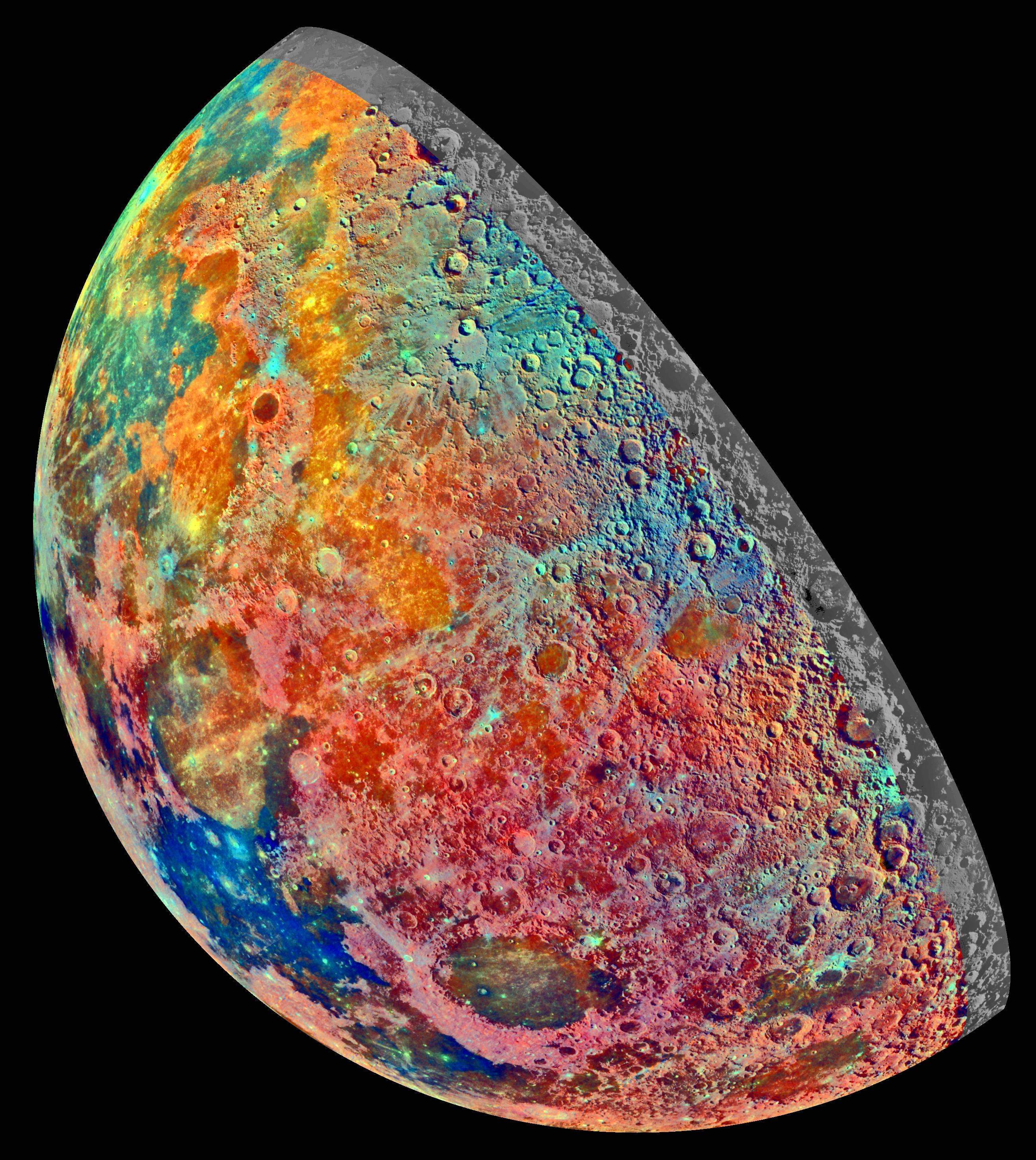
This false-color mosaic was constructed from a series of 53 images taken through three spectral filters by Galileo's imaging system as the spacecraft flew over the northern regions of the Moon on December 7, 1992. The part of the Moon visible from Earth is on the left side in this view. The color mosaic shows compositional variations in parts of the Moon's northern hemisphere. Bright pinkish areas are highlands materials, such as those surrounding the oval lava-filled Crisium impact basin toward the bottom of the picture. Blue to orange shades indicate volcanic lava flows. To the left of Crisium, the dark blue Mare Tranquillitatis is richer in titanium than the green and orange maria above it. Thin mineral-rich soils associated with relatively recent impacts are represented by light blue colors; the youngest craters have prominent blue rays extending from them. The monochrome band on the right edge shows the unretouched surface of the moon. The Galileo project, whose primary mission is the exploration of the Jupiter system in 1995-97, is managed for NASA's Office of Space Science and Applications by the Jet Propulsion Laboratory.Source: http://photojournal.jpl.nasa.gov/jpeg/PIA00131.jpg
TIFF Version: http://photojournal.jpl.nasa.gov/tiff/PIA00131.tif
NASA Photojournal Catalog Page: http://photojournal.jpl.nasa.gov/catalog/PIA00131
Sunday, April 6, 2008
Athletic Teamwork
Of a Garden on the Moon, Part 1
Ken MurphyOut of the Cradle
Archives
One of the key questions for early Lunar selenologists was whether or not the regolith of the Moon could support life. The results were pretty conclusively no, as most of the elements that we consider important for life such as carbon and nitrogen are scarce to be found. This would seem to make the Moon a pretty rotten place to try to grow plants, but there’s a strong likelihood that the Moon could turn out to be a fantastic place to grow the plants of Earth.
Early settlers are going to be looking to go deep underground on the Moon, with lots of rock above them to protect them from the vacuum and radiation. This does not mean that Moon dwellers will end up as troglodytes, as modern technology has given us many tools to work with that can help us create a subselenian paradise on the Moon.
While early plans for a Moonbase typically settled for an near-equatorial location to help keep the orbital mechanics easy and resupply cheap, newer ways of looking at how we return to the Moon, such as using an Earth-Moon L-1 platform as a staging location, are giving increasing consideration to polar locations. The difficulty of access is offset by what appears to be large supplies of hydrogen (in some form, currently unknown but hoped to be water) in the everdark craters at the North and South poles. There appears to be more at the North pole, but the more rugged terrain of the South pole, perched on the rim of the Aitken Basin, offers more interesting opportunities.
Irish Students preview Kaguya (Selene) HD
‘‘"When (Harrison ‘Jack’) Schmitt saw this new Japanese footage, he said that, since he walked on the moon, this screening was as close as he’d experienced to being on the moon,” he said.
Saturday, April 5, 2008
Evansville, IN students take college division in the Great Moon Buggy Race
Angela StoreyMarshall Space Flight Center, Huntsville
(256) 544-0034
angela.d.storey@nasa.gov
Friday, April 4, 2008
Google X-Prize Update
March was a great month for the Google Lunar X PRIZE. We’ve highlighted some of the prize’s recent successes below, but, as always, check out www.googlelunarxprize.org for team updates and other information.Space Florida – New Preferred Partner
Space Education
National Science Teachers Association National Conference on Science Education
2008 Botball Design Challenge
Team Summit
The Google Lunar X PRIZE Online Presence
India planning manned moon flight ~ 2015
"The report also speaks about collaborations and creating teams for coordinating the mission," Nair told reporters, Indo-Asian News Service reports.
"On India's space programmes," Nair said "ISRO would undertake 70 missions during 2007-2012."
More on NRL's Lunar Athlete Rover
While I've written before of the U.S. Navy's Athlete, a dexterous, long distance and freight-handling robotic walking lunar rover, under development by the Naval Research Laboratory in cooperation with the Massachusetts Institute of Technology, I thought I'd be reading of something quite different when teased by a passing headline a short time ago. Dumbed-down summary of thrust oscillation fix, GAO criticisms for Ares I
Dead center of this image taken by ESA's SMART-1 is a good spot for landing, if you want to investigate that swath of acreage along the one-quarter of the depths of Shackleton Crater that isn't ever touched by the sun. I really hated the stock images that have accompanied these dumbed down articles about the Ares 1, so I decided to post this important, if stark, CCD still instead.From The Chronicle Story, April 4:
"The design of the space shocks, theoretically similar to the equipment used to lessen the shake, rattle and roll on an off-road pickup, should be ready by fall for the Ares 1 rocket. The rocket, which also is in the design stage, will carry the Orion moon capsule into orbit by March 2015.
"Space agency officials outlined their strategy to dull the vibrations Thursday following congressional hearings in Washington and the release of a critical report by the Government Accountability Office. Lawmakers at a House subcommittee's hearing joined GAO auditors in expressing new concerns about the rocket's design and development. Some questioned whether the agency can realize its goal to return astronauts to the moon by 2020.
"In the Senate, some Republicans joined Democrats in calling for a $1 billion increase in the space agency's budget. They said the funds were needed to help NASA overcome technical obstacles and ensure the agency maintains a focus on climate studies, robotic science missions and aeronautics."