Showing posts with label blocks. Show all posts

Thursday, May 17, 2012

LROC: Multiple Flow Lobes

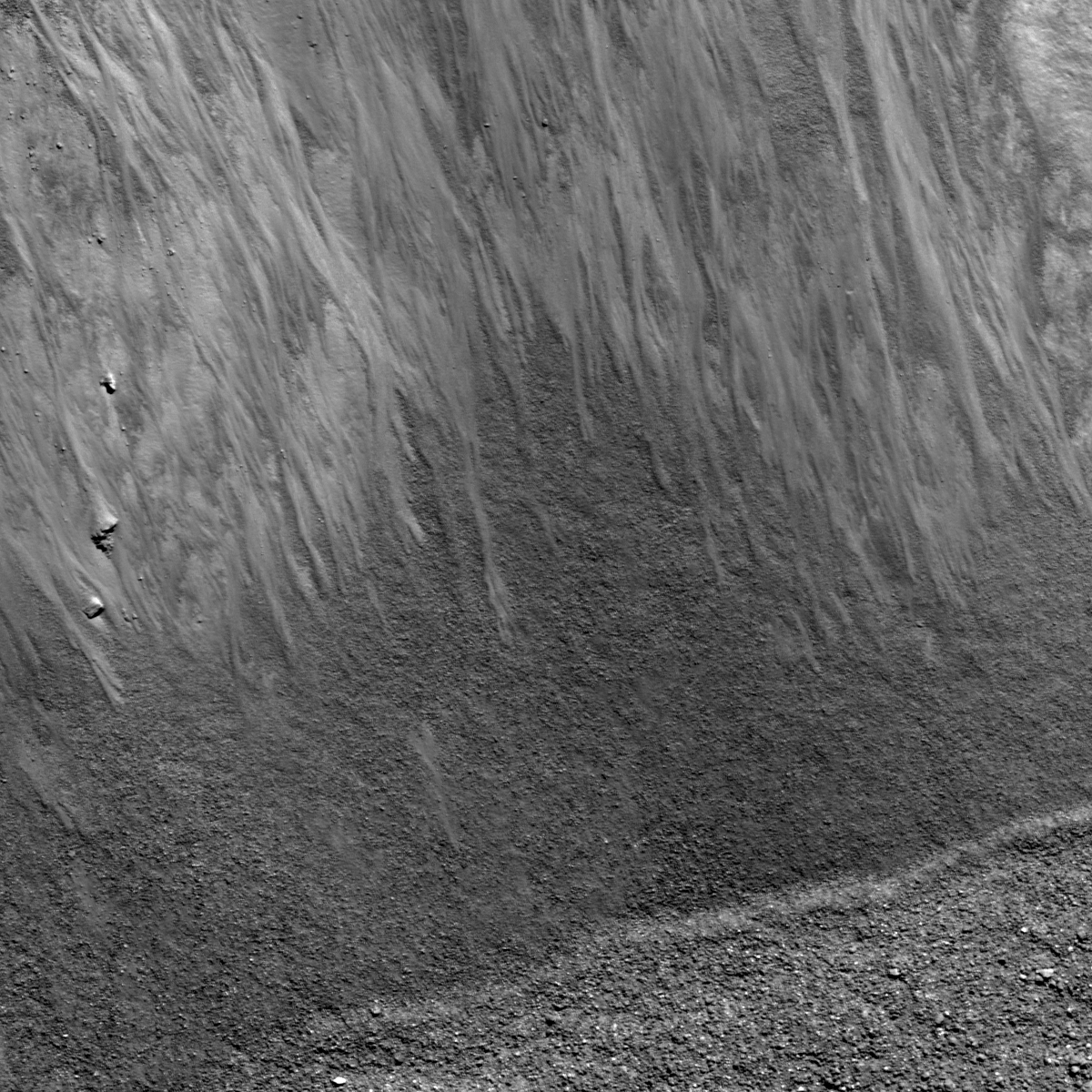
Multiple flow lobes on the northern interior slope of Furnerius A. Field of view 756 meters, LROC Narrow Angle Camera (NAC) observation M187848982R, LRO orbit 12747, March 31, 2012. Sunlight is from northeast, resolution 0.63 meters. View the 1200 x 1200 pixel LROC Featured Image, released May 17, 2012, HERE [NASA/GSFC/Arizona State University].

Hiroyuki Sato
LROC News System

Today's Featured Image highlights granular flows on the northern wall of Furnerius A crater (11.21 km in diameter), located between Mare Fecunditatis and the South Pole-Aitken basin. At the bottom of the image, a diagonal boundary delineates between the coarse blocky crater floor (relatively bright) and the still coarsely textured, but relatively darker surface, which is part of the sloping crater wall. From the top of the image extend a number of relatively bright granular flows. At the end of each flow, the flow lobe is visible against the darker, coarsely textured crater wall. Notice that the sunlight is from the right side, thus each flow unit is positive relief (not negative relief) on the top of preexisted slope.

Foreshortened contextual view of the Featured Image detailed within the 4.1 kilometer-across field of view swept up in LROC NAC frame M187848932R, March 31, 2012 [NASA/GSFC/Arizona State University].
These granular flow features are commonly observed inside the fresh crater walls on the Moon. Little by little slope failures degrade the steep walls, which enlarge the apparent diameters of the craters, as well as create shallower crater floors. Over long periods of time, small impacts also destroy any sharp relief features, and someday Furnerius A will be transformed into a crater like Furnerius C (left side crater in the image below). Since the Moon's surface has no water or wind weathering (erosion), the Moon is the best natural museum to learn about the long term evolution of crater forms.

Surrounding area of Furnerius A crater in WAC monochrome mosaic (100 m/pix). Image center is 33.49°S, 59.03°E. The locations of full NAC frame (blue box) and the area highlighted in the LROC Featured Image released May 17, 2012 (yellow arrow) are indicated [NASA/GSFC/Arizona State University].
Nearly the same field of view at a higher angle of incidence, perhaps a day after local sunrise (inclination angle 69.65°), reveals more relief, and with the addition of data derived from the LROC WAC Digital Terrain Model, Furnerius A is seen as being on the edge of Furnerius proper to the southeast. LROC Wide Angle Camera (WAC) observation M177251343 (604nm), LRO orbit 11257, November 30, 2011; resolution 69.7 meters from 51 kilometers [NASA/GSFC/Arizona State University].
Explore the beautiful flow lobes in the full NAC frame yourself! 

Related Posts:
Detour!
Lunar landslides!
Dark streaks in Diophantus crater
Rock avalanche in Robinson crater

Saturday, February 25, 2012

LROC: Impact melt boundary and Moltke

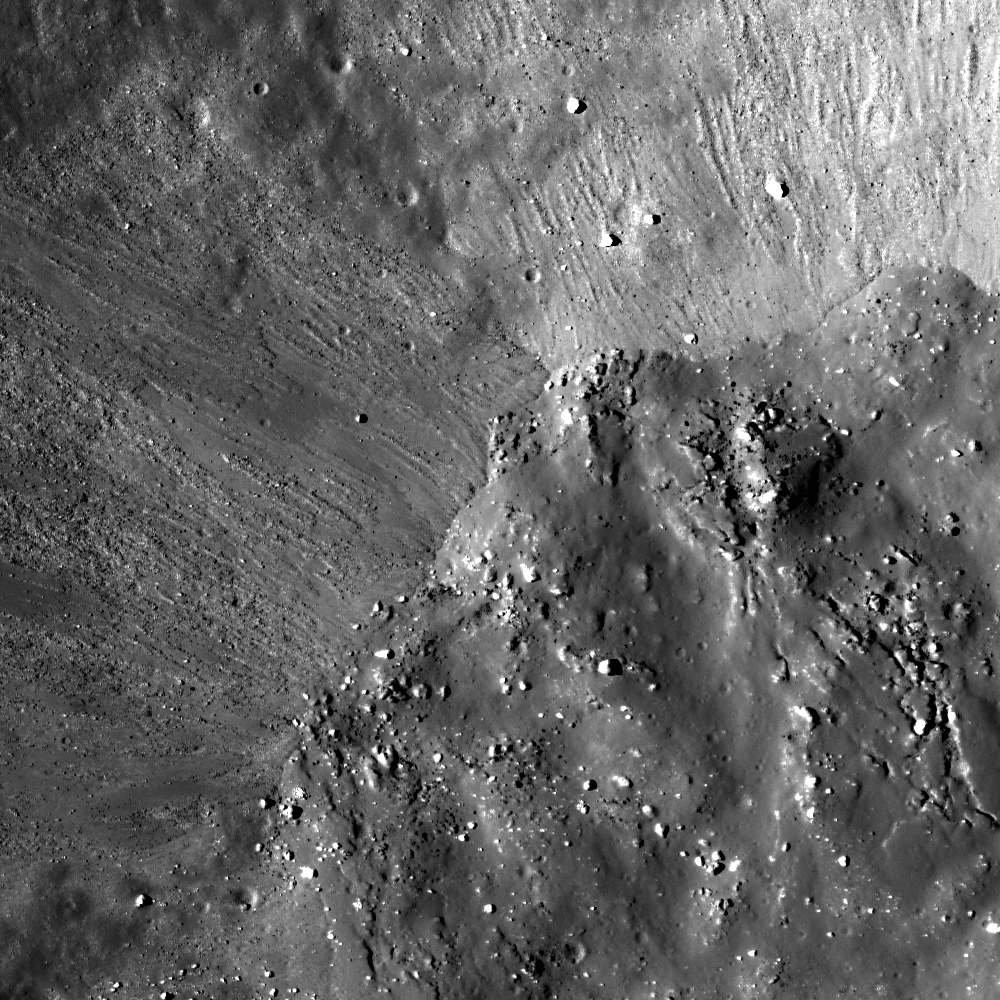
Dry debris flows terminate on the cracked and bouldery melt sheet in Mare Tranquillitatis landmark crater Moltke, 43 kilometers southeast of the landing site of Apollo 11. A textural change marks the boundary between crater wall and impact melt deposits embaying the crater floor. Image field of view 1100 meters. Credited as LROC Narrow Angle Camera (NAC) observation M122591558L, orbit 3200, March 7, 2010; resolution 0.5 meters from 40.63 km. View the full size LROC Featured Image (labeled M183360570RE) HERE [NASA/GSFC/Arizona State University].
Drew Enns
LROC News System

In the absence of an absolute age date, lunar scientists have to rely on the geomorphology of a crater to determine how old it is relative to other craters. The sharpness of the deposits in today's Featured Image is a good indicator that Moltke is young, probably Copernican in age. Large cracks in the impact melt formed as the melt cooled and contracted towards the center of the crater. The uneven terrain within the melt is probably composed of smaller ejecta blocks that have been mixed in with the impact melt. These features have not been covered by regolith or debris flows from the crater wall that naturally accumulate over time, indicating that Moltke is probably young. Do these observations agree with a larger contextual view?

Context for the LROC Featured Image (FOV yellow arrow). Moltke (0.589°S, 24.180°E) is barely 6 kilometers in diameter but has a diffuse high-reflectance ejecta blanket that makes it very easy to spot in modest telescopes trained in on the south-southeastern corner of Mare Tranquillitatis, nestled between the craggy "horns" of the contact separating the relatively flat Sea of Tranquility. This makes it easy to spot, at least in the mind's eye, the spot where "man first walked upon the Moon, July 20, 1969, a very little distance to the northwest. LROC Wide Angle Camera (WAC) observation M144463675CE, orbit 6463m November 15, 2010; resolution 62 meters from 45.07 kilometers [NASA/GSFC/Arizona State University].
These observations do agree with the larger contextual view! A bright halo of ejecta surrounds Moltke, superposing older and darker mare material. The "freshness" of the impact melt and crater wall, the brightness of the ejecta blanket all argue that Moltke must be a relatively young Copernican aged crater.

Sparely labeled HDTV frame of the southwestern corner of Mare Tranquillitatis, landing site of Ranger 8, Surveyor 5 and Apollo 11, as captured by Japan's lunar orbiter SELENE-1 (Kaguya) and released November 2009. View an enlarged version HERE [JAXA/NHK/SELENE].

Explore more of the Moltke melt sheet in the full NAC frame!

The dry debris flows in the context of the western side of Moltke crater were also imaged from LRO during the brief and extraordinary low-periapsis maneuvers, on August 15, 2011, from only 24.96 kilometers altitude; with resolution of 40 centimeters. Those unique unprocessed frames are M168048451L and M168048451R.

Related Posts:
Action Shot
Linne Crater
Melt and more melt