Showing posts with label natural bridge. Show all posts

Friday, September 10, 2010

King Crater Natural Bridge


About ten kilometers north of the deep 73 km-wide crater King, a 20 meter-long natural bridge near 6.23°N, 119.70°E. has been discovered, surveyed in high-resolution from Lunar Reconnaissance Orbiter (LRO). Impact melt from King's energetic formation was flung up and over this area. Still semi-liquid, cooling unevenly, the flood then rushed back into King's interior, carving a wide notch on the crater rim. This brief chaos blistered and channeled this slope, under the surface. A void, perhaps briefly a subsurface channel, eventually degraded into a pit opening amazingly "bridged" by a uniquely stubborn ceiling. This intriguing lunar feature is well within the King Crater Region of Interest, a Tier One priority target for LRO. Further views and Discussion about this discovery [NASA/GSFC/Arizona State University].

Paul D. Spudis
The Once & Future Moon
Smithsonian Air & Space

The camera aboard NASA’s Lunar Reconnaissance Orbiter spacecraft, currently about to begin its second year of mapping the Moon, continues to reveal new and fascinating details of the geology of the Moon. A recent featured image at the LROC web site shows what appears to be a “natural bridge” on the lunar surface, i.e., an unsupported strip of terrain that connects two topographic prominences. What might this feature be telling us about the Moon’s processes and history?


Four Windows Cave, El Malpais National Monument, New Mexico [DesertMarmot].

Natural bridges are not common on Earth. They typically form by erosion of rock from beneath, in which material is slowly and gradually removed at such a rate that the uppermost surface remains intact. They are found most often on Earth in sedimentary deposits, in which running water erodes rock away from opposite sides of an area, causing the retreat of two scarps that eventually meet, leaving an intact arch or “bridge” that appears to connect two hills. Such a feature is ephemeral, of course; the same erosion that created the bridge will eventually destroy it, leaving at last only two disconnected hills, both of which will eventually be eroded flat themselves over time.

As there is no running water, how can such a feature be made on the Moon? A flowing liquid is involved, but it’s not water. I have discussed the flow of lava in the lunar maria and its production of caves in a previous column. Billions of years ago, lava erupted onto the surface of the Moon. This lava was of very low viscosity (about the consistency of motor oil at room temperature) and it spread out into thin sheets that flowed across the surface very rapidly. As the lava cooled, it solidified from the outside inward, leaving the hottest, most fluid material in the center of the flow. In some cases, this created a lava tube, which is a very efficient method of transporting erupted lava from a vent to a flow margin. Lava tubes can be active for most of the duration of an eruption and when the eruption stops, the lava inside them often drains out, leaving behind an empty, underground tunnel. Sometimes, the roofs of these tunnels collapse, exposing the tube interiors to space through cave “skylights.”


Natural bridge in a terrestrial lava tube, El Malpais National Monument, New Mexico. "Nearby, old lava tubes have collapsed to form narrow steep-walled box canyons (the largest called 'Catepillar Collapse' for its winding path). A small section of a cave roof survived to form this narrow bridge." [DesertMarmot].

It is difficult to understand how caves on the Moon may be preserved for very long periods of time. When drained, the tube roofs are exposed to space and over time, may be hit by impact debris, both meteoroid projectiles from space and secondary debris kicked up by other impacts nearby. This debris will erode and shake the surface and could destroy the tube roofs to the point where they might collapse, filling in the underlying void space. If such a process were incomplete, collapse could create a natural bridge on the Moon, where adjacent segments of a collapsed lava tube roof are still connected by a segment of the roof that has not yet been destroyed (see picture above).

One interesting aspect of the newly found natural bridge is that it does not occur in volcanic terrain, but in the middle of the far side highlands. How can such a feature form here, so far away from the volcanic maria that is found predominantly on the near side? The same processes are at work but the liquid rock here has a different origin. During very large impact events, some of the shock energy of the impacting projectile is dissipated as heat, both vaporizing and melting some of the rocky target. The LROC images have shown us a wealth of features around very young craters that appear to be solidified flows of liquid rock (shock melt from the impact event). In the case of this natural bridge, it is found in a smooth pool of impact melt that was formed when the 70 km diameter crater King was formed. King is a very young crater in lunar terms, probably having formed no more than a few hundred million years ago. This is extremely old by Earth standards, but on the Moon – with its extremely low rates of erosion – it is part of the Copernican time system, which encompasses events that occurred within the last one billion years of lunar history. King is probably slightly younger than the crater Copernicus and to look at its rim in the high resolution images from LROC, one sees a myriad of fresh, crisp features that look liked they formed only a few days ago.

The natural bridge found near King crater probably formed when a large pool of shock liquid rock cooled enough to roof over, creating a solid surface crust. Downhill draining of the melt pond removed the liquid from beneath this crust, weakening the surface and causing its collapse in some places. The natural bridge is actually just a zone of preserved surface crust that occurs between two adjacent collapse pits. As with natural bridges on the Earth, this bridge is transient; the constant bombardment of the lunar surface will grind away the bridge through erosion by impact, which is extremely slow (erosion rates on the order of one millimeter per 20 million years.) Eventually, both surface grinding and shaking during impacts will cause the collapse of this feature. However, this won’t happen anytime soon, so you have several tens of millions of years to see it.

Closer look at the King crater natural bridge


Stretched "3D" close-up of the 20 meter natural bridge over a far side lunar pit discovered by the Lunar Reconnaissance Orbiter Camera (LROC) team at Arizona State University. The bridge's shadow cast on the pit floor is visible in the west opening [NASA/GSFC/Arizona State University].


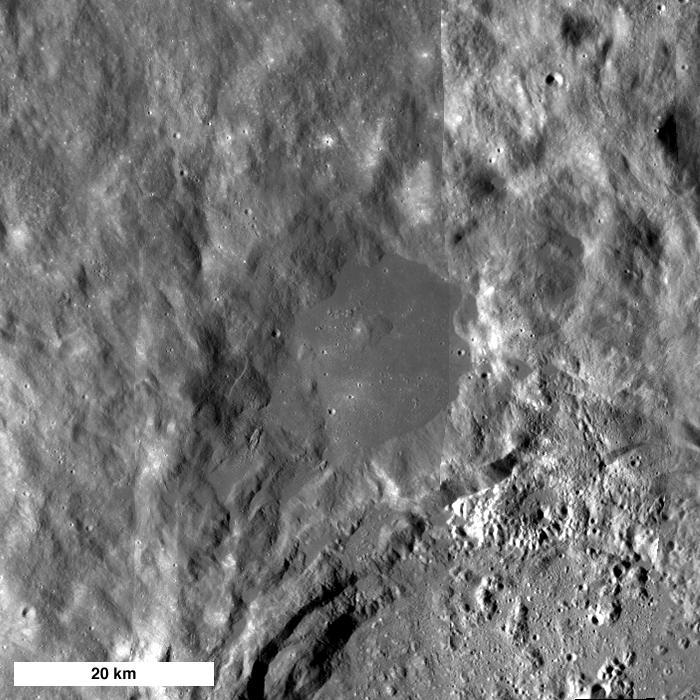
The view over "King Y," the 17 km-wide impact-melt flooded depression northwest of 72 km King (5°N, 120.5°E). The interior and western rim of the larger complex crater is on the horizon. 10 km north of King the natural bridge is seen huddled in the blistered melt sheet. Flow patterns from the King impact event hint at the forces briefly at work here, and quickly fossilized, hundreds of millions of years ago.

Discovering a Natural Bridge on the Moon


Credited as the first view of the natural bridge discovered in high-resolution surveys of the King Crater Constellation Region of interest (ROI). This 400 x 400 pixel segment, cropped from a 5064 x 52224 pixel Narrow Angle Camera (NAC) strip was swept up early in the Lunar Reconnaissance Orbiter (LRO) mission, August 1, 2009. The vehicle was slewed -6.09° to image the King ROI target, 118.57 kilometers over the Moon. The field of view is approximately 480 meters. LROC NAC observation M103725084L, orbit 451 (Res. 1.22 m, Sun-Moon-LRO phase angle 68.74°) [NASA/GSFC/Arizona State University].


The subsequent orbit (LRO orbit 452) over King brought cameras nearer to being directly over the natural bridge, and this slightly better view was captured, again on August 1, 2009, from 118.72 kilometers. The field of view is approximately 480 meters. LROC NAC observation M103732241L; Res. 1.2 meters, phase angle 53.57° [NASA/GSFC/Arizona State University].


The next opportunity to image the King ROI took place a lunar month later, August 28, 2009, still in the LRO Commissioning phase of its mission. The Natural Bridge was imaged in afternoon sunshine from 127.88 kilometers, and the 400 pixel field of view was approximately 517 meters. LROC NAC observation M106088433LE, LRO orbit 781, res. 1.29 m, phase angle 36.92° [NASA/GSFC/Arizona State University].


By November 18, 2009, LRO was several weeks into the year-long Nominal mission, circling the Moon at an average altitude of 54 kilometers. This "Shadow under a Walking Bridge" and Featured Image (Inset) view was released with its announced discovery, September 7, 2010. Below that is shown a greatly reduced "full-width" of the Right Frame image from the LROC NAC observation, to allow for context. LROC NAC M113168034R, from 60.49 km, LRO orbit 1811 (Res. 0.625 m, phase angle = 46.36°) [NASA/GSFC/Arizona State University].

Tuesday, September 7, 2010

Natural Bridge on the Moon

Updated September 16, 2010 2006 UT

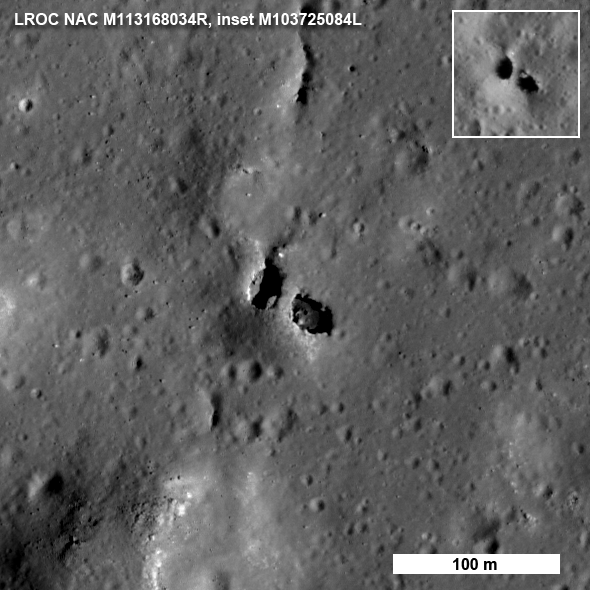
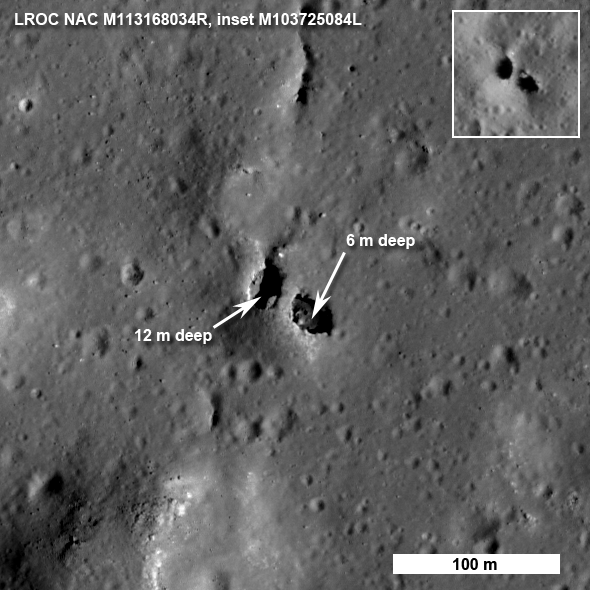
Another amazing bit of lunar geology revealed by LROC, northwest of Narrow Angle Camera (NAC) observation M113168034R (Near 6.41°N, 119.74°E, within an impact melt "pond," inundating the depression King Y, immediately northwest of far side landmark King crater. (North is up; LRO orbit 1811, November 18, 2009; alt. 60.49, res. 0.625 m, phase angle = 46.36°) [NASA/GSFC/Arizona State University].

Mark Robinson
Principal Investigator
Lunar Reconnaissance Orbiter Camera
Arizona State University

Just when you think you have seen everything, LROC reveals a natural bridge on the Moon!

Who would have thought? Natural bridges on Earth are typically the result of wind and water erosion - not a likely scenario on the Moon. So how did this natural bridge form? The most likely answer is a dual collapse into a lava tube. From the Apollo era, SELENE, and LROC images, we know that lava tubes did form in the Moon's ancient past. SELENE and LROC images have raised the tantalizing prospects that lava tubes remain intact to this day. However this bridge did not form in mare (basalt), but rather in (a splash of) impact melt from King crater! More astonishingly, the same NAC image revealed two natural bridges - not just one!


The bridge is approximately 7 meters wide on top and perhaps 9 meters on the bottom side, a 20 meter walk to cross from one side to the other (see full-size view of above, HERE [NASA/GSFC/Arizona State University].

How do we know for sure that this feature is truly a bridge? Look closely at the west pit (left side) and you can see a little crescent of light on its floor. That patch of light came from the east, under the bridge. In another lower resolution image (see inset), you can see light passed under the bridge from the west. So there must be a passage. How did this oddity form? The impact melt deposit on the north rim of King crater is over 15 km across and was emplaced in a matter of minutes as the crater grew to its final configuration.


King Y: A large (17 km east to west), smooth impact melt "pond" on the northwest rim of King crater (5°N, 120.5°E - 72 kilometers in diameter). LROC WAC mosaic [NASA/GSFC/Arizona State University].

The impact melt that was thrown out of the crater pooled on the newly deposited ejecta and must be many tens of meters thick, allowing its interior to stay molten for a long time. As the local terrain readjusted after the shock of the impact, the substrate of this massive pool of melt was jostled to some degree. Local pressures built up and the melt moved around under a deforming crust. You can see that the south end of the bridge extends from a small local rise, shaped something like a blister. Perhaps some melt was locally pushed up forming the rise, then the magma found a path to flow away, leaving a void which the crusted roof partially collapsed? Right now we do not know for certain the details of how the bridge formed, however, the LROC team is processing stereo images into topographic maps to aid scientists in determining exactly what took place on this fascinating melt sheet. There are actually six NAC images in which you can find the bridge under varying lighting (M103725084L, M103732241L, M106088433L, M113168034R, M123785162L,* M123791947L*). Why so many images?

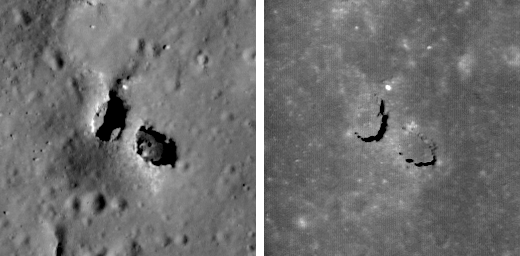
The melt sheet north of King crater is one of fifty Constellation Regions of Interest - high priority for LROC coverage. As the pair of images below vividly illustrate, having a set of images of the same area under varying lighting allows scientists to more confidently interpret the local geology and thus better prepare for future exploration.


Left shows the bridge when the Sun is 42° above the horizon and the right is the same area when the Sun is 80° above the horizon (near noon). M113168034R on the left, M123791947L* on the right, both are 128 meters across, north is up - full-sized inset, HERE [NASA/GSFC/Arizona State University].

Explore the entire LROC NAC image and investigate the variety of geologic features in the King crater melt sheet. Can you find the second natural bridge in the full NAC frame (hint - it's fairly close to the one shown above and about half its size)?

Learn more about the Constellation Regions of Interest:

Tier1 Regions
Tier2 Regions

*LROC Narrow Angle Camera observation M123785162L & M123791947L are not yet available through the Planetary Data System.

M113168034RE sampled at full resolution and pushed to 200%

Discovering the King Y Natural Bridge


Credited as the first view of the natural bridge discovered in high-resolution surveys of the King Crater Constellation Region of interest (ROI). This 400 x 400 pixel segment, cropped from a 5064 x 52224 pixel Narrow Angle Camera (NAC) strip was swept up early in the Lunar Reconnaissance Orbiter (LRO) mission, August 1, 2009. The vehicle was slewed -6.09° to image the King ROI target, 118.57 kilometers over the Moon. The field of view is approximately 480 meters. LROC NAC observation M103725084L, orbit 451 (Res. 1.22 m, Sun-Moon-LRO phase angle 68.74°) [NASA/GSFC/Arizona State University].


The subsequent orbit (LRO orbit 452) over King brought cameras nearer to being directly over the natural bridge, and this slightly better view was captured, again on August 1, 2009, from 118.72 kilometers. The field of view is approximately 480 meters. LROC NAC observation M103732241L; Res. 1.2 meters, phase angle 53.57° [NASA/GSFC/Arizona State University].


The next opportunity to image the King ROI took place a lunar month later, August 28, 2009, still in the LRO Commissioning phase of its mission. The Natural Bridge was imaged in afternoon sunshine from 127.88 kilometers, and the 400 pixel field of view was approximately 517 meters. LROC NAC observation M106088433LE, LRO orbit 781, res. 1.29 m, phase angle 36.92° [NASA/GSFC/Arizona State University].


By November 18, 2009, LRO was several weeks into the year-long Nominal mission, circling the Moon at an average altitude of 54 kilometers. This "Shadow under a Walking Bridge" and Featured Image (Inset) view was released with its announced discovery, September 7, 2010. Below that is shown a greatly reduced "full-width" of the Right Frame image from the LROC NAC observation, to allow for context. LROC NAC M113168034R, from 60.49 km, LRO orbit 1811 (Res. 0.625 m, phase angle = 46.36°) [NASA/GSFC/Arizona State University].