Showing posts with label mare. Show all posts

Tuesday, January 21, 2014

Wrinkled? Yes, but how old?

Wrinkle Ridge, Eastern Mare Frigoris
A wrinkle ridge formation in eastern Mare Frigoris (54.430°N, 35.670°E), from a 2 km -wide field of view from LROC Narrow Angle Camera (NAC) observation M139672711R, spacecraft orbit 5717, September 21, 2010; 56.22° incidence angle, resolution 47 cm per pixel from 38.87 km. LROC Featured Image, "Wrinkled, yes, but how old? - Released January 21, 2014 [NASA/GSFC/Arizona State University].
H. Meyer
LROC News System

Wrinkle ridges are not only some of the most striking features that wind their way across the lunar mare, but they are also extremely informative. Wrinkle ridges are the surface expression of tectonic stresses, and from observing the morphology of the ridges, we can interpret the tectonic history of the regions in which they are found.

Mare Frigoris hosts intricate systems of intertwining wrinkle ridges, suggesting a complex history. It is thought that this area was a topographic low that was later filled in with dense mare, causing the less dense anorthosite crust to sag as it underwent isostatic adjustment. The sagging resulted in compression at the surface, and the development of wrinkle ridges. As the crust was compressed it fractured, and long linear stretches of crust were pushed on top of itself thus forming these fascinating ridges.

Wrinkle Ridge, Eastern Mare Frigoris
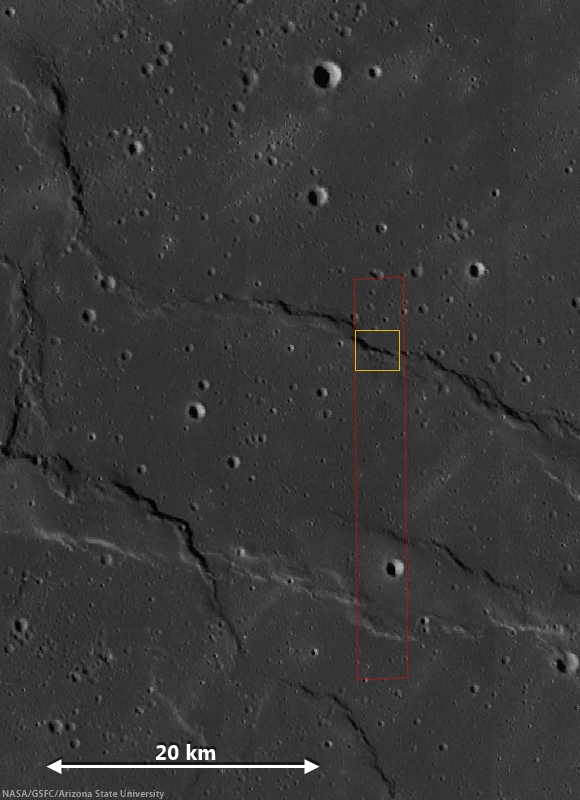
LROC WAC context image of eastern Mare Frigoris. The full NAC field of view is outlined in red and that of the LROC Featured Image released January 21, 2014 is boxed in yellow [NASA/GSFC/Arizona State University].
The ropy appearance of the ridges in the WAC context image above are a testament to the complex motion that took place within the rock, indicating multiple directions of stress. Though most of the tectonic activity that produced wrinkle ridges in Mare Frigoris is thought to have occurred ~2.6-3.8 billion years ago, recent work suggests that wrinkle ridges may have formed in this region only 1.2 billion years ago. Believe it or not, that is young (for the Moon at least)!

Who knew wrinkles could be useful? Explore the Moon's wrinkles for yourself, HERE

Related Posts:
Bulging Wrinkle
Wrinkle Ridge in Mare Crisium
Wrinkles in Mare Frigoris
Really Wrinkled
Wrinkled Reiner Gamma
Wrinkle Ridge v Impact Crater

Tuesday, July 23, 2013

Small-Scale Volcanism on the Lunar Mare

LROCWAC-small-shield-volcanism-1314
"Small Shield Volcanism on the Lunar Mare," (figure 1.) EPSC 2013-875 Plescia, Robinson & Joliff. Constructs in Mare Tranquillitatis. a: low-relief, low-slope with central crater; b "pancake-shaped"; c and d': hummocky, steep-sided , gc: ghost crater. LROC Wide Angle Camera high-angle incident mosaic, centered near 7.5°N, 37.5°E [NASA/GSFC/Arizona State University] .
Plescia, Robinson & Jolliff
Johns Hopkins APL
Arizona State University
Washington University of St. Louis


"Small shield volcanoes having low relief and gentle slopes are scattered across the lunar mare. These features represent the terminal phases of mare volcanism and are formed by short-duration, low-volume eruptions. Composition and eruption dynamics may have varied as the morphology and color of the shields vary. There appears to be regional correlations of morphometric properties indicating larger-scale organization of the eruptions.

"Data from LRO and other missions now provide the ability to characterize each dome in terms of areal extent, topography, morphology, and color properties in unprecedented detail allowing for an analysis of their origin.


"Here, a subset of the domes are interpreted to represent a volcanic style characterized by small volume eruptions that built low-relief constructs (Fig. 1). This style of volcanism has been termed plains volcanism [14] and is common in the Tharsis region."

Small Shield Volcanism on the Lunar Mare, European Planetary Science Conference 2013, Vol. 8, #875; J.B. Plescia, Johns Hopkins University Applied Science Laboratory; M.S. Robinson, Arizona State University; B. Jolliff, Washington University, St. Louis

M190351657L-NSJ-0503-6509x8978
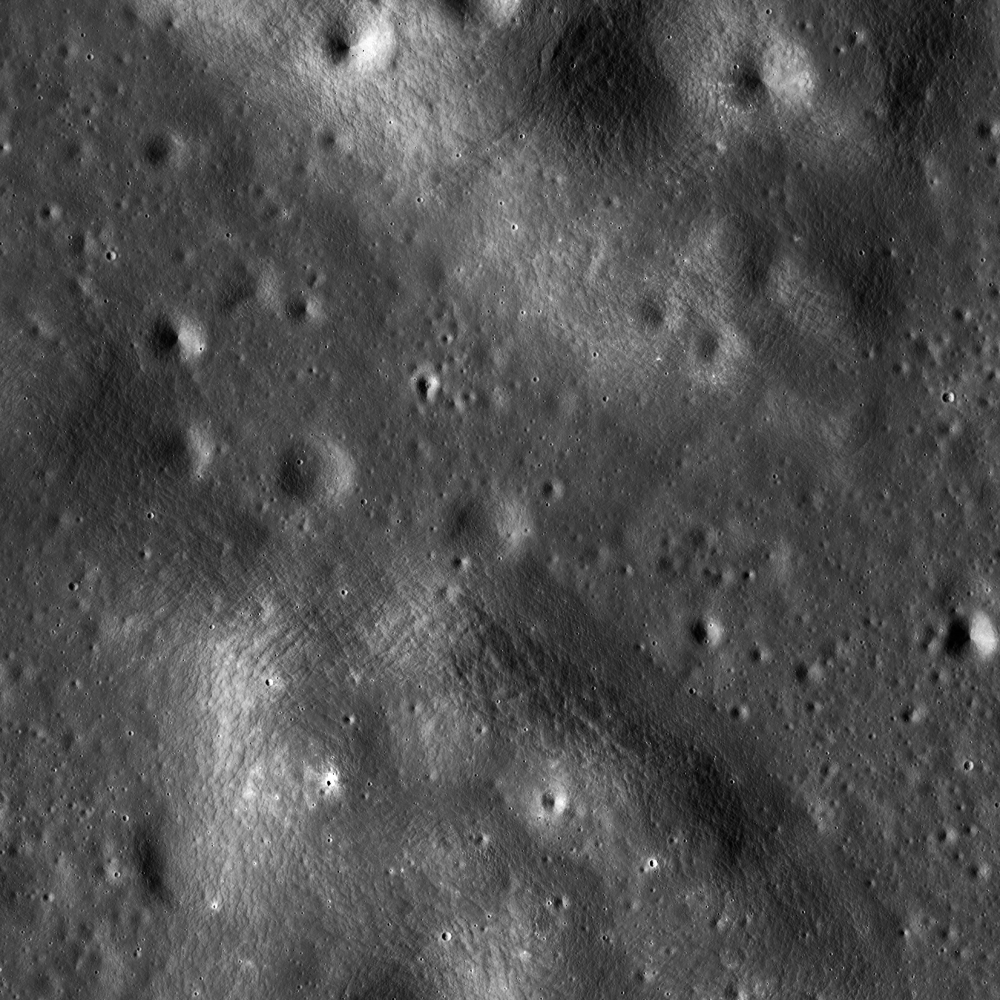
Small-scale shield volcanic vent structure ("d." in WAC mosaic above) south of Rupes Cauchy in Mare Tranquillitatis, near 7.5°N, 37.5°E; Vent strongly presents features resembling those of the Ina structure. 6.2 km-wide field of view from LROC NAC mosaic M190351657LR, LRO orbit 13098, April 29, 2012; 41.95° angle of incidence, resolution 0.95 meters per pixel from 113.33 km. Full-size versions HERE [NASA/GSFC/Arizona State University].

Thursday, June 6, 2013

Imbrium Bench Crater: Regolith all the way down?

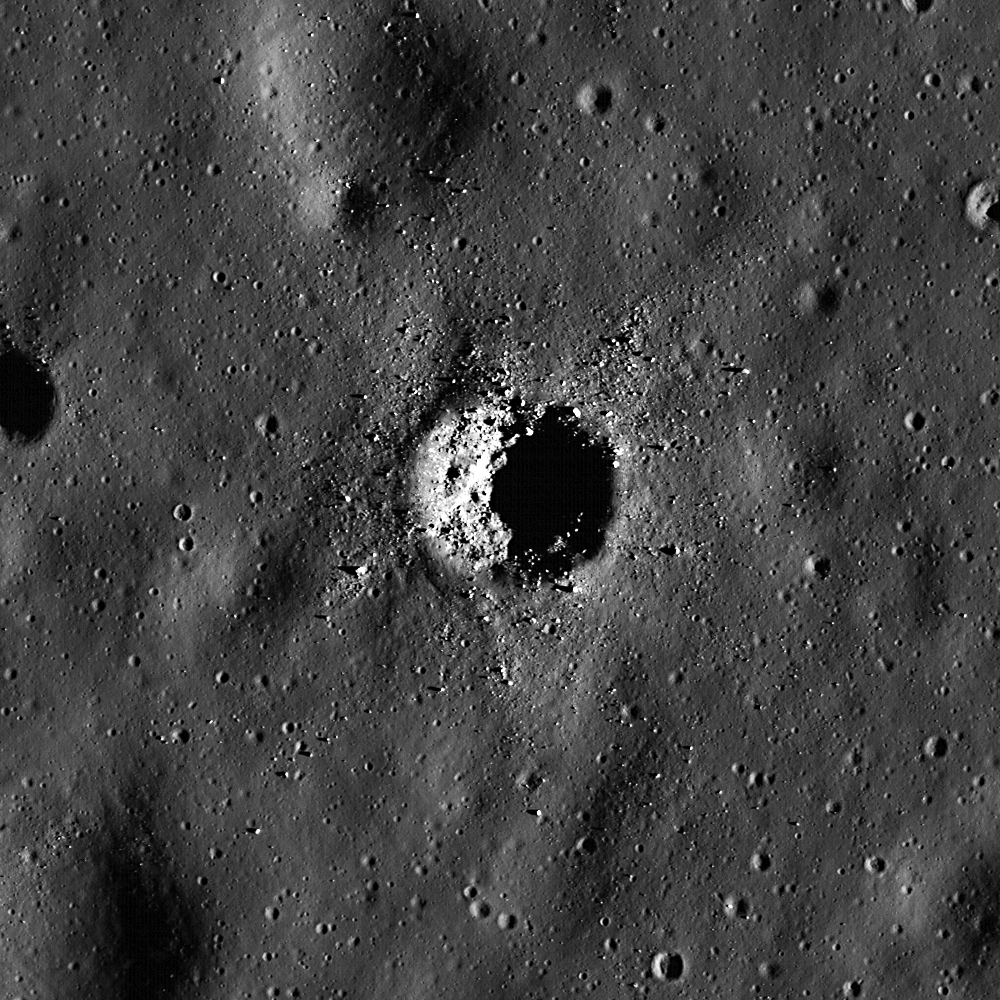
A small crater hides a bench of bedrock within its walls. Boulders sit just outside the rim. LROC Narrow Angle Camera (NAC) observation M162447033R, LRO orbit 9074, June 11, 2011; 78° angle of incidence, resolution 0.78 meters per pixel, image field of view 800 meters across from 37.5 km [NASA/GSFC/Arizona State University].
Drew Enns
LROC News System

Today's Featured Image shows a bench crater in the lunar mare. Bench craters are so called because they have a small bench lining the interior of the crater wall. In fact, this bench is interpreted to be the contact between the bottom of the regolith and the basaltic bedrock below.

The regolith is a layer of brecciated material that develops as a result of micrometeorite bombardment, it consists mostly of a fine powder containing numerous angular fragments.

The regolith and the coherent basalt both have different strengths, with the regolith being easier to displace than the underlying basalt during an impact event. The result of a moderate impact (in this case one that produced a 160 meter diameter crater) into this area then gave us a spectacular view of the local stratigraphy.

Another Narrow Angle Camera view of the unnamed crater of interest in Mare Imbrium, from a higher altitude later in the LRO mission. LROC NAC frame M190738110R, orbit 13152, May 4, 2012; 52.37° incidence angle, resolution 1.44 meters from 145.83 km [NASA/GSFC/Arizona State University].
Context LROC Lunaserv view showing the location of the small unnamed crater of interest, east-southeast of McDonald crater in Mare Imbrium. The bench crater is near the center of Mare Imbrium at 30.165° N, 339.493°E. Image width is 100 km [NASA/GSFC/Arizona State University].
Regolith development takes time, and many meteor impacts. Since the impact flux (the number of meteors and comets hitting the Moon) has not been constant in the past, the mare have a thinner regolith than the highlands.

Can you find any more bench craters in the full LROC NAC, HERE?

Related Posts:
New Impact Crater on the Moon!
Regolith on Basalt
Fresh Bench Crater in Oceanus Procellarum

Thursday, May 23, 2013

Pit Crater in Fecunditatis

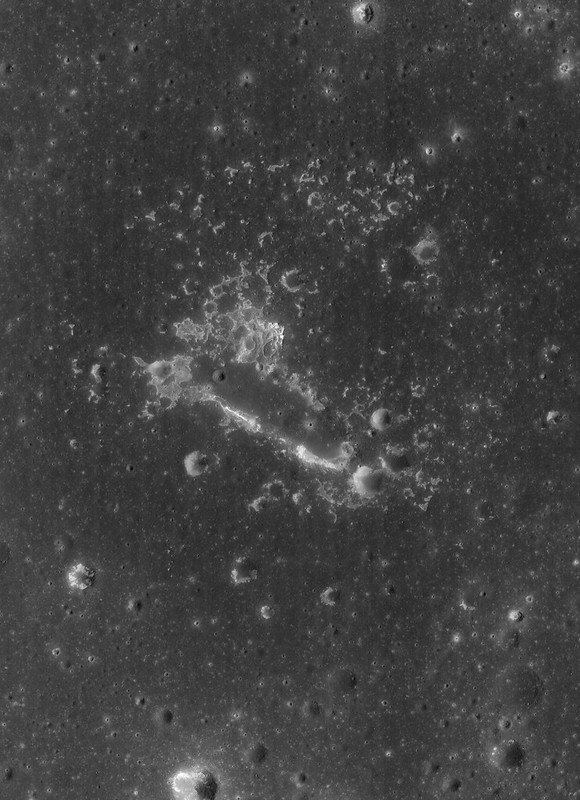
What may be a newly resolved "pit crater," similar to at least three other unique features found elsewhere on the Moon. This one is near the equator in Mare Fecunditatus (0.92°S, 48.66°E). The nearly circular 110 meter-wide opening may or may not narrow in diameter further into its interior. LROC Narrow Angle Camera (NAC) observation M1107960917R, (at 180%) LRO orbit 11562, November 19, 2012; angle of incidence 62.93° from 108 km [NASA/GSFC/Arizona State University].
Joel Raupe
Lunar Pioneer

It’s time to inventory the Moon’s “pit craters.” The first, the "Haruyama," or "Marius Hills pit crater" (14.065°N, 303.224°E) is in a sinuous rille immediately west of the famous shield volcano range in Oceanus Procellarum.

A second and third have now been found and photographed from many angles, in Mare Tranquilitatis (8.34°N, 33.22°E) and Mare Ingenii (35.95°S, 166.06°E), respectively.

It appears the LROC team at Arizona State University uncovered another, over the past year, out on the vast equatorial plains of Mare Fecunditatis (0.92°S, 48.66°E).

This is remarkable for a number of reasons, not least among them the mission’s elapsed time. As of this writing LRO has completed 17,801 orbits around the Moon. Without knowing the exact percentage of the lunar surface yet to be photographed by the LROC Narrow Angle Cameras – it’s remarkable a 110 meter wide target could have been missed until relatively recently.

That is it might seem remarkable, until we consider some basic “beta angles,” so to speak, some basic mission priorities and logistics.

Location of a possible pit crater in a 155 km-wide field of view of northwest Mare Fecunditatis. LROC QuickMap 250 meter per pixel resolution [NASA/GSFC/Arizona State University].
The target is within a single degree south of the equator. Obviously a spacecraft in polar orbit is going to see its orbital pathways and targeting opportunities converge directly over the poles, conversely those same opportunities will be at their greatest distance apart at the equator.

A closer look through one particularly fine set of LROC Wide Angle Camera passes over target (arrow), the feature is just visible in this imperfectly merged monochrome (604 nm) WAC mosaic swept up during three sequential orbital passes; from 47.4 km altitude. Resolution roughly 55 meters, 63° angle of incidence; field of view a little over 40 km, from west to east [NASA/GSFC/Arizona State University].
Secondly, this has got to be one of the Moon’s great “Rub’ al khali's,” an empty quarter, which must have seemed nearly void of inviting targets, with very inviting targets nearby, particularly to the west, where the fascinating Messier and Messier A craters reside. The east rim of Messier B is only a little over 20 kilometers directly to the west. The desire, even the need, to slew the spacecraft and camera’s off nadir to examine these and other nearby targets is reason enough for the pit to have been overlooked.

Then there’s the target itself, which brightens considerably between a 30° and 0° angle of incidence. Under the highest sun, near noon, and again, very near the equator, the target looks like what it may in fact be: an unusual but still rather commonplace nearly fresh crater.

It proves, yet again, that there are still great new discoveries yet to be made on the Moon.

Raw rendition of the LROC NAC observation which may have touched off further interest in a new "target of opportunity," in the months that followed. The pit crater in Mare Fecunditatis shows up on the very edge of this frame from orbit 13087, April 28, 2012. LROC NAC M190280022L, 62.93° angle of incidence, 1.09 meters resolution from 108.01 km [NASA/GSFC/Arizona State University].
Having to guess just what drew their interest, the target seems to have been photographed at high resolution April 28, 2012, in orbit 13087. Amazingly, the pit was nearly missed. You can see the north half of the target at the very top of LROC Observation M190280022L, HERE.

By last fall it seems the pit was directly targeted under three lighting conditions, the first, last September, must have seemed disappointing. With the Sun only five degrees from directly overhead what little topography might be seen on target and in the region may have seemed washed out in shadowless albedo contrasts. If this was a pit crater the “ledge,” if any, was not overshadowing.

First full close-up released to the PDS shows a brightly lit interior, and little to no depth. But the Sun was high, and the location less than a degree south of the equator. LROC NAC M1103245601L, orbit 14902, September 25, 2012, angle of incidence 7.765° at 0.94 meters resolution, from 108.88 km [NASA/GSFC/Arizona State University].
A month later the Sun was a little more favorable. LROC NAC M1105602888L, orbit 15232, October 23, 2012; angle of incidence 35.18° at 0.93 meters resolution from 108.28 km [NASA/GSFC/Arizona State University].
After yet another month, the mid-morning Sun is at an even greater angle. Shown at its original resolution, this is the image at the top of the post. LROC NAC M1107960917R, orbit 15562, November 19, 2012; angle of incidence 62.93° at 1.1 meters resolution, from 108.01 km [NASA/GSFC/Arizona State University].

Related Posts:
Impact melt collapse pit (March 2, 2012)
Failed Skylights of Copernicus (January 24, 2012)
New view of Sinas pit crater (November 11, 2011)
Sublunarean Void (February 7, 2011)
New views of lunar pits (September 14, 2010)
How common are mare pit craters? (July 15, 2010)

Thursday, April 25, 2013

The Monadnocks of Sinus Honoris

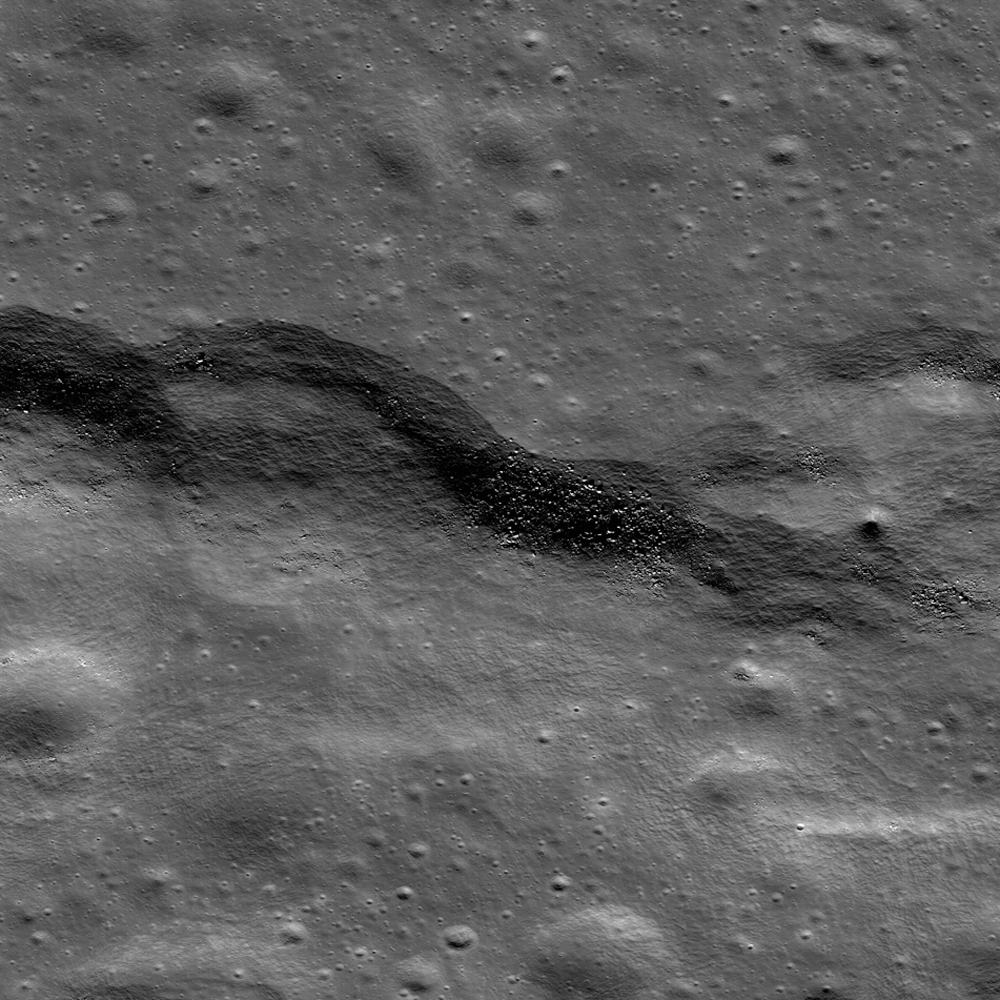
A northwest-southwest oriented groove between two inselbergs in Sinus Honoris (12.276°S; 18.712°E), an embayment near the northwest extreme of Mare Tranquillitatis. LROC Narrow Angle Camere (NAC) frame M181944849L, LRO orbit 11796, January 12, 2012. Illumination angle of incidence 67.94°from the west, field of view roughly 5.8 km across, resolution in the original 1.21 meters per pixel from 122.13  km [NASA/GSFC/Arizona State University].
James Ashley
LROC News System

Most of the physical sciences are instructive in the art of piecing together observations made at vastly different scales. Note, for example, how climatologists look at pollen in soil samples to assess climate change through time on a global scale. Geologists use microscopes to examine mm-scale crystals in order to understand magma chambers many cubic miles in volume.

Astronomers attempt to make sense of subatomic particles in the context of the entire visible Universe. With this in mind, try to explain the sculpted mountains in today's Featured Image, located at the northwestern margin of Mare Tranquillitatis.

Field of view shown at high-resolution in the LROC Featured Image released April 25, 2013 is outlined in yellow in this Wide Angle Camera (WAC) monochrome (566 nm) observation M165726769C, swept up in orbit 9557, July 19, 2011. Field of view 45.8 km, resolution 58 meters per pixel from 40.97 km [NASA/GSFC/Arizona State University].
You may find that adjusting the scale is necessary. Indeed; we will have to zoom out until we can see a good deal of the lunar nearside before the features have the context they need to be understood. (Examine the image above and below to pull back for increasingly smaller-scale, wider-field of view LROC WAC context images.)

A mosaic of the LROC WAC image immediately above, stitched together to observations of the same latitude from one orbit prior and after, July 19, 2011. Field of view roughly 145 km [NASA/GSFC/Arizona State University].
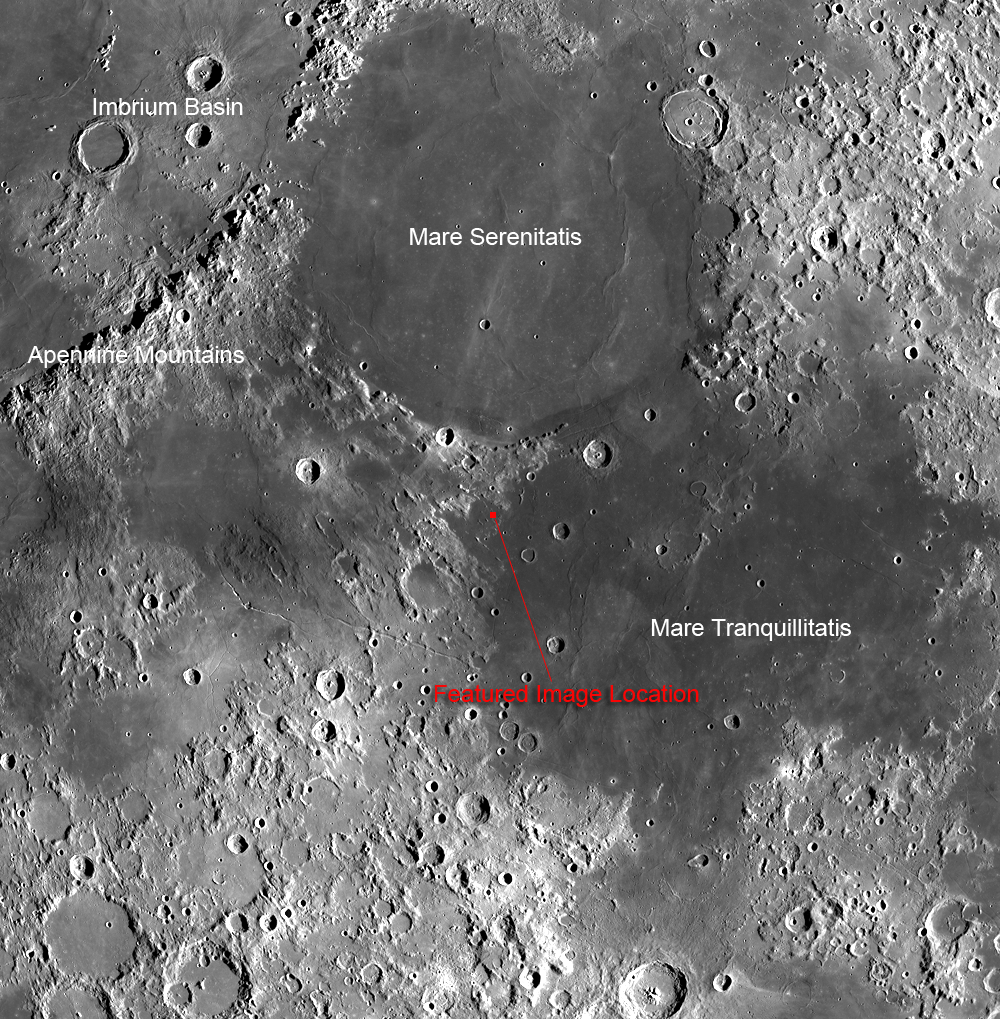
The WAC mosaic context image released with the LROC NAC Featured Image covers a more familiar 1,500 km wide field of view (one that happens also to include four of six successful Apollo landing sites; Apollo 11, 15, 16 and 17) [NASA/GSFC/Arizona State University].
These mountains are members of a group of mare-surrounded highland structures nestled between Mare Tranquillitatis and Mare Serenitatis. Examination of the region will quickly reveal a strong northwest to southeast trending orientation to most of the upland features that points directly back to the Apennine Mountains, which form the southeastern rim of the Imbrium basin. Now we can see that this whole region was sculpted by ground-hugging forces unleashed in the terrible cataclysm that formed that basin. Imagine witnessing this awesome event from the Earth over 3 billion years ago; it would have been clearly visible to the unaided eye!

Isolated mountains like these, which rise from a surrounding plain, are often referred to by geologists as monadnocks or inselbergs ("island mountains," or "sky islands"). On Earth such features might be erosional remnants, but here in the Bay of Honor (Sinus Honoris) we know them to be isolated by surrounding mare deposits.

Click HERE to see the full NAC frame. Additional examples of large-scale features on the Moon can be explored with Four of a Kind in Catena Davy, Nearside Spectacular!, and A Scar in the Highlands.

Thursday, April 18, 2013

New views of the lava terraces of Bowditch

A lava terrace rings the floor of farside crater Bowditch. LROC Narrow Angle Camera (NAC) observation M180493674L, LRO orbit 11718, January 12, 2012; a roughly 4 km-wide field of view at 1.74 meters per pixel resolution, angle of incidence 75.91° from 85.27 km [NASA/GSFC/Arizona State University].
Sarah Braden
LROC News System

Bowditch is a highly irregularly shaped farside crater partially filled with a mare basalt (25.0°S, 103.2°E).

Today's Featured Image is located along the inner wall of the crater, where the mare deposit meets the wall (24.935°S, 102.705°E). A section of the crater wall is visible in the upper left hand corner of the image, there is a step down in topography from left to right.

All along the inner wall of Bowditch there is a higher elevation ring, or terrace.

LROC WAC context image of mare-filled Bowditch crater. The yellow box outlines the field of view captured at high resolution in the LROC Featured Image released April 18, 2013. Field of view above roughly 38.3 km-wide. The LROC WAC context image accompanying the Featured Image released shows greater topographic relief at smaller scale HERE [NASA/GSFC/Arizona State University].
It is thought that this terrace is a marker of the highest level of liquid lava within the crater. As the lava cooled and solidified within the Bowditch depression it subsided into the center of the depression, causing a lower final elevation of mare basalt towards the center of the crater. Lava terraces such as this one provide important clues about the thickness, viscosity, composition, and cooling rate of lunar lavas and will help us better understand volcanism on the Moon.

View the entire LROC NAC frame to explore more of the Bowditch mare basalt deposit, HERE.

Related Images:
Bowditch Lava Terraces
A Lunar Dichotomy
The Mare-highlands Boundary in Tsiolkovskiy!