Showing posts with label Rutherfurd. Show all posts

Tuesday, January 28, 2014

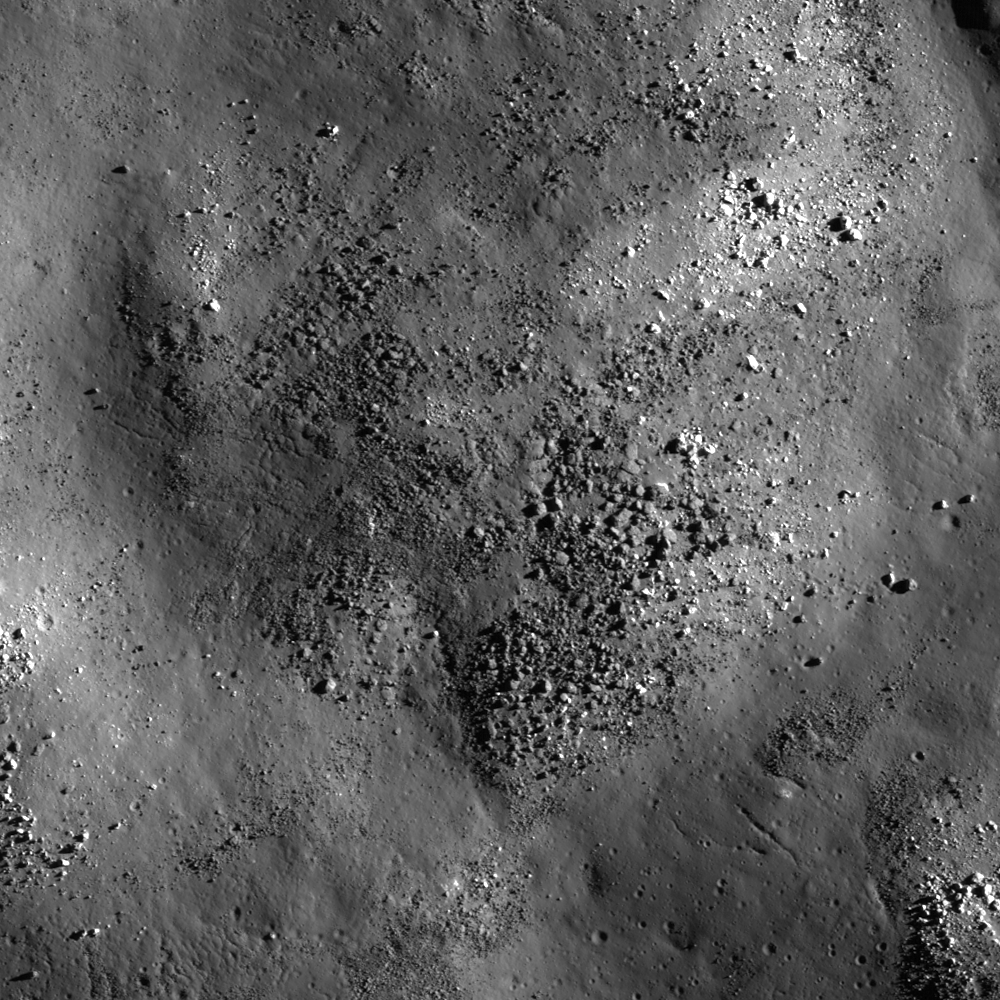
Boulders on a hill on the floor of Rutherfurd crater

Boulders on the floor of Rutherford (LROC NAC)
Knobby surface of Rutherfurd crater floor, 1050 meter-wide LROC NAC field of view centered on 61.340°S, 348.085°ENAC M1123653329R, spacecraft orbit 17669, May 20, 2013; incidence angle 81° from 50.83 km  [NASA/GSFC/Arizona State University].
Hiroyuki Sato
LROC News System

Today's Featured Image highlights a bumpy hill adjacent to a large melt pool (now frozen to solid rock) inside Rutherfurd crater (48 km in diameter). As seen in the WAC context image below, the floor is mostly littered with materials that collapsed and slumped from the crater wall, and with impact melts filling the topographic lows.

Uphill is to the left of the image, here you can see a wrinkled/fractured surface, likely formed as a thin rigid sheet of frozen melt. Over time this melt rock slowly broke apart -- the source of other boulders. The boulders slowly migrate downhill, breaking themselves apart, a form of mass wasting similar to that seen on Earth. However there is a big difference, almost all the energy on the Moon is provided by a continual rain of small meteorites, whereas on the Earth erosion is driven by plate motion induced earthquakes, and weathering.
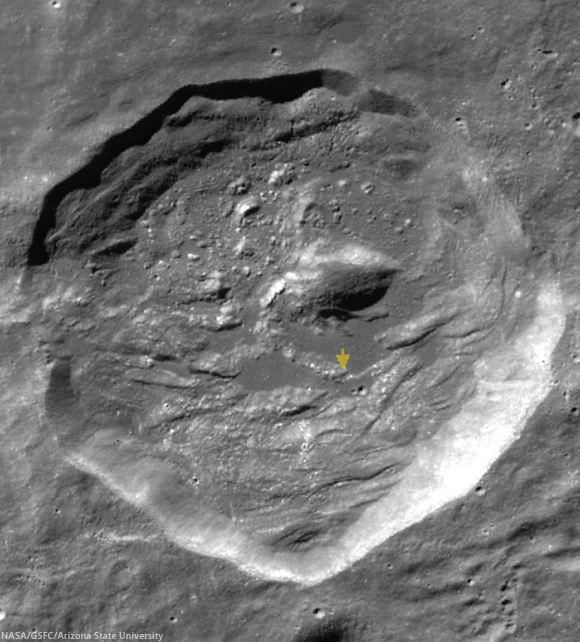
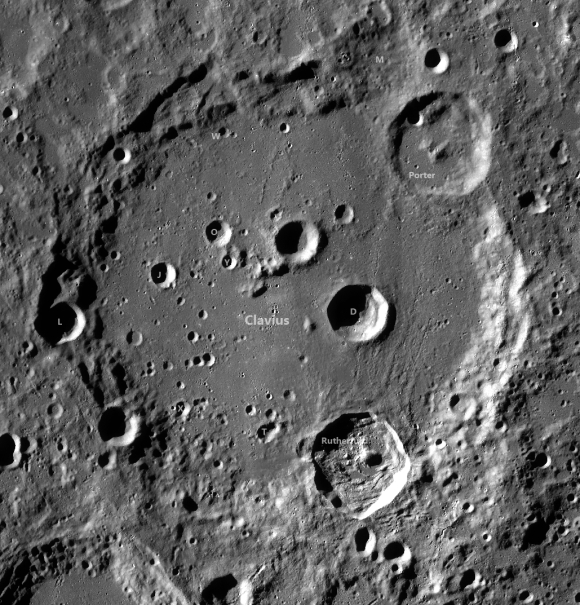
Rutherfurd crater (LROC WAC)
49.98 km Rutherfurd crater (61.15°S, 346.278°E), nested on the rim of more famed, much wider and older Clavius, in the nearside southern highlands. The area captured at high-resolution and released as the LROC Featured Image, January 28, 2014, is marked with an arrow. LROC WAC global mosaic [NASA/GSFC/Arizona State University].

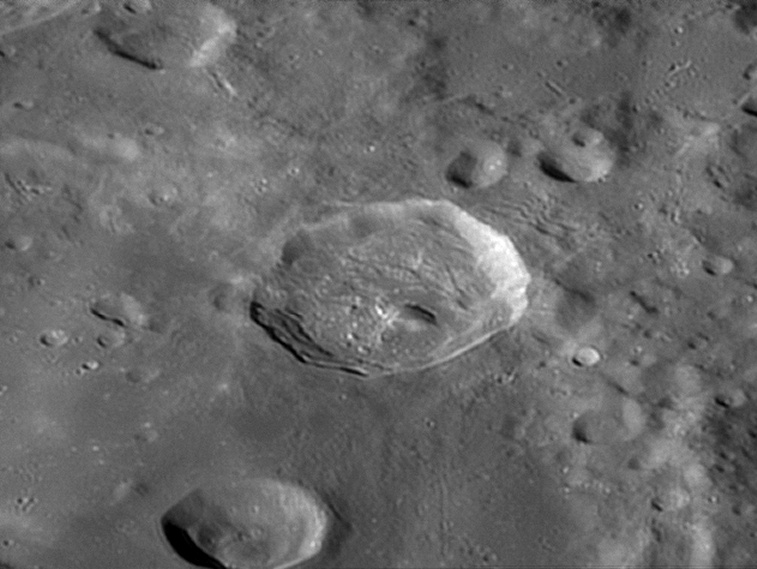
Rutherfurd from Earth (Damian Peach)
Rutherfurd as viewed from Earth by experienced astrophotographer Damian Peach, November 20, 2005. "Rutherfurd is located entirely within the southern rim of much larger Clavius," he writes. "Rutherfurd is somewhat oval in shape, with the long axis oriented approximately in a north-south direction. The rim is overlaying the inner wall of Clavius, and thus the rim of Rutherfurd is higher above the surface along the north and west sides. The floor is irregular in shape, and there is a central peak somewhat offset to the northeast. The ejecta pattern; oblong shape, and location of the central peak indicate the original impact may have been at a low angle from the southeast [Damian Peach].
Rutherfurd on the rim of Clavius (LROC WAC)
49.98 km Rutherfurd (61.15°S, 346.278°E), nested on the southeastern rim of more famed, much wider and older Clavius, in the nearside Southern Highlands. The area captured at high-resolution and released as the LROC Featured Image, January 28, 2014, is marked with an arrow. LROC WAC global mosaic [NASA/GSFC/Arizona State University].
Explore the floor of Rutherfurd crater in the full NAC frame with very low sun, HERE.

Related Posts:
Central Peak of Rutherfurd
Rough Crater Wall Surface
Sinuous Cracks
View From The Other Side
Cracked mound
A beautiful bench crater (Rutherfurd)

Wednesday, October 17, 2012

A Beautiful Bench Crater

A beautiful bench crater, formed in melt trapped on a western wall terrace of Rutherfurd crater, south of Clavius on the lunar near side. A 300 meter-wide field of view from LROC Narrow Angle Camera (NAC) observation M185961318R, spacecraft orbit 12483, March 9, 2012; resolution 0.52 meters from 51.29 km [NASA/GSFC/Arizona State University].
Lillian Ostrach
LROC News System

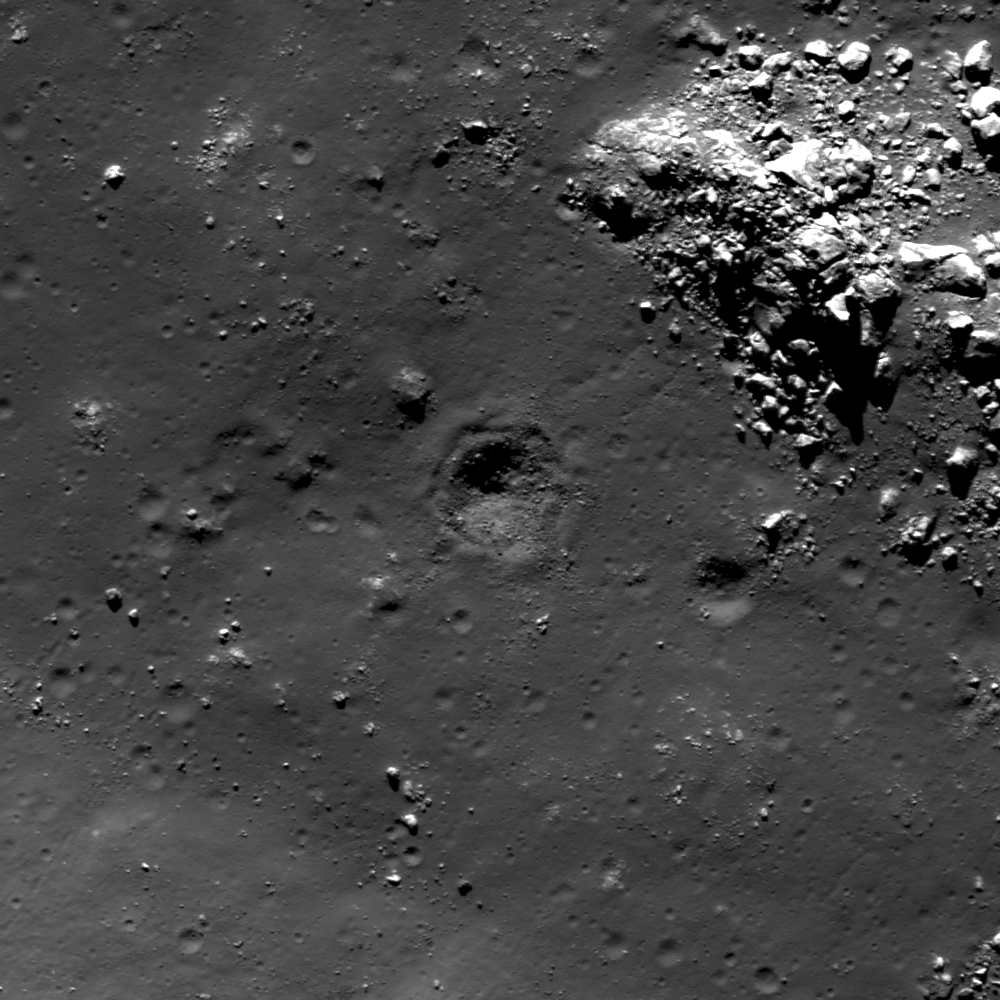
Regolith covers the lunar surface, and the thickness of regolith on the surface is related to the age of the surface. Older surfaces have thicker regolith layers than younger surfaces, and observations of crater morphologies are used to learn about the regolith for a specific area. Bench craters form in layered targets when there are variations in strength between the layers because different strength targets require different amounts of energy during the excavation phase of impact cratering. On the Moon, bench crater formation is usually interpreted to result when a bolide punches through an unconsolidated regolith layer to excavate a more cohesive layer such as mare basalt bedrock. The 75 m diameter bench crater in the opening image (61.504°S, 346.728°E) is a prime example of a bench crater that formed in an impact melt pond that is covered by a thin layer of regolith. However, observations of LROC NAC images show some bench craters like the one above to be self secondary craters, formed during the last stages of the impact process. It may be that the bench crater above was one of the last secondary craters formed during the Rutherfurd impact event, soon after the melt was emplaced, but without further study, we cannot be certain.

LROC WAC monochrome 64 meter resolution mosaic of Rutherfurd crater (61.186°S, 347.683°E, ~47 km diameter), from LROC QuickMap. Featured Image field of view noted by plot point on the southwestern crater wall [NASA/GSFC/Arizona State University].

The smoothed, softened texture of the pond surface, absence of cracks and fractures in the melt, and presence of superposed impact craters of various sizes and degradational states provide evidence of a layer of regolith in this area. If the 75 m diameter bench crater is not a self secondary crater, the projectile that formed the crater likely excavated roughly 7-8 m into the melt rock. Meter-sized boulders distributed within and around the eastern portion of the bench crater support an impact into a consolidated target and the formation of these boulders during excavation of the crater. Besides confirming the results of experiments conducted in the 1960s with layered targets, today's bench crater might be used to help constrain the depth of the impact melt pond. If there are other craters of similar degradational state in the pond, the morphology of these craters could be studied to help constrain not only the regolith thickness but also perhaps the thickness of the melt pond in this region. Unfortunately, it looks like the ~40 m diameter crater to the right of the bench crater may too degraded or affected by the boulders outcropping toward the upper right of the image. Additionally, finding these craters may prove difficult because the Featured Image may be the location of the only small melt pond with a bench crater in this portion of the Rutherfurd crater wall and any bench craters occurring elsewhere may reflect the strength contrast between the impact melt veneer on Rutherfurd's wall and the crater wall material.

How many bench craters can you find in the full LROC NAC frame? Are the bench craters located in small melt ponds or in the impact melt veneer on Rutherfurd's wall? If you find bench craters in the melt veneer, what two layers do you think might be responsible for forming the bench (hint: think about what the melt veneer covered) if the craters are not self secondaries?

Related Posts:
Not so Simple!
Fresh Bench Crater in Oceanus Procellarum
Bench Crater in Plato