Showing posts with label Thales. Show all posts

Tuesday, January 31, 2012

LROC: On the Floor of Thales

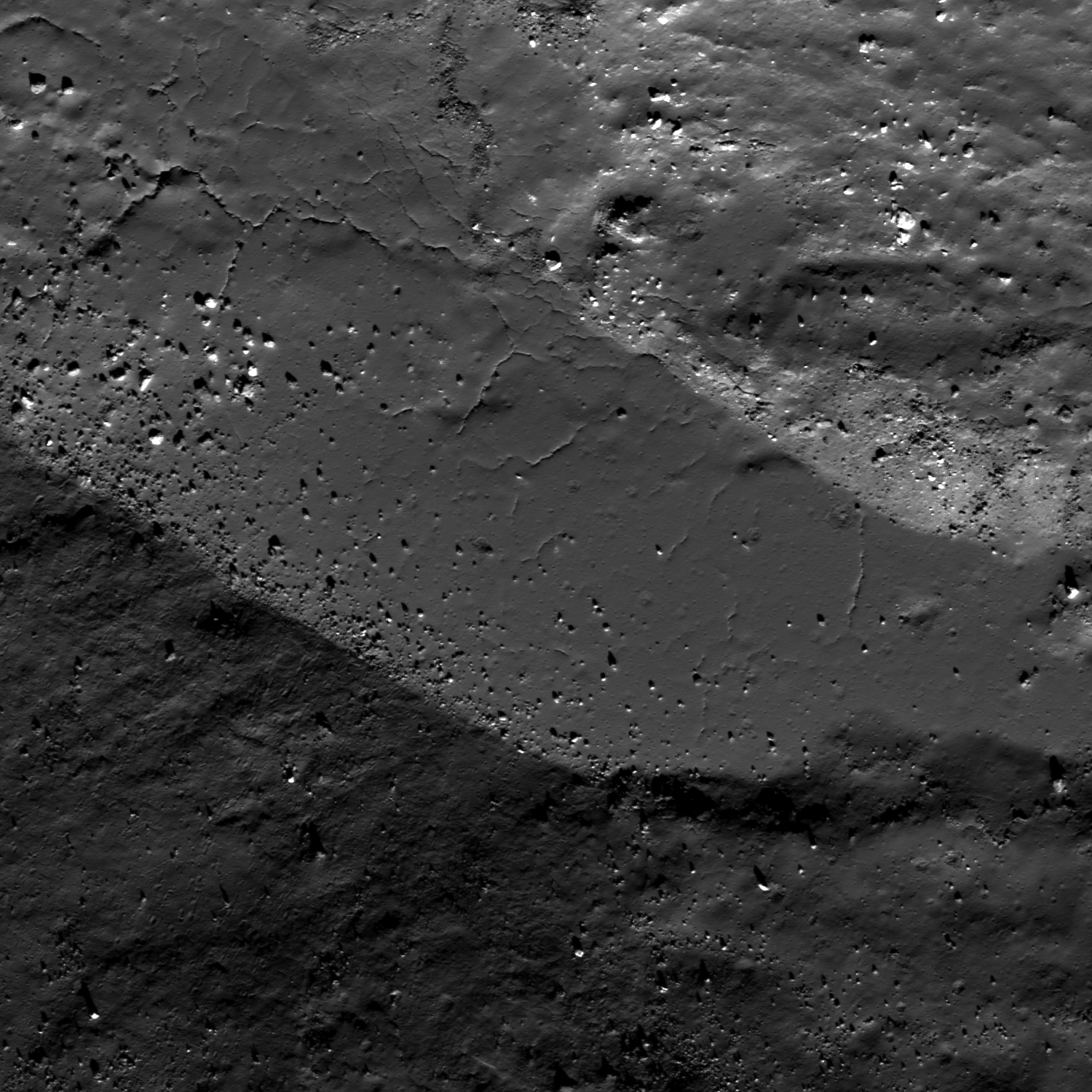
Full resolution detail from the LROC Featured Image, released January 31, 2012, showing contact between channelized impact melt and fractured melt on the floor of Thales crater. LROC Narrow Angle Camera (NAC) observation M170218508L, orbit 10219, September 9, 2011; incidence angle 64.16° with a resolution of 0.47 meters per pixel from 39.12 km. Image field of view 290 meters. See the 700 meter field of view HERE [NASA/GSFC/Arizona State University].
Lillian Ostrach
LROC News System

Many Copernican- and Eratosthenian-aged craters have substantial impact melt deposits within and surrounding them. Like so many other craters on the Moon, Thales crater (61.732°N, 50.284°E, ~31 km diameter) is remarkable in the diversity of geologic features observed in LROC NAC and WAC images. In the opening image, channelized impact melt flowed toward the crater floor from high up on the crater wall. The contact at which crater floor and wall meet is less distinct, but the change from channelized impact melt to fractured impact melt is representative of this boundary. 

Tomorrow's Featured Image will explore why impact melt may fracture a specific way, but suffice to say, the morphology of the impact melt in today's Featured Image is spectacular!

LROC WAC monochrome (604 nm) mosaic of Thales (61.732°N, 50.284°E) swept up at the same time as the NAC frame source of the Featured Image, September 9, 2011; resolution roughly 55.6 meters per pixel. .Yellow rectangle notes location of the LROC Featured Image, at the contact between crater wall and floor [NASA/GSFC/Arizona State University].
It is likely that impact melt channels formed in the crater walls as hot impact melt flowed from higher elevation toward the crater floor, using pre-existing weaknesses and cracks in the target rocks created by the violent impact event. As more impact melt flowed downhill, these channels may have grown larger. On average, these channels are between ~25 - 40 m across. Some channels appear shallower than others, which may suggest that more melt flowed down the deeper channels, carving more material from them. Or, perhaps the impact melt cooled and solidified in the shallower channels prior to reaching the crater floor, thus explaining the apparent channel depth differences across this small region of the crater wall. Comparatively, the fractures in the impact melt on the crater floor represent the relief of stress during cooling as the melt solidified near the crater floor-crater wall contact. These fractures may have been caused by the impact melt "sticking" to the lowermost portion of the crater wall as it cooled, similar to a mixture of cornstarch and water drying out.

Why don't you go for an adventure on the floor of Thales crater and discover the amazing impact melt morphologies visible in the full LROC NAC frame?

Related Posts:
Channelized impact melt
Fractured impact melt

Friday, May 27, 2011

Fractured Impact Melt


Cracks in impact melt inside Thales crater. The smooth impact melt is fractured and then sprinkled with boulders from the neighboring slope. LROC NAC M157270357R, LRO orbit 8311, April 12, 2011; image scale is 0.53 meters/pixel, incidence angle is 62° View the full-sized LROC Featured Image HERE [NASA/GSFC/Arizona State University].

Sarah Braden
LROC News System

Thales (61.8°N, 50.3°E) is a young, 32 km diameter crater located at 61.8°N, 50.3°S. The interior of Thales has many different features including terraces formed by slumping and impact melt. Today's Featured Image illustrates the dynamic nature of Thales, with smooth impact melt implaced at the time of impact, which then fractured and was subsequently sprinkled with boulders from a neighboring slope.

Impact melt is instant lava, formed when lunar rock is melted when the tremendous energy of impact is released in a moment. After the initial impact, the melt can end up anywhere in the crater. It can pool in the bottom of the crater floor, pool on terraces, or flow down crater walls inside and outside of the rim. Sometimes melt is thrown out of the crater during the impact and lands outside the crater forming pools outside the rim.

The cracks in the impact melt probably formed as the melt cooled and solidified. With the cooling of the material comes a change in volume, which could open the cracks. Or, the cracks may have formed over time as the crater floor slowly changed shape and the impact melt material cracked to compensate.


LROC Wide Angle Camera (WAC) 100 m/px mosaic of Thales. The red box indicates the position of the LROC Featured NAC Image, May 26, 2011. The white arrow points to an area on the rim where slumping occurred, changing the crater's overall shape. The crater is 32 km in diameter. View the full-sized LROC WAC context image HERE [NASA/GSFC/Arizona State University].

Explore the LROC NAC for more exciting impact melt features inside Thales crater!

Related Images:
Fragmented Impact Melt
Impact melt at Necho crater
Forked Impact Melt Flows at Farside Crater
Out of the Shadows: Impact Melt Flow at Byrgius A Crater


LROC WAC Mosaic view of Thales under "ideal" illumination [NASA/GSFC/Arizona State University].

Thursday, June 18, 2009

Orbital in $250 million deal with Thales for pressurized cargo modules for ISS resupply

Orbital Sciences, with SpaceX, last year won NASA contracts to fly twenty Automated Transfer Vehicle (ATV) cargo re-supply flights to the International Space Station through mid-2015.

Thales announced on Wednesday that Orbital has contracted with Thales Alenia in a $250 million deal to design and build the pressurized modules for Orbital's own ATV, Cygnus.

"The contract foresees the first unit delivery in December 2010," Thales announced. "The Pressurized Cargo Modules will be designed and developed for Orbital’s CRS (Commercial Resupply Services) contract with NASA."

"Cygnus first flight is planned for the spring of 2011."

"The maneuvering spacecraft will consist of Orbital’s Service Module with which the PCM, will be integrated. The PCMs to be developed by Thales Alenia Space has experience acquired from previous ISS-related programs, such as the Multi-Purpose Logistics Module Leonardo built on behalf of the Italian Space Agency and NASA, and the ATV Jules Verne produced by Thales Alenia Space for ESA."

"The nine PCMs will start with one built for a COTS demonstration mission"

The COTS demonstration mission is scheduled to take place in the fourth quarter of 2010.

"With the award of the Commercial Resupply Service," said Orbital, "NASA has selected Orbital to provide 8 pressurized cargo missions beginning in the latter half of 2011

For NASA, CRS will provide a U.S.-produced and-operated automated cargo delivery service for ISS logistic support, to complement Russian, European and Japanese ISS cargo vehicles.

(Which seems to beg the question whether Thales is building the Japanese ATV, as well, and whether they've played any role in announced improvements in Russia's standard Progress ATV's.)

"Orbital will carry out design, manufacturing and test of the new Taurus II launch vehicle in Dulles, Virginia and Chandler, Arizona.

"The company’s development, production and integration of its Cygnus spacecraft and cargo modules will be done in Dulles and Wallops Island.

"The Taurus II launch vehicle will have a payload capacity of 4,750 to 6,250 Kg to low-Earth orbits (depending on altitude and inclination). The Cygnus spacecraft will be capable of delivering up to 2,700 Kg of pressurized or unpressurized cargo to the ISS, and will be capable of returning up to 1,200 Kg of cargo from ISS to Earth."

Of the twenty CRS ISS resupply missions NASA awarded nine to Orbital and eleven to SpaceX of California, now testing engines for their Falcon 9 vehicle already deployed at Cape Canaveral."